
Semester II MDSC-2A Indian Government and Politics
Unit IX · 18 min read · Updated 24 Nov 2026
As per the University of Delhi (DU) BA (Hons) Political Science syllabus
Contents
- 9.1 Understanding the Indian State
- 9.2 The Developmental State
- 9.3 The Welfare State: From Benevolence to Rights
- 9.4 The Regulatory State
- 9.5 Important Questions
- Discuss the nature of the Indian state with reference to its developmental, welfare and regulatory roles.
- Examine the Indian welfare state: is it a shift from benevolence to rights?
- Discuss the rise of the regulatory state in India.
- Short Notes
हमारा आदर्श आर्थिक लोकतंत्र है, और जो भी सरकार सत्ता में हो, वह आर्थिक लोकतंत्र लाने का प्रयास करेगी।
Our ideal is economic democracy and … every Government whatever is in power shall strive to bring about economic democracy.
— B.R. Ambedkar, Constituent Assembly, 19 November 1948
WHAT KIND OF STATE is the Indian state? It is a democracy with free elections, yet it can be coercive and distant. In the first decades after independence it acted as a developmental state, planning the economy and building industries. It has always claimed to be a welfare state, committed by the Directive Principles to justice for the poor, and in the 2000s it began to recognise social and economic rights by law. After 1991 it also became a regulatory state, creating independent agencies to regulate markets it no longer controlled directly. In this chapter we study these three faces of the Indian state and the theories that try to explain its character, from Marxist ideas of a class state to Partha Chatterjee’s postcolonial state and Manoranjan Mohanty’s idea of the duality of the state process.
9.1 Understanding the Indian State
Scholars have described the Indian state in different ways. Marxist scholars see it as a state that serves the dominant classes; Pranab Bardhan identified a coalition of industrial capitalists, rich farmers and professionals whose competing demands shaped policy. Lloyd and Susanne Rudolph described a ‘weak–strong’ state: strong in its claims and powers, but weak in its capacity to implement policies against powerful interests. Gunnar Myrdal called South Asian states ‘soft states’ that could not enforce discipline. Partha Chatterjee, in ‘The State’ (2010), describes India as a postcolonial state that inherited colonial institutions but drew its legitimacy from development: it claimed to stand above particular interests and to pursue the welfare of the whole population, which it governed through a growing range of policies and programmes.
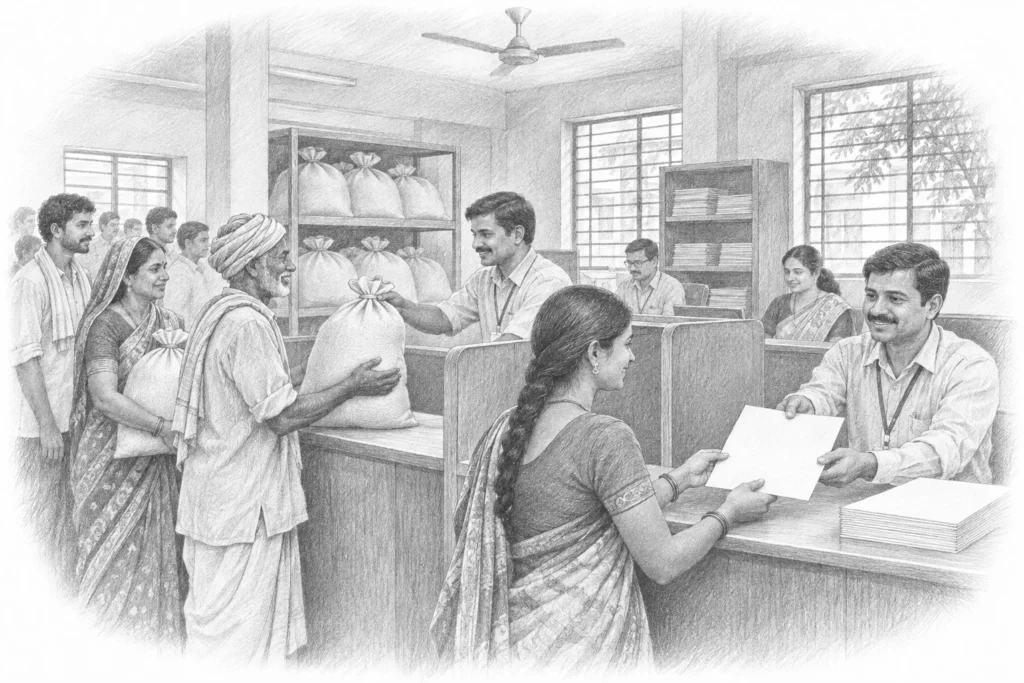
Manoranjan Mohanty, in ‘Duality of the State Process in India’ (1989), argued that the Indian state has a dual character. On one hand it promotes capitalist development and protects the interests of the dominant classes, using coercion when necessary; on the other, because it is a democracy, it must respond to the struggles and demands of workers, peasants, Dalits, Adivasis and women, granting rights and welfare to maintain its legitimacy. The state is thus a site of contradiction and struggle, not a single, fixed entity. Madhav Khosla and Milan Vaishnav similarly argue that the Indian state presents different faces to different citizens (Figure 9.2).

9.2 The Developmental State
A developmental state is a state that makes rapid economic development its main goal and actively directs the economy to achieve it, through planning, public investment, industrial policy and control over finance. The term was used by Chalmers Johnson (1982) to describe Japan, and later South Korea and Taiwan, where strong, competent bureaucracies guided private business towards export-led industrialisation.
India after 1950 was a developmental state of a particular kind. As Chapter 7 showed, the state planned investment through the Planning Commission, built heavy industry in the public sector, controlled private industry through licences and sought self-reliance through import substitution. Chatterjee argues that development was the central source of the state’s legitimacy. Yet India’s developmental performance was weaker than East Asia’s. Atul Kohli, in State-Directed Development (2004), explains this by calling India a fragmented multi-class state: it had to satisfy many classes and groups at once, so it could not discipline business or pursue a single goal consistently, unlike the cohesive-capitalist state of South Korea. After 1991 the Indian state did not disappear from development; it became more pro-business, supporting private investment, infrastructure and growth rather than owning industry itself.
9.3 The Welfare State: From Benevolence to Rights
A. The benevolent state
The Directive Principles committed the Indian state to welfare: the right to work, education and public assistance, a living wage and improved nutrition. For decades, however, welfare was provided as benevolence: the public distribution system, subsidies, rural development schemes and programmes for weaker sections were favours granted by the state at its discretion. Citizens were treated as passive beneficiaries, and schemes suffered from leakages, corruption and poor targeting.
B. The rights-based turn
From the late 1990s, pressure from social movements, such as the Right to Food campaign and the movement for the right to information, and from the courts changed this. In the Right to Food case (PUCL v. Union of India, from 2001) the Supreme Court turned schemes such as mid-day meals into legal entitlements. Parliament then passed a series of rights-based laws: the Right to Information Act (2005), the National Rural Employment Guarantee Act (2005), which guarantees a hundred days of paid work to rural households, the Forest Rights Act (2006), the Right to Education Act (2009) and the National Food Security Act (2013). A. Chakraborty explains the difference this makes: when welfare becomes a right, citizens become rights-claimants who can demand entitlements, use grievance procedures and social audits, and hold officials accountable.
C. A halting shift
Reetika Khera, in ‘India’s Welfare State: A Halting Shift from Benevolence to Rights’ (2020), argues that the shift has been incomplete. Rights laws were weakened by poor funding and implementation, delays in wage payments and exclusion due to Aadhaar authentication failures. Since 2014 welfare has expanded in new forms, often called the ‘new welfarism’: Direct Benefit Transfer using the JAM trinity of Jan Dhan accounts, Aadhaar and mobile phones; LPG connections, toilets and houses; health insurance (Ayushman Bharat, 2018) and income support for farmers (PM-KISAN, 2019). These schemes have reached millions efficiently, but Khera notes that they treat citizens more as beneficiaries of the government than as holders of rights.
9.4 The Regulatory State
After 1991, as the state withdrew from owning and controlling industries, it took on a new role: regulating markets through independent agencies. This is called the regulatory state. Arun Thiruvengadam, in ‘Flag-bearers of a New Era? The Evolution of New Regulatory Institutions in India (1991–2016)’, traces the creation of agencies such as the Securities and Exchange Board of India (SEBI, statutory from 1992), the Telecom Regulatory Authority of India (TRAI, 1997), the Central Electricity Regulatory Commission (1998), the Insurance Regulatory and Development Authority (1999) and the Competition Commission of India (2002, fully functional from 2009), alongside older bodies such as the Reserve Bank of India.
Such regulators are meant to be expert, autonomous from day-to-day politics and rule-based, ensuring fair competition, protecting consumers and investors and making markets work. Thiruvengadam finds that their independence varies: governments influence them through appointments, funding and directions; ministries resist losing power; courts review their decisions; and their accountability to Parliament is weak. Navroz Dubash and Bronwen Morgan describe a regulatory state of the South, in which regulators also pursue social goals, such as access to electricity and telecom for the poor, and operate in a politicised environment. M.P. Singh and Rekha Saxena note that the regulatory role has added a new layer to the Indian state alongside its developmental and welfare roles.
9.5 Important Questions
- Question 1 Discuss the nature of the Indian state with reference to its developmental, welfare and regulatory roles.
- Question 2 Examine the Indian welfare state: is it a shift from benevolence to rights?
- Question 3 Discuss the rise of the regulatory state in India.
DU asks the same idea in different words. So learn one broad answer for each question below; the same answer works for every question joined by OR.
Important Question 1
Discuss the nature of the Indian state with reference to its developmental, welfare and regulatory roles.
OR
Examine the ‘duality of the state process’ in India.
OR
Was India a developmental state? Discuss.
Model Answer
“The executive of the modern state is but a committee for managing the common affairs of the whole bourgeoisie.”
— Karl Marx and Friedrich Engels, The Communist Manifesto (1848)
Introduction. The Indian state has played many roles since independence: planner and owner of industry, provider of welfare, and regulator of markets. Scholars have offered different theories to explain its character, from class analysis to postcolonial and democratic perspectives.
1. Theories of the Indian State
Marxists see a state serving dominant classes; Bardhan identified a coalition of industrialists, rich farmers and professionals. The Rudolphs saw a weak–strong state, Myrdal a soft state, and Chatterjee a postcolonial state legitimised by development. The Rudolphs described a ‘weak-strong’ state facing a ‘demand polity’. Pranab Bardhan’s three dominant proprietary classes offer another view.
2. Passive Revolution
Partha Chatterjee described the post-colonial state as carrying out a ‘passive revolution’, in which the capitalist class shared power with landed elites and the bureaucracy rather than overthrowing them.
3. Mohanty’s Duality
Mohanty argued that the state both promotes capitalist development for dominant classes and responds to democratic struggles by granting rights and welfare. It combines coercion and consent and is a site of conflict. This creates contradictions within state policy.
4. The Developmental State
From 1950 the state planned investment, built public sector industry and controlled private business to achieve self-reliance and industrialisation. Public sector enterprises and the IITs were part of this project.
5. Embedded Autonomy
Peter Evans argued that successful developmental states combine autonomy from interest groups with close ties to business; India’s state was less effective because it lacked this balance.
6. Limits of Developmental Performance
Kohli calls India a fragmented multi-class state that could not discipline business or pursue single goals, unlike South Korea’s cohesive-capitalist state. After 1991 it became more pro-business. Kohli contrasts India with South Korea’s ‘cohesive capitalist’ state.
7. The Welfare State
Guided by the Directive Principles, the state provided welfare first as benevolence, then, from the 2000s, as legal rights through the RTI, MGNREGA, FRA, RTE and NFSA. Schemes include the PDS, midday meals and rural employment.
8. New Welfarism
Since 2014, direct benefit transfers and schemes for houses, toilets, gas, health insurance and farmers’ income have expanded welfare, though Khera notes they treat citizens as beneficiaries rather than rights-holders. These schemes provide private goods such as houses, toilets and gas connections.
9. The State and the Market
After 1991 the state shifted from controlling the economy to facilitating private investment, while still running large welfare programmes.
10. The Regulatory State
After 1991 the state created regulators such as SEBI, TRAI and the CCI to govern markets. Thiruvengadam finds that their independence and accountability are uneven. Courts and tribunals also play regulatory roles.
11. The Coercive State
The state also uses coercive power through the police, security laws and armed forces in conflict areas, which shapes many citizens’ experience of it.
12. The State and Federalism
Much of the state’s work is done by state governments, so developmental and welfare performance varies greatly from Kerala to Bihar.
13. A Hybrid State
Scholars increasingly describe India as a hybrid state that combines a developmental core, a welfare safety net and regulatory institutions.
14. Evaluation
The Indian state is simultaneously developmental, welfare-oriented and regulatory; its roles have changed with economic strategy and democratic pressure, and it remains both powerful and limited in capacity. Its character varies across sectors and regions.
15. The State in Everyday Life
Chatterjee argues that most of the poor encounter the state not as rights-bearing citizens of civil society but as members of political society, negotiating with officials and politicians for benefits, often through mobilisation and para-legal arrangements, such as squatters seeking services. Chatterjee calls this the domain of ‘political society’.
16. Different Faces
Khosla and Vaishnav suggest that in recent years the state has shown a more capable face in delivering welfare goods directly to citizens, a more centralised face in its political structure, and, in their view, a more majoritarian face in matters of identity, which together complicate any single description.
Conclusion. Thus, the Indian state cannot be reduced to one label. Its duality, serving dominant interests while responding to democratic demands, explains its many faces.
Important Question 2
Examine the Indian welfare state: is it a shift from benevolence to rights?
OR
Discuss rights-based welfare legislation in India.
OR
‘From passive beneficiary to rights claimant.’ Discuss.
Model Answer
“India’s Welfare State: A Halting Shift from Benevolence to Rights.”
— Title of Reetika Khera’s article (2020)
Introduction. A welfare state takes responsibility for the basic well-being of its citizens. India’s Constitution committed the state to welfare through the Directive Principles, but for decades welfare was a matter of state discretion. From the 2000s it began to be framed as legal rights, a shift that remains incomplete.
1. Constitutional Basis
The Directive Principles call for the right to work, education and public assistance, a living wage and better nutrition, though they are not enforceable in courts. Articles 39, 41, 42, 43 and 47 are the key provisions. For decades these directives were treated as aspirations rather than rights.
2. Welfare as Benevolence
The PDS, subsidies and rural development schemes were provided at the state’s discretion. Citizens were passive beneficiaries, and leakages and corruption were common. Beneficiaries depended on the discretion of officials. Politicians often used schemes for patronage.
3. Movements and Courts
The Right to Food and right to information campaigns, and the Supreme Court’s orders in PUCL v. Union of India (from 2001), turned schemes such as mid-day meals into entitlements. The PUCL right to food case (from 2001) led to orders on midday meals and the ICDS.
4. The National Advisory Council
The National Advisory Council (2004–14), chaired by Sonia Gandhi and including activists such as Aruna Roy and Jean Drèze, drafted many rights-based laws.
5. Rights-Based Laws
The RTI Act (2005), MGNREGA (2005), Forest Rights Act (2006), RTE Act (2009) and NFSA (2013) created legal rights to information, work, forest land, education and food. The Right to Education Act (2009) and the National Food Security Act (2013) followed.
6. From Beneficiary to Rights-Claimant
Chakraborty explains that rights give citizens the power to claim entitlements, use grievance redress and social audits, and hold officials accountable, changing the relationship between citizen and state. Grievance redress and penalties make officials accountable.
7. A Halting Shift
Khera shows that rights laws were weakened by underfunding, payment delays and exclusion due to Aadhaar authentication failures. Exclusions linked to Aadhaar authentication also denied some people their rations.
8. New Welfarism
Since 2014, DBT, Jan Dhan, Ujjwala, housing, toilets, Ayushman Bharat and PM-KISAN have expanded welfare efficiently, but often as government gifts to beneficiaries rather than rights. Arvind Subramanian and others coined the term ‘new welfarism’.

9. Health as a Right
India has no national legal right to health; Rajasthan’s Right to Health Act (2023) was the first state law of its kind.
10. Universal Basic Income
The Economic Survey of 2016–17 discussed a universal basic income as an alternative to many schemes, and several states have adopted cash transfers to women.
11. Welfare, Federalism and Citizenship
States such as Tamil Nadu and Kerala lead in welfare while others lag, so rights vary in practice; rights-based welfare strengthens citizenship by treating people as equals with entitlements rather than as recipients of charity.
12. Gaps in Social Security
Most informal workers still lack pensions and health insurance, which shows how incomplete the welfare state remains.
13. Evaluation
India has moved towards a rights-based welfare state, but the shift is incomplete; real rights require adequate funding, accountability and inclusion. The challenge is to secure adequate funding and accountability.
14. Social Audits and Accountability
The Mazdoor Kisan Shakti Sangathan (founded 1990) in Rajasthan held public hearings (jan sunwais) that exposed corruption in public works and inspired the RTI Act. MGNREGA made social audits mandatory, and states such as Andhra Pradesh built independent audit units.
15. Cash and In-kind Transfers
A major debate concerns whether welfare should be given as cash transfers or in kind. Supporters of DBT argue that cash reduces leakages and gives choice; Khera and others argue that the PDS protects the poor against price rises and that cash depends on access to banks. Studies show mixed results depending on local markets and access to banks.
Conclusion. Thus, Indian welfare has moved from benevolence towards rights, but haltingly; making citizens true rights-claimants remains the challenge.
Important Question 3
Discuss the rise of the regulatory state in India.
OR
Examine the role and problems of independent regulatory institutions in India.
Model Answer
“Flag-bearers of a New Era?”
— Title of Arun Thiruvengadam’s study of new regulatory institutions in India (1991–2016)
Introduction. A regulatory state governs the economy not mainly by owning enterprises or directing investment, but by making and enforcing rules through specialised agencies. In India it emerged after the economic reforms of 1991.
1. From Owner to Regulator
As licensing ended and private and foreign firms entered sectors such as telecom, power, insurance and finance, the state needed new institutions to regulate markets. This followed global trends in Britain and the United States.
2. The New Regulators
SEBI (1992), TRAI (1997), the CERC (1998), IRDA (1999) and the Competition Commission (2002/2009) were created, alongside the RBI. Others include the Competition Commission and the Reserve Bank’s regulatory role.
3. Reasons for Regulators
Regulators are created to correct market failures such as monopoly and information gaps, to give investors confidence through independence from politics, and to balance the interests of consumers and producers.
4. Functions
Regulators license firms, set tariffs and standards, ensure competition, protect consumers and investors, and resolve disputes. They also resolve disputes and protect consumers.
5. Expected Features
They are meant to be expert, autonomous from day-to-day politics, transparent and rule-based, giving investors and consumers confidence. They combine legislative, executive and quasi-judicial functions.
6. Regulators in Infrastructure
In electricity, airports and ports, regulators set tariffs and service standards for private and public operators, as the Airports Economic Regulatory Authority (2009) does.
7. Independence in Practice
Thiruvengadam shows that governments influence regulators through appointments, budgets and directions; ministries resist losing power; and independence varies across sectors. The appointment of retired bureaucrats and judges also raises concerns.
8. Regulatory Conflicts
Conflicts between TRAI and telecom firms and debates over the independence of SEBI show the challenges of regulation.
9. Accountability
Regulators are weakly accountable to Parliament; courts review their decisions; and there is a risk of capture by the industries they regulate. Parliamentary committees rarely examine them.

10. The Regulatory State of the South
Dubash and Morgan show that in countries such as India, regulators also pursue social goals, such as universal access to electricity and telecom, in a politicised environment. Regulation is shaped by politics, development goals and limited capacity.
11. The RBI as Regulator
The Reserve Bank regulates banks and conducts monetary policy, with an inflation-targeting framework and a Monetary Policy Committee adopted in 2016.
12. Digital and Data Regulation
New areas such as data protection, under the Data Protection Board created by the 2023 Act, and digital platforms extend the regulatory state.
13. Regulation and Federalism
State electricity regulatory commissions show that regulation operates at both levels, sometimes creating conflicts over tariffs and subsidies.
14. Global Influences
The rise of regulators also reflected advice from the World Bank and the spread of global models of independent regulation.
15. Evaluation
The regulatory state has added a new layer to the Indian state, improving market governance, but it needs clearer independence, accountability and capacity. Strengthening independence and accountability together is the key reform.
16. Regulation for Social Goals
Indian regulators also pursue social aims. In 2016 TRAI upheld net neutrality by prohibiting discriminatory pricing of data, and electricity regulators set tariffs that cross-subsidise farmers and poor consumers. Regulators also protect consumers through grievance mechanisms.
17. Courts and Appellate Tribunals
Decisions of regulators can be challenged before appellate tribunals such as TDSAT and SAT, and the Supreme Court has shaped regulation, as when it cancelled 122 telecom licences in the 2G case (2012) and required auctions of spectrum. Examples include the Securities Appellate Tribunal and the Telecom Disputes Settlement and Appellate Tribunal.
18. Reform Proposals
The Financial Sector Legislative Reforms Commission (2013) proposed clearer laws, transparency and accountability for financial regulators, and many scholars call for stronger parliamentary oversight of all regulators. It proposed clearer accountability and a unified financial regulator.
Conclusion. Thus, the regulatory state reflects the changing role of the Indian state after 1991, from owner to rule-maker, though its institutions are still evolving.
Short Notes
(a) The Right to Food case
PUCL v. Union of India, a public interest petition filed in 2001 during starvation deaths amid full government granaries. Through interim orders the Supreme Court turned schemes such as the mid-day meal and the public distribution system into legal entitlements, paving the way for the National Food Security Act (2013).
(b) JAM trinity and DBT
The combination of Jan Dhan bank accounts, Aadhaar identity numbers and Mobile phones, used since the mid-2010s to transfer subsidies and benefits directly into beneficiaries’ bank accounts (Direct Benefit Transfer), reducing leakages but raising concerns about exclusion and privacy.
More notes: MDSC-2A Indian Government and Politics
- Indian Constitution: basic features, debates on Fundamental Rights, Directive Principles and Federalism
- State formation and nation building: Integration of princely states, linguistic re-organisation of states
- Political institutions at the Centre and State levels: Parliament, Judiciary, Prime Minister, Chief Minister
- Social structure and political power: caste, class, gender
- Religion and politics: debates on secularism and communalism
- Political parties and party systems
- Development strategies: planned economy, neo-liberal restructuring
- Social movements: workers, farmers, environmental, and women’s movements
These notes are prepared by PADHO TO AISE for study help. They are not an official University of Delhi publication.