
Semester II MDSC-2A Indian Government and Politics
Unit V · 19 min read · Updated 24 Nov 2026
As per the University of Delhi (DU) BA (Hons) Political Science syllabus
Contents
- 5.1 Religion, Secularism and Communalism
- 5.2 Indian Secularism: Features and Models
- 5.3 Debates on Secularism: Learning from Its Critics
- 5.4 Communalism in India
- 5.5 Important Questions
- Discuss the nature of Indian secularism. How is it different from Western secularism?
- Examine the major critiques of Indian secularism.
- What is communalism? Discuss its causes and consequences in India.
- Short Notes
जो कहते हैं कि धर्म का राजनीति से कोई संबंध नहीं, वे नहीं जानते कि धर्म का अर्थ क्या है।
Those who say that religion has nothing to do with politics do not know what religion means.
— M.K. Gandhi, An Autobiography or The Story of My Experiments with Truth (1927)
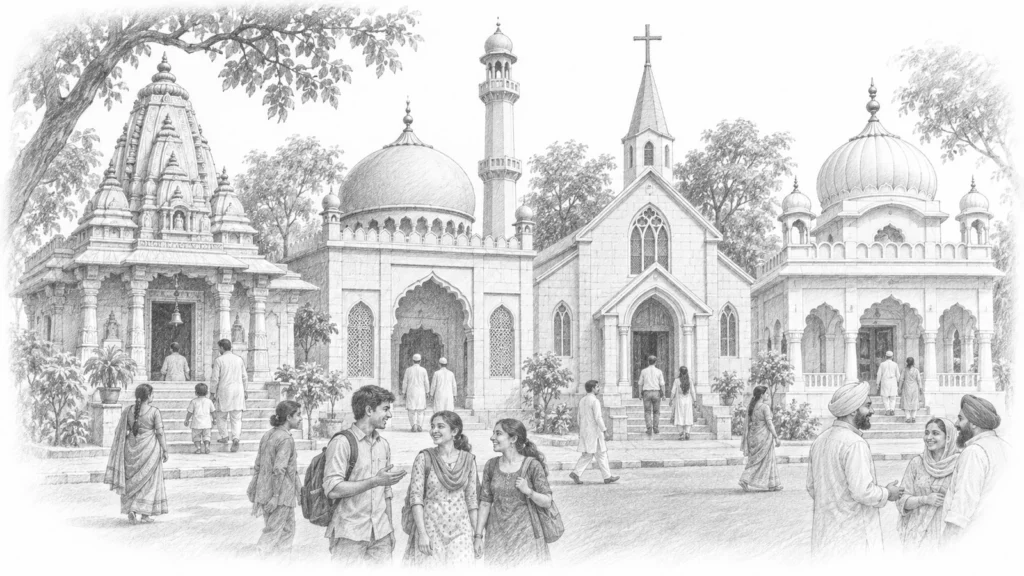
INDIA IS ONE OF THE MOST religiously diverse societies in the world. Hindus, Muslims, Christians, Sikhs, Buddhists, Jains, Parsis and many others live side by side, and for most Indians religion is an important part of life. The Partition of 1947, carried out amid communal violence, showed how dangerous the mixing of religion and politics could be. The makers of the Constitution therefore chose secularism, but a secularism different from the Western model of a strict wall between church and state. Ever since, Indian politics has been shaped by debates on what secularism means, whether it suits Indian society, and how to deal with communalism, the use of religious identity for political mobilisation against other communities. This chapter studies these debates.
5.1 Religion, Secularism and Communalism
Secularism is a doctrine about the relationship between the state and religion. In general it means that the state is not controlled by any religion, does not establish an official religion, protects the freedom of religion of all, and treats citizens equally irrespective of their faith. Communalism, in the Indian sense, is very different from ‘community’ feeling. Bipan Chandra defined it as the belief that people who follow the same religion have common secular interests, political, economic and social, that these interests differ from those of followers of other religions, and that they are in conflict. Secularism and communalism are therefore opposites: one seeks to keep the state above religious divisions; the other seeks to make religion the basis of political identity.
5.2 Indian Secularism: Features and Models
A. Constitutional provisions
- The Preamble declares India a secular republic (the word was added in 1976, but the principle was present from the start).
- There is no state religion; the state is not to be identified with any faith.
- Articles 14, 15 and 16 guarantee equality and prohibit discrimination on grounds of religion.
- Articles 25–28 guarantee freedom of conscience and the right to profess, practise and propagate religion, subject to public order, morality and health; religious denominations may manage their own affairs; no religious instruction is given in state-funded institutions.
- Articles 29–30 protect the cultural and educational rights of minorities, including the right to establish and administer educational institutions.
- Article 25(2) allows the state to regulate secular activities connected with religion and to undertake social reform, such as opening Hindu temples to all castes; Article 44 directs the state to endeavour to secure a uniform civil code.
B. How Indian secularism differs from the Western model
In the Western model, as in France (laïcité) or the United States, there is a strict separation: the state keeps out of religion and religion keeps out of the state. The Indian model differs in three ways (Figure 5.2). It protects the rights of religious communities, not only individuals; it allows the state to intervene in religion to promote equality and reform, as in the abolition of untouchability and temple entry; and it permits the state to give equal support to all religions, for example through aid to minority educational institutions. Gandhi spoke of sarva dharma samabhava, equal respect for all religions, while Nehru stressed the separation of religion from the state; Indian secularism combined both.

C. Principled distance
Rajeev Bhargava, in Secularism and Its Critics (1998), describes Indian secularism as principled distance. The state keeps a distance from all religions, but this distance is not fixed: depending on the context, the state may engage with religion (for example by funding minority schools), keep away from it (by not adopting any religion), or intervene in it (by abolishing untouchability or banning practices such as triple talaq). The principle that guides these choices is whether they promote freedom and equality among individuals and among communities. Bhargava calls this a contextual secularism that treats religions not identically but with equal concern and respect.
D. Chandhoke on secularism
Neera Chandhoke, in ‘Secularism’ in the Oxford Companion to Politics in India (2010), explains that Indian secularism emerged from the experience of the national movement and Partition as a political project to manage religious diversity and protect minorities in a democracy. It is less about removing religion from public life than about ensuring that no religious majority dominates the state and that all communities are equal. She argues that secularism should be defended as a democratic value of equality among religious groups, and that its crisis lies not in its theory but in the failure of the state and parties to apply it consistently.
5.3 Debates on Secularism: Learning from Its Critics
Thomas Pantham, in ‘Understanding Indian Secularism: Learning from its Recent Critics’ (2004), reviews the main critiques:
- The anti-modernist critique: Ashis Nandy, in ‘An Anti-Secularist Manifesto’ (1985), and T.N. Madan, in ‘Secularism in Its Place’ (1987), argued that secularism is a Western, modernist ideology alien to a deeply religious society. Imposed by a Westernised elite, it marginalises faith, provokes fundamentalism and cannot stop communal violence. They preferred the traditions of religious tolerance found within India’s faiths.
- The Hindu nationalist critique: leaders of the Bharatiya Janata Party called Indian secularism ‘pseudo-secularism’, arguing that it meant appeasement of minorities, as in the Shah Bano case, and proposed ‘positive secularism’ based on a single national culture.
- Partha Chatterjee’s critique: in ‘Secularism and Toleration’ (1994), Chatterjee argued that the state had reformed Hindu law while leaving minority personal laws untouched, and that the doctrine of secularism could not defend minorities against a majoritarian state. He proposed a politics of toleration that allows communities to reform themselves through internal democratic processes.
- The Marxist critique: communalism is rooted in economic competition and the interests of classes, which secularism as an ideology does not address.
Pantham argues that Indian secularism should learn from these critics but not be abandoned. It is not a simple copy of Western secularism; it draws on Gandhi’s equal respect for religions, Nehru’s separation of state and religion, and Ambedkar’s concern for equality, and it can be developed as a dialogical secularism that respects religion while protecting equal citizenship. In S.R. Bommai (1994) the Supreme Court held that secularism is a basic feature of the Constitution.
5.4 Communalism in India
A. Meaning and stages
Bipan Chandra describes communalism as an ideology that develops in three stages: first, the belief that followers of a religion share common secular interests; second, liberal communalism, the belief that these interests differ from those of other communities; and third, extreme communalism, the belief that these interests are hostile and incompatible, which leads to fear, hatred and violence.
B. Causes
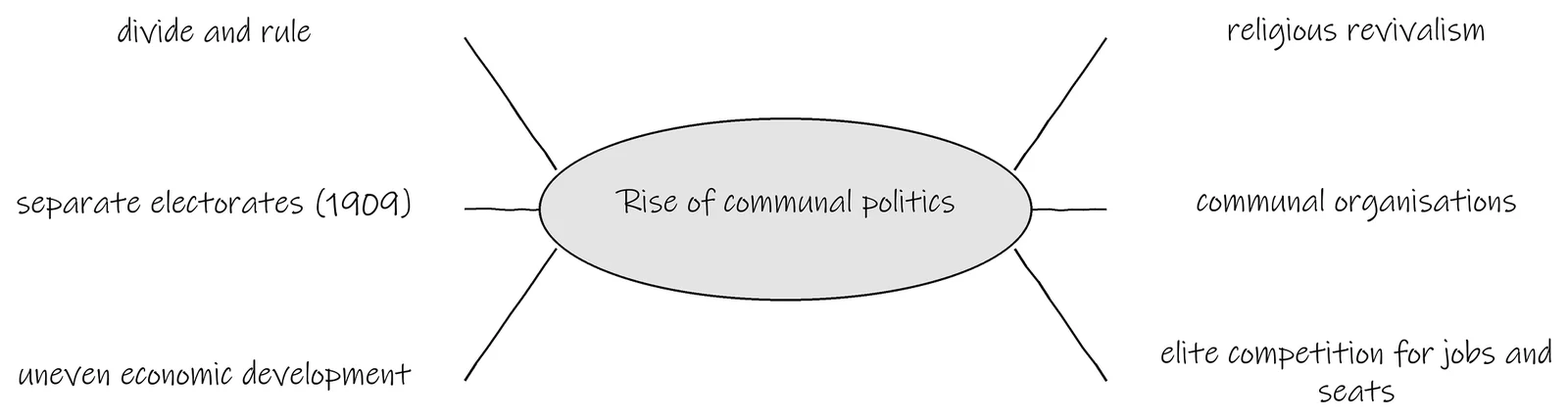
The causes of communalism are many (Figure 5.3): the colonial policy of divide and rule and separate electorates (1909); competition among the middle classes for jobs and seats; the use of religion for political mobilisation; communal organisations and propaganda; the legacy of Partition; economic backwardness and unemployment; and, after independence, vote-bank politics, in which parties court religious groups as blocs.
C. Communalism after independence
Communal violence has recurred: the anti-Sikh violence in Delhi (1984), the Shah Bano case (1985–86), in which the government overturned a Supreme Court judgment granting maintenance to a divorced Muslim woman, the opening of the locks of the disputed site at Ayodhya (1986), the Ram Janmabhoomi movement and the demolition of the Babri Masjid (6 December 1992), followed by riots in Mumbai and elsewhere, the Gujarat violence (2002) and the Muzaffarnagar riots (2013). The rise of Hindu nationalism has made the relationship between religion and the nation a central question of Indian politics, while debates continue on a uniform civil code, conversion laws, cow protection and citizenship (the Citizenship Amendment Act, 2019). Ashutosh Varshney showed that cities with strong inter-communal civic networks are less prone to riots, which suggests that civil society matters as much as the state in preventing communal violence.
5.5 Important Questions
- Question 1 Discuss the nature of Indian secularism. How is it different from Western secularism?
- Question 2 Examine the major critiques of Indian secularism.
- Question 3 What is communalism? Discuss its causes and consequences in India.
DU asks the same idea in different words. So learn one broad answer for each question below; the same answer works for every question joined by OR.
Important Question 1
Discuss the nature of Indian secularism. How is it different from Western secularism?
OR
Explain the idea of ‘principled distance’.
OR
Examine the constitutional provisions on secularism in India.
Model Answer
“Secularism is a basic feature of the Constitution.”
— Supreme Court of India, S.R. Bommai v. Union of India (1994)
Introduction. Secularism defines the relationship between the state and religion. India adopted secularism after the trauma of Partition, but developed a distinctive model suited to a society in which religion is important and diversity is great.
1. Meaning
A secular state does not establish any religion, protects freedom of religion and treats citizens equally irrespective of faith. It is the opposite of a theocratic or communal state. Secularism also implies equal citizenship regardless of religion.
2. Constitutional Provisions
The Preamble declares India secular; Articles 14–16 prohibit discrimination; Articles 25–28 guarantee religious freedom; Articles 29–30 protect minorities; and there is no state religion. Article 25 gives freedom of conscience and religion, subject to public order, health and morality, and Article 28 bars religious instruction in state-funded schools.
3. The Western Model
In France and the United States, secularism means strict separation: the state stays out of religion and religion out of the state, and the focus is on individual freedom. French laïcité keeps religion out of public life.
4. Community Rights
Indian secularism protects religious communities as well as individuals, through minority educational rights and personal laws. Articles 29 and 30 protect minorities’ cultural and educational rights.
5. State Intervention for Reform
The state may intervene in religion to promote equality, as in the abolition of untouchability, temple entry laws and the banning of triple talaq. Temple entry laws and the abolition of untouchability are examples.
6. Equal Respect and Support
Following Gandhi’s sarva dharma samabhava, the state treats all religions with equal respect and may support them equally, for example by aiding minority institutions. This is sometimes called positive secularism.
7. Personal Laws and the Uniform Civil Code
India retains separate personal laws for different communities, and the directive on a uniform civil code (Article 44) remains contested; Uttarakhand enacted a uniform civil code in 2024.
8. Principled Distance
Bhargava calls Indian secularism principled distance: the state engages, keeps away or intervenes depending on whether its action promotes freedom and equality. It is a contextual secularism. The state may keep its distance or intervene depending on what promotes freedom and equality.
9. Secularism in Practice
The state funds pilgrimages, manages temples in some states and recognises religious holidays, showing engagement with religion rather than strict separation.
10. Secularism and Democracy
Secularism protects democracy by ensuring that citizenship does not depend on religion and that minorities are not dominated by majorities.
11. Chandhoke’s View
Chandhoke sees secularism as a democratic project ensuring equality among religious groups and protecting minorities, whose crisis lies in inconsistent practice rather than in its theory.
12. Gandhi, Nehru and Ambedkar
Gandhi saw religion as the basis of ethics and wanted equal respect for all faiths; Nehru wanted the state to be separate from religion and to promote a scientific temper; Ambedkar insisted that a secular state must have the power to reform religion, because religion in India governed social life, including caste. Indian secularism combined these three views. Nehru sought a state neutral between religions and promoted a scientific temper.
13. Secularism and Caste
Ambedkar saw secularism as also requiring the state to dismantle religious sanctions for caste, which is why Article 17 abolishes untouchability.
14. Secularism and the Courts
Courts have shaped secularism: S.R. Bommai (1994) made it a basic feature of the Constitution; Aruna Roy (2002) held that the study of religions in schools is not against secularism; and Shayara Bano (2017) struck down instant triple talaq, showing the state’s power to reform religious practices for equality. Courts also decide whether a practice is an ‘essential’ part of a religion, which makes them arbiters of religious questions.
15. A Model for Diverse Societies
Charles Taylor and Rajeev Bhargava suggest that India’s context-sensitive secularism may suit religiously diverse societies better than strict separation.
16. Evaluation
Indian secularism is a distinctive model for a deeply religious and plural society; its strength lies in equal respect and principled distance, but it requires consistent and impartial practice.
Conclusion. Thus, Indian secularism is not the absence of religion from public life but the equal treatment of all religions by a state that belongs to none.
Important Question 2
Examine the major critiques of Indian secularism.
OR
‘Learning from its recent critics.’ Discuss with reference to Indian secularism.
OR
Is secularism alien to Indian society? Discuss.
Model Answer
“Secularism as a shared credo of life is impossible, as a basis for state action impracticable, and as a blueprint for the foreseeable future impotent.”
— T.N. Madan, ‘Secularism in Its Place’ (1987)
Introduction. Indian secularism has been criticised from several directions since the 1980s, a period of rising communal conflict. Thomas Pantham argues that these critics raise important questions from which secularism can learn, without being abandoned.
1. The Context
The Shah Bano case, the Ayodhya movement, the demolition of the Babri Masjid and communal riots created a sense of crisis and led scholars to question the meaning and viability of secularism. These events led scholars to question the secular project.
2. The Shah Bano Case
The Shah Bano judgment (1985) and the law that followed it (1986) became, for critics, a symbol of the state yielding to religious conservatism.
3. Nandy’s Critique
Ashis Nandy argued that secularism is a modernist ideology of a Westernised elite; it marginalises faith and provokes fundamentalism, while traditional faiths have their own resources of tolerance. He preferred the traditional tolerance of faith to modern ideologies. He developed this in ‘The Politics of Secularism and the Recovery of Religious Tolerance’ (1988).
4. Madan’s Critique
T.N. Madan argued that secularism, born in Protestant Europe, is unsuitable for a society where religion is central to people’s lives, and that it cannot be imposed by the state. He described secularism as a gift of Christianity that South Asians cannot easily accept.
5. The Hindu Nationalist Critique
Hindu nationalists called Indian secularism pseudo-secularism and minority appeasement, pointing to the Shah Bano case and separate personal laws, and called for a national culture. They criticised special rights for minorities as appeasement.
6. Chatterjee’s Critique
Partha Chatterjee argued that the state reformed Hindu law but not minority law, and that secularism cannot protect minorities from a majoritarian state. He proposed toleration and internal democratic reform within communities. He suggested a politics of toleration based on democratic reform within minority communities. This appeared in ‘Secularism and Toleration’ (1994).
7. The Marxist Critique
Marxists argue that communalism arises from economic competition and class interests, which secularism as an ideology does not address. They see communalism as a form of false consciousness.
8. Feminist Critique
Feminists argue that both secular and religious authorities have used personal laws to control women, so secularism must be judged by its effect on gender equality.

9. Dalit Critique
Dalit scholars argue that Indian secularism focused on Hindu–Muslim relations and neglected caste discrimination within religions.
10. Communal Violence and the Secular State
Repeated communal violence, from Bhagalpur (1989) to Gujarat (2002) and Delhi (2020), is cited by critics as evidence that the secular state has failed to protect minorities.
11. Nehruvian Secularism and Its Critics
Critics argue that Nehruvian secularism remained an elite ideology that did not take root in popular culture, while defenders say it protected minorities and democracy.
12. Defence of Secularism
Pantham, Bhargava and Chandhoke argue that Indian secularism is not a copy of the Western model; it draws on Gandhi, Nehru and Ambedkar, respects religion while ensuring equal citizenship, and is necessary to protect minorities in a democracy. Bhargava argues that critics wrongly treat Indian secularism as a copy of the Western model. Chandhoke links secularism to equality and minority rights.
13. Secularism as a Political Slogan
Parties accuse each other of pseudo-secularism or communalism, showing that secularism has become a contested political slogan.
14. Evaluation
The critics show that secularism must be sensitive to religion and consistent in its application. But abandoning it would leave minorities unprotected; the challenge is to practise principled distance fairly. Secularism must remain committed to equality while being sensitive to religion.
15. Secularism and Minorities
The Sachar Committee (2006) found that Muslims lagged behind in education, employment and representation in public institutions. This shows that equal citizenship requires attention to substantive equality and not only to formal neutrality. The Committee recommended an Equal Opportunity Commission.
16. Secularism Today
Debates now centre on majoritarianism, cultural nationalism and the rights of minorities. Courts, civil society and opposition parties continue to defend constitutional secularism, while its critics call for a redefinition based on a common national culture. Scholars such as Christophe Jaffrelot speak of an emerging ‘ethnic democracy’.
Conclusion. Thus, the critiques have deepened the understanding of Indian secularism, which remains a basic feature of the Constitution and a condition of equal citizenship.
Important Question 3
What is communalism? Discuss its causes and consequences in India.
OR
Examine the growth of communalism in India after independence.
OR
Discuss the relationship between communalism and electoral politics.
Model Answer
“Communalism is the belief that because a group of people follow a particular religion they have, as a result, common social, political and economic interests.”
— Bipan Chandra, Communalism in Modern India (1984)
Introduction. Communalism is the ideology that treats religious communities as political units with conflicting interests. It led to the Partition of India and has remained a major challenge to Indian democracy and secularism.
1. Meaning
Bipan Chandra defines communalism as the belief that followers of a religion share common secular interests that differ from, and are opposed to, those of other religions. It treats religious communities as homogeneous blocs with opposed interests.
2. Three Stages
Communalism develops from communal nationalism, through liberal communalism (separate interests), to extreme communalism (hostile interests), which produces fear, hatred and violence. These are communal nationalism, liberal communalism and extreme communalism.
3. Colonial Roots
Divide and rule, separate electorates (1909), census categories and competition for jobs among the middle classes encouraged communal politics before independence. The Morley-Minto reforms (1909) introduced separate electorates.
4. The Legacy of Partition
The two-nation theory and the violence of Partition left a legacy of distrust that communal politics continues to exploit.
5. Causes after Independence
Vote-bank politics, the use of religious symbols in elections, communal organisations, economic insecurity and unemployment, and the legacy of Partition have sustained communalism. Economic competition and unemployment also fuel tensions.
6. Major Events
The anti-Sikh violence (1984), the Shah Bano case (1985–86), the Ayodhya movement and the demolition of the Babri Masjid (1992), the Gujarat violence (2002) and the Muzaffarnagar riots (2013) are major episodes. The Gujarat violence (2002) and Muzaffarnagar (2013) are other examples.
7. Varshney’s Explanation
Ashutosh Varshney found that cities with strong inter-communal civic associations, such as Calicut and Lucknow, had far fewer riots than comparable cities without them, such as Aligarh and Hyderabad.
8. Brass and the Riot System
Paul Brass argued that riots are often produced by an ‘institutionalised riot system’ of political actors who benefit from violence.
9. Consequences
Communalism causes loss of life and property, insecurity among minorities, segregation of communities, erosion of secular institutions and the polarisation of electoral politics.
10. Communalism and Gender
Communal violence often targets women, and communal ideologies use women’s ‘honour’ to mobilise men.
11. Remedies
Strict enforcement of the law against communal violence, impartial police and administration, secular education, inter-communal civic networks (Varshney), economic development and a political culture that refuses to exploit religion. Civil society initiatives such as the mohalla committees of Mumbai have helped. Teaching history accurately and promoting contact between communities also help.
12. Evaluation
Communalism thrives when political parties use religion for votes and when the state fails to act impartially. Democracy and civil society also provide resources to resist it. Building inter-community trust and impartial institutions is the best defence.
13. Communalism and Nationalism
Communalism is linked to rival ideas of the nation. V.D. Savarkar’s Hindutva (1923) and Muhammad Ali Jinnah’s two-nation theory defined the nation in religious terms, while Gandhi and Nehru defended a composite nationalism in which all communities are equal members of the nation. Gandhi and Nehru advocated an inclusive nationalism.
14. The Role of the State and Media
Commissions such as the Srikrishna Commission on the Bombay riots (1998) found that partisan police and administrations allowed violence to spread. Today hate speech and misinformation on social media spread communal hostility quickly; the law punishes promoting enmity between groups, and the Election Commission’s model code bars appeals to religion.
Conclusion. Thus, communalism is a political ideology, not a natural product of religious diversity. Combating it requires both a secular state and a secular society.
Short Notes
(a) Principled distance
Rajeev Bhargava’s description of Indian secularism: the state keeps a distance from all religions, but may engage with, stay away from or intervene in religion depending on whether this promotes freedom and equality. It means equal concern and respect for all religions, not identical treatment.
(b) Uniform civil code
Article 44 directs the state to endeavour to secure a uniform civil code, a common set of personal laws on marriage, divorce, inheritance and adoption for all citizens. Supporters see it as necessary for gender justice and national unity; critics fear it may impose majority norms on minorities. Goa has a common civil code, and Uttarakhand passed one in 2024.
(c) Communalism
An ideology that treats people belonging to one religion as a community with common secular interests that are different from, and opposed to, those of other religious communities. Bipan Chandra described it as developing in three stages: the belief in common interests within a religion, the belief that these interests differ from those of other religions, and the belief that they are mutually antagonistic. It has fuelled violence and divisive politics.
More notes: MDSC-2A Indian Government and Politics
- Indian Constitution: basic features, debates on Fundamental Rights, Directive Principles and Federalism
- State formation and nation building: Integration of princely states, linguistic re-organisation of states
- Political institutions at the Centre and State levels: Parliament, Judiciary, Prime Minister, Chief Minister
- Social structure and political power: caste, class, gender
- Political parties and party systems
- Development strategies: planned economy, neo-liberal restructuring
- Social movements: workers, farmers, environmental, and women’s movements
- The nature of state in India: developmental, welfare, regulatory
These notes are prepared by PADHO TO AISE for study help. They are not an official University of Delhi publication.