
Semester II MDSC-2A Indian Government and Politics
Unit VII · 20 min read · Updated 24 Nov 2026
As per the University of Delhi (DU) BA (Hons) Political Science syllabus
Contents
- 7.1 The Idea of Planned Development
- 7.2 The Planned Economy
- 7.3 Neo-liberal Restructuring
- 7.4 From the Planning Commission to NITI Aayog
- 7.5 Important Questions
- Discuss the planned model of development in India. Why did planning decline?
- Examine the neo-liberal restructuring of the Indian economy since 1991.
- Discuss the shift from the Planning Commission to NITI Aayog.
- Short Notes
जो सबसे गरीब और सबसे कमज़ोर आदमी तुमने देखा हो, उसका चेहरा याद करो और अपने आप से पूछो कि जो कदम तुम उठाने जा रहे हो, वह उसके किसी काम आएगा या नहीं।
Recall the face of the poorest and the weakest man whom you may have seen, and ask yourself, if the step you contemplate is going to be of any use to him.
— M.K. Gandhi, Gandhi’s Talisman (1948)
AT INDEPENDENCE India was one of the poorest countries in the world, with low incomes, little industry, frequent famines and mass illiteracy. How should such a country develop? For the first four decades the answer was planning: the state would direct investment through Five-Year Plans, build heavy industry in the public sector and regulate private business. In 1991, faced with an economic crisis, India changed course towards liberalisation, opening its economy to markets, private enterprise and global trade, a shift often called neo-liberal restructuring. In 2015 the Planning Commission itself was replaced by NITI Aayog. In this chapter we study these two development strategies, why each was adopted, what each achieved, and how scholars have judged them.
7.1 The Idea of Planned Development
The idea that the state should plan India’s development grew during the freedom struggle. Nationalists blamed colonial rule for de-industrialisation and poverty and believed that an independent India must industrialise rapidly. The Congress set up a National Planning Committee in 1938 under Nehru. In 1944 several plans were proposed: the Bombay Plan of leading industrialists, which accepted a large role for the state in building infrastructure; the People’s Plan of M.N. Roy; and the Gandhian Plan, which favoured village industries. The Soviet Union’s rapid industrialisation through planning also impressed Indian leaders. After independence, a broad consensus emerged that the state should lead development through planning within a mixed economy, combining public and private sectors.
7.2 The Planned Economy
A. Institutions and plans
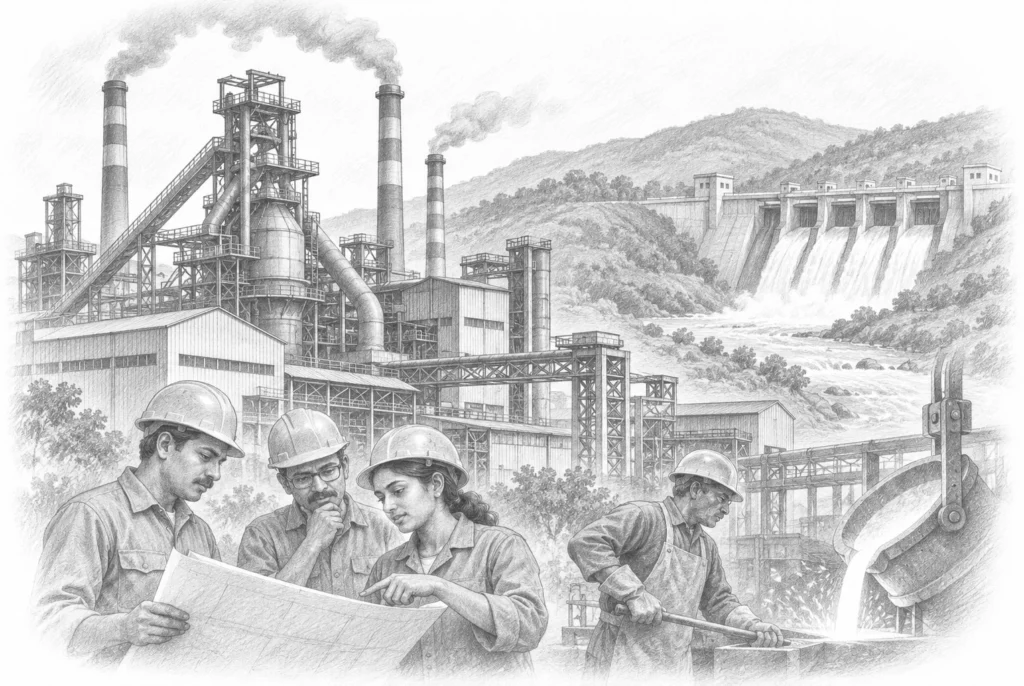
The Planning Commission was set up in March 1950 by an executive resolution, with the Prime Minister as its chairman, to assess the country’s resources and formulate plans for their effective use; the National Development Council (1952) brought the Chief Ministers into the process. The First Five-Year Plan (1951–56) concentrated on agriculture, irrigation and infrastructure. The Second Plan (1956–61), based on the model of the statistician P.C. Mahalanobis, gave priority to heavy industry and capital goods in the public sector, so that India could produce its own machines and achieve self-reliance. The Industrial Policy Resolution of 1956 reserved the ‘commanding heights’ of the economy, such as steel, heavy machinery, mining and railways, for the state. Private industry was regulated through industrial licensing under the Industries (Development and Regulation) Act, 1951, and imports were restricted to protect domestic industry (import substitution) (Figure 7.2).

B. Agriculture and the turn to the left
In agriculture, the state abolished zamindari but other land reforms were weakly implemented; the Community Development Programme (1952) sought rural development; and after food shortages in the mid-1960s, the Green Revolution introduced high-yielding seeds, fertilisers and irrigation, especially in Punjab and Haryana, making India self-sufficient in food grains. Under Indira Gandhi the state’s role expanded further: banks were nationalised (1969), monopolies were restricted (MRTP Act, 1969), foreign capital was controlled (FERA, 1973), and the slogan ‘Garibi Hatao’ (1971) promised poverty removal.
C. Achievements and failures
Planning built a diversified industrial base, public sector enterprises, dams, power and steel plants, scientific and technical institutions such as the IITs, and food self-sufficiency, and it kept India independent of foreign economic control. But growth was slow, around 3.5 per cent a year, which the economist Raj Krishna called the ‘Hindu rate of growth’; poverty remained widespread; the ‘licence-permit raj’ bred inefficiency and corruption; public enterprises often made losses; and land reforms and mass education lagged.
D. Why planning declined: Mozoomdar and Chatterjee
Ajit Mozoomdar, in ‘The Rise and Decline of Development Planning in India’ (1994), shows that planning rose on a broad consensus about state-led industrialisation, but declined as resources ran short after the mid-1960s, as political pressures for subsidies and populist spending grew, as implementation remained weak, and as the controls became a source of rent-seeking. By the 1980s planning had lost much of its authority. Partha Chatterjee, in ‘Development Planning and the Indian State’ (2000), argues that planning gave the postcolonial state its legitimacy: the state presented itself as standing above particular interests and embodying the universal goal of development, pursued rationally by experts in the Planning Commission, outside the conflicts of politics. In practice, however, the planners had to negotiate with the dominant classes and political pressures, so the separation of planning from politics could not be sustained.
7.3 Neo-liberal Restructuring
A. The crisis of 1991
By 1991 India faced a severe balance-of-payments crisis. Years of fiscal deficits and borrowing, the rise in oil prices during the Gulf War and the collapse of trade with the Soviet Union left foreign exchange reserves sufficient for only a few weeks of imports; India had to pledge gold to obtain loans. The government of P.V. Narasimha Rao, with Manmohan Singh as Finance Minister, launched wide-ranging reforms in July 1991, supported by loans from the IMF and World Bank.
B. Liberalisation, privatisation and globalisation
- Liberalisation: industrial licensing was abolished for most industries, the MRTP restrictions were relaxed, and the role of the market expanded.
- Privatisation: the number of industries reserved for the public sector was cut, and the government began disinvestment, selling shares in public enterprises.
- Globalisation: tariffs and import controls were reduced, the rupee was devalued and made convertible on the current account, and foreign direct and portfolio investment was welcomed. India joined the World Trade Organization in 1995.
- Fiscal and financial reforms: taxes were rationalised, the financial sector was reformed, and later reforms included the Goods and Services Tax (2017) and the Insolvency and Bankruptcy Code (2016).
C. Explaining the shift
Terence Byres describes the change as a shift from the interventionist state of development planning to a neo-liberal state. It was driven by the fiscal and external crisis, by pressure from the IMF and World Bank, by the changing interests of Indian business, which had grown strong enough to want freedom from controls, by the rise of a new middle class, and by the global triumph of market ideas after the collapse of the Soviet Union. Rob Jenkins argued that reforms were often carried out ‘by stealth’, gradually and without open debate, to avoid political opposition.
D. Results and critiques
Growth accelerated, reaching 8–9 per cent in some years of the 2000s; services and information technology boomed; foreign reserves grew; and poverty declined. But Prabhat Patnaik and C.P. Chandrasekhar, in ‘India: Dirigisme, Structural Adjustment, and the Radical Alternative’ (2007), argue that neo-liberal reforms increased inequality, produced agrarian distress and farmer suicides, created ‘jobless growth’ in which employment lagged behind output, cut public investment through fiscal austerity, and made the economy vulnerable to global finance. They propose a radical alternative based on public investment, land reform, expanding the purchasing power of the masses and controls on capital flows. Defenders of reform reply that growth has lifted millions out of poverty and financed welfare schemes.
| Basis | Planned economy (1950–1991) | Neo-liberal restructuring (after 1991) |
|---|---|---|
| Role of the state | Directs investment; owns key industries | Regulates and facilitates markets |
| Private sector | Controlled by licences | Freed from most licensing |
| Foreign trade and capital | Import substitution; restricted | Open trade; foreign investment welcomed |
| Main goal | Self-reliance and industrialisation | Efficiency and faster growth |
7.4 From the Planning Commission to NITI Aayog
After liberalisation, the Planning Commission continued to prepare Five-Year Plans until the Twelfth Plan (2012–17), but its role shrank. In 2014 the new government announced its abolition, and on 1 January 2015 it was replaced by the NITI Aayog (National Institution for Transforming India). Santosh Mehrotra and Sylvie Guichard, in Planning in the 20th Century and Beyond (2020), compare the two. NITI Aayog is a policy think tank rather than an allocating body: it does not distribute funds to states; it promotes co-operative federalism through a Governing Council that includes all Chief Ministers, and competitive federalism through indices ranking states on health, education and the Sustainable Development Goals; and it runs programmes such as the Aspirational Districts Programme (2018). Critics argue that India lost an institution for long-term planning, co-ordination and resource transfer to states, and that the Finance Commission and the Centre have absorbed its financial role. Mehrotra and Guichard argue that some functions of planning, long-term vision, investment co-ordination and attention to regional inequality, remain necessary even in a market economy.
7.5 Important Questions
- Question 1 Discuss the planned model of development in India. Why did planning decline?
- Question 2 Examine the neo-liberal restructuring of the Indian economy since 1991.
- Question 3 Discuss the shift from the Planning Commission to NITI Aayog.
DU asks the same idea in different words. So learn one broad answer for each question below; the same answer works for every question joined by OR.
Important Question 1
Discuss the planned model of development in India. Why did planning decline?
OR
Examine the Mahalanobis model and the role of the public sector.
OR
Discuss the relationship between development planning and the Indian state.
Model Answer
“To promote a rapid rise in the standard of living of the people by efficient exploitation of the resources of the country.”
— Government of India, Resolution setting up the Planning Commission (March 1950)
Introduction. For four decades after independence India followed a strategy of planned development, in which the state directed investment through Five-Year Plans, built heavy industry in the public sector and regulated private enterprise. The strategy shaped the Indian state and economy but declined by the 1980s and was largely abandoned after 1991.
1. Origins
Nationalists blamed colonialism for poverty and wanted rapid industrialisation. The National Planning Committee (1938), the Bombay Plan, the People’s Plan and the Gandhian Plan (1944), and the Soviet example created a consensus on state-led development. The Congress National Planning Committee (1938) under Nehru and the industrialists’ Bombay Plan (1944) prepared the ground.
2. Institutions
The Planning Commission (1950), chaired by the Prime Minister, prepared plans, and the National Development Council (1952) involved Chief Ministers. Plans allocated resources among sectors and states. The National Development Council (1952) brought chief ministers into planning.
3. The Mahalanobis Model
The Second Plan (1956–61) gave priority to heavy industry and capital goods in the public sector, so that India could produce its own machinery and achieve self-reliance, while consumer goods would come from small industries. It aimed at self-reliance and long-term growth.
4. The Mixed Economy and Controls
The Industrial Policy Resolution (1956) reserved the commanding heights for the state; private industry was regulated by licensing; imports were restricted; and later banks were nationalised (1969) and monopolies controlled. A licence system regulated private industry.
5. Agriculture
Zamindari was abolished, but land reforms were weak. The Green Revolution of the mid-1960s made India self-sufficient in food grains, though mainly in irrigated regions. The Green Revolution of the late 1960s raised wheat and rice output.
6. Crises and Plan Holidays
Wars with China (1962) and Pakistan (1965), droughts and a foreign exchange crisis led to the devaluation of 1966 and three annual plans (1966–69) in place of a five-year plan.
7. Democratic Planning
India’s planning was democratic and only indicative for the private sector, unlike the Soviet command model.
8. Achievements
Planning built an industrial base, infrastructure, scientific institutions and food security, and preserved economic independence. Institutions such as the IITs, ISRO and public sector steel plants were built.
9. Failures
Growth was slow (the ‘Hindu rate of growth’), poverty persisted, the licence-permit raj bred inefficiency and corruption, and public enterprises were often loss-making. The economist Raj Krishna called the slow growth of about 3.5 per cent the ‘Hindu rate of growth’.
10. The Licence-Permit Raj
Critics such as Jagdish Bhagwati argued that excessive controls bred corruption and inefficiency, a system known as the ‘licence-permit raj’.
11. Why Planning Declined
Mozoomdar shows that resource shortages, populist pressures, weak implementation and rent-seeking eroded planning. Chatterjee argues that planning gave the state legitimacy as a rational agent above interests, but in practice it had to bargain with dominant classes, so planning could not stay above politics.
12. Planning and Federalism
Plan funds gave the Centre great leverage over the states, since much central assistance flowed through the Planning Commission. The Gadgil formula (1969) made the distribution of plan assistance more objective, but states continued to complain that planning centralised power and imposed uniform schemes.
13. Planning and Social Development
Critics such as Jean Drèze and Amartya Sen argued that Indian planning neglected primary education, health and land reform, which East Asian countries had used to spread the benefits of growth. As a result, industrialisation did not reach the mass of the people.
14. Evaluation
Planning laid the foundations of India’s industrial and scientific base, but its rigidities and a changing global economy led to its decline and to market-oriented reform.
Conclusion. Thus, planned development laid the foundations of modern India but could not deliver rapid growth or end poverty, which led to its decline and the turn to markets.
Important Question 2
Examine the neo-liberal restructuring of the Indian economy since 1991.
OR
Discuss the causes and consequences of the economic reforms of 1991.
OR
Critically evaluate liberalisation, privatisation and globalisation in India.
Model Answer
“No power on earth can stop an idea whose time has come.”
— Manmohan Singh, Budget Speech, 24 July 1991 (quoting Victor Hugo)
Introduction. In 1991 India abandoned much of its planned, controlled economy and began a process of liberalisation, privatisation and globalisation. This neo-liberal restructuring transformed the economy and the role of the state, and remains a subject of intense debate.
1. The Crisis of 1991
Fiscal deficits, rising debt, the Gulf War oil shock and the collapse of Soviet trade left India with reserves for only a few weeks of imports; it pledged gold to borrow abroad. Reserves fell to about two weeks of imports, and India pledged gold to raise loans.
2. The Reforms
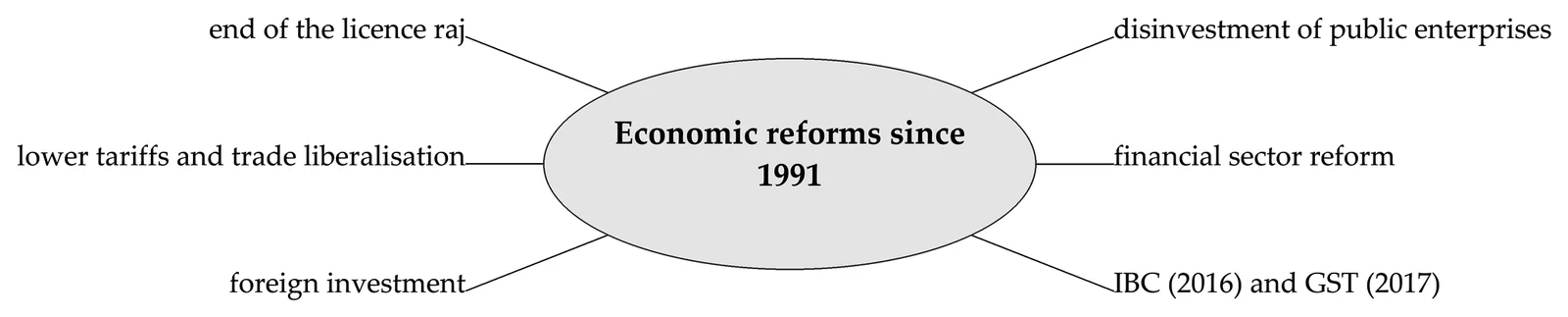
The Rao–Manmohan Singh government abolished most industrial licensing, cut the list of industries reserved for the public sector, began disinvestment, reduced tariffs, devalued the rupee and welcomed foreign investment. They devalued the rupee, cut tariffs and opened sectors to foreign investment. Industrial licensing was abolished for most industries.
3. The 1991 Budget
In his budget speech of July 1991, Manmohan Singh quoted Victor Hugo that no power on earth can stop an idea whose time has come.
4. Later Reforms
India joined the WTO (1995), reformed the financial sector and taxes, and introduced the GST (2017) and the Insolvency and Bankruptcy Code (2016). The Insolvency and Bankruptcy Code (2016) and the GST (2017) were later reforms.
5. Explaining the Shift
Byres describes a move from the interventionist to the neo-liberal state, driven by crisis, IMF and World Bank pressure, the changing interests of Indian capital, the middle class and global market ideology. Jenkins notes that reforms were often carried out by stealth. Others stress pressure from the IMF and World Bank and a new elite consensus.
6. Reform by Stealth
Rob Jenkins argued that reforms were introduced ‘by stealth’, gradually and without open debate, which allowed democracy to accommodate them.
7. Pro-Business and Pro-Market
Atul Kohli argues that a pro-business shift began in the 1980s, favouring established firms, before the pro-market reforms of 1991.
8. Achievements
Growth accelerated, services and IT boomed, reserves grew, consumer choice expanded and poverty declined, financing larger welfare schemes. Growth averaged over six per cent and poverty fell substantially.
9. The Critique of Patnaik and Chandrasekhar
They argue that reforms increased inequality, caused agrarian distress, produced jobless growth, cut public investment and exposed India to global finance, and propose a radical alternative of public investment, land reform and controls on capital. They also point to jobless growth and agrarian crisis, including farmer suicides.
10. Impact on the State
The state changed from owner and controller to regulator and facilitator, creating regulators such as SEBI and TRAI, while expanding rights-based welfare. Disinvestment reduced the public sector.
11. Growth and Employment
Growth was driven by services and capital-intensive industry, creating fewer jobs than needed, so most workers remain in agriculture and the informal sector.
12. Liberalisation and Agriculture
Agriculture received less public investment after 1991, and open trade exposed farmers to price volatility, contributing to agrarian distress.
13. Rising Inequality
Studies by Thomas Piketty and Lucas Chancel show that income inequality in India rose sharply from the 1980s.
14. Evaluation
Reforms delivered growth but uneven benefits. The challenge is to combine market efficiency with employment, equity and public investment in health and education. The debate on how to combine growth with equity continues.
15. Reforms, Federalism and Regional Inequality
After 1991 states began to compete for private and foreign investment, a form of competitive federalism. Southern and western states grew faster, while many northern and eastern states lagged, widening regional inequality. Southern and western states attracted more investment.
16. Reforms and Welfare
Faster growth increased tax revenues, which financed rights-based welfare laws such as MGNREGA and the Food Security Act. A famous debate in 2013 between Jagdish Bhagwati, who stressed growth, and Amartya Sen, who stressed public investment in health and education, captured the disagreement about the priorities of reform. MGNREGA and the Food Security Act were financed partly by higher revenues.
Conclusion. Thus, neo-liberal restructuring made India one of the fastest-growing economies, but also raised questions of inequality and the role of the state that remain unresolved.
Important Question 3
Discuss the shift from the Planning Commission to NITI Aayog.
OR
Is planning still relevant in a market economy? Discuss.
Model Answer
“Development can be seen … as a process of expanding the real freedoms that people enjoy.”
— Amartya Sen, Development as Freedom (1999)
Introduction. The replacement of the Planning Commission by NITI Aayog in 2015 marked the end of an era of Five-Year Plans. Mehrotra and Guichard compare the two institutions and ask what kind of planning a market economy still needs.
1. The Planning Commission
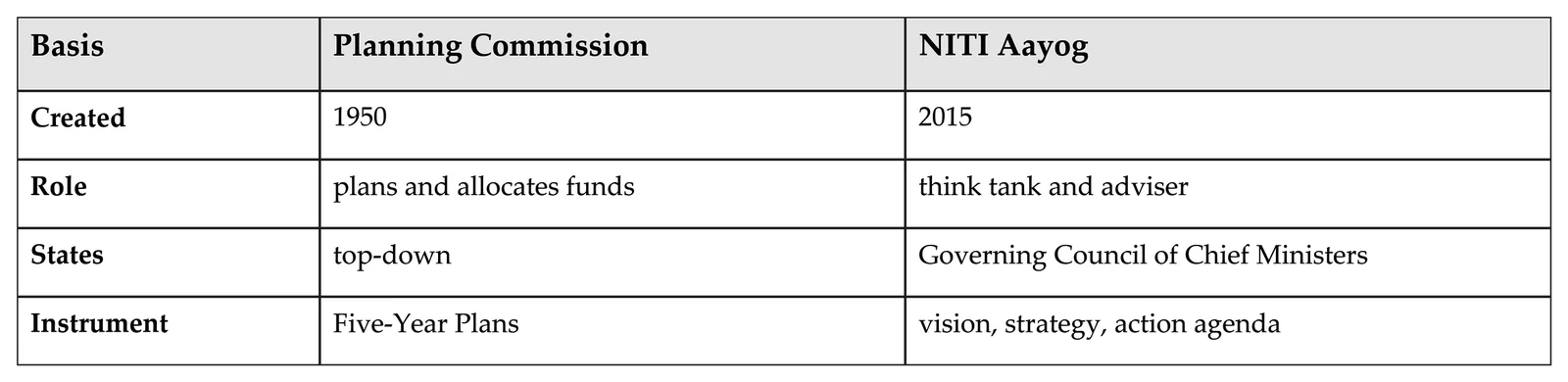
Set up in 1950 by executive resolution, it prepared Five-Year Plans, allocated plan funds to ministries and states, and was a powerful institution under the Prime Minister. The Prime Minister chaired it, with a Deputy Chairman of cabinet rank. It also allocated plan grants to states and ministries.
2. Decline after 1991
With liberalisation, the market and private investment became more important, and the Commission’s role shrank. Critics also saw it as centralising, imposing uniform schemes on states. Critics called it a relic of the command economy.
3. Reasons for the Change
The government argued that a ‘one size fits all’ approach of central plans did not suit a diverse market economy and that states needed more freedom to design programmes.
4. NITI Aayog
Created on 1 January 2015, NITI Aayog is a policy think tank chaired by the Prime Minister, with a Governing Council of all Chief Ministers. It does not allocate funds. NITI stands for National Institution for Transforming India.
5. Structure of NITI Aayog
The Prime Minister chairs it; it has a Vice-Chairperson, full-time and ex-officio members, a CEO and a Governing Council of all Chief Ministers and Lieutenant Governors.
6. Co-operative and Competitive Federalism
NITI promotes co-operation through the Governing Council and competition through indices ranking states on health, education, water and SDGs. It ranks states on indices of health, education and the Sustainable Development Goals.
7. The End of Five-Year Plans
The Twelfth Plan (2012–17) was the last; NITI replaced plans with a fifteen-year vision, a seven-year strategy and a three-year action agenda.
8. Programmes
It runs the Aspirational Districts Programme (2018), monitors the SDGs and advises on policy reforms, such as in health and agriculture. It also prepared a Three-Year Action Agenda and a Strategy for New India @75. The Aspirational Districts Programme ranks over a hundred backward districts on development indicators.
9. NITI and the States
Some states welcomed greater freedom, while others complained that the end of plan grants reduced their resources and bargaining power.
10. Long-Term Vision
NITI has prepared long-term vision documents such as Viksit Bharat @2047, setting development goals for the centenary of independence.
11. Criticism
Critics argue that India lost long-term planning and co-ordination, that financial power shifted to the Centre and the Finance Commission, and that NITI lacks independent authority. Unlike the Planning Commission, it has no power to allocate funds. Some economists also argue that it has become too close to the government’s political agenda.
12. The Continuing Need for Planning
Mehrotra and Guichard argue that a market economy still needs long-term vision, co-ordination of public investment, attention to regional inequality and human development, functions that NITI only partly performs. They argue for planning in areas such as infrastructure, climate and human development.
13. Between Think Tank and Planner
Critics ask whether NITI, as a think tank without funds, can coordinate development as the Planning Commission once did.
14. Evaluation
The shift reflects the changing role of the state, from directing the economy to guiding and enabling it, but the challenges of employment, inequality and climate change require strategic planning. Its success depends on genuine cooperation with the states.
15. Other Functions of NITI Aayog
NITI Aayog also runs the Atal Innovation Mission (2016), publishes the SDG India Index (from 2018), evaluates government programmes through its Development Monitoring and Evaluation Office, and promotes ‘Team India’ by bringing the Centre and states together.
16. The Finance Commission and Transfers
With the end of plan transfers, the Finance Commission became more important. The Fourteenth Finance Commission (2015) raised the states’ share of central taxes from 32 to 42 per cent, giving states more untied funds. Centrally sponsored schemes still transfer large funds through ministries.
Conclusion. Thus, NITI Aayog replaced command planning with advice and federal co-operation, while the debate on what planning a developing market economy needs continues.
Short Notes
(a) The Mahalanobis model
The model behind the Second Five-Year Plan (1956–61), designed by P.C. Mahalanobis, which gave priority to investment in heavy industries and capital goods in the public sector, so that India could produce its own machines and achieve long-term self-reliance and growth, with consumer goods supplied by small and cottage industries.
(b) The Green Revolution
The introduction from the mid-1960s of high-yielding varieties of wheat and rice, chemical fertilisers, pesticides and irrigation, especially in Punjab, Haryana and western Uttar Pradesh. It made India self-sufficient in food grains but increased regional and class inequalities and caused environmental problems.
(c) Licence-permit raj
The system of industrial licensing, controls and permits that regulated private industry in India from the Industries (Development and Regulation) Act of 1951 until the reforms of 1991. Firms needed government approval to set up or expand capacity, import inputs or change products. Critics argued that it encouraged inefficiency, delays and corruption, and its dismantling was a central part of the 1991 reforms.
More notes: MDSC-2A Indian Government and Politics
- Indian Constitution: basic features, debates on Fundamental Rights, Directive Principles and Federalism
- State formation and nation building: Integration of princely states, linguistic re-organisation of states
- Political institutions at the Centre and State levels: Parliament, Judiciary, Prime Minister, Chief Minister
- Social structure and political power: caste, class, gender
- Religion and politics: debates on secularism and communalism
- Political parties and party systems
- Social movements: workers, farmers, environmental, and women’s movements
- The nature of state in India: developmental, welfare, regulatory
These notes are prepared by PADHO TO AISE for study help. They are not an official University of Delhi publication.