
Semester II MDSC-2A Indian Government and Politics
Unit III · 23 min read · Updated 24 Nov 2026
As per the University of Delhi (DU) BA (Hons) Political Science syllabus
Contents
- 3.1 Parliament
- 3.2 Judiciary
- 3.3 Prime Minister
- 3.4 Chief Minister
- 3.5 Important Questions
- Discuss the composition and functions of the Indian Parliament. Has Parliament declined?
- Examine the role of the Supreme Court in India with reference to judicial review and judicial activism.
- Discuss the position and role of the Prime Minister in India.
- Discuss the position of the Chief Minister and the Chief Minister’s relationship with the Governor.
- Short Notes
संसदीय कार्यपालिका की सिफ़ारिश करके प्रारूप संविधान ने अधिक स्थायित्व की अपेक्षा अधिक उत्तरदायित्व को प्राथमिकता दी है।
The Draft Constitution in recommending the parliamentary system of Executive has preferred more responsibility to more stability.
— B.R. Ambedkar, Constituent Assembly, 4 November 1948
INDIA CHOSE a parliamentary system of government, both at the Centre and in the states. In this system the people elect a legislature; the leader of the majority becomes the head of government, the Prime Minister at the Centre and the Chief Minister in a state; the government stays in office only as long as it enjoys the confidence of the legislature; and an independent judiciary guards the Constitution. In this chapter we study four key institutions: Parliament, the judiciary, the Prime Minister and the Chief Minister. For each, we look at what the Constitution says and how the institution has actually worked, because, as S.K. Chaube and Arun Thiruvengadam remind us, the practice of Indian politics has often differed from the constitutional text.
3.1 Parliament
A. Composition
Parliament has two Houses. The Lok Sabha (House of the People) is directly elected by the people from single-member constituencies by the first-past-the-post system; it has 543 elected members and a term of five years unless dissolved earlier. The Rajya Sabha (Council of States) represents the states; most of its members are elected by state legislative assemblies by proportional representation, twelve are nominated by the President for their expertise, and it is a permanent house, one-third of whose members retire every two years. States may have one house (a Legislative Assembly) or two (with a Legislative Council).
B. Functions
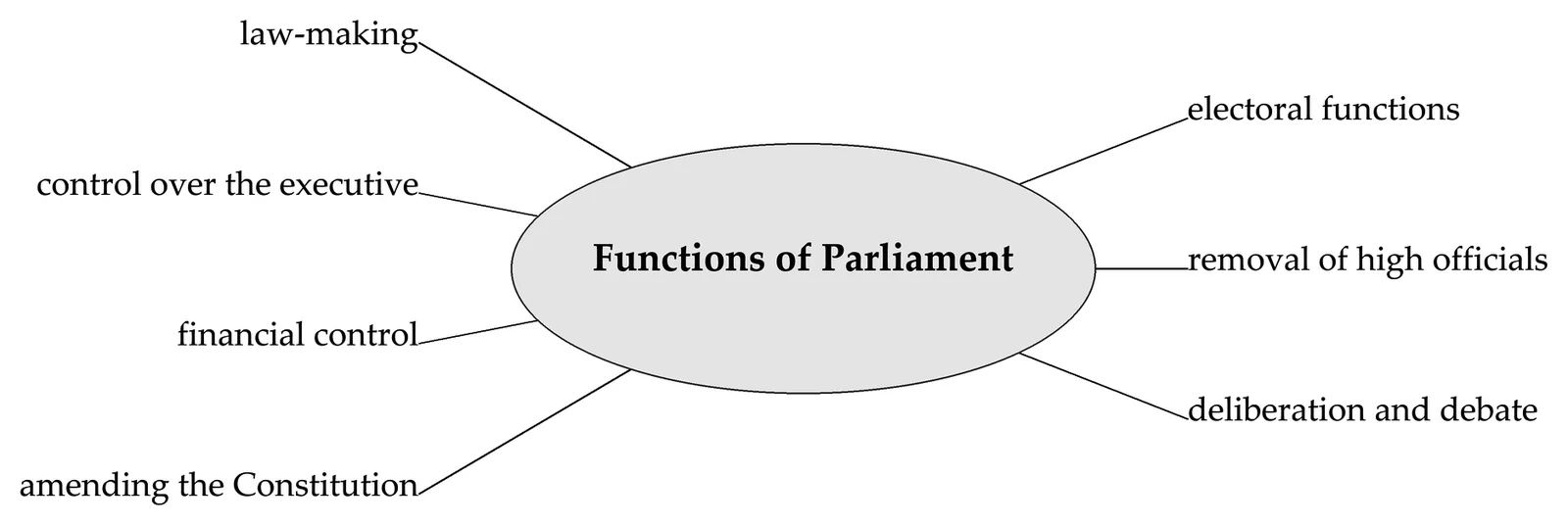
Parliament performs several functions (Figure 3.2):
- Law-making: it makes laws on Union List and Concurrent List subjects, and in certain circumstances on State List subjects.
- Control over the executive: the Council of Ministers is collectively responsible to the Lok Sabha (Article 75(3)); Parliament controls it through Question Hour, Zero Hour, debates, adjournment and calling-attention motions, and the no-confidence motion.
- Financial control: no tax can be levied and no money spent without its approval. The Lok Sabha has primacy in money matters: the Rajya Sabha can only delay a Money Bill for fourteen days (Article 109–110). The Public Accounts Committee and Estimates Committee scrutinise spending.
- Amending the Constitution under Article 368.
- Electoral functions: electing the President (with state legislatures) and the Vice-President.
- Removal of high officials: impeaching the President and removing judges of the Supreme Court and High Courts.
- Deliberation: debating national issues and reflecting public opinion.
C. The decline of Parliament
Arun Thiruvengadam and other scholars point to signs that Parliament’s role has weakened. The number of sitting days has fallen from over a hundred a year in the 1950s to far fewer; many bills are passed with little debate and without being sent to committees; frequent disruptions waste time; the government relies on ordinances and on classifying bills as Money Bills to bypass the Rajya Sabha; and the anti-defection law (1985), while checking opportunistic defections, has made members follow the party whip on every vote, reducing independent judgement. The growth of executive dominance, especially under strong governments, has led to talk of a ‘decline of Parliament’. On the other hand, Parliament remains the central arena of democratic debate, its committees do valuable work, and it has passed landmark laws on rights and welfare.
3.2 Judiciary
A. Structure
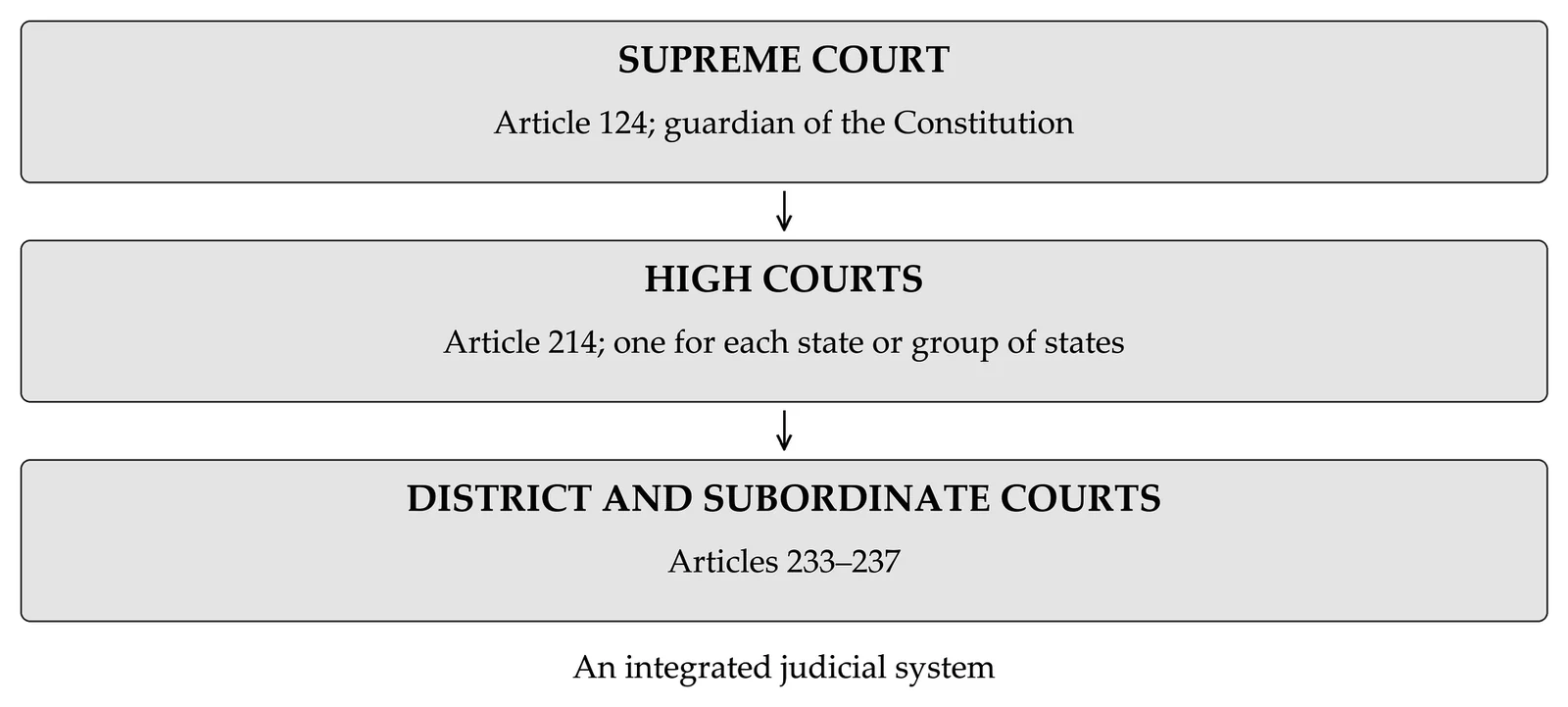
India has a single, integrated judicial system (Figure 3.3). At the top is the Supreme Court (Article 124), below it the High Courts (Article 214) in the states, and below them the district and subordinate courts (Articles 233–237), which handle civil and criminal cases. P.S. Khanna explains that the same courts apply both central and state laws, unlike the dual court system of the United States. Alternative forums such as Lok Adalats, tribunals and consumer courts supplement the regular courts.
B. Jurisdiction of the Supreme Court
- Original jurisdiction in disputes between the Union and states or among states (Article 131).
- Writ jurisdiction to enforce Fundamental Rights through writs such as habeas corpus, mandamus, prohibition, certiorari and quo warranto (Article 32); High Courts have wider writ powers under Article 226.
- Appellate jurisdiction in constitutional, civil and criminal cases, and through special leave to appeal (Article 136).
- Advisory jurisdiction: the President may seek its opinion on questions of law or fact (Article 143).
- It is a court of record, and its decisions are binding on all courts (Article 141).
C. Independence of the judiciary
The Constitution protects judicial independence through security of tenure, removal only by a special majority of both Houses of Parliament on grounds of proved misbehaviour or incapacity, salaries charged on the Consolidated Fund, and a bar on discussing judges’ conduct in Parliament. The method of appointment has been debated. Through the ‘Judges cases’ (1981, 1993 and 1998) the Supreme Court created the collegium system, in which senior judges effectively choose judges. Parliament’s attempt to replace it with a National Judicial Appointments Commission (99th Amendment, 2014) was struck down in 2015 as a threat to judicial independence. Critics argue that the collegium lacks transparency.
D. Judicial review and activism
Through judicial review, courts can strike down laws and executive actions that violate the Constitution. From the late 1970s the Supreme Court became activist: it developed public interest litigation (PIL), allowing anyone to petition on behalf of the poor; expanded Article 21; and issued directions on bonded labour, prison conditions, environment, sexual harassment (Vishaka, 1997) and corruption. Supporters see activism as a response to executive failure; critics warn of judicial overreach into policy-making and point to the huge backlog of pending cases in the lower courts.
3.3 Prime Minister
A. Constitutional position
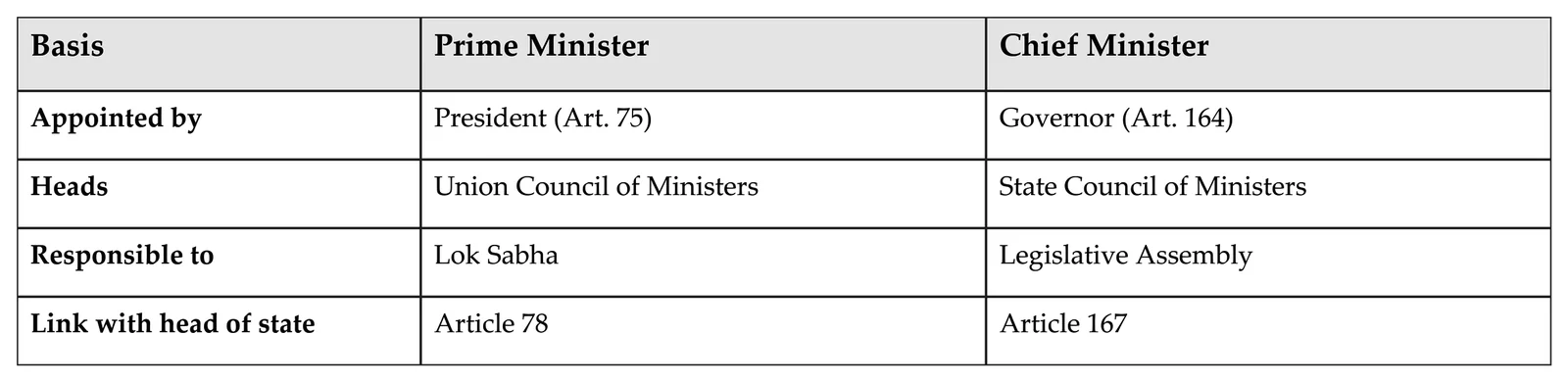
The President is the constitutional head of the Union, but Article 74 provides a Council of Ministers headed by the Prime Minister to aid and advise the President, who must act on that advice (made explicit by the 42nd and 44th Amendments). The Prime Minister is appointed by the President (Article 75), by convention the leader of the party or coalition that commands a majority in the Lok Sabha; other ministers are appointed on the Prime Minister’s advice. The Council of Ministers is collectively responsible to the Lok Sabha. Article 78 makes the Prime Minister the channel of communication between the President and the Council of Ministers.
B. Powers and functions
- Head of the government: chooses ministers, allocates portfolios and can drop ministers; the resignation or death of the Prime Minister dissolves the Council of Ministers.
- Chairman of the cabinet: presides over cabinet meetings and its most important committees, co-ordinating the work of ministries.
- Link with the President (Article 78), communicating decisions and advising on appointments and the dissolution of the Lok Sabha.
- Leader of the Lok Sabha and of the ruling party, chief spokesperson of the government.
- Chief architect of foreign policy and crisis management, assisted by the Prime Minister’s Office and the Cabinet Secretariat.
The Prime Minister was once described as ‘first among equals’ (primus inter pares) in the cabinet. Lord Morley called the office the ‘keystone of the cabinet arch’, and Ivor Jennings the sun around which the planets revolve.
C. The office in practice
The real power of the Prime Minister has depended on politics. Nehru dominated government but valued cabinet discussion. Indira Gandhi personalised and centralised power, strengthening the Prime Minister’s Secretariat and controlling the Congress party. In the coalition era (1989–2014), Prime Ministers such as V.P. Singh, Vajpayee and Manmohan Singh had to accommodate allies and regional parties, and their power was constrained. Since 2014, with a single-party majority, the office has again become dominant and centralised. Thiruvengadam notes that the parliamentary system in India has tended towards executive dominance, with the Prime Minister at its centre.
3.4 Chief Minister
The Chief Minister occupies in a state the position that the Prime Minister occupies at the Centre (Figure 3.4). The Governor is the constitutional head of the state, but Article 163 provides a Council of Ministers headed by the Chief Minister to aid and advise the Governor, except where the Governor is required to act in discretion. The Chief Minister is appointed by the Governor (Article 164), by convention the leader of the majority in the Legislative Assembly; the Council of Ministers is collectively responsible to the Assembly; and under Article 167 the Chief Minister communicates the decisions of the Council to the Governor.
The Chief Minister’s functions are similar to those of the Prime Minister: forming and leading the government, chairing the cabinet, leading the Assembly and the party, and serving as chief spokesperson of the state. Two factors shape the office in practice. The first is the party system: during Congress dominance, Chief Ministers were often chosen and replaced by the party’s central ‘high command’, while leaders of regional parties have been powerful and independent figures. The second is the Governor: Governors appointed by the Centre have sometimes used their discretion in appointing Chief Ministers after unclear election results, recommending President’s Rule under Article 356, or delaying assent to state bills. The Supreme Court in S.R. Bommai (1994) held that a government’s majority must be tested on the floor of the House, not in the Governor’s chamber, and later judgments have limited the Governor’s discretion. The Sarkaria and Punchhi Commissions recommended that Governors be impartial persons and that the Chief Minister be consulted on their appointment.
3.5 Important Questions
- Question 1 Discuss the composition and functions of the Indian Parliament. Has Parliament declined?
- Question 2 Examine the role of the Supreme Court in India with reference to judicial review and judicial activism.
- Question 3 Discuss the position and role of the Prime Minister in India.
- Question 4 Discuss the position of the Chief Minister and the Chief Minister’s relationship with the Governor.
DU asks the same idea in different words. So learn one broad answer for each question below; the same answer works for every question joined by OR.
Important Question 1
Discuss the composition and functions of the Indian Parliament. Has Parliament declined?
OR
Examine the role of Parliament in controlling the executive.
OR
Discuss the decline of Parliament in India.
Model Answer
“However good a Constitution may be, it is sure to turn out bad because those who are called to work it, happen to be a bad lot.”
— B.R. Ambedkar, Constituent Assembly, 25 November 1949
Introduction. Parliament is the supreme legislative body of the Union and the centre of India’s parliamentary democracy. It represents the people and the states, makes laws, controls the executive and finances, and serves as the main forum of national debate.
1. Composition
Parliament consists of the President, the Lok Sabha and the Rajya Sabha. The Lok Sabha is directly elected for five years; the Rajya Sabha is a permanent house mostly elected by state assemblies, with twelve nominated members. The Lok Sabha has 543 elected members; the Rajya Sabha has up to 250.
2. Law-Making
Parliament legislates on Union and Concurrent subjects and, in certain circumstances, on state subjects. Ordinary bills need the approval of both Houses; deadlocks can be resolved by a joint sitting. Joint sittings resolve deadlocks on ordinary bills.
3. Control over the Executive
Ministers are collectively responsible to the Lok Sabha. Question Hour, Zero Hour, debates, adjournment motions and the no-confidence motion keep the government answerable. The no-confidence motion is the ultimate check.
4. Question Hour and Zero Hour
Question Hour allows members to question ministers, and Zero Hour lets them raise urgent issues, keeping government answerable.
5. Financial Control
No tax or expenditure is lawful without Parliament’s approval. The Lok Sabha controls Money Bills, and the Public Accounts Committee examines the reports of the Comptroller and Auditor General. The Public Accounts Committee examines the CAG’s audit reports.
6. Constituent, Electoral and Judicial Functions
Parliament amends the Constitution, elects the President and Vice-President with others, and can impeach the President and remove judges.
7. Committees
Standing committees, including departmentally related committees since 1993, examine bills and budgets in detail, allowing cross-party scrutiny. Committees allow detailed and less partisan scrutiny. The share of bills referred to committees has declined in recent years.
8. Parliament and Representation
Parliament reflects India’s diversity through reserved seats for Scheduled Castes and Tribes and, after the 106th Amendment, will include one-third women.
9. Signs of Decline
Fewer sitting days, hurried passage of bills, fewer bills sent to committees, disruptions, frequent ordinances, the use of the Money Bill route, and the anti-defection law, which makes members follow the whip, have weakened Parliament relative to the executive. The anti-defection law has also reduced independent voting by MPs.
10. Parliament and the Courts
Parliament’s power to amend the Constitution is limited by the basic structure, and its laws are subject to judicial review.
11. Continuing Importance
Parliament still holds governments accountable, passes landmark laws such as the RTI Act and MGNREGA, and represents India’s diversity. Reforms such as more sitting days and compulsory committee scrutiny could strengthen it.
12. The Role of the Rajya Sabha
The Rajya Sabha represents the states and acts as a revising chamber that can delay hasty legislation. It has special powers: by a two-thirds resolution it can authorise Parliament to legislate on a State List subject (Article 249) or create new all-India services (Article 312). Critics question its usefulness when it is dominated by party politics.
13. Reform Proposals
Suggested reforms include a minimum number of sitting days, compulsory reference of bills to committees, a neutral role for the Speaker, and the transfer of defection cases to an independent authority. Better research support for MPs is also suggested.
14. Evaluation
Parliament remains the centre of Indian democracy, but strengthening its deliberative and scrutiny functions is necessary to restore its role.
Conclusion. Thus, Parliament remains the heart of Indian democracy, though its effectiveness depends on the conduct of governments, parties and members.
Important Question 2
Examine the role of the Supreme Court in India with reference to judicial review and judicial activism.
OR
Discuss the structure and jurisdiction of the Indian judiciary.
OR
Examine the debate on judicial independence and the appointment of judges.
Model Answer
“The Court [is] the sentinel on the qui vive with regard to fundamental rights.”
— Justice Patanjali Sastri, State of Madras v. V.G. Row (1952)
Introduction. The judiciary interprets the Constitution, protects rights and settles disputes. In India it has become one of the most powerful courts in the world, through judicial review and judicial activism, while facing debates on its independence, accountability and overreach.
1. An Integrated Judiciary
India has a single hierarchy of courts: the Supreme Court, High Courts and subordinate courts, applying both central and state laws, supplemented by tribunals and Lok Adalats. The same Supreme Court interprets both Union and state laws.
2. Jurisdiction
The Supreme Court has original jurisdiction in federal disputes (Article 131), writ jurisdiction (Article 32), appellate jurisdiction including special leave (Article 136), and advisory jurisdiction (Article 143). Its decisions bind all courts. It also has advisory jurisdiction under Article 143.
3. Independence
Security of tenure, a difficult removal process, salaries charged on the Consolidated Fund and the collegium system protect independence. The NJAC was struck down in 2015, though the collegium is criticised for opacity. Judges are appointed through the collegium system.
4. Judicial Review
Courts can invalidate laws and executive actions that violate the Constitution. The basic structure doctrine (1973) extended review to constitutional amendments. Kesavananda Bharati (1973) established the basic structure doctrine.
5. Article 21 and Expanded Rights
From Maneka Gandhi (1978) onwards the Court read many rights into Article 21, including livelihood, education, health, shelter, a clean environment and privacy.
6. Judicial Activism and PIL
From the late 1970s the Court relaxed standing rules, accepted letters as petitions and expanded Article 21, intervening on bonded labour, prisoners’ rights, environment and sexual harassment. Justices P.N. Bhagwati and V.R. Krishna Iyer pioneered public interest litigation.
7. Achievements
Activism protected the rights of the poor and marginalised, checked executive abuse and made the Court a trusted institution. Examples include protecting bonded labourers, prisoners, the environment and the right to food.
8. Criticism
Critics warn of judicial overreach into policy, weak enforcement of directions, and neglect of the huge backlog of cases in lower courts, where most citizens encounter justice. Some speak of ‘judicial overreach’ when courts make policy.
9. Judicial Restraint
Judicial restraint means respecting the roles of the legislature and executive and intervening only when rights or the Constitution are violated.
10. Balance
A healthy democracy needs a court that protects rights while respecting the roles of the legislature and executive, and judicial reforms to reduce delays.
11. Appointment of Judges
The collegium system, created by the Judges Cases (1993, 1998) and maintained when the NJAC was struck down (2015), gives judges primacy in appointments but is criticised for opacity.
12. Courts and Federalism
The Supreme Court is also the umpire of Indian federalism: it decides disputes between the Union and states under Article 131, and in S.R. Bommai (1994) it protected states against the arbitrary use of President’s Rule.
13. Judicial Reforms
With around five crore cases pending across courts, reforms are urgent: more judges, e-courts and technology, alternative dispute resolution, better infrastructure for lower courts, and a transparent system of appointments. Judges can be removed only through the process under the Judges (Inquiry) Act, 1968, which has never succeeded. Proposals include more judges, fast-track courts and alternative dispute resolution.
14. Evaluation
The Supreme Court has been a powerful guardian of the Constitution and of the rights of the weak, but its legitimacy depends on restraint, transparency and efficiency.
Conclusion. Thus, the Supreme Court is the guardian of the Constitution and of citizens’ rights; its legitimacy depends on combining activism with restraint and independence with accountability.
Important Question 3
Discuss the position and role of the Prime Minister in India.
OR
‘The Prime Minister is the keystone of the cabinet arch.’ Discuss.
OR
Compare the positions of the Prime Minister and the Chief Minister.
Model Answer
“The keystone of the cabinet arch.”
— Lord Morley on the Prime Minister
Introduction. In India’s parliamentary system the President is the constitutional head, but real executive power lies with the Council of Ministers headed by the Prime Minister. The office has become the most powerful in the country, though its strength has varied with the party system.
1. Appointment
The President appoints as Prime Minister the leader who commands a majority in the Lok Sabha (Article 75). Other ministers are appointed on the Prime Minister’s advice. The Prime Minister must be a member of Parliament or become one within six months.
2. Head of Government
The Prime Minister forms the government, allocates portfolios, reshuffles and drops ministers; the Council of Ministers falls with the Prime Minister. The Prime Minister can ask a minister to resign. The 91st Amendment (2003) limits the Council of Ministers to fifteen per cent of the Lok Sabha’s strength.
3. Leader of the Cabinet
The Prime Minister chairs the cabinet and key committees, co-ordinates ministries and resolves disputes, assisted by the PMO and Cabinet Secretariat. The Prime Minister presides over key cabinet committees.
4. Link with the President
Under Article 78 the Prime Minister communicates cabinet decisions to the President and advises on appointments and dissolution. The President may ask that a matter decided by a minister be considered by the whole cabinet.
5. Leader in Parliament and Party
As leader of the Lok Sabha and the ruling party, the Prime Minister guides legislation and represents the government in debates and elections.
6. Foreign Policy and Crises
The Prime Minister is the chief maker of foreign policy and the leader in national crises. The Prime Minister also heads the Political Council of the Nuclear Command Authority. During wars and emergencies the office becomes even more central.
7. The Prime Minister’s Office
The PMO, headed by a Principal Secretary, has become a powerful centre of policy coordination, especially under strong Prime Ministers.
8. The Office in Practice
Nehru dominated but valued the cabinet; Indira Gandhi centralised power; coalition-era Prime Ministers were constrained by allies; since 2014 the office has again become dominant. Thiruvengadam notes a trend towards executive dominance. Coalition Prime Ministers had to share power with their allies.
9. Limits on the Prime Minister
The Prime Minister is limited by Parliament, the party, coalition partners, the courts, the states, the media and public opinion.
10. Presidentialisation
Scholars speak of the presidentialisation of the office, as elections increasingly focus on the Prime Minister’s personality.
11. Coalition Prime Ministers
Prime Ministers such as Vajpayee and Manmohan Singh managed coalitions through coordination committees and common minimum programmes, showing a more collegial style.
12. Prime Minister and Chief Minister
The Chief Minister performs similar roles in a state, appointed by the Governor and responsible to the Assembly, but works within the limits of a federal system and depends more on the Governor and the Centre.
13. The Prime Minister and the President
Normally the President must act on the advice of the Council of Ministers, and can only return it once for reconsideration. The President’s discretion matters in a hung Parliament: in 1979 Charan Singh was appointed but never faced Parliament, and in 1996 Vajpayee’s government lasted only thirteen days.
14. Collective Responsibility
All ministers share responsibility for cabinet decisions and must resign together if defeated in the Lok Sabha. Cabinet committees decide many matters, and under Indira Gandhi an informal ‘kitchen cabinet’ of advisers sometimes mattered more than the cabinet itself. A minister who disagrees must resign or support the decision.
15. Evaluation
The Prime Minister is the pivot of the Indian political system, but the office’s strength varies with the party system and personality; parliamentary accountability keeps it democratic.
Conclusion. Thus, the Prime Minister is the keystone of India’s parliamentary system; the extent of the office’s power depends on the party system and political leadership.
Important Question 4
Discuss the position of the Chief Minister and the Chief Minister’s relationship with the Governor.
OR
Examine the role of the Governor in state politics.
Model Answer
“The Governor under the Constitution has no functions which he can discharge by himself.”
— B.R. Ambedkar, Constituent Assembly (1949)
Introduction. In the states, the parliamentary system mirrors that of the Centre. The Governor is the constitutional head and the Chief Minister the real executive head. Their relationship has been one of the most contested aspects of Indian federalism.
1. Appointment and Responsibility
The Governor appoints the Chief Minister, by convention the leader of the majority in the Assembly (Article 164). The Council of Ministers is collectively responsible to the Assembly. The Chief Minister must keep the confidence of the Legislative Assembly.
2. Functions
The Chief Minister forms the government, allocates portfolios, chairs the cabinet, leads the Assembly and the party and represents the state, including in dealings with the Centre. The Chief Minister also heads the state’s planning body. The Chief Minister advises the Governor on summoning and dissolving the Assembly.
3. Link with the Governor
Under Article 167 the Chief Minister informs the Governor of decisions and provides information the Governor requests. This parallels Article 78 for the Prime Minister.
4. The Governor’s Dual Role
The Governor is both the constitutional head of the state and the representative of the Union, which creates tension when different parties rule the Union and the state.
5. The Governor’s Discretion
Though the Governor normally acts on ministerial advice, discretion arises in appointing a Chief Minister after an unclear verdict, recommending President’s Rule under Article 356, and reserving bills for the President. Discretion arises in appointing a Chief Minister in a hung assembly, recommending President’s Rule and reserving bills.
6. Conflicts
Governors appointed by the Centre have been accused of partisan conduct: dismissing governments, delaying floor tests and withholding assent to bills, particularly when different parties rule the Centre and the state. Recent disputes involve governors delaying assent to bills passed by assemblies. Chief Ministers of opposition-ruled states have accused governors of acting as agents of the Union.
7. Assent to Bills
Under Article 200 the Governor may assent, withhold assent, return a bill or reserve it for the President; in 2025 the Supreme Court held that governors cannot delay indefinitely.
8. Judicial Correctives
S.R. Bommai (1994) required majorities to be tested on the floor of the House and subjected President’s Rule to judicial review; later judgments further limited the Governor’s discretion. Nabam Rebia (2016) limited the Governor’s discretionary powers.
9. Party System and the Chief Minister
Under Congress dominance the high command often chose Chief Ministers; regional party leaders have been more independent and powerful; coalition governments constrain Chief Ministers. Regional parties have produced powerful Chief Ministers with national influence.

10. Strong Chief Ministers
Leaders such as N.T. Rama Rao and Jyoti Basu built strong regional bases, showing how the Chief Minister’s power depends on the party system and personal popularity.
11. Chief Ministers in Coalitions
In coalition governments, Chief Ministers must balance their partners’ demands, which limits their control over ministers and policy.
12. The Speaker and Defections
Disputes over defections, decided by the Speaker under the Tenth Schedule, have often decided the fate of state governments, as recent Supreme Court cases on Karnataka and Maharashtra show.
13. Reform Proposals
The Sarkaria and Punchhi Commissions recommended impartial Governors, consultation with the Chief Minister on their appointment and restraint in the use of Article 356. They also suggested consulting the Chief Minister before appointing a Governor.
14. Article 356 and State Governments
The first major use of Article 356 against an elected government was the dismissal of the Communist ministry in Kerala in 1959. After 1977 and 1980, governments at the Centre dismissed many opposition state governments at once. Such misuse ended largely after the Bommai judgment.
15. The Chief Minister in Co-operative Federalism
Chief Ministers represent their states in the Governing Council of NITI Aayog, the Inter-State Council and the Zonal Councils, and state finance ministers sit on the GST Council, making the Chief Minister a key actor in co-operative federalism. They also negotiate with the Union over funds, projects and disaster relief.
16. Forums of Cooperation
The Inter-State Council and the Zonal Councils allow Chief Ministers to discuss common issues with the Union.
17. Evaluation
The relationship works best when the Governor acts as a constitutional head and the Chief Minister respects constitutional limits; misuse of the Governor’s office damages federalism.
Conclusion. Thus, the Chief Minister is the real head of the state government, while the Governor should act as a constitutional head and a bridge with the Centre, not as its agent.
Short Notes
(a) Anti-defection law
The Tenth Schedule, added by the 52nd Amendment (1985), disqualifies legislators who voluntarily give up party membership or vote against the party whip, except in a merger of two-thirds of a legislature party. It checks opportunistic defections but has been criticised for curbing members’ independence and for delays by Speakers in deciding cases.
(b) Collegium system
The system, created by the Supreme Court in the Second (1993) and Third (1998) Judges cases, by which the Chief Justice of India and senior judges recommend appointments and transfers of judges. Its replacement by the National Judicial Appointments Commission was struck down in 2015.
More notes: MDSC-2A Indian Government and Politics
- Indian Constitution: basic features, debates on Fundamental Rights, Directive Principles and Federalism
- State formation and nation building: Integration of princely states, linguistic re-organisation of states
- Social structure and political power: caste, class, gender
- Religion and politics: debates on secularism and communalism
- Political parties and party systems
- Development strategies: planned economy, neo-liberal restructuring
- Social movements: workers, farmers, environmental, and women’s movements
- The nature of state in India: developmental, welfare, regulatory
These notes are prepared by PADHO TO AISE for study help. They are not an official University of Delhi publication.