
Semester II MDSC-2A Indian Government and Politics
Unit VIII · 22 min read · Updated 24 Nov 2026
As per the University of Delhi (DU) BA (Hons) Political Science syllabus
Contents
- 8.1 Understanding Social Movements
- 8.2 Workers’ Movement
- 8.3 Farmers’ and Peasant Movements
- 8.4 Environmental Movements
- 8.5 Women’s Movement
- 8.6 Important Questions
- What are social movements? Discuss the nature of the workers’ movement in India.
- Examine the farmers’ and peasant movements in India after independence.
- Discuss the nature and significance of environmental movements in India.
- Trace the evolution of the women’s movement in India.
- Short Notes
क्या हैं जंगल के उपकार? मिट्टी, पानी और बयार।
What do the forests bear? Soil, water and pure air.
— Slogan of the Chipko movement, Uttarakhand, 1970s
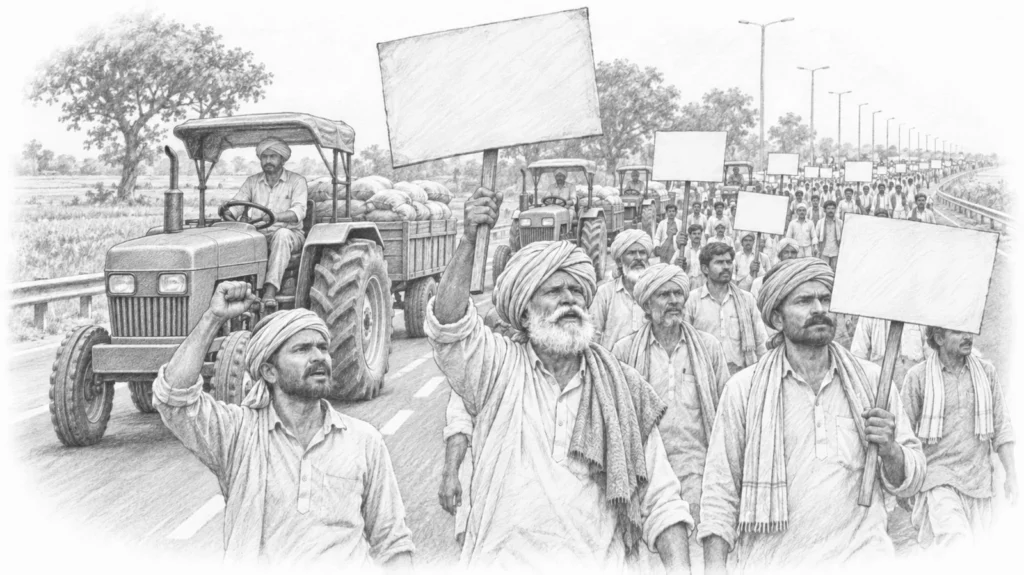
DEMOCRACY IS NOT ONLY about elections and parliaments. Much of the change in independent India has been brought about by people organising outside formal institutions: workers striking for wages, peasants fighting for land, farmers demanding fair prices, villagers hugging trees to save forests, and women campaigning against dowry, rape and discrimination. These are social movements. They raise issues that parties neglect, give voice to the marginalised and often force the state to change laws and policies. In this chapter we study what social movements are and four of the most important kinds in India: workers’, farmers’, environmental and women’s movements.
8.1 Understanding Social Movements
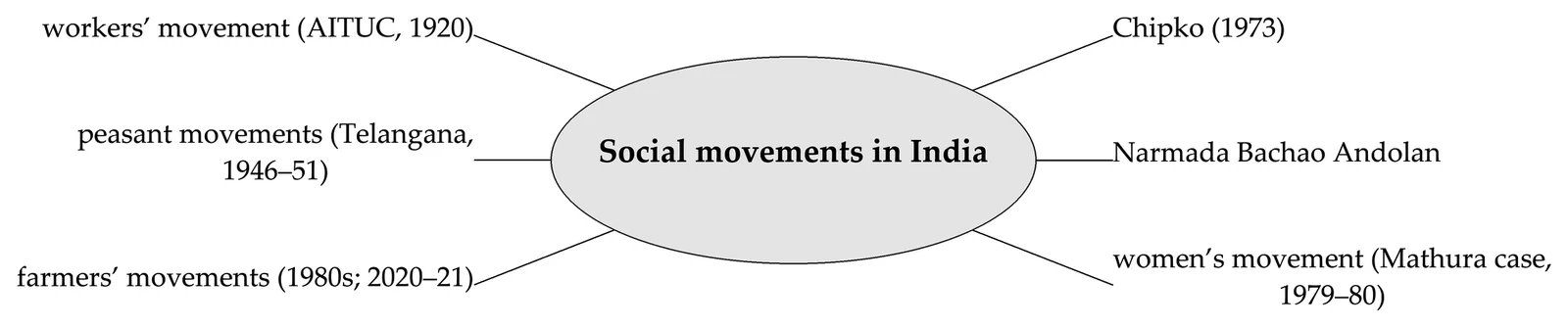
Ghanshyam Shah, in Social Movements in India: A Review of Literature (2004), defines a social movement as a form of collective action with some degree of organisation, a shared ideology and common objectives, which seeks to bring about or resist change in society or the state, usually outside institutional channels such as elections. Movements differ from interest groups, which bargain within the system, and from parties, which seek power. Shah classifies Indian movements by their participants and issues: peasant and farmers’, tribal, Dalit, backward-caste, women’s, students’, middle-class, working-class and environmental movements. Movements may be reformist, seeking change within the system; revolutionary, seeking to overturn it; or revivalist, seeking to restore an imagined past.
Scholars also distinguish old social movements, such as labour and peasant movements, which were based on class and sought economic gains, often through parties, from new social movements (NSMs), which emerged from the 1970s around identity, environment, gender, human rights and quality of life, and which stress autonomy from parties and the state. In India the boundary is blurred, since many ‘new’ movements, like Chipko or the Narmada movement, also concern livelihood and survival (Figure 8.2).
8.2 Workers’ Movement
The working-class movement in India began in the late nineteenth century in the textile mills of Bombay and the jute mills of Bengal. The All India Trade Union Congress was founded in 1920, with Lala Lajpat Rai as its first president, and trade unions became linked with political parties: the INTUC (1947) with the Congress, the CITU (1970) with the CPI(M) and the BMS (1955) with the Jana Sangh and later the BJP. Major struggles included the railway strike of 1974 led by George Fernandes and the Bombay textile strike of 1982–83 led by Datta Samant, whose failure marked the decline of the mill unions. After 1991, as Chapter 4 showed, informalisation and contract labour weakened organised labour. Over 90 per cent of workers are in the unorganised sector, where unionisation is difficult. Yet unions continue to organise nationwide strikes against privatisation and the new labour codes, and new groups such as scheme workers and platform workers have begun to organise.
8.3 Farmers’ and Peasant Movements
A. Desai: agrarian struggles after independence
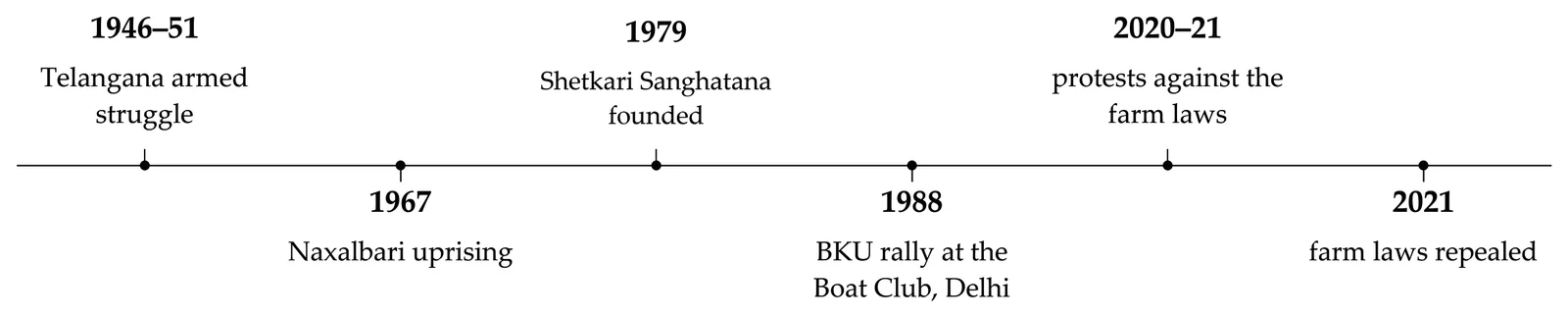
A.R. Desai, in his introduction to Agrarian Struggles in India After Independence (1986), argued that independence did not end agrarian conflict, because the state’s policies favoured the landed classes and led to capitalist development in agriculture. He distinguished two kinds of struggles. The first were struggles of poor peasants, tenants and landless labourers against landlords and the state, for land, fair wages and against eviction, such as the Telangana armed struggle (1946–51) against the Nizam and landlords, the Tebhaga movement of sharecroppers in Bengal (1946–47) and the Naxalbari uprising (1967), which gave rise to the Naxalite movement. The second were struggles of rich and middle farmers, who had gained from the Green Revolution, against the state, for higher prices, cheaper inputs and loan waivers.
B. The new farmers’ movements
From the late 1970s powerful farmers’ movements emerged: the Shetkari Sanghatana of Sharad Joshi in Maharashtra, which presented the conflict as ‘Bharat versus India’, rural producers exploited by urban India through low prices; the Bharatiya Kisan Union of Mahendra Singh Tikait in western Uttar Pradesh; and the Karnataka Rajya Raitha Sangha of M.D. Nanjundaswamy. D.N. Dhanagare, in his study of the farmers’ movement in Maharashtra (2017), offers a framework for understanding them: they mobilised farmers across caste lines around market and price issues, were led mainly by middle and rich peasants, used populist rhetoric of a united peasantry, and stayed formally outside party politics, though leaders later entered politics. Critics such as Tom Brass argued that their ‘peasant unity’ hid class differences between rich farmers and labourers. The farmers’ protests of 2020–21, led by the Samyukt Kisan Morcha mainly from Punjab, Haryana and western Uttar Pradesh, camped at Delhi’s borders for over a year and forced the government to repeal three farm laws in November 2021.
8.4 Environmental Movements
Environmental movements in India are mostly movements of the poor whose livelihoods depend on forests, rivers and land. Ramachandra Guha and Joan Martinez-Alier called this the environmentalism of the poor. The most important are:
- Chipko (1973): in Chamoli district of Uttarakhand, villagers, many of them women led by figures such as Gaura Devi at Reni, hugged trees to stop commercial felling. Leaders such as Chandi Prasad Bhatt and Sunderlal Bahuguna made it a symbol of ecological protest, and it led to a ban on green felling in the Himalayan forests.
- Silent Valley (late 1970s–1983): scientists, writers and activists in Kerala campaigned against a hydroelectric project that would have flooded a rare rainforest; the project was dropped and the area became a national park.
- Narmada Bachao Andolan (from the late 1980s): led by Medha Patkar, it opposed the Sardar Sarovar dam and other dams on the Narmada, which would displace hundreds of thousands of people, mostly Adivasis. The World Bank withdrew from the project in 1993, though the Supreme Court allowed construction to continue in 2000. The movement raised fundamental questions about who pays for development.
- Other movements: Appiko in Karnataka (1983), and the Dongria Kondh’s struggle at Niyamgiri in Odisha, where in 2013 the Supreme Court allowed gram sabhas to decide on bauxite mining, which they rejected.
These movements contributed to laws such as the Forest Conservation Act (1980), the Environment (Protection) Act (1986) and the Forest Rights Act (2006), which recognised the rights of forest dwellers.
8.5 Women’s Movement
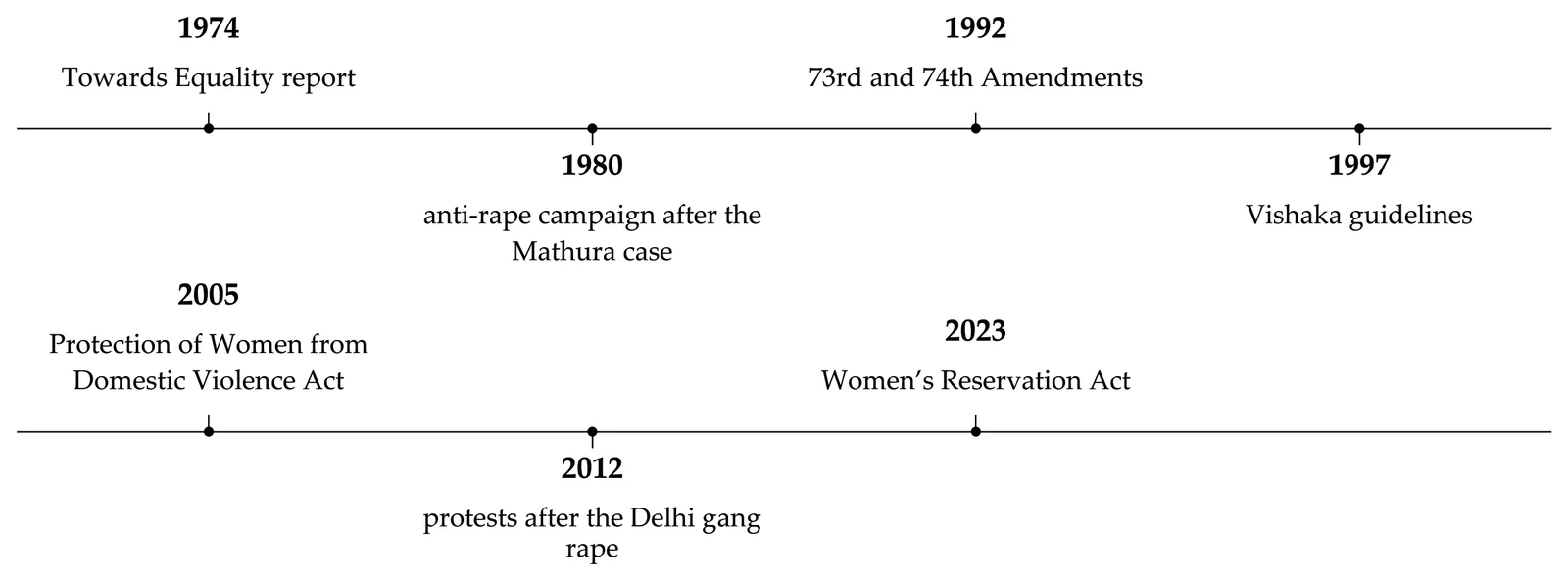
Anupama Roy, in ‘The Women’s Movement’ in the Oxford Companion to Politics in India (2010), traces its phases. In the nineteenth century, social reformers campaigned against sati, child marriage and for widow remarriage and women’s education; in the nationalist period women joined the freedom struggle in large numbers, and organisations such as the All India Women’s Conference (1927) demanded legal rights. After independence the Constitution granted equality and the Hindu Code Bills reformed family law, and the movement was relatively quiet. The report ‘Towards Equality’ (1974) of the Committee on the Status of Women in India showed that women’s position had declined in many respects, and it revived the movement.
From the late 1970s an autonomous women’s movement, independent of parties, campaigned against dowry deaths, against custodial rape after the Mathura case (1979–80), which led to the amendment of rape laws in 1983, against the glorification of sati after Roop Kanwar’s death (1987), and for the rights of women workers through organisations such as SEWA (1972). Rural women led the anti-arrack movement in Andhra Pradesh (1992). The movement achieved the National Commission for Women (1992), reservation in local bodies (1992), the Vishaka guidelines (1997), the Domestic Violence Act (2005) and stronger laws after the Delhi gang rape (2012). Roy also notes the debates within the movement: its relationship with the state, the risks of NGO-isation, and the challenge of difference, since Dalit, Adivasi and Muslim women argued that the movement had been dominated by upper-caste, urban women.
8.6 Important Questions
- Question 1 What are social movements? Discuss the nature of the workers’ movement in India.
- Question 2 Examine the farmers’ and peasant movements in India after independence.
- Question 3 Discuss the nature and significance of environmental movements in India.
- Question 4 Trace the evolution of the women’s movement in India.
DU asks the same idea in different words. So learn one broad answer for each question below; the same answer works for every question joined by OR.
Important Question 1
What are social movements? Discuss the nature of the workers’ movement in India.
OR
Distinguish between old and new social movements.
OR
Examine the classification of social movements in India.
Model Answer
“Educate, agitate, organise.”
— B.R. Ambedkar (1942)
Introduction. Social movements are forms of collective action through which people seek to change society or the state outside formal institutions. In India they have been central to democracy, giving voice to workers, peasants, Dalits, women and the environment.
1. Meaning
Ghanshyam Shah defines a social movement as collective action with some organisation, a shared ideology and common objectives, aimed at bringing about or resisting change, usually through non-institutional means such as protests and campaigns. He set this out in Social Movements in India (2004).
2. Movements, Groups and Parties
Unlike interest groups, which bargain within the system, and parties, which seek power, movements mobilise people to challenge existing arrangements, though they often interact with both. Movements may also become parties, as the anti-corruption movement led to the Aam Aadmi Party (2012).
3. Classification
Shah classifies movements by participants and issues: peasant, tribal, Dalit, backward-caste, women’s, students’, middle-class, working-class and environmental. Movements may be reformist, revolutionary or revivalist. Examples include peasant, tribal, Dalit, women’s, student and environmental movements.
4. Old and New Social Movements
Old movements were class-based and economic; new movements focus on identity, environment, gender and rights, and value autonomy from parties. In India, many new movements also concern livelihood. New movements focus on identity, environment, gender and rights.
5. The Workers’ Movement: Origins
Trade unions began in the mills of Bombay and Bengal; AITUC was founded in 1920, and unions later became attached to parties: INTUC, CITU, BMS and others.
6. Unions and Parties
Major unions are linked to parties, INTUC with the Congress, AITUC and CITU with the communist parties and the BMS with the RSS family, which divided the labour movement.
7. Major Struggles
The railway strike of 1974 and the Bombay textile strike of 1982–83 were landmark struggles; the failure of the latter weakened the textile unions. The Bombay textile strike (1982–83) led by Datta Samant involved about 2.5 lakh workers.
8. The Labour Codes
The four labour codes (2019–20) consolidated labour laws; unions criticised them for weakening protections, while employers welcomed greater flexibility.
9. Decline and Change
After 1991, informalisation, contract labour and privatisation weakened organised labour; most workers are in the unorganised sector. Unions now oppose labour codes and privatisation, while new groups such as gig and scheme workers organise. Union membership fell and strikes declined.
10. Significance
Social movements have widened Indian democracy by raising neglected issues and winning laws and rights, though they face problems of fragmentation, co-optation and repression. They also act as a check on state power.
11. The Anti-Caste Movement
Gail Omvedt traced the anti-caste movement from Jotirao Phule and Ambedkar to the Dalit Panthers (1972) and the Bahujan Samaj Party, showing how it challenged Brahmanical hegemony and created a new discourse of power and dignity for Dalits and lower castes.
12. Women Workers
Movements of domestic workers, anganwadi workers and ASHAs show that women are at the forefront of new labour struggles.
13. Organising the Unorganised
Since most workers are informal, new forms of organising have emerged: SEWA for self-employed women, construction workers’ welfare boards, and campaigns that won the Unorganised Workers’ Social Security Act (2008), as S. Shyam describes.
14. Evaluation
Social movements, including the workers’ movement, have deepened democracy by giving voice to the excluded, though the labour movement has weakened with informalisation and must find new forms of organisation.
Conclusion. Thus, social movements, including the workers’ movement, are a vital part of Indian democracy, carrying the demands of those whom formal politics neglects.
Important Question 2
Examine the farmers’ and peasant movements in India after independence.
OR
Discuss A.R. Desai’s analysis of agrarian struggles after independence.
OR
Analyse the nature of the new farmers’ movements.
Model Answer
“Bharat versus India.”
— Sharad Joshi, slogan of the Shetkari Sanghatana
Introduction. Agrarian struggles have been among the most important social movements in India, where most people still depend on agriculture. They range from the struggles of landless labourers for land to the campaigns of prosperous farmers for better prices.
1. Desai’s Framework
A.R. Desai argued that post-independence policies favoured landed classes and capitalist agriculture, producing two kinds of struggles: of poor peasants and labourers against landlords, and of rich and middle farmers against the state. He edited Peasant Struggles in India (1979) and Agrarian Struggles in India after Independence (1986).
2. Telangana and Tebhaga
The Telangana armed struggle (1946–51) against the Nizam and landlords and the Tebhaga movement of Bengal sharecroppers (1946–47) demanded land and fair shares of crops. Led by the communists, the Telangana struggle redistributed land before the Indian army intervened. Tebhaga demanded two-thirds of the crop for sharecroppers.
3. Naxalbari
The Naxalbari uprising of 1967 in North Bengal launched the Naxalite movement, which continues as Maoist insurgency in tribal areas, raising issues of land, forests and dispossession. Led by Charu Majumdar and Kanu Sanyal, it inspired the Maoist movement. Maoist insurgency later spread to tribal areas of central India.
4. Land Movements
Movements such as Bhoodan (1951) under Vinoba Bhave and later struggles for land by Dalits and Adivasis show that land remains a central issue.
5. The Green Revolution
The Green Revolution created a class of prosperous farmers dependent on markets, inputs and state prices, which became the base of new farmers’ movements. Punjab, Haryana and western Uttar Pradesh benefited most.
6. The New Farmers’ Movements
Shetkari Sanghatana (Sharad Joshi), the BKU (Mahendra Singh Tikait) and the Karnataka Rajya Raitha Sangha mobilised farmers for remunerative prices, cheaper inputs and loan waivers, presenting the conflict as Bharat versus India. They demanded remunerative prices, cheap inputs and loan waivers. They mobilised mainly middle and rich peasants.
7. Bharat versus India
Sharad Joshi described a conflict between rural ‘Bharat’ and urban ‘India’, arguing that the state extracted surplus from agriculture through low prices.
8. Dhanagare’s Analysis
Dhanagare shows that these movements were led by middle and rich peasants, focused on prices and markets, used populist rhetoric of peasant unity and stayed outside parties. Brass argued that this unity hid class divisions. He also wrote Peasant Movements in India, 1920–1950 (1983).
9. The Protests of 2020–21
Farmers led by the Samyukt Kisan Morcha protested at Delhi’s borders for over a year against three farm laws, which the government repealed in November 2021, showing the continuing power of farmers’ movements. The farm laws were repealed in November 2021.
10. The Swaminathan Commission
The National Commission on Farmers (2004–06), chaired by M.S. Swaminathan, recommended a minimum support price fifty per cent above the comprehensive cost of production, a key demand of farmers’ movements.
11. Women Farmers
Women do much of the agricultural work but rarely own land; recent movements have raised women farmers’ demands for recognition and land rights.
12. Farmers’ Organisations
Organisations such as the Bharatiya Kisan Union, Shetkari Sanghatana, the All India Kisan Sabha and the Samyukt Kisan Morcha show the diversity of farmers’ politics, from the left to non-party movements.
13. Evaluation
Agrarian movements have won land reforms in some regions, price support and debt relief, but landless labourers and small farmers often gain less than rich farmers, and agrarian distress continues. They remain powerful in shaping agricultural policy.
14. Farmers’ Demands and the State
Farmers’ movements have focused on the minimum support price, procurement and debt relief. The National Commission on Farmers (Swaminathan Commission, 2004–06) recommended that MSP be at least fifty per cent above the full cost of production, which became a central demand, and the national loan waiver of 2008 responded to agrarian pressure. MSP is announced for over twenty crops each year but effectively procured for only a few.
15. Peasants and Elections
Rural voters are the majority of the electorate, so agrarian issues strongly influence elections and policies such as PM-KISAN (2019).
16. Agrarian Distress
Small holdings, rising costs, debt and price volatility have caused deep agrarian distress, including farmer suicides, which keeps farmers’ movements alive. The NCRB records thousands of farmer suicides every year.
Conclusion. Thus, farmers’ and peasant movements reflect the changing class structure of Indian agriculture, from struggles for land to campaigns over markets and prices.
Important Question 3
Discuss the nature and significance of environmental movements in India.
OR
Write a note on the Chipko movement.
OR
Examine the Narmada Bachao Andolan.
Model Answer
“The earth provides enough to satisfy every man’s needs, but not every man’s greed.”
— M.K. Gandhi (as recorded by Pyarelal)
Introduction. Environmental movements in India are mostly struggles of people whose survival depends on natural resources, against projects that destroy forests, rivers and land. They have raised fundamental questions about the model of development.
1. Environmentalism of the Poor
Guha and Martinez-Alier argued that Indian environmentalism differs from Western environmentalism: it is about livelihood and justice for forest dwellers, fishers and farmers, not only about conservation. They contrasted it with the ‘full-stomach’ environmentalism of the West.
2. The Chipko Movement
From 1973 villagers in Chamoli, many of them women, hugged trees to stop commercial felling. Led by Chandi Prasad Bhatt and Sunderlal Bahuguna, Chipko won a ban on green felling in the Himalayan forests and became a global symbol. Its leaders included Chandi Prasad Bhatt, Sunderlal Bahuguna and Gaura Devi.
3. Appiko and Other Movements
Chipko inspired the Appiko movement in Karnataka (1983), and movements against mining, nuclear plants such as Kudankulam and industrial pollution followed.
4. Silent Valley
A campaign by scientists and activists stopped a hydroelectric project that would have flooded a rare rainforest in Kerala; the area became a national park in the 1980s. The Kerala Sastra Sahitya Parishad led the campaign, and the valley became a national park in 1984.
5. Narmada Bachao Andolan
Led by Medha Patkar, the NBA opposed large dams on the Narmada that would displace Adivasis and farmers, demanding just rehabilitation and questioning big-dam development. The World Bank withdrew in 1993, though the dam was completed. The World Bank withdrew from the Sardar Sarovar project in 1993.
6. Niyamgiri and Forest Rights
At Niyamgiri the Dongria Kondh resisted bauxite mining; in 2013 the Supreme Court let their gram sabhas decide, and they rejected the project. Such struggles contributed to the Forest Rights Act (2006). In 2013 the Supreme Court let the gram sabhas decide, and they rejected mining.
7. Plachimada
In Plachimada, Kerala, villagers led by Mylamma forced a Coca-Cola bottling plant to close in 2004 over the depletion of groundwater.
8. Climate Activism
Climate change has created new forms of activism, from youth climate strikes to campaigns against air pollution in Delhi.
9. Methods
Movements have used Gandhian non-violence, satyagraha, padyatras, fasts, litigation and international campaigns. Public interest litigation was also used.
10. Courts and the Environment
The Supreme Court, through cases brought by M.C. Mehta, and the National Green Tribunal (2010) have become important arenas for environmental struggles.
11. Significance
They have influenced laws, made displacement and rehabilitation political issues, and given voice to Adivasis and women. They contributed to laws such as the Forest Rights Act (2006) and the land acquisition law of 2013.
12. Limitations
Many struggles have failed to stop projects; they face accusations of being anti-development, and their gains are often undermined by weak implementation.
13. Ecofeminism and Its Critics
Vandana Shiva’s Staying Alive (1988) presented Chipko as an ecofeminist movement, arguing that women have a special closeness to nature. Bina Agarwal (1998) criticised this as essentialist and proposed feminist environmentalism: women’s concern for forests arises from their material position, their responsibility for fuel, fodder and water and their lack of property, not from an innate bond with nature.
14. Environment versus Development
Environmental movements are often accused of opposing development. They reply that they oppose a pattern of development that displaces the poor and degrades resources, and they call for sustainable and just alternatives.
15. Evaluation
Environmental movements in India link ecology with livelihood and justice and challenge the dominant model of development; they have changed laws and debates even when they could not stop projects.
Conclusion. Thus, environmental movements have challenged India to make development sustainable and just for those who bear its costs.
Important Question 4
Trace the evolution of the women’s movement in India.
OR
Discuss the achievements and challenges of the women’s movement in India.
Model Answer
“To call woman the weaker sex is a libel; it is man’s injustice to woman.”
— M.K. Gandhi, Young India (1930)
Introduction. The women’s movement in India has a long history, from nineteenth-century social reform to the autonomous feminist movement of recent decades. Anupama Roy shows how it has changed with the state and society and how it has transformed laws and debates about gender.
1. Social Reform
Reformers such as Raja Rammohan Roy and Ishwar Chandra Vidyasagar campaigned against sati and for widow remarriage, while Savitribai Phule and Pandita Ramabai worked for women’s education. Jyotirao and Savitribai Phule opened schools for girls from 1848. Pandita Ramabai and Tarabai Shinde were early women reformers and writers.
2. The Nationalist Phase
Women joined the freedom struggle in large numbers, and organisations such as the All India Women’s Conference (1927) demanded legal and political rights. The All India Women’s Conference (1927) campaigned for education and legal reform. Sarojini Naidu became Congress president in 1925.
3. After Independence
The Constitution granted equality and the Hindu Code Bills reformed family law, but the movement was quiet until the report ‘Towards Equality’ (1974) revealed women’s declining position. The Hindu Code laws (1955–56) gave women rights in marriage, divorce and inheritance.
4. Towards Equality
The Committee on the Status of Women in India’s report Towards Equality (1974) revealed declining sex ratios and women’s disadvantage, sparking the modern movement.
5. The Autonomous Women’s Movement
From the late 1970s groups independent of parties campaigned against dowry deaths, custodial rape after the Mathura case, sati after Roop Kanwar, and for women workers through SEWA. The Mathura custodial rape case and dowry deaths sparked protests.
6. Achievements
The movement won the 1983 rape law amendment, the National Commission for Women (1992), local reservation, the Vishaka guidelines, the Domestic Violence Act (2005) and stronger laws after 2012. The Domestic Violence Act (2005) and the criminal law amendments of 2013 after the Delhi gang rape were later gains.
7. Campaigns against Violence
Campaigns against dowry, rape, acid attacks and sexual harassment, including the MeToo movement of 2018, have changed laws and public debate.
8. Rural and Grassroots Struggles
The anti-arrack movement of Andhra Pradesh, self-help groups and women in panchayats show the movement’s spread beyond cities. SEWA, founded by Ela Bhatt in 1972, organised self-employed women.
9. Dalit Women’s Movements
The National Federation of Dalit Women (1995) and Dalit feminist writers argued that mainstream feminism had ignored caste.
10. Women in Panchayats
Reservation in panchayats since 1993 has made lakhs of women local leaders, giving the movement a new base.
11. Debates and Challenges
Roy notes debates on the relationship with the state, NGO-isation, and difference, since Dalit, Adivasi and Muslim women criticised the dominance of upper-caste, urban women. Debates also concern caste, sexuality and the inclusion of Dalit and Muslim women.
12. Women and Work
Women’s low labour force participation, unpaid care work and unequal wages are central concerns of the contemporary movement.
13. Alliances with LGBTQ Movements
The movement has increasingly allied with LGBTQ activists, who won the decriminalisation of homosexuality in 2018.
14. Global Links
The movement has linked with global feminism through CEDAW, which India ratified in 1993, and the Beijing Platform for Action (1995).
15. Evaluation
The women’s movement has transformed laws and public awareness, though violence, inequality and low representation persist. Its challenge is to address the needs of all women across caste, class and religion.
16. Political Representation
The women’s movement campaigned for reservation in legislatures; the Women’s Reservation Bill, first introduced in 1996, finally became the 106th Amendment in 2023. Debates over a sub-quota for OBC women showed the tension between gender and caste justice. Women’s groups campaigned for it from 1996 to 2023.
17. The Women’s Reservation Act
The long campaign for reservation in legislatures succeeded with the 106th Amendment (2023).
18. Personal Law and Minority Women
The Shah Bano case (1985) and the triple talaq judgment (2017) raised the question of how to secure gender justice for minority women without undermining minority rights, a difficult issue for the movement and for secularism. The triple talaq judgment (2017) followed petitions by Muslim women.
Conclusion. Thus, the women’s movement has made gender justice a central issue of Indian democracy, while learning to include the voices of all women.
Short Notes
(a) Chipko movement
A forest protection movement that began in 1973 in Chamoli district of Uttarakhand, in which villagers, especially women, hugged trees to prevent commercial felling. Associated with Gaura Devi, Chandi Prasad Bhatt and Sunderlal Bahuguna, it led to a ban on green felling in the Himalayas and inspired environmental movements worldwide.
(b) ‘Towards Equality’ report (1974)
The report of the Committee on the Status of Women in India, which found that women’s position had declined in many respects since independence, with falling sex ratios, low participation in work and politics and continuing discrimination. It revived the women’s movement and shaped women’s studies in India.
More notes: MDSC-2A Indian Government and Politics
- Indian Constitution: basic features, debates on Fundamental Rights, Directive Principles and Federalism
- State formation and nation building: Integration of princely states, linguistic re-organisation of states
- Political institutions at the Centre and State levels: Parliament, Judiciary, Prime Minister, Chief Minister
- Social structure and political power: caste, class, gender
- Religion and politics: debates on secularism and communalism
- Political parties and party systems
- Development strategies: planned economy, neo-liberal restructuring
- The nature of state in India: developmental, welfare, regulatory
These notes are prepared by PADHO TO AISE for study help. They are not an official University of Delhi publication.