
Semester II MDSC-2A Indian Government and Politics
Unit II · 19 min read · Updated 24 Nov 2026
As per the University of Delhi (DU) BA (Hons) Political Science syllabus
Contents
- 2.1 State Formation and Nation Building after 1947
- 2.2 Integration of Princely States
- 2.3 Linguistic Re-organisation of States
- 2.4 Important Questions
- Discuss the process of the integration of princely states into the Indian Union.
- Examine the linguistic reorganisation of states in India.
- Discuss the challenges of state formation and nation building in India after independence.
- Short Notes
आधी रात के समय, जब दुनिया सो रही होगी, भारत जीवन और स्वतंत्रता के लिए जागेगा।
At the stroke of the midnight hour, when the world sleeps, India will awake to life and freedom.
— Jawaharlal Nehru, Tryst with Destiny, 14–15 August 1947
IN AUGUST 1947 India became independent, but it was not yet a single, settled state. Partition had divided the country and uprooted millions; more than five hundred princely states, covering about two-fifths of its territory, were legally free to choose their future; and the provinces inherited from British rule cut across the boundaries of language and culture. The new leadership had to do two things at once: state formation, establishing the authority and territorial unity of the new state, and nation building, creating among diverse peoples a shared sense of belonging to India. In this chapter we study these twin processes through two great achievements of the early years: the integration of the princely states and the linguistic reorganisation of states.
2.1 State Formation and Nation Building after 1947
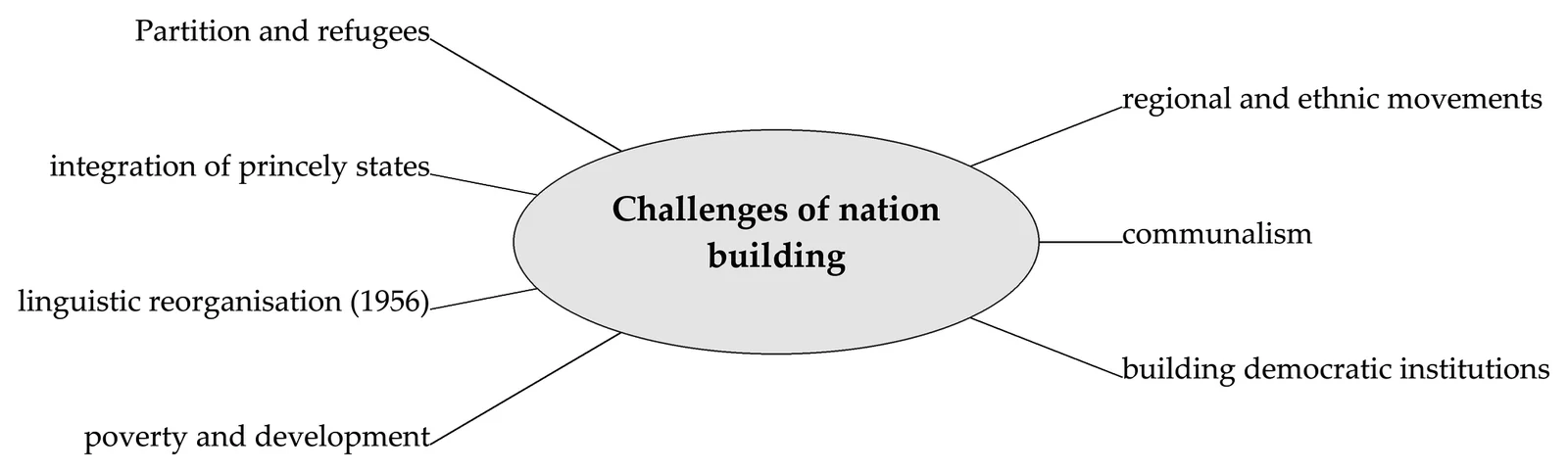
State formation is the process of establishing a state’s authority over a defined territory through institutions such as the army, the administration, courts and a constitution. Nation building is the process of creating among the people a common identity and loyalty to that state. In Europe these processes took centuries; in India they had to be achieved at once and democratically. Bipan Chandra, Aditya Mukherjee and Mridula Mukherjee, in India Since Independence, describe the challenges the new state faced: the violence and refugee crisis of Partition; the integration of the princely states; the demands of linguistic and regional groups; communal tensions; poverty and underdevelopment; and the need to build democratic institutions in a largely illiterate society.
The leadership chose a distinctive path. Instead of imposing a single language, religion or culture, it sought unity in diversity: a democratic, secular and federal state that would accommodate differences while building national institutions. Constitution-making, the integration of the states and the reorganisation of provinces went on together, so that the new nation was built through consent and negotiation as much as through state power.
2.2 Integration of Princely States
A. The problem
The princely states were ruled by Indian princes under British paramountcy, the supreme power of the British Crown. They varied enormously, from large states such as Hyderabad, Kashmir and Mysore to tiny estates of a few villages. The Indian Independence Act, 1947 declared that paramountcy would lapse on 15 August, which meant that, legally, each state was free to join India, join Pakistan or remain independent. Several rulers, encouraged by some British officials, dreamed of independence. If they had succeeded, India would have been broken into many pieces.
B. Patel, Menon and the Instrument of Accession
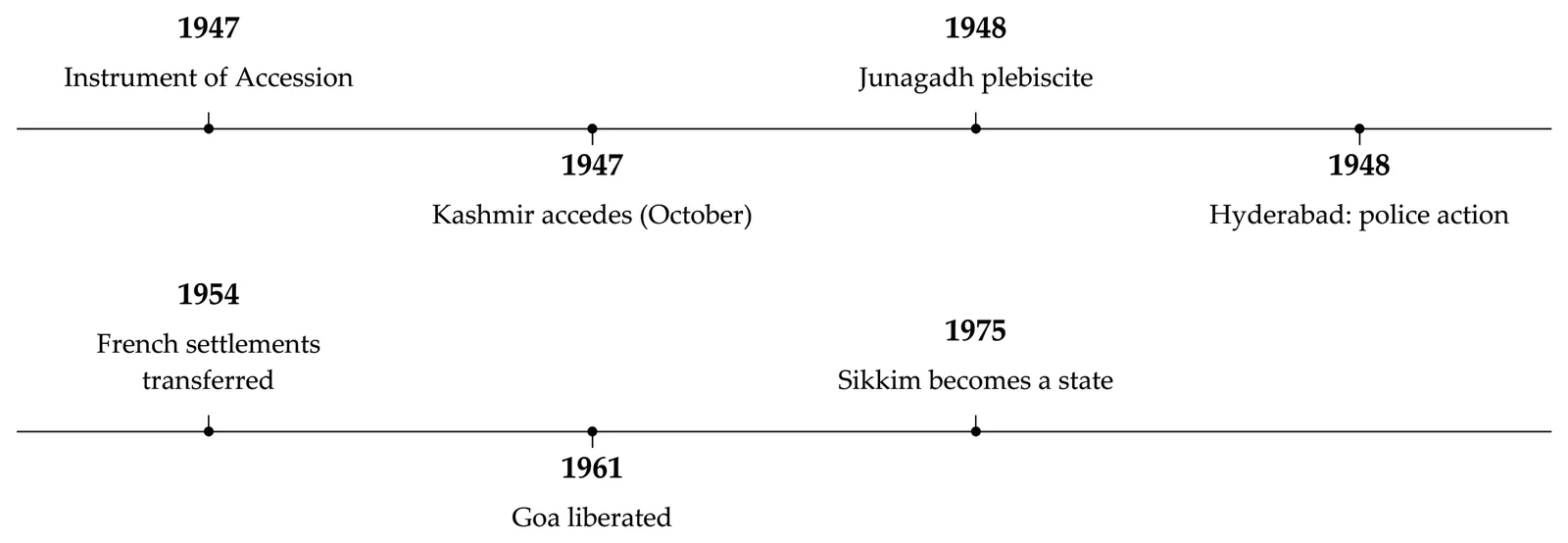
In July 1947 the States Department was set up under Sardar Vallabhbhai Patel, with V.P. Menon as its Secretary. Patel appealed to the princes’ patriotism, saying it was better to make laws together as friends than treaties as aliens, while making clear that the people of the states would not tolerate separation. Menon devised a simple Instrument of Accession, under which a state surrendered only three subjects, defence, external affairs and communications, to the Union, together with a Standstill Agreement to continue existing arrangements. Lord Mountbatten persuaded the rulers to sign. By 15 August 1947 almost all the states within India’s borders had acceded, except Junagadh, Hyderabad and Kashmir (Figure 2.2).
C. The three difficult cases
- Junagadh: the Muslim ruler of this Hindu-majority state in Kathiawar acceded to Pakistan. The people revolted, the Nawab fled, Indian forces moved in, and a plebiscite in February 1948 voted overwhelmingly for India.
- Hyderabad: the Nizam of the largest princely state wanted independence. He signed a Standstill Agreement in November 1947 but allowed the Razakars, a militia led by Qasim Razvi, to terrorise the people, while a powerful peasant struggle raged in Telangana. In September 1948 the Indian army entered in a ‘police action’ (Operation Polo), and the state was integrated.
- Kashmir: Maharaja Hari Singh delayed his decision. When tribal raiders backed by Pakistan invaded in October 1947, he signed the Instrument of Accession on 26 October; Indian troops were flown in, and India referred the matter to the United Nations in January 1948. Special status was later given under Article 370, which was abrogated in 2019.
D. From accession to integration
Accession was only the first step. In a second stage, the states were merged with neighbouring provinces or grouped into larger unions, such as Saurashtra, Rajasthan, Madhya Bharat, PEPSU and Travancore-Cochin, and their administrations were democratised. In return, the rulers received privy purses and kept their titles and personal property. The Constitution of 1950 listed the former states as Part B states, headed by Rajpramukhs; this category was abolished by the reorganisation of 1956, and privy purses were abolished by the 26th Amendment (1971). French possessions such as Pondicherry were transferred from 1954, Portuguese Goa was liberated in 1961, and Sikkim became a state in 1975.
E. The cost and the achievement
V.P. Menon, in The Story of the Integration of the Indian States (1956), described the cost of integration: the privy purses and the burden of reorganising backward administrations. But he argued that the gains were immense: a unified territory, the end of princely autocracy, the extension of democracy to millions of subjects and the elimination of a threat to India’s unity. The integration of more than five hundred states, largely without bloodshed and within two years, was one of the greatest achievements of the new state, and earned Patel the title of the ‘Iron Man of India’.
2.3 Linguistic Re-organisation of States
A. The background
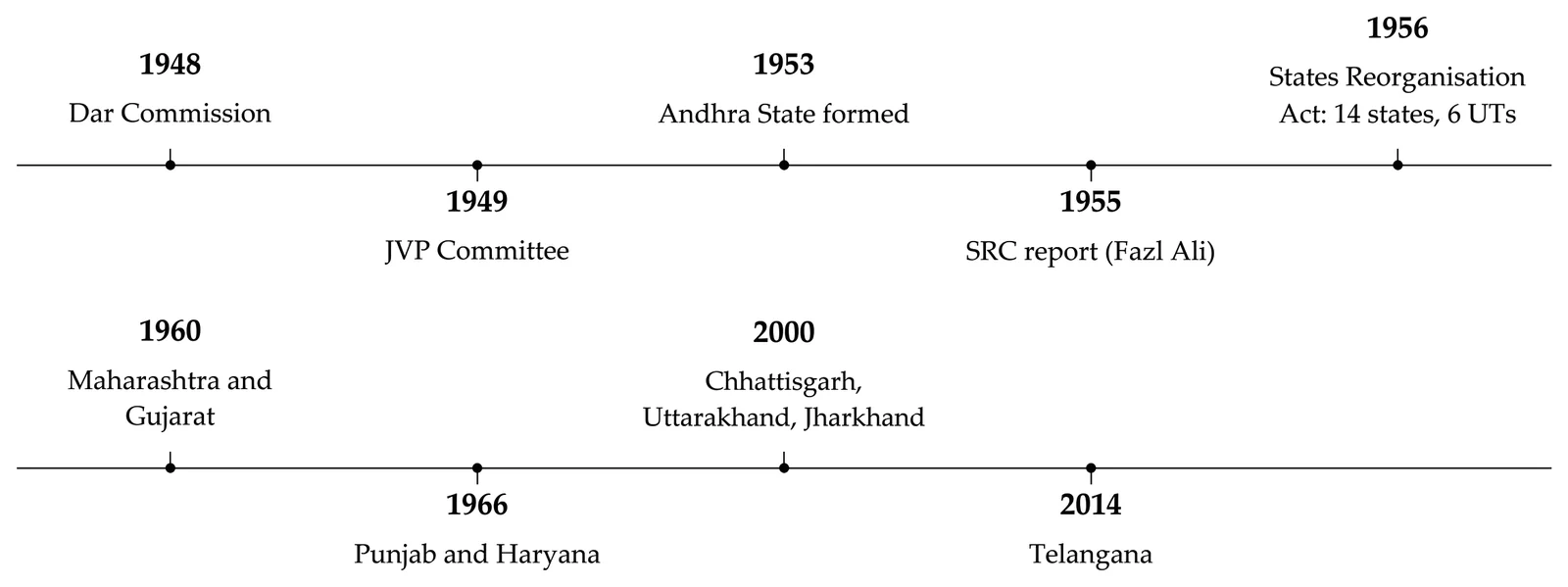
The provinces of British India had been formed for administrative convenience, not according to language. The Congress had accepted the idea of linguistic provinces as early as its Nagpur session (1920), when it reorganised its own provincial committees on linguistic lines. After independence, however, leaders such as Nehru and Patel hesitated: Partition had shown the dangers of dividing the country on the basis of identity, and they feared that linguistic states would weaken national unity. The Dar Commission (1948) advised against linguistic reorganisation, and the JVP Committee (Jawaharlal Nehru, Vallabhbhai Patel and Pattabhi Sitaramayya, 1949) recommended postponing it, warning that language could divide as well as unite.
B. The Andhra movement and the SRC
Popular movements forced the issue. Telugu speakers demanded a separate Andhra state from the Madras Presidency. In October 1952 Potti Sriramulu, a Gandhian leader, began a fast unto death; his death on 15 December 1952 led to widespread protests, and the government announced the creation of Andhra State, formed on 1 October 1953. The government then appointed the States Reorganisation Commission (SRC), headed by Fazl Ali with H.N. Kunzru and K.M. Panikkar. Its report (1955) accepted language as an important basis for reorganisation but also stressed national unity, administrative and economic viability, and the welfare of the people. The States Reorganisation Act, 1956 created 14 states and 6 union territories (Figure 2.3).
C. Later reorganisations
- Bombay: the SRC left Bombay as a bilingual state; the Samyukta Maharashtra movement and the Mahagujarat movement led to the creation of Maharashtra and Gujarat in 1960.
- Punjab: the Punjabi Suba movement led to the division of Punjab into Punjab and Haryana in 1966, with some hill areas joining Himachal Pradesh.
- The North-East: Nagaland (1963), Meghalaya, Manipur and Tripura (1972), and Mizoram and Arunachal Pradesh (1987) became states, reflecting tribal and ethnic identities.
- New states for development: Chhattisgarh, Uttarakhand and Jharkhand were created in 2000, and Telangana in 2014, on grounds of regional identity, backwardness and administrative convenience.
D. Evaluation
Many feared that linguistic states would lead to the break-up of India. Bipan Chandra and his co-authors argue that the opposite happened: by satisfying a legitimate democratic demand, linguistic reorganisation removed a major source of grievance, made administration more accessible in the people’s own language, and strengthened the Union. Language did not become a basis for secession, except in a few cases where other factors were involved. The related question of a national language was settled by compromise: Hindi became the official language of the Union, English was continued (Official Languages Act, 1963) after protests, especially the anti-Hindi agitation in Tamil Nadu (1965), and the three-language formula was adopted in education. Critics note that linguistic states could not satisfy every group, and that new demands based on region, tribe and development continue to arise.
2.4 Important Questions
- Question 1 Discuss the process of the integration of princely states into the Indian Union.
- Question 2 Examine the linguistic reorganisation of states in India.
- Question 3 Discuss the challenges of state formation and nation building in India after independence.
DU asks the same idea in different words. So learn one broad answer for each question below; the same answer works for every question joined by OR.
Important Question 1
Discuss the process of the integration of princely states into the Indian Union.
OR
Examine the role of Sardar Patel and V.P. Menon in the integration of princely states.
OR
Discuss the integration of Junagadh, Hyderabad and Kashmir.
Model Answer
“It is better for us to make laws sitting together as friends than to make treaties as aliens.”
— Sardar Vallabhbhai Patel, appeal to the princes (July 1947)
Introduction. At independence about 565 princely states, covering two-fifths of India’s territory, became legally free when British paramountcy lapsed. Their integration into the Indian Union, achieved within two years under Sardar Patel and V.P. Menon, was central to the formation of the Indian state.
1. The Problem of the Princely States
The states were ruled by princes under British paramountcy. The Indian Independence Act ended paramountcy, leaving each ruler free to join India or Pakistan or stay independent. Some, such as Travancore and Hyderabad, hoped for independence, which threatened to fragment India. There were over five hundred states, from large ones like Hyderabad and Kashmir to tiny estates.
2. The States Department
Set up in July 1947 under Patel, with Menon as Secretary, the Department combined persuasion and pressure. Patel appealed to the rulers’ patriotism and warned that their people would not accept separation. Patel appealed to the princes’ patriotism while warning them of the consequences of refusal.
3. Mountbatten’s Role
Lord Mountbatten told the princes that independence was not practical and urged them to accede, supporting Patel’s efforts.
4. Instrument of Accession and Standstill Agreement
States acceded on only three subjects, defence, external affairs and communications, and signed Standstill Agreements to continue existing arrangements. Mountbatten persuaded most rulers, and nearly all acceded by 15 August 1947. The standstill agreement kept existing arrangements in place until new ones were made.
5. Hesitant Rulers
Some rulers, such as those of Travancore and Bhopal, hesitated at first, but most acceded by 15 August 1947 after persuasion.
6. Junagadh
The Nawab acceded to Pakistan though most subjects were Hindu. After a popular revolt and Indian intervention, a plebiscite in February 1948 confirmed accession to India. A plebiscite in February 1948 confirmed accession to India.
7. Hyderabad
The Nizam sought independence, while the Razakars terrorised the people and the Telangana peasant struggle spread. In September 1948 the ‘police action’ integrated Hyderabad into India. Police action, ‘Operation Polo’, in September 1948 ended the Nizam’s resistance.
8. Kashmir
When Pakistani-backed raiders invaded in October 1947, Maharaja Hari Singh acceded to India on 26 October. Indian troops defended the state, and India took the issue to the UN. Article 370 gave special status, abrogated in 2019. India referred the issue to the United Nations in January 1948. Maharaja Hari Singh signed the Instrument of Accession on 26 October 1947.
9. Merger and Democratisation
States were merged into provinces or grouped into unions, their administrations democratised, and rulers given privy purses, which were abolished in 1971. Pondicherry (from 1954), Goa (1961) and Sikkim (1975) joined later. Rulers received privy purses, which the 26th Amendment abolished in 1971. Rajpramukhs were appointed as heads of the new unions of states.
10. Integration as Nation-Building
Integration created a single political and administrative map of India, brought democratic institutions to the former states and prepared the ground for later reorganisation.
11. Significance
Menon acknowledged the costs of integration but emphasised its gains: territorial unity, the end of princely autocracy and the extension of democracy. It was a largely peaceful revolution that laid the foundation of the Indian state. V.P. Menon’s The Story of the Integration of the Indian States (1956) describes the process.
12. The People of the States
Integration was not only the work of leaders. The All India States People’s Conference (1927) and Praja Mandal movements had long demanded democracy and union with India, and popular agitations in states such as Travancore, Junagadh and Hyderabad put pressure on rulers. Mountbatten’s persuasion of the princes also helped secure accession before 15 August. The All India States People’s Conference demanded responsible government in the states.
13. Evaluation
The integration of the princely states was one of the great achievements of the early Indian state, combining diplomacy, pressure and occasional force, though it left the Kashmir question unresolved.
Conclusion. Thus, the integration of the princely states, combining diplomacy, firmness and democratic incorporation, was one of the founding achievements of independent India.
Important Question 2
Examine the linguistic reorganisation of states in India.
OR
Discuss the role of the States Reorganisation Commission.
OR
Did linguistic reorganisation strengthen or weaken Indian unity? Discuss.
Model Answer
“Language was not only a binding force but also a separating one.”
— JVP Committee Report (1949)
Introduction. The reorganisation of states on the basis of language was one of the most important exercises in Indian nation building. It turned a popular democratic demand into a lasting federal arrangement and, contrary to early fears, strengthened the unity of the country.
1. Background
British provinces ignored language. The Congress accepted linguistic provinces in 1920, but after Partition leaders feared that language-based states would encourage separatism. The Nagpur Congress of 1920 created Pradesh Congress Committees on linguistic lines.
2. Dar Commission and JVP Committee
The Dar Commission (1948) rejected linguistic reorganisation, and the JVP Committee (1949) advised postponing it, emphasising security and unity. The JVP Committee (Jawaharlal Nehru, Vallabhbhai Patel and Pattabhi Sitaramayya) feared that linguistic states would weaken unity after Partition.
3. The Andhra Movement
Potti Sriramulu’s fast unto death and death in December 1952 led to mass protests and the creation of Andhra State on 1 October 1953, the first linguistic state. Andhra State was created on 1 October 1953.
4. The States Reorganisation Commission
The SRC (Fazl Ali, Kunzru, Panikkar) reported in 1955 that language was an important basis for states but must be balanced with national unity, administrative and economic viability and people’s welfare. It also weighed administrative and economic factors.
5. The 1956 Act
The States Reorganisation Act created 14 states and 6 union territories and abolished the earlier categories of Part A, B and C states.
6. The Bombay Question
The Samyukta Maharashtra movement for a Marathi state including Bombay, and the Mahagujarat movement, led to violent protests before the bilingual Bombay state was divided in 1960.
7. Later Reorganisations
Maharashtra and Gujarat (1960), Punjab and Haryana (1966), the North-Eastern states (1963–87), and Chhattisgarh, Uttarakhand, Jharkhand (2000) and Telangana (2014) followed, increasingly on grounds of tribal identity and development. Telangana (2014) was formed on grounds of regional development rather than language.
8. Language and Democracy
Linguistic states allowed administration, education and politics in the people’s own languages, widening participation by those who knew neither English nor Hindi.
9. Unity and Division
Bipan Chandra and others argue that reorganisation removed a major grievance, brought administration closer to people in their own language and strengthened the Union; it did not lead to secession. Language policy, with Hindi as official language, English continued and the three-language formula, completed the compromise.
10. Limitations
Linguistic states left linguistic minorities within each state, disputes over borders (such as Belagavi) and river waters, and new demands based on region and backwardness. The Eighth Schedule now lists twenty-two languages.
11. Language Policy
Article 343 made Hindi in Devanagari the official language of the Union, with English to continue for fifteen years. Fears of Hindi imposition led to the Official Languages Act (1963), which allowed English to continue, and to violent anti-Hindi protests in Tamil Nadu in 1965. The three-language formula and the recognition of twenty-two languages in the Eighth Schedule reflect a policy of linguistic pluralism. The Official Languages Act (1963) allowed English to continue.
12. The Smaller States Debate
Supporters of smaller states argue that they improve governance, development and representation, as claimed for Uttarakhand and Telangana. Critics fear endless demands, such as Gorkhaland, Vidarbha and Bodoland, and question the viability of very small states. Supporters cite Uttarakhand and Chhattisgarh; critics point to instability in Jharkhand.
13. Evaluation
Linguistic reorganisation, at first feared as divisive, strengthened Indian unity by accommodating diversity, though minority languages and regional disparities remain continuing issues.
Conclusion. Thus, linguistic reorganisation showed that accommodating diversity can strengthen national unity. It remains a model of democratic nation building.
Important Question 3
Discuss the challenges of state formation and nation building in India after independence.
OR
How did India consolidate itself as a nation after 1947?
OR
Examine the relationship between state formation and nation building in India.
Model Answer
“The unity of India was no longer merely an intellectual conception for me: it was an emotional experience which overpowered me.”
— Jawaharlal Nehru, The Discovery of India (1946)
Introduction. State formation means establishing authority over a territory; nation building means creating a shared identity among its people. In India both had to be achieved simultaneously after 1947, and democratically, in a society of immense diversity.
1. The Legacy of Partition
Partition displaced millions and caused large-scale communal violence. Rehabilitating refugees and restoring trust between communities were the first tasks of the new state. Rehabilitating refugees became a huge administrative task.
2. Territorial Integration
Over five hundred princely states had to be brought into the Union. Patel and Menon achieved this through the Instrument of Accession and later merger, with Junagadh, Hyderabad and Kashmir as difficult cases. French and Portuguese territories were integrated later, Goa in 1961.
3. Constitution-Making
The Constituent Assembly created a democratic, secular and federal framework, with universal adult franchise, Fundamental Rights and safeguards for minorities, making the Constitution a central instrument of nation building. The Constitution came into force on 26 January 1950. Ambedkar chaired its Drafting Committee.
4. Linguistic Diversity
Popular movements forced the reorganisation of states on linguistic lines (1953–56), and language policy settled the role of Hindi and English, accommodating diversity within unity. The anti-Hindi agitation in Tamil Nadu (1965) led to the continued use of English.
5. Communalism and Secularism
The assassination of Gandhi (1948) and communal violence tested the commitment to secularism; the state chose equal respect for all religions and protection of minorities. Nehru insisted on a secular state despite Partition.
6. Regional and Tribal Movements
Movements in the North-East, Punjab and elsewhere demanded autonomy or new states; the state responded with a mix of accommodation, special provisions and force. Nagaland (1963), Meghalaya and other states were created to accommodate them.
7. Democracy as Nation-Building
Universal adult franchise and regular elections gave all citizens a stake in the nation and channelled conflicts into peaceful competition.
8. Social Justice
Reservations for Scheduled Castes and Tribes and the abolition of untouchability aimed to include historically excluded groups in the nation.
9. Economic Development
Planning, land reforms and industrialisation aimed to give citizens a stake in the nation by reducing poverty and inequality. The Planning Commission (1950) and Five-Year Plans guided development.
10. Non-Alignment
Non-alignment allowed India to protect its independence and concentrate on development during the Cold War.
11. Unity in Diversity
India accepted diversity of language, religion and region within a common citizenship, in contrast to models that sought a single national culture. The three-language formula in education reflected this approach.
12. Kashmir and Punjab
Insurgencies in Punjab and Kashmir in the 1980s and 1990s tested the Indian state, which combined force, negotiation and elections to restore order.
13. India’s Distinctive Path
Chandra and his co-authors argue that India built a nation through democracy, federalism, secularism and accommodation, not through the imposition of one language or religion, and that this explains its survival despite predictions of break-up.
14. Integrating the North-East
The North-East posed special challenges. The Naga National Council under A.Z. Phizo demanded independence, and Mizo insurgency followed in 1966. The state combined military action with accommodation: the Sixth Schedule’s autonomous councils, new states such as Nagaland (1963), and accords such as the Mizo Accord (1986). The Mizo Accord (1986) ended a long insurgency.
15. Institutions of Nation Building
The first general election (1951–52), conducted by the Election Commission with universal adult franchise, the all-India services, planning and Parliament itself became institutions that bound citizens to the new nation. The All India Services and an integrated judiciary also bound the nation together.
16. Evaluation
India’s state formation and nation building succeeded remarkably in preserving unity and democracy amid great diversity and poverty, though communalism, regional inequality and insurgency remain challenges.
Conclusion. Thus, state formation and nation building in India went hand in hand. Integration, constitution-making and reorganisation created a state that holds together a diverse people by recognising their differences.
Short Notes
(a) Instrument of Accession
The legal document, devised by V.P. Menon in 1947, by which a princely state acceded to the Indian Dominion, transferring control over defence, external affairs and communications. It was accompanied by a Standstill Agreement continuing existing arrangements. Maharaja Hari Singh signed it for Kashmir on 26 October 1947.
(b) Privy purses
Annual payments guaranteed to former rulers of princely states in return for their accession and merger, along with their titles and privileges. Seen as incompatible with equality, they were abolished by the 26th Amendment (1971) after a presidential order of 1970 was struck down by the Supreme Court.
More notes: MDSC-2A Indian Government and Politics
- Indian Constitution: basic features, debates on Fundamental Rights, Directive Principles and Federalism
- Political institutions at the Centre and State levels: Parliament, Judiciary, Prime Minister, Chief Minister
- Social structure and political power: caste, class, gender
- Religion and politics: debates on secularism and communalism
- Political parties and party systems
- Development strategies: planned economy, neo-liberal restructuring
- Social movements: workers, farmers, environmental, and women’s movements
- The nature of state in India: developmental, welfare, regulatory
These notes are prepared by PADHO TO AISE for study help. They are not an official University of Delhi publication.