
Semester II MDSC-2A Indian Government and Politics
Unit I · 21 min read · Updated 24 Nov 2026
As per the University of Delhi (DU) BA (Hons) Political Science syllabus
Contents
- 1.1 The Making and Basic Features of the Constitution
- 1.2 Debates on Fundamental Rights
- 1.3 Directive Principles of State Policy
- 1.4 Federalism
- 1.5 Important Questions
- Discuss the basic features of the Indian Constitution.
- Examine the debates on Fundamental Rights and their relationship with the Directive Principles.
- Is India a federation? Discuss the nature of Indian federalism.
- Short Notes
26 जनवरी 1950 को हम विरोधाभासों के जीवन में प्रवेश करने जा रहे हैं। राजनीति में हमारे पास समानता होगी और सामाजिक व आर्थिक जीवन में असमानता।
On the 26th of January 1950, we are going to enter into a life of contradictions. In politics we will have equality and in social and economic life we will have inequality.
— B.R. Ambedkar, Constituent Assembly, 25 November 1949
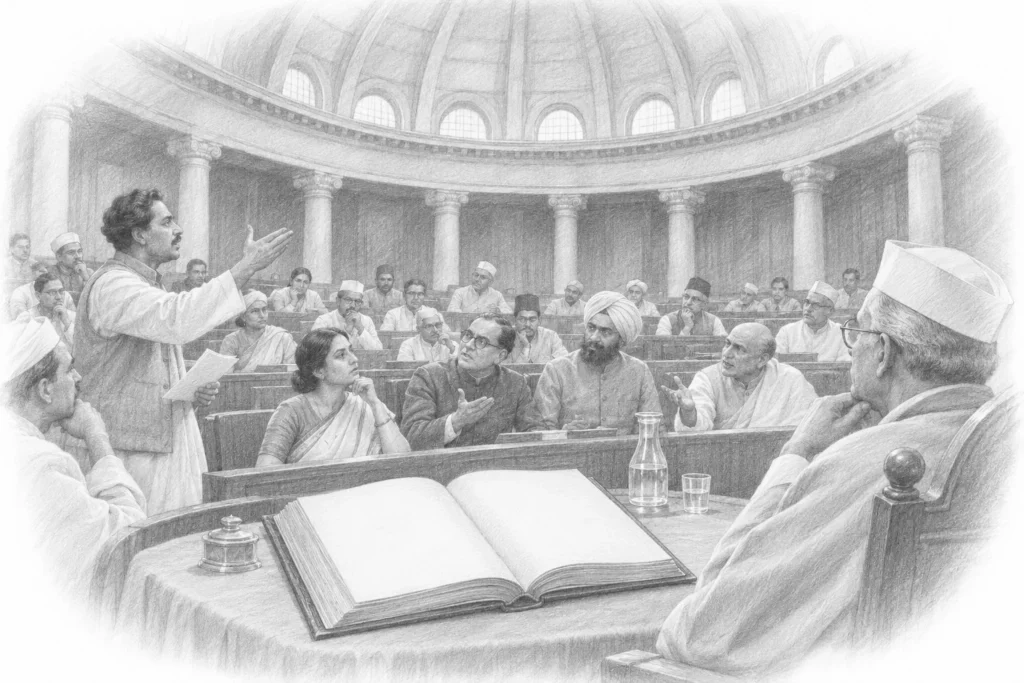
THE CONSTITUTION OF INDIA is the foundation of the Indian Republic. It was written by a Constituent Assembly between December 1946 and November 1949, at a time of partition, communal violence and deep poverty, and came into force on 26 January 1950. Its makers wanted it to do three things at once: hold together a vast and diverse country, establish democracy and bring about a social revolution against inequality. In this chapter we study the basic features of the Constitution, especially as B.R. Ambedkar explained them, and three of its most debated parts: the Fundamental Rights, the Directive Principles of State Policy and the federal division of power between the Union and the states.
1.1 The Making and Basic Features of the Constitution
The Constituent Assembly was elected indirectly by the provincial legislatures under the Cabinet Mission Plan of 1946, with representatives of the princely states; after Partition it had 299 members. Jawaharlal Nehru’s Objectives Resolution (13 December 1946) set out its ideals: an independent, sovereign republic guaranteeing justice, equality and freedom to all, with safeguards for minorities and backward classes. Granville Austin, in The Indian Constitution: Cornerstone of a Nation (1966), showed that the makers pursued three goals together, national unity, democracy and social revolution, and worked largely by consensus and accommodation.
A. Ambedkar on the basic features
Introducing the Draft Constitution on 4 November 1948, B.R. Ambedkar explained its main features. It chose a parliamentary executive, which gives more responsibility though less stability than the American presidential system. It was federal, with a dual polity of Union and states, but could become unitary in emergencies; India was called a ‘Union of States’ because no state could secede. It provided single citizenship, a single integrated judiciary, uniformity in basic civil and criminal laws, and all-India services. It guaranteed Fundamental Rights with limits, and introduced Directive Principles as a ‘novel feature’. In his final speech of 25 November 1949 he warned that political democracy must be made a social democracy, that the people must give up unconstitutional methods, and that they must not lay their liberties at the feet of even a great man.
B. The basic features
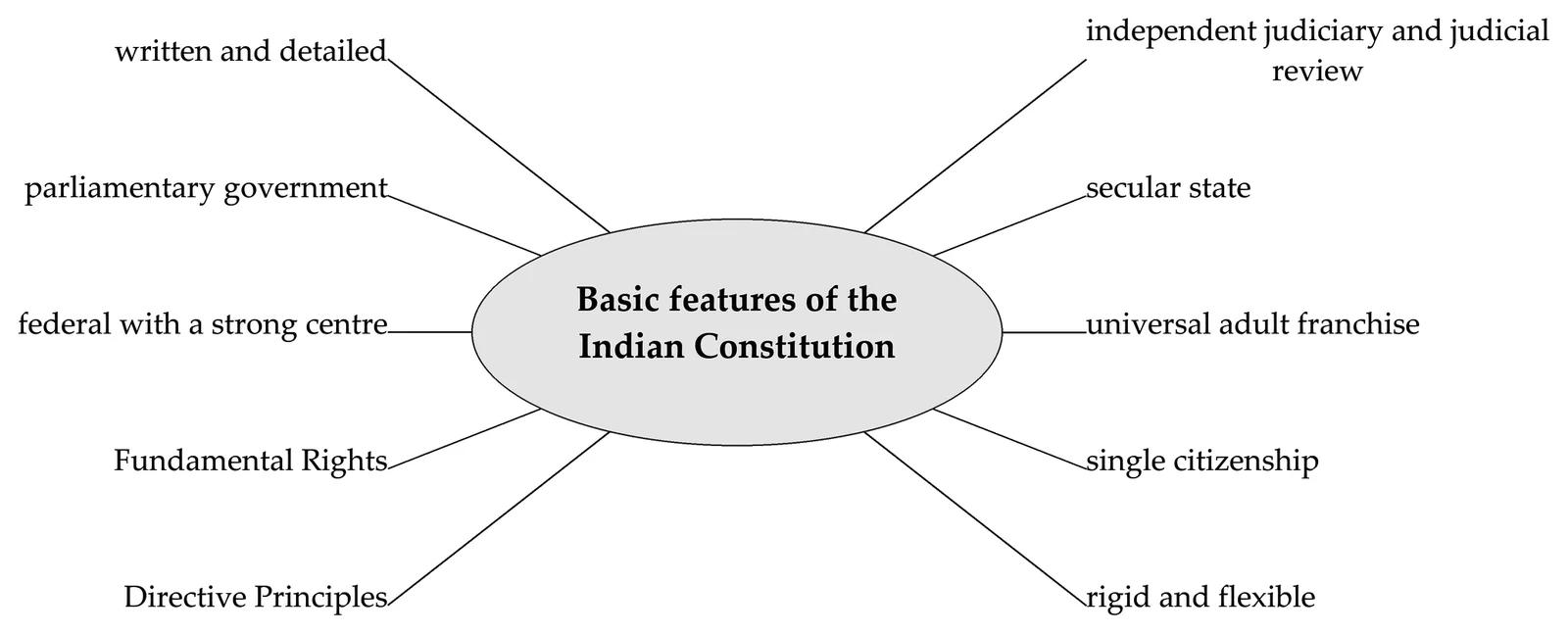
The main features of the Constitution are summarised in Figure 1.2:
- A written and detailed constitution, the longest in the world, drawing on the Government of India Act 1935 and on British, American, Irish, Canadian and other models.
- A sovereign, socialist, secular, democratic republic, as the Preamble declares; ‘socialist’ and ‘secular’ were added by the 42nd Amendment (1976).
- Parliamentary government at the Union and in the states, with the executive responsible to the legislature.
- A federation with a strong centre, with powers divided by the Seventh Schedule.
- Fundamental Rights (Part III), enforceable in the courts, and Directive Principles (Part IV), guidelines for the state; Fundamental Duties were added in 1976.
- An independent judiciary with the power of judicial review.
- Universal adult franchise from the very first election, a bold step in a largely illiterate country.
- Single citizenship, emergency provisions, and an amendment procedure that is partly rigid and partly flexible (Article 368).
1.2 Debates on Fundamental Rights
Part III (Articles 12–35) guarantees six groups of Fundamental Rights: the right to equality (Articles 14–18), to freedom (19–22), against exploitation (23–24), to freedom of religion (25–28), cultural and educational rights (29–30) and the right to constitutional remedies (32), which Ambedkar called the heart and soul of the Constitution. The right to property was originally a Fundamental Right but was removed by the 44th Amendment (1978) and made a legal right under Article 300A. D.D. Basu explains that these rights are enforceable against the state and that Parliament may impose reasonable restrictions on them. Several debates have surrounded them:
- Rights with exceptions: in the Constituent Assembly, members such as Somnath Lahiri complained that rights were hedged with so many restrictions that they seemed framed from the point of view of a police constable. Supporters replied that rights in a new and fragile nation needed limits for public order and security.
- Preventive detention: Article 22 permits detention without trial in certain circumstances, which critics have always seen as a threat to liberty.
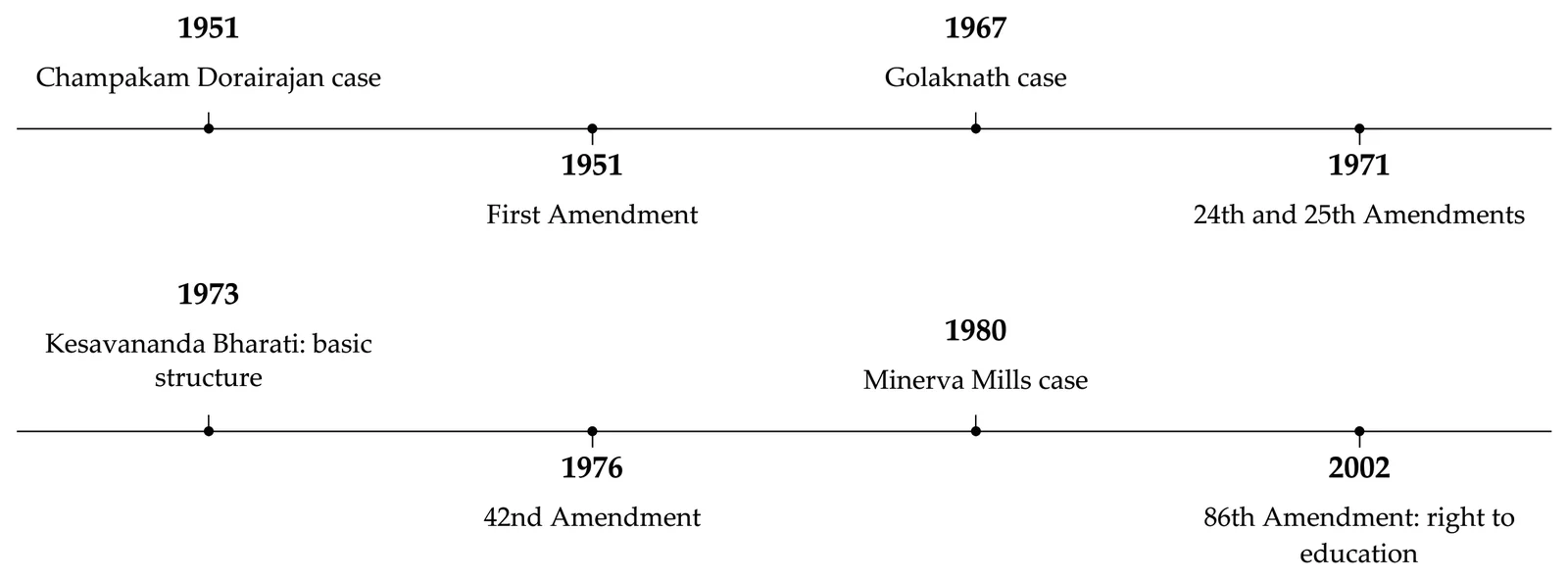
- Property and social reform: when courts struck down land reform laws, Parliament passed the First Amendment (1951), which created the Ninth Schedule to protect such laws. In Golaknath (1967) the Supreme Court held that Parliament could not amend Fundamental Rights; the 24th Amendment (1971) reasserted Parliament’s power; and in Kesavananda [केशवानंद] Bharati (1973) the Court held that Parliament can amend any part of the Constitution but cannot destroy its basic structure.
- The expansion of Article 21: in Maneka Gandhi (1978) the Court held that any procedure depriving a person of life or liberty must be fair, just and reasonable. It has since read into the right to life the rights to livelihood, shelter, health, a clean environment, education (later made Article 21A by the 86th Amendment, 2002) and privacy (Puttaswamy, 2017).
- Public interest litigation: from the 1980s the Court relaxed the rules of standing so that anyone could approach it on behalf of the poor, making rights more accessible.
1.3 Directive Principles of State Policy
Part IV (Articles 36–51), inspired by the Irish Constitution, contains the Directive Principles of State Policy. Article 37 says they are not enforceable by any court but are nevertheless fundamental in the governance of the country, and it is the duty of the state to apply them in making laws. Ambedkar described them as an ‘instrument of instructions’ to future governments, while K.T. Shah mocked them as a cheque on a bank payable at the convenience of the bank. S.K. Chaube treats them as the duties of the state, alongside the Fundamental Duties of citizens. They are usually grouped into three kinds:
- Socialist principles: a social order based on justice (Article 38), adequate means of livelihood, distribution of resources for the common good and prevention of the concentration of wealth (Article 39), the right to work, education and public assistance (Article 41), a living wage (Article 43).
- Gandhian principles: village panchayats (Article 40), cottage industries (Article 43), prohibition of intoxicating drinks (Article 47), protection of cows (Article 48) and the welfare of weaker sections (Article 46).
- Liberal-intellectual principles: a uniform civil code (Article 44), early childhood care and education (Article 45), protection of the environment (Article 48A), separation of the judiciary from the executive (Article 50) and promotion of international peace (Article 51).
Fundamental Rights and Directive Principles
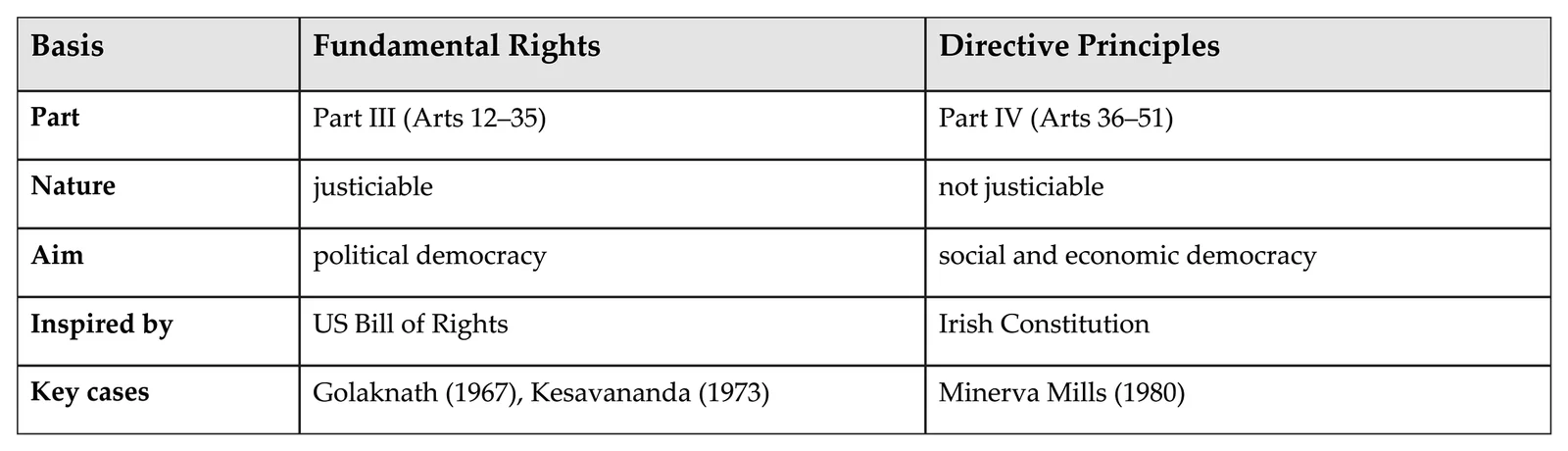
The two parts differ in nature (Figure 1.4): Fundamental Rights aim at political democracy and are justiciable; Directive Principles aim at social and economic democracy and are not. Their relationship has been a long debate. In Champakam Dorairajan (1951) the Court held that Fundamental Rights prevail over Directive Principles. Parliament responded with amendments, and the 25th Amendment (1971) added Article 31C to protect laws implementing Article 39(b) and (c). In Minerva Mills (1980) the Court held that the Constitution rests on the balance and harmony between the two, and that this balance is itself part of the basic structure. Today courts use the Directive Principles to interpret Fundamental Rights, and many principles have been implemented: land reforms, panchayati raj (73rd Amendment), free education (RTE Act, 2009), employment guarantee (MGNREGA, 2005) and food security (2013).
1.4 Federalism
A federation divides power between a central government and regional governments, each supreme in its own sphere, under a written constitution interpreted by an independent judiciary. India’s Constitution does not use the word ‘federation’; Article 1 calls India a Union of States. D.D. Basu shows that it has the main federal features: a dual polity; a written, supreme constitution; a division of powers through three lists in the Seventh Schedule, Union, State and Concurrent (Figure 1.5), with residuary powers given to the Union (Article 248); an independent judiciary to settle disputes; a bicameral Parliament with a Rajya Sabha representing the states; and a requirement that amendments affecting federal provisions be ratified by half the states.

It also has strong unitary features: a powerful Union with the more important subjects; single citizenship and a single constitution; an integrated judiciary; all-India services; Governors appointed by the Union; Parliament’s power to create new states and change boundaries (Article 3); the supremacy of Union law in the Concurrent List (Article 254); unequal representation of states in the Rajya Sabha; the financial dependence of states; and emergency provisions: national emergency (Article 352), President’s Rule in a state (Article 356) and financial emergency (Article 360).
Describing Indian federalism
K.C. Wheare called India quasi-federal, a unitary state with subsidiary federal features; Ivor Jennings saw a federation with a strong centralising tendency; Granville Austin called it co-operative federalism; and W.H. Morris-Jones spoke of bargaining federalism. Rajeev Dhavan and Rekha Saxena show that Indian federalism has changed with politics. During Congress dominance it was highly centralised and Article 356 was frequently misused; from the late 1980s coalition governments and regional parties gave states more voice. The Sarkaria Commission (1983–88) and the Punchhi Commission (2007–10) recommended better centre–state relations, and in S.R. Bommai (1994) the Supreme Court restricted the misuse of President’s Rule. Fiscal federalism works through the Finance Commission (Article 280) and, since 2017, the GST Council. India also practises asymmetric federalism, with special provisions for some states (Article 371) and tribal areas (Fifth and Sixth Schedules).
1.5 Important Questions
- Question 1 Discuss the basic features of the Indian Constitution.
- Question 2 Examine the debates on Fundamental Rights and their relationship with the Directive Principles.
- Question 3 Is India a federation? Discuss the nature of Indian federalism.
DU asks the same idea in different words. So learn one broad answer for each question below; the same answer works for every question joined by OR.
Important Question 1
Discuss the basic features of the Indian Constitution.
OR
Examine B.R. Ambedkar’s views on the basic features of the Indian Constitution.
OR
‘The Indian Constitution is first and foremost a social document.’ Discuss.
Model Answer
“The Indian Constitution is first and foremost a social document.”
— Granville Austin, The Indian Constitution: Cornerstone of a Nation (1966)
Introduction. The Constitution of India, adopted on 26 November 1949 and in force from 26 January 1950, is the supreme law of the land. Its makers sought national unity, democracy and social revolution together, and B.R. Ambedkar, as chairman of the Drafting Committee, explained its main features to the Constituent Assembly.
1. Written and Detailed
It is the longest written constitution in the world, with detailed provisions on centre–state relations, services, elections and emergencies, drawn from the Government of India Act 1935 and many foreign constitutions. Its detail reflects India’s size, diversity and the makers’ wish to leave little to chance. It originally had 395 Articles and 8 Schedules.
2. Sovereign, Socialist, Secular, Democratic Republic
The Preamble declares India a sovereign, socialist, secular, democratic republic committed to justice, liberty, equality and fraternity. ‘Socialist’ and ‘secular’ were added in 1976, but the values were present from the start. The words socialist and secular were added by the 42nd Amendment (1976).
3. Parliamentary Government
Ambedkar explained that the makers preferred responsibility to stability: the executive is drawn from and responsible to the legislature, and the President is a constitutional head acting on ministerial advice. The executive is collectively responsible to the Lok Sabha.
4. Federal with a Strong Centre
The Constitution creates a dual polity with a division of powers, but gives the Union greater powers and the ability to act in a unitary way in emergencies. India is a ‘Union of States’ from which no state can secede. Article 1 calls India a ‘Union of States’.
5. Sources of the Constitution
The makers borrowed widely: the Government of India Act, 1935 for the federal scheme and emergency powers; Britain for parliamentary government; the United States for fundamental rights and judicial review; Ireland for the directive principles; and Canada for a strong centre.
6. Rights, Directives and Duties
Fundamental Rights guarantee political democracy and are enforceable; Directive Principles guide the state towards social and economic democracy; Fundamental Duties, added in 1976, remind citizens of their obligations. Fundamental Duties were added in 1976.
7. Independent Judiciary and Judicial Review
A single integrated judiciary headed by the Supreme Court protects rights and interprets the Constitution; the basic structure doctrine (1973) limits even Parliament’s amending power. Since 1973 the basic structure doctrine limits even constitutional amendments.
8. Universal Adult Franchise and Single Citizenship
Every adult citizen received the vote from the first election, a revolutionary decision in a society divided by caste, class and gender. Single citizenship and uniform basic laws strengthen national unity. It was a bold step in a largely illiterate society.
9. Flexible and Rigid; Emergency Provisions
Some provisions can be amended by a simple majority, others need a special majority and some also state ratification (Article 368). Emergency provisions allow the Union to deal with crises but have been misused. More than a hundred amendments show its flexibility.
10. Independent Constitutional Bodies
The Election Commission, the Comptroller and Auditor General, the UPSC and the Finance Commission are independent bodies that ensure fair elections, accountability and fiscal federalism.
11. A Social Document
Austin called the Constitution a social document because its aim was social revolution: abolishing untouchability, protecting weaker sections and guiding the state towards justice. Ambedkar warned that political democracy would not last unless it became social democracy. It aims at a social revolution through law.
12. Constitutional Morality
Ambedkar stressed that the Constitution would work only if leaders and citizens developed constitutional morality, i.e. respect for its procedures and values.
13. Criticisms and Ambedkar’s Reply
Critics called the Constitution a ‘bag of borrowings’, too long and legalistic; Gandhians regretted that it was not built on village republics; and others noted that the Assembly was not elected by universal franchise. Ambedkar replied that the fundamentals of constitutions had long been settled and that what mattered was adapting borrowed ideas to Indian conditions, which the makers had done. He warned that however good a constitution may be, it will turn out bad if those who work it are bad.
14. Evaluation
The Constitution’s features reflect its aims of democracy, unity and social justice, and its flexibility has helped it endure for more than seventy years.
Conclusion. Thus, the basic features of the Constitution combine unity with diversity, democracy with stability, and liberty with social justice.
Important Question 2
Examine the debates on Fundamental Rights and their relationship with the Directive Principles.
OR
Discuss the relationship between Fundamental Rights and Directive Principles of State Policy.
OR
Critically examine the Directive Principles of State Policy.
Model Answer
“A cheque on a bank payable at the convenience of the bank.”
— K.T. Shah on the Directive Principles, Constituent Assembly
Introduction. Fundamental Rights (Part III) and Directive Principles of State Policy (Part IV) together express the Constitution’s vision of liberty and justice. Their scope and their relationship have been among the most important debates in Indian constitutional history, involving Parliament, the courts and political movements.
1. Fundamental Rights
The Constitution guarantees rights to equality, freedom, against exploitation, freedom of religion, cultural and educational rights and constitutional remedies. They are justiciable and subject to reasonable restrictions; Article 32 allows citizens to approach the Supreme Court directly. Article 32, the right to constitutional remedies, makes them enforceable in the Supreme Court.
2. Debate: Rights with Exceptions
Critics in the Constituent Assembly argued that restrictions and preventive detention made rights weak. Supporters replied that a new nation needed limits for order and security. Ambedkar replied that no right can be absolute.
3. Debate: Property and Social Reform
Land reform laws led to the First Amendment and the Ninth Schedule (1951). Golaknath (1967) denied Parliament the power to amend Fundamental Rights; Kesavananda Bharati (1973) allowed amendment but protected the basic structure; the 44th Amendment (1978) removed the right to property from Part III. The right to property was finally removed from Part III by the 44th Amendment (1978).
4. Directive Principles
Directive Principles, inspired by the Irish Constitution, are non-justiciable but fundamental in governance. They include socialist, Gandhian and liberal-intellectual principles. Ambedkar called them an instrument of instructions; K.T. Shah called them a cheque payable at the bank’s convenience. Ambedkar called them an ‘instrument of instructions’.
5. Conflict
In Champakam Dorairajan (1951) the Court held that rights prevail over directives. Parliament amended the Constitution; Article 31C (1971) protected laws implementing Article 39(b) and (c), and the 42nd Amendment (1976) tried to give all directives priority. Golaknath (1967) held that Parliament could not amend Fundamental Rights, and Kesavananda Bharati (1973) allowed amendment subject to the basic structure.
6. Harmony
In Minerva Mills (1980) the Court held that the Constitution rests on the balance between rights and directives, and that giving absolute primacy to either would destroy the basic structure. The balance between Parts III and IV is itself part of the basic structure.
7. Expansion through Interpretation
Courts have used Directive Principles to expand Article 21, reading in rights to livelihood, health, education and a clean environment. The 86th Amendment made education a Fundamental Right (Article 21A).
8. Courts and the Directives
Courts use the directives to interpret laws and to uphold reasonable restrictions on rights that serve directive goals, such as land reform and environmental protection.
9. Directives into Law
Free education up to fourteen (Article 21A), MGNREGA, the Food Security Act and panchayati raj (Article 40) show directives being turned into law.
10. Implementation
Many directives have been implemented through land reforms, panchayati raj, MGNREGA, the RTE Act and the Food Security Act, though others, such as a uniform civil code, remain controversial.
11. Rights and Duties
S.K. Chaube reminds us that the Constitution speaks of duties as well as rights: the Directive Principles are duties of the state, and the Fundamental Duties (Article 51A) are duties of citizens. Courts have used both to interpret laws, for example in protecting the environment.
12. The Emergency and Rights
During the Emergency (1975–77) the enforcement of rights was suspended, and in ADM Jabalpur (1976) the Supreme Court held that even the right to life could not be enforced. This judgment was later disowned, finally overruled in Puttaswamy (2017), and the 44th Amendment (1978) made Articles 20 and 21 non-suspendable during an emergency.
13. Evaluation
Fundamental Rights and Directive Principles are complementary: one protects liberty, the other promotes justice, and together they express the Constitution’s vision of a just democracy.
Conclusion. Thus, Fundamental Rights and Directive Principles are complementary: rights protect liberty, directives pursue justice, and their balance is part of the Constitution’s basic structure.
Important Question 3
Is India a federation? Discuss the nature of Indian federalism.
OR
Examine the federal and unitary features of the Indian Constitution.
OR
Discuss the changing nature of centre–state relations in India.
Model Answer
“The Federation is a Union because it is indestructible.”
— B.R. Ambedkar, Constituent Assembly, 4 November 1948
Introduction. Federalism divides power between a central government and regional governments under a written constitution. India’s Constitution creates a federal system with a strong centre, which has led scholars to describe it in different ways and has made centre–state relations a constant subject of debate.
1. Federal Features
India has a dual polity, a written and supreme Constitution, a division of powers through the Union, State and Concurrent Lists, an independent judiciary, a bicameral Parliament with the Rajya Sabha, and state ratification for federal amendments. An independent Supreme Court settles disputes between the Union and the states.
2. Unitary Features
The Union has more and more important powers, residuary powers, control over state boundaries (Article 3), Governors, all-India services, an integrated judiciary, single citizenship, supremacy in the Concurrent List and financial dominance. These include single citizenship, an integrated judiciary, all-India services and governors appointed by the Union.
3. Emergency Provisions
Under Articles 352, 356 and 360 the Union can take over state functions, making the system unitary in emergencies. Article 356 was used more than a hundred times, often for political reasons. During emergencies the federation can work as a unitary state.
4. Descriptions
Wheare called India quasi-federal; Jennings a federation with a centralising tendency; Austin co-operative federalism; Morris-Jones bargaining federalism. Ambedkar said India is a Union because it is indestructible. Granville Austin called it cooperative federalism. Morris-Jones described it as bargaining federalism.
5. Changing Practice
Dhavan and Saxena show that federalism was centralised under Congress dominance, while coalition governments and regional parties from the late 1980s gave states more influence. The S.R. Bommai judgment (1994) limited the misuse of President’s Rule. Coalition politics after 1989 strengthened the states.
6. Party System and Federalism
Under one-party dominance federalism was centralised, while coalition governments after 1989 gave regional parties and states greater influence.
7. Federalism as Basic Structure
In S.R. Bommai (1994) the Supreme Court held that federalism is part of the basic structure, limiting the misuse of Article 356.
8. Commissions and Reforms
The Sarkaria and Punchhi Commissions recommended consultation, careful use of Article 356 and stronger inter-state councils. The Inter-State Council (1990) was set up under Article 263. Tamil Nadu’s Rajamannar Committee (1969) had earlier demanded more autonomy.
9. Institutions of Cooperation
The Inter-State Council, the Zonal Councils, NITI Aayog’s Governing Council and the GST Council provide forums for cooperation.
10. Fiscal Federalism
The Finance Commission shares central taxes with the states; the GST Council, created by the 101st Amendment (2016), is a forum of co-operative fiscal federalism; and NITI Aayog replaced the Planning Commission in 2015. The GST Council (2017) makes indirect taxation a joint Union–state decision.
11. Asymmetric Federalism
Special provisions for some states (Article 371) and tribal areas (Fifth and Sixth Schedules) accommodate diversity; Article 370 for Jammu and Kashmir was abrogated in 2019. The Fifth and Sixth Schedules protect tribal areas.
12. A Holding-Together Federation
Alfred Stepan described India as a holding-together federation, created by a central decision to keep a diverse country united, unlike the coming-together federation of the United States, formed by independent states. This explains its strong centre as well as its accommodation of linguistic, tribal and regional diversity through state reorganisation and special provisions. Such federations give the centre more power than coming-together federations such as the United States.
13. Demands for Autonomy and Recent Debates
States have demanded more autonomy, as in Tamil Nadu’s Rajamannar Committee (1969) and Punjab’s Anandpur Sahib Resolution (1973). Recent debates concern the role of Governors, the use of central agencies, GST compensation and the shift from co-operative to competitive federalism through NITI Aayog. The Anandpur Sahib Resolution (1973) was another such demand.
14. Centre–State Disputes Today
Disputes over GST compensation, central agencies, governors’ roles and the sharing of central taxes show that federal bargaining continues.
15. Evaluation
India is a federation with strong unitary features, designed to hold a diverse country together; its working depends on the party system, the courts and the spirit of cooperation between the Union and the states.
Conclusion. Thus, India is a federation with a strong centre, designed for unity in diversity. Its working depends as much on politics and co-operation as on the constitutional text.
Short Notes
(a) Fundamental Duties
Added by the 42nd Amendment (1976) on the recommendation of the Swaran Singh Committee, Article 51A lists the duties of citizens, such as respecting the Constitution, the national flag and anthem, protecting the sovereignty and unity of India, promoting harmony, protecting the environment and developing a scientific temper. The eleventh duty, to provide educational opportunities to children aged six to fourteen, was added in 2002. They are not enforceable by courts.
(b) The basic structure doctrine
Laid down in Kesavananda Bharati v. State of Kerala (1973), the doctrine holds that Parliament can amend any part of the Constitution under Article 368 but cannot destroy its basic structure, which includes the supremacy of the Constitution, the rule of law, democracy, secularism, federalism, judicial review and the balance between Fundamental Rights and Directive Principles.
(c) Directive Principles of State Policy
Part IV of the Constitution (Articles 36–51), inspired by the Irish Constitution, directs the state to secure social, economic and political justice: adequate livelihood, equal pay for equal work, prevention of the concentration of wealth, free and compulsory education, public health, village panchayats, a uniform civil code and protection of the environment. They are not enforceable in courts but are fundamental in governance (Article 37), and since Minerva Mills (1980) the balance between them and Fundamental Rights is part of the basic structure.
More notes: MDSC-2A Indian Government and Politics
- State formation and nation building: Integration of princely states, linguistic re-organisation of states
- Political institutions at the Centre and State levels: Parliament, Judiciary, Prime Minister, Chief Minister
- Social structure and political power: caste, class, gender
- Religion and politics: debates on secularism and communalism
- Political parties and party systems
- Development strategies: planned economy, neo-liberal restructuring
- Social movements: workers, farmers, environmental, and women’s movements
- The nature of state in India: developmental, welfare, regulatory
These notes are prepared by PADHO TO AISE for study help. They are not an official University of Delhi publication.