

UGC NET UGC NET Paper 1: Teaching and Research Aptitude
Unit 1 · 19 min read · Updated 26 Nov 2026
As per the UGC NET syllabus notified by the National Testing Agency (NTA)
Contents
- 1.1 Teaching: Concept, Objectives and Characteristics
- Objectives of teaching
- Characteristics and basic requirements of teaching
- 1.2 Levels of Teaching: Memory, Understanding and Reflective
- Memory level (Herbart)
- Understanding level (Morrison)
- Reflective level (Hunt)
- 1.3 The Learner and the Factors Affecting Teaching
- Adolescent learners
- Adult learners (andragogy)
- John Carroll’s model of school learning
- Factors affecting teaching
- 1.4 Methods of Teaching in Higher Education
- Teacher-centred methods
- Learner-centred methods
- Offline and online methods: SWAYAM, SWAYAM Prabha and MOOCs
- 1.5 Teaching Support System
- 1.6 Evaluation Systems, CBCS and Computer-Based Testing
- Types of evaluation
- Characteristics of a good evaluation tool
- Evaluation in the Choice Based Credit System (CBCS)
- Computer-based testing and innovations
- 1.7 Quiz: 20 Practice MCQs
शिक्षा मनुष्य में पहले से विद्यमान पूर्णता की अभिव्यक्ति है।
Education is the manifestation of the perfection already in man.
— Swami Vivekananda
TEACHING APTITUDE is the first unit of UGC NET Paper 1, and every year it gives about 5 questions (10 marks). It asks a simple question: what makes a good teacher? To answer it, we study what teaching is, its objectives and levels, the learner, the factors that affect teaching, the methods used in colleges and universities (including online platforms such as SWAYAM and MOOCs), the support systems that help teaching, and finally evaluation, i.e. how we check whether learning has really taken place. In simple words, this unit is about the teacher, the learner and the bridge between them.
1.1 Teaching: Concept, Objectives and Characteristics
Teaching is a planned interaction between a teacher and learners that helps the learners gain knowledge, skills and values. It is not just giving information. When a teacher teaches, three things come together: the teacher (who guides), the learner (who learns) and the curriculum (what is learnt). These are organised in a systematic way to reach goals that are decided in advance. That is why teaching is called a bipolar process (teacher and learner) by older writers and a tripolar process (teacher, learner and curriculum) by later writers such as John Dewey.
In simple words, teaching is successful only when learning happens. A teacher who speaks for an hour while nobody learns has not really taught. This idea, that teaching and learning are two sides of one coin, is the key to most questions in this unit.
Objectives of teaching
The general objectives of teaching are wide and long term. Teaching aims to develop the all-round personality of the learner; to shape behaviour in a desired direction; to help the learner adjust to new situations; to encourage independent thinking and problem solving; and to give the learner sound knowledge of the subject. The specific objectives are narrower and are usually written for one lesson, for example to develop critical and logical thinking, to build understanding of a concept, or to develop a skill such as drawing a graph.
The most famous classification of objectives is Bloom’s taxonomy. Benjamin S. Bloom and his colleagues published the Taxonomy of Educational Objectives in 1956 and divided objectives into three domains:
- Cognitive domain (knowing): knowledge, comprehension, application, analysis, synthesis and evaluation. In 2001 Lorin Anderson and David Krathwohl revised it as remember, understand, apply, analyse, evaluate and create, so creating is now the highest level.
- Affective domain (feeling): attitudes, interests and values, arranged by Krathwohl and others (1964) as receiving, responding, valuing, organisation and characterisation.
- Psychomotor domain (doing): physical and manual skills, such as handling laboratory equipment or typing, arranged in levels from imitation to naturalisation.
Characteristics and basic requirements of teaching
- Teaching is interactive: it is a two-way process of communication between teacher and learners, not a one-way lecture.
- Teaching is purposeful: every lesson has objectives, and the teacher plans to reach them.
- Teaching is both an art and a science: it needs creativity and warmth (art) as well as planning, methods and evaluation (science).
- Teaching is diagnostic and remedial: a good teacher finds out where learners face difficulty and helps them overcome it.
- Teaching is measurable: its results can be observed and evaluated through tests, assignments and behaviour.
- Teaching needs basic requirements: a teacher with command over the subject, communication skills and patience; motivated learners; a clear curriculum; and suitable facilities such as a classroom, board, books and digital tools.
1.2 Levels of Teaching: Memory, Understanding and Reflective
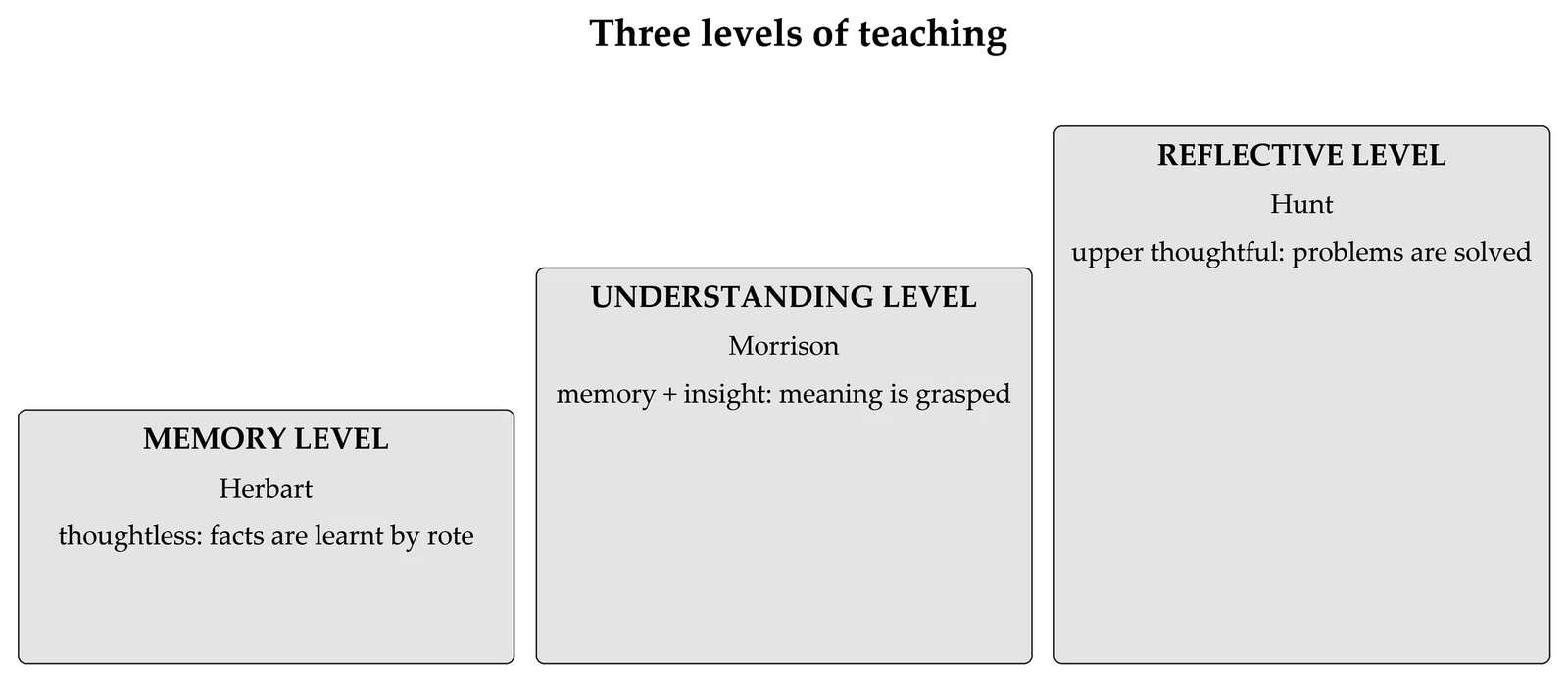
Teaching can take place at three levels, from simple to deep. Every UGC NET paper asks at least one question here, so learn the name of the level, the thinker linked with it and its nature.
Memory level (Herbart)
The memory level is the first and lowest level. Its main aim is to make learners remember facts, i.e. names, dates, formulae and definitions. It is linked with the German thinker Johann Friedrich Herbart (1776–1841), whose followers gave five formal steps of teaching: preparation, presentation, association (comparison), generalisation and application. At this level the teacher is dominant and the learner is passive. It is called thoughtless teaching because learning happens by rote without much thinking. Yet it is the base of the other two levels, since we cannot understand what we do not remember.
Understanding level (Morrison)
The understanding level goes beyond memory. Here the learner grasps the meaning, the relationships and the use of facts. It is linked with Henry Clinton Morrison (1871–1945), whose model has five steps: exploration, presentation, assimilation, organisation and recitation. Morrison described it as memory plus insight. Both teacher and learner are active, and the learner can explain and apply what is learnt. It is called thoughtful teaching.
Reflective level (Hunt)
The reflective level is the highest. It is linked with Morris L. Bigge and Maurice P. Hunt, and is usually written in exams simply as Hunt’s level. Teaching is problem-centred: the learner faces a real problem, forms hypotheses, collects evidence and reaches a solution. The learner is most active and the teacher becomes a guide. It is called upper thoughtful teaching and it develops critical thinking, creativity and independent judgement. Research work at the doctoral level, for example, is teaching at the reflective level.
| Feature | Memory level | Understanding level | Reflective level |
|---|---|---|---|
| Thinker | Herbart | Morrison | Hunt (Bigge and Hunt) |
| Nature | thoughtless | thoughtful | upper thoughtful |
| Aim | remember facts | grasp meaning and use | solve problems |
| Role of learner | passive | active | most active |
| Evaluation | recall questions | objective and essay questions | open-ended problems |
1.3 The Learner and the Factors Affecting Teaching
A teacher teaches learners, not just a subject. Learners differ in their academic ability (previous knowledge, study habits), social background (family, language, peers), emotional make-up (confidence, anxiety, motivation) and cognitive development (memory, reasoning, attention). These differences are called individual differences, and a good teacher plans for them instead of treating the class as one block.
Adolescent learners
Adolescence (roughly 12 to 18 years) is a period of fast physical and emotional change. According to Jean Piaget, adolescents reach the formal operational stage (from about 11 years), i.e. they can think in abstract terms, form hypotheses and reason logically. Erik Erikson called this the stage of identity versus role confusion: young people try to answer the question ‘who am I?’. Adolescent learners are sensitive to peer opinion, want independence, and respond well to discussion, projects and respect from the teacher.
Adult learners (andragogy)
Most learners in higher education are adults. Malcolm Knowles popularised the term andragogy, i.e. the art and science of helping adults learn, in contrast with pedagogy (teaching children). According to Knowles, adult learners are self-directed; they bring rich experience; they are ready to learn what they need for their roles; they are problem-centred rather than subject-centred; and they are motivated more by internal factors such as self-esteem than by external rewards. So adult teaching works best through discussion, case studies, projects and links with real life.
John Carroll’s model of school learning
In 1963 John B. Carroll gave a simple formula for learning: the degree of learning depends on time actually spent divided by time needed. Time spent depends on opportunity (time allowed) and perseverance (time the learner is willing to spend). Time needed depends on aptitude, the ability to understand instruction and the quality of instruction. In simple words, a learner learns fully when he gets and uses as much time as he needs. Robert Slavin later developed this into the QAIT model: Quality of instruction, Appropriate level of instruction, Incentive and Time.
Factors affecting teaching
- Teacher: subject knowledge, communication skill, personality, attitude, experience and use of methods.
- Learner: motivation, aptitude, intelligence, previous knowledge, health and family background.
- Support material: textbooks, reference books, notes, audio-visual aids and online resources.
- Instructional facilities: classrooms, laboratories, libraries, seating, light and internet access.
- Learning environment: discipline, a friendly classroom climate and the teacher–student relationship.
- Institution: its policies, leadership, class size, timetable and the culture of research and innovation.
1.4 Methods of Teaching in Higher Education
Methods of teaching are usually divided into teacher-centred and learner-centred methods. In practice a good teacher mixes them according to the topic and the class.
Teacher-centred methods
- Lecture method: the oldest and most common method in universities. It covers much content in little time and suits large classes, but learners may remain passive.
- Demonstration method: the teacher shows how something is done, for example an experiment, while learners watch.
- Tutorial method: the teacher guides a small group or one learner to clear doubts and give individual attention.
Learner-centred methods
- Discussion and seminar: learners present and debate ideas; the teacher moderates.
- Project method: given by William H. Kilpatrick (1918), based on John Dewey’s idea of learning by doing; learners complete a purposeful task in real-life settings.
- Problem-solving and heuristic method: learners discover answers themselves; the heuristic method is linked with H.E. Armstrong.
- Case study and role play: learners analyse real situations or act out roles, popular in management, law and social sciences.
- Brainstorming: popularised by Alex Osborn; members give many ideas freely before any is judged.
- Flipped classroom: learners study videos or readings at home and use class time for discussion and problem solving.
Microteaching is a training technique for teachers, developed at Stanford University in 1963 (Dwight Allen and colleagues). A trainee teaches one skill to a small group for a few minutes, gets feedback, replans and reteaches. In the Indian model the cycle is: teach 6 minutes, feedback 6, replan 12, reteach 6 and re-feedback 6, i.e. 36 minutes in all.
Offline and online methods: SWAYAM, SWAYAM Prabha and MOOCs
Offline methods are classroom methods in which teacher and learner meet face to face. Online methods use the internet, and blended learning combines the two. The Government of India runs several online platforms that are regularly asked in UGC NET:
- SWAYAM (Study Webs of Active Learning for Young Aspiring Minds), launched in July 2017, offers free online courses from school to postgraduate level. Every course has four quadrants: video lectures (e-tutorial), reading material (e-content), self-assessment tests, and a discussion forum. Under UGC rules, students can earn credits for SWAYAM courses and transfer them to their degree.
- SWAYAM Prabha is a group of educational DTH (Direct to Home) channels that telecast programmes 24 hours a day, 7 days a week, using a satellite, so that students without good internet can also learn. It began in 2017 with 32 channels.
- MOOCs (Massive Open Online Courses) are online courses open to anyone, often free, with very large enrolments. The term was coined in 2008 by Dave Cormier.
- NROER (National Repository of Open Educational Resources), launched in 2013, is a collection of free digital resources such as videos, images and documents for teachers and learners.
| Point | Teacher-centred | Learner-centred |
|---|---|---|
| Who is active | mainly the teacher | mainly the learner |
| Examples | lecture, demonstration | project, discussion, case study |
| Level reached | memory, understanding | understanding, reflective |
| Best for | large classes, new content | skills, thinking, application |
1.5 Teaching Support System
A teaching support system is the set of aids and tools that help the teacher present content clearly and help the learner understand it. It is usually divided into three types:
- Traditional support system: chalkboard, textbooks, charts, maps, models, flannel boards and printed notes. They are cheap and easy to use.
- Modern support system: overhead projectors, slide projectors, audio and video players, LCD projectors and educational television.
- ICT-based support system: smart boards, presentations, e-content, virtual laboratories, learning management systems such as Moodle, video conferencing and online assessment tools.
Why do aids help? Edgar Dale’s Cone of Experience (1946) answers this. At the base of the cone are direct, purposeful experiences (learning by doing), and at the top are verbal symbols (words alone). The lower we go in the cone, the more concrete and lasting the learning. Audio-visual aids move learning down the cone, from pure words towards experience.
1.6 Evaluation Systems, CBCS and Computer-Based Testing
Evaluation is the process of judging how far the objectives of teaching have been achieved. It is wider than measurement (giving a number, such as 65 marks) and assessment (collecting information about learning). Evaluation adds a value judgement, for example ‘good’ or ‘needs improvement’. Its three elements form a triangle: objectives (what we want), learning experiences (how we teach) and evaluation tools (how we check).
Types of evaluation
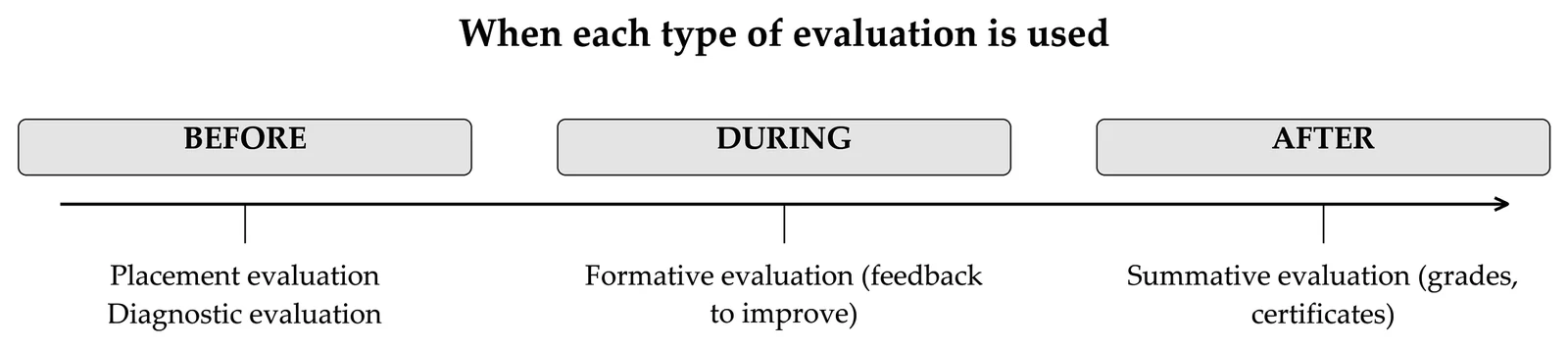
- Placement evaluation: at the start, to find the learner’s entry level and place him in the right course or group.
- Formative evaluation: during teaching, through class tests, quizzes and assignments, to give feedback and improve teaching. The terms formative and summative were coined by Michael Scriven in 1967.
- Diagnostic evaluation: to find the causes of persistent learning difficulties, followed by remedial teaching.
- Summative evaluation: at the end of a course or term, to give grades, marks and certificates, for example semester-end examinations.
- Norm-referenced evaluation: compares a learner with others in the group (rank, percentile). Criterion-referenced evaluation: compares a learner with a fixed standard of mastery; the term was given by Robert Glaser (1963).
- Continuous and Comprehensive Evaluation (CCE): regular evaluation of both scholastic and co-scholastic areas throughout the year.
Characteristics of a good evaluation tool
- Validity: it measures what it claims to measure. This is the most important quality.
- Reliability: it gives consistent results when repeated under similar conditions.
- Objectivity: the score does not depend on who checks it.
- Usability (practicability): it is easy to give, score and interpret, and not too costly.
- Comprehensiveness: it covers the whole syllabus and all objectives.
- Discrimination: it separates good learners from weak learners.
Evaluation in the Choice Based Credit System (CBCS)
The UGC introduced CBCS in universities from the academic year 2015–16. Under CBCS, students choose courses from core, elective (discipline-specific and generic) and skill-based baskets, and each course carries credits. Performance is shown by grades on a 10-point scale, and the SGPA (Semester Grade Point Average) and CGPA (Cumulative Grade Point Average) are calculated from them. This makes grades comparable across universities and allows credit transfer.
| Letter grade | Meaning | Grade point |
|---|---|---|
| O | Outstanding | 10 |
| A+ | Excellent | 9 |
| A | Very good | 8 |
| B+ | Good | 7 |
| B | Above average | 6 |
| C | Average | 5 |
| P | Pass | 4 |
| F | Fail | 0 |
Computer-based testing and innovations
Computer-based testing (CBT) means the test is taken on a computer instead of on paper. The National Testing Agency (NTA) has conducted UGC NET in CBT mode since December 2018. CBT gives quick and accurate results, reduces paper use and allows question banks and shuffling. Other innovations in evaluation include online and on-demand examinations, open-book examinations, grading instead of marks, rubrics, e-portfolios, peer and self-assessment, and question banks.
Thus, teaching aptitude covers the whole cycle of teaching: deciding objectives, understanding the learner, choosing methods and aids, and evaluating learning. A teacher who keeps this cycle in mind can answer almost every question in this unit.
1.7 Quiz: 20 Practice MCQs
Test yourself with these 20 exam-pattern questions. Choose your answer first, then tap Show answer to check it and read the short explanation.
Question 1
Which level of teaching is called ‘thoughtless’ teaching?
- Reflective level
- Understanding level
- Memory level
- Autonomous level
Show answer
Answer: (c) Memory level. At the memory level (Herbart) facts are learnt by rote without much thinking
Question 2
The understanding level of teaching is associated with:
- Herbart
- Morrison
- Hunt
- Bloom
Show answer
Answer: (b) Morrison. Henry C. Morrison described understanding as memory plus insight
Question 3
Teaching at the reflective level is mainly:
- teacher-centred and rote
- problem-centred and learner-centred
- content-centred and memory-based
- examination-centred
Show answer
Answer: (b) problem-centred and learner-centred. Hunt’s reflective level is problem-centred; the learner is most active
Question 4
Match List I with List II.
| List I | List II |
|---|---|
| A. Project method | I. Malcolm Knowles |
| B. Formative and summative (terms) | II. W.H. Kilpatrick |
| C. Andragogy | III. Dave Cormier |
| D. MOOC (term) | IV. Michael Scriven |
- A-II, B-IV, C-I, D-III
- A-I, B-II, C-III, D-IV
- A-II, B-I, C-IV, D-III
- A-IV, B-II, C-I, D-III
Show answer
Answer: (a) A-II, B-IV, C-I, D-III. Kilpatrick (project method, 1918), Scriven (1967), Knowles (andragogy), Cormier (MOOC, 2008)
Question 5
In John Carroll’s model of school learning, the degree of learning depends on:
- aptitude multiplied by perseverance
- quality of instruction divided by opportunity
- time actually spent divided by time needed
- time needed divided by time spent
Show answer
Answer: (c) time actually spent divided by time needed. Carroll (1963): degree of learning = f(time spent / time needed)
Question 6
Assertion (A): Formative evaluation is conducted during the course of instruction. Reason (R): Its main aim is to give feedback that improves teaching and learning.
- Both A and R are true, and R is the correct explanation of A
- Both A and R are true, but R is not the correct explanation of A
- A is true, but R is false
- A is false, but R is true
Show answer
Answer: (a) Both A and R are true, and R is the correct explanation of A. Formative evaluation happens during teaching precisely so that feedback can improve it
Question 7
Which of the following is NOT a learner-centred method?
- Project method
- Lecture method
- Problem-solving method
- Case study method
Show answer
Answer: (b) Lecture method. In the lecture method the teacher is active and learners mostly listen
Question 8
Courses on SWAYAM are delivered in four quadrants. Which of these is NOT one of them?
- Video lectures (e-tutorial)
- Reading material (e-content)
- Discussion forum
- Classroom attendance register
Show answer
Answer: (d) Classroom attendance register. The four quadrants are e-tutorial, e-content, self-assessment and discussion forum
Question 9
Consider these statements about SWAYAM Prabha:
- It is a group of educational DTH channels.
- It telecasts programmes 24 hours a day.
- It is available only in metro cities.
- I and II only
- II and III only
- I and III only
- I, II and III
Show answer
Answer: (a) I and II only. It is a 24×7 group of DTH channels delivered by satellite across the country, not only in metros
Question 10
A test that measures exactly what it claims to measure has:
- reliability
- objectivity
- validity
- usability
Show answer
Answer: (c) validity. Validity is the most important quality of a test
Question 11
A test gives the same results when repeated on the same group under similar conditions. This quality is called:
- validity
- reliability
- comprehensiveness
- discrimination
Show answer
Answer: (b) reliability. Reliability means consistency of results
Question 12
Under the UGC’s 10-point grading scale in CBCS, the grade ‘O’ stands for:
- Optimum
- Ordinary
- Overall
- Outstanding
Show answer
Answer: (d) Outstanding. O = Outstanding, with 10 grade points
Question 13
Criterion-referenced evaluation compares a learner’s performance with:
- the average of the group
- a fixed standard of mastery
- the topper’s score
- last year’s results
Show answer
Answer: (b) a fixed standard of mastery. Norm-referenced tests compare with the group; criterion-referenced tests compare with a fixed standard
Question 14
Arrange the Herbartian steps of teaching in the correct order.
- Presentation
- Preparation
- Generalisation
- Association (comparison)
- Application
- II, I, IV, III, V
- I, II, III, IV, V
- II, IV, I, III, V
- I, II, IV, V, III
Show answer
Answer: (a) II, I, IV, III, V. Preparation, presentation, association, generalisation, application
Question 15
At the base of Edgar Dale’s Cone of Experience are:
- direct, purposeful experiences
- verbal symbols
- motion pictures
- visual symbols
Show answer
Answer: (a) direct, purposeful experiences. The base is the most concrete (learning by doing); verbal symbols are at the top
Question 16
Microteaching was first developed at:
- Harvard University
- University of Oxford
- Stanford University
- University of Delhi
Show answer
Answer: (c) Stanford University. It was developed at Stanford University in 1963
Question 17
Which domain of Bloom’s taxonomy deals with feelings, attitudes and values?
- Cognitive
- Psychomotor
- Conative
- Affective
Show answer
Answer: (d) Affective. The affective domain covers receiving, responding, valuing, organisation and characterisation
Question 18
In the revised Bloom’s taxonomy (Anderson and Krathwohl, 2001), the highest cognitive level is:
- Evaluating
- Analysing
- Creating
- Applying
Show answer
Answer: (c) Creating. The revised order is remember, understand, apply, analyse, evaluate, create
Question 19
Assertion (A): Summative evaluation is mainly used to diagnose learning difficulties during teaching. Reason (R): Summative evaluation is conducted at the end of a course.
- Both A and R are true, and R is the correct explanation of A
- Both A and R are true, but R is not the correct explanation of A
- A is true, but R is false
- A is false, but R is true
Show answer
Answer: (d) A is false, but R is true. A is false (diagnosis is done by diagnostic and formative evaluation), but R is true
Question 20
Which of these is an ICT-based teaching support system?
- Chalkboard
- Printed textbook
- Flannel board
- Learning management system such as Moodle
Show answer
Answer: (d) Learning management system such as Moodle. Chalkboards, textbooks and flannel boards are traditional aids
More notes: UGC NET Paper 1: Teaching and Research Aptitude
These notes are prepared by PADHO TO AISE for study help. They are not an official publication.