
UGC NET UGC NET Paper 1: Teaching and Research Aptitude
Unit 4 · 14 min read · Updated 26 Nov 2026
As per the UGC NET syllabus notified by the National Testing Agency (NTA)
Contents
- 4.1 Meaning, Elements and Models of Communication
- Elements of the communication process
- Models of communication
- 4.2 Characteristics, Types and Directions of Communication
- Characteristics
- Types of communication
- Directions of communication in an institution
- 4.3 Verbal and Non-Verbal Communication
- 4.4 Effective, Intercultural and Group Communication
- Intercultural communication
- Group communication
- 4.5 Classroom Communication
- 4.6 Barriers to Effective Communication
- 4.7 Mass Media and Society
- 4.8 Quiz: 20 Practice MCQs
माध्यम ही संदेश है।
The medium is the message.
— Marshall McLuhan, Understanding Media (1964)
COMMUNICATION is the fourth unit of Paper 1 and gives about 5 questions every year. A teacher spends most of the day communicating, so the UGC wants every candidate to understand how communication works and why it fails. In this chapter we study the meaning, elements and models of communication, its types and directions, verbal and non-verbal communication, effective, intercultural and group communication, classroom communication, the barriers to communication and, finally, mass media and society with the main media theories.
4.1 Meaning, Elements and Models of Communication
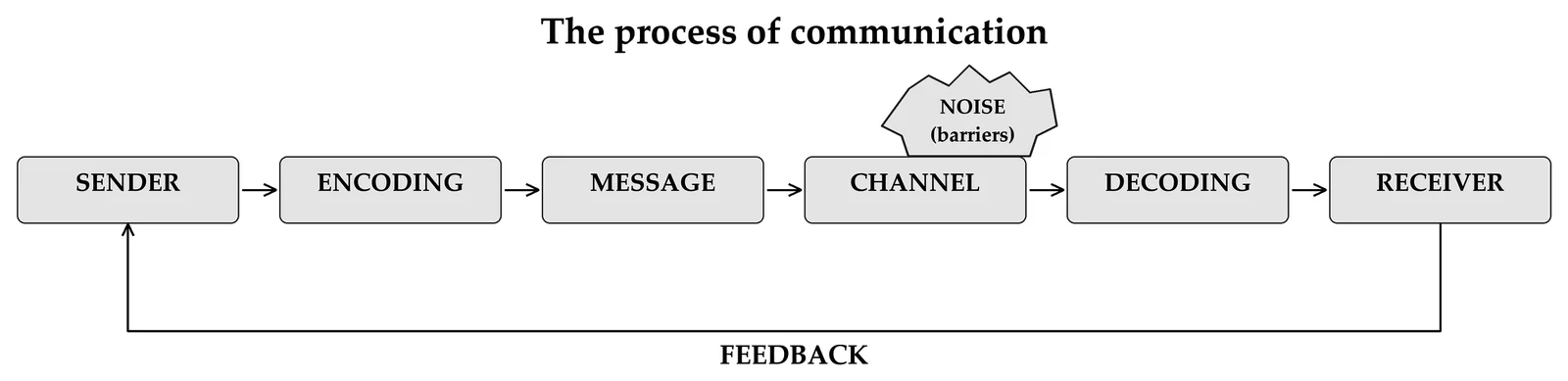
The word communication comes from the Latin communis, i.e. common, and communicare, i.e. to share or make common. Communication is the process of sharing information, ideas and feelings between two or more persons so that they reach a common understanding. In simple words, communication has taken place only when the receiver understands the message more or less as the sender meant it.
Elements of the communication process
- Sender (source or encoder): the person who starts the communication with an idea.
- Encoding: turning the idea into symbols, such as words, pictures or gestures.
- Message: the content that is sent, i.e. what is communicated.
- Channel (medium): the path by which the message travels, such as speech, letter, phone, e-mail or television.
- Decoding: the receiver turning the symbols back into meaning.
- Receiver (decoder): the person for whom the message is meant.
- Feedback: the receiver’s response, which tells the sender how the message was understood. It makes communication two-way.
- Noise: anything that disturbs the message, from a loud sound to a confusing word or a prejudice.
- Context: the setting (physical, social and cultural) in which communication takes place.
Models of communication
- Aristotle’s model (the oldest): speaker, speech, occasion, audience and effect. It is a one-way model of persuasive public speaking.
- Lasswell’s model (1948): Harold Lasswell described communication as ‘who says what in which channel to whom with what effect’. It is linear and is widely used in mass communication research.
- Shannon–Weaver model (1949): Claude Shannon and Warren Weaver gave a mathematical model of information transmission: source, transmitter, channel, receiver and destination. It is famous for introducing the idea of noise.
- Berlo’s SMCR model (1960): David Berlo named four elements, Source, Message, Channel and Receiver, and said that the communication skills, attitudes, knowledge and culture of source and receiver shape the result.
- Osgood–Schramm model (1954): a circular model in which both parties encode, decode and interpret in turn, showing that communication is continuous and two-way.
4.2 Characteristics, Types and Directions of Communication
Characteristics
- It is a process: it moves through stages, from encoding to feedback.
- It is two-way: without feedback we cannot know whether the message has been understood.
- It is continuous and dynamic: it goes on all the time and changes with situations.
- It is purposeful: it aims to inform, persuade, instruct, entertain or build relations.
- It is irreversible: a word once spoken cannot be taken back.
- It is contextual: the same words can mean different things in different settings and cultures.
Types of communication
- By the number of people: intrapersonal (with oneself, such as thinking), interpersonal (between two persons), group (in a small group), public (one speaker to an audience) and mass communication (to a large, scattered audience through media).
- By channel: verbal (using words, oral or written) and non-verbal (without words).
- By formality: formal communication follows the official chain of command; informal communication, called the grapevine, spreads through personal contacts and moves fast.
- Direct and indirect: direct communication is face to face; indirect (mediated) communication passes through a medium such as letters, phones or the internet.
Directions of communication in an institution
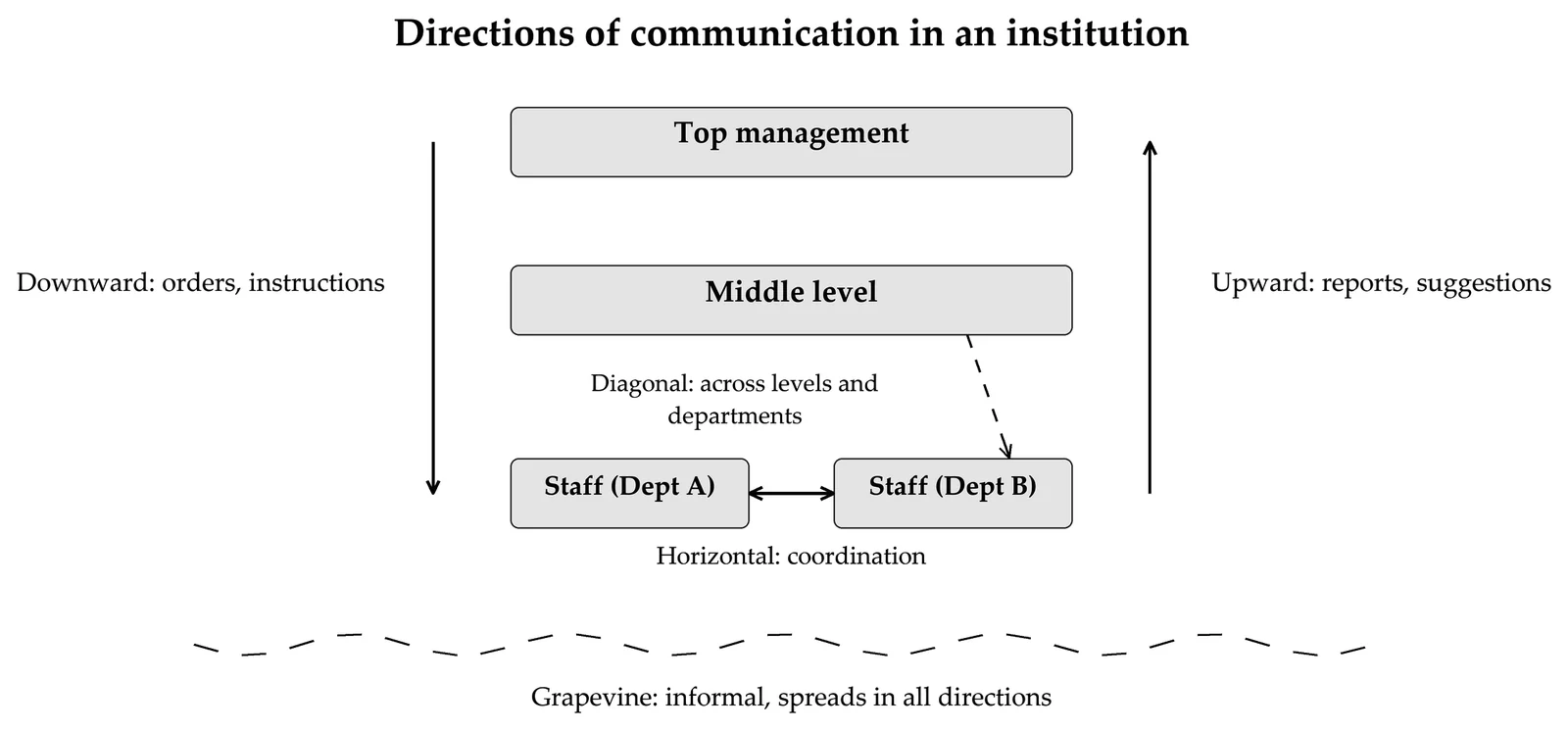
Downward communication flows from superiors to subordinates (orders, circulars, instructions). Upward communication flows from subordinates to superiors (reports, requests, suggestions, grievances). Horizontal (lateral) communication takes place between persons at the same level, for coordination. Diagonal (crosswise) communication cuts across both levels and departments. The grapevine is the informal network that carries news and rumours in all directions.
4.3 Verbal and Non-Verbal Communication
Verbal communication uses words. It may be oral (lectures, conversations, phone calls, meetings), which is quick and allows instant feedback, or written (letters, notices, reports, e-mails), which is permanent, precise and useful as a record. Non-verbal communication is communication without words. It often carries feelings and attitudes more powerfully than words, and when words and body language disagree, listeners tend to believe the body language.
| Kind | What it studies | Example |
|---|---|---|
| Kinesics | body movements, gestures, posture, facial expressions | a nod, crossed arms, a smile |
| Proxemics | use of space and distance (Edward T. Hall) | standing close or far while talking |
| Haptics | touch | a handshake, a pat on the back |
| Chronemics | use of time | punctuality, waiting time |
| Paralanguage | tone, pitch, volume, pace and pauses of voice | a sarcastic tone |
| Oculesics | eye contact and eye movement | looking at the class while teaching |
| Artifacts / appearance | dress, accessories, surroundings | a uniform, a formal suit |
Edward T. Hall described four distance zones in The Hidden Dimension (1966): intimate (up to about 18 inches), personal (about 1.5 to 4 feet), social (about 4 to 12 feet) and public (beyond 12 feet). A classroom lecture usually takes place at social and public distance.
4.4 Effective, Intercultural and Group Communication
Communication is effective when the message is received and understood as intended and produces the desired response. A common checklist is the 7 Cs: the message should be clear, concise, concrete, correct, coherent, complete and courteous. Good communicators also know their audience, choose the right channel, listen actively, use simple language, check understanding through feedback and keep their non-verbal signals consistent with their words.
Intercultural communication
Intercultural communication takes place between people of different cultures, languages or regions. It is very common in Indian universities, where students come from many states. Edward T. Hall distinguished high-context cultures, where meaning depends heavily on context, relationships and non-verbal cues (much of Asia, including India), from low-context cultures, where meaning is stated explicitly in words (for example the USA and Germany). The main barriers to intercultural communication are ethnocentrism (judging others by one’s own culture), stereotypes and prejudice, language differences, different meanings of gestures, and different ideas of time and politeness. Respect, curiosity and patience reduce these barriers.
Group communication
Group communication takes place among three or more people who interact for a common purpose, such as a seminar, a committee or a project team. It allows sharing of ideas and better decisions, but it can suffer from domination by a few members, conflict or groupthink, i.e. the pressure to agree without critical thinking. A good group needs a clear goal, a fair leader, equal chances to speak and a culture of listening.
4.5 Classroom Communication
Classroom communication is the exchange of ideas and feelings between teacher and students and among students. It is verbal (explanation, questioning, discussion) and non-verbal (eye contact, gestures, movement, tone), and it can be teacher-dominated or interactive. Effective classroom communication is two-way: the teacher asks questions, encourages students to ask, gives feedback and creates a climate where students are not afraid of making mistakes.
Ned Flanders developed the Flanders Interaction Analysis Category System (FIACS) to record classroom talk. It has 10 categories: seven of teacher talk, two of student talk and one of silence or confusion. Teacher talk is divided into indirect influence (1 accepting feelings, 2 praising or encouraging, 3 accepting or using students’ ideas, 4 asking questions) and direct influence (5 lecturing, 6 giving directions, 7 criticising or justifying authority). Student talk is 8 (response) and 9 (initiation), and category 10 is silence or confusion.
- Channels of classroom communication: speech, the board, printed material, audio-visual aids, gestures and, increasingly, digital platforms.
- Good practices: clear voice and pace, examples from students’ lives, questions at different levels, use of students’ names, positive feedback and patience with slow learners.
4.6 Barriers to Effective Communication
- Physical barriers: noise, poor acoustics, distance, bad seating and faulty equipment.
- Semantic (language) barriers: difficult words, jargon, ambiguous words and poor translation.
- Psychological barriers: emotions, anger, fear, prejudice, lack of attention and closed minds.
- Physiological barriers: hearing or speech problems, fatigue and illness.
- Organisational barriers: too many levels of hierarchy, rigid rules and status differences.
- Cultural barriers: different values, customs and meanings of gestures.
- Technological barriers: poor network, unfamiliar software and information overload.
- Filtering and selective perception: the sender or receiver passes on or hears only what he wants.
These barriers can be reduced by using simple language, choosing the right medium, listening actively, encouraging feedback, being aware of cultural differences and removing physical disturbances.
4.7 Mass Media and Society
Mass media are the means of communication that reach a large, scattered audience at the same time. They are of three main kinds: print media (newspapers, magazines, books), electronic or broadcast media (radio, television, film) and new or digital media (the internet, social media, podcasts and mobile apps). In a democracy the press is often called the fourth estate, because it informs citizens and watches over government.
Harold Lasswell (1948) gave three functions of mass media: surveillance of the environment (news), correlation of the parts of society (interpretation and opinion) and transmission of the social heritage (education). Charles Wright added a fourth function, entertainment. Media can also have negative effects, such as spreading misinformation, sensationalism and the commercialisation of news.
| Theory | Given by | Main idea |
|---|---|---|
| Hypodermic needle (magic bullet) | early media research (1920s–30s) | media inject messages directly into a passive audience |
| Two-step flow | Paul Lazarsfeld and colleagues (1944) | media influence reaches people through opinion leaders |
| Agenda-setting | Maxwell McCombs and Donald Shaw (1972) | media tell us what to think about |
| Uses and gratifications | Jay Blumler and Elihu Katz (1974) | people actively use media to satisfy their needs |
| Cultivation theory | George Gerbner | heavy television viewing shapes people’s view of reality |
| Spiral of silence | Elisabeth Noelle-Neumann (1974) | people stay silent if they think their view is in the minority |
| Gatekeeping | Kurt Lewin; applied to news by David Manning White (1950) | editors decide which news passes through |
| Medium is the message; global village | Marshall McLuhan (1960s) | the medium itself shapes society; media make the world one village |
Thus, communication is the life of teaching and of society. A teacher who understands its process, models, types, barriers and media can communicate better and can also answer every question of this unit with confidence.
4.8 Quiz: 20 Practice MCQs
Test yourself with these 20 exam-pattern questions. Choose your answer first, then tap Show answer to check it and read the short explanation.
Question 1
The word ‘communication’ comes from the Latin word ‘communis’, which means:
- common
- message
- speech
- to transmit
Show answer
Answer: (a) common. To communicate is to make something common or shared
Question 2
The model ‘Who says what in which channel to whom with what effect’ was given by:
- Aristotle
- Harold Lasswell
- Shannon and Weaver
- David Berlo
Show answer
Answer: (b) Harold Lasswell. Lasswell gave this verbal model in 1948
Question 3
Which model of communication is famous for introducing the idea of ‘noise’?
- Lasswell’s model
- Aristotle’s model
- Shannon–Weaver model
- Berlo’s model
Show answer
Answer: (c) Shannon–Weaver model. Shannon and Weaver’s mathematical model (1949) included noise in the channel
Question 4
Berlo’s SMCR model stands for:
- Sender, Medium, Code, Response
- Signal, Message, Context, Reply
- Source, Medium, Channel, Response
- Source, Message, Channel, Receiver
Show answer
Answer: (d) Source, Message, Channel, Receiver. David Berlo, 1960
Question 5
Match List I with List II.
| List I | List II |
|---|---|
| A. Proxemics | I. Touch |
| B. Kinesics | II. Use of time |
| C. Haptics | III. Use of space |
| D. Chronemics | IV. Body movements and gestures |
- A-IV, B-III, C-I, D-II
- A-III, B-I, C-IV, D-II
- A-II, B-IV, C-I, D-III
- A-III, B-IV, C-I, D-II
Show answer
Answer: (d) A-III, B-IV, C-I, D-II. Proxemics = space, kinesics = body movement, haptics = touch, chronemics = time
Question 6
The informal network of communication in an organisation is called the:
- grapevine
- chain of command
- downward channel
- formal network
Show answer
Answer: (a) grapevine. The grapevine spreads news and rumours informally and fast
Question 7
Reports and suggestions sent by subordinates to their superiors are an example of:
- downward communication
- horizontal communication
- upward communication
- diagonal communication
Show answer
Answer: (c) upward communication. Upward communication flows from lower to higher levels
Question 8
Which of the following is NOT a barrier to communication?
- Noise
- Jargon
- Prejudice
- Feedback
Show answer
Answer: (d) Feedback. Feedback helps communication by showing whether the message was understood
Question 9
The agenda-setting theory of mass media was given by:
- Maxwell McCombs and Donald Shaw
- George Gerbner
- Elisabeth Noelle-Neumann
- Elihu Katz
Show answer
Answer: (a) Maxwell McCombs and Donald Shaw. Their 1972 study showed that media tell us what to think about
Question 10
The ‘spiral of silence’ theory is associated with:
- Marshall McLuhan
- Paul Lazarsfeld
- Elisabeth Noelle-Neumann
- Harold Lasswell
Show answer
Answer: (c) Elisabeth Noelle-Neumann. Noelle-Neumann (1974): people hide views they believe are in the minority
Question 11
Who said ‘The medium is the message’?
- Harold Lasswell
- Marshall McLuhan
- Wilbur Schramm
- Noam Chomsky
Show answer
Answer: (b) Marshall McLuhan. McLuhan, Understanding Media (1964)
Question 12
Assertion (A): Feedback makes communication a two-way process. Reason (R): Feedback tells the sender how the message has been received and understood.
- Both A and R are true, and R is the correct explanation of A
- Both A and R are true, but R is not the correct explanation of A
- A is true, but R is false
- A is false, but R is true
Show answer
Answer: (a) Both A and R are true, and R is the correct explanation of A. Because feedback returns to the sender, communication becomes two-way
Question 13
Consider these statements about non-verbal communication:
- It includes facial expressions and gestures.
- Paralanguage refers to the tone, pitch and pace of the voice.
- Non-verbal signals have the same meaning in every culture.
- I only
- II and III only
- I, II and III
- I and II only
Show answer
Answer: (d) I and II only. Gestures and signals differ across cultures, so III is wrong
Question 14
How many categories are there in Flanders’ Interaction Analysis Category System (FIACS)?
- 7
- 8
- 10
- 12
Show answer
Answer: (c) 10. Seven of teacher talk, two of student talk and one of silence or confusion
Question 15
In Flanders’ system, ‘lecturing’ is classified as:
- indirect teacher talk
- direct teacher talk
- student talk
- silence or confusion
Show answer
Answer: (b) direct teacher talk. Lecturing, giving directions and criticising are direct influence
Question 16
According to the two-step flow theory, media messages influence most people mainly through:
- opinion leaders
- the government
- advertisers
- teachers
Show answer
Answer: (a) opinion leaders. Lazarsfeld and colleagues found that opinion leaders pass media ideas on to others
Question 17
The uses and gratifications theory focuses on:
- what media do to people
- what people do with media
- who owns the media
- government propaganda
Show answer
Answer: (b) what people do with media. It sees the audience as active users who choose media to meet their needs
Question 18
According to Edward T. Hall, high-context cultures rely mainly on:
- explicit spoken words
- context, relationships and non-verbal cues
- written contracts
- formal rules
Show answer
Answer: (b) context, relationships and non-verbal cues. In low-context cultures meaning is carried mainly by explicit words
Question 19
Arrange Hall’s distance zones from the closest to the farthest.
- Public
- Intimate
- Social
- Personal
- II, III, IV, I
- IV, II, III, I
- II, I, IV, III
- II, IV, III, I
Show answer
Answer: (d) II, IV, III, I. Intimate, personal, social, public
Question 20
Which of these is an example of mass communication?
- A phone call between two friends
- A group discussion in a classroom
- A national television news broadcast
- Thinking to oneself
Show answer
Answer: (c) A national television news broadcast. Mass communication reaches a large, scattered audience through media
More notes: UGC NET Paper 1: Teaching and Research Aptitude
These notes are prepared by PADHO TO AISE for study help. They are not an official publication.