

UGC NET UGC NET Paper 1: Teaching and Research Aptitude
Unit 2 · 17 min read · Updated 26 Nov 2026
As per the UGC NET syllabus notified by the National Testing Agency (NTA)
Contents
- 2.1 Research: Meaning, Objectives and Characteristics
- Characteristics of good research
- 2.2 Positivism, Post-Positivism and Research Paradigms
- 2.3 Types of Research
- By purpose: basic, applied and action research
- By data: qualitative, quantitative and mixed
- By method or design
- 2.4 Methods and Tools of Data Collection
- 2.5 Hypothesis, Variables and Sampling
- Sampling
- 2.6 Steps of Research, Thesis and Article Writing
- Structure of a thesis and a research article
- Referencing styles and footnote terms
- 2.7 ICT in Research and Research Ethics
- Research ethics
- 2.8 Quiz: 20 Practice MCQs
शोध औपचारिक जिज्ञासा है। यह उद्देश्य के साथ की गई खोजबीन है।
Research is formalized curiosity. It is poking and prying with a purpose.
— Zora Neale Hurston, Dust Tracks on a Road (1942)
RESEARCH APTITUDE is the second unit of Paper 1 and one of the most scoring, with about 5 questions every year. Research means a careful, systematic search for new knowledge or for new answers to old questions. In this chapter we study the meaning, characteristics and types of research, the positivist and post-positivist approaches, the main methods and tools, hypothesis and sampling, the steps of research, thesis and article writing with referencing styles, the use of ICT in research and, finally, research ethics. In simple words, this unit teaches how knowledge is produced honestly and scientifically.
2.1 Research: Meaning, Objectives and Characteristics
The word research comes from the old French recherche, i.e. to search again. Research is a systematic, objective and critical investigation of a problem in order to find facts, test ideas, discover relationships or develop new theories. It is different from casual enquiry because it follows a planned method, uses evidence and can be checked by others.
The objectives of research are usually described at four levels: to explore a new area and gain familiarity with it; to describe a person, group or situation accurately; to explain why something happens, i.e. find cause-and-effect relationships; and to predict or apply knowledge to solve practical problems. The purpose of research may be to add to theory, to help policy, or to improve practice in fields such as education and health.
Characteristics of good research
- Systematic: it follows ordered steps, from the problem to the report.
- Empirical: conclusions rest on evidence that can be observed or measured.
- Objective: the researcher keeps personal bias away from the findings.
- Logical: it uses sound reasoning, both inductive (from particular facts to a general rule) and deductive (from a general rule to particular cases).
- Replicable: another researcher using the same method should get similar results.
- Controlled and precise: it controls other factors and uses exact measurement.
- Critical and generalisable: it examines its own limits, and its findings can be applied beyond the sample studied.
2.2 Positivism, Post-Positivism and Research Paradigms
A paradigm is a shared set of beliefs about what reality is and how it can be known. The term was made popular by Thomas Kuhn in The Structure of Scientific Revolutions (1962), who argued that science moves through paradigm shifts. Two paradigms are named in the UGC syllabus:
- Positivism: founded by Auguste Comte (1798–1857), who also coined the word sociology. Positivists believe that only knowledge based on observation and measurement is valid, that social life can be studied like natural science, and that the researcher should stay neutral. Positivism favours quantitative methods, experiments, surveys and statistics.
- Post-positivism: it accepts that complete objectivity is impossible, because observation is shaped by theory and by the researcher. Karl Popper argued that a theory can never be finally proved, only falsified, so a scientific statement must be open to testing and rejection. Post-positivists still seek truth, but they speak of probability rather than certainty, and they use multiple methods (triangulation).
- Interpretivism (anti-positivism): associated with Max Weber’s idea of verstehen, i.e. understanding the meaning that people give to their actions. It favours qualitative methods such as interviews, case studies and ethnography.
| Point | Positivism | Interpretivism |
|---|---|---|
| Reality | single and objective | socially constructed |
| Aim | explain and predict | understand meanings |
| Data | numbers (quantitative) | words, observations (qualitative) |
| Logic | mainly deductive | mainly inductive |
| Researcher | detached observer | involved participant |
2.3 Types of Research
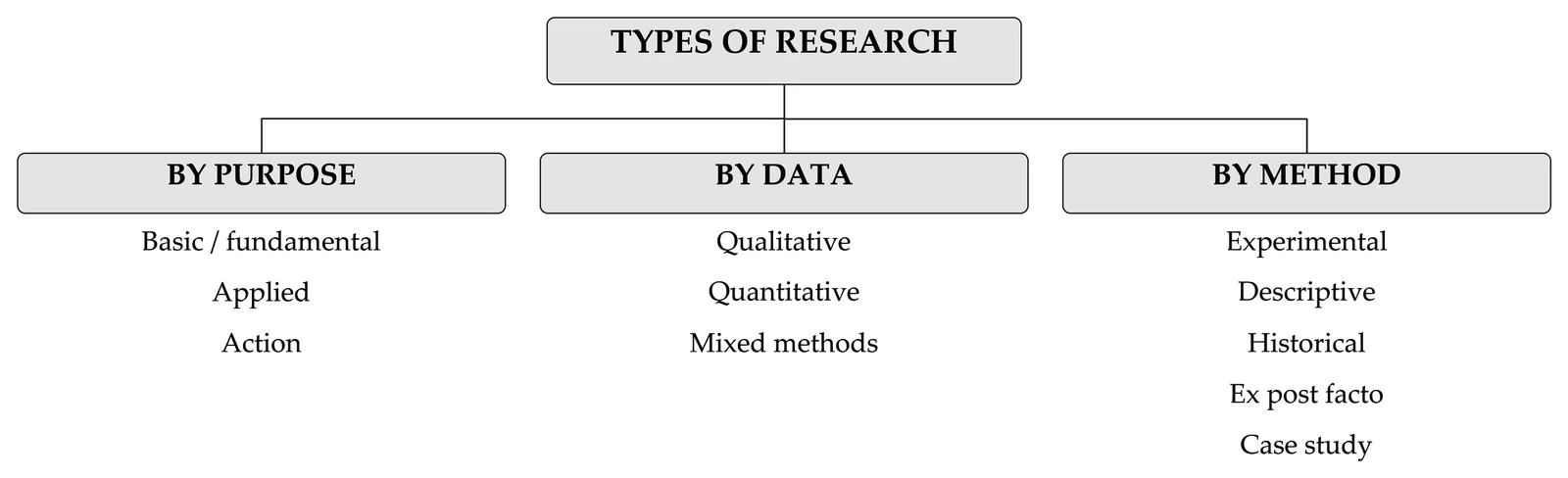
By purpose: basic, applied and action research
- Basic (fundamental or pure) research: done to add to knowledge and build theory, without an immediate practical use; for example, research on the nature of learning.
- Applied research: done to solve a practical problem of society or industry; for example, finding the best method to teach reading.
- Action research: done by practitioners, such as teachers, to solve an immediate problem in their own situation. The term was coined by Kurt Lewin (1946). It works in a cycle of plan, act, observe and reflect.
By data: qualitative, quantitative and mixed
Quantitative research collects numerical data and analyses it with statistics; it asks ‘how many’ and ‘how much’. Qualitative research collects words, pictures and observations and interprets meanings; it asks ‘why’ and ‘how’. Mixed methods research combines both, so that the weakness of one is covered by the strength of the other.
By method or design
- Exploratory research: a first study of a new or little-known problem to form hypotheses.
- Descriptive research: describes the present state of things, for example a survey of reading habits. It answers what is.
- Explanatory (analytical) research: explains why something happens, by analysing facts already available.
- Experimental (causal) research: the researcher manipulates the independent variable and controls other factors to see its effect on the dependent variable; it is the strongest design for cause and effect.
- Ex post facto research: literally after the fact; the cause is studied after the effect has already occurred, and the researcher cannot manipulate variables, for example studying the causes of school dropout.
- Historical research: studies past events using primary sources (original documents) and secondary sources; it uses external criticism (is the document genuine?) and internal criticism (is its content reliable?).
- Developmental research: studies changes over time, such as growth in children.
- Ethnography: the in-depth study of a culture by living among the people and using participant observation, a method made famous by Bronislaw Malinowski.
- Phenomenology: studies how people experience a phenomenon, following Edmund Husserl.
- Grounded theory: builds theory from the data itself rather than testing an existing theory; it was given by Barney Glaser and Anselm Strauss (1967).
2.4 Methods and Tools of Data Collection
Data are of two kinds: primary data, collected first hand by the researcher through observation, interviews, questionnaires or experiments, and secondary data, already collected by others, such as the Census, books and reports.
- Survey: collects information from a large number of people through questionnaires or interviews; good for describing opinions and trends.
- Case study: an in-depth study of one unit, such as a person, family, institution or village. Frederic Le Play is credited with bringing it into social science.
- Observation: watching behaviour directly. In participant observation the researcher joins the group; in non-participant observation he watches from outside.
- Questionnaire: a set of written questions that respondents fill in themselves. A schedule is similar, but it is filled in by an enumerator who asks the questions.
- Interview: a face-to-face or online conversation, which may be structured (fixed questions), semi-structured or unstructured.
- Sociometry: a technique by J.L. Moreno (1934) to study likes, dislikes and relations within a group, shown in a sociogram.
- Longitudinal study: follows the same group over a long time. Cross-sectional study: studies different groups at one point of time. A cross-sequential study combines the two.
- Cohort study: follows a group sharing a characteristic (for example, born in the same year). Case-control study: compares people with a condition (cases) with people without it (controls).
- Correlational study: measures how strongly two variables move together, without proving cause.
- Rating scales: the Likert scale (Rensis Likert, 1932) asks for agreement on a five-point scale; the Thurstone and Guttman scales and Bogardus’s social distance scale are other attitude scales.
2.5 Hypothesis, Variables and Sampling
A hypothesis is a tentative statement about the relationship between two or more variables, which the research will test. It must be clear, specific and testable. The null hypothesis (H0) says there is no relationship or difference; the alternative hypothesis (H1) says there is one. Research never ‘proves’ a hypothesis; it only rejects or fails to reject the null hypothesis at a chosen level of significance, usually 0.05 or 0.01.
- Type I error: rejecting a null hypothesis that is actually true (a false alarm). Its probability is the significance level (α).
- Type II error: accepting (failing to reject) a null hypothesis that is actually false (a miss). Its probability is β.
- Independent variable: the cause, which the researcher changes. Dependent variable: the effect, which is measured. Intervening variable: comes between them and explains the link. Extraneous variable: an outside factor that must be controlled.
Sampling
A population (universe) is the whole group under study; a sample is the part actually studied. A good sample is representative of the population. Sampling methods are of two kinds:
| Probability sampling (every unit has a known chance) | Non-probability sampling (chance not known) |
|---|---|
| Simple random: lottery or random numbers | Convenience: whoever is easily available |
| Systematic: every k-th unit from a list | Purposive (judgement): chosen by the researcher’s judgement |
| Stratified: population divided into strata, then random selection from each | Quota: a fixed number from each group, chosen non-randomly |
| Cluster: whole groups (such as villages) chosen at random | Snowball: each respondent leads to the next; used for hard-to-reach groups |
2.6 Steps of Research, Thesis and Article Writing
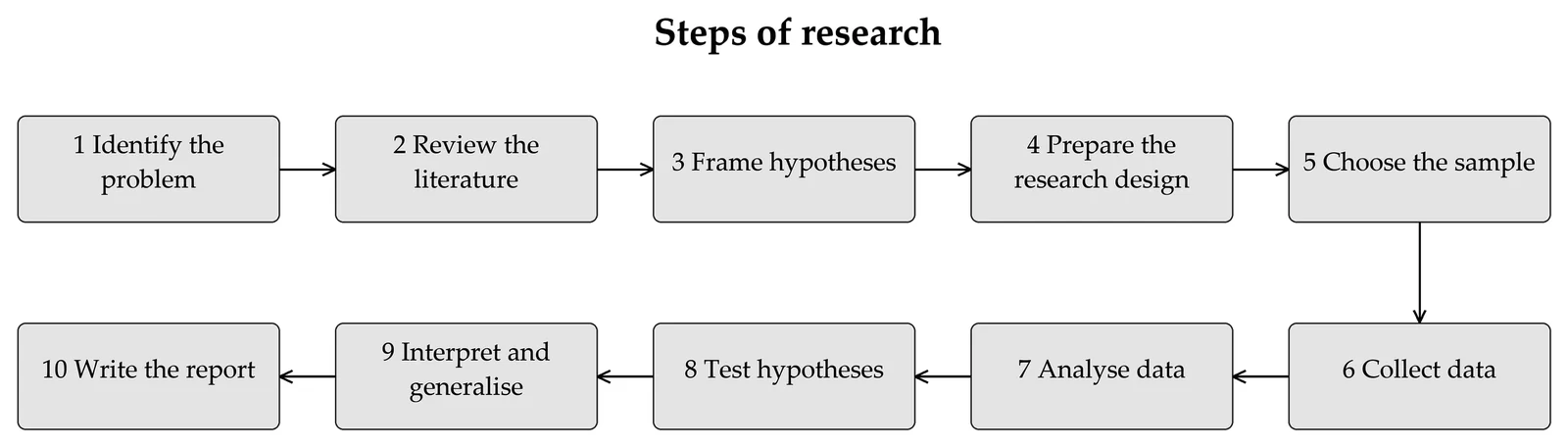
Research moves through ten steps: identifying the problem and objectives; a critical review of literature to see what is already known; formulating hypotheses; preparing the research design (the blueprint of the study); deciding the sample design; developing tools and collecting data; analysing data with suitable statistics or coding; testing hypotheses; interpreting results and drawing generalisations; and finally writing the report, thesis or article. A research proposal (synopsis) is written after the design is ready, to get approval or funding.
Structure of a thesis and a research article
A thesis has three parts: the preliminary pages (title page, declaration, certificate, acknowledgements, contents, list of tables and abstract); the main text (introduction, review of literature, methodology, analysis and results, discussion, and conclusion with suggestions); and the end matter (references or bibliography and appendices). A research article usually follows the IMRaD format: Introduction, Methods, Results and Discussion, with an abstract (a short summary of about 150–250 words) and keywords at the beginning.
Referencing styles and footnote terms
- APA style (American Psychological Association): author–date system, for example (Kothari, 2004); common in social sciences and education. Its 7th edition appeared in 2019.
- MLA style (Modern Language Association): author–page system, for example (Kothari 45); common in literature and humanities.
- Chicago style: offers a notes-and-bibliography system (footnotes) used in history, and an author–date system.
- Footnote (at the foot of the page) and endnote (at the end of the chapter or book) give sources; a bibliography lists all works consulted, while a reference list gives only the works cited.
- Ibid. = in the same place, i.e. the same source as the note just before. Op. cit. = in the work cited earlier (not immediately before). Loc. cit. = in the place cited, i.e. the same page of a work cited earlier. Et al. = and others. Cf. = compare. Viz. = namely.
2.7 ICT in Research and Research Ethics
Information and communication technology helps at every stage of research: searching literature in online databases and journals; collecting data through online surveys (for example Google Forms); analysing data with software such as SPSS, R, Excel and qualitative tools such as NVivo and ATLAS.ti; managing references with Zotero, Mendeley or EndNote; checking plagiarism; and sharing results through online journals and repositories.
- INFLIBNET (Information and Library Network) runs Shodhganga (theses), Shodhgangotri (synopses), e-ShodhSindhu (access to e-journals for universities) and IRINS (research information of faculty).
- ShodhShuddhi (2019) is the Ministry of Education’s initiative that gives universities access to plagiarism-detection software through INFLIBNET.
- NASSDOC is the documentation centre of the ICSSR (Indian Council of Social Science Research, 1969). NISCAIR was CSIR’s science communication institute; in 2021 it was merged with NISTADS to form CSIR-NIScPR.
- Funding bodies: UGC, ICSSR, ICHR (history), ICPR (philosophy), CSIR, DST and others sponsor research projects and fellowships such as the JRF.
Research ethics
Research ethics are the moral rules that make research honest and respectful. The main ethical duties are: informed consent of participants; voluntary participation and the right to withdraw; confidentiality and anonymity; avoiding harm; honesty in data, i.e. no fabrication (inventing data), falsification (changing data) or plagiarism (using others’ words or ideas without credit); proper authorship; and declaring any conflict of interest.
| Level | Similarity | Meaning |
|---|---|---|
| Level 0 | up to 10% | minor similarity, no penalty |
| Level 1 | above 10% to 40% | revise and resubmit within a set time |
| Level 2 | above 40% to 60% | debarred from resubmitting for one year |
| Level 3 | above 60% | registration cancelled |
Thus, good research is systematic, honest and useful. If you remember the types, the steps, the meaning of the terms (hypothesis, sample, ibid., op. cit.) and the ethical rules, this unit can give you full marks.
2.8 Quiz: 20 Practice MCQs
Test yourself with these 20 exam-pattern questions. Choose your answer first, then tap Show answer to check it and read the short explanation.
Question 1
The idea of a ‘paradigm shift’ in science was made popular by:
- Karl Popper
- Thomas Kuhn
- Auguste Comte
- Max Weber
Show answer
Answer: (b) Thomas Kuhn. Kuhn, The Structure of Scientific Revolutions (1962)
Question 2
Who said that a scientific theory can never be finally proved, only falsified?
- Auguste Comte
- Emile Durkheim
- Thomas Kuhn
- Karl Popper
Show answer
Answer: (d) Karl Popper. Falsifiability is Popper’s test of a scientific statement
Question 3
A teacher studies why students in her own class do not submit homework and tries a new plan to solve it. This is:
- basic research
- action research
- historical research
- ex post facto research
Show answer
Answer: (b) action research. Action research is done by practitioners to solve an immediate problem in their own setting
Question 4
In which research does the investigator study the cause after the effect has already occurred, without manipulating any variable?
- Experimental research
- Action research
- Ex post facto research
- Developmental research
Show answer
Answer: (c) Ex post facto research. Ex post facto means ‘after the fact’
Question 5
Match List I with List II.
| List I | List II |
|---|---|
| A. Sociometry | I. Kurt Lewin |
| B. Grounded theory | II. Rensis Likert |
| C. Action research (term) | III. J.L. Moreno |
| D. Five-point attitude scale | IV. Glaser and Strauss |
- A-III, B-I, C-IV, D-II
- A-II, B-IV, C-I, D-III
- A-III, B-IV, C-II, D-I
- A-III, B-IV, C-I, D-II
Show answer
Answer: (d) A-III, B-IV, C-I, D-II. Moreno (sociometry), Glaser and Strauss (grounded theory), Lewin (action research), Likert (scale)
Question 6
Rejecting a null hypothesis when it is actually true is called:
- Type I error
- Type II error
- standard error
- sampling error
Show answer
Answer: (a) Type I error. Type I is a false alarm; Type II is accepting a false null hypothesis
Question 7
Which of the following is a probability sampling method?
- Snowball sampling
- Quota sampling
- Stratified random sampling
- Purposive sampling
Show answer
Answer: (c) Stratified random sampling. In stratified random sampling every unit has a known chance of selection
Question 8
Snowball sampling is most suitable when:
- the population is large and fully listed
- members are hard to reach but know one another
- every member must have an equal chance
- the population is divided into strata
Show answer
Answer: (b) members are hard to reach but know one another. Each respondent leads the researcher to the next, as with hidden or rare groups
Question 9
Arrange these steps of research in the correct order.
- Formulating hypotheses
- Review of literature
- Identifying the research problem
- Data collection
- Report writing
- III, II, I, IV, V
- II, III, I, IV, V
- III, I, II, IV, V
- I, III, II, IV, V
Show answer
Answer: (a) III, II, I, IV, V. Problem, literature review, hypotheses, data collection, report
Question 10
Assertion (A): A study that follows the same group of people for many years is a longitudinal study. Reason (R): Cross-sectional studies collect data from different groups at one point of time.
- Both A and R are true, and R is the correct explanation of A
- Both A and R are true, but R is not the correct explanation of A
- A is true, but R is false
- A is false, but R is true
Show answer
Answer: (b) Both A and R are true, but R is not the correct explanation of A. Both statements are true, but R defines a different design, so it does not explain A
Question 11
In a footnote, ‘Ibid.’ means:
- in the work cited earlier
- in the same place, i.e. the source just cited
- and others
- compare
Show answer
Answer: (b) in the same place, i.e. the source just cited. Op. cit. = work cited earlier; et al. = and others; cf. = compare
Question 12
Which referencing style uses the author-date format and is widely used in social sciences and education?
- APA
- MLA
- Chicago notes-bibliography
- Vancouver
Show answer
Answer: (a) APA. APA is author-date; MLA is author-page; Vancouver is numbered
Question 13
The IMRaD structure of a research article stands for:
- Ideas, Methods, Review and Data
- Introduction, Model, Results and Data
- Introduction, Methods, Results and Discussion
- Issue, Method, Research and Discussion
Show answer
Answer: (c) Introduction, Methods, Results and Discussion. IMRaD is the standard format of scientific articles
Question 14
Shodhganga, the repository of Indian PhD theses, is maintained by:
- NASSDOC
- NISCAIR
- NAAC
- INFLIBNET
Show answer
Answer: (d) INFLIBNET. INFLIBNET, Gandhinagar, maintains Shodhganga and Shodhgangotri
Question 15
Under the UGC plagiarism regulations of 2018, which statement is correct?
- Level 0 is similarity up to 10%, with no penalty
- Level 1 is similarity up to 10%
- Level 3 is similarity from 40% to 60%
- Level 2 is similarity above 60%
Show answer
Answer: (a) Level 0 is similarity up to 10%, with no penalty. Level 0 up to 10%, Level 1 10-40%, Level 2 40-60%, Level 3 above 60%
Question 16
Consider these statements about hypotheses:
- A hypothesis is a tentative statement to be tested.
- A null hypothesis states that there is no relationship or difference.
- A hypothesis must be proved true for research to be valid.
- I only
- II and III only
- I, II and III
- I and II only
Show answer
Answer: (d) I and II only. Research is valid even if the hypothesis is rejected; III is wrong
Question 17
‘Fabrication’ in research means:
- changing real data to fit the results
- copying another’s words without credit
- inventing data that were never collected
- publishing the same paper twice
Show answer
Answer: (c) inventing data that were never collected. Changing data is falsification; copying is plagiarism; publishing twice is duplicate publication
Question 18
Which index was proposed by Jorge Hirsch in 2005 to measure a researcher’s output and citations?
- Impact factor
- i10-index
- CiteScore
- h-index
Show answer
Answer: (d) h-index. Garfield proposed the impact factor; the i10-index is Google Scholar’s
Question 19
A researcher lives in a tribal village for a year, takes part in daily life and records the culture. This is:
- ethnography with participant observation
- a survey
- an experiment
- content analysis
Show answer
Answer: (a) ethnography with participant observation. Ethnography studies a culture from inside through participant observation
Question 20
In an experiment, the variable that the researcher changes or manipulates is the:
- dependent variable
- intervening variable
- independent variable
- extraneous variable
Show answer
Answer: (c) independent variable. The independent variable is the cause; the dependent variable is the measured effect
More notes: UGC NET Paper 1: Teaching and Research Aptitude
These notes are prepared by PADHO TO AISE for study help. They are not an official publication.