
UGC NET UGC NET Paper 1: Teaching and Research Aptitude
Unit 6 · 16 min read · Updated 26 Nov 2026
As per the UGC NET syllabus notified by the National Testing Agency (NTA)
Contents
- 6.1 Arguments: Deductive and Inductive Reasoning
- 6.2 Categorical Propositions and the Square of Opposition
- Immediate inference: conversion and obversion
- 6.3 Syllogism, Mood and Figure, and Venn Diagrams
- Solving statement–conclusion questions with Venn diagrams
- Conditional propositions
- 6.4 Analogy, Connotation and Denotation, and Uses of Language
- 6.5 Formal and Informal Fallacies
- 6.6 Indian Logic: Pramanas, Anumana and Hetvabhasas
- Structure of anumana and vyapti
- Hetvabhasas: fallacies of inference
- 6.7 Quiz: 20 Practice MCQs
LOGICAL REASONING is the sixth unit of Paper 1. It studies how we draw correct conclusions from given statements. The questions look tricky, but they follow a few clear rules from Western logic (Aristotle’s categorical propositions and syllogisms) and Indian logic (the pramanas of the Nyaya and other schools). In this chapter we learn the structure of arguments, deductive and inductive reasoning, categorical propositions and the square of opposition, syllogisms with Venn diagrams, analogies, connotation and denotation, the uses of language, fallacies, and finally Indian logic: the six pramanas, anumana, vyapti and the hetvabhasas.
6.1 Arguments: Deductive and Inductive Reasoning
An argument is a group of statements in which some statements, called premises, are offered as reasons for another statement, called the conclusion. Words like therefore, hence, so, thus signal a conclusion, while because, since, for, as signal a premise. A statement is either true or false; an argument is either valid or invalid (in deduction) or strong or weak (in induction).
- Deductive argument: the conclusion is claimed to follow necessarily from the premises. If the premises are true and the form is valid, the conclusion must be true. All men are mortal; Socrates is a man; so Socrates is mortal.
- Inductive argument: the conclusion is claimed to follow only probably, because it goes beyond the premises. Every crow I have seen is black; so all crows are black. Induction is the basis of scientific generalisation.
- Validity and truth: validity concerns the form of the argument, not the truth of its statements. All cats are birds; all birds can fly; so all cats can fly is valid but its premises are false. A valid argument with all premises true is called sound.
6.2 Categorical Propositions and the Square of Opposition
A categorical proposition relates two classes, the subject (S) and the predicate (P). By quantity it is universal or particular; by quality it is affirmative or negative. This gives four standard forms, named by the vowels of the Latin words affirmo (I affirm) and nego (I deny):
| Form | Statement | Quantity and quality | Distributed term(s) |
|---|---|---|---|
| A | All S are P | universal affirmative | subject only |
| E | No S is P | universal negative | both subject and predicate |
| I | Some S are P | particular affirmative | neither |
| O | Some S are not P | particular negative | predicate only |
A term is distributed when the proposition says something about all members of its class. A simple rule: universals distribute the subject, negatives distribute the predicate.
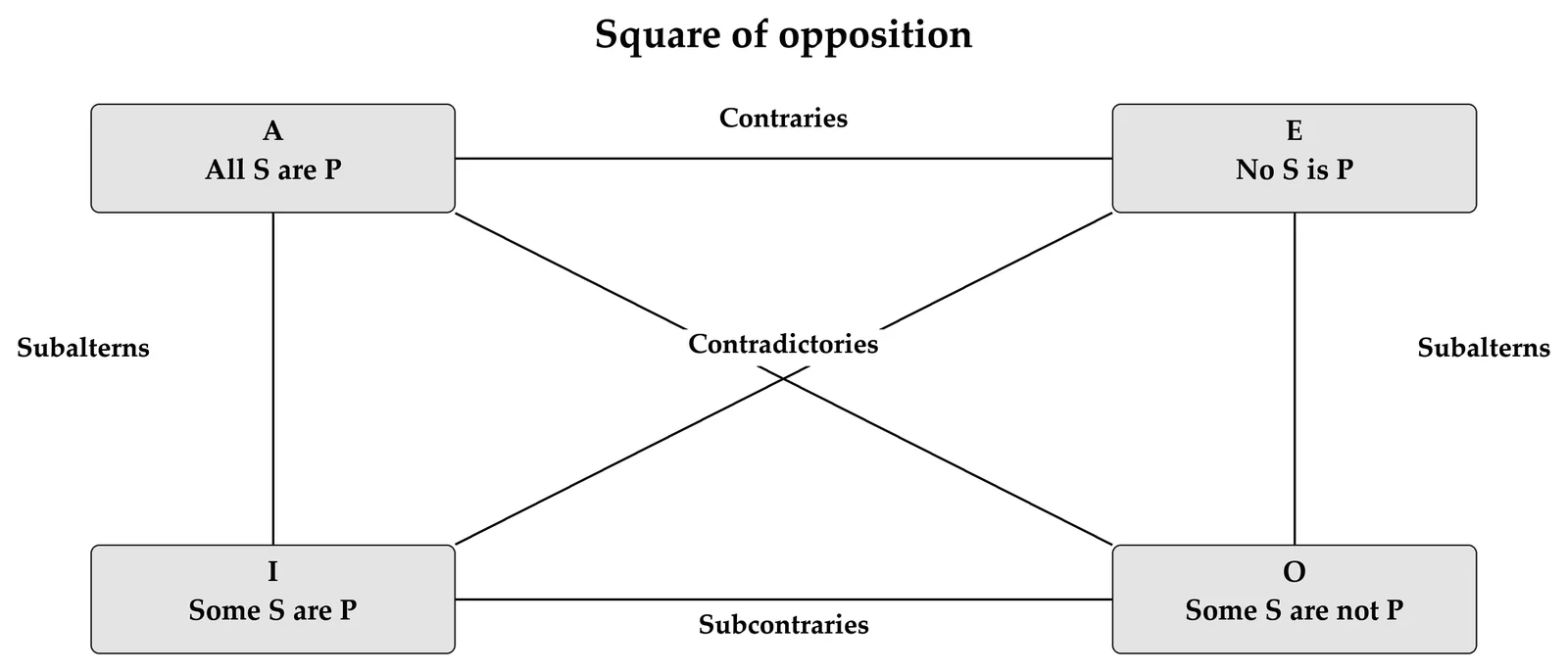
- Contradictories (A–O and E–I): they can neither both be true nor both be false. If one is true, the other is false.
- Contraries (A–E): they cannot both be true, but both can be false.
- Subcontraries (I–O): they cannot both be false, but both can be true.
- Subalterns (A–I and E–O): if the universal is true, the particular is true; if the particular is false, the universal is false. Otherwise the result is undetermined.
Immediate inference: conversion and obversion
Conversion interchanges subject and predicate. E and I convert simply (No S is P → No P is S; Some S are P → Some P are S); A converts only by limitation (All S are P → Some P are S); and O has no valid converse. Obversion changes the quality and replaces the predicate by its complement: All S are P becomes No S is non-P, and No S is P becomes All S are non-P.
6.3 Syllogism, Mood and Figure, and Venn Diagrams
A categorical syllogism is a deductive argument with two premises and one conclusion, containing exactly three terms: the major term (predicate of the conclusion), the minor term (subject of the conclusion) and the middle term, which appears in both premises but not in the conclusion. Its mood is the list of the forms of its propositions (for example AAA), and its figure is decided by the position of the middle term in the premises (four figures). The most famous valid form is Barbara (AAA in the first figure): All M are P; all S are M; so all S are P.
Solving statement–conclusion questions with Venn diagrams
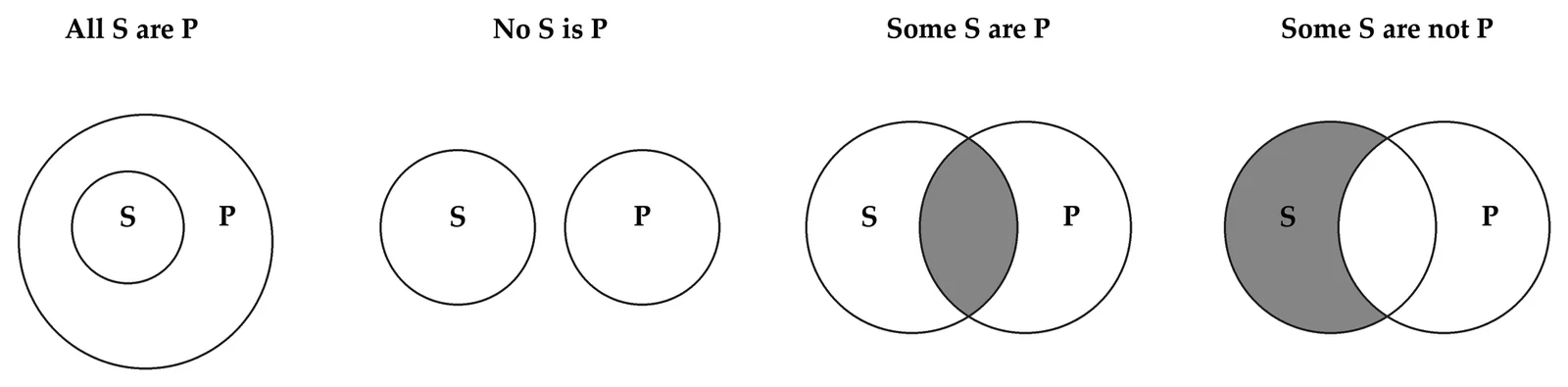
Draw the circles for each premise in the least possible overlap that the statement allows, then check whether a conclusion is true in every possible diagram. If it is true only in some diagrams, it does not follow. When neither of two conclusions follows definitely but one of them must be true (such as Some A are B and Some A are not B where nothing is certain), the answer is ‘either I or II follows’ (a complementary pair).
Conditional propositions
A conditional (hypothetical) proposition has the form If p, then q, where p is the antecedent and q the consequent. Two forms are valid: modus ponens (If p then q; p; so q) and modus tollens (If p then q; not q; so not p). Two forms are fallacies: affirming the consequent (If p then q; q; so p) and denying the antecedent (If p then q; not p; so not q).
6.4 Analogy, Connotation and Denotation, and Uses of Language
An argument from analogy concludes that because two things are alike in some respects, they are probably alike in another. The points of likeness are called the positive analogy and the points of difference the negative analogy. An analogy is stronger when the similarities are many and relevant to the conclusion, and when the differences are few and irrelevant.
Every general term has two kinds of meaning. Connotation (intension) is the set of qualities that the term implies, for example rational animal for man. Denotation (extension) is the set of objects to which it applies, i.e. all human beings. They vary inversely: as connotation increases, denotation decreases. Animal has a wider denotation than rational animal.
Irving Copi distinguished three main uses of language: informative (to give information, true or false), expressive (to express or arouse feelings, as in poetry) and directive (to cause or stop action, as in commands and requests). Language also has ceremonial uses (greetings) and performative uses (I promise, I declare the meeting open), in which saying something is doing it.
6.5 Formal and Informal Fallacies
A fallacy is an error in reasoning. Formal fallacies are errors in the form of an argument, such as the undistributed middle, illicit major or minor, affirming the consequent and denying the antecedent. Informal fallacies are errors in the content, language or relevance of an argument:
| Fallacy | What it does | Example |
|---|---|---|
| Ad hominem | attacks the person, not the argument | His view on tax is wrong; he failed his exams. |
| Ad populum (bandwagon) | appeals to popularity | Everyone is buying it, so it must be good. |
| Ad verecundiam | appeals to an unqualified authority | A film star says this medicine works. |
| Ad ignorantiam | true because not proved false | No one has proved ghosts do not exist, so they exist. |
| Ad misericordiam / ad baculum | appeals to pity / to force or threat | Pass me, I worked hard. / Agree or lose your job. |
| Straw man | distorts the opponent’s view, then attacks it | They want less defence spending, so they want us defenceless. |
| Red herring | changes the subject to distract | Why discuss pollution when there is unemployment? |
| Petitio principii (begging the question) | assumes what it should prove | God exists because the scripture says so, and the scripture is God’s word. |
| Post hoc ergo propter hoc | after this, therefore because of this | I wore a new shirt and passed, so the shirt brought luck. |
| Hasty generalisation | general rule from too few cases | Two shopkeepers cheated me, so all shopkeepers cheat. |
| Slippery slope / false dilemma | a chain of unlikely results / only two options when more exist | Either you agree with me or you are against the nation. |
| Composition / division | what is true of parts is true of the whole, or the reverse | Every player is excellent, so the team is excellent. |
6.6 Indian Logic: Pramanas, Anumana and Hetvabhasas
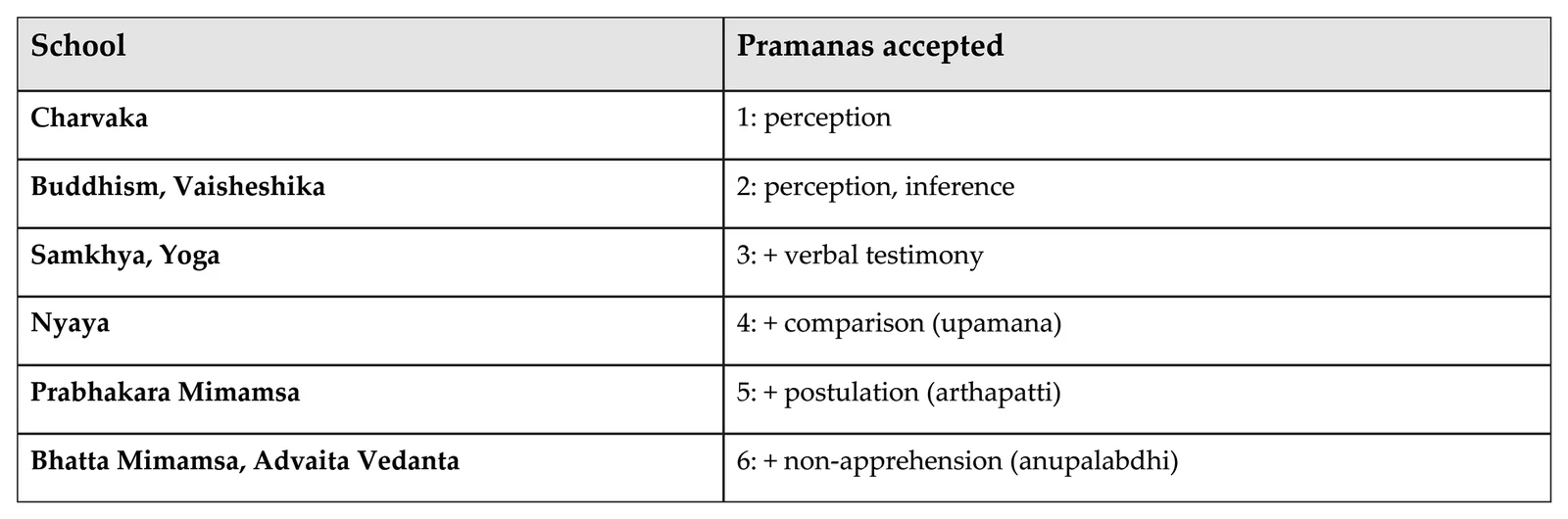
In Indian philosophy a pramana is a valid means of knowledge, prama is valid knowledge, pramata is the knower and prameya is the object known. The schools differ on how many pramanas they accept:
- Pratyaksha (perception): knowledge through the contact of the senses with an object. Nyaya divides it into nirvikalpaka (indeterminate, without name or quality) and savikalpaka (determinate, with name and quality).
- Anumana (inference): knowledge of something through a sign (linga) that is invariably connected with it.
- Upamana (comparison): knowledge of a thing through its similarity to a known thing; a city dweller told that a wild cow (gavaya) looks like a cow recognises it in the forest.
- Shabda (verbal testimony): knowledge from the words of a reliable person (apta); it may be laukika (worldly) or vaidika (scriptural).
- Arthapatti (postulation or presumption): assuming a fact to explain something otherwise unexplainable: fat Devadatta does not eat by day, so he must eat at night.
- Anupalabdhi (non-apprehension): knowing the absence of a thing from its non-perception: there is no jar on the table.
Structure of anumana and vyapti
Every inference has three terms: the paksha (minor term, the subject about which we infer, e.g. the hill), the sadhya (major term, what we infer, e.g. fire) and the hetu or linga (middle term, the reason, e.g. smoke). The basis of inference is vyapti, i.e. the invariable concomitance between hetu and sadhya: wherever there is smoke, there is fire. Inference is svartha (for oneself) or parartha (for others). The inference for others is stated in the Nyaya five-membered syllogism (panchavayava):
Nyaya also classifies inference as purvavat (from cause to effect: dark clouds, so rain will come), sheshavat (from effect to cause: the river is flooded, so it rained upstream) and samanyatodrishta (from general observation, not causal).
Hetvabhasas: fallacies of inference
A hetvabhasa is a reason that looks valid but is not. Nyaya lists five: savyabhichara (irregular or inconclusive: the reason goes with both the sadhya and its absence), viruddha (contradictory: the reason proves the opposite), satpratipaksha (counter-balanced by another equally strong reason), asiddha (unproved: the reason itself is not established) and badhita (contradicted by another, stronger pramana such as perception).
Thus, logical reasoning is a matter of rules, not guesswork. Learn the four propositions, the square, the syllogism rules, the common fallacies and the six pramanas, and practise with Venn diagrams; then this unit becomes one of the quickest to solve.
6.7 Quiz: 20 Practice MCQs
Test yourself with these 20 exam-pattern questions. Choose your answer first, then tap Show answer to check it and read the short explanation.
Question 1
‘All S are P’ is which type of categorical proposition?
- A
- E
- I
- O
Show answer
Answer: (a) A. A = universal affirmative
Question 2
In an E proposition (‘No S is P’), which terms are distributed?
- Subject only
- Predicate only
- Neither
- Both subject and predicate
Show answer
Answer: (d) Both subject and predicate. Universals distribute the subject and negatives distribute the predicate
Question 3
Two propositions that cannot both be true but can both be false are called:
- contradictories
- contraries
- subcontraries
- subalterns
Show answer
Answer: (b) contraries. A and E are contraries
Question 4
If ‘All teachers are honest’ is true, which of the following must be false?
- Some teachers are honest.
- Some honest persons are teachers.
- Some teachers are not honest.
- All honest persons are teachers.
Show answer
Answer: (c) Some teachers are not honest.. The O proposition contradicts the A proposition; the last option is undetermined
Question 5
The valid converse of ‘No politician is a saint’ is:
- All saints are politicians.
- Some saints are politicians.
- No saint is a politician.
- Some politicians are not saints.
Show answer
Answer: (c) No saint is a politician.. An E proposition converts simply
Question 6
Statements: All pens are books. All books are tables. Conclusions: I. All pens are tables. II. Some tables are pens.
- Only I follows
- Only II follows
- Neither I nor II follows
- Both I and II follow
Show answer
Answer: (d) Both I and II follow. I follows (Barbara), and II is the converse of I by limitation
Question 7
Statements: Some cats are dogs. No dog is a rat. Conclusions: I. Some cats are not rats. II. No cat is a rat.
- Only I follows
- Only II follows
- Both I and II follow
- Neither I nor II follows
Show answer
Answer: (a) Only I follows. I + E gives O: the cats that are dogs are not rats; other cats are uncertain
Question 8
The figure of a categorical syllogism is decided by:
- the quality of the premises
- the quantity of the premises
- the number of premises
- the position of the middle term
Show answer
Answer: (d) the position of the middle term. Mood is the list of forms; figure is the position of the middle term
Question 9
‘If it rains, the ground is wet. The ground is wet. So it rained.’ This is the fallacy of:
- denying the antecedent
- affirming the consequent
- undistributed middle
- illicit major
Show answer
Answer: (b) affirming the consequent. The ground may be wet for another reason
Question 10
Attacking the person who makes an argument instead of the argument itself is called:
- argumentum ad populum
- argumentum ad verecundiam
- argumentum ad baculum
- argumentum ad hominem
Show answer
Answer: (d) argumentum ad hominem. Ad hominem means ‘against the person’
Question 11
‘Everyone is buying this phone, so it must be the best.’ This commits the fallacy of:
- ad populum (bandwagon)
- ad misericordiam
- red herring
- straw man
Show answer
Answer: (a) ad populum (bandwagon). It appeals to popularity
Question 12
Match List I with List II.
| List I | List II |
|---|---|
| A. Post hoc ergo propter hoc | I. Assuming what is to be proved |
| B. Petitio principii | II. Misrepresenting an opponent’s view |
| C. Ad ignorantiam | III. True because not proved false |
| D. Straw man | IV. B followed A, so A caused B |
- A-IV, B-III, C-I, D-II
- A-IV, B-I, C-III, D-II
- A-I, B-IV, C-III, D-II
- A-II, B-I, C-III, D-IV
Show answer
Answer: (b) A-IV, B-I, C-III, D-II. Post hoc = false cause; petitio principii = begging the question
Question 13
As the connotation of a term increases, its denotation:
- increases
- remains the same
- decreases
- doubles
Show answer
Answer: (c) decreases. Connotation and denotation vary inversely
Question 14
How many pramanas does the Charvaka school accept?
- Two
- Three
- Four
- One
Show answer
Answer: (d) One. Charvaka accepts only perception (pratyaksha)
Question 15
In Indian logic, ‘arthapatti’ means:
- perception
- comparison
- postulation (presumption)
- non-apprehension
Show answer
Answer: (c) postulation (presumption). Fat Devadatta does not eat by day, so he must eat at night
Question 16
In the inference ‘The hill has fire because it has smoke’, the hetu (middle term) is:
- the hill
- fire
- smoke
- the kitchen
Show answer
Answer: (c) smoke. Hill = paksha, fire = sadhya, smoke = hetu
Question 17
The invariable concomitance between the hetu and the sadhya is called:
- paksha
- vyapti
- upanaya
- nigamana
Show answer
Answer: (b) vyapti. Vyapti is the basis of every inference
Question 18
Arrange the five members of the Nyaya syllogism in the correct order.
- Udaharana
- Pratijna
- Nigamana
- Hetu
- Upanaya
- II, IV, I, V, III
- IV, II, I, V, III
- II, I, IV, V, III
- II, IV, V, I, III
Show answer
Answer: (a) II, IV, I, V, III. Pratijna, hetu, udaharana, upanaya, nigamana
Question 19
Assertion (A): An argument can be valid even if its premises are false. Reason (R): Validity depends only on whether the conclusion follows from the premises, i.e. on the form of the argument.
- Both A and R are true, and R is the correct explanation of A
- Both A and R are true, but R is not the correct explanation of A
- A is true, but R is false
- A is false, but R is true
Show answer
Answer: (a) Both A and R are true, and R is the correct explanation of A. Validity is about form; truth of premises decides soundness
Question 20
Consider these statements:
- In a valid deductive argument with true premises, the conclusion must be true.
- The conclusion of an inductive argument is only probable.
- Inductive arguments are judged as valid or invalid.
- I only
- I and II only
- II and III only
- I, II and III
Show answer
Answer: (b) I and II only. Inductive arguments are judged as strong or weak, not valid or invalid
More notes: UGC NET Paper 1: Teaching and Research Aptitude
These notes are prepared by PADHO TO AISE for study help. They are not an official publication.