
UGC NET UGC NET Paper 1: Teaching and Research Aptitude
Unit 9 · 14 min read · Updated 26 Nov 2026
As per the UGC NET syllabus notified by the National Testing Agency (NTA)
Contents
- 9.1 Development, Sustainable Development, MDGs and SDGs
- Millennium Development Goals (2000–2015)
- Sustainable Development Goals (2015–2030)
- 9.2 Human–Environment Interaction and Environmental Issues
- 9.3 Pollution, Waste and Their Effects on Health
- Kinds of waste
- 9.4 Climate Change and Its Dimensions
- 9.5 Natural and Energy Resources
- 9.6 Natural Hazards and Disaster Management
- 9.7 Environmental Laws and International Agreements
- 9.8 Quiz: 20 Practice MCQs
सतत विकास वह विकास है जो भविष्य की पीढ़ियों की अपनी आवश्यकताएँ पूरी करने की क्षमता से समझौता किए बिना वर्तमान की आवश्यकताओं को पूरा करता है।
Sustainable development is development that meets the needs of the present without compromising the ability of future generations to meet their own needs.
— World Commission on Environment and Development, Our Common Future (1987)
PEOPLE, DEVELOPMENT AND ENVIRONMENT is the ninth unit of Paper 1 and gives about 5 questions every year, many of them on dates, conventions and laws. The unit asks one big question: how can people develop without destroying the environment on which they depend? We study development and sustainable development, the Millennium and Sustainable Development Goals, the impact of human activities on the environment, pollution and waste, climate change, natural and energy resources, natural hazards and disaster management, and finally the laws and international agreements that protect the environment.
9.1 Development, Sustainable Development, MDGs and SDGs
Economic growth means an increase in a country’s output and income (GDP). Development is wider: it means better health, education, freedom and quality of life for people. The Human Development Index (HDI), first published by the UNDP in 1990 under the guidance of Mahbub ul Haq with ideas from Amartya Sen, measures development through three dimensions: a long and healthy life, knowledge and a decent standard of living.
Sustainable development was defined by the Brundtland Commission in its report Our Common Future (1987) as development that meets the needs of the present without compromising the ability of future generations to meet their own needs. It rests on three pillars: economic growth, social equity and environmental protection.
Millennium Development Goals (2000–2015)
The MDGs were adopted after the UN Millennium Summit of 2000 and had 8 goals to be achieved by 2015: (1) eradicate extreme poverty and hunger; (2) achieve universal primary education; (3) promote gender equality and empower women; (4) reduce child mortality; (5) improve maternal health; (6) combat HIV/AIDS, malaria and other diseases; (7) ensure environmental sustainability; and (8) develop a global partnership for development.
Sustainable Development Goals (2015–2030)
In September 2015 the UN adopted the 2030 Agenda for Sustainable Development with 17 goals and 169 targets. Unlike the MDGs, the SDGs are universal: they apply to all countries, rich and poor. The 17 goals are: no poverty; zero hunger; good health and well-being; quality education; gender equality; clean water and sanitation; affordable and clean energy; decent work and economic growth; industry, innovation and infrastructure; reduced inequalities; sustainable cities and communities; responsible consumption and production; climate action; life below water; life on land; peace, justice and strong institutions; and partnerships for the goals. In India, NITI Aayog monitors progress through the SDG India Index.
9.2 Human–Environment Interaction and Environmental Issues
Human beings depend on the environment for air, water, food and raw materials, and they change it through their activities. Changes caused by human beings are called anthropogenic. The main anthropogenic activities that harm the environment are deforestation, urbanisation, industrialisation, mining, intensive agriculture (with chemical fertilisers and pesticides), transport and the burning of fossil fuels. Their effects include loss of forests and wildlife, soil erosion, falling groundwater, pollution and climate change.
- Local issues: garbage, noise, polluted ponds and local air pollution in a town.
- Regional issues: river pollution, acid rain (from sulphur and nitrogen oxides), desertification and smog over a region.
- Global issues: climate change, ozone layer depletion, biodiversity loss and pollution of the oceans, which no country can solve alone.
9.3 Pollution, Waste and Their Effects on Health
Pollution is the addition of harmful substances or energy to the environment. The main types are:
- Air pollution: caused by particulate matter (PM10 and PM2.5), sulphur dioxide, nitrogen dioxide, carbon monoxide, ground-level ozone, ammonia and lead. India’s National Air Quality Index (2014) reports these eight pollutants on a scale from good to severe. Air pollution causes asthma, lung and heart diseases.
- Water pollution: caused by sewage, industrial effluents and farm run-off. BOD (biochemical oxygen demand) measures organic pollution: the higher the BOD, the more polluted the water. Excess nutrients cause eutrophication, i.e. algal blooms that kill fish.
- Soil pollution: from chemical fertilisers, pesticides, industrial waste and plastics, which reduce fertility and enter the food chain.
- Noise pollution: measured in decibels (dB). India’s Noise Pollution (Regulation and Control) Rules, 2000 declare areas of at least 100 metres around hospitals, schools and courts as silence zones.
- Thermal and radioactive pollution: hot water from power plants lowers oxygen in rivers; radiation from nuclear waste or accidents damages living cells.
| Pollutant | Disease or effect |
|---|---|
| Mercury | Minamata disease (Japan) |
| Cadmium | Itai-itai disease (Japan) |
| Excess fluoride | fluorosis (teeth and bones) |
| Arsenic | arsenicosis, black foot disease |
| Nitrates in water | blue baby syndrome |
| Lead | damage to the brain and nerves, especially in children |
Kinds of waste
Solid waste (municipal garbage), liquid waste (sewage and effluents), biomedical waste (from hospitals), hazardous waste (toxic, flammable or corrosive industrial waste) and electronic waste (e-waste) (discarded phones and computers containing lead, mercury and cadmium) each need separate handling. Under the Bio-Medical Waste Management Rules, 2016, waste is separated by colour: yellow (anatomical and soiled waste, for incineration), red (contaminated recyclable plastics), white translucent (sharps such as needles) and blue (glassware). The key principle of waste management is the 3 Rs: reduce, reuse and recycle, and India banned many single-use plastic items from 1 July 2022.
9.4 Climate Change and Its Dimensions
Climate change is the long-term change in temperature and weather patterns, now driven mainly by human activities. Gases such as carbon dioxide, methane and nitrous oxide trap heat in the atmosphere (the greenhouse effect), so more of them means global warming. The Intergovernmental Panel on Climate Change (IPCC), set up in 1988 by the WMO and UNEP, assesses the science of climate change.
- Socio-economic dimensions: falling crop yields, heat stress, water scarcity, spread of diseases, damage to coasts from sea-level rise, and climate migration. The poor, who contribute least to emissions, suffer most.
- Political dimensions: who should cut emissions and who should pay. Developing countries argue for common but differentiated responsibilities (CBDR), i.e. all countries share the duty, but rich countries that polluted first must do more and help others with finance and technology. This is the idea of climate justice.
- India’s commitments: India has announced the goal of net-zero emissions by 2070, and its updated targets for 2030 include reducing the emissions intensity of GDP by 45% from the 2005 level and getting about half of its installed power capacity from non-fossil sources.
9.5 Natural and Energy Resources
Natural resources are materials from nature that people use. Renewable resources are replaced naturally (sunlight, wind, water, forests if managed well), while non-renewable resources take millions of years to form and get exhausted (coal, petroleum, natural gas, minerals).
| Source | Type | Note |
|---|---|---|
| Solar | renewable | India’s fastest-growing source; photovoltaic panels and solar thermal |
| Wind | renewable | large farms in Tamil Nadu, Gujarat and other coastal and plateau states |
| Hydro | renewable | clean, but large dams can displace people and harm rivers |
| Geothermal | renewable | heat from inside the earth; potential sites such as Puga valley in Ladakh |
| Biomass and biogas | renewable | from crop waste, dung and wood; useful in villages |
| Nuclear | non-renewable (uranium, thorium) | low carbon, but raises safety and waste concerns |
| Coal, oil, gas | non-renewable (fossil fuels) | main source of greenhouse gases |
Forests give timber, fuel, medicines and livelihoods, control floods and soil erosion, and absorb carbon. India’s National Forest Policy (1988) set a goal of having one-third of the country’s area under forest or tree cover, and the Forest Survey of India reports the forest cover every two years in the India State of Forest Report.
9.6 Natural Hazards and Disaster Management
A hazard is a natural or human-made event that can cause harm, such as an earthquake or cyclone. It becomes a disaster when it seriously disrupts a community and causes losses beyond its capacity to cope. Vulnerability (how exposed and weak a community is) and capacity (its ability to cope) decide how large the damage will be.
- Earthquakes are sudden shaking of the ground; their magnitude is measured on the Richter (or moment magnitude) scale. Tsunamis are giant sea waves, usually caused by undersea earthquakes, like the Indian Ocean tsunami of 26 December 2004.
- Tropical cyclones have different names: hurricanes in the Atlantic and north-east Pacific, typhoons in the north-west Pacific and cyclones in the Indian Ocean.
- Floods, droughts, landslides, heat waves and cloudbursts are other common hazards in India, made worse by deforestation and climate change.
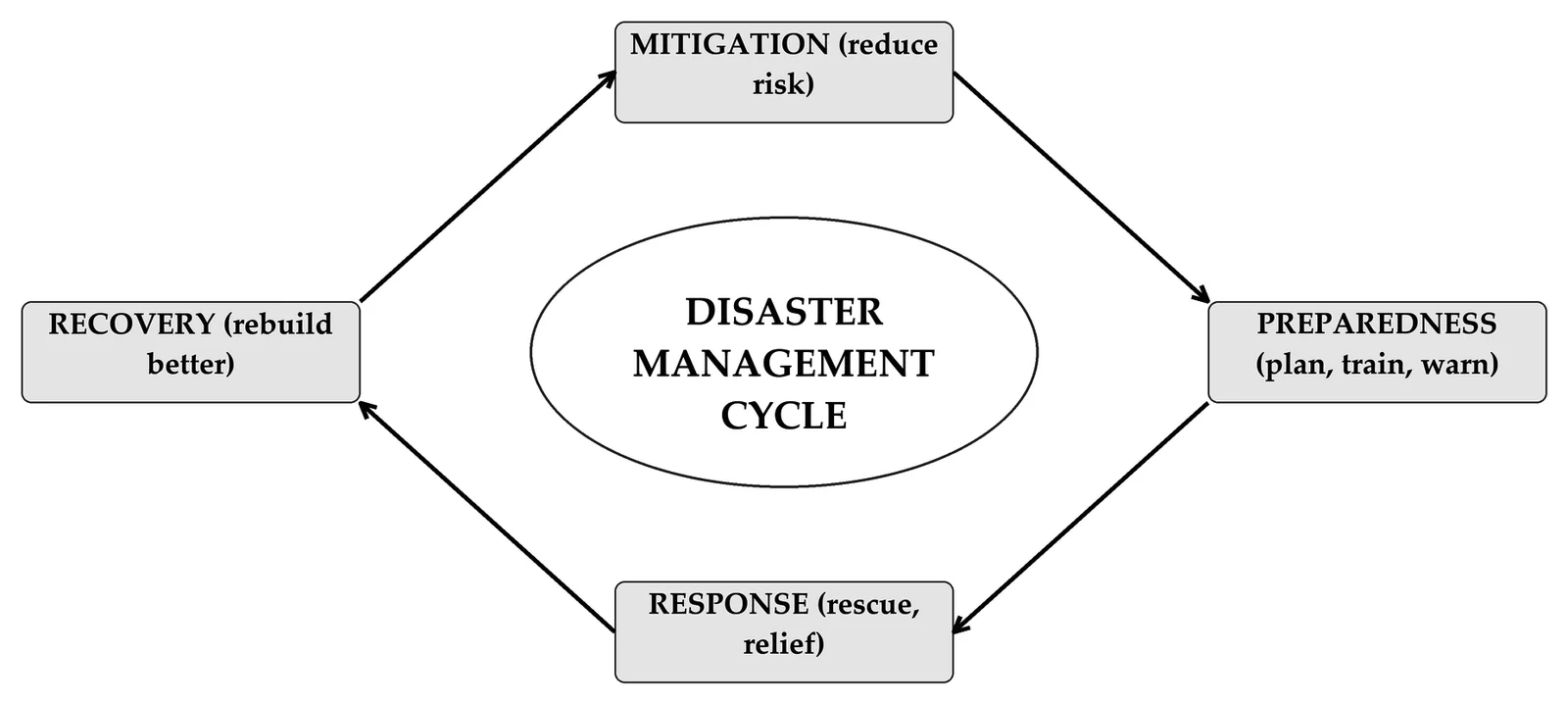
India’s Disaster Management Act, 2005 created the National Disaster Management Authority (NDMA), chaired by the Prime Minister, with state and district authorities under it. The National Disaster Response Force (NDRF) handles specialised rescue, and the National Institute of Disaster Management (NIDM) trains and researches. Internationally, the Sendai Framework for Disaster Risk Reduction (2015–2030) replaced the Hyogo Framework (2005–2015).
9.7 Environmental Laws and International Agreements
| Year | Law or policy |
|---|---|
| 1972 | Wild Life (Protection) Act |
| 1974 | Water (Prevention and Control of Pollution) Act |
| 1980 | Forest (Conservation) Act |
| 1981 | Air (Prevention and Control of Pollution) Act |
| 1986 | Environment (Protection) Act, passed after the Bhopal gas tragedy of 1984 |
| 2002 | Biological Diversity Act |
| 2006 | Forest Rights Act |
| 2008 | National Action Plan on Climate Change (8 national missions) |
| 2010 | National Green Tribunal Act |
The National Action Plan on Climate Change (NAPCC) of 2008 has eight missions: Solar; Enhanced Energy Efficiency; Sustainable Habitat; Water; Sustaining the Himalayan Ecosystem; Green India; Sustainable Agriculture; and Strategic Knowledge for Climate Change.
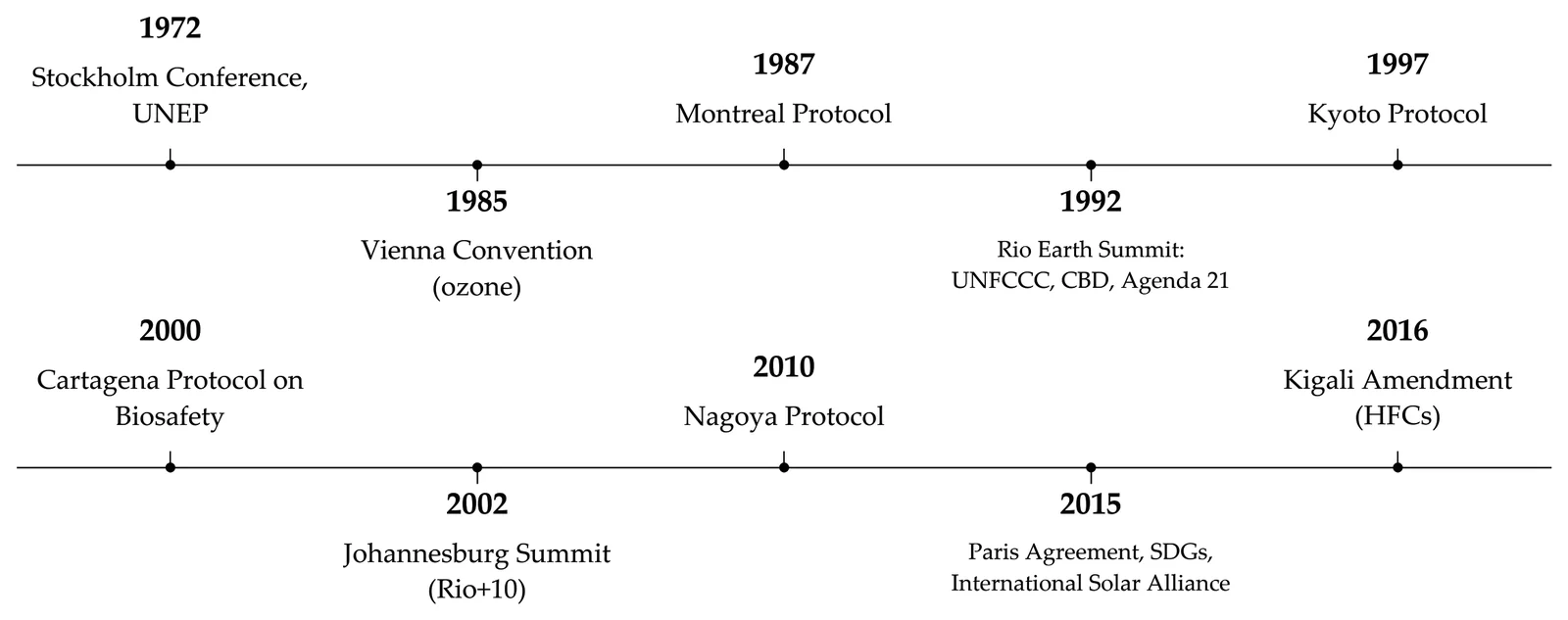
- Stockholm Conference (1972): the first UN conference on the human environment; it led to the creation of UNEP. 5 June is World Environment Day.
- Montreal Protocol (1987): phases out ozone-depleting substances such as CFCs; it followed the Vienna Convention (1985) and is often called the most successful environmental treaty. The Kigali Amendment (2016) added HFCs.
- Rio Earth Summit (1992): gave the UNFCCC (climate), the Convention on Biological Diversity (CBD), Agenda 21 and the Rio Declaration.
- Kyoto Protocol (1997): set binding emission targets for developed countries, with market mechanisms such as carbon trading.
- Cartagena Protocol (2000): on biosafety, i.e. the safe movement of living modified organisms. Nagoya Protocol (2010): on access and benefit sharing of genetic resources. Both are under the CBD.
- Paris Agreement (2015): all countries submit Nationally Determined Contributions (NDCs) to keep warming well below 2 °C and try to limit it to 1.5 °C.
- International Solar Alliance (2015): launched by India and France at the Paris climate conference to promote solar energy; its headquarters is in Gurugram, India.
- Other conventions: Ramsar (1971, wetlands), CITES (1973, trade in endangered species), Basel (1989, movement of hazardous waste) and Stockholm Convention (2001, persistent organic pollutants).
Thus, this unit connects people, development and the planet. Development that ignores the environment is not sustainable, and environmental protection that ignores people is not just. Remember the goals, the laws, the conventions and their years, and you will score well in this unit.
9.8 Quiz: 20 Practice MCQs
Test yourself with these 20 exam-pattern questions. Choose your answer first, then tap Show answer to check it and read the short explanation.
Question 1
How many Sustainable Development Goals (SDGs) were adopted by the UN in 2015?
- 15
- 17
- 8
- 169
Show answer
Answer: (b) 17. 17 goals with 169 targets, to be achieved by 2030
Question 2
The Millennium Development Goals (MDGs) consisted of:
- 8 goals for 2000–2015
- 17 goals for 2015–2030
- 8 goals for 1990–2000
- 10 goals for 2000–2020
Show answer
Answer: (a) 8 goals for 2000–2015. They were adopted after the Millennium Summit of 2000
Question 3
The Brundtland Commission report of 1987, which defined sustainable development, is titled:
- Limits to Growth
- Silent Spring
- Our Common Future
- Agenda 21
Show answer
Answer: (c) Our Common Future. Our Common Future gave the best-known definition of sustainable development
Question 4
Minamata disease is caused by poisoning from:
- lead
- cadmium
- arsenic
- mercury
Show answer
Answer: (d) mercury. Cadmium causes itai-itai disease
Question 5
A high BOD (biochemical oxygen demand) in a river indicates:
- more organic pollution
- cleaner water
- more dissolved oxygen
- lower temperature
Show answer
Answer: (a) more organic pollution. Microbes use more oxygen to break down more organic waste
Question 6
The Montreal Protocol (1987) deals with:
- climate change
- biodiversity
- hazardous waste
- ozone-depleting substances
Show answer
Answer: (d) ozone-depleting substances. It phases out CFCs and other ozone-depleting substances
Question 7
Consider these statements about the International Solar Alliance:
- It was launched at the Paris climate conference in 2015 by India and France.
- Its headquarters is in India.
- It is an organ of the UN Security Council.
- I only
- I and II only
- II and III only
- I, II and III
Show answer
Answer: (b) I and II only. Its headquarters is in Gurugram; it is not a Security Council organ
Question 8
The Environment (Protection) Act of India was passed in:
- 1972
- 1981
- 1986
- 2002
Show answer
Answer: (c) 1986. It was passed after the Bhopal gas tragedy of 1984
Question 9
How many national missions does the National Action Plan on Climate Change (2008) have?
- 6
- 8
- 10
- 12
Show answer
Answer: (b) 8. From the Solar Mission to Strategic Knowledge for Climate Change
Question 10
The National Disaster Management Authority (NDMA) is chaired by:
- the President
- the Home Minister
- the Prime Minister
- the Chief Justice of India
Show answer
Answer: (c) the Prime Minister. Under the Disaster Management Act, 2005
Question 11
Tropical cyclones in the north-west Pacific Ocean are called:
- hurricanes
- typhoons
- willy-willies
- tornadoes
Show answer
Answer: (b) typhoons. In the Atlantic they are called hurricanes
Question 12
Match List I with List II.
| List I | List II |
|---|---|
| A. Ramsar Convention | I. Trade in endangered species |
| B. CITES | II. Wetlands |
| C. Basel Convention | III. Biosafety of living modified organisms |
| D. Cartagena Protocol | IV. Movement of hazardous waste |
- A-I, B-II, C-IV, D-III
- A-II, B-I, C-III, D-IV
- A-II, B-IV, C-I, D-III
- A-II, B-I, C-IV, D-III
Show answer
Answer: (d) A-II, B-I, C-IV, D-III. Ramsar = wetlands, CITES = endangered species, Basel = hazardous waste, Cartagena = biosafety
Question 13
Which of these is NOT a greenhouse gas?
- Carbon dioxide
- Methane
- Nitrous oxide
- Nitrogen (N₂)
Show answer
Answer: (d) Nitrogen (N₂). Nitrogen makes up most of the air but does not trap heat
Question 14
Arrange these in chronological order.
- Kyoto Protocol
- Stockholm Conference
- Paris Agreement
- Montreal Protocol
- II, IV, I, III
- IV, II, I, III
- II, I, IV, III
- II, IV, III, I
Show answer
Answer: (a) II, IV, I, III. 1972, 1987, 1997, 2015
Question 15
Under the Bio-Medical Waste Management Rules, 2016, sharps such as used needles are put in a:
- yellow bag
- red bag
- white translucent puncture-proof container
- blue box
Show answer
Answer: (c) white translucent puncture-proof container. Blue is for glassware; yellow for anatomical and soiled waste; red for recyclable plastics
Question 16
Assertion (A): Burning fossil fuels contributes to global warming. Reason (R): It releases carbon dioxide, a greenhouse gas that traps heat in the atmosphere.
- Both A and R are true, and R is the correct explanation of A
- Both A and R are true, but R is not the correct explanation of A
- A is true, but R is false
- A is false, but R is true
Show answer
Answer: (a) Both A and R are true, and R is the correct explanation of A. R gives the reason why burning fossil fuels warms the planet
Question 17
Consider these statements about the SDGs:
- They were adopted in 2015.
- They are to be achieved by 2030.
- They apply only to developing countries.
- I and II only
- I only
- II and III only
- I, II and III
Show answer
Answer: (a) I and II only. Unlike the MDGs, the SDGs are universal
Question 18
The Sendai Framework (2015–2030) relates to:
- biodiversity
- disaster risk reduction
- ozone protection
- international trade
Show answer
Answer: (b) disaster risk reduction. It replaced the Hyogo Framework (2005–2015)
Question 19
Which of these is a non-renewable source of energy?
- Solar energy
- Wind energy
- Coal
- Biomass
Show answer
Answer: (c) Coal. Fossil fuels take millions of years to form
Question 20
By which year has India announced it will reach net-zero emissions?
- 2050
- 2060
- 2047
- 2070
Show answer
Answer: (d) 2070. Announced at the Glasgow climate conference (COP26) in 2021
More notes: UGC NET Paper 1: Teaching and Research Aptitude
These notes are prepared by PADHO TO AISE for study help. They are not an official publication.