
UGC NET UGC NET Paper 1: Teaching and Research Aptitude
Unit 5 · 11 min read · Updated 26 Nov 2026
As per the UGC NET syllabus notified by the National Testing Agency (NTA)
Contents
- 5.1 Types of Reasoning
- 5.2 Number Series and Letter Series
- 5.3 Coding and Decoding
- 5.4 Relationships: Blood Relations, Directions, Ranking, Clock and Calendar
- Blood relations
- Direction sense
- Ranking
- Clock
- Calendar
- 5.5 Mathematical Aptitude: Percentage, Profit, Interest, Averages and Ratio
- Percentage
- Profit, loss and discount
- Simple and compound interest
- Averages and ratio
- 5.6 Time and Work, Time and Distance, and Counting
- Time and work
- Time, speed and distance
- Permutation and combination
- 5.7 Quiz: 20 Practice MCQs
MATHEMATICAL REASONING AND APTITUDE is the fifth unit of Paper 1. Many students from arts and humanities fear it, but the questions are of Class 8 to 10 level and follow fixed patterns. Once you know the patterns and a few formulas, these 5 questions become sure marks. In this chapter we first see the types of reasoning, then number and letter series, coding–decoding, relationships (blood relations, directions, ranking, clock and calendar), and finally mathematical aptitude: percentage, profit and loss, interest, averages, ratio, time and work, time and distance, and a little of permutation and combination. Every topic has a solved example.
5.1 Types of Reasoning
Reasoning is the process of drawing a conclusion from given facts. The UGC syllabus mentions the types of reasoning, which link this unit with Unit 6 (Logical Reasoning):
- Deductive reasoning moves from a general rule to a particular case, and its conclusion is certain if the premises are true: all numbers ending in 0 are divisible by 10; 250 ends in 0; so 250 is divisible by 10.
- Inductive reasoning moves from particular cases to a general rule, and its conclusion is only probable: 2, 4, 6 and 8 are even and divisible by 2, so all even numbers are divisible by 2. Number series questions use induction: we find a rule from the given terms.
- Analogical reasoning concludes that because two things are alike in some ways, they are alike in another way too, as in analogy questions (Book : Author :: Painting : Painter).
- Abductive reasoning chooses the most likely explanation of a fact: the ground is wet, so it probably rained.
5.2 Number Series and Letter Series
In a series the terms follow a hidden rule. To find it, first check the differences between terms; if they do not help, check ratios (multiplication), squares and cubes, and mixed rules such as ×2 + 1. Sometimes two series run alternately in the same row.
For letter series, turn letters into their positions in the alphabet (A = 1 … Z = 26). The trick EJOTY helps you remember the positions: E = 5, J = 10, O = 15, T = 20 and Y = 25. Opposite letters add up to 27: A–Z, B–Y, C–X, D–W, and so on.
5.3 Coding and Decoding
In coding–decoding, a word or number is written in a secret form according to a rule. The commonest rules are: each letter moved forward or backward by a fixed number; letters replaced by their opposite letters; letters replaced by their position numbers; or the word written in reverse. Write the alphabet with positions on rough paper and compare the word with its code letter by letter.
5.4 Relationships: Blood Relations, Directions, Ranking, Clock and Calendar
Blood relations
Draw a small family tree: write males and females with different signs, put each generation on one level, and join couples and children. Decode long phrases step by step, starting from the speaker: ‘my paternal grandfather’s only son’ can only be my father, because an only son has no brothers.
Direction sense
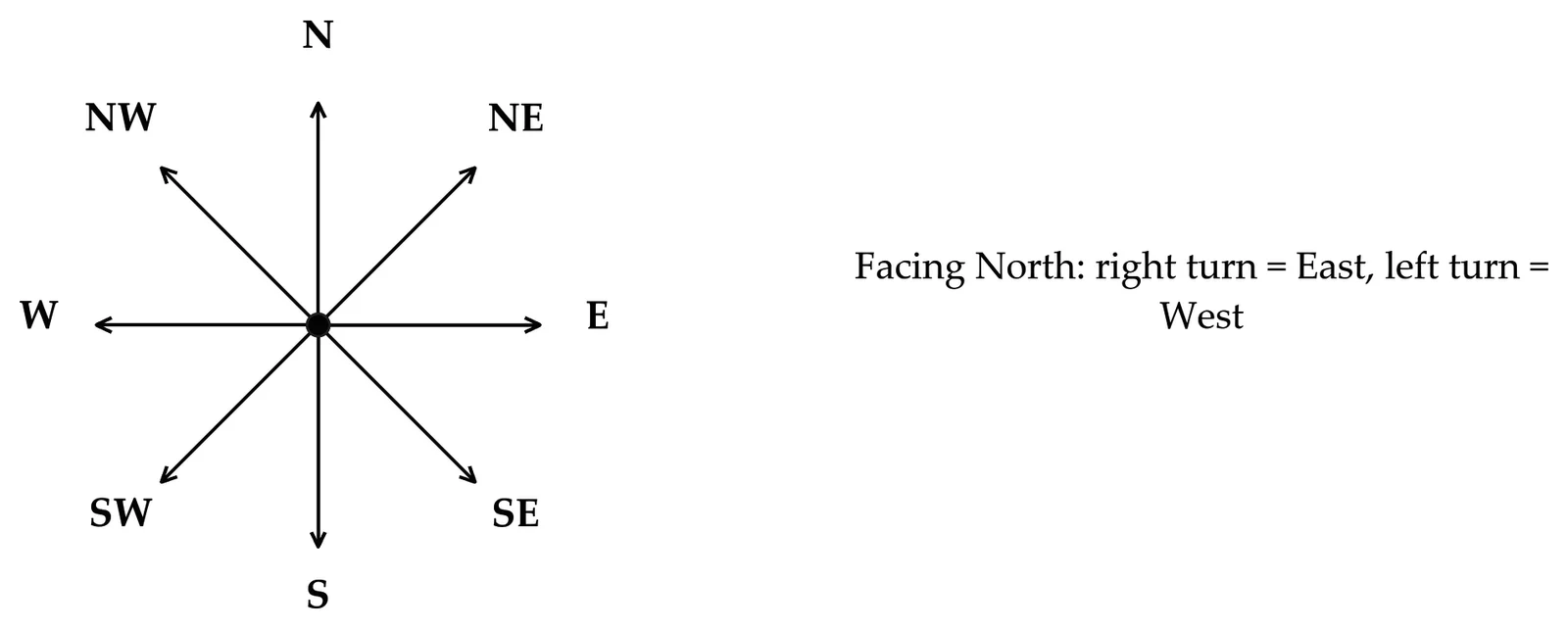
Always draw the path. Remember that a right turn is clockwise and a left turn anticlockwise from the direction you are facing. When the path makes a right angle, use Pythagoras’ theorem to find the shortest distance: distance = √(a² + b²). Common triplets are 3-4-5, 6-8-10 and 5-12-13.
Ranking
If a person’s rank is x from the top and y from the bottom, then the total number of persons = x + y − 1. Example: Ravi is 7th from the top and 12th from the bottom, so there are 7 + 12 − 1 = 18 students.
Clock
The minute hand moves 6° per minute and the hour hand 0.5° per minute. The angle between the hands at H hours M minutes is |30H − 5.5M| (if the result is more than 180°, subtract it from 360°). Example: at 3:40, the angle is |90 − 220| = 130°. The hands coincide 11 times in 12 hours and 22 times in a day.
Calendar
Odd days are the extra days beyond complete weeks. An ordinary year (365 days) has 1 odd day and a leap year (366 days) has 2 odd days. So the same date moves forward by one weekday after an ordinary year and by two after a leap year: 1 January 2023 was a Sunday, so 1 January 2024 was a Monday. A year is a leap year if it is divisible by 4, but a century year is a leap year only if it is divisible by 400; so 2000 was a leap year but 1900 was not. 100 years have 5 odd days, 200 years 3, 300 years 1 and 400 years 0.
5.5 Mathematical Aptitude: Percentage, Profit, Interest, Averages and Ratio
| Fraction | Percentage | Fraction | Percentage |
|---|---|---|---|
| 1/2 | 50% | 1/8 | 12.5% |
| 1/3 | 33.33% | 1/10 | 10% |
| 1/4 | 25% | 1/12 | 8.33% |
| 1/5 | 20% | 1/16 | 6.25% |
| 1/6 | 16.67% | 1/20 | 5% |
Percentage
Percent means per hundred. x% of y = x × y ÷ 100. If a price rises by r%, consumption must fall by r ÷ (100 + r) × 100% to keep spending the same: a 25% rise needs a cut of 25/125 × 100 = 20%. For two successive changes of a% and b%, the net change is a + b + ab/100 (use minus signs for decreases): +20% and then −20% gives 20 − 20 − 4 = −4%, i.e. a net fall of 4%.
Profit, loss and discount
Cost price (CP) is the price at which an article is bought and selling price (SP) the price at which it is sold. Profit = SP − CP, and profit % is always calculated on the cost price: bought for ₹400 and sold for ₹500, the profit is 100/400 × 100 = 25%. Discount is given on the marked price (MP): an article marked ₹1,000 sold at 10% discount sells for ₹900; if its cost price is ₹750, the profit is 150/750 × 100 = 20%.
Simple and compound interest
Simple interest (SI) = P × R × T ÷ 100, where P is the principal, R the rate per cent per year and T the time in years. ₹5,000 at 8% for 3 years gives SI = 5,000 × 8 × 3 ÷ 100 = ₹1,200. In compound interest (CI), interest is added to the principal every period, so the amount A = P(1 + R/100)^T and CI = A − P. ₹10,000 at 10% for 2 years gives A = 10,000 × 1.1 × 1.1 = ₹12,100, so CI = ₹2,100 (the SI would be ₹2,000). For 2 years, CI − SI = P(R/100)² = 10,000 × 0.01 = ₹100.
Averages and ratio
Average = sum of observations ÷ number of observations. If the average of 5 numbers is 20, their sum is 100; if one number, 30, is removed, the average of the remaining four is 70 ÷ 4 = 17.5. A ratio compares two quantities of the same kind: to divide ₹1,200 in the ratio 3 : 5, add the parts (8), so the shares are 3/8 × 1,200 = ₹450 and 5/8 × 1,200 = ₹750. In a proportion a : b = c : d, the product of the extremes equals the product of the means, i.e. a × d = b × c.
5.6 Time and Work, Time and Distance, and Counting
Time and work
If A can finish a work in a days, A does 1/a of the work in one day. Working together, A and B do 1/a + 1/b per day. A finishes a work in 10 days and B in 15 days; together they do 1/10 + 1/15 = 5/30 = 1/6 per day, so they finish it in 6 days. Pipes and cisterns follow the same logic: a filling pipe adds and an emptying pipe subtracts.
Time, speed and distance
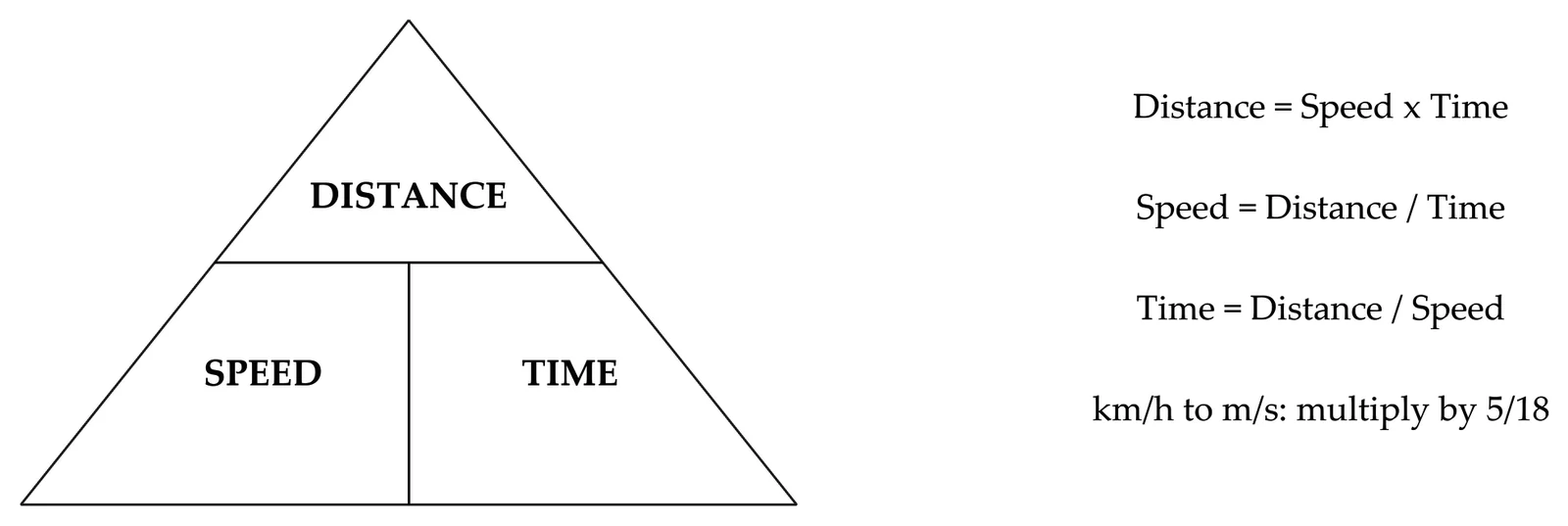
- Distance = Speed × Time. To change km/h into m/s, multiply by 5/18; to change m/s into km/h, multiply by 18/5. So 72 km/h = 20 m/s.
- A train crossing a pole or a person covers its own length: a 200 m train at 72 km/h (20 m/s) takes 200 ÷ 20 = 10 seconds. Crossing a platform, it covers its length plus the platform’s length.
- Relative speed: add the speeds when two bodies move in opposite directions; subtract when they move in the same direction.
- Average speed for equal distances at speeds x and y is 2xy ÷ (x + y), not their simple average: going at 60 km/h and returning at 40 km/h gives 2 × 60 × 40 ÷ 100 = 48 km/h.
- Boats and streams: downstream speed = boat + stream; upstream speed = boat − stream.
Permutation and combination
A permutation is an arrangement, where order matters: the number of ways to arrange r things out of n is nPr = n! ÷ (n − r)!. Four different books can be arranged on a shelf in 4! = 24 ways. A combination is a selection, where order does not matter: nCr = n! ÷ [r! × (n − r)!]. Two students can be chosen out of five in 5C2 = 10 ways.
Thus, mathematical reasoning needs practice more than talent. Learn the formulas in this chapter, solve ten questions a day for a month, and this unit will no longer be a fear but a strength.
5.7 Quiz: 20 Practice MCQs
Test yourself with these 20 exam-pattern questions. Choose your answer first, then tap Show answer to check it and read the short explanation.
Question 1
Find the next number: 2, 6, 12, 20, 30, ?
- 40
- 42
- 44
- 36
Show answer
Answer: (b) 42. Differences are 4, 6, 8, 10, 12; or n(n + 1): 6 × 7 = 42
Question 2
Find the next number: 1, 4, 9, 16, 25, ?
- 36
- 35
- 49
- 30
Show answer
Answer: (a) 36. Squares of 1, 2, 3, 4, 5, 6
Question 3
Find the next letter: C, F, I, L, ?
- N
- P
- O
- M
Show answer
Answer: (c) O. Positions 3, 6, 9, 12, 15; the 15th letter is O
Question 4
Find the next number: 5, 11, 23, 47, ?
- 94
- 96
- 93
- 95
Show answer
Answer: (d) 95. Each term is ×2 + 1: 47 × 2 + 1 = 95
Question 5
If PEN is coded as QFO, how is INK coded?
- JOL
- HMJ
- JNL
- KOL
Show answer
Answer: (a) JOL. Each letter moves one step forward: I→J, N→O, K→L
Question 6
A is B’s sister. C is B’s mother. D is C’s father. How is A related to D?
- Daughter
- Granddaughter
- Sister
- Mother
Show answer
Answer: (b) Granddaughter. A is C’s daughter, and D is C’s father, so A is D’s granddaughter
Question 7
A man walks 6 km south, turns left and walks 8 km. How far is he from the starting point?
- 14 km
- 10 km
- 2 km
- 12 km
Show answer
Answer: (b) 10 km. √(6² + 8²) = √100 = 10 km
Question 8
In a class, Neha is 9th from the top and 16th from the bottom. How many students are there in the class?
- 25
- 23
- 24
- 26
Show answer
Answer: (c) 24. 9 + 16 − 1 = 24
Question 9
What is the angle between the hands of a clock at 4:20?
- 0°
- 5°
- 20°
- 10°
Show answer
Answer: (d) 10°. |30 × 4 − 5.5 × 20| = |120 − 110| = 10°
Question 10
Which of the following years was NOT a leap year?
- 1600
- 2000
- 1900
- 2024
Show answer
Answer: (c) 1900. A century year must be divisible by 400; 1900 is not
Question 11
What is 25% of 40% of 600?
- 60
- 75
- 90
- 45
Show answer
Answer: (a) 60. 40% of 600 = 240; 25% of 240 = 60
Question 12
The price of sugar rises by 25%. By what percentage must a family reduce its consumption to keep its spending the same?
- 25%
- 20%
- 15%
- 30%
Show answer
Answer: (b) 20%. 25 ÷ 125 × 100 = 20%
Question 13
An article bought for ₹800 is sold for ₹1,000. What is the profit percentage?
- 20%
- 22.5%
- 25%
- 30%
Show answer
Answer: (c) 25%. Profit ₹200 on a cost price of ₹800 = 25%
Question 14
What is the simple interest on ₹4,000 at 5% per year for 3 years?
- ₹500
- ₹650
- ₹700
- ₹600
Show answer
Answer: (d) ₹600. 4,000 × 5 × 3 ÷ 100 = ₹600
Question 15
What is the compound interest on ₹10,000 at 10% per year for 2 years (compounded yearly)?
- ₹2,000
- ₹2,100
- ₹2,200
- ₹2,010
Show answer
Answer: (b) ₹2,100. 10,000 × 1.1 × 1.1 = 12,100; CI = ₹2,100
Question 16
What is the average of 6, 8, 10, 12 and 14?
- 10
- 9
- 11
- 12
Show answer
Answer: (a) 10. Sum 50 ÷ 5 = 10
Question 17
A can do a piece of work in 12 days and B in 24 days. In how many days can they finish it together?
- 6
- 9
- 8
- 18
Show answer
Answer: (c) 8. 1/12 + 1/24 = 3/24 = 1/8, so 8 days
Question 18
A speed of 90 km/h is equal to:
- 20 m/s
- 30 m/s
- 15 m/s
- 25 m/s
Show answer
Answer: (d) 25 m/s. 90 × 5/18 = 25 m/s
Question 19
A train 150 m long runs at 54 km/h. How long does it take to cross a pole?
- 10 seconds
- 12 seconds
- 9 seconds
- 15 seconds
Show answer
Answer: (a) 10 seconds. 54 km/h = 15 m/s; 150 ÷ 15 = 10 seconds
Question 20
In how many ways can 2 students be chosen from a group of 6?
- 30
- 12
- 20
- 15
Show answer
Answer: (d) 15. 6C2 = (6 × 5) ÷ 2 = 15
More notes: UGC NET Paper 1: Teaching and Research Aptitude
These notes are prepared by PADHO TO AISE for study help. They are not an official publication.