
UGC NET UGC NET Paper 1: Teaching and Research Aptitude
Unit 10 · 13 min read · Updated 26 Nov 2026
As per the UGC NET syllabus notified by the National Testing Agency (NTA)
Contents
- 10.1 Higher Learning in Ancient and Medieval India
- 10.2 Colonial Foundations and Post-Independence Evolution
- Colonial period
- After independence
- 10.3 National Education Policy 2020
- 10.4 Oriental, Conventional and Non-Conventional Learning
- 10.5 Professional, Technical and Skill-Based Education
- 10.6 Value Education and Environmental Education
- 10.7 Policies, Governance and Administration
- 10.8 Quiz: 20 Practice MCQs
भारत की नियति अब उसकी कक्षाओं में गढ़ी जा रही है।
The destiny of India is now being shaped in her classrooms.
— Education Commission (Kothari Commission), Report (1966)
HIGHER EDUCATION SYSTEM is the tenth and last unit of Paper 1. Since UGC NET selects future college and university teachers, the UGC expects every candidate to know the system in which they will teach. The unit covers institutions of higher learning in ancient India, the evolution of higher learning and research after independence, oriental, conventional and non-conventional learning, professional, technical and skill-based education, value and environmental education, and the policies, governance and administration of higher education, including the National Education Policy 2020. Many questions ask for years, commissions and bodies, so the tables and timelines here are worth revising often.
10.1 Higher Learning in Ancient and Medieval India
India had famous centres of higher learning long before modern universities. In the Vedic period education was given in the gurukul, where students lived with the teacher (guru) and learnt the Vedas, grammar, logic and ethics. Later, large residential monastic universities grew up, especially under Buddhist patronage, and attracted students from China, Korea, Tibet and Central Asia.
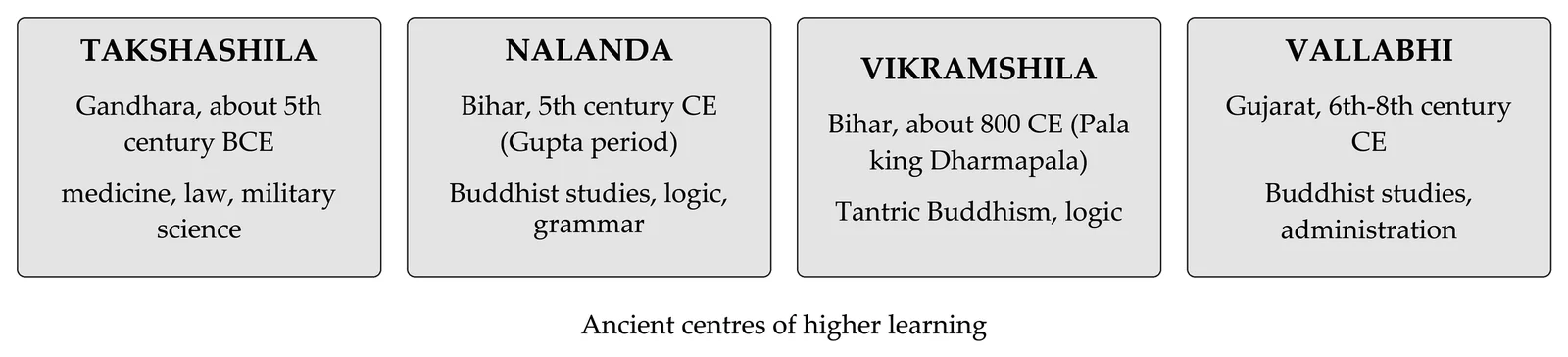
- Takshashila (Taxila): in Gandhara (now in Pakistan), flourishing from about the 5th century BCE; known for medicine, law, military science and the arts. Tradition links it with teachers such as Chanakya and the physician Jivaka.
- Nalanda: in Bihar, founded in the 5th century CE in the Gupta period (under Kumaragupta I); a great Buddhist centre where the Chinese pilgrim Xuanzang studied in the 7th century. It declined after the attack of Bakhtiyar Khalji around 1193. Its ruins are a UNESCO World Heritage Site.
- Vikramshila: in Bihar, founded by the Pala king Dharmapala (late 8th century); known for Tantric Buddhism and logic. The scholar Atisha Dipankara taught here.
- Vallabhi: in Gujarat (6th–8th century CE), under the Maitraka kings; known for Buddhist studies and administration.
- Odantapuri (Bihar, Pala period) and Kanchi (south India) were other important centres.
In the medieval period, maktabs gave elementary education and madrasas gave higher education in Arabic and Persian, theology, law, philosophy, medicine and astronomy, supported by rulers and nobles.
10.2 Colonial Foundations and Post-Independence Evolution
Colonial period
- Macaulay’s Minute (1835) argued for English education for a small class, which would spread knowledge downwards (the downward filtration idea).
- Wood’s Despatch (1854), called the Magna Carta of English education in India, proposed universities on the model of the University of London.
- In 1857 the first three modern universities were set up at Calcutta, Bombay and Madras.
- The Indian Universities Act (1904) under Lord Curzon increased government control; the Sadler (Calcutta University) Commission, 1917–19 recommended reforms such as intermediate colleges; the Sargent Plan (1944) proposed a national system of education.
After independence
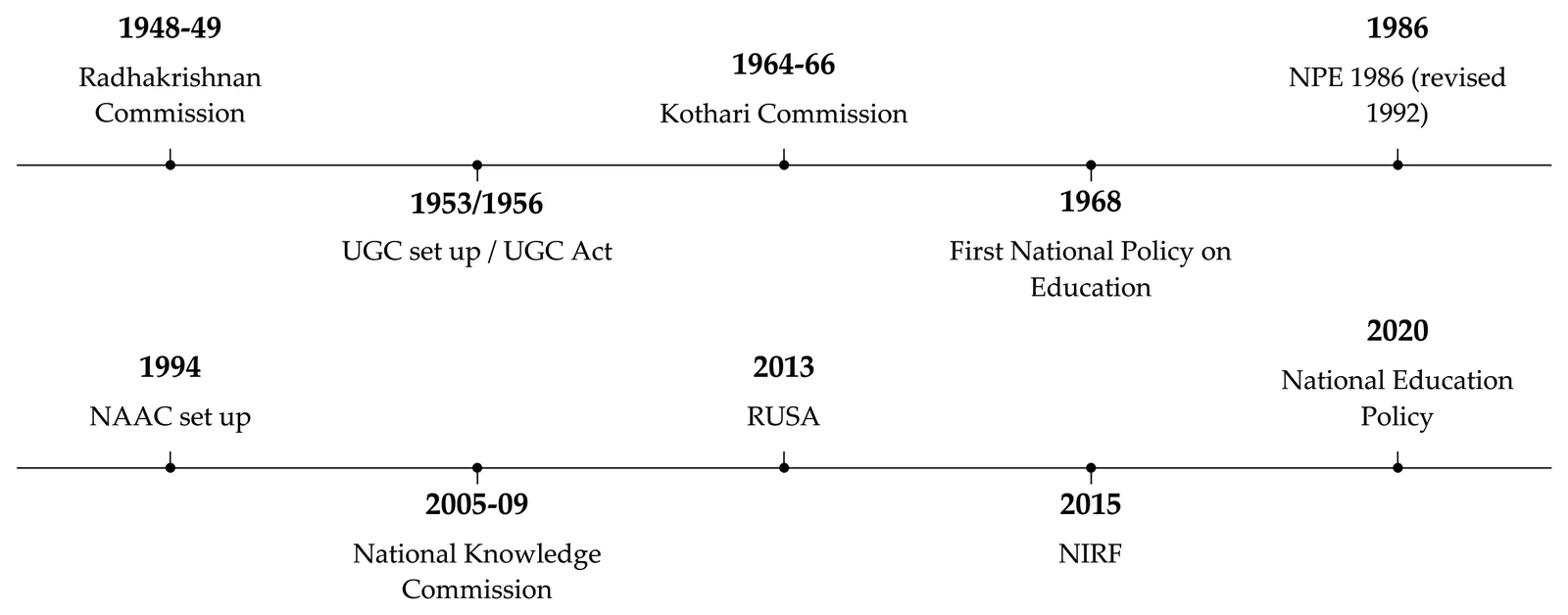
- University Education Commission (1948–49), chaired by Dr S. Radhakrishnan: the first commission of free India; it recommended a University Grants Commission on the British model, rural universities and higher standards.
- UGC: inaugurated in 1953 and made a statutory body by the UGC Act, 1956; it coordinates and maintains standards and gives grants to universities.
- Education Commission (1964–66), chaired by D.S. Kothari: recommended the 10+2+3 pattern, spending 6% of national income on education, a common school system and work experience. It began with the line ‘The destiny of India is now being shaped in her classrooms.’
- National Policy on Education 1968 (the first) and NPE 1986 (revised in 1992 with a Programme of Action): open universities, autonomous colleges and the creation of NAAC (1994) for accreditation.
- National Knowledge Commission (2005–09) under Sam Pitroda and the Yash Pal Committee (2009) on renovation and rejuvenation of higher education.
- RUSA (2013) funds state universities; NIRF (2015) ranks institutions; the National Education Policy (2020) is the latest policy.
10.3 National Education Policy 2020
The National Education Policy (NEP) 2020, drafted by a committee under Dr K. Kasturirangan, was approved in July 2020. It replaced the NPE of 1986 and is the first education policy of the twenty-first century. Its main proposals for higher education are:
- Gross Enrolment Ratio (GER) in higher education to reach 50% by 2035.
- Multidisciplinary universities and colleges, and a four-year undergraduate programme with multiple entry and exit (certificate, diploma, degree), supported by the Academic Bank of Credits.
- A single umbrella regulator, the Higher Education Commission of India (HECI), for all higher education except medical and legal, with four independent verticals.
- Phasing out the affiliating system over about 15 years, so that colleges become autonomous degree-granting colleges or parts of universities.
- A National Research Foundation to fund research (set up through the Anusandhan National Research Foundation Act, 2023), and public spending on education of 6% of GDP.
- In schools, the 5+3+3+4 structure replaces 10+2, with mother tongue as medium of instruction where possible, at least until Grade 5.

The four verticals are the National Higher Education Regulatory Council (NHERC) for regulation, the National Accreditation Council (NAC) for accreditation, the Higher Education Grants Council (HEGC) for funding, and the General Education Council (GEC) for setting academic standards.
10.4 Oriental, Conventional and Non-Conventional Learning
- Oriental learning means the study of classical Indian and Asian languages and knowledge systems, such as Sanskrit, Pali, Prakrit, Persian and Arabic, in Sanskrit universities, pathshalas and oriental colleges. The Central Sanskrit University Act of 2020 converted three deemed Sanskrit universities into central universities.
- Conventional learning is the regular, campus-based system of colleges and universities with classroom teaching, fixed timetables and examinations.
- Non-conventional learning includes open and distance learning (ODL), correspondence courses and online learning. Delhi University began correspondence courses in 1962; the first open university was set up in Andhra Pradesh in 1982 (now Dr B.R. Ambedkar Open University); and IGNOU was established in 1985 as the national open university. Today UGC regulations also allow fully online degrees from eligible institutions.
| Type | Set up by | Example |
|---|---|---|
| Central university | an Act of Parliament | University of Delhi, JNU, BHU |
| State university | an Act of the state legislature | most state universities |
| Deemed-to-be university | declared under Section 3 of the UGC Act | many specialised institutes |
| Private university | a state Act, as a private body | universities run by trusts and societies |
| Institution of National Importance | an Act of Parliament | IITs, AIIMS, NITs, IIMs |
10.5 Professional, Technical and Skill-Based Education
Professional education prepares students for a profession such as medicine, law, teaching, engineering, management or architecture. Technical education covers engineering, technology and polytechnics; the first IIT was set up at Kharagpur in 1951. Skill-based (vocational) education gives job-ready skills for particular trades. Each field has its own regulator:
| Body | Field |
|---|---|
| AICTE (All India Council for Technical Education) | technical education; statutory since 1987 |
| NCTE (National Council for Teacher Education) | teacher education; statutory since 1993 |
| NMC (National Medical Commission) | medical education; replaced the Medical Council of India in 2020 |
| BCI (Bar Council of India) | legal education, under the Advocates Act, 1961 |
| ICAR | agricultural education and research |
| PCI / COA | pharmacy / architecture |
| NCVET (2018) | regulator for vocational education and training |
For skills, the Skill India Mission and the Pradhan Mantri Kaushal Vikas Yojana (PMKVY) were launched in 2015, and the National Skills Qualifications Framework (NSQF) arranges qualifications by levels so that vocational and academic learning can be linked. The four National Institutes of Technical Teachers’ Training and Research (NITTTRs) at Bhopal, Chandigarh, Chennai and Kolkata train teachers of technical institutions.
10.6 Value Education and Environmental Education
Value education develops moral, social, democratic and spiritual values such as truth, non-violence, respect for others, responsibility and constitutional values like justice, liberty and equality. Its objectives are to build character, develop a sense of duty and citizenship, promote harmony in a diverse society and help students make ethical choices. The UNESCO Delors Report, Learning: The Treasure Within (1996), named four pillars of learning: learning to know, learning to do, learning to live together and learning to be.
Environmental education creates awareness, knowledge, attitudes, skills and participation needed to protect the environment. The Belgrade Charter (1975) and the Tbilisi Declaration (1977), the first intergovernmental conference on environmental education, set out its goals. In India, the Supreme Court in the M.C. Mehta case directed that environmental education be made compulsory at all levels, and the UGC introduced a compulsory course on environmental studies for undergraduates. The UN observed 2005–2014 as the Decade of Education for Sustainable Development.
10.7 Policies, Governance and Administration
- Constitutional position: education was moved from the State List to the Concurrent List by the 42nd Amendment (1976), so both the Centre and the states can make laws on it. The Union Ministry of Education (renamed from the Ministry of Human Resource Development in 2020) frames national policy.
- Quality assurance: NAAC, set up by the UGC in 1994 at Bengaluru, accredits institutions with grades from A++ to C; the NBA accredits technical programmes; every accredited institution has an IQAC (Internal Quality Assurance Cell).
- Ranking: the NIRF (2015) ranks institutions on five parameters: teaching, learning and resources; research and professional practice; graduation outcomes; outreach and inclusivity; and perception.
- Data: the All India Survey on Higher Education (AISHE) collects data on institutions, enrolment and teachers.
- University governance: the President of India is the Visitor of central universities; the Chancellor is the formal head; the Vice-Chancellor is the chief executive and academic officer; the Executive Council handles administration and finance, the Academic Council handles academic matters, the Court is a large advisory body, and the Registrar keeps records.
Thus, India’s higher education system joins an ancient tradition with modern institutions and new reforms. Learn the commissions and their years, the bodies and what they regulate, and the main ideas of NEP 2020, and you will be well prepared both for this unit and for your career as a teacher.
10.8 Quiz: 20 Practice MCQs
Test yourself with these 20 exam-pattern questions. Choose your answer first, then tap Show answer to check it and read the short explanation.
Question 1
The University Education Commission chaired by Dr S. Radhakrishnan worked in:
- 1948–49
- 1952–53
- 1964–66
- 1986
Show answer
Answer: (a) 1948–49. It was the first education commission of independent India
Question 2
The UGC became a statutory body through:
- the Constitution of India
- the UGC Act, 1956
- the National Policy on Education, 1968
- the Kothari Commission
Show answer
Answer: (b) the UGC Act, 1956. It was inaugurated in 1953 and made statutory in 1956
Question 3
The Kothari Commission (1964–66) recommended which structure of education?
- 8+4+3
- 5+3+3+4
- 10+2+3
- 11+1+3
Show answer
Answer: (c) 10+2+3. 5+3+3+4 is the school structure of NEP 2020
Question 4
Wood’s Despatch of 1854 is often called:
- the Charter of Indian universities
- the downward filtration theory
- the basic education plan
- the Magna Carta of English education in India
Show answer
Answer: (d) the Magna Carta of English education in India. It laid the foundation of modern education and universities in India
Question 5
Which of these was NOT among the first three universities set up in 1857?
- Calcutta
- Bombay
- Madras
- Allahabad
Show answer
Answer: (d) Allahabad. Allahabad University came in 1887
Question 6
Nalanda University was founded in the:
- Maurya period
- Gupta period
- Mughal period
- Chola period
Show answer
Answer: (b) Gupta period. It was founded in the 5th century CE under the Guptas
Question 7
Vikramshila University was founded by:
- Ashoka
- Harsha
- Dharmapala
- Kanishka
Show answer
Answer: (c) Dharmapala. The Pala king Dharmapala founded it in the late 8th century
Question 8
NAAC was established in:
- 1986
- 1990
- 1994
- 2005
Show answer
Answer: (c) 1994. It was set up by the UGC in 1994 at Bengaluru
Question 9
NEP 2020 aims to raise the Gross Enrolment Ratio in higher education by 2035 to:
- 50%
- 40%
- 60%
- 100%
Show answer
Answer: (a) 50%. GER of 50% by 2035
Question 10
NEP 2020 replaces the 10+2 school structure with:
- 10+2+3
- 5+3+3+4
- 8+4
- 5+5+2
Show answer
Answer: (b) 5+3+3+4. Foundational, preparatory, middle and secondary stages
Question 11
Match List I with List II.
| List I | List II |
|---|---|
| A. AICTE | I. Teacher education |
| B. NCTE | II. Legal education |
| C. NMC | III. Technical education |
| D. Bar Council of India | IV. Medical education |
- A-III, B-I, C-IV, D-II
- A-I, B-III, C-IV, D-II
- A-III, B-IV, C-I, D-II
- A-III, B-I, C-II, D-IV
Show answer
Answer: (a) A-III, B-I, C-IV, D-II. AICTE = technical, NCTE = teacher, NMC = medical, BCI = legal education
Question 12
IGNOU, the national open university, was established in:
- 1975
- 1982
- 1985
- 1990
Show answer
Answer: (c) 1985. 1982 is the year of the first state open university, in Andhra Pradesh
Question 13
Education was placed in the Concurrent List by the:
- 42nd Amendment (1976)
- 44th Amendment (1978)
- 73rd Amendment (1992)
- 86th Amendment (2002)
Show answer
Answer: (a) 42nd Amendment (1976). The 86th Amendment made elementary education a fundamental right
Question 14
Which of these is NOT one of the four pillars of learning in the Delors Report?
- Learning to know
- Learning to do
- Learning to live together
- Learning to earn
Show answer
Answer: (d) Learning to earn. The fourth pillar is learning to be
Question 15
The Tbilisi conference of 1977 is associated with:
- ozone protection
- environmental education
- desertification
- biodiversity
Show answer
Answer: (b) environmental education. It was the first intergovernmental conference on environmental education
Question 16
Arrange these in chronological order.
- National Policy on Education 1986
- Kothari Commission
- Radhakrishnan Commission
- National Education Policy 2020
- III, II, I, IV
- II, III, I, IV
- III, I, II, IV
- II, I, III, IV
Show answer
Answer: (a) III, II, I, IV. 1948–49, 1964–66, 1986, 2020
Question 17
Consider these statements about the HECI proposed in NEP 2020:
- It has four independent verticals.
- The NAC is its vertical for accreditation.
- It will also regulate medical and legal education.
- I only
- I and II only
- II and III only
- I, II and III
Show answer
Answer: (b) I and II only. Medical and legal education are kept outside HECI
Question 18
Who is the Visitor of central universities in India?
- The Prime Minister
- The Education Minister
- The President of India
- The Chairman of the UGC
Show answer
Answer: (c) The President of India. The Vice-Chancellor is the chief executive; the President is the Visitor
Question 19
The National Institutional Ranking Framework (NIRF) was launched in:
- 2013
- 2017
- 2020
- 2015
Show answer
Answer: (d) 2015. It was launched in 2015; the first rankings came in 2016
Question 20
Assertion (A): The UGC was set up on the recommendation of the Kothari Commission. Reason (R): The UGC became a statutory body through the UGC Act, 1956.
- Both A and R are true, and R is the correct explanation of A
- Both A and R are true, but R is not the correct explanation of A
- A is true, but R is false
- A is false, but R is true
Show answer
Answer: (d) A is false, but R is true. A is false: the UGC was recommended by the Radhakrishnan Commission and set up in 1953, long before the Kothari Commission. R is true
More notes: UGC NET Paper 1: Teaching and Research Aptitude
These notes are prepared by PADHO TO AISE for study help. They are not an official publication.