
Semester II MDSC-2A Indian Government and Politics
Unit VI · 20 min read · Updated 24 Nov 2026
As per the University of Delhi (DU) BA (Hons) Political Science syllabus
Contents
- 6.1 Parties and Party Systems
- 6.2 The Congress System
- 6.3 From Hegemony to Convergence: Party Systems in the States
- 6.4 The Fourth Party System and the Second Dominant Party
- 6.5 Features of Indian Political Parties
- 6.6 Important Questions
- Explain Rajni Kothari’s concept of the ‘Congress system’.
- Trace the evolution of the party system in India.
- Has India moved to a second dominant party system? Discuss the changes in the party system since 2014.
- Short Notes
दल ऐसे लोगों का समूह है जो किसी विशेष सिद्धांत पर, जिस पर वे सब सहमत हैं, अपने संयुक्त प्रयासों से राष्ट्रीय हित को बढ़ावा देने के लिए एकजुट होते हैं।
Party is a body of men united, for promoting by their joint endeavours the national interest, upon some particular principle in which they are all agreed.
— Edmund Burke, Thoughts on the Cause of the Present Discontents (1770)
POLITICAL PARTIES are the link between citizens and government in a democracy. They choose candidates, fight elections, form governments or act as the opposition, and give voters choices between policies and leaders. The party system, the pattern of competition among parties, shapes how a democracy works: whether governments are stable or short-lived, whether power is concentrated or shared, and whether different social groups find a voice. India’s party system has changed dramatically since 1952: from the long dominance of the Congress, through decades of coalitions and regional parties, to the rise of the BJP as a new dominant party. In this chapter we study these changes through the work of Rajni Kothari, Yogendra Yadav and Suhas Palshikar, Christophe Jaffrelot, Milan Vaishnav, and Pradeep Chhibber and Rahul Verma.
6.1 Parties and Party Systems
A political party is an organised group of people who share broad goals and seek to win power through elections in order to implement them. Parties perform several functions in a democracy: they aggregate the demands of different groups into programmes, recruit and train leaders, mobilise voters, form governments or act as the opposition, and link the people with the state. A party system is the pattern of interaction among parties. Political scientists classify party systems by the number and relative strength of parties: one-party systems, as in authoritarian states; two-party systems, as in the United States; multi-party systems, as in much of Europe; and dominant-party systems, in which several parties compete freely but one party wins elections again and again. Maurice Duverger argued that plurality elections tend to produce two-party systems, but India, with first-past-the-post elections and many parties, shows the limits of this rule, because parties can be strong in particular states.
6.2 The Congress System
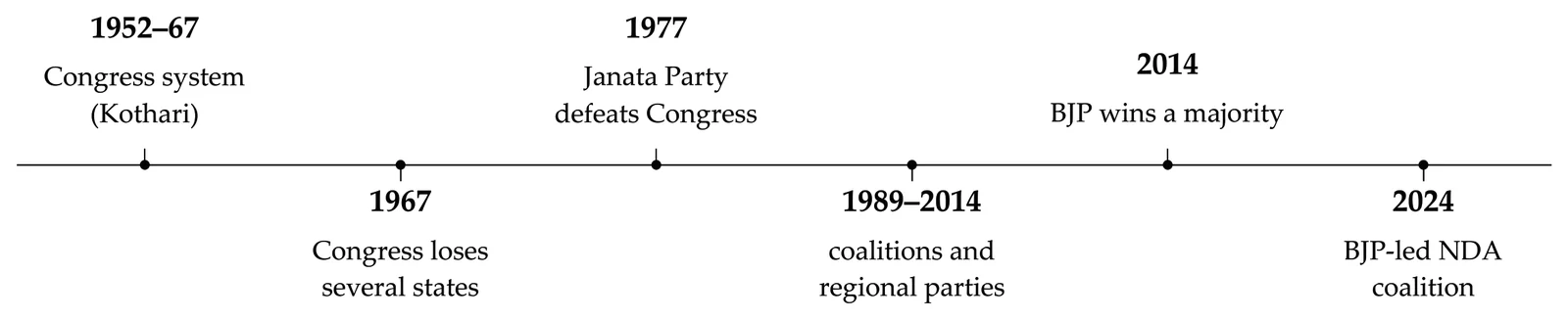
From the first general election (1951–52) to 1967, the Indian National Congress won every national election and governed almost every state. Rajni Kothari, in ‘The Congress “System” in India’ (1964), argued that this was not a one-party state but a distinctive system of one-party dominance within a competitive democracy. He described it as a competitive party system in which the competing parts played very different roles. The Congress was the party of consensus: a broad umbrella that included many castes, classes, religions, regions and ideologies, inherited the legitimacy of the freedom movement, and resolved conflicts internally through factions and bargaining. The opposition parties, such as the Socialists, Communists, Swatantra and Jana Sangh, were parties of pressure: they could not hope to replace the Congress, but they operated at the margin, influencing the factions within the Congress and pressing it to change its policies. If the Congress drifted too far from public opinion, the opposition could gain, so a latent threat kept it responsive. W.H. Morris-Jones described this as dominance co-existing with competition.
The Congress system declined after Nehru’s death. In the 1967 elections the Congress lost power in several states to coalitions of opposition parties (the Samyukta Vidhayak Dal governments). The party split in 1969; Indira Gandhi centralised power, won the 1971 election with the slogan ‘Garibi Hatao’, and replaced the old system of accommodation with populist, personalised leadership. After the Emergency (1975–77), the Congress lost the 1977 election to the Janata Party, the first non-Congress government at the Centre.
6.3 From Hegemony to Convergence: Party Systems in the States
Yogendra Yadav and Suhas Palshikar, in ‘Party System and Electoral Politics in the Indian States, 1952–2002: From Hegemony to Convergence’ (2006), argue that India’s national party system can be understood only by studying the states, where electoral competition actually takes place. They describe three broad phases, which Yadav elsewhere calls three electoral systems (Figure 6.2):
- Congress hegemony (1952–1967): the Congress dominated almost everywhere; opposition was fragmented.
- Congress versus the opposition (1967–1989): in many states, competition became a contest between the Congress and a principal opposition party or front, though the Congress usually remained the pole around which politics was organised; at the national level it was dominant except in 1977–80.
- Multi-party competition and convergence (after 1989): the Congress declined, the BJP rose, and regional, OBC and Dalit parties became powerful. Nationally, no party could win a majority, and coalition governments became the rule, such as the National Front (1989), the United Front (1996–98), the NDA (1998–2004) and the UPA (2004–14).

Their central argument is about convergence. Although the national system appeared fragmented, party competition within most states was converging towards a bipolar pattern: a contest between two parties or two alliances, such as the Congress and the BJP in Gujarat or Madhya Pradesh, or the LDF and UDF in Kerala. National fragmentation was the result of adding together many different state-level bipolarities. The states became the main arena of politics, and regional parties became indispensable partners in coalitions. This period also saw the regionalisation of politics, the political rise of lower castes (the ‘second democratic upsurge’), and greater participation by the poor and marginalised.
6.4 The Fourth Party System and the Second Dominant Party
The elections of 2014 and 2019 transformed the party system. The BJP won an absolute majority on its own in the Lok Sabha for the first time, with 282 seats in 2014 and 303 seats and about 37 per cent of the vote in 2019, while the Congress fell to its lowest-ever tallies. Several scholars argued that a new party system had emerged.
A. Vaishnav and Hintson: the fourth party system
Milan Vaishnav and Jamie Hintson, in ‘The Dawn of India’s Fourth Party System’ (2019), argue that India has entered a fourth party system in which the BJP is the dominant national party, as the Congress was in the first. Its features include the BJP’s dominance at the national level and its expansion into new regions, the decline of the Congress as the main national alternative, the nationalisation of elections around a national leader and national issues, high voter turnout, and the continuing strength of some regional parties in their states.
B. Chhibber and Verma: the second dominant party system
Pradeep Chhibber and Rahul Verma, in ‘The Rise of the Second Dominant Party System in India’ (2019), argue that the BJP has built a new social coalition that goes far beyond its earlier upper-caste and urban base. In 2019 it won large shares of the votes of lower OBCs, Dalits and Adivasis, combining Hindu nationalism, national security, welfare schemes and the popularity of Narendra Modi. Like the Congress system, this is a dominant-party system in which one party occupies the centre of political competition, though its ideological basis is very different.
C. Jaffrelot and Verniers: towards a new political system
Christophe Jaffrelot and Gilles Verniers, in ‘A New Party System or a New Political System?’ (2020), ask whether the change goes deeper than the party system. They point to the personalisation of politics around a single leader, the centralisation of power, the use of Hindu nationalism to unite voters across castes, the weakening of institutional checks and the decline of the opposition. They suggest that India may be moving towards a different kind of political system, which some describe as a majoritarian or ‘ethnic’ democracy. Others reply that elections remain competitive, as shown in 2024, when the BJP won 240 seats, fell short of a majority and formed a coalition government with its NDA allies, and that regional parties continue to win many states.
6.5 Features of Indian Political Parties
- National and state parties: the Election Commission recognises a few national parties and many state parties on the basis of their vote shares and seats; regional parties are powerful in many states.
- Personalised and dynastic parties: many parties are built around a leader or family, and leadership passes within families.
- Weak internal democracy: party organisational elections are rare, and candidates are often chosen by central leaders.
- Social bases: parties draw support from coalitions of castes, communities and classes rather than from ideology alone.
- Coalitions: since 1989, alliances such as the NDA and UPA have been central to forming governments.
- Defection and funding: the anti-defection law (1985) sought to stop floor-crossing; party funding remains opaque, and the Supreme Court struck down the electoral bonds scheme in 2024 for violating voters’ right to information.
6.6 Important Questions
- Question 1 Explain Rajni Kothari’s concept of the ‘Congress system’.
- Question 2 Trace the evolution of the party system in India.
- Question 3 Has India moved to a second dominant party system? Discuss the changes in the party system since 2014.
DU asks the same idea in different words. So learn one broad answer for each question below; the same answer works for every question joined by OR.
Important Question 1
Explain Rajni Kothari’s concept of the ‘Congress system’.
OR
Discuss the nature of one-party dominance in India.
OR
Why did the Congress system decline?
Model Answer
“It is a competitive party system, but one in which the competing parts play rather dissimilar roles.”
— Rajni Kothari, ‘The Congress “System” in India’ (1964)
Introduction. For two decades after independence the Congress dominated Indian politics. Rajni Kothari explained this dominance not as a one-party state but as a distinctive ‘Congress system’ of one-party dominance within a competitive democracy, in which the opposition still played an important role.
1. Context
The Congress inherited the legitimacy, organisation and leadership of the freedom movement. Under Nehru it won the elections of 1952, 1957 and 1962 with large majorities in Parliament and governed almost all states, while opposition parties were small and divided. It had led the freedom struggle and had an organisation reaching down to the districts.
2. A Competitive Dominant-Party System
Kothari argued that India was not a one-party state like the Soviet Union. Elections were free, opposition parties existed and criticised the government, and the press was free. The Congress was dominant because it won, not because it suppressed rivals. Kothari set this out in his article on the Congress system in 1964.
3. The Party of Consensus
The Congress was a broad umbrella that included many castes, classes, religions, regions and ideologies, from socialists to conservatives. It resolved conflicts internally, through bargaining among its factions, and so absorbed the diversity of Indian society. It accommodated landlords and peasants, industrialists and workers, upper castes and Dalits.
4. Factions
Factions within the Congress competed for power and represented different groups and regions. Factional competition provided a form of internal democracy and allowed new groups to rise within the party. Factional competition served as an internal opposition, giving voters choices within the party.
5. Morris-Jones’s Description
W.H. Morris-Jones described the system as dominance co-existing with competition but without a trend towards alternation.
6. Parties of Pressure and the Margin of Pressure
Opposition parties could not replace the Congress, but they acted as parties of pressure, influencing Congress factions and policies from outside. A latent threat that dissatisfied groups might move to the opposition kept the Congress responsive. Parties such as the Swatantra Party, the Jana Sangh and the socialists influenced Congress policy from outside.
7. Nehru’s Leadership
Nehru’s stature, commitment to democracy and tolerance of dissent within the party helped the system work.
8. Decline
After Nehru, the system weakened: the Congress lost several states in 1967, split in 1969, and under Indira Gandhi replaced internal accommodation with centralised, populist leadership. The Emergency and the defeat of 1977 ended its unchallenged dominance. The 1967 elections, when the Congress lost power in several states, and the split of 1969 ended the system.
9. Indira Gandhi and the End of the System
Indira Gandhi’s centralisation, populist slogans such as ‘Garibi Hatao’ and personal control of the party replaced the federal, factional Congress with a leader-centred one.
10. Significance
The Congress system helped consolidate democracy in its early years by accommodating diverse groups and training leaders. Critics note that it also allowed dominant castes and classes to control the party and slowed radical social change. It also helped institutionalise democratic norms.
11. Criticism
Critics argue that the model idealised Congress dominance and underplayed the exclusion of lower castes and the role of patronage.
12. Relevance Today
Scholars such as Chhibber and Verma compare the BJP’s dominance after 2014 with the Congress system, calling it a second dominant party system, though based on different ideology and social coalitions.
13. The Congress System at the Grassroots
The Congress system worked through local networks. The party drew support from dominant castes and local notables who could deliver the votes of their followers, the ‘vote banks’ described by M.N. Srinivas, and distributed patronage through these intermediaries. Myron Weiner’s Party Building in a New Nation (1967) showed how the Congress organisation adapted to local social structures in different districts, which helped it survive and win across a diverse country.
14. Evaluation
Kothari’s concept remains a classic account of how a dominant party sustained democracy in a new nation by absorbing diversity and allowing competition within itself.
Conclusion. Thus, the Congress system was a unique form of dominance through consensus and accommodation, which shaped the early Indian democracy and remains a model for understanding dominant parties.
Important Question 2
Trace the evolution of the party system in India.
OR
‘From hegemony to convergence.’ Discuss the party system in the Indian states.
OR
Discuss the role of coalition politics and regional parties in India.
Model Answer
“From Hegemony to Convergence.”
— Subtitle of Yogendra Yadav and Suhas Palshikar’s study of state party systems (2006)
Introduction. India’s party system has passed through several phases since 1952, from Congress dominance to multi-party coalitions and then to the dominance of the BJP. Scholars such as Yadav and Palshikar argue that these changes can be understood only by studying the states, where competition actually takes place.
1. The First System: Congress Hegemony (1952–67)
The Congress won every national election and most state elections, functioning as Kothari’s party of consensus while opposition parties acted as parties of pressure. The Congress usually won about 45 per cent of the vote but around three-quarters of the seats.
2. The Second System: Congress versus Opposition (1967–89)
From 1967 the Congress faced serious challenges in the states, often from coalitions or principal opposition parties. It split in 1969 and lost power at the Centre in 1977, but returned in 1980 and remained the pole around which competition was organised. The Janata Party’s victory in 1977 after the Emergency showed that the Congress could be defeated.
3. The Third System: Multi-Party Competition (1989–2014)
The Congress declined, the BJP rose on the Ayodhya movement, and regional, OBC and Dalit parties became powerful after Mandal. No party won a majority, and coalition governments, such as the NDA and UPA, became the norm. Regional and caste-based parties became crucial in coalitions.
4. Yadav’s Electoral Systems
Yogendra Yadav described a first electoral system of Congress dominance, a second of Congress versus opposition and a third of multi-party competition and coalitions; scholars now speak of a fourth.
5. Convergence in the States
Yadav and Palshikar show that while the national system fragmented, state systems converged towards bipolar competition between two parties or alliances. National fragmentation was the sum of different state bipolarities. In most states competition is now between two parties or alliances.
6. Regionalisation and the Democratic Upsurge
States became the main arena of politics; regional parties became indispensable coalition partners; and lower castes, the poor and rural voters participated more, which Yadav called the second democratic upsurge. Yogendra Yadav called the rising participation of lower castes, women and the poor after 1990 a ‘second democratic upsurge’.
7. The Rise of the BJP
The BJP rose from 2 Lok Sabha seats in 1984 to 85 in 1989 and 182 in 1998, through the Ayodhya movement and alliances.
8. Coalition Politics
Coalitions gave states and regions more voice, encouraged consensus and strengthened federalism, but also led to instability, bargaining over portfolios and policy compromises. The United Front (1996–98), the NDA (1998–2004) and the UPA (2004–14) were the major coalitions.
9. Fragmentation
The effective number of parties in the Lok Sabha rose sharply in the 1990s and fell after 2014, showing changing levels of fragmentation.
10. The Fourth System: BJP Dominance (2014– )
The BJP won majorities in 2014 and 2019, creating what Vaishnav and Hintson call a fourth party system, while the Congress declined. In 2024 the BJP fell short of a majority and governed with NDA allies, showing that coalition politics remains important. In 2024 the BJP fell short of a majority and governs with its NDA allies.
11. Defections and Party Change
The Tenth Schedule (1985) tried to curb defections, but splits and mergers continue to reshape parties.
12. Evaluation
The evolution reflects deeper social changes: the political rise of lower castes, regional identities, Hindu nationalism and the nationalisation of elections around leaders. The party system thus mirrors social change and federalisation.
13. Why Competition Became Bipolar in the States
The first-past-the-post system rewards two-way contests, because a third party that cannot win a seat wastes votes. Parties therefore formed pre-poll alliances, and in each state competition settled into two main parties or fronts, though which parties they were differed from state to state. This is Duverger’s law at work.
14. Regional Parties and Federalism
Regional parties brought regional issues to the national stage, bargained for resources for their states and made coalition governments more cautious about using Article 356 against state governments, strengthening federalism in practice. Parties such as the DMK, TDP, BJD and Trinamool Congress have shaped national coalitions.
Conclusion. Thus, India’s party system has moved from hegemony through fragmentation and convergence to a new dominance, while remaining competitive and rooted in the states.
Important Question 3
Has India moved to a second dominant party system? Discuss the changes in the party system since 2014.
OR
Discuss the ‘fourth party system’ in India.
OR
‘A new party system or a new political system?’ Discuss.
Model Answer
“The Rise of the Second Dominant Party System in India.”
— Title of the article by Pradeep Chhibber and Rahul Verma (2019)
Introduction. The general elections of 2014 and 2019 gave the BJP absolute majorities of its own, something no party had achieved since 1984. Scholars have debated whether this marks a new party system, a second dominant party system or even a new political system.
1. The Electoral Facts
The BJP won 282 seats in 2014 and 303 seats with about 37 per cent of the vote in 2019, expanding into new regions, while the Congress fell to its lowest-ever numbers. In 2024 it won 240 seats and formed a government with its NDA allies.
2. The Fourth Party System
Vaishnav and Hintson argue that the BJP has become the dominant national party, that elections have been nationalised around a national leader and issues, and that turnout and competition have increased, while some regional parties remain strong. They argue that the BJP now sets the terms of national competition.
3. The BJP’s New Social Coalition
Chhibber and Verma show that the BJP won large shares of lower OBC, Dalit and Adivasi votes in addition to its upper-caste base, building a broad Hindu coalition across castes. It gained support among OBCs, Dalits and tribal voters while keeping upper-caste support. It also won substantial support among women voters.
4. Ideology, Welfare and Leadership
The BJP combined Hindu nationalism, national security, welfare schemes delivered directly to beneficiaries, and the personal popularity of Narendra Modi, along with a strong party organisation linked to the RSS. Narendra Modi’s personal popularity became central to its campaigns. Schemes such as free rations, housing and toilets created direct links with voters.
5. Organisational Strength
The BJP’s organisation, supported by the RSS network, booth-level workers and digital campaigning, gives it an advantage over rivals.
6. Nationalism and Identity
Debates on national security, Hindutva and cultural identity have reshaped the issues of competition.
7. Comparison with the Congress System
Like the Congress, the BJP occupies the centre of competition. Unlike the Congress, it is based on a clear ideology rather than a broad consensus, and it seeks to replace rather than accommodate rival ideologies. Unlike the Congress, it has a clear ideological core.
8. Comparing Two Dominances
Congress dominance rested on a broad centrist coalition, while BJP dominance rests on a clearer ideology combined with welfare and leadership.
9. Towards a New Political System
Jaffrelot and Verniers argue that the change extends to the political system: personalisation, centralisation, majoritarian nationalism, weaker institutions and a weakened opposition. They describe changes in institutions, the media and civil society alongside electoral dominance.
10. State-Level Variation
The BJP is weaker in many southern and eastern states, where regional parties or the Congress remain strong, so its dominance is uneven.
11. Campaign Finance
The BJP’s financial advantage, including through electoral bonds before they were struck down in 2024, is often cited as a factor in its dominance.
12. Counter-Arguments
Others point out that elections remain competitive, that regional parties continue to win states, and that in 2024 the BJP lost its majority and formed a coalition with NDA allies. The 2024 result showed the limits of dominance.
13. The 2024 Election
In 2024 the BJP lost its majority, falling to 240 seats, while the opposition gained ground, which suggests a dominant but not hegemonic position.
14. Implications for Democracy
Scholars debate whether dominance strengthens governance or weakens checks such as Parliament, the media and federalism.
15. Evaluation
The BJP’s dominance is real at the national level, but India’s federal structure, regional parties and competitive elections continue to limit it, so the party system remains in flux. Whether it becomes a lasting system depends on future elections.
16. Welfare and the Beneficiary Voter
Scholars note that the BJP’s delivery of private goods, such as toilets, houses, cooking gas and cash transfers, directly to households created a large class of beneficiaries (labharthi) who credited the central leadership. This combination of welfare, Hindu nationalism and strong leadership distinguished the new dominant party.
17. The Opposition
The Congress declined to its lowest levels, but regional parties such as the Trinamool Congress and DMK retained their states. In 2023 opposition parties formed the INDIA alliance, and their gains in 2024 showed that the dominant party could still be checked. The INDIA alliance was formed in 2023 to challenge the BJP.
Conclusion. Thus, India has seen the rise of a second dominant party, though whether it has become a lasting system or a new political order remains open.
Short Notes
(a) Coalition politics
The formation of governments by alliances of several parties, common in India since 1989: the National Front (1989), United Front (1996–98), NDA (1998–2004 and since 2014) and UPA (2004–14). Coalitions increased the influence of regional parties and the states, and encouraged common minimum programmes, but also produced instability and bargaining.
(b) Regional parties
Parties whose support is concentrated in one or a few states and which often represent regional, linguistic or caste identities, such as the DMK, Shiv Sena, Akali Dal, Trinamool Congress, Biju Janata Dal, TDP and Samajwadi Party. They have governed many states and become crucial partners in national coalitions, strengthening federalism.
(c) Anti-defection law
The Tenth Schedule of the Constitution, added by the 52nd Amendment in 1985, which disqualifies legislators who voluntarily give up membership of their party or vote against its whip. The 91st Amendment (2003) removed the exception for splits, allowing only mergers supported by two-thirds of a legislature party. The Speaker decides disqualification, which critics say has led to delays and partisan decisions.
More notes: MDSC-2A Indian Government and Politics
- Indian Constitution: basic features, debates on Fundamental Rights, Directive Principles and Federalism
- State formation and nation building: Integration of princely states, linguistic re-organisation of states
- Political institutions at the Centre and State levels: Parliament, Judiciary, Prime Minister, Chief Minister
- Social structure and political power: caste, class, gender
- Religion and politics: debates on secularism and communalism
- Development strategies: planned economy, neo-liberal restructuring
- Social movements: workers, farmers, environmental, and women’s movements
- The nature of state in India: developmental, welfare, regulatory
These notes are prepared by PADHO TO AISE for study help. They are not an official University of Delhi publication.