
Semester II MDSC-2A Indian Government and Politics
Unit IV · 19 min read · Updated 24 Nov 2026
As per the University of Delhi (DU) BA (Hons) Political Science syllabus
Contents
- 4.1 Social Structure and Democracy
- 4.2 Caste and Politics
- 4.3 Class and Politics
- 4.4 Gender and Political Power
- 4.5 Important Questions
- Discuss the relationship between caste and politics in India.
- Examine the role of class in Indian politics.
- Discuss gender and political power in India, with reference to the intersection of caste and gender.
- Short Notes
जाति ईंटों की दीवार जैसी कोई भौतिक वस्तु नहीं है… जाति एक धारणा है, यह मन की एक अवस्था है।
Caste is not a physical object like a wall of bricks… Caste is a notion, it is a state of the mind.
— B.R. Ambedkar, Annihilation of Caste (1936)
INDIA’S CONSTITUTION treats every citizen as equal, with one person, one vote, one value. But Indian society is deeply unequal. It is divided by caste, a hierarchy into which people are born; by class, the unequal ownership of land, capital and skills; and by gender, the subordination of women in the family and society. How do these social structures shape political power, and how has democracy changed them in turn? In this chapter we study the relationship between caste and politics, from Rajni Kothari’s idea of the politicisation of caste to the rise of lower castes and Dalits; the role of class and the impact of globalisation on labour; and gender and political power, including the way caste and gender are intertwined.
4.1 Social Structure and Democracy
Social structure refers to the lasting patterns of relationships and inequalities in a society, such as caste, class, gender, religion and region. Political power is the ability to influence decisions about the allocation of resources and status. In India the relationship between the two runs both ways. Social structure shapes politics: caste, class and gender influence who votes for whom, who becomes a candidate and whose interests are served. And politics reshapes social structure: universal franchise, reservations, rights and welfare policies have given subordinated groups new power and changed the meaning of their identities. Ambedkar warned that political democracy would not last unless it rested on social democracy.
4.2 Caste and Politics
A. Meaning of caste
Caste combines the four-fold varna order with thousands of local jatis. Its traditional features were a hierarchy based on ideas of purity and pollution, endogamy (marriage within the caste), hereditary occupation, restrictions on eating and social contact, and the exclusion of ‘untouchable’ castes. The Constitution abolished untouchability (Article 17) and provided reservations in legislatures, education and jobs for Scheduled Castes and Scheduled Tribes, later extended to Other Backward Classes.
B. Kothari: the politicisation of caste
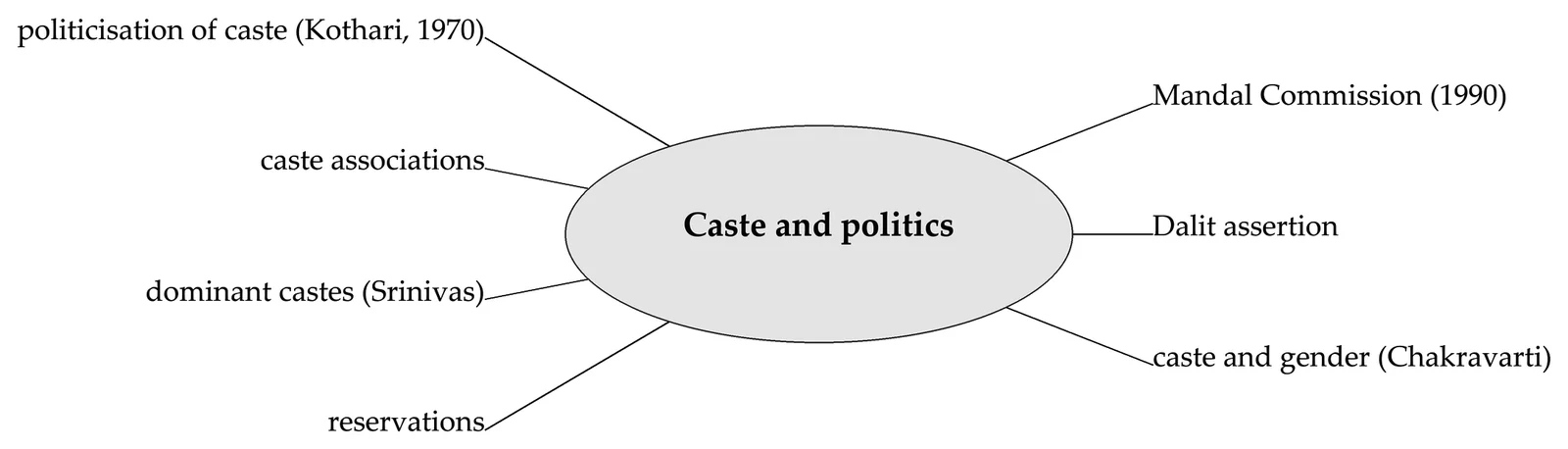
Many feared that caste would corrupt Indian democracy. Rajni Kothari, in his introduction to Caste in Indian Politics (1970), reversed the argument: it is not politics that gets caste-ridden, it is caste that gets politicised. Democratic politics needs organisation and support, and caste, with its ready networks, became a means of political mobilisation. In the process caste itself changed. Kothari identified three aspects: a secular aspect, in which caste groups behave like interest groups bargaining for resources; an integrative aspect, in which caste draws people into the democratic system and gives them a stake in it; and a consciousness aspect, in which caste identity becomes a political identity. Lloyd and Susanne Rudolph similarly showed how caste associations became modern vehicles of democratic participation, and M.N. Srinivas described the power of dominant castes, which combine numbers, land, ritual status and education.
C. The struggle for equality
Myron Weiner, in ‘The Struggle for Equality: Caste in Indian Politics’ (2001), showed how democracy enabled lower castes to use their numbers to challenge upper-caste dominance. In the south and west, non-Brahmin movements did this early; in the north, the rise of Other Backward Classes came later, especially after the implementation of the Mandal Commission report in 1990, which reserved 27 per cent of central government jobs for OBCs and was upheld, with a 50 per cent ceiling and the exclusion of the ‘creamy layer’, in Indra Sawhney (1992). Christophe Jaffrelot called this India’s silent revolution. Dalit politics, inspired by Ambedkar, produced the Bahujan Samaj Party, founded by Kanshi Ram in 1984, whose leader Mayawati became Chief Minister of Uttar Pradesh.
D. Caste in and as Indian democracy
Satish Deshpande, in ‘Caste in and as Indian Democracy’ (2016), argues that caste is not a mere remnant of tradition; it lives inside democratic institutions. Upper castes have converted their traditional advantages into modern caste capital, education, professions and networks, and now present themselves as ‘casteless’ and meritocratic, while lower castes remain marked by caste, especially through reservation. Surinder Jodhka shows that caste has moved from hierarchy to difference: it is less about ritual rank and more about competing identities and interests, though caste discrimination and violence against Dalits continue.
4.3 Class and Politics
A. Class and the Indian state
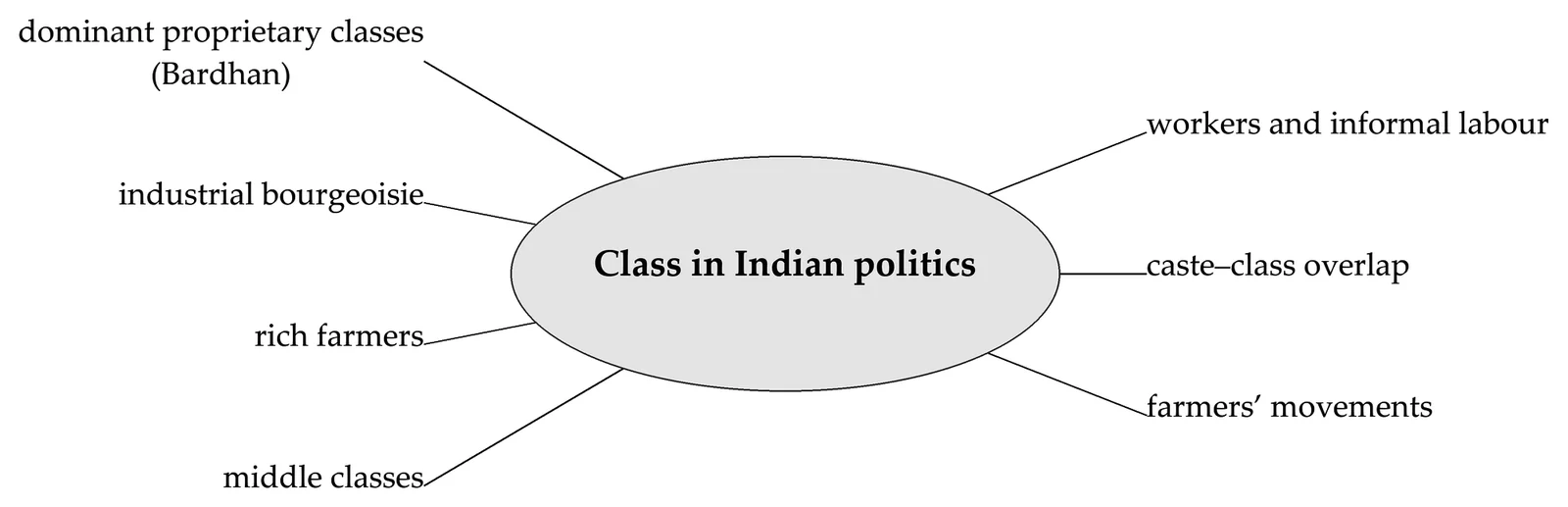
Class refers to groups defined by their position in the economy: ownership of land and capital, occupation and income. Marxist scholars argue that class shapes the character of the state. Raju J. Das, in ‘Class Relations, Class Struggle and the State in India’ (2019), argues that the Indian state is a capitalist state that protects the interests of property-owning classes, industrial capitalists and landowners, though it enjoys relative autonomy and must respond to pressures from workers and peasants in a democracy. Pranab Bardhan earlier identified three dominant proprietary classes, industrial capitalists, rich farmers and professionals including the bureaucracy, whose competing demands shaped the economy.
B. Why class politics is weak
Despite deep inequality, class has rarely been the main basis of Indian electoral politics. Caste, religion, language and region cut across class lines and divide workers and peasants; most workers are in the unorganised sector, which is hard to unionise; and Left parties have been strong only in some states, such as Kerala, West Bengal and Tripura. Yet class matters in other ways: through peasant and workers’ movements, through the policies of parties, and through the overlap of caste and class, since upper castes dominate land and professions while Dalits are concentrated among landless labourers.
C. Globalisation and labour
S. Chowdhury, in ‘Globalization and Labour’ (2007), shows how economic liberalisation after 1991 changed the position of workers. Competition and the search for flexibility led to informalisation, contract and casual labour, and the weakening of trade unions; public sector employment shrank; and the bargaining power of capital rose. Labour laws were relaxed, and four labour codes passed in 2019–20 consolidated older laws, which unions criticised for weakening protections. At the same time, new forms of labour, such as platform and gig workers, have begun to organise.
4.4 Gender and Political Power
A. Patriarchy and political participation
Patriarchy is a system in which men hold power over women in the family, the economy and the state. In Indian politics it shows in the low representation of women in legislatures (about 14 per cent of the Lok Sabha in 2024), in party nominations and leadership, and in violence and harassment that discourage women’s participation. Yet women’s voting turnout has risen steadily and in 2019 slightly exceeded men’s. Reservation in panchayats and municipalities (1992) brought lakhs of women into local politics, and the 106th Amendment (2023) will reserve one-third of seats in Parliament and state assemblies. Parties now treat women as an important constituency, with welfare schemes such as LPG connections and cash transfers aimed at them.
B. Gendering caste: Uma Chakravarti
Uma Chakravarti, in Gendering Caste through a Feminist Lens (2003), argues that caste and gender are inseparable. Caste purity is maintained through endogamy, which requires strict control over women’s sexuality and marriage. She calls this Brahmanical patriarchy: a system in which the caste hierarchy and the subordination of women reinforce each other. This explains the violence against inter-caste couples and ‘honour’ killings, the particular vulnerability of Dalit women to sexual violence, and the way upper-caste women’s seclusion marked status. Gopal Guru argued that Dalit women ‘talk differently’, facing oppression by both caste and gender.

C. The state and gender
The state has passed laws against dowry (1961), domestic violence (2005) and sexual harassment at the workplace (2013), and strengthened rape laws after the 2012 Delhi gang rape. Women’s movements have pushed these changes. But implementation is weak, and feminist scholars argue that the state itself often reflects patriarchal values, as in debates over personal laws and marital rape.
4.5 Important Questions
- Question 1 Discuss the relationship between caste and politics in India.
- Question 2 Examine the role of class in Indian politics.
- Question 3 Discuss gender and political power in India, with reference to the intersection of caste and gender.
DU asks the same idea in different words. So learn one broad answer for each question below; the same answer works for every question joined by OR.
Important Question 1
Discuss the relationship between caste and politics in India.
OR
‘It is not politics that gets caste-ridden; it is caste that gets politicised.’ Discuss.
OR
Examine the role of caste in Indian democracy.
Model Answer
“It is not politics that gets caste-ridden; it is caste that gets politicised.”
— Rajni Kothari, Caste in Indian Politics (1970)
Introduction. Caste is the most distinctive feature of Indian social structure, and its relationship with democratic politics has been one of the central themes of Indian political science. Democracy has not abolished caste, but it has transformed it, and caste has in turn shaped democracy.
1. Meaning of Caste
Caste combines varna and jati and was marked by hierarchy based on purity and pollution, endogamy, hereditary occupation and untouchability. The Constitution abolished untouchability and introduced reservations to correct historical injustice. Ghurye described its features as segmentation, hierarchy and restrictions on food, marriage and occupation.
2. The Politicisation of Caste
Kothari argued that democratic competition drew caste into politics. Caste networks became channels of mobilisation, and caste was transformed from a ritual hierarchy into a political resource and identity. He made this argument in Caste in Indian Politics (1970).
3. Three Aspects
Kothari described a secular aspect, in which castes act as interest groups; an integrative aspect, in which caste draws people into democracy; and a consciousness aspect, in which caste becomes a political identity. These are the secular, integration and consciousness aspects.
4. Caste Associations and Dominant Castes
The Rudolphs showed how caste associations became modern democratic organisations; Srinivas showed how dominant castes, strong in numbers, land and status, controlled village and state politics. M.N. Srinivas’s idea of the dominant caste explained rural power.
5. Sanskritisation and Mobility
Srinivas showed that castes sought upward mobility by adopting upper-caste customs and modern education, which also shaped their political strategies.
6. The Struggle for Equality
Weiner showed how lower castes used democracy to challenge upper-caste dominance. The Mandal Commission’s implementation in 1990 and the rise of OBC parties transformed North Indian politics, which Jaffrelot called a silent revolution.
7. Mandal and OBC Politics
The implementation of the Mandal Commission’s recommendations in 1990 brought OBC parties and leaders to power, a change Jaffrelot called India’s ‘silent revolution’.
8. Dalit Assertion
Inspired by Ambedkar, Dalit movements and parties such as the BSP challenged caste hierarchy and won state power, while Dalit intellectuals exposed continuing discrimination. The BSP, founded by Kanshi Ram in 1984, formed governments in Uttar Pradesh.
9. Caste and Reservations
Reservations in education, jobs and legislatures have created a Dalit and OBC middle class and political leadership, though benefits are unevenly shared.
10. Caste in and as Democracy
Deshpande argues that upper castes converted caste privilege into modern capital and appear ‘casteless’, while lower castes remain marked by caste. Jodhka shows that caste has shifted from hierarchy to difference, though violence and discrimination persist. Upper castes now often present themselves as ‘casteless’ while benefiting from inherited advantages.
11. The Caste Census Debate
The debate on a caste census, revived by Bihar’s caste survey of 2023, shows that caste remains central to policy and politics.
12. Evaluation
Caste politics has deepened democracy by empowering excluded groups, but it can also fragment society, reduce politics to identity and leave the poorest among lower castes behind. Caste and class overlap, so social justice requires both representation and economic change. But it can also entrench caste identities.
13. Caste and Elections
Voters consider caste, but rarely caste alone; parties therefore try to build social coalitions of several castes and communities. Examples include the Congress’s KHAM coalition in Gujarat in the 1980s (Kshatriyas, Harijans, Adivasis and Muslims), the Samajwadi Party’s Muslim–Yadav base, the BSP’s alliance of Dalits and Brahmins in 2007, and the BJP’s wide coalition of upper castes, non-Yadav OBCs and non-Jatav Dalits. Bihar’s caste survey (2023) revived the debate on a national caste census. Lokniti–CSDS studies show caste working alongside class, development and leadership.
14. Caste and Violence
Caste continues to produce discrimination and violence, especially against Dalits, as in the Khairlanji killings (2006). The Scheduled Castes and Scheduled Tribes (Prevention of Atrocities) Act, 1989 provides special protection, but its enforcement remains weak. The SC/ST (Prevention of Atrocities) Act (1989) seeks to address this.
Conclusion. Thus, caste and democracy have transformed each other. Caste has become a vehicle of political participation, while democracy has weakened ritual hierarchy without ending inequality.
Important Question 2
Examine the role of class in Indian politics.
OR
Discuss the impact of globalisation on labour in India.
OR
Why has class not been the main basis of politics in India?
Model Answer
“The history of all hitherto existing society is the history of class struggles.”
— Karl Marx and Friedrich Engels, The Communist Manifesto (1848)
Introduction. Class refers to groups defined by their economic position: ownership of land and capital, occupation and income. In India class inequality is deep, but its political expression has been shaped and often weakened by caste, religion and region.
1. Class and the State
Raju J. Das argues that the Indian state is capitalist, protecting property-owning classes, though it has relative autonomy and must respond to democratic pressures from workers and peasants. It also seeks legitimacy through welfare and elections.
2. Dominant Proprietary Classes
Pranab Bardhan identified industrial capitalists, rich farmers and professionals including the bureaucracy as the dominant classes whose competing demands shaped economic policy and subsidies. In The Political Economy of Development in India (1984), he argued that competition among them slowed growth.
3. Land Reforms
Land reforms after independence abolished zamindari but were weakly implemented in most states, leaving land inequality largely intact.
4. Workers and Peasants
Workers organised through trade unions linked to parties, and peasants through movements from Telangana to the farmers’ movements of the 1980s and 2020–21. These movements have influenced policy even when class parties were weak. Unions such as AITUC, INTUC and CITU are linked to parties.
5. Left Parties in India
The communist parties built strong bases in Kerala, West Bengal and Tripura, carrying out land reforms and organising workers and peasants.
6. Why Class Politics Is Weak
Caste, religion, language and region divide workers and peasants; most workers are in the unorganised sector; and Left parties have been strong only in a few states. Most workers are in the informal sector and hard to organise.
7. Caste–Class Overlap
Caste and class overlap: upper castes dominate land, business and professions, while Dalits and Adivasis are concentrated among landless labourers, so caste mobilisation often carries a class content. Dalits remain overrepresented among landless labourers.
8. Globalisation and Labour
Chowdhury shows that liberalisation after 1991 led to informalisation, contract labour and weaker unions, increasing the power of capital. The labour codes of 2019–20 were criticised by unions for reducing protections. Contract labour and outsourcing weakened unions.
9. New Forms of Class Politics
New groups of workers, such as gig and platform workers and scheme workers like ASHA and anganwadi workers, have begun to organise, while welfare schemes respond to the demands of the poor. The Code on Social Security (2020) recognises gig and platform workers.
10. Farmers’ Movements
The farmers’ protests of 2020–21 against three farm laws, which were repealed in 2021, showed the political power of organised agrarian classes.
11. Class and Welfare Politics
Parties increasingly appeal to the poor through welfare schemes, so class shapes electoral strategy even when it is not named.
12. Business and Politics
Business associations such as FICCI and CII and large corporate groups influence policy through lobbying and party funding, including electoral bonds, which the Supreme Court struck down in 2024.
13. Class and Voting
Surveys show that poorer voters in India turn out in larger numbers than the rich, unlike in many Western democracies.
14. Evaluation
Class shapes the character of the state and of economic policy even when it is not the main basis of voting. A full understanding of Indian politics must combine class analysis with the study of caste and other identities. Class remains an important but often hidden dimension of Indian politics.
15. Agrarian Classes and Farmers’ Politics
After the Green Revolution, rich and middle peasants became a powerful political force. Leaders such as Charan Singh in the 1970s, and farmers’ movements led by Sharad Joshi and Mahendra Singh Tikait in the 1980s, demanded remunerative prices, cheap inputs and loan waivers. The farmers’ protests of 2020–21 forced the repeal of the three farm laws, showing the continuing power of agrarian classes. Leaders such as Charan Singh and Mahendra Singh Tikait mobilised farmers.
16. The Middle Classes
The urban middle classes grew rapidly after liberalisation. They influence the media, public opinion and policy, and were prominent in the anti-corruption movement of 2011.
Conclusion. Thus, class is a powerful but often hidden force in Indian politics, mediated by caste and identity and transformed by globalisation.
Important Question 3
Discuss gender and political power in India, with reference to the intersection of caste and gender.
OR
Examine Uma Chakravarti’s idea of Brahmanical patriarchy.
OR
Discuss women’s political participation and representation in India.
Model Answer
“I measure the progress of a community by the degree of progress which women have achieved.”
— B.R. Ambedkar (1942)
Introduction. Gender is a basic dimension of social structure and political power. In India women have equal political rights, yet patriarchy limits their power, and their position is shaped by caste and class as well as gender.
1. Patriarchy
Patriarchy gives men power over women in the family, economy and state, through control over property, mobility, sexuality and decision-making. Sylvia Walby identified patriarchal structures in paid work, the household, the state, violence, sexuality and culture.
2. Participation
Women’s voting turnout has risen steadily and slightly exceeded men’s in 2019. Women have become an important constituency for parties and welfare schemes. Women’s turnout has exceeded men’s in several recent elections.
3. Representation
Women remain under-represented in legislatures (about 14 per cent of the Lok Sabha in 2024) and party leadership. Reservation in local bodies brought lakhs of women into politics, and the 106th Amendment (2023) will extend reservation to legislatures. The 106th Amendment (2023) will reserve one-third of seats. Women hold about fourteen per cent of seats in the Lok Sabha elected in 2024.
4. Brahmanical Patriarchy
Uma Chakravarti argues that caste purity is maintained through endogamy and control over women’s sexuality; caste hierarchy and women’s subordination reinforce each other. She introduced the term in an essay of 1993.
5. Consequences
This explains violence against inter-caste couples, ‘honour’ killings, the vulnerability of Dalit women to sexual violence, and the seclusion of upper-caste women as a mark of status. Khap panchayats have opposed inter-caste and same-gotra marriages.
6. Dalit Feminism
Gopal Guru argued that Dalit women ‘talk differently’, facing both caste and gender oppression, which mainstream feminism and Dalit politics often ignored. Sharmila Rege called for a Dalit feminist standpoint.
7. Women’s Organisations
Groups such as SEWA, the All India Democratic Women’s Association and the National Federation of Dalit Women (1995) have mobilised women across class and caste.
8. State and Law
Laws against dowry, domestic violence and sexual harassment, and stronger rape laws after 2012, reflect the pressure of women’s movements, though implementation remains weak. The POSH Act (2013) followed the Vishaka guidelines.
9. Violence at the Intersection
Cases such as Khairlanji (2006) and Hathras (2020) show how Dalit women face violence that combines caste and gender oppression.
10. Women Leaders
Women leaders such as Indira Gandhi, Mayawati, Jayalalithaa and Mamata Banerjee reached the top, but often through party or family routes rather than broad structural change.
11. Evaluation
Women’s political power has grown, especially at the local level, but proxy representation, violence and patriarchal attitudes remain obstacles. An intersectional approach is necessary to understand the different experiences of women. Intersectionality shows that women’s experience of power differs by caste and class.
12. Women and Parties
Parties field few women candidates, though they court women voters through welfare schemes such as cash transfers to women.
13. Women in Local Government
Reservation in panchayats and municipalities made lakhs of women local leaders; many states raised the quota to one-half. Studies such as Chattopadhyay and Duflo (2004) show that women leaders change local priorities, for example towards drinking water. But the problem of the ‘sarpanch pati’, a husband exercising power in his wife’s name, shows that training and social change are also needed.
14. Women Voters and Welfare
Women increasingly vote independently of male relatives, and parties now design welfare schemes for them, such as cash transfers, LPG connections and toilets. In Bihar, prohibition was introduced in 2016 partly in response to women’s demands.
15. Women’s Movement and the Law
Campaigns after the Mathura custodial rape case (1979–80) led to the amendment of rape laws in 1983, and protests after the 2012 Delhi gang rape led to the Justice Verma Committee and the Criminal Law (Amendment) Act, 2013.
Conclusion. Thus, gender, caste and class together shape political power in India. Empowering women requires challenging both patriarchy and the caste structures that sustain it.
Short Notes
(a) Dominant caste
M.N. Srinivas’s concept for a caste that dominates a village or region by combining numerical strength, economic power through landownership, political influence and a relatively high ritual status. Examples include the Jats, Marathas, Reddys and Vokkaligas. Dominant castes have played a central role in electoral politics.
(b) Mandal Commission
The Second Backward Classes Commission (1979–80), chaired by B.P. Mandal, recommended 27 per cent reservation for Other Backward Classes in central government jobs. Its implementation by the V.P. Singh government in 1990 sparked protests and was upheld in Indra Sawhney (1992) with a 50 per cent ceiling and exclusion of the creamy layer.
More notes: MDSC-2A Indian Government and Politics
- Indian Constitution: basic features, debates on Fundamental Rights, Directive Principles and Federalism
- State formation and nation building: Integration of princely states, linguistic re-organisation of states
- Political institutions at the Centre and State levels: Parliament, Judiciary, Prime Minister, Chief Minister
- Religion and politics: debates on secularism and communalism
- Political parties and party systems
- Development strategies: planned economy, neo-liberal restructuring
- Social movements: workers, farmers, environmental, and women’s movements
- The nature of state in India: developmental, welfare, regulatory
These notes are prepared by PADHO TO AISE for study help. They are not an official University of Delhi publication.