
Semester III DSC-8 Ancient and Medieval Indian Political Thought
Unit VII · 20 min read · Updated 24 Nov 2026
As per the University of Delhi (DU) BA (Hons) Political Science syllabus
Contents
- 7.1 Tiruvalluvar and the Tirukkural
- 7.2 Ethical Life: Aram
- 7.3 Politics and Economy: Porul
- 7.4 Interpreting the Kural: The Role of Commentary
- 7.5 Evaluation
- 7.6 Important Questions
- ‘Among the ancient ethical writings of the world that have come down to us is the Tirukkural.’ Discuss the above statement.
- Discuss the political ideas of Tiruvalluvar.
- Short Notes
बुराई करने वालों को दंड देने का सबसे अच्छा तरीका है उनके साथ ऐसी भलाई करना कि वे लज्जित हो जाएँ।
The way to punish those who do evil is to shame them by doing good to them.
— Tirukkural, Couplet 314
THE TIRUKKURAL of Tiruvalluvar is one of the most admired ethical works in the world. In 1,330 short couplets it teaches how to live a good life as a person, a householder, a citizen and a ruler. It belongs to no single religion or sect, which is why Tamil tradition calls it the ‘common scripture of the world’, and it has been translated into dozens of languages. Leo Tolstoy quoted it in his Letter to a Hindu (1908), which influenced Gandhi’s thinking on non-violence. The Kural is also a work of political thought: its second book, on porul, discusses the king, ministers, the army, the economy and good government. In this chapter we study the Tirukkural as a work of ethics and of politics, and the way it connects the two.
7.1 Tiruvalluvar and the Tirukkural
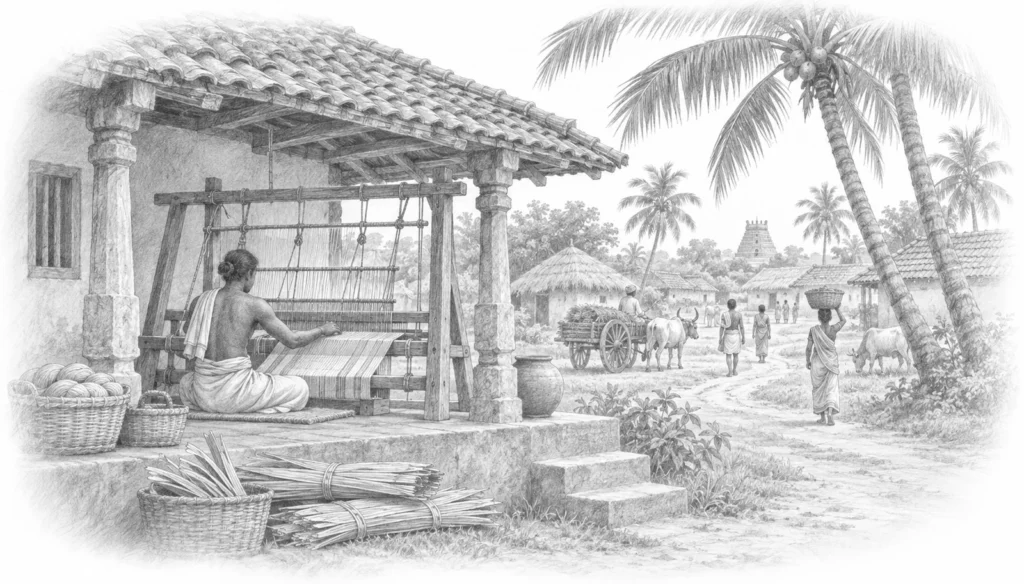
Almost nothing certain is known about Tiruvalluvar. Tradition says he was a weaver of Mylapore, but this cannot be verified, and scholars date the Kural variously between the last centuries BCE and the fifth or sixth century CE. The Tirukkural (‘sacred couplets’) is written in the brief, two-line kural venba metre and is organised into three books (Figure 7.2): Aram (virtue), with 38 chapters; Porul (wealth and polity), with 70 chapters; and Inbam or Kamam (love), with 25 chapters. These correspond to the first three of the Sanskrit purusharthas, dharma, artha and kama, though the Kural does not have a separate book on moksha. S. Maharajan, in his study of Tiruvalluvar, emphasises the work’s universality: it addresses all human beings and does not name any particular god, sect or caste.

The Tamil literary background
The Kural belongs to the period after the Sangam anthologies of early Tamil poetry, which were composed in the first centuries of the Common Era. Those poems describe the Chera, Chola and Pandya kingdoms, the generosity of kings to poets, heroic warfare and the poetic division of life into akam (the inner world of love) and puram (the outer world of war and public life). The Kural is grouped with the ‘Eighteen Minor Works’ (Patinenkilkanakku), a collection of mostly didactic texts. Its stress on ethics, moderation and non-violence may reflect the growing influence of Jain and Buddhist ideas in the Tamil country, which is why some scholars think Tiruvalluvar was a Jain, while others claim him for Shaiva or Vaishnava traditions.
Aram, porul, inbam and the purusharthas
The three books correspond to the first three purusharthas, dharma, artha and kama, but the Kural has no separate book on moksha, liberation. This choice reflects its this-worldly focus: the good life is achieved through virtuous action in the household and society, and politics is judged by whether it makes such a life possible.
The poet and the legends
Later legends, collected in the Tiruvalluva Malai, describe the Kural being presented to the assembly of poets at Madurai and praised by them, and give Tiruvalluvar a devoted wife named Vasuki. These stories are not historical, but they show the reverence in which the work was held. Because the Kural names no god or sect, Jains, Shaivas, Vaishnavas and modern rationalists have all claimed Tiruvalluvar as their own.
7.2 Ethical Life: Aram
The first book, on aram (virtue), lays the ethical foundation for everything else. Its main teachings are:
- Virtue as the source of happiness: only that pleasure which flows from virtue is true pleasure; wealth and power without virtue bring ruin.
- The householder’s life: the Kural gives great importance to the household (illaram), which supports ascetics, guests, the poor and the departed; the good householder is greater than the one who renounces.
- Hospitality and charity: welcoming guests and giving to those in need are central duties.
- Gratitude, truthfulness and self-control: a single favour received in need is worth more than the world; truthful speech and the control of anger and desire are praised.
- Non-violence: not killing is the highest virtue; the Kural advises that the way to punish evildoers is to shame them by doing good to them, a teaching Tolstoy quoted and Gandhi admired.
- Non-covetousness and humility: coveting others’ wealth, envy and pride are condemned.
- The ascetic life: the second part of the book describes renunciation, compassion and the abandonment of desire.
Ethics for Tiruvalluvar is not separate from social life: the virtuous person is a good householder, neighbour and citizen, and virtue is the foundation on which wealth, power and love must rest.
7.3 Politics and Economy: Porul
A. The king and his kingdom
The second book, on porul, is the longest and deals with the state. C.S. Srinivasachari, in ‘The Political Ideology of the Kural’ (1949), shows that it describes a monarchy limited by ethics. The Kural says that a king who possesses six things, an army, people, wealth, ministers, allies and fortresses, is a lion among kings (couplet 381), a list close to Kautilya’s saptanga. The ideal king has courage, liberality, wisdom and energy; he is easily accessible, speaks kindly, listens to criticism, and protects his people without partiality.
B. The just sceptre
The central political image of the Kural is the sengol, the righteous sceptre. It is not the spear but the sceptre, held without swerving, that brings a king victory; the world looks to the just sceptre as living things look to the rain. Its opposite, the kodungol, the cruel sceptre of tyranny, is condemned: a king who oppresses his people is more cruel than a murderer, and a kingdom ruled unjustly perishes. Justice, impartiality and protection of the weak are thus the basis of legitimate rule.
C. Ministers, envoys and spies
The Kural devotes many chapters to the qualities of ministers, who must be learned, courageous, honest and able to give unwelcome advice; to envoys, who must be eloquent and loyal; and to spies, who are the eyes of the king. It also discusses the fortress, the army, alliances and the dangers of hostility, showing a practical understanding of statecraft.
D. The economy
K.V. Nagarajan, in ‘Thiruvalluvar’s Vision: Polity and Economy in Thirukkural’ (2005), shows that the Kural has a coherent economic vision. Wealth is necessary for both virtue and power, but it must be acquired by righteous means. Agriculture is the foundation of the economy: however people roam, the world follows the plougher. The king must protect producers, collect taxes justly, and spend on welfare; a prosperous country is one free of hunger, disease and enmity. Begging is condemned, and both individuals and the state are urged to work and share.
E. Learning, friendship and the army
The Kural places great value on learning: numbers and letters, it says, are the two eyes of living beings, and the unlearned, however high their birth, are inferior to the learned. A king must be learned and must honour the learned, since an ignorant ruler cannot judge advice. Several chapters deal with friendship: friends should be tested before they are trusted, and a true friend helps in distress as instinctively as the hand reaches out to catch a slipping garment. Others describe the qualities of a good army, its courage, discipline and loyalty, and the conduct of war, which should be undertaken only after weighing strength, time and place.
F. War, peace and enmity
Although the Kural accepts war as part of statecraft, it prefers peace and diplomacy. A wise king avoids making enemies, even in jest, wins over opponents by kindness where possible and fights only after weighing his strength, the time and the place. It describes enmity as a disease that destroys good fellowship, but also warns that a hostile force which is ignored while weak may grow strong. Military strength is valued, but always as a servant of justice and the protection of the people.
7.4 Interpreting the Kural: The Role of Commentary
Norman Cutler, in ‘Interpreting Thirukkural: The Role of the Commentary in the Creation of a Text’ (1992), shows that what the Kural means has depended on its commentators. The most influential, Parimelalagar (13th century), read it through Sanskrit categories, interpreting aram as dharma and placing it within the framework of varna and Vedic tradition. In the twentieth century, Tamil and Dravidian movements emphasised its non-Brahmanical, universal and rational character, as a symbol of Tamil identity and of ethics independent of caste and ritual. Cutler’s point is that a classic text is always created anew through interpretation, so different communities have found different messages in the same couplets.
The Kural in modern times
The Kural has been translated into many languages, from the Latin version of the Jesuit missionary Constanzo Beschi in the eighteenth century to G.U. Pope’s English translation of 1886. Leo Tolstoy quoted it in his Letter to a Hindu (1908), through which Gandhi came to admire it. In twentieth-century Tamil Nadu, the Dravidian movement presented the Kural as a secular, rational and egalitarian Tamil classic, an alternative to Sanskrit texts that sanctioned caste. It is called the ‘Tamil Veda’ and the ‘universal scripture’ (ulaga podhumarai); its couplets are displayed in public buses and offices, and a 133-foot statue of Tiruvalluvar, one foot for each chapter, was unveiled at Kanyakumari in 2000.
Gender in the Kural
The Kural praises the virtuous wife as the glory of the household and expects women to be chaste and devoted to their husbands, reflecting the patriarchal norms of its time; one chapter even warns men against being ruled by their wives. Feminist readers note that its universal ethics stop short of equality between the sexes. Yet its third book treats love between man and woman with tenderness and mutual longing, and its ethics of kindness, truth and non-violence apply to all human beings.
7.5 Evaluation
The Tirukkural is distinctive because it joins ethics and politics without making politics subordinate to religion or caste. Its king is bound not by the authority of priests but by justice, kindness and the welfare of the people. Its emphasis on agriculture, honest wealth and the household shows a practical, this-worldly ethics. Its limits lie in its acceptance of monarchy and its silence on popular participation, and in some of its views on women in the household. But its universal moral vision explains why it is admired across cultures and why it remains alive in Tamil public life, where its couplets are displayed in buses and government offices.
Tiruvalluvar and other Indian traditions
Compared with Manu, the Kural is striking for what it leaves out: it does not tie duties or punishments to varna and speaks to all human beings. Compared with Kautilya, it shares the elements of the state, the value of ministers and spies and the importance of the economy, but it refuses to separate statecraft from ethics. Its non-violence and compassion recall Jain and Buddhist teaching, and its idea of returning good for evil anticipates Gandhi. The Kural thus represents a distinctive Tamil synthesis in which ethics, economy and polity form one humane whole.
7.6 Important Questions
- Question 1 ‘Among the ancient ethical writings of the world that have come down to us is the Tirukkural.’ Discuss the above statement.
- Question 2 Discuss the political ideas of Tiruvalluvar.
DU asks the same idea in different words. So learn one broad answer for each question below; the same answer works for every question joined by OR.
Important Question 1
‘Among the ancient ethical writings of the world that have come down to us is the Tirukkural.’ Discuss the above statement.
OR
Discuss Tiruvalluvar’s ideas on ethical life and politics.
OR
Examine the ethical foundations of politics in the Tirukkural.
Model Answer
“Not the spear but the sceptre, held without swerving, gives a king victory.”
— Tirukkural (546)
Introduction. The Tirukkural of Tiruvalluvar is one of the great ethical works of the world. In 1,330 couplets it teaches virtue, the conduct of public life and the art of love, without attachment to any sect, caste or god, which is why Tamil tradition calls it the common scripture of the world.
1. A Universal Text
The Kural addresses all human beings and names no particular god or sect. Its universality has led to translations into dozens of languages, and Tolstoy quoted it in his Letter to a Hindu (1908), which influenced Gandhi. Tolstoy quoted it in his Letter to a Hindu (1908), through which Gandhi came to admire it.
2. Structure
Its three books, Aram (virtue, 38 chapters), Porul (wealth and polity, 70 chapters) and Inbam (love, 25 chapters), correspond to dharma, artha and kama, showing a complete vision of human life in which virtue comes first. Together they contain 1,330 couplets in 133 chapters of ten couplets each.
3. Virtue and Happiness
Only pleasure that flows from virtue is true pleasure. Gratitude, truthfulness, self-control, humility and the absence of envy are the foundations of a good life. The Kural says that there is no greater gain than virtue and no greater loss than forgetting it.
4. The Householder’s Ethics
Unusually, the Kural honours the householder above the ascetic, because the household supports guests, the poor and society. Hospitality and charity are central virtues. The ideal householder is generous to guests, kind in speech and faithful in marriage, and the virtuous wife is praised as the glory of the home.
5. Ethics of Speech and Friendship
The Kural gives great importance to sweet and truthful speech: to use harsh words when kind ones are at hand, it says, is like eating unripe fruit when ripe fruit is available. It also advises testing friends carefully before trusting them.
6. Non-Violence
Not killing is the highest virtue, and the way to punish evildoers is to shame them by doing them good. This teaching influenced Tolstoy and Gandhi. It also condemns meat-eating, asking how one who eats the flesh of other creatures to increase his own can be called compassionate.
7. Ethics in Politics
The king must rule with the just sceptre (sengol); a tyrant is worse than a murderer. Ministers must speak the truth, and the king must listen to criticism. Ethics is the foundation of legitimate power. Punishment must be proportionate and intended to correct rather than to destroy.
8. Ethics for Rulers and Ruled
The Kural applies the same ethics to rulers and subjects: honesty, gratitude, self-control and compassion are required of all. Politics thus becomes an extension of personal morality rather than a separate sphere with its own rules, unlike Kautilya’s statecraft.
9. Ethics in Economy
Wealth must be acquired righteously; agriculture is the foundation of society, and the state must protect producers and relieve hunger, as Nagarajan shows. Begging is condemned as degrading: if some must beg to live, the Kural says, let the creator of the world himself wander and perish.
10. Love as the Third Aim
The third book, Inbam, treats love between man and woman with delicacy, describing longing, union and separation in the tradition of Tamil love poetry. Its inclusion shows that the Kural sees a full human life as one that combines virtue, wealth and love, each in its proper place.
11. The Kural and Gandhi
Gandhi admired the Kural’s teaching of returning good for evil and its ethic of non-violence and simplicity. Its idea of shaming evildoers by doing them good resembles satyagraha, which sought to change opponents through suffering and love rather than force.
12. Interpretation
Cutler shows that commentators such as Parimelalagar read the Kural through Sanskrit categories, while modern Tamil movements stress its universal, non-Brahmanical character. Parimelalagar’s reading fitted the Kural into the Sanskrit scheme of dharma and varna, while twentieth-century Tamil scholars presented it as an independent, egalitarian Tamil classic.
13. Evaluation
The Kural unites ethics, politics and economy in a this-worldly, humane vision. It accepts monarchy and is silent on popular participation, but its moral teachings remain universally relevant. Its secular and universal tone explains why it is cited in Parliament, in courts and in schools across India.
14. Wealth and the Good Life
Unlike traditions that despise wealth, the Kural holds that wealth earned by righteous means is necessary for virtue, charity and the support of family and guests. It condemns wealth gained by fraud or cruelty and warns that it brings ruin, linking ethics and economy. Wealth gained through the tears of others, it warns, will depart with tears.
15. The Kural and Kautilya Compared
The Kural’s six elements of a kingdom resemble Kautilya’s saptanga, and both value ministers, spies and forts. But where Kautilya is a pragmatic realist who permits deception for the state’s sake, the Kural insists that power must rest on virtue and that the just sceptre, not cunning, secures a kingdom.
Conclusion. Thus, the Tirukkural rightly ranks among the world’s great ethical writings, because it grounds every sphere of life, from the household to the throne, in universal virtue.
Important Question 2
Discuss the political ideas of Tiruvalluvar.
OR
Examine the concept of kingship in the Tirukkural.
Model Answer
“More cruel than a murderer is the king who oppresses his people.”
— Tirukkural (551)
Introduction. The second book of the Tirukkural, on porul, is a substantial work of political thought. It describes the qualities of the king, the elements of the kingdom and the principles of just rule, within a framework of ethics.
1. The Elements of the Kingdom
A king who has an army, people, wealth, ministers, allies and fortresses is a lion among kings, a list similar to Kautilya’s saptanga. Since the king is the possessor of these six, the list implies the seven elements of Kautilya’s state.
2. The Ideal King
The king should have courage, liberality, wisdom and energy, be accessible and kind in speech, and protect all impartially. He must be free from pride, anger and lust and easily approachable, since a king who is hard to see and harsh in speech will be ruined even without enemies.
3. The Just Sceptre
The sengol, the righteous sceptre, brings victory and prosperity; the world depends on it as living things depend on rain. The Kural even says that rain and harvests fail in the land of an unjust king, linking good government with the prosperity of nature itself.
4. Justice and Punishment
The king must investigate carefully, show no favour and punish in proportion to the offence. The Kural compares a king who punishes grave criminals to a farmer who pulls out weeds to protect the crop, so punishment exists to protect society, not to satisfy anger.
5. Against Tyranny
The cruel sceptre of an oppressive king is condemned; such a king is worse than a murderer and his kingdom will perish. The tears of people who suffer under oppression, it warns, will wear away the king’s wealth.
6. Learning and the King
Learning is praised as true wealth: numbers and letters are the two eyes of living beings. A king must be learned and must honour the learned, since an ignorant ruler cannot judge the advice he receives.
7. Ministers and Advice
Ministers must be learned, brave and honest enough to give unwelcome advice; a king without wise counsellors falls. The ideal minister knows the right means, the right time and the right method, and has the courage to oppose the king when he is wrong.
8. Envoys, Spies and Defence
Envoys must be eloquent and loyal, spies are the king’s eyes, and the fortress and army secure the kingdom. Spies should be checked against one another, since no single report should be trusted, and a good fortress has water, open land, hills and forest.
9. Friendship and Alliances
Chapters on friendship advise testing friends and allies before trusting them; a true friend, the Kural says, comes to help in distress as instinctively as the hand reaches out to catch a slipping garment.
10. Economy and Welfare
The king must protect agriculture, tax justly and ensure that the country is free of hunger, disease and enmity. A country is truly a country, the Kural says, when it is free from excessive hunger, incurable disease and destructive enemies.
11. The King and the People
The relationship between king and people is one of mutual dependence: the people are protected by the king, and the king is sustained by their prosperity and affection. A king who wins his subjects’ love needs no other defence.
12. Evaluation
Srinivasachari describes a monarchy limited by ethics, not by priests or assemblies. It lacks ideas of popular sovereignty but sets a high moral standard for rulers. Unlike Manu, it does not link kingship with varna, and unlike Kautilya, it does not justify deception for the sake of the state.
13. The King and Criticism
The Kural warns that a king without counsellors who rebuke him perishes even without enemies. A wise ruler welcomes criticism, controls his anger and keeps his word, since these qualities sustain the loyalty of the people. Rulers who cannot bear bitter words, it warns, are ruined by their own pride.
14. Taxation and Prosperity
Taxes must be collected justly; a king who extorts from his people is compared to a robber with a spear. A good kingdom produces abundant crops, has honest traders and is free from hunger, disease and hostility.
15. The Kural and Kautilya Compared
Both list similar elements of the state and value counsel, espionage and defence, but the Kural subordinates power to ethics, while Kautilya allows deception and force when the interest of the state requires them.
16. Limits of the Kural’s Political Thought
The Kural accepts monarchy as natural and offers no institution, such as an assembly with real power, to restrain a bad king; the only checks are ethics, counsel and the danger of ruin. It also says little about the rights of the people as such.
17. Relevance Today
The Kural’s ideas of just rule, accountability to criticism, honest wealth and welfare remain relevant, and its couplets are often quoted in Tamil public life as a guide to good governance. The installation of a sengol in India’s new Parliament building in 2023 shows the continuing symbolic power of the idea of the just sceptre.
Conclusion. Thus, Tiruvalluvar’s politics is an ethical monarchy in which the just sceptre, wise counsel and the welfare of the people are the measures of good government.
Short Notes
(a) Sengol and kodungol
In the Tirukkural, the sengol is the righteous sceptre of a just king, which brings victory and prosperity, while the kodungol is the cruel sceptre of a tyrant, which brings ruin. The images express the idea that legitimate power rests on justice and impartiality.
(b) The structure of the Tirukkural
The Tirukkural has 1,330 couplets in 133 chapters of ten each, arranged in three books: Aram (virtue, 38 chapters), Porul (wealth and polity, 70 chapters) and Inbam (love, 25 chapters), corresponding to dharma, artha and kama.
More notes: DSC-8 Ancient and Medieval Indian Political Thought
These notes are prepared by PADHO TO AISE for study help. They are not an official University of Delhi publication.