
Semester III DSC-8 Ancient and Medieval Indian Political Thought
Unit VIII · 19 min read · Updated 24 Nov 2026
As per the University of Delhi (DU) BA (Hons) Political Science syllabus
Contents
- 8.1 Basavanna: Life and Context
- 8.2 The Vachana Movement and the Anubhava Mantapa
- 8.3 Social and Religious Ideas
- 8.4 The Crisis at Kalyana
- 8.5 History and Historiography
- 8.6 Significance and Evaluation
- 8.7 Important Questions
- Discuss the social and political ideas of Basavanna.
- Examine the Vachana movement and the Anubhava Mantapa.
- Short Notes
कायक ही कैलास है।
Work is worship: work itself is heaven (Kayakave Kailasa).
— A guiding principle of the Vachana movement, 12th century
IN TWELFTH-CENTURY KARNATAKA, a minister in the court of the Kalachuri king Bijjala led one of the most radical social movements of medieval India. Basavanna, also called Basaveshwara, rejected caste, temple ritual and priestly authority, declared that all honest work is worship, gathered men and women of every caste into an assembly of spiritual discussion, and supported a marriage between a family of Brahmin origin and a family of cobbler origin, which ended in violence and persecution. His short poems in Kannada, the vachanas, remain among the finest works of Indian literature. In this chapter we study Basavanna’s life and context, the Vachana movement and the Anubhava Mantapa, his social and religious ideas, the historiography of his life, and his significance for Indian political thought.
8.1 Basavanna: Life and Context
Basavanna was born in the twelfth century in a Brahmin family in northern Karnataka; according to tradition, he refused to wear the sacred thread and left home for Kudalasangama, where he studied and devoted himself to Shiva, whom he called Kudalasangamadeva, ‘lord of the meeting rivers’. He later joined the court of Bijjala II of the Kalachuri dynasty at Kalyana (now Basavakalyan), rising to be treasurer and chief minister. H. Thipperudraswamy, in his biography Basaveshwara (1975), describes the society in which he lived: dominated by caste hierarchy, temple wealth, Brahmanical ritual and the exclusion of lower castes and women from religious life. Basavanna used his position and his poetry to challenge this order, and his followers became known as Lingayats or Virashaivas, devotees of Shiva who wear the linga.
8.2 The Vachana Movement and the Anubhava Mantapa
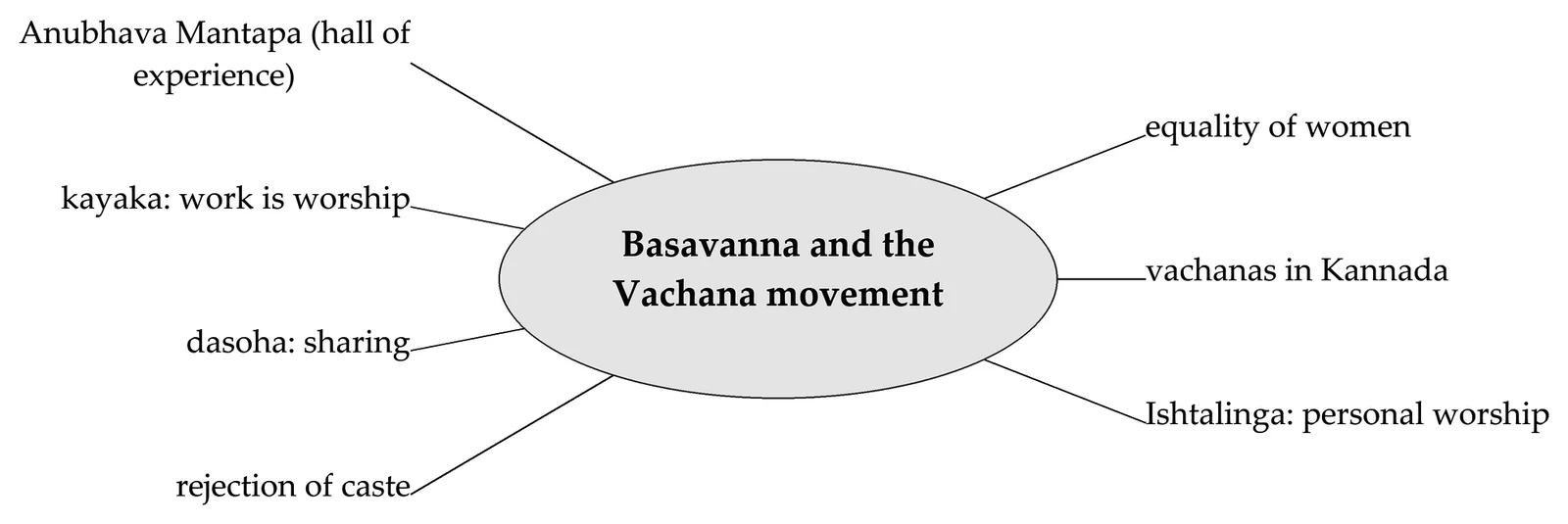
The Vachana movement produced thousands of vachanas, ‘sayings’, short prose-poems in simple Kannada, the language of the people rather than Sanskrit. Their authors, called sharanas (devotees), came from every caste and occupation and included many women. Besides Basavanna, they included Allama Prabhu, the mystic, Akka Mahadevi, the woman poet who renounced all for Shiva, and devotees who were cobblers, washermen, boatmen and ferrymen. The vachanas speak directly of personal devotion, criticise ritual and hierarchy, and describe the struggles of the inner life.
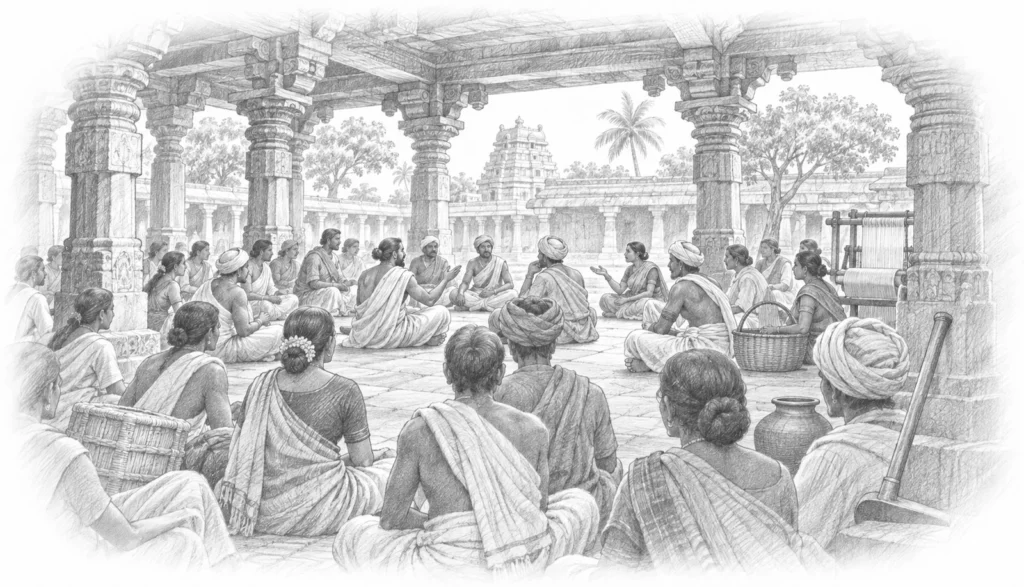
At Kalyana, the sharanas gathered in the Anubhava Mantapa, the ‘hall of experience’, where people of all castes and both sexes met as equals to discuss spiritual, ethical and social questions. Tradition says that Allama Prabhu presided over it. Modern admirers have described it as a spiritual parliament and a forerunner of democratic assemblies, though historians caution that our knowledge of it comes from later sources. It nevertheless expresses the movement’s ideal of open discussion among equals (Figure 8.2).
The sharanas of Kalyana
The movement gathered remarkable personalities. Allama Prabhu, a mystic of great intellectual power, is said to have presided over the Anubhava Mantapa. Akka Mahadevi, a young woman from Udutadi who rejected marriage to a king and wandered in devotion to Shiva as Chennamallikarjuna, composed some of the most celebrated vachanas. Channabasavanna, Basavanna’s nephew, systematised the community’s theology, and Siddharama combined devotion with public works such as tanks. Many sharanas came from labouring castes and took their names from their work: Madara Chennayya the cobbler, Madivala Machideva the washerman and Ambigara Chowdayya the ferryman. Their presence shows that the movement was not only a reform led from above but a community of people of every caste and both sexes.
8.3 Social and Religious Ideas
- Personal devotion without mediation: Basavanna taught that the devotee should worship Shiva directly through the ishtalinga, a small linga worn on the body, without priests, temples or elaborate ritual. He contrasted the sthavara, the static temple that will fall, with the jangama, the living, moving devotee, in whom God truly resides.
- Rejection of caste: all devotees of Shiva are equal, whatever their birth. Basavanna condemned untouchability and the pride of birth, and treated devotees from the lowest castes as his kin.
- Kayaka: every honest occupation, whether weaving, shoemaking or farming, is a form of worship (kayakave kailasa). This gave dignity to labour and rejected the idea that some work is impure.
- Dasoha: the fruits of work should be shared with the community of devotees and the needy, not hoarded; surplus belongs to society.
- Equality of women: women took part as sharanas, composed vachanas and joined discussions, and Basavanna rejected ideas of ritual pollution attached to women.
- Ethical conduct: a well-known vachana sums up his ethics: do not steal, do not kill, do not lie, do not be angry, do not despise others, do not praise yourself, do not blame others.
- Rejection of superstition and sacrifice: he criticised animal sacrifice, astrology and empty rituals.
- The language of the people: by writing in Kannada, the movement made religion and ethics accessible to all.
The body as temple and the community’s discipline
In one celebrated vachana, translated by A.K. Ramanujan in Speaking of Siva (1973), Basavanna contrasts the rich, who build temples for Shiva, with the poor devotee whose own body is the temple, legs its pillars and head its golden dome; what stands (sthavara) will fall, but what moves (jangama) will remain. The image sums up the rejection of temple religion in favour of living devotion. The sharanas also gave their community a shared discipline: a path of six stages (shatsthala) from devotee to union with Shiva, eight aids (ashtavarana) such as the guru, the linga and the jangama, and five codes of conduct (panchachara). These did not depend on caste or on temple priests, so they could bind together devotees of every background. The popular saying kayakave kailasa, ‘work is heaven’, expresses the movement’s ethic of labour.
Kayaka and dasoha as an economic ethic
Some scholars compare kayaka with the Protestant work ethic described by Max Weber, since both treat work as a religious calling. But dasoha adds something Weber’s Protestants lacked: an obligation to share the surplus with the community rather than to accumulate it. Together the two ideas describe a moral economy in which every honest occupation is respected, no one lives on the labour of others, and wealth is held in trust for the community.
Devotion, kingship and power
Although Basavanna served a king, his vachanas place devotion and conduct above royal power and wealth: a devotee owes loyalty first to Shiva and to the community of sharanas, not to any earthly ruler or to the pride of rank. This created a potential conflict with the state and with orthodox society, which surfaced in the crisis at Kalyana, when the king sided with orthodox opinion against the sharanas.
8.4 The Crisis at Kalyana
The movement’s challenge to caste led to a crisis. According to tradition, the sharanas arranged a marriage between the daughter of Madhuvarasa, of Brahmin origin, and the son of Haralayya, of cobbler origin. Orthodox groups saw this as a violation of caste and complained to the king. Bijjala punished the fathers severely, which led to violence, the killing of the king and the persecution and dispersal of the sharanas, an episode remembered as the Kalyana Kranti (revolution at Kalyana). Basavanna left Kalyana and died at Kudalasangama, probably around 1167–68. The episode shows both the radicalism of the movement and the resistance of the established order.
After Kalyana: the survival of the vachanas
After the crisis, the sharanas dispersed and carried their vachanas to other regions. In the fifteenth century, under the Vijayanagara rulers, Virashaiva scholars collected and arranged the vachanas in anthologies such as the Shunyasampadane, built around dialogues of Allama Prabhu. In the twentieth century, F.G. Halakatti devoted his life to collecting and publishing vachana manuscripts, which made the literature widely available and fed the modern image of Basavanna as a social reformer.
8.5 History and Historiography
Julia Leslie, in ‘Understanding Basava: History, Historiography, and a Modern Kannada Drama’ (1998), shows that what we know of Basavanna comes mostly from later hagiographies, such as Harihara’s Kannada poems and Palkuriki Somanatha’s Telugu Basava Purana (13th century), which present him as a saint and an incarnation, and from later Lingayat tradition. Modern writers have presented him in new ways: as a social reformer, a democrat, a rebel against caste or a symbol of Kannada identity. Girish Karnad’s play Taledanda (1990), written in the year of the Mandal controversy, used the story of Kalyana to reflect on caste violence in modern India. Leslie argues that each image of Basava reflects the concerns of its time. M.P. Samartha, in ‘Basava’s Spiritual Struggle’ (1977), emphasises the inner, spiritual tensions in his vachanas, reminding us that his social radicalism was rooted in religious experience.
Basavanna in modern Karnataka
Basavanna remains a powerful symbol in Karnataka. The Lingayat community, one of the state’s largest, traces its origin to the movement, and there is a long debate over whether Lingayats are a separate religion or part of the wider Veerashaiva and Hindu tradition; in 2018 the state government recommended minority religion status, which the Union did not accept. Basavanna’s statue stands beside the Thames in London, unveiled in 2015, and in 2024 the Karnataka government declared him the state’s cultural leader. Political leaders of all parties invoke the Anubhava Mantapa as an early model of democracy. Critics point out the irony that a movement against caste produced a community that functions as a caste in electoral politics, which shows how social structures can absorb radical movements.
8.6 Significance and Evaluation
Basavanna’s movement was one of the earliest organised challenges to caste hierarchy in Indian history. Its ideas of equality of all devotees, dignity of labour, sharing of wealth, inclusion of women, open discussion and use of the people’s language anticipate modern democratic and egalitarian values. It gave rise to a lasting community and literature, and Basavanna is honoured today as a social reformer; in 2024 the Karnataka government declared him the ‘cultural leader’ of the state. Critics note the limits of the evidence, the later development of hierarchy within the Lingayat community itself, and the debate on whether Lingayats form a separate religion. Yet as a voice of equality in a hierarchical age, Basavanna remains a central figure of Indian political and social thought.
Basavanna and other reformers
Basavanna’s ideas invite comparison with other critics of hierarchy. Like the Buddha, he judged people by conduct rather than birth; like Kabir and the Bhakti poets of north India, he used the people’s language and rejected priestly ritual; like Jotirao Phule and B.R. Ambedkar, he attacked caste and the exclusion of women; and like Gandhi, he honoured manual labour. What makes him distinctive is that his movement tried to build an actual community, at Kalyana, organised around equality, work, sharing and open discussion.
8.7 Important Questions
- Question 1 Discuss the social and political ideas of Basavanna.
- Question 2 Examine the Vachana movement and the Anubhava Mantapa.
DU asks the same idea in different words. So learn one broad answer for each question below; the same answer works for every question joined by OR.
Important Question 1
Discuss the social and political ideas of Basavanna.
OR
Examine Basavanna’s critique of caste and his idea of equality.
OR
Discuss the significance of Basavanna in Indian political thought.
Model Answer
“Kayakave Kailasa: work itself is heaven.”
— Principle of the Vachana movement associated with Basavanna
Introduction. Basavanna, the twelfth-century minister of the Kalachuri king Bijjala at Kalyana, led the Vachana movement, which challenged caste, ritual and priestly authority and proclaimed the equality of all devotees. His ideas make him one of the most radical social thinkers of medieval India.
1. Context
Twelfth-century Karnataka was dominated by caste hierarchy, temple wealth and Brahmanical ritual, which excluded lower castes and women from religious life. Basavanna, though born a Brahmin, rejected these privileges and used his position at court to support the sharanas. Basavanna served as a minister at the court of the Kalachuri king Bijjala at Kalyana, which gave the movement a base in a royal capital.
2. Devotion without Mediation
He taught direct devotion to Shiva through the ishtalinga worn on the body, rejecting priests and temples; the living devotee, the jangama, is the true temple. In a celebrated vachana he contrasts the rich who build temples with the poor devotee whose own body is the temple, and declares that what stands will fall but what moves will remain.
3. Critique of Caste
All devotees are equal whatever their birth; Basavanna condemned untouchability and the pride of birth and embraced devotees of the lowest castes as kin. In his vachanas he claims kinship with devotees of the lowest castes, such as the cobbler Madara Chennayya, reversing the caste hierarchy through devotion.
4. Rejection of Ritual and Superstition
Basavanna rejected animal sacrifice, astrology, pilgrimage and belief in auspicious times, arguing that conduct, not ritual, brings a devotee close to God. This ethical religion threatened the authority of priests who lived by ritual.
5. Kayaka: Dignity of Labour
Every honest occupation is worship; no work is impure. This challenged the caste hierarchy of occupations and gave dignity to artisans and labourers. The popular saying kayakave kailasa, ‘work is heaven’, sums up the teaching: honest labour is itself a path to God, and even a guru or a king must work.
6. Dasoha: Sharing
The fruits of labour should be shared with the community and the needy, expressing an ethic of social responsibility against hoarding. Dasoha also meant that wealth belongs ultimately to God and the community, so accumulation beyond need was condemned.
7. Equality of Women
Women such as Akka Mahadevi were sharanas and poets; Basavanna rejected ideas of ritual pollution attached to women. Akka Mahadevi’s vachanas, which challenge social conventions about women’s bodies and marriage, show how far the movement opened space for women’s voices.
8. The Anubhava Mantapa
The hall of experience brought people of all castes and both sexes together for open discussion, often described as a spiritual parliament and an early model of democratic deliberation. Allama Prabhu is said to have presided over it, and members debated ethical and spiritual questions on the basis of experience (anubhava) rather than scriptural authority.
9. Kalyana as a New Society
The sharanas tried to build at Kalyana a community in which devotion, work and sharing replaced birth as the basis of status. Scholars have called it an experiment in an egalitarian social order, though its scale and duration were limited.
10. The Crisis at Kalyana
Support for an inter-caste marriage led to persecution, violence and the dispersal of the sharanas, showing the resistance of the established order to his radical equality. The city was thrown into turmoil, the sharanas were scattered and Basavanna withdrew to Kudalasangama, where he died soon after.
11. Evaluation
Basavanna anticipated modern ideas of equality, dignity of labour and participation. Leslie warns that our images of him are shaped by later hagiography and modern concerns, and hierarchy later re-emerged within the Lingayat community. His legacy is also political: the Anubhava Mantapa is invoked as an early model of democratic deliberation, and in 2024 the Karnataka government declared Basavanna the state’s cultural leader.
12. The Language of the People
By composing vachanas in simple Kannada rather than Sanskrit, Basavanna and the sharanas made religious and ethical ideas accessible to ordinary men and women, and gave Kannada literature one of its greatest traditions. The choice of language was itself a challenge to the monopoly of learned elites.
13. Basava and Later Reformers
Basavanna’s rejection of caste, his dignity of labour and his inclusion of women anticipate the ideas of later reformers such as Jotirao Phule and B.R. Ambedkar, which is why modern movements for equality in Karnataka claim him as a predecessor.
14. The Lingayat Community Today
The movement gave rise to the Lingayat community, which remains an important social and political force in Karnataka. Ironically, hierarchy and caste-like divisions later developed within it, and the demand for recognition of Lingayats as a separate religion has been a contested political issue.
Conclusion. Thus, Basavanna’s social and political ideas, equality, dignity of labour, sharing and open deliberation, make him a pioneer of egalitarian thought in India.
Important Question 2
Examine the Vachana movement and the Anubhava Mantapa.
OR
Discuss kayaka and dasoha as social ideals.
Model Answer
“Understanding Basava: History, Historiography, and a Modern Kannada Drama.”
— Title of Julia Leslie’s study (1998)
Introduction. The Vachana movement of twelfth-century Karnataka, led by Basavanna and his fellow sharanas, used short poems in Kannada to spread a message of devotion, equality and ethical living. The Anubhava Mantapa was its centre of discussion.
1. Vachanas
Vachanas are short prose-poems in simple Kannada, the language of the people, ending with a name of Shiva. They criticise ritual and hierarchy and express personal devotion. Thousands of vachanas, attributed to more than two hundred sharanas, survive, and A.K. Ramanujan’s Speaking of Siva (1973) brought them to a worldwide audience.
2. Language and Literature
By writing in simple Kannada prose-poetry instead of Sanskrit, the sharanas created a new literary form and made religious and social ideas available to ordinary people, a democratisation of knowledge comparable to the use of vernaculars by Kabir and the Bhakti poets.
3. The Sharanas
The authors came from every caste and occupation, including cobblers, washermen and ferrymen, and many women, showing the movement’s inclusiveness. Among them were Madara Chennayya, a cobbler, Madivala Machideva, a washerman, and Ambigara Chowdayya, a ferryman, whose names carry their occupations.
4. The Anubhava Mantapa
The hall of experience at Kalyana brought sharanas of all castes and both sexes together as equals for discussion, traditionally presided over by Allama Prabhu. Members spoke from their own experience rather than from scripture, and questions were settled through discussion among equals.
5. Shatsthala and Ashtavarana
The sharanas described the spiritual path as six stages (shatsthala), from devotee to union with Shiva, supported by eight aids (ashtavarana), such as the guru, the linga and the jangama, and five codes of conduct (panchachara). These gave the community a shared discipline that did not depend on caste or temple priests.
6. Kayaka
All honest work is worship; this principle gave dignity to labour and undermined the caste ranking of occupations. The saying kayakave kailasa, ‘work is heaven’, captures this idea.
7. Dasoha
Wealth earned through kayaka should be shared with the community and the needy, creating an ethic of service. Shared meals and resources expressed this ethic in practice, much like the langar of the Sikhs.
8. Ethics and Reform
The movement condemned stealing, killing, lying, anger, contempt, self-praise and blaming others, and rejected sacrifice, astrology and superstition. This code made moral conduct, not ritual purity, the test of religion.
9. Political Significance
The movement’s political significance lies in its challenge to the link between religion, birth and power. By making work, devotion and conduct the basis of status, and by bringing people of all castes and both sexes into one deliberative community, it questioned the foundations of the hierarchical social order on which kingship and priestly authority rested.
10. Historiography
Leslie shows that knowledge of the movement comes mostly from later hagiographies, and that modern writers, including Karnad in Taledanda, have reinterpreted it in the light of present concerns. Harihara’s Kannada poems and Palkuriki Somanatha’s Telugu Basava Purana, among the earliest accounts, were written long after Basavanna’s death.
11. Women Sharanas
Women were prominent in the movement. Akka Mahadevi, who renounced worldly life and wandered in devotion to Shiva, composed some of the most powerful vachanas, and other women sharanas took part in the discussions of the Anubhava Mantapa, a remarkable inclusion for the twelfth century. Other women, such as Muktayakka and Basavanna’s wife Neelambike, also composed vachanas.
12. Jangama and Sthavara
The sharanas contrasted the static temple (sthavara) with the moving, living devotee (jangama), teaching that God lives in the devotee’s body and community rather than in stone, which shifted religious authority from temples and priests to ordinary believers.
13. A Model of Deliberation
The Anubhava Mantapa, where people of all castes and both sexes debated questions of faith and conduct, is often presented as an early model of open deliberation among equals, an idea that resonates with modern democratic values. Scholars caution against calling it a parliament in the modern sense, but its ideals of open discussion and equal voice remain powerful.
14. Limits of the Evidence
Historians note that detailed accounts of the Mantapa come from later sources, so its organisation may be idealised; but the vachanas themselves clearly express its spirit of equality. This does not make the movement less significant; it reminds us that every age reinterprets the past for its own needs.
15. Evaluation
The Vachana movement and the Anubhava Mantapa were among the most radical social experiments of medieval India, joining devotion with equality, labour, sharing and open debate. Even if later sources have idealised them, their ideals continue to inspire movements for social justice and democratic participation.
Conclusion. Thus, the Vachana movement and the Anubhava Mantapa embodied ideals of equality, dignity of labour, sharing and open discussion that remain powerful today.
Short Notes
(a) Kayaka and dasoha
Two central ideals of Basavanna’s movement. Kayaka means that every honest occupation is a form of worship, giving dignity to labour and rejecting the caste ranking of work. Dasoha means sharing the fruits of one’s work with the community and the needy rather than hoarding them.
(b) Anubhava Mantapa
The ‘hall of experience’ at Kalyana where sharanas of all castes and both sexes gathered to discuss spiritual, ethical and social questions as equals. Often described as a spiritual parliament, it symbolises the movement’s ideal of open, inclusive deliberation.
(c) Ishtalinga
The personal linga that Basavanna and the Virashaiva tradition asked every devotee, whatever their caste or gender, to wear on the body. By making the symbol of Shiva personal and portable, it rejected the need for temples, priests and ritual intermediaries, and expressed the equality of all devotees before God.
More notes: DSC-8 Ancient and Medieval Indian Political Thought
These notes are prepared by PADHO TO AISE for study help. They are not an official University of Delhi publication.