
Semester III DSC-8 Ancient and Medieval Indian Political Thought
Unit V · 21 min read · Updated 24 Nov 2026
As per the University of Delhi (DU) BA (Hons) Political Science syllabus
Contents
- 5.1 Kautilya and the Arthashastra
- 5.2 The Origin of the State
- 5.3 The Saptanga Theory: The Elements of Sovereignty
- 5.4 The King, Law and Administration
- 5.5 The Debate on Kautilyan Autocracy
- 5.6 Foreign Policy: The Mandala and the Six-Fold Policy
- 5.7 Important Questions
- ‘The Kautilyan King was not an autocrat.’ Evaluate the theory of state in ancient India in light of the above statement.
- Explain Kautilya’s foreign policy with reference to the mandala theory and the six-fold policy.
- Short Notes
प्रजासुखे सुखं राज्ञः प्रजानां च हिते हितम्। नात्मप्रियं हितं राज्ञः प्रजानां तु प्रियं हितम्॥
In the happiness of his subjects lies the happiness of the king, and in their welfare his welfare; what pleases himself the king shall not consider good, but what pleases his subjects.
— Kautilya, Arthashastra (1.19)
KAUTILYA, also known as Chanakya and Vishnugupta, is the most famous political thinker of ancient India, and his Arthashastra the most systematic ancient treatise on the state. Tradition makes him the minister who helped Chandragupta Maurya overthrow the Nanda dynasty in the fourth century BCE. His work has been compared with Machiavelli’s The Prince for its realism, and it has been read both as a manual of ruthless power politics and as a guide to welfare-oriented government. We studied Kautilya’s statecraft in Semester I and his realpolitik in Semester II; here we focus on his theory of the state: its origin, its seven elements, the place of the king, law and administration, and the important question whether the Kautilyan king was an autocrat.
5.1 Kautilya and the Arthashastra
The Arthashastra is a treatise on artha, which Kautilya defines as the livelihood of people and the territory inhabited by them; the science of artha deals with acquiring and protecting that territory. It has fifteen books covering the training of the king, administration and its departments, law and justice, the suppression of criminals, secret operations, the elements of the state, foreign policy, war and strategies against enemies. Its date is debated: tradition places it in the Mauryan age, while scholars such as Thomas Trautmann and Patrick Olivelle argue that the present text was compiled later, in the early centuries CE, from older material. R.P. Kangle’s three-volume edition (1960–65) remains the standard study, and V.R. Mehta calls Kautilya’s outlook a pragmatic vision, concerned with how a state can be secure and prosperous in a competitive world.
Authorship and date
Tradition identifies Kautilya with Chanakya or Vishnugupta, the Brahmin minister who helped Chandragupta Maurya overthrow the Nanda dynasty around 321 BCE. R.P. Kangle accepted this view, but Thomas Trautmann’s statistical study of the text’s style (1971) suggested several authors, and Patrick Olivelle (2013) argues that the present text was composed and revised in the early centuries CE, drawing on an older Arthashastra. Most scholars now treat the work as the culmination of a long tradition of statecraft that came to be associated with Kautilya’s name.
5.2 The Origin of the State
Kautilya explains the origin of kingship through the idea of matsyanyaya, the law of the fishes. When there is no ruler wielding danda, the strong devour the weak, as big fish swallow small ones. To escape this condition, people made Manu Vaivasvata their king and agreed to give him one-sixth of their grain and one-tenth of their merchandise as his share; in return the king took upon himself the duty of protecting them and ensuring their welfare (1.13). This account combines a contractual element, the people’s choice and payment of taxes, with the idea that kingship is necessary to maintain order. It makes the king’s right to taxes depend on his duty of protection: a king who fails to protect is responsible for the sins of his subjects.
5.3 The Saptanga Theory: The Elements of Sovereignty
Kautilya’s most famous contribution is the theory of the seven elements (prakritis or angas) of the state, which he calls the elements of sovereignty (6.1). Each element has ideal qualities (Figure 5.2):
- Swami (the king): of noble birth, wise, energetic, truthful, disciplined, devoted to the welfare of the people and willing to follow the advice of elders.
- Amatya (ministers and officials): native, of good family, learned, honest, loyal and tested before appointment.
- Janapada (territory and people): fertile, rich in resources, with hardworking and loyal people, defensible and free of calamities.
- Durga (the fortified capital): strong forts that protect the treasury and army and offer refuge in war.
- Kosha (the treasury): filled by lawful means, sufficient to meet calamities; Kautilya says that all undertakings depend on the treasury.
- Danda (the army and coercive power): loyal, well-trained, hereditary soldiers, ready to fight.
- Mitra (the ally): a hereditary, constant and powerful friend who can be relied on in need.
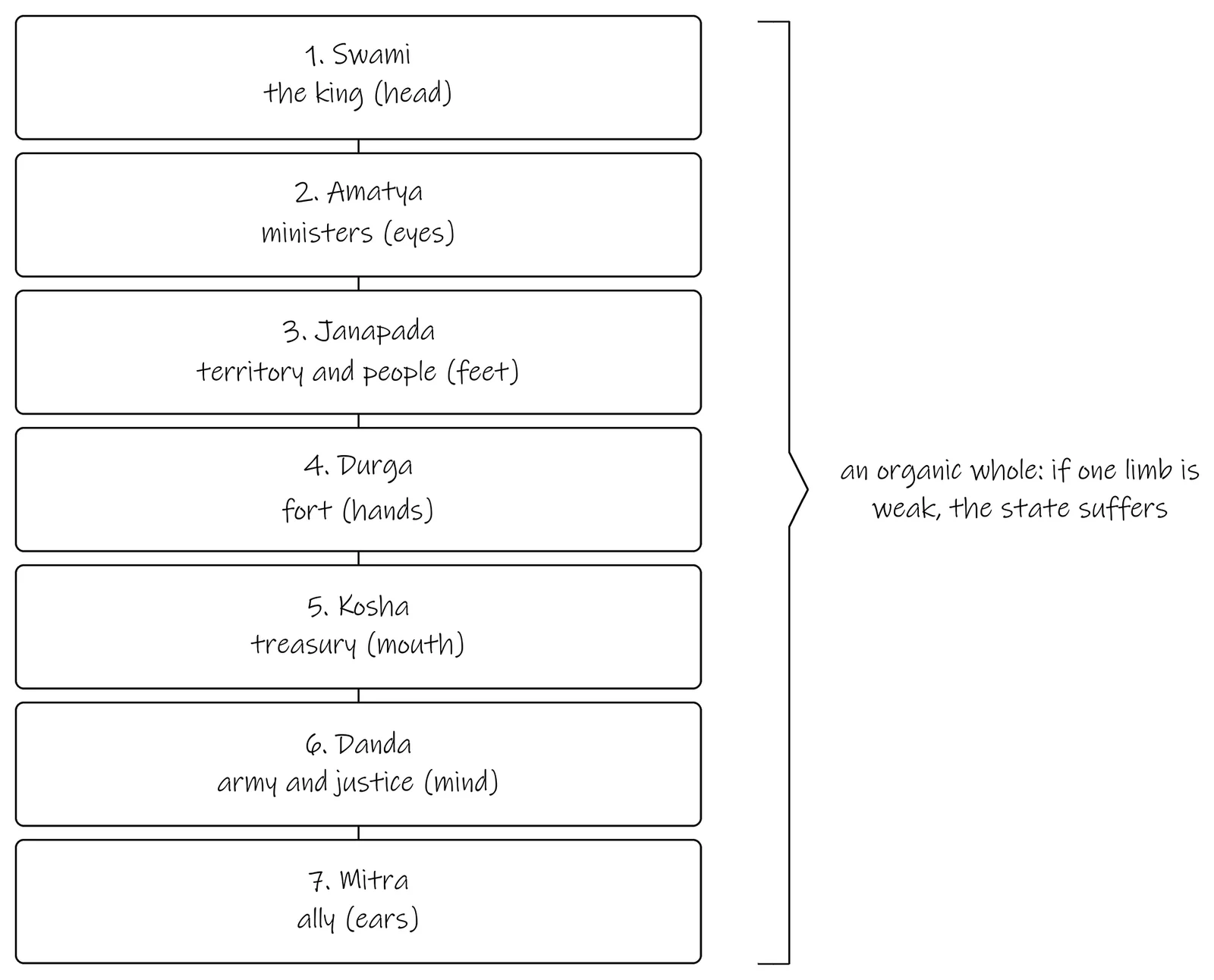
The elements are listed in order of importance, and a calamity affecting an earlier element is more serious than one affecting a later element. The theory is organic: the elements depend on each other like the limbs of a body, and the state is strong only when all are sound. Kangle notes that Kautilya says, in summing up, that the king and his rule are the whole of the constituents, which shows how central the king is in his scheme.
Saptanga and the modern idea of the state
The modern definition of the state, as population, territory, government and sovereignty, is narrower than Kautilya’s. Kautilya adds the treasury, the army, the fort and the ally, so his theory describes the state as a working system of power and resources rather than a legal abstraction. Unlike the abstract sovereignty of Bodin or Hobbes, the saptanga theory locates sovereignty in the king but makes its exercise depend on all the elements together. This is why it is often called the first Indian theory of sovereignty.
5.4 The King, Law and Administration
A. The king
The king is at the centre of the state. He must be trained in four sciences: anvikshiki (philosophy and logic), trayi (the Vedas), varta (economics) and dandaniti (the science of government). His training (vinaya) emphasises control of the senses: a king who gives in to lust, anger, greed, pride, arrogance or excitement perishes. Kautilya gives him a strict daily timetable for hearing reports, receiving petitions, consulting ministers and supervising the army, and warns that a king who is inaccessible will be deceived by his officers. His purpose is yogakshema, the acquisition of what is not possessed and the protection of what is possessed: the security and prosperity of the people.
B. Danda
Danda, coercive authority, holds the social order together. Kautilya warns that a king who is severe with punishment terrifies the people, one who is mild is despised, and one who awards just punishment is respected. Danda used properly makes the people devoted to dharma, artha and kama; used wrongly, from passion or ignorance, it enrages even forest hermits.
C. Law
Kautilya describes four sources of law, the ‘four legs’ of a legal matter: dharma (sacred law, based on truth), vyavahara (evidence and transactions, based on witnesses), charitra (custom, based on the tradition of the people) and rajashasana (the king’s edict). When they conflict, the later prevails over the earlier, so the king’s edict has the final word, but the king himself must act according to dharma and justice.
D. Administration
The state is run by a large, specialised bureaucracy: the council of ministers, the collector-general (samaharta), the treasurer (sannidhata), and about thirty adhyakshas (superintendents) for departments such as agriculture, mines, trade, weights and measures, forests and the mint. A wide network of spies watches officials and enemies. The state also performs welfare functions: irrigation, famine relief, protection of the weak, regulation of prices and support for widows, orphans and the old.
E. The economy and the welfare of subjects
The Kautilyan state plays a large role in the economy. It owns mines, forests and state farms, controls the mint and the salt trade, builds irrigation works and settles new villages. The superintendent of trade regulates markets, fixes prices and limits merchants’ profits, allowing a margin of five per cent on local goods and ten per cent on foreign goods, and punishes adulteration and false weights. Kautilya also requires the king to maintain orphans, the aged, the sick and helpless women, and to give relief in famine by distributing seed and food and starting public works. The state is thus both a coercive and a welfare organisation, guided by the ideal of yogakshema, the security and well-being of the people.
5.5 The Debate on Kautilyan Autocracy
Was the Kautilyan king an autocrat? Scholars disagree, and there are strong arguments on both sides.
A. Arguments that he was an autocrat
- Kautilya concentrates power in the king, who controls the army, treasury, administration and justice.
- The king’s edict (rajashasana) prevails over other sources of law in case of conflict.
- There are no popular assemblies or constitutional limits on royal power; the old sabha and samiti have disappeared.
- The extensive use of spies, secret agents and harsh punishments suggests a police state.
- Kautilya allows deception and even assassination in the interest of the state.
B. Arguments that he was not an autocrat
- The king is bound by dharma, by the shastras and by custom; his edicts must be just.
- His rigorous training and self-control make him a disciplined ruler, not a self-indulgent despot.
- He must consult the council of ministers and take decisions after deliberation; Kautilya says that rule is possible only with assistance, as a single wheel cannot move.
- His happiness lies in the happiness of his subjects; yogakshema and welfare are the purpose of rule.
- Danda must be just, neither too severe nor too mild, or it destroys the king himself.
- Local customs, guilds and village institutions retain authority, and taxes are a payment for protection.
Most scholars, including Kangle, conclude that the Kautilyan king was a centralised but limited monarch: very powerful, but bound by duty, dharma, counsel and the welfare of the people. He may be described as a benevolent or enlightened monarch rather than a despot, though without the institutional checks of modern constitutional government.
C. Kautilya and Machiavelli
Kautilya is often called the ‘Indian Machiavelli’. Max Weber remarked in ‘Politics as a Vocation’ (1919) that, compared with the Arthashastra, Machiavelli’s The Prince was harmless. Both thinkers treat politics as the art of acquiring and keeping power, accept deception and force when necessary and study human nature realistically. But the differences are important. Machiavelli wrote amid Italian disunity and separated politics from Christian morality; Kautilya wrote within the framework of dharma and made the welfare of the people the purpose of power. Kautilya also gave a systematic account of administration, economy and law, which Machiavelli did not. The comparison shows that political realism is not a Western invention.
5.6 Foreign Policy: The Mandala and the Six-Fold Policy
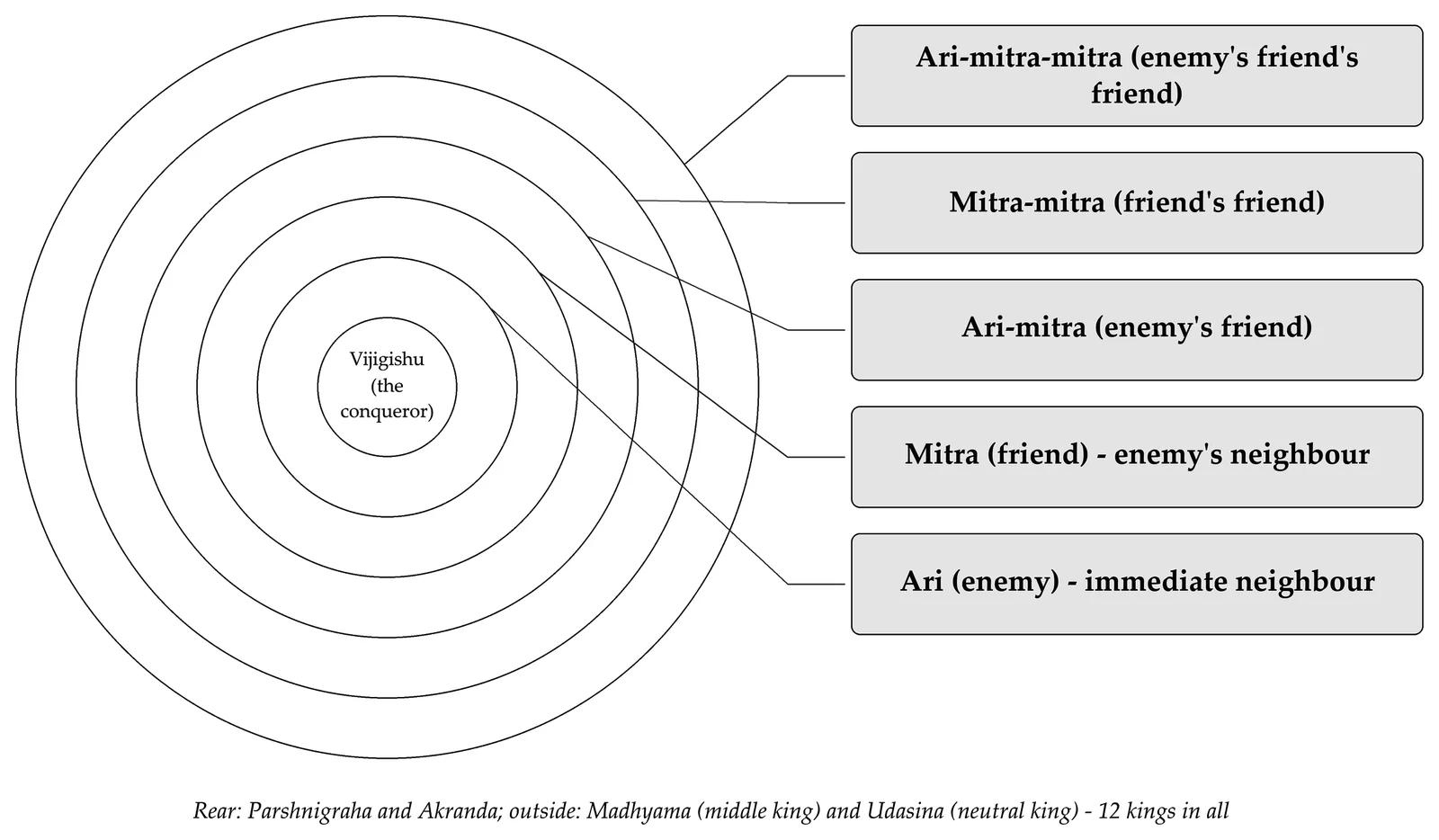
Kautilya’s state exists in a world of rival states. In his mandala theory, the king seeking conquest (vijigishu) stands at the centre of a circle of states: the neighbour is the natural enemy, the neighbour’s neighbour a natural friend, and so on, with a middle king and a neutral king who can influence the whole circle (Figure 5.3). The king chooses among the six-fold policy of peace, war, neutrality, marching, alliance and the double policy according to his relative strength, and uses the four upayas: conciliation, gifts, dissension and force. The aim is to increase one’s power and avoid decline.
Kautilya and Indian strategic thought today
Kautilya has returned to the centre of discussions on Indian strategy and on non-Western theories of international relations. Scholars use the mandala to think about India’s relations with its neighbours and the great powers, and the upayas and the six-fold policy to describe the mix of diplomacy, deterrence and alliances in modern foreign policy. Others caution that ideas from an ancient world of kingdoms cannot be applied directly to modern states, but agree that the Arthashastra shows a long Indian tradition of strategic thinking.
5.7 Important Questions
- Question 1 ‘The Kautilyan King was not an autocrat.’ Evaluate the theory of state in ancient India in light of the above statement.
- Question 2 Explain Kautilya’s foreign policy with reference to the mandala theory and the six-fold policy.
DU asks the same idea in different words. So learn one broad answer for each question below; the same answer works for every question joined by OR.
Important Question 1
‘The Kautilyan King was not an autocrat.’ Evaluate the theory of state in ancient India in light of the above statement.
OR
Discuss Kautilya’s theory of state.
OR
Examine Kautilya’s saptanga theory of the state.
Model Answer
“Rulership can be successfully carried out only with assistance. One wheel alone does not move.”
— Kautilya, Arthashastra (1.7)
Introduction. Kautilya’s Arthashastra is the most systematic ancient Indian treatise on the state. It describes a powerful, centralised monarchy, which has led some to call the Kautilyan king an autocrat. But a closer reading shows that Kautilya’s king is bound by dharma, counsel, discipline and the duty of welfare, so the statement that he was not an autocrat deserves careful evaluation.
1. The Origin of the State
To escape matsyanyaya, the condition in which the strong devour the weak, people chose Manu Vaivasvata as king and agreed to pay him one-sixth of their grain and one-tenth of their merchandise. The king, in return, undertook to protect them. Kingship thus rests on a quasi-contract in which taxes are payment for protection and welfare. Since the people themselves agreed to pay taxes in return for protection, kingship rests on an implied contract, and a king who fails to protect loses his claim on their loyalty.
2. The Saptanga Theory
The state has seven elements: the king, ministers, territory and people, fort, treasury, army and ally. They are organically interdependent, listed in order of importance, and the state is strong only when all are sound. The king is the first element, but he cannot function without the others. Kautilya says that the king and his rule sum up all the elements, which shows how central the king is, yet the theory also makes the king depend on ministers, treasury, army and allies.
3. Concentration of Power
The king controls the army, treasury, administration and justice, and his edict prevails over other sources of law in case of conflict. There are no popular assemblies, and a large network of spies watches officials and subjects. These features suggest an autocratic, even police, state. The king also controls a large economic sector, including mines, forests, the mint and state farms, which extends his power far beyond that of a modern constitutional head.
4. Ruthless Statecraft
Kautilya permits secret agents, deception and even assassination of enemies and traitors in the interest of the state, which has led to comparisons with Machiavelli and to the view that his king is unconstrained by morality in matters of power. Max Weber remarked in ‘Politics as a Vocation’ (1919) that, compared with the Arthashastra, Machiavelli’s The Prince was harmless.
5. Limits of Dharma and Law
Yet the king is bound by dharma, the shastras and custom. Law has four legs, dharma, vyavahara, charitra and rajashasana, and the king’s edict must itself be just. He is the protector of the social order, not its creator. A king who rules unjustly is warned that he will be overthrown by his people or his enemies, so dharma is backed by the practical danger of revolt.
6. Training, Self-Control and Counsel
The king must be educated in four sciences and must control his senses; a king who yields to lust, anger or greed perishes. He must consult his ministers, since rule is possible only with assistance, as one wheel alone does not move. His daily timetable divides day and night into periods for hearing reports, receiving petitions, consulting ministers and reviewing the army, so that he remains constantly at work for the state.
7. Ministers and Council
The king must appoint ministers after testing their honesty and ability, consult the council of ministers (mantriparishad) on important matters and follow the opinion of the majority in urgent business. A king who acts alone, Kautilya says, is like a chariot with a single wheel, which cannot move.
8. Welfare as the Purpose
Kautilya declares that in the happiness of the subjects lies the happiness of the king. The state builds irrigation works, relieves famine, protects the weak and regulates prices. The goal of rule is yogakshema, the security and prosperity of the people. He must also care for orphans, the aged, the infirm and helpless women, protect consumers against cheating merchants and fix fair wages, which makes the Kautilyan state an early welfare state.
9. Just Danda
Punishment must be neither too severe nor too mild; unjust danda provokes revolt and destroys the king. Coercive power is thus limited by the need for legitimacy and the people’s loyalty.
10. Scholarly Views
Scholars disagree. Writers influenced by colonial ideas of oriental despotism saw the Kautilyan king as an absolute despot; nationalist historians such as K.P. Jayaswal stressed the limits on royal power; Kangle and Olivelle present a more balanced picture of a strong monarch bound by the norms of his tradition.
11. Evaluation
Kangle and most scholars see the Kautilyan king as a centralised but limited monarch, benevolent rather than despotic, though lacking modern institutional checks such as elections and independent courts. The ancient Indian theory of state generally combined strong royal authority with moral limits. In modern terms the Kautilyan king is best described as a paternalist monarch: powerful and centralised, but bound by duty, counsel and the welfare of the people.
Conclusion. Thus, the Kautilyan king was powerful but not an autocrat in the sense of an arbitrary ruler: dharma, counsel, self-discipline and the duty of welfare limited his authority, making him an enlightened monarch within a pragmatic theory of the state.
Important Question 2
Explain Kautilya’s foreign policy with reference to the mandala theory and the six-fold policy.
OR
Write a note on the foreign policy of Kautilya.
Model Answer
“The king who is situated anywhere immediately on the circumference of the conqueror’s territory is termed the enemy.”
— Kautilya, Arthashastra (Book VI, tr. R. Shamasastry)
Introduction. Kautilya’s Arthashastra contains one of the earliest systematic theories of inter-state relations. Assuming a world of competing states, it advises the king how to secure and expand his power through the mandala, the six-fold policy and the four upayas.
1. The Aim of Foreign Policy
The aim is to move from decline to stability and from stability to advancement. The king should always seek to increase his own power relative to others, using whichever policy best serves this end. Kautilya describes three conditions of a state, decline (kshaya), stability (sthana) and advancement (vriddhi), and every policy is judged by whether it moves the state towards advancement.
2. The Mandala Theory
The vijigishu, the king seeking conquest, stands at the centre of a circle of states. His neighbour is a natural enemy and the state beyond it a natural friend, with alternating rings of enemies and friends. A middle king and a neutral king, powerful enough to influence all, complete the circle. The full mandala has twelve kings: the vijigishu, the enemy, the friend, the enemy’s friend and others in front and behind, together with the middle king (madhyama) and the neutral king (udasina), who are stronger than the rest.
3. The Six-Fold Policy
The king may choose sandhi (peace), vigraha (war), asana (neutrality), yana (marching), samshraya (seeking shelter with a stronger power) and dvaidhibhava (the double policy of peace with one and war with another), according to whether he is stronger, equal or weaker. A king weaker than his rival should make peace; a stronger one should wage war; one who cannot harm or be harmed should stay neutral; one with superior strength should march; one greatly weakened should seek shelter; and one who needs help should follow the double policy.
4. The Four Upayas
Conciliation (sama), gifts (dana), dissension (bheda) and force (danda) are to be used in that order, so that war is a last resort after other means have failed. Gifts and conciliation cost less in men and money than war, and dissension can weaken an enemy from within without open conflict.
5. Diplomacy and Espionage
Envoys of different ranks, spies in enemy courts, alliances and treaties are the instruments of policy, and the king must constantly gather information about the circle of states. Kautilya distinguishes envoys with full powers, envoys with a limited mission and mere carriers of royal messages, and describes spies disguised as ascetics, merchants and students. Envoys must not be harmed even when they speak harshly, Kautilya says, because an envoy is only the mouthpiece of his king.
6. Treaties and Alliances
Kautilya discusses many kinds of treaties, made with or without conditions, with hostages, with payment of tribute or with cession of territory, and judges each by whether it improves the king’s relative position. Alliances should be sought with kings who are strong but reliable, since an over-powerful ally can become a master.
7. Realism
Kautilya’s foreign policy is guided by interest and relative power, not by permanent friendship, which is why he is often called an early realist, comparable with Machiavelli and modern balance-of-power theory. Like modern realists, he assumes a world without any higher authority above states, where each state must rely on its own power and alliances for security.
8. Three Kinds of Conquerors
Kautilya distinguishes the righteous conqueror (dharmavijayi), who is satisfied with the enemy’s submission; the greedy conqueror (lobhavijayi), who seeks land and wealth; and the demoniac conqueror (asuravijayi), who seizes land, wealth, family and life. A weak king may submit to the first, but must resist the last with all his strength.
9. Ethical Limits
Yet he advises treating conquered peoples well, respecting their customs and winning their loyalty, since a conquest that alienates the people cannot last. After a conquest the king should adopt the dress, language and customs of the conquered people, honour their gods and festivals, release prisoners and remit taxes, so that the conquest becomes acceptable.
10. Three Kinds of War
Kautilya distinguishes open war (prakasha yuddha), fought at a declared time and place; concealed war (kuta yuddha), using surprise, ambush and deception; and silent war (tushnim yuddha), carried on secretly through spies, assassins and sowing dissension within the enemy’s kingdom. A king should choose the form of war that brings victory at the least cost.
11. Kautilya and Modern Realism
Kautilya’s assumptions that states pursue power and security, that neighbours are rivals and that alliances shift with interest anticipate modern realism and balance-of-power theory. Indian strategists still invoke the Arthashastra, and scholars in Global IR study it as a non-Western source of theory, though others stress its concern for prosperity and the welfare of conquered peoples. Writers on Indian strategy continue to draw on the mandala to think about neighbours, rivals and partners.
12. Evaluation
Kautilya’s foreign policy is a systematic and realistic theory of inter-state relations, written centuries before Western realism. Its emphasis on expansion and deception is troubling, but its insistence on calculation, diplomacy and the welfare of conquered peoples makes it relevant to the study of international relations today.
Conclusion. Thus, Kautilya’s foreign policy combines realism, flexibility and calculation, making the Arthashastra a pioneering text of international relations.
Short Notes
(a) Foreign policy of Kautilya
Based on the mandala theory, in which the neighbour is the natural enemy and the neighbour’s neighbour a friend, Kautilya’s foreign policy offers six options, peace, war, neutrality, marching, alliance and the double policy, chosen according to relative strength, and four means, conciliation, gifts, dissension and force, with war as a last resort. Its guiding principle is the interest and power of the state.
(b) The four legs of law
Kautilya’s four sources of law: dharma (truth and sacred law), vyavahara (evidence and transactions), charitra (custom) and rajashasana (the king’s edict). In case of conflict the later prevails over the earlier, though the king’s edict must itself accord with justice.
(c) Kautilya’s system of spies
Kautilya describes an elaborate secret service. Stationary spies worked from fixed positions disguised as a fraudulent disciple, a recluse, a householder, a merchant or an ascetic; wandering spies included secret agents, bravoes ready for violence, poisoners and mendicant women who could enter households. They watched ministers and officials, tested their loyalty, reported public opinion and worked in enemy states. Reports were trusted only when confirmed by three independent spies. The system shows both Kautilya’s realism and the authoritarian side of the state he described.
More notes: DSC-8 Ancient and Medieval Indian Political Thought
These notes are prepared by PADHO TO AISE for study help. They are not an official University of Delhi publication.