
Semester III DSC-8 Ancient and Medieval Indian Political Thought
Unit IX · 20 min read · Updated 24 Nov 2026
As per the University of Delhi (DU) BA (Hons) Political Science syllabus
Contents
- 9.1 Shankara: Life and Context
- 9.2 The Main Tenets of Advaita Vedanta
- 9.3 Knowledge, Liberation and the Two Levels of Truth
- 9.4 Contribution to Hindu Philosophy and Indian Culture
- 9.5 Critics and Evaluation
- 9.6 Important Questions
- Discuss and analyse the contribution of Adi Shankaracharya to Hindu philosophy.
- Explain the main tenets of Advaita Vedanta.
- Short Notes
ब्रह्म सत्यं जगन्मिथ्या जीवो ब्रह्मैव नापरः।
Brahman is real, the world is an appearance, and the individual self is none other than Brahman.
— Verse traditionally attributed to Shankara, Brahmajnanavali
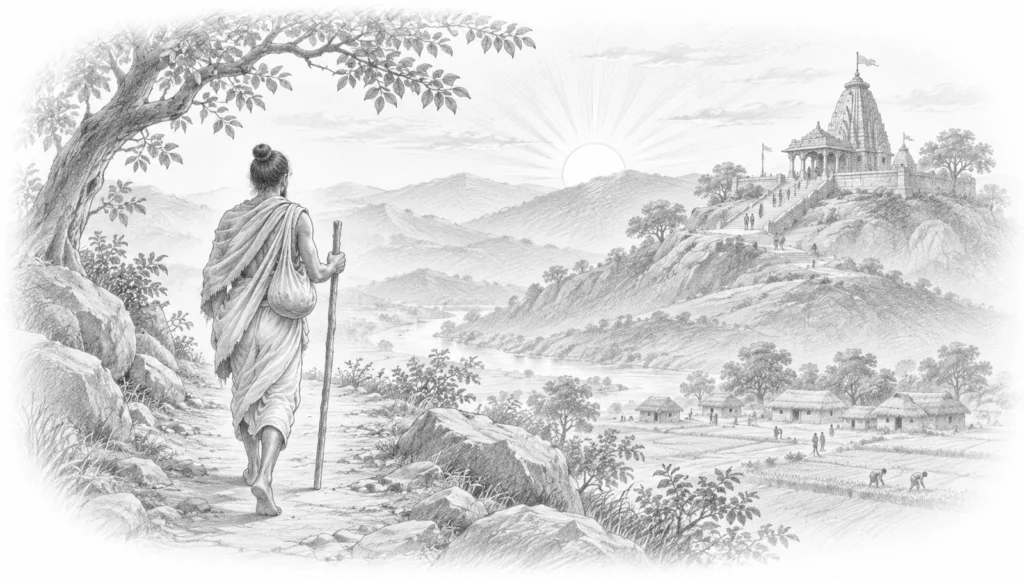
ADI SHANKARACHARYA, usually dated to the eighth century CE, is the most influential philosopher of the Hindu tradition. In a short life, tradition says, he walked from Kerala to the Himalayas, debated scholars of rival schools, wrote commentaries on the central texts of Vedanta, and founded monasteries at the four corners of India. His philosophy, Advaita Vedanta, ‘non-dualism’, teaches that the only reality is Brahman, and that the individual self is identical with it. Though Shankara was a philosopher rather than a political thinker, he is part of this paper because his ideas shaped the cultural unity of India, the revival of Vedic tradition, and modern Hindu thought, and because Advaita has been used to rethink politics and even international relations. In this chapter we study Shankara’s life and work, the tenets of Advaita, his contribution to Hindu philosophy, and its critics.
9.1 Shankara: Life and Context
Shankara was born, according to tradition, at Kaladi in Kerala, became a renouncer (sannyasi) at a young age and studied under Govindapada. He wrote commentaries (bhashyas) on the three foundational texts of Vedanta, the prasthanatraya: the Brahma Sutras, the principal Upanishads and the Bhagavad Gita. Many hymns and short works, such as Bhaja Govindam and Vivekachudamani, are also attributed to him, though some were written by later followers. He lived at a time when Buddhism and Jainism challenged Vedic authority, and when Mimamsa stressed ritual action. Shankara defended the authority of the Upanishads against Buddhists, but interpreted them as teaching knowledge rather than ritual. Tradition describes his debates with scholars such as Mandana Mishra, his travels across India and his foundation of monasteries and an order of monks, the Dashanami sampradaya.
Dates and legends
Tradition dates Shankara to 788–820 CE, though many modern scholars place him somewhat earlier in the eighth century. Most details of his life come from later hagiographies called Shankaravijayas, ‘the victories of Shankara’, such as the fourteenth-century work attributed to Madhava. They describe his renunciation as a boy, his debates with rival scholars across India, the founding of monasteries and his death at a young age in the Himalayas. These stories present him as a conquering teacher who restored the Vedic tradition, but historians treat them with caution.
9.2 The Main Tenets of Advaita Vedanta
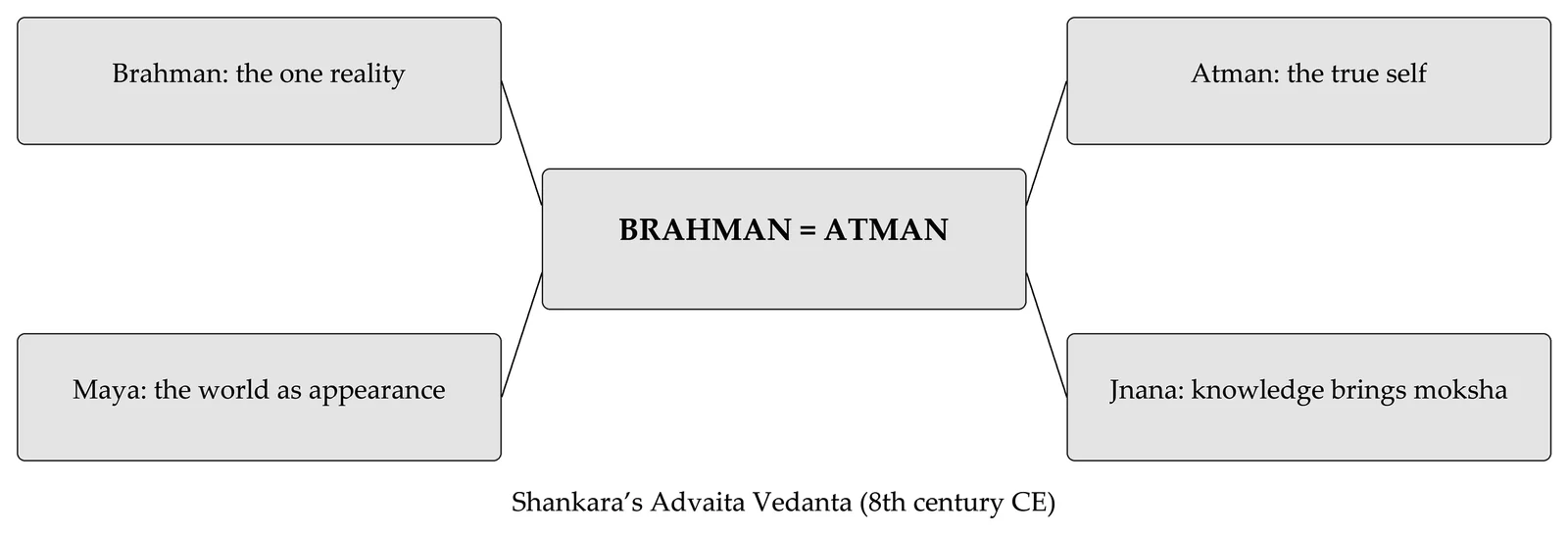
John Koller, in his essay on Shankara, and S.C. Chatterjee and D.M. Datta, in An Introduction to Indian Philosophy, summarise the main tenets of Advaita (Figure 9.2):
- Brahman alone is real: the ultimate reality is Brahman, pure being, consciousness and bliss (sat-chit-ananda), one without a second, without attributes (nirguna), eternal and unchanging.
- Atman is Brahman: the true self (atman) of every being is identical with Brahman. The Upanishadic great sayings (mahavakyas) express this: ‘That thou art’ (tat tvam asi) and ‘I am Brahman’ (aham brahmasmi).
- Maya and the world: the world of many things appears real but is ultimately an appearance (mithya), produced by maya, the power of illusion, and by avidya, ignorance. It is neither absolutely real nor absolutely unreal.
- Vivartavada: the world is an apparent transformation of Brahman, not a real one, as a rope in dim light appears to be a snake. When knowledge dawns, the snake disappears and the rope is seen as it is.
- Ishvara: from the empirical standpoint, Brahman appears as saguna Brahman, the personal God or Ishvara, creator and ruler of the world, who is the object of worship.
- Jiva: the individual self (jiva) is Brahman limited by ignorance and by the body and mind; bondage is the false identification of the self with the body.
Advaita before Shankara
Shankara did not invent non-dualism. Its roots lie in the Upanishads, which teach that the self (atman) is Brahman, in sayings such as ‘That thou art’ (Chandogya Upanishad) and ‘I am Brahman’ (Brihadaranyaka Upanishad). Badarayana’s Brahma Sutras summarised Upanishadic teaching in brief aphorisms that needed commentary. Gaudapada, the teacher of Shankara’s own teacher Govindapada, wrote the Mandukya Karika, which already argued that the world of plurality is not ultimately real. Shankara’s achievement was to give these ideas a systematic and rigorous form and to defend them against rival schools.
9.3 Knowledge, Liberation and the Two Levels of Truth
For Shankara, the goal of life is moksha, liberation, which is the realisation of the identity of atman and Brahman. Because bondage is caused by ignorance, liberation comes only through knowledge (jnana), not through ritual action (karma). Ritual and devotion (bhakti) are useful as preparation: they purify the mind and make it fit for knowledge. The seeker must cultivate discrimination between the eternal and the non-eternal, detachment, self-control and a longing for liberation, and must study the scriptures with a teacher. A person who realises Brahman is liberated even while living (jivanmukti).
To reconcile the reality of everyday experience with the unity of Brahman, Shankara distinguished levels of truth: the vyavaharika or empirical level, at which the world, individual selves and God are real for practical purposes, and the paramarthika or absolute level, at which Brahman alone is real. A third level, the pratibhasika, refers to illusions such as dreams. This distinction allowed Advaita to accept ordinary life, social duties and worship at one level while affirming absolute non-duality at the other.
The path to liberation
Shankara describes a disciplined path. The seeker must first acquire the fourfold qualification: discrimination between the eternal and the passing, detachment from rewards here and hereafter, six virtues such as calmness and self-control, and an intense desire for liberation. He then listens to the teaching of the Upanishads from a teacher (shravana), reflects on it to remove doubts (manana) and meditates on it until the knowledge becomes direct experience (nididhyasana). Ritual action and devotion purify the mind but cannot by themselves give liberation. One who realises Brahman while alive becomes a jivanmukta, free though still embodied, who acts without attachment for the good of others.
9.4 Contribution to Hindu Philosophy and Indian Culture
- Systematising Vedanta: Shankara gave the Upanishadic teaching a rigorous, systematic form through his commentaries, making Advaita one of the most influential schools of Indian philosophy.
- Reviving Vedic tradition: he restored the authority of the Upanishads at a time when Buddhism and Jainism were strong, and contributed to the revival of Brahmanical Hinduism.
- Synthesis: by accepting worship of different deities at the empirical level, Advaita provided a philosophical basis for the coexistence of many sects; the Smarta tradition of worshipping five deities is associated with him.
- Institutions: the four monasteries attributed to him at Sringeri, Dwarka, Puri and Jyotirmath, and the Dashanami order of monks, organised Hindu monasticism.
- Cultural unity: the location of the monasteries at the four corners of the subcontinent and his travels across it expressed and strengthened the idea of India as one sacred land.
- Influence on modern thought: in the nineteenth and twentieth centuries, Swami Vivekananda’s neo-Vedanta, Sri Aurobindo and others drew on Advaita to argue for the divinity of every person and the unity of all religions, ideas that influenced Indian nationalism. In International Relations, Deepshikha Shahi has proposed an Advaitic theory for Global IR.
Hymns and popular religion
Shankara is also credited with devotional hymns, such as the Bhaja Govindam, which urges people to turn from worldly attachment to God, and with organising the worship of five deities, Shiva, Vishnu, Devi, Surya and Ganesha, in the Smarta tradition. Whether or not all these works are his, they show how Advaita reached ordinary devotees: the many gods of popular religion could be seen as forms of one reality, which encouraged coexistence among sects.
Shankara and Mandana Mishra
The most famous story in the Shankaravijayas is Shankara’s debate with Mandana Mishra, a great scholar of Mimamsa, the school that made Vedic ritual the heart of religion. Mandana’s learned wife, Ubhaya Bharati, is said to have acted as judge. Shankara won, and Mandana became his disciple under the name Sureshvara. Whatever its historical truth, the story expresses Advaita’s claim that knowledge, not ritual action, is the path to liberation, and it shows the Indian tradition of public philosophical debate (shastrartha).
Advaita after Shankara
Shankara’s disciples, such as Sureshvara and Padmapada, developed his teaching, and later Advaita divided into two sub-schools: the Bhamati school, named after Vachaspati Mishra’s commentary, and the Vivarana school of Prakashatman. In the fourteenth century Vidyaranya, associated with the founding of the Vijayanagara kingdom and the Sringeri matha, wrote the Panchadashi, a popular manual of Advaita. Through these teachers and the mathas, Advaita became the most widely known school of Vedanta.
9.5 Critics and Evaluation
Advaita has been criticised from several directions. Ramanuja, founder of Vishishtadvaita (qualified non-dualism), argued that the world and selves are real modes of a personal God and raised several objections to the doctrine of maya, asking, for example, where ignorance resides if Brahman alone exists. Madhva, founder of Dvaita (dualism), held that God, selves and the world are eternally distinct. Some critics called Shankara a ‘crypto-Buddhist’ because his idea of maya resembles Buddhist ideas of emptiness. Social critics point out a tension between his teaching that all selves are one Brahman and his acceptance of varna rules that excluded Shudras from Vedic study; the work Manisha Panchakam, attributed to him, tells of his recognising a person of low caste as his teacher, but this does not remove the tension. Others criticised Advaita for encouraging world-negation. Nevertheless, Shankara’s philosophy remains one of the summits of Indian thought, and its idea of the oneness of all beings has inspired arguments for equality and tolerance.
Advaita and modern Indian political thought
In modern India, Advaita was given a social and political meaning. Swami Vivekananda preached a ‘practical Vedanta’: if the divine is present in every being, then serving the poor is worshipping God, and caste pride is a denial of the truth of Vedanta. Gandhi drew on the idea of the essential unity of all life to justify non-violence and service. S. Radhakrishnan presented Vedanta as the basis of Hindu tolerance. Critics such as Ambedkar replied that the Vedantic teaching of the oneness of all beings had never been allowed to produce social equality in Hindu society, and that a philosophy which treated the world as appearance could coexist with the worst inequalities. The debate shows how metaphysical ideas can be used both to criticise and to excuse social hierarchy.
The Manisha Panchakam
A short poem attributed to Shankara, the Manisha Panchakam, tells how at Kashi a chandala (an outcaste) blocked his path, and when Shankara asked him to move aside, the chandala asked whether he wanted the body or the self to move, since both were the same in all beings. Shankara is said to have accepted him as his teacher, declaring that whoever has realised the one self is his guru, whatever his birth. Reformers have used the story to argue that Advaita implies social equality, while critics note that the tradition rarely acted on this implication.
9.6 Important Questions
- Question 1 Discuss and analyse the contribution of Adi Shankaracharya to Hindu philosophy.
- Question 2 Explain the main tenets of Advaita Vedanta.
DU asks the same idea in different words. So learn one broad answer for each question below; the same answer works for every question joined by OR.
Important Question 1
Discuss and analyse the contribution of Adi Shankaracharya to Hindu philosophy.
OR
Examine the significance of Shankara in Indian thought and culture.
Model Answer
“Tat tvam asi: That thou art.”
— Chandogya Upanishad (6.8.7), a great saying central to Shankara’s Advaita
Introduction. Adi Shankaracharya, the eighth-century philosopher, systematised Advaita Vedanta, the doctrine of non-dualism, and played a central role in the revival and organisation of Hinduism. His contribution extends from metaphysics to institutions and the cultural unity of India.
1. Context
Shankara lived when Buddhism and Jainism challenged Vedic authority and Mimamsa emphasised ritual. He defended the Upanishads while interpreting them as teaching knowledge of Brahman rather than ritual action. Tradition dates him to 788–820 CE, though many modern scholars place him somewhat earlier in the eighth century.
2. Commentaries
His bhashyas on the Brahma Sutras, the principal Upanishads and the Bhagavad Gita, the prasthanatraya, gave Vedanta a rigorous and systematic form that became the basis of later Hindu philosophy. The Brahma Sutra Bhashya is his masterpiece, in which he refutes the Samkhya, Buddhist, Jain and other schools and argues that the Upanishads teach non-duality.
3. Advaita: Brahman and Atman
Brahman alone is real, pure being, consciousness and bliss; the self is identical with Brahman, as the great sayings ‘That thou art’ and ‘I am Brahman’ declare. These sayings come from the Chandogya and Brihadaranyaka Upanishads, and Shankara made them the core of his teaching.
4. Maya and the Two Levels of Truth
The world is an appearance produced by maya and ignorance, like a rope mistaken for a snake. At the empirical level the world, selves and God are real; at the absolute level only Brahman is. This allowed Shankara to accept ordinary life and worship while affirming non-duality. This allowed him to accept everyday life, duties and worship at the practical level while denying their ultimate reality.
5. Knowledge and Liberation
Liberation comes through knowledge, not ritual; karma and bhakti purify the mind. One who realises Brahman is liberated while living. The seeker must listen to the teaching (shravana), reflect on it (manana) and meditate on it (nididhyasana) under a qualified teacher.
6. Synthesis of Sects
By accepting worship of different deities at the empirical level, Advaita gave a philosophical basis for coexistence among Hindu sects, associated with the Smarta tradition. The Smarta tradition credits him with the worship of five deities, Shiva, Vishnu, Devi, Surya and Ganesha, so that devotees of different gods could see them as forms of one reality.
7. Hymns and Popular Religion
Shankara is also credited with devotional hymns such as the Bhaja Govindam, which urges people to turn from worldly attachment to God. These hymns carried Advaita’s message beyond scholars to ordinary devotees.
8. Institutions and Cultural Unity
The four monasteries attributed to him at Sringeri, Dwarka, Puri and Jyotirmath, and the Dashanami order, organised monasticism and expressed the unity of India as a sacred land. Placed at the four corners of India, these mathas created a network that linked the subcontinent spiritually, and their heads, the Shankaracharyas, remain influential today.
9. Modern Influence
Vivekananda’s neo-Vedanta, Aurobindo and others used Advaita to argue for the divinity of all and the unity of religions, influencing nationalism; Shahi has even proposed an Advaitic IR theory. Vivekananda’s ‘practical Vedanta’ called for service to the poor as worship of the divine in every person.
10. Criticism
Ramanuja and Madhva rejected maya and non-duality; some called Shankara a crypto-Buddhist; social critics note the tension between the oneness of selves and his acceptance of varna restrictions. Ambedkar argued that the Vedantic doctrine of the unity of all beings had never been allowed to produce social equality in Hindu society.
11. Debate and Travel
Tradition describes Shankara’s debates with scholars of rival schools, such as the Mimamsaka Mandana Mishra, and his journey across India, called a ‘conquest of the quarters’ (digvijaya). Whatever their historical detail, these accounts show that his influence was spread through argument and travel, making him an all-India figure.
12. Advaita and Social Ethics
If every self is Brahman, distinctions of caste and status are ultimately unreal. The Manisha Panchakam, attributed to Shankara, tells how he recognised as his teacher a man of low caste who taught him this truth. Modern reformers used this idea of oneness to argue for equality, although Shankara himself accepted varna rules in practice.
13. Advaita and Buddhism
Shankara opposed Buddhist philosophy, insisting on a permanent self and the authority of the Vedas, yet his ideas of maya and the two levels of truth resemble Buddhist ideas, which is why critics called him a crypto-Buddhist. His success helped bring about the decline of Buddhism in India.
14. Evaluation
Shankara’s contribution was intellectual, religious and institutional: he gave Vedanta its most rigorous form, made the Upanishads central to Hindu thought and created institutions that knit together a diverse religious landscape. His legacy remains contested, especially over the gap between metaphysical unity and social hierarchy, but few thinkers have shaped Indian thought so deeply.
Conclusion. Thus, Shankara’s contribution to Hindu philosophy was foundational: he systematised Advaita, revived Vedic thought, unified sects and institutions, and left an idea of oneness that continues to shape Indian thought.
Important Question 2
Explain the main tenets of Advaita Vedanta.
OR
Discuss Shankara’s concepts of Brahman, maya and moksha.
Model Answer
“Each soul is potentially divine.”
— Swami Vivekananda, Raja Yoga (1896), on Vedanta
Introduction. Advaita Vedanta, systematised by Shankara, is the doctrine of non-dualism: reality is one, and the individual self is identical with it. Its central concepts are Brahman, atman, maya, the levels of truth and liberation through knowledge.
1. Brahman
Brahman is the one ultimate reality, pure being, consciousness and bliss, without attributes and without a second. It is described as sat-chit-ananda, being, consciousness and bliss, and can only be indicated negatively as ‘not this, not this’ (neti neti).
2. Atman
The true self of every being is identical with Brahman; ‘That thou art’ and ‘I am Brahman’ express this identity. The self is not the body, the senses or the mind, but the pure witness-consciousness behind them, which remains unchanged in waking, dream and deep sleep.
3. Maya and Avidya
The world of plurality is produced by maya and ignorance; it is neither absolutely real nor absolutely unreal, but an appearance. Maya is the power by which the one appears as many, and avidya is the individual’s ignorance; both are indescribable (anirvachaniya) as either real or unreal.
4. Vivartavada
The world is an apparent, not real, transformation of Brahman, as a rope appears to be a snake in dim light. It is opposed to parinamavada, the Samkhya view that the world is a real transformation of its material cause, as milk turns into curd.
5. Ishvara and Jiva
At the empirical level Brahman appears as the personal God, Ishvara, and the individual self, jiva, is Brahman limited by ignorance and the body. Ishvara creates, sustains and dissolves the world and is the object of worship, but at the highest level there is no distinction between God, self and world.
6. Levels of Truth
The vyavaharika level of everyday experience, the paramarthika level of absolute truth and the pratibhasika level of illusion reconcile practical life with non-duality. A dream is real while it lasts but is cancelled on waking; similarly the world is real for practical purposes but is cancelled by the knowledge of Brahman.
7. Moksha through Jnana
Liberation is the realisation of the identity of self and Brahman, attained through knowledge with the help of a teacher; ritual and devotion are preparatory. The liberated person is free even while living. One who attains this knowledge while alive becomes a jivanmukta, free though still embodied, who acts without attachment.
8. Advaita and Other Schools
Advaita contrasts with Ramanuja’s Vishishtadvaita, which treats the world and souls as real attributes of God, and Madhva’s Dvaita, which holds that God, souls and matter are eternally distinct. These debates show that Vedanta is a family of interpretations, among which Advaita is the most uncompromising in its non-dualism.
9. Advaita and Buddhism
Shankara rejected the Buddhist denial of a permanent self and insisted on the authority of the Vedas, yet his use of maya and two levels of truth resembles Nagarjuna’s Madhyamaka, which led critics to call him a ‘crypto-Buddhist’. Advaita can be seen as absorbing Buddhist insights into a Vedic framework.
10. Significance and Critique
Advaita influenced Hindu philosophy and modern thought, but was criticised by Ramanuja and Madhva for denying the reality of the world and the distinction between God and selves.
11. Means of Knowledge
Advaita accepts six means of valid knowledge: perception, inference, comparison, postulation, non-apprehension and testimony. For knowledge of Brahman, which is beyond the senses, the decisive means is shruti, the Upanishads, understood through reasoning and the guidance of a teacher. Of these, scripture (shruti) is decisive for knowledge of Brahman, which cannot be known by perception or inference.
12. The Fourfold Qualification
The seeker must possess four qualifications (sadhana chatushtaya): discrimination between the eternal and the non-eternal (viveka), detachment from enjoyments (vairagya), six virtues such as calmness, self-control and faith, and an intense desire for liberation (mumukshutva).
13. Ethics of Advaita
Although Advaita aims at knowledge, it demands a strict ethical discipline: truthfulness, non-violence, detachment and control of the senses prepare the mind for liberation. Since every self is ultimately Brahman, compassion towards all beings follows naturally from its teaching.
14. Advaita and Politics
Though Advaita is a metaphysics, its idea of the oneness of all beings has been used to support equality, tolerance and universal brotherhood, from Vivekananda’s neo-Vedanta to recent attempts to build an Advaitic theory of international relations. Gandhi’s belief in the unity of all life and Vivekananda’s call to serve the poor as God show how these ideas entered modern Indian politics.
15. Evaluation
Advaita offers a powerful vision of the unity of all existence and a path of liberation through knowledge. Critics question its treatment of the world as appearance and its distance from social reform, but its ideas continue to influence Indian philosophy, religion and modern thought.
Conclusion. Thus, Advaita teaches that reality is one and that liberation lies in knowing one’s identity with Brahman, a profound and influential vision of the unity of all existence.
Short Notes
(a) Maya
In Advaita, the power through which the one Brahman appears as the many things of the world. The world produced by maya is mithya, neither absolutely real nor absolutely unreal, like a rope appearing as a snake. Knowledge removes the illusion and reveals Brahman.
(b) Levels of truth
Shankara’s distinction between the vyavaharika (empirical) level, at which the world, selves and God are real for practical purposes, the paramarthika (absolute) level, at which Brahman alone is real, and the pratibhasika level of illusions such as dreams.
(c) Mahavakyas
The four great sayings of the Upanishads, central to Advaita Vedanta: prajnanam brahma, consciousness is Brahman (Aitareya); aham brahmasmi, I am Brahman (Brihadaranyaka); tat tvam asi, that thou art (Chandogya); and ayam atma brahma, this self is Brahman (Mandukya). Shankara interpreted them as expressing the identity of the individual self and the ultimate reality.
More notes: DSC-8 Ancient and Medieval Indian Political Thought
These notes are prepared by PADHO TO AISE for study help. They are not an official University of Delhi publication.