
Semester III DSC-8 Ancient and Medieval Indian Political Thought
Unit VI · 20 min read · Updated 24 Nov 2026
As per the University of Delhi (DU) BA (Hons) Political Science syllabus
Contents
- 6.1 The Aggañña Sutta: Context
- 6.2 The Story of the Beginnings
- 6.3 Distinctive Elements of the Theory of Kingship
- 6.4 The Early Buddhist View of the State
- 6.5 Evaluation: Contract, Satire and Dhamma
- 6.6 Important Questions
- What were the distinctive elements of the theory of kingship in the Aggañña Sutta? Examine.
- Discuss the early Buddhist view of the state.
- Short Notes
धम्मो हि सेट्ठो जनेतस्मिं दिट्ठे चेव धम्मे अभिसम्परायञ्च।
Dhamma is the best thing for people, in this life and in the next as well.
— Aggañña Sutta, Digha Nikaya 27
THE AGGAÑÑA SUTTA, the twenty-seventh discourse of the Digha Nikaya (the ‘Long Discourses’ of the Buddha in the Pali canon), contains one of the most remarkable political ideas of ancient India: that kingship arose not from divine creation but from an agreement among the people, who chose one of themselves to keep order and paid him a share of their rice. The discourse also rejects the Brahmanical claim that Brahmins are superior by birth. Scholars have called it the earliest social contract theory in Indian thought, though others read it as a gentle satire on Brahmanical myths. In this chapter we study the story told in the Aggañña Sutta, the distinctive elements of its theory of kingship, and the early Buddhist view of the state.
6.1 The Aggañña Sutta: Context
The discourse is set as a conversation between the Buddha and two young Brahmins, Vasettha and Bharadvaja, who had become monks and were being abused by other Brahmins for abandoning the ‘best’ varna. The Brahmins claimed that they alone were born from the mouth of Brahma and were the true heirs of Brahma, while the other varnas were inferior. The Buddha replies by pointing out that Brahmins are born of women like everyone else, and then tells a story of the beginnings (aggañña, ‘what is primary’ or ‘knowledge of origins’) of the world and society, which explains the origin of kingship and of the four social groups in natural and moral terms. Steven Collins, in his annotated translation (2001), translates the title as ‘The Discussion on What is Primary’.
The Digha Nikaya and the Pali Canon
The Aggañña Sutta is the twenty-seventh discourse of the Digha Nikaya, the ‘collection of long discourses’, which forms the first part of the Sutta Pitaka of the Pali Canon of Theravada Buddhism. The canon was handed down orally for centuries and written down in Sri Lanka in the first century BCE. Its discourses reflect the world of the Buddha in the fifth century BCE, the age of the Mahajanapadas, when kingdoms such as Magadha and Kosala were expanding at the expense of republics, cities and trade were growing, and Brahmanical claims to superiority were being challenged by new religious movements such as Buddhism and Jainism.
6.2 The Story of the Beginnings
The story proceeds through a series of stages, each caused by a moral decline (Figure 6.2):
- Radiant beings: at the beginning of a world cycle, beings are self-luminous, made of mind, feeding on joy and moving through the air. There is no sun or moon, no day or night, no male or female.
- Greed and decline: a savoury earth appears on the waters. A greedy being tastes it, others follow, and as they eat they lose their radiance; sun, moon and stars appear. Differences in appearance lead to pride and contempt for others.
- Rice and sexuality: the savoury earth disappears, followed by other foods, and finally by self-growing rice without husks. As people eat it, sexual differences appear; sexual activity is condemned, and people build houses to hide it.
- Storing and property: a lazy person begins to gather enough rice for several meals at once; others copy him; the rice develops husks and stops growing back. People then divide the rice fields and set boundaries, creating private property.
- Theft and disorder: a greedy person steals another’s share; he is reprimanded but repeats the act; lying, censure and punishment with sticks follow. Theft, lying and violence spread.
- Choosing a king: the people assemble and decide to choose one among them who will be angry with whatever deserves anger, censure what deserves censure and banish whoever deserves banishment. They choose the most handsome, gracious and capable person, and in return give him a share of their rice.
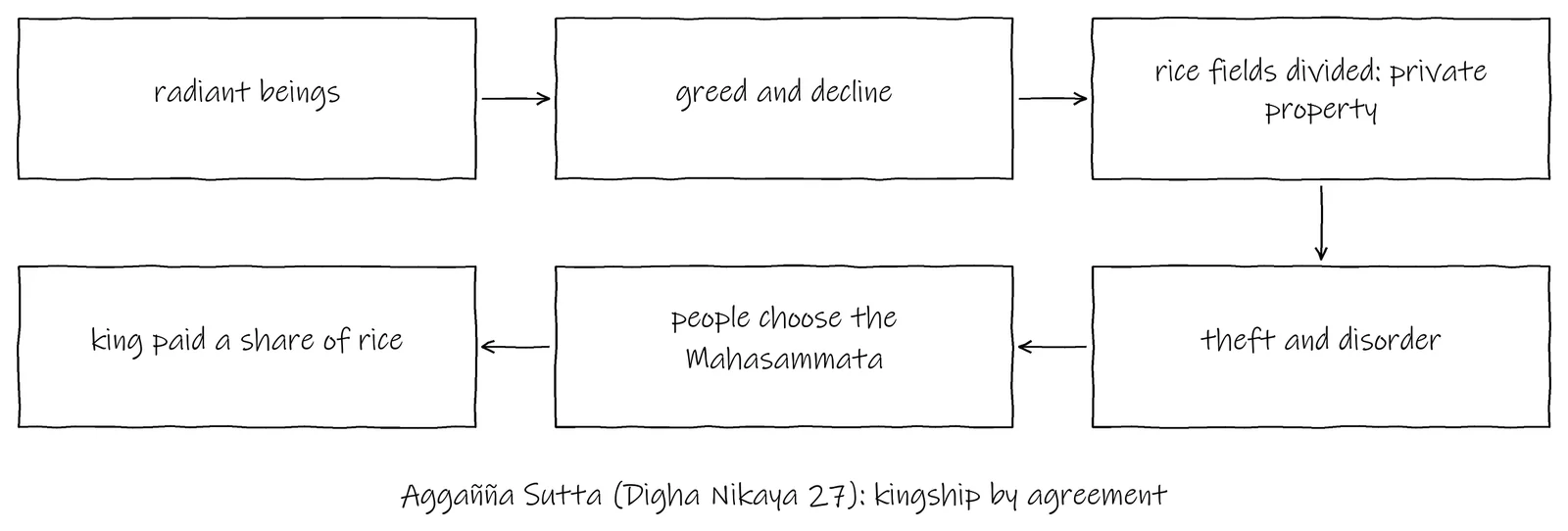
The chosen person receives three titles. He is Mahasammata, ‘the great elect’, because he is agreed upon by the people; Khattiya, ‘lord of the fields’; and Raja, because he pleases (ranjeti) others by dhamma. The discourse then explains the origins of the other groups: Brahmins as those who put aside evil and meditated (and later those who composed texts), Vessas as those who took up various trades, and Suddas as those who took up hunting and lowly work. It concludes that whoever, from any of these groups, lives righteously and attains liberation is foremost, because dhamma is the best thing for people in this life and the next.
Birth, conduct and the best of beings
The discourse closes with a verse which sums up its message: among those who value lineage, the Khattiya is the best, but the one who is perfect in knowledge and conduct is the best among gods and human beings. Social rank based on birth is thus accepted only as a worldly convention, while true excellence depends on conduct and wisdom. This is why the discourse is often read as one of the earliest critiques of the varna hierarchy, even though it does not call for the abolition of social groups.
6.3 Distinctive Elements of the Theory of Kingship
The theory of kingship in the Aggañña Sutta has several distinctive elements:
- A natural, historical origin: kingship arises from a process of social change, not from divine creation as in Manu, where the king is made of particles of the gods.
- Moral decline as the cause: the need for a king arises from greed, laziness, property, theft and lying; the state is a response to human moral failure.
- Property as the turning point: the division of rice fields into private plots creates theft and conflict, linking the origin of the state to the origin of property, an idea that recalls Rousseau’s later argument about the first man who enclosed a piece of land.
- Election and agreement: the first king, Mahasammata, is chosen by the people in an assembly, so his authority rests on consent.
- The king as a paid functionary: the king receives a share of rice as payment for his services, so kingship is a function performed for the people, not a divine right.
- Limited function: the king’s task is to maintain order by censuring, punishing and banishing wrongdoers, that is, to administer justice.
- Dhamma above the king: the king pleases people by dhamma, and dhamma, not birth or power, is the highest value.
- Social groups as occupational, not divine: the varnas arise from different occupations, not from different parts of Brahma’s body, and anyone of any group can attain the highest goal.
Kingship in other Buddhist texts
Other Buddhist texts develop the ideal of righteous kingship. In the Chakkavatti Sihanada Sutta (Digha Nikaya 26), the wheel-turning king rules by dhamma, protects all beings and gives wealth to the needy; when a later king fails to help the poor, poverty leads to theft, violence, falsehood and the shortening of human life. The Jatakas list ten royal virtues (dasa raja dhamma): generosity, moral conduct, self-sacrifice, honesty, gentleness, self-restraint, freedom from anger, non-violence, patience and not opposing what is right. Together these texts make the king’s legitimacy depend on his conduct and on the welfare of his people.
6.4 The Early Buddhist View of the State
B.G. Gokhale, in ‘The Early Buddhist View of the State’ (1966), shows that early Buddhism saw the state as a necessary institution arising from the decline of an ideal condition, much like a necessary evil. Its purpose is to restrain wrongdoing and maintain order. Buddhist texts also present the ideal of the chakkavatti or dhammaraja, the righteous universal ruler who rules by dhamma rather than by force. The Chakkavatti Sihanada Sutta (Digha Nikaya 26) tells how a king who failed to give wealth to the poor caused poverty, which led to theft, violence, lying and the moral collapse of society, showing that the king has a duty to relieve poverty. Ashoka, after the Kalinga war, tried to rule according to such ideals through his policy of dhamma. Buddhist monastic communities, the sangha, also practised decision-making by discussion and voting, reflecting the republican traditions of the ganas in which the Buddha himself was born.
Ashoka and Buddhist kingship
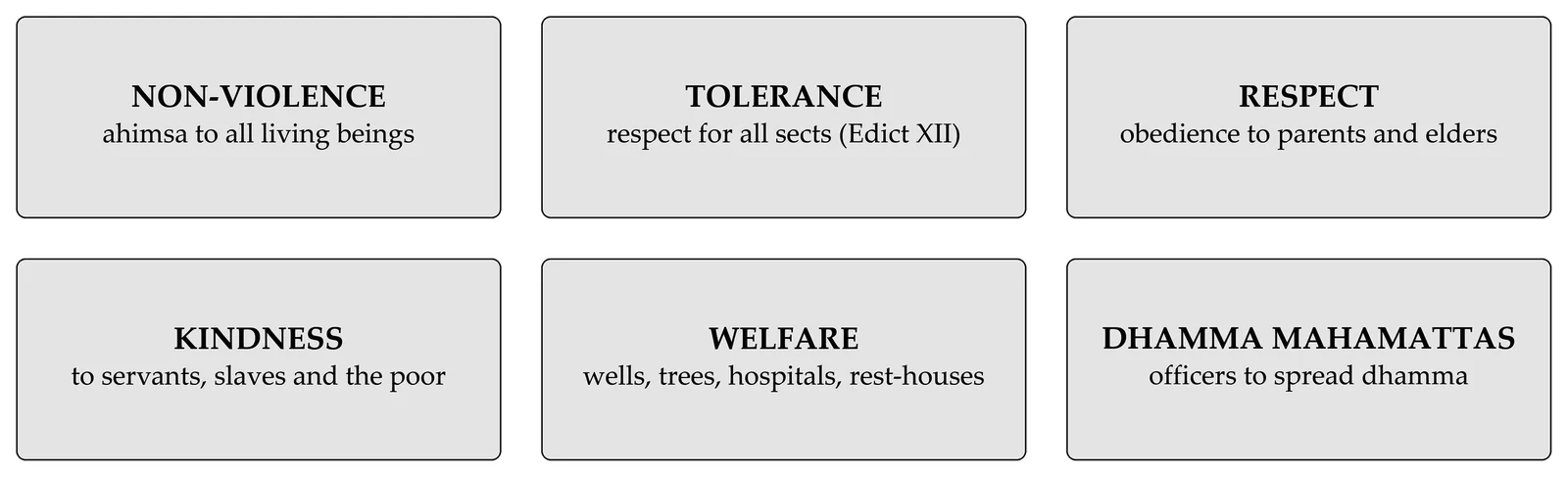
The Mauryan emperor Ashoka (c. 268–232 BCE) tried to put Buddhist ideals into practice. After the bloody Kalinga war, recorded in his Thirteenth Rock Edict, he turned from conquest by arms to conquest by dhamma. His edicts declare that all people are his children, appoint officers of dhamma (dhamma-mahamattas) to look after the welfare of all communities, and record the planting of shade trees, the digging of wells, the building of rest-houses and the provision of medical care for humans and animals. Ashoka urged respect for all sects and restraint in speech about other religions. His reign shows how the Buddhist idea of the righteous ruler could shape the policy of a great empire, even though he kept the army and the death penalty.
6.5 Evaluation: Contract, Satire and Dhamma
Many scholars have called the Aggañña Sutta the earliest Indian version of the social contract, comparing it with Hobbes, Locke and Rousseau: a pre-political condition, a decline into disorder, and the creation of authority by agreement. Others are more cautious. Steven Collins argues that the discourse is partly a parody of Brahmanical creation myths, such as the Purusha Sukta, using humour and irony to undermine the claims of Brahmins; its main purpose is religious and moral, to show that dhamma, not birth, is what matters. The ‘election’ of Mahasammata is not a democratic vote in the modern sense, and the story still accepts kingship as necessary. Nevertheless, the discourse is a powerful statement that political authority rests on human agreement and function, that the king serves the people and is paid by them, and that social status is not fixed by birth, ideas that offered an alternative to the Brahmanical theory of divinely ordained kingship and varna.
Buddhist political ideas and Ambedkar
Buddhist political ideas were revived in modern India above all by B.R. Ambedkar, who embraced Buddhism in 1956 and set out his reading of it in The Buddha and His Dhamma (1957). Ambedkar valued Buddhism for its rejection of caste, its rationalism and its ethics of liberty, equality and fraternity. In his final speech to the Constituent Assembly on 25 November 1949, he observed that India had once been studded with republics and that the Buddhist sanghas followed rules about motions, resolutions, quorum, the whip, the counting of votes, voting by ballot and censure motions. For Ambedkar, the Buddhist tradition proved that democracy was not foreign to India, though he warned that it could be lost again.
6.6 Important Questions
- Question 1 What were the distinctive elements of the theory of kingship in the Aggañña Sutta? Examine.
- Question 2 Discuss the early Buddhist view of the state.
DU asks the same idea in different words. So learn one broad answer for each question below; the same answer works for every question joined by OR.
Important Question 1
What were the distinctive elements of the theory of kingship in the Aggañña Sutta? Examine.
OR
Discuss the Buddhist theory of the origin of kingship.
OR
Is the Aggañña Sutta a social contract theory? Discuss.
Model Answer
“Dhamma is the best thing for people, in this life and in the next as well.”
— Aggañña Sutta (Digha Nikaya 27)
Introduction. The Aggañña Sutta, the twenty-seventh discourse of the Digha Nikaya, tells the story of the beginnings of the world and society. In it the Buddha explains the origin of kingship as the result of an agreement among the people, offering a striking alternative to the Brahmanical theory of divinely created kingship.
1. Context
The Buddha speaks to two Brahmin monks, Vasettha and Bharadvaja, who were abused by other Brahmins for leaving the ‘best’ varna. He refutes the Brahmin claim to be born from Brahma’s mouth by noting that Brahmins are born of women like everyone else, and then tells the story of the beginnings. The discourse is the twenty-seventh sutta of the Digha Nikaya in the Pali Canon, and its title refers to knowledge of beginnings. The abuse of the two monks thus becomes the occasion for a discussion of the origin of social distinctions and of kingship.
2. From Radiance to Decline
At first beings are radiant and live on joy. Greed for the savoury earth makes them lose their radiance; differences in appearance produce pride. Each stage of the story is caused by a moral failing. The story treats moral decline, not divine creation, as the cause of social change.
3. Property and Disorder
When people begin to store rice, it stops growing back; they divide the fields and set boundaries, creating private property. Theft, lying, censure and punishment follow, and disorder spreads. Private property thus appears as both a product of greed and a cause of conflict, an idea that anticipates Rousseau’s account of the origin of inequality.
4. Election of Mahasammata
The people assemble and choose the most handsome, gracious and capable among them to censure, punish and banish wrongdoers. He is called Mahasammata, the great elect, because he is agreed upon by the people. The king’s functions are limited to restraining wrongdoing through censure, punishment and banishment, which makes the state essentially an institution for maintaining order.
5. A Paid Functionary
In return for his service the people give the king a share of their rice. Kingship is therefore a function performed for the people and paid by them, not a divine right; the titles Khattiya, lord of the fields, and Raja, one who pleases by dhamma, express this. Unlike the Brahmanical king created from particles of the gods, this king owes his position to the people and to his service.
6. Kingship and the Varnas
The discourse places the Khattiya first in its account of social groups, reversing the Brahmanical order in which the Brahmana stands highest. This reflects the importance of kings and republics in the Buddha’s time, but its deeper point is that all groups arise from human choices and occupations.
7. Dhamma above Birth
The discourse explains the varnas as occupational groups and declares that anyone who lives righteously is foremost, because dhamma is the best thing for people. This rejects the divine hierarchy of varna. The discourse ends by saying that while the Khattiya is best among those who value lineage, the one perfect in wisdom and conduct is best among gods and men.
8. Rejection of Varna Hierarchy
The Buddha points out that Brahmins are born of women like everyone else and that people of every varna can act well or badly, so purity and superiority cannot come from birth. This makes the Aggañña Sutta one of the earliest critiques of caste hierarchy in Indian thought.
9. Comparison with Contract Theory
Like Hobbes, Locke and Rousseau, the story moves from a pre-political condition, through disorder caused by property and greed, to authority created by agreement. Its link between property and conflict recalls Rousseau. Unlike Hobbes, the Buddhist account does not make the ruler absolute, and unlike Locke it does not speak of natural rights; its focus is on moral conduct.
10. Satire and Limits
Collins reads the discourse partly as a parody of Brahmanical myths, with a mainly religious purpose. The election is not democratic in the modern sense, and kingship remains necessary. Women and the poor play no explicit part in choosing the king, and the story offers no institution for removing a bad ruler.
11. Significance
Gokhale shows that early Buddhism saw the state as a necessary institution to restrain wrongdoing, and the ideal of the dhammaraja made the king responsible for righteous rule and the relief of poverty. Ambedkar drew on Buddhist ideas of equality and on the democratic procedures of the sangha to argue that democracy was not foreign to India.
12. The Origin of the Other Groups
The discourse also explains the other social groups. Some people, disgusted by evil, went to the forest to meditate and were called meditators; others, unable to meditate, settled near villages and compiled texts, a playful origin for the Brahmins. Those who took up trades became Vessas, and those who took up hunting and lowly work Suddas. Members of any group could leave it to become ascetics. Social groups are thus explained by occupation and conduct, not by birth from the body of a god.
13. Evaluation
The distinctive elements of the theory, a natural rather than divine origin of the state, election by the people, payment for service and the supremacy of dhamma over birth, make the Aggañña Sutta a remarkable alternative to Brahmanical theories. Its limits remind us not to read modern democracy into an ancient religious text.
Conclusion. Thus, the Aggañña Sutta offers a natural, contractual and functional theory of kingship, in which authority rests on agreement and the king serves the people, a distinctive alternative to the divine theory of the Brahmanical texts.
Important Question 2
Discuss the early Buddhist view of the state.
OR
Compare the Buddhist and Brahmanical theories of kingship.
Model Answer
“The Early Buddhist View of the State.”
— Title of B.G. Gokhale’s study (1966)
Introduction. Early Buddhism developed in the sixth and fifth centuries BCE, in a world of growing kingdoms and republics. Its texts offer a distinctive view of the origin, purpose and ideal form of the state, which differs in important ways from the Brahmanical tradition.
1. The State as a Product of Decline
In the Aggañña Sutta the state arises from moral decline, greed, property and theft, as a necessary means to restrain wrongdoing; Gokhale calls it a necessary institution rather than a divine creation. This resembles Augustine’s idea of the state as a remedy for sin: political authority is needed because human beings have fallen from an ideal condition.
2. Kingship by Agreement
The first king, Mahasammata, is chosen by the people and paid a share of rice for his services, so authority rests on consent and function. The three titles given to the first king, Mahasammata, Khattiya and Raja, express consent, protection of the fields and the duty to please the people through dhamma. The first king is chosen for his ability, not his descent, which makes merit the basis of political authority.
3. The Dhammaraja
The ideal ruler is the chakkavatti or dhammaraja, who rules by righteousness rather than force and protects all beings. The chakkavatti conquers without the sword, by the power of righteousness, and other kings accept his rule willingly; the wheel (chakka) symbolises the dhamma he sets in motion.
4. The King’s Duty to the Poor
The Chakkavatti Sihanada Sutta shows that when a king failed to give wealth to the poor, poverty led to theft, violence and moral collapse, making the relief of poverty a royal duty. The sutta makes economic welfare a condition of social order: crime is traced to poverty, not to the wickedness of the poor.
5. The Ten Royal Virtues
Buddhist texts such as the Jatakas list ten virtues of a king (dasa raja dhamma): generosity, moral conduct, self-sacrifice, honesty, gentleness, self-restraint, freedom from anger, non-violence, patience and not opposing what is right. They make the king’s legitimacy depend on his character and conduct.
6. Ashoka’s Dhamma
After Kalinga, Ashoka tried to govern by dhamma: tolerance, non-violence, welfare works and moral instruction through edicts. His edicts declare that all people are his children, appoint officers of dhamma to look after welfare, and record the building of wells, rest-houses, shade trees and medical care for humans and animals.
7. Sangha and Republican Traditions
The sangha decided matters by discussion and voting, reflecting the gana republics such as the Shakyas, from which the Buddha came. Ambedkar told the Constituent Assembly in November 1949 that the Buddhist sanghas had rules on motions, resolutions, quorum, voting by ballot and censure, which showed that India had known democratic procedure.
8. The State and the Moral Life
For early Buddhism the state cannot by itself make people good; it can only restrain wrongdoing and create conditions in which people may follow the dhamma. Liberation is a matter for individuals and the sangha, so the state serves morality without claiming to embody it.
9. Comparison with Brahmanical Theory
Brahmanical texts such as Manu present the king as created from the gods to protect varna-dharma; Buddhist texts present him as a chosen, paid functionary and reject the divine hierarchy of varna. The Buddhist view is more secular and contractual, but both traditions agree that kingship exists to prevent anarchy and protect the people.
10. Republics and the Sangha
The Buddha lived among the ganas or sanghas, republican states such as the Shakyas and the Vajjis, governed by assemblies of clan elders. In the Mahaparinibbana Sutta he praised the Vajjis for meeting often, deciding in harmony and respecting their traditions and elders, and the monastic sangha adopted similar procedures of discussion and voting.
11. Limits of Buddhist Political Thought
Buddhist thought accepted kingship as necessary and did not develop a theory of popular government for large states. Its focus was ethical and religious: it sought to make rulers righteous rather than to design institutions that would restrain them, and later Buddhist kings often relied on the same instruments of power as others. It also tended to treat politics as a lower, worldly activity compared with the pursuit of liberation.
12. Influence
Nevertheless, the contractual origin of kingship, the duty of the ruler to relieve poverty and the ideal of rule by righteousness influenced Ashoka and later Buddhist kingdoms across Asia, and modern thinkers such as Ambedkar drew on Buddhist ideas of equality and reason. Buddhist kings in Sri Lanka, Myanmar and Thailand were expected to follow the ten royal virtues, and the ideal of the righteous ruler shaped political culture across South and Southeast Asia.
13. Evaluation
The early Buddhist view combines a realistic acceptance of the state with an ethical demand that power be used for the welfare of all. Its contractual and anti-hierarchical elements make it an important alternative to Brahmanical theories of kingship, though it did not develop institutions to restrain kings.
Conclusion. Thus, the early Buddhist view of the state is secular in origin, contractual in form and ethical in purpose, centred on dhamma and the welfare of all.
Short Notes
(a) Mahasammata
‘The great elect’ or ‘the one agreed upon by the people’: the first king in the Aggañña Sutta, chosen by the people to censure, punish and banish wrongdoers, and paid a share of their rice. He is also called Khattiya, lord of the fields, and Raja, one who pleases by dhamma.
(b) Chakkavatti (dhammaraja)
The ideal universal monarch of Buddhist texts, who conquers by righteousness rather than force and rules for the welfare of all beings. The Chakkavatti Sihanada Sutta stresses his duty to provide for the poor; Ashoka’s rule after Kalinga drew on this ideal.
More notes: DSC-8 Ancient and Medieval Indian Political Thought
These notes are prepared by PADHO TO AISE for study help. They are not an official University of Delhi publication.