
Semester III DSC-8 Ancient and Medieval Indian Political Thought
Unit XI · 20 min read · Updated 24 Nov 2026
As per the University of Delhi (DU) BA (Hons) Political Science syllabus
Contents
- 11.1 Abu’l Fazl: Life and Works
- 11.2 The Theory of Monarchy: Kingship as Divine Light
- 11.3 Sulh-i-kul and the Universal King
- 11.4 Monarchy in Practice: Administration and Society
- 11.5 The Imperial Vision: Barani and Abu’l Fazl Compared
- 11.6 Evaluation
- 11.7 Important Questions
- Critically examine the concept of monarchy in Abu’l Fazl.
- Compare the political ideas of Barani and Abu’l Fazl.
- Short Notes
राजत्व ईश्वर से निकलने वाला प्रकाश है, ब्रह्मांड को प्रकाशित करने वाले सूर्य की एक किरण है।
Royalty is a light emanating from God, and a ray from the sun, the illuminator of the universe.
— Abu’l Fazl, Ain-i-Akbari (tr. H. Blochmann)
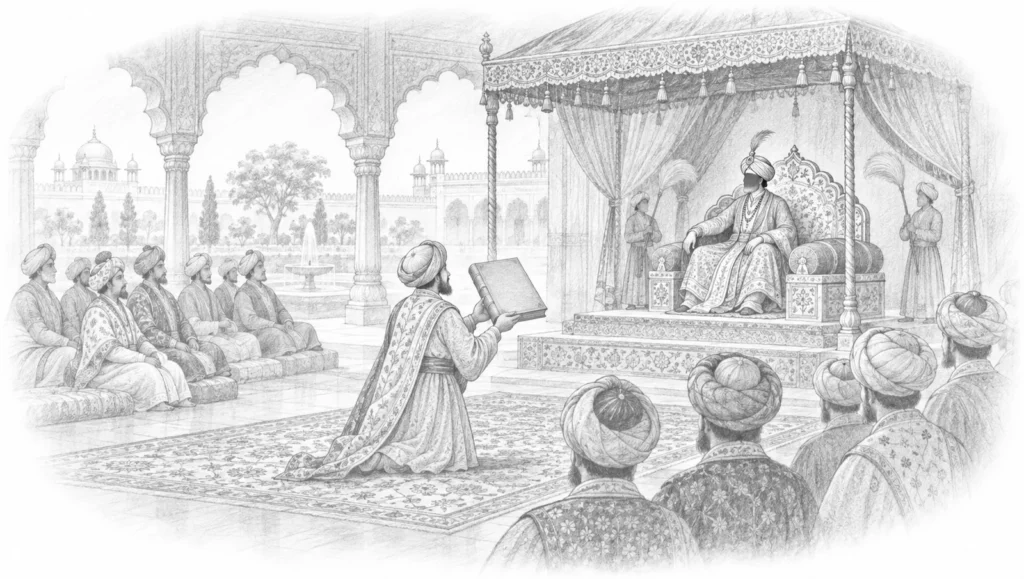
ABU’L FAZL was the chief ideologue of the Mughal emperor Akbar, his friend, minister and historian. In the Akbarnama and its third volume, the Ain-i-Akbari, he wrote not only a history of Akbar’s reign and a detailed account of its administration, but also a theory of monarchy: kingship as a divine light, the king as the perfect man who stands above all sects and communities, and sulh-i-kul, ‘peace with all’, as the principle of rule. His ideas gave Mughal rule a legitimacy that went beyond Islamic law, and they offered a vision of a tolerant, universal empire in a land of many religions. In this chapter we study Abu’l Fazl’s life and works, his theory of monarchy, his contrast with the earlier thinker Barani, and the strengths and limits of his imperial vision.
11.1 Abu’l Fazl: Life and Works
Abu’l Fazl was born in 1551 at Agra, the son of Shaikh Mubarak, a learned and liberal theologian, and brother of the poet Faizi. He joined Akbar’s court in 1574 and became his closest adviser and the main spokesman of his religious and political policies. His great work, the Akbarnama, is a history of Akbar and his ancestors in three volumes; the third, the Ain-i-Akbari, describes the institutions, administration, revenue system, army, court and society of the empire, and also discusses Indian philosophy and religions. He was murdered in 1602 by Bir Singh Bundela at the instigation of Prince Salim, who resented his influence. V.R. Mehta, in ‘The Imperial Vision: Barni and Fazl’, treats him as the theorist of a universal, imperial monarchy.
Akbar’s religious policy
Abu’l Fazl’s theory grew out of Akbar’s policies. Akbar abolished the tax on Hindu pilgrims (1563) and the jizya, the poll tax on non-Muslims (1564); formed marriage and political alliances with Rajput rulers, beginning with Amber in 1562; built the Ibadat Khana (house of worship) at Fatehpur Sikri in 1575, where scholars of Islam, Hinduism, Jainism, Zoroastrianism and Christianity debated; issued the Mahzar (1579), which recognised his authority to decide between conflicting views of the jurists; and in 1582 formed a circle of disciples devoted to him, later called Din-i-Ilahi. He also sponsored Persian translations of Sanskrit works, including the Mahabharata as the Razmnama.
11.2 The Theory of Monarchy: Kingship as Divine Light
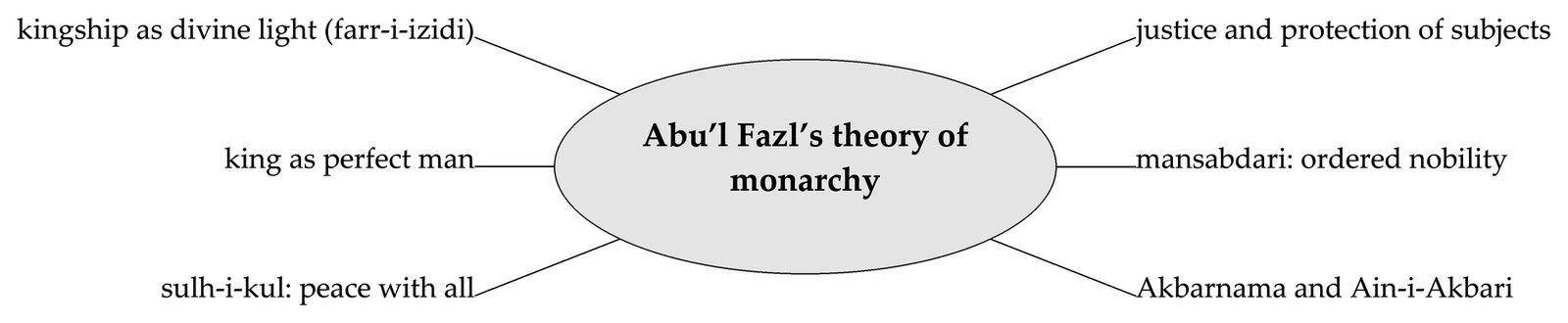
In the preface to the Ain-i-Akbari, Abu’l Fazl declares that no dignity is higher in the eyes of God than royalty. Royalty is a light emanating from God, a ray from the sun that illuminates the universe; modern language, he says, calls this light farr-i-izidi, the divine light, which God communicates to kings without the intermediary of anyone. The idea draws on Persian traditions of kingship and on the illuminationist philosophy (ishraq) of Suhrawardi. Its main elements are (Figure 11.2):
- Divine origin: kingship is a gift from God, not a creation of the clergy or the community; the true king receives the divine light directly.
- The true king and the selfish ruler: Abu’l Fazl distinguishes the true king (padshah), who has a paternal love for his subjects, a large heart, trust in God, devotion and justice, from the selfish ruler, who seeks only his own pleasure and brings ruin.
- The king as the perfect man: the true king is the insan-i-kamil, the perfect human being, and a spiritual guide to his people; Akbar is presented as such a ruler.
- The king as father: the king should love all his subjects as a father loves his children, without distinction of religion or community.
- Necessity of kingship: without a king, the storm of strife would never subside and selfish ambition would destroy society; the king maintains order, justice and harmony.
The Akbarnama and the Ain-i-Akbari
The Akbarnama, Abu’l Fazl’s official history of Akbar’s reign, is in three volumes; the third, the Ain-i-Akbari, is a vast survey of the empire. It describes the imperial household, the court, the army and the mansabdari system, the revenue system developed by Raja Todar Mal, the provinces (subas) with their statistics, and the sciences, customs and beliefs of the Hindus. The work is both a theory of kingship and a practical manual of government, showing how the ideal of a just and universal monarchy was to be realised in administration.
11.3 Sulh-i-kul and the Universal King
The most important principle of Abu’l Fazl’s monarchy is sulh-i-kul, ‘peace with all’ or universal concord. The king, standing above all sects, must treat followers of all religions impartially and must not allow religious differences to disturb the peace of his kingdom. This principle reflected Akbar’s policies: the abolition of the pilgrim tax (1563) and of the jizya on non-Muslims (1564), the appointment of Rajputs and Hindus to high office, discussions among scholars of many religions in the Ibadat Khana (house of worship, from 1575), and the translation of Sanskrit works such as the Mahabharata into Persian. In 1579 a declaration (mahzar) affirmed that Akbar, as a just ruler, could decide between conflicting opinions of Muslim jurists. Later, Akbar’s circle of disciples practised a code of conduct sometimes called Din-i-Ilahi (or tauhid-i-ilahi), which Abu’l Fazl promoted. For Abu’l Fazl, sulh-i-kul was not mere tolerance but the duty of a universal king whose authority came directly from God and therefore transcended the claims of any one religious community.
Critics of Akbar and Abu’l Fazl
Abu’l Fazl’s picture of Akbar did not go unchallenged. Abdul Qadir Badauni, a contemporary historian at the same court, wrote in his Muntakhab-ut-Tawarikh that Akbar had abandoned Islam and that Abu’l Fazl had flattered him into it. The Naqshbandi Sufi Shaikh Ahmad Sirhindi campaigned for the restoration of orthodox Sunni Islam at court. Under Aurangzeb, who reimposed the jizya in 1679, the empire moved back towards a more orthodox conception of the Muslim ruler. These debates show that Abu’l Fazl’s inclusive kingship was a contested political choice, not an inevitable development.
Sulh-i-kul and the Rajputs
Sulh-i-kul was also a political strategy. By marrying into Rajput ruling families and appointing Rajput chiefs as high-ranking nobles, Akbar turned former rivals into pillars of the empire. Raja Man Singh of Amber commanded imperial armies, and Raja Todar Mal reorganised the revenue system. The Rajputs kept their hereditary lands as watan jagirs and their religious practices, while serving the emperor. This integration gave the Mughal state a broad base of support that a purely Muslim ruling class could not have provided.
11.4 Monarchy in Practice: Administration and Society
The Ain-i-Akbari also shows how the ideal monarchy was to work. Abu’l Fazl compares society to the four elements: warriors (fire), artisans and merchants (air), the learned (water) and cultivators (earth); the king keeps them in balance so that none oppresses the others. The nobility was organised through the mansabdari system, in which every officer held a rank (mansab) determining his pay and the troops he maintained, which tied the nobles to the emperor. Revenue was assessed through the zabt system associated with Raja Todar Mal, based on measurement of land and average produce. The king was to hear petitions, administer justice impartially and care for the welfare of his subjects. Abu’l Fazl thus combined a theory of absolute, divinely sanctioned monarchy with a vision of rational, ordered administration.
Rituals of kingship
The theory of divine light was expressed in court ritual. Every morning Akbar appeared before his subjects at the jharokha (balcony window), so that people could see the emperor; on his birthdays he was weighed against gold and other goods, which were distributed as charity; courtiers performed prostration before him; and chosen nobles became his disciples, receiving his portrait and taking vows of devotion. Mughal painting surrounded the emperor with a halo of light. These practices made the emperor a sacred and visible centre of the empire, above all sects and communities.
The mansabdari and revenue systems
The ideal of a universal monarchy was supported by a centralised administration. Every officer held a mansab, a rank expressed in two numbers: zat, personal rank and pay, and sawar, the number of cavalry he had to maintain. Officers were paid through jagirs, assignments of revenue that were regularly transferred so that no noble could build a local power base. Revenue was assessed under the zabt system, based on the measurement of land and the average produce and prices of previous years, which Todar Mal developed in the dahsala settlement of 1580. The system tied nobles of all origins to the emperor’s service and rewarded merit and loyalty rather than birth alone.
11.5 The Imperial Vision: Barani and Abu’l Fazl Compared
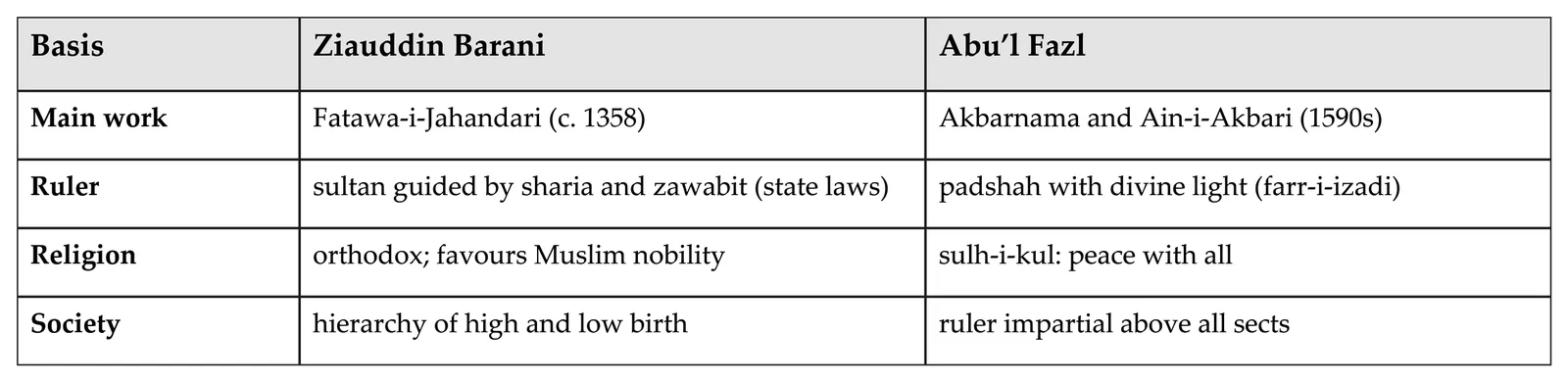
Mehta compares Abu’l Fazl with Ziauddin Barani, the fourteenth-century historian of the Delhi Sultanate, whose Fatawa-i-Jahandari advised Muslim rulers. Barani held that kingship was necessary and that rulers might make secular state laws (zawabit) in addition to the sharia, but his king was above all the protector of Islam and of the Muslim nobility; he favoured high-born Muslims and was hostile to Hindus and to low-born people holding office. Abu’l Fazl, writing two centuries later, reversed this emphasis: his king derives legitimacy directly from God rather than from Islamic law and the clergy, stands above all religious communities, and treats all subjects equally through sulh-i-kul. Barani’s vision was that of a Muslim state in India; Abu’l Fazl’s was that of a universal Indian empire.
Death and legacy
Abu’l Fazl was killed in 1602 by the Bundela chief Bir Singh Deo, at the instigation of Prince Salim, the future emperor Jahangir, who saw him as an enemy at court. His ideas nevertheless shaped Mughal imperial ideology for generations. Akbar’s great-grandson Dara Shikoh continued the search for common ground between Islam and Hinduism in Majma-ul-Bahrain, ‘the mingling of the two oceans’, and translated the Upanishads into Persian. Modern historians debate whether sulh-i-kul anticipates Indian secularism or was mainly a strategy of imperial control, but it remains one of the most important statements of religious accommodation in Indian political thought.
11.6 Evaluation
Abu’l Fazl’s theory gave the Mughal empire a powerful ideology that could unite a diverse population and a nobility of Turanis, Iranis, Afghans, Rajputs and Indian Muslims. Its principle of sulh-i-kul is often cited as an early model of religious tolerance and even of a secular state in India. But it also legitimised absolute monarchy: the king answerable only to God, and Akbar raised to the status of a spiritual guide, which critics, including the contemporary historian Badauni, condemned as flattery and heresy. It had no place for popular consent or institutional limits on power. Its tolerance depended on the will of the ruler and was partly reversed by later emperors. Yet as a vision of a just, inclusive and orderly state in a plural society, Abu’l Fazl’s monarchy remains one of the most important contributions of medieval Indian political thought.
Abu’l Fazl and European ideas of sovereignty
Abu’l Fazl wrote at about the same time as Jean Bodin in France, who, amid the wars of religion, argued in Six Books of the Commonwealth (1576) for a sovereign above religious factions. Both thinkers responded to religious conflict by elevating a monarch who stood above sects and could impose peace, and both linked sovereignty with order and justice. The comparison shows that the problem of ruling religiously divided societies, and the solution of a strong, neutral sovereign, appeared in both India and Europe in the sixteenth century.
11.7 Important Questions
- Question 1 Critically examine the concept of monarchy in Abu’l Fazl.
- Question 2 Compare the political ideas of Barani and Abu’l Fazl.
DU asks the same idea in different words. So learn one broad answer for each question below; the same answer works for every question joined by OR.
Important Question 1
Critically examine the concept of monarchy in Abu’l Fazl.
OR
Discuss Abu’l Fazl’s theory of kingship.
OR
Examine the idea of sulh-i-kul.
Model Answer
“No dignity is higher in the eyes of God than royalty.”
— Abu’l Fazl, Ain-i-Akbari (tr. H. Blochmann)
Introduction. Abu’l Fazl, Akbar’s minister and historian, developed a theory of monarchy in the Akbarnama and Ain-i-Akbari that justified Mughal rule and presented the emperor as a divinely illuminated, universal ruler standing above all communities. It is the most important statement of medieval Indian imperial political thought.
1. Context
Akbar ruled a vast, diverse empire of Hindus, Muslims of different sects, Rajputs and others. He needed a legitimacy that did not depend only on Islamic law and the clergy, and Abu’l Fazl provided it. The Mughals inherited Persian and Timurid traditions of kingship, but had to rule a population that was overwhelmingly non-Muslim.
2. Kingship as Divine Light
Royalty is a light emanating from God, the farr-i-izidi, communicated directly to the king without intermediaries. This draws on Persian traditions and illuminationist philosophy and places the king above the clergy. Because the light passes directly from God to the king, the ulema could not claim to be the source of his legitimacy.
3. The True King and the Selfish Ruler
The true king has paternal love for his subjects, a large heart, trust in God and devotion to justice; the selfish ruler seeks his own pleasure and brings ruin. The true king regards his subjects as his children and is not troubled by differences of religion, while the selfish ruler seeks only pleasure and power and his rule brings only outward glory.
4. The Perfect Man
The true king is the insan-i-kamil, the perfect human, and a spiritual guide to his people; Akbar is presented as such a ruler, with disciples bound to him. Akbar accepted chosen nobles as disciples in a circle of personal devotion, later called Din-i-Ilahi, which expressed this spiritual role.
5. Rituals of Kingship
Practices such as the emperor’s daily appearance at the jharokha window, his weighing against gold for charity and the prostration of courtiers expressed the idea of the king as a sacred, light-filled figure above all communities.
6. Sulh-i-kul
Peace with all requires the king to treat all religions impartially. Akbar abolished the jizya, appointed Hindus to high office, held discussions in the Ibadat Khana and had Sanskrit works translated. He also abolished the pilgrim tax, allowed temples to be built and sponsored Persian translations of the Mahabharata and Ramayana.
7. The Mahzar
The declaration of 1579 affirmed Akbar’s authority as a just ruler to decide between conflicting views of jurists, strengthening the king against the clergy. Critics such as Badauni saw it as a claim to religious infallibility, while supporters saw it as a way of ending sectarian disputes among the ulema.
8. Order and Administration
The king balances the four classes of society, organises the nobility through the mansabdari system and administers justice and revenue rationally. The mansabdari system ranked nobles by zat and sawar and transferred their jagirs regularly, which prevented local power bases.
9. The King and the Nobility
The theory also bound a diverse nobility to the emperor: Turanis, Iranis, Afghans, Rajputs and Indian Muslims all owed loyalty to one sovereign above sect and ethnicity, which strengthened imperial unity against factions.
10. Contrast with Barani
Barani’s king protected Islam and the Muslim nobility; Abu’l Fazl’s king stands above all communities, a shift from a Muslim state to a universal empire, as Mehta argues. Barani would have found Akbar’s appointment of Rajputs and Hindus to high office unacceptable.
11. Evaluation
The theory promoted tolerance and integration, but it legitimised absolute monarchy and a personality cult that Badauni condemned; tolerance depended on the ruler’s will and lacked institutional guarantees. Badauni’s Muntakhab-ut-Tawarikh accused Akbar of abandoning Islam, and later rulers such as Aurangzeb returned to a more orthodox idea of the Muslim ruler.
12. Persian and Islamic Sources
Abu’l Fazl drew on the Persian idea of farr, the royal glory of ancient Iranian kings celebrated in the Shahnameh, on the illuminationist philosophy of Suhrawardi, and on the tradition of Persian ethical writing such as Nasir al-Din Tusi’s Akhlaq-i-Nasiri, which taught that the ruler must maintain balance and justice among the classes of society.
13. Abu’l Fazl and Secularism
Modern scholars often see sulh-i-kul as an early form of secular rule, since the state did not discriminate among religions. But it differed from modern secularism: it rested on the sacred authority of the emperor, not on the rights of citizens or a constitution, and it could be withdrawn by a later ruler, as Aurangzeb’s reimposition of the jizya showed. But this tolerance flowed from the emperor’s will, not from constitutional rights, so a later ruler could reverse it.
Conclusion. Thus, Abu’l Fazl’s monarchy combined divine legitimacy, paternal and universal kingship and sulh-i-kul, an imperial vision of a tolerant but absolute state.
Important Question 2
Compare the political ideas of Barani and Abu’l Fazl.
OR
Discuss the imperial vision in medieval Indian political thought.
Model Answer
“The Imperial Vision: Barni and Fazl.”
— Title of V.R. Mehta’s chapter (1992)
Introduction. Ziauddin Barani, the fourteenth-century historian of the Delhi Sultanate, and Abu’l Fazl, the sixteenth-century ideologue of Akbar, both wrote about kingship in a land where Muslim rulers governed a largely non-Muslim population. V.R. Mehta compares their imperial visions.
1. Barani’s Fatawa-i-Jahandari
Barani advised Muslim rulers on governance, holding that kingship was necessary to maintain order and protect religion. Written in the 1350s, towards the end of Barani’s life, it drew on Persian traditions of kingship as well as Islamic ideals.
2. State Law and Sharia
Barani accepted that rulers might make secular state laws, zawabit, beyond the sharia, when needed for good government. He justified such laws by necessity: a ruler must sometimes act in ways that are not strictly religious to protect the state, as the Persian kings had done.
3. Barani’s Exclusivism
His king was the protector of Islam and the Muslim nobility; he favoured high-born Muslims and opposed giving office to Hindus and low-born people. He even advised that the low-born should not be taught to read and write, so that they would not rise above their station.
4. Abu’l Fazl’s Divine Light
Abu’l Fazl derived kingship directly from God’s light, not from the sharia or the clergy, placing the king above religious authorities. The idea drew on Illuminationist (ishraqi) philosophy and on Persian ideas of royal glory.
5. Universal Kingship
His king stands above all communities and treats all subjects as a father, through sulh-i-kul, appointing Hindus and Rajputs to high office. He presented the emperor as a father to all his subjects, whatever their religion.
6. Justice in Both Thinkers
Both treat justice as the pillar of kingship. For Barani, justice means protecting the faith and punishing wrongdoers so that the strong do not oppress the weak; for Abu’l Fazl, it means impartial treatment of all subjects and the balance of the social classes.
7. Religion and the State
The key difference concerns religion: Barani wanted the state to serve Islam, even if its laws went beyond the sharia, while Abu’l Fazl wanted the state to stand above all religions through sulh-i-kul.
8. Differences
Barani’s vision is that of a Muslim state; Abu’l Fazl’s that of a universal Indian empire. Barani defended hierarchy of birth; Abu’l Fazl defended merit and service under the emperor. In short, Barani’s king rules for a community, Abu’l Fazl’s for an entire realm.
9. The Ruler and the Ulema
For Barani, the ulema were essential advisers who kept the ruler within the faith, though he criticised worldly scholars who served kings for gain. Abu’l Fazl saw the quarrels of the ulema as a cause of disorder and made the emperor the final judge in religious disputes, as the Mahzar declared.
10. Similarities
Both supported strong monarchy, justice and order, and both accepted that the ruler’s authority went beyond religious law. Both drew on the Persian tradition of advice literature, the ‘mirrors for princes’, which made justice the foundation of rule.
11. Different Historical Contexts
Barani wrote in the fourteenth century, when the Delhi Sultanate depended on a narrow Muslim ruling class and faced Mongol threats; Abu’l Fazl wrote in the sixteenth century for an empire that needed the loyalty of Rajputs, Hindus and diverse Muslim groups. Their theories reflect these different needs. Abu’l Fazl, by contrast, wrote in the late sixteenth century for an expanding empire that needed the loyalty of Rajputs and other non-Muslim groups.
12. Birth and Merit
Barani insisted that only the high-born should hold office and despised the low-born, while Abu’l Fazl’s mansabdari system, though aristocratic, rewarded service and loyalty to the emperor and included men of different origins and religions. Abu’l Fazl praised Raja Todar Mal, a Hindu Khatri, as a model administrator.
13. Influence on Later Rule
Akbar’s successors largely kept the inclusive framework until Aurangzeb, while Barani’s ideas appealed to those who wanted the state to uphold Islamic orthodoxy, a tension that ran through Mughal history.
14. Legacy
Barani’s ideas represent a defensive, exclusive conception of Muslim rule, while Abu’l Fazl’s inclusive vision influenced later debates on toleration and the Indian tradition of the state as standing above religious communities. Their contrast still shapes debates on whether rulers should represent one community or all citizens. Modern Indian secularism has drawn more on Abu’l Fazl’s inclusive vision than on Barani.
15. Evaluation
The comparison shows two models of rule in medieval India: an exclusive model grounded in religious community and birth, and an inclusive imperial model grounded in a universal sovereign. Abu’l Fazl’s model proved better suited to ruling a diverse empire, though both remained forms of absolute monarchy.
Conclusion. Thus, Barani and Abu’l Fazl represent two imperial visions: an exclusive Muslim kingship and an inclusive universal monarchy, the latter becoming the ideology of Akbar’s empire.
Short Notes
(a) Sulh-i-kul
‘Peace with all’: the principle of Akbar’s rule articulated by Abu’l Fazl, requiring the king to treat followers of all religions impartially and to prevent religious conflict. It was expressed in the abolition of the jizya, the appointment of non-Muslims to high office, the Ibadat Khana debates and the translation of Sanskrit texts.
(b) Farr-i-izidi
The ‘divine light’ which, according to Abu’l Fazl, God communicates directly to true kings. It made royalty the highest dignity, independent of the clergy and Islamic law, and justified the emperor’s position above all religious communities.
More notes: DSC-8 Ancient and Medieval Indian Political Thought
These notes are prepared by PADHO TO AISE for study help. They are not an official University of Delhi publication.