
Semester III DSC-8 Ancient and Medieval Indian Political Thought
Unit X · 21 min read · Updated 24 Nov 2026
As per the University of Delhi (DU) BA (Hons) Political Science syllabus
Contents
- 10.1 Syncretism, Bhakti and Sufism
- 10.2 Kabir
- 10.3 Kabir, Ravidas and the Vision of Begumpura
- 10.4 Guru Nanak
- 10.5 The Features and Significance of Their Syncretism
- 10.6 Important Questions
- Discuss the principal features of Guru Nanak’s syncretism.
- Examine Kabir’s syncretism and his social vision.
- Short Notes
न कोई हिन्दू, न कोई मुसलमान।
There is no Hindu, there is no Musalman.
— Guru Nanak, as remembered in the Janamsakhi tradition
IN THE FIFTEENTH AND SIXTEENTH CENTURIES, North India was divided by religion, caste and the power of sultans and priests. In this world two remarkable figures spoke a message that cut across these divisions. Kabir, a weaver of Banaras, mocked the rituals of both Hindus and Muslims and sang of a formless God who dwells in the heart. Guru Nanak, born in Punjab, declared that there is no Hindu and no Muslim, preached devotion to one God, equality of all people and honest work, and founded the tradition that became Sikhism. Both drew on the Bhakti and Sufi traditions and are often described as syncretic thinkers, who brought different religious traditions together. In this chapter we study the meaning of syncretism, the ideas of Kabir and Guru Nanak, and their social and political significance.
10.1 Syncretism, Bhakti and Sufism
Syncretism means the combination of different religious or cultural traditions into a new whole. In medieval India it took place through two great devotional movements. The Bhakti movement, which began with the Alvars and Nayanars of South India between the sixth and ninth centuries and spread to the North by the fourteenth and fifteenth centuries, taught loving devotion to God, open to all regardless of caste or sex, in the languages of the people. It had two streams: saguna bhakti, devotion to God with form, such as Rama or Krishna (Tulsidas, Surdas, Mirabai), and nirguna bhakti, devotion to a formless God (Kabir, Ravidas, Dadu, Nanak). Sufism, the mystical tradition of Islam, brought by orders such as the Chishtis, emphasised love of God, the guidance of the master, music and service to humanity. V.R. Mehta shows that the nirguna saints drew on both currents and rejected the external forms of organised religion.
Nirguna and saguna devotion; the Sufi idea of unity
Historians distinguish two currents within Bhakti. Saguna bhakti worships God with attributes and form, such as Rama or Krishna, as in Tulsidas and Surdas. Nirguna bhakti worships God without attributes, beyond all forms and names, as in Kabir, Ravidas and Guru Nanak. The nirguna saints, often from artisan and lower-caste backgrounds, were the sharpest critics of ritual, priests and caste. Among the Sufis, the doctrine of wahdat al-wujud, the ‘unity of being’ associated with Ibn Arabi, held that all existence is a manifestation of the one God, an idea that resonated with Vedantic and nirguna thought and made dialogue between the traditions easier.
The Sufi saints of India
Sufism reached India with the Ghurid conquest, and the Chishti order became the most popular. Khwaja Moinuddin Chishti settled at Ajmer, Baba Farid at Pakpattan in Punjab and Shaikh Nizamuddin Auliya at Delhi. Their hospices (khanqahs) kept open kitchens, welcomed people of all faiths and used music (sama) in devotion; many kept their distance from the court, refusing grants from rulers. Their teaching of love, service and the inner path to God, and their use of local languages, made their shrines (dargahs) places where Hindus and Muslims worshipped together, as they still do.
10.2 Kabir
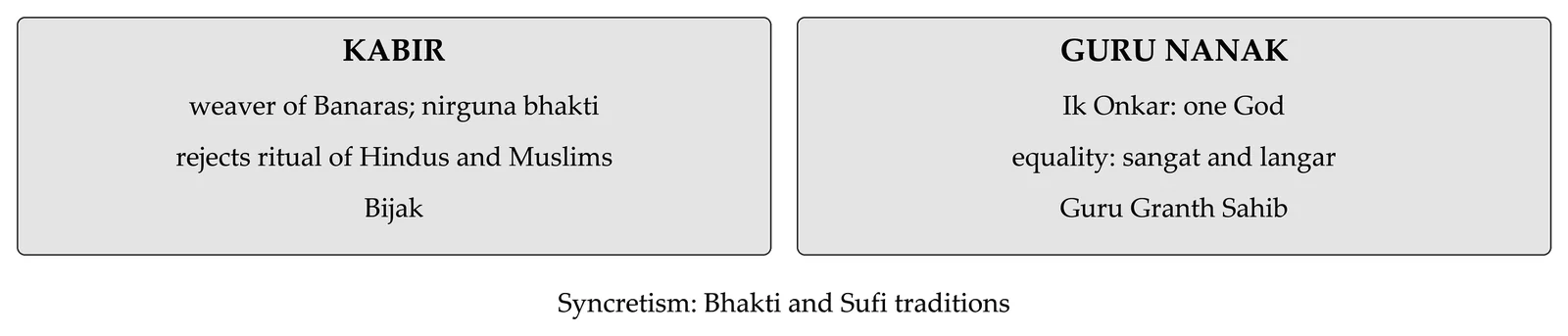
Kabir lived in Banaras in the fifteenth century. He belonged to a family of Muslim weavers (julahas), and tradition makes him a disciple of the Vaishnava teacher Ramananda. He did not write; his sayings and songs, in the plain language of the people, were collected later in the Bijak (used by the Kabir Panth), the Kabir Granthavali and the Guru Granth Sahib. Linda Hess and Shukdev Singh’s translation of the Bijak (2002) conveys his sharp, provocative voice. His main ideas are:
- One formless God: God is one, without form, called by many names, Ram, Rahim, Allah, Hari, and dwells within the human heart, not in temples or mosques.
- Rejection of ritual of both religions: Kabir mocked idol worship, pilgrimage, fasting, ritual bathing and caste rules of Hindus, and circumcision, the call to prayer and pilgrimage of Muslims, as empty forms.
- Critique of priests and mullahs: he attacked the authority of Brahmins and qazis who claimed to stand between people and God.
- Rejection of caste: all human beings are made of the same blood and bone; Kabir asked how one could be a Brahmin and another a Shudra.
- Love and inner experience: true knowledge is not book learning but love; as one of his couplets says, those who read many books did not become wise, but whoever reads the two and a half letters of ‘love’ becomes truly learned.
- The guru and the name: devotion requires a true guru and the remembrance of God’s name.
Scholars debate whether Kabir was really a ‘syncretist’. Hess argues that he did not blend Hinduism and Islam so much as reject both institutional religions in favour of a direct, inner experience of the divine; his ‘syncretism’ lies in transcending religious boundaries rather than mixing them.
Kabir’s poetry and its imagery
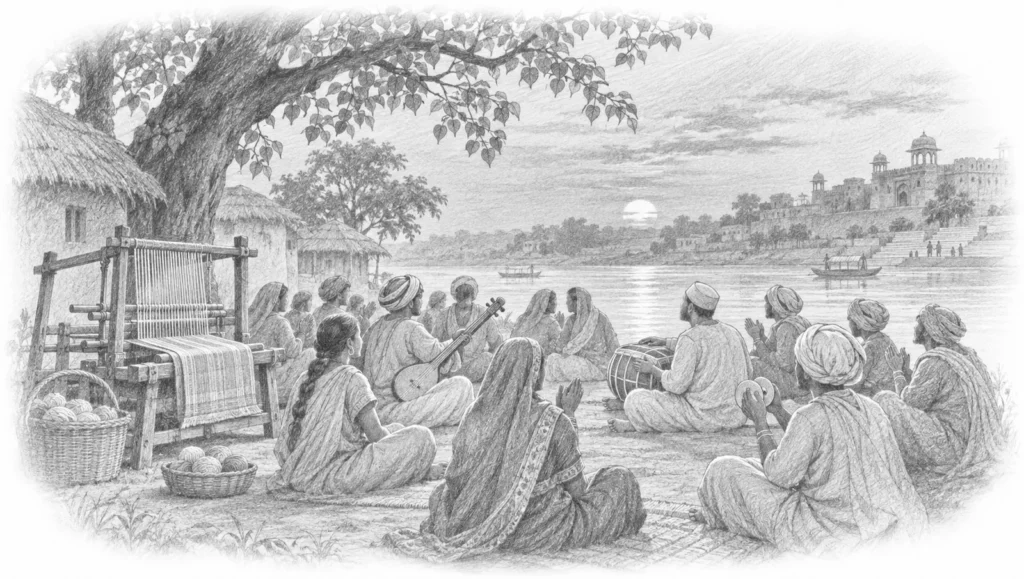
Kabir’s verses survive in three main collections: the Bijak of the Kabir Panth, the Kabir Granthavali preserved in Rajasthan, and the hymns included in the Guru Granth Sahib. They take the form of short couplets (dohas or sakhis) and songs (padas). Kabir drew his images from everyday working life, above all from the loom: in a famous song the body is a finely woven cloth that the wise devotee returns to God unstained. He also used ‘upside-down’ language (ulatbamsi), riddles that turn ordinary sense on its head to shock listeners out of habit. This style made deep ideas memorable to people who could not read.
10.3 Kabir, Ravidas and the Vision of Begumpura
Gail Omvedt, in ‘Kabir and Ravidas, Envisioning Begumpura’ in Seeking Begumpura (2008), reads the nirguna saints as the first great anti-caste intellectuals of India. Ravidas, a leather worker of Banaras and a contemporary of Kabir, sang of Begumpura, ‘the city without sorrow’, where there is no tax, no fear, no grief, no caste hierarchy and no second or third class, where people move freely and all are equal. Omvedt argues that this was the first utopia in Indian thought, a vision of a just society that rejected both the caste order and oppressive rule. Kabir’s similar image of a deathless land (Amarpur) and his attack on caste make him, for Omvedt, part of a radical tradition that runs from the Buddha to Phule and Ambedkar.
Kabir in modern times
Kabir has been continually reinterpreted. Rabindranath Tagore’s English translation, Songs of Kabir (1915), presented him as a universal mystic. Hazari Prasad Dwivedi’s Kabir (1942) placed him within the Indian tradition of yogic and devotional thought, while Dalit writers and scholars such as Gail Omvedt see him as an anti-caste rebel, and Purushottam Agrawal reads him as an expression of an indigenous Indian modernity. The Kabir Panth, his sect of followers, continues today, and his couplets remain part of everyday speech and folk music across north India.
10.4 Guru Nanak
Guru Nanak (1469–1539) was born at Talwandi, now Nankana Sahib in Pakistan, in a Khatri family. After a spiritual experience at Sultanpur, tradition says, he declared that there is no Hindu and no Muslim, meaning that true devotion transcends religious labels. He travelled widely in journeys known as the udasis, and late in life settled at Kartarpur, where he built a community of farmers and devotees. His hymns, including the morning prayer Japji, are in the Adi Granth compiled by Guru Arjan in 1604. His main ideas are:
- Ik Onkar: there is one God, formless (nirankar), timeless, without fear or enmity, the creator of all.
- Naam simran: liberation comes through remembering and meditating on God’s name and through divine grace, not through ritual.
- Rejection of ritual and formalism: Nanak criticised idol worship, pilgrimage, ritual purity and the sacred thread, and also the empty formalism of Muslim practice, calling for inner devotion and truthful living.
- Equality of all people: he rejected caste distinctions and taught that all are equal before God.
- Equality of women: he asked why woman should be called inferior, when kings are born from her.
- Honest work and sharing: the ideals of kirat karo (earn by honest work), naam japo (remember God’s name) and vand chhako (share with others) united spiritual and social life.
- Sangat and langar: the congregation (sangat) and the community kitchen (langar), where all sit together and eat regardless of caste or status, put equality into practice.
- Critique of tyranny: in hymns known as the Babarvani, Nanak condemned the violence of Babur’s invasion, and he wrote that kings had become like tigers and their officials like dogs, a sharp criticism of oppressive rule.
From Guru Nanak to the Sikh community
Guru Nanak appointed Guru Angad as his successor, beginning a line of ten Gurus. Guru Angad popularised the Gurmukhi script, Guru Amar Das strengthened the langar and organised the community, and Guru Arjan compiled the Adi Granth in 1604, including the hymns of the Gurus together with those of Kabir, Ravidas, Namdev and the Sufi Shaikh Farid. Under Guru Hargobind the community adopted the idea of miri and piri, temporal and spiritual authority, and Guru Gobind Singh founded the Khalsa in 1699 and declared the scripture, the Guru Granth Sahib, the eternal Guru. Nanak’s teaching thus grew into a new religious community with its own scripture, institutions and political identity.
The Guru Granth Sahib as a scripture of many voices
The Guru Granth Sahib is itself a monument to syncretic devotion. Besides the hymns of the Sikh Gurus, it includes compositions of Kabir, Ravidas, Namdev, Trilochan and other Bhakti saints of different castes, and of the Sufi Shaikh Farid. The hymns are arranged by musical modes (ragas), not by author, so the words of a weaver, a leather-worker, a calico-printer and a Sufi stand side by side as equally sacred. This arrangement expresses the conviction that truth belongs to no single community or caste.
10.5 The Features and Significance of Their Syncretism
The syncretism of Kabir and Guru Nanak has these principal features: devotion to one formless God beyond the names used by different religions; rejection of the rituals and external forms of both Hinduism and Islam; emphasis on inner experience, love and the remembrance of God’s name; the importance of the guru; equality of all castes and of women; an ethic of honest work and sharing; the use of the people’s languages; and the creation of inclusive communities, such as the sangat and langar. Their significance is social as well as religious: they challenged caste and priestly authority, promoted harmony between Hindus and Muslims, criticised unjust rulers and gave dignity to artisans and the poor. The inclusion of Kabir’s and other saints’ verses in the Guru Granth Sahib is itself a practical expression of syncretism. At the same time, Nanak’s teaching became the foundation of a distinct religion, Sikhism, so his tradition is best seen as a new synthesis rather than a mere blend.
Syncretism and Indian secularism
Kabir and Guru Nanak are often cited as symbols of India’s composite culture, the ‘Ganga-Jamuni’ tradition in which Hindu and Muslim traditions shared saints, music, shrines and ideas. Nationalist leaders such as Nehru, in The Discovery of India (1946), drew on this history to argue that Indian unity rested on a long tradition of synthesis. Scholars note, however, that syncretism is not the same as secularism: the saints blended or transcended religious boundaries in the name of devotion, while secularism concerns the state’s equal treatment of all religions. Both, nonetheless, express a refusal to let religious difference become enmity.
Syncretism in practice
Syncretism was lived, not only preached. In Bengal, Hindus and Muslims worshipped Satya Pir, a figure combining a Sufi saint and Satyanarayan; across north India, Hindus visited the dargahs of Sufi saints and Muslims sang devotional songs to Krishna. A popular legend says that when Kabir died, Hindus wanted to cremate him and Muslims to bury him; when they lifted the sheet, they found only flowers, which they divided between them. The story captures the way Kabir belonged to both communities and to neither.
10.6 Important Questions
- Question 1 Discuss the principal features of Guru Nanak’s syncretism.
- Question 2 Examine Kabir’s syncretism and his social vision.
DU asks the same idea in different words. So learn one broad answer for each question below; the same answer works for every question joined by OR.
Important Question 1
Discuss the principal features of Guru Nanak’s syncretism.
OR
Examine the social and religious ideas of Guru Nanak.
Model Answer
“Why call her inferior, from whom kings are born?”
— Guru Nanak, Asa di Var (Guru Granth Sahib)
Introduction. Guru Nanak (1469–1539), the founder of Sikhism, emerged from the Bhakti and Sufi traditions of medieval North India. His teaching combined devotion to one God with a rejection of the ritual and social divisions of both Hinduism and Islam, which is why it is often described as syncretic.
1. Context
Nanak lived in a Punjab divided by religion, caste and the power of the Lodi sultans and then Babur. Hindus and Muslims were separated by ritual, and caste excluded many from worship and dignity. Born in 1469 at Talwandi, he worked for a time as a storekeeper at Sultanpur before his spiritual experience around 1500.
2. ‘There Is No Hindu, No Musalman’
After his spiritual experience at Sultanpur, Nanak is remembered as declaring that there is no Hindu and no Muslim, meaning that true devotion lies beyond religious labels and divisions. This did not deny the existence of the two communities but asserted that true religion lies beyond such labels, in devotion and right conduct.
3. Ik Onkar
God is one, formless, timeless and without enmity, the creator of all. This conception transcends the particular names and forms of different religions. The Mul Mantar, the opening of the Japji, describes God as one, the true name, the creator, without fear and without enmity, timeless, unborn and self-existent.
4. Inner Devotion
Liberation comes through naam simran, remembering God’s name, and divine grace, not through idol worship, pilgrimage, ritual purity or empty formalism of either religion. Nanak also rejected renunciation, teaching that God can be realised while living as a householder.
5. Equality of Castes and Women
Nanak rejected caste distinctions and asked why women should be called inferior, when kings are born from them, affirming the equality of all before God. In the Asa di Var he asks why woman should be called inferior when from her kings are born.
6. Work and Sharing
The ideals of honest work, remembrance of God and sharing with others linked spiritual life with social responsibility. These became the three pillars of Sikh ethics: kirat karni (honest work), naam japna (remembering God) and vand chhakna (sharing).
7. Sangat and Langar
The congregation and the community kitchen, where all sit and eat together, turned equality into practice and broke caste taboos on commensality. At Kartarpur, where he settled in his last years, his followers worked the land, prayed and ate together.
8. Critique of Tyranny
In the Babarvani Nanak condemned the violence of Babur’s invasion, and he likened oppressive kings to tigers and their officials to dogs, asserting that God alone is the true king. His criticism shows that devotion did not mean indifference to political oppression.
9. Nanak’s Idea of Just Rule
Nanak’s hymns imply an ideal of righteous rule in which the ruler follows God’s order (hukam) and protects the weak; power without justice is condemned. Later Sikh tradition developed this into the idea of miri and piri, temporal and spiritual authority.
10. Evaluation
Nanak’s syncretism drew on Bhakti and Sufi traditions, but it became the basis of a new religion with its own scripture and institutions. It remains a powerful source of ideas of equality and harmony. Some scholars stress Nanak’s originality rather than synthesis, arguing that he founded an independent path.
11. Travels and Dialogues
During his journeys, the udasis, Nanak is said to have visited centres of Hindu and Muslim pilgrimage and to have held dialogues with yogis, Sufis and scholars, such as those recorded in the Siddh Gosht. These encounters reflect his effort to speak across religious traditions. The Janamsakhis, later collections of stories about his life, describe journeys as far as Mecca, Baghdad, Sri Lanka and the Himalayas.
12. Bhakti and Sufi Influences
Nanak’s emphasis on loving devotion, the name of God and the guru reflects the nirguna Bhakti tradition, while his emphasis on divine grace, inner surrender and service echoes Sufism. His companion Mardana, a Muslim musician, accompanied his hymns, a living symbol of this meeting of traditions. The inclusion of Shaikh Farid’s verses in the Guru Granth Sahib is a sign of this Sufi influence.
13. From Syncretism to a New Tradition
By appointing a successor guru, creating the sangat, langar and the community at Kartarpur, and composing hymns later gathered in the Adi Granth, Nanak laid the foundations of a distinct religious community, Sikhism, so his syncretism produced a new tradition rather than a simple blend.
14. Relevance Today
Nanak’s teaching of one God for all, equality of castes and sexes, honest work and sharing remains a powerful resource for interfaith harmony and social equality; the opening of the Kartarpur corridor between India and Pakistan in 2019 showed its continuing power to bridge divisions.
Conclusion. Thus, Guru Nanak’s syncretism combined devotion to one formless God, rejection of ritual and caste, equality, honest work and community, creating a new and egalitarian religious and social vision.
Important Question 2
Examine Kabir’s syncretism and his social vision.
OR
Write a note on Kabir’s syncretism.
OR
Discuss Kabir and Ravidas as anti-caste thinkers.
Model Answer
“Reading books the whole world died, yet none became learned; whoever reads the two and a half letters of love becomes truly learned.”
— Kabir
Introduction. Kabir, the fifteenth-century weaver-poet of Banaras, is one of the most radical voices of the Bhakti movement. His songs reject the rituals and hierarchies of both Hinduism and Islam and celebrate a formless God within the heart, which is why he is seen as a symbol of syncretism.
1. Background
Born into a Muslim weaver family and associated with the Vaishnava teacher Ramananda, Kabir belonged to both worlds and to neither, which shaped his independent outlook. He lived in Banaras, the centre of Brahmanical learning, and earned his living at the loom, which is reflected in his imagery of weaving.
2. One Formless God
God is one and formless, called Ram, Rahim or Allah, and dwells in the heart, not in temples or mosques. God, he says, is to be found neither in temple nor mosque, neither in Kaaba nor Kailash, but within, in every breath.
3. Rejection of Ritual
Kabir mocked idol worship, pilgrimage, fasting and caste rules of Hindus, and circumcision, the call to prayer and pilgrimage of Muslims, as empty forms. If God could be found by worshipping stones, he mocks, he would worship a mountain; better the household grindstone that grinds grain for the world.
4. Critique of Priests
He attacked Brahmins and qazis who claimed authority over religion and stood between people and God. He asked the Brahmin why, if he was born different from others, he had not come into the world by a different way. He mocked the mulla too, asking whether God had become deaf that the call to prayer must be shouted from a mosque of piled stones.
5. Rejection of Caste
All humans share the same blood and bone; caste distinctions are false. Omvedt sees Kabir as an anti-caste intellectual. Do not ask the caste of a holy man, he says, but his knowledge, just as one values the sword and not its sheath.
6. The Guru and the Inner Path
For Kabir the true guru awakens inner knowledge of God, and he says the guru deserves even greater honour than God because he shows the way. This inward path made spiritual authority depend on experience rather than birth or office.
7. Love over Learning
True wisdom is love, not book learning; Kabir’s couplet on the two and a half letters of love sums up this teaching. This placed the illiterate devotee above the learned pandit.
8. Begumpura
Omvedt links Kabir with Ravidas, whose Begumpura, a city without sorrow, taxes, fear or caste, was the first utopia of equality in Indian thought. It was a vision of a just society where no one is second or third, all are equal and all are free to go where they wish.
9. Syncretist and Iconoclast
Hess argues that Kabir rejected both religions rather than blending them; his syncretism lies in transcending boundaries in favour of inner experience. Purushottam Agrawal reads him as an expression of an indigenous Indian modernity rooted in the vernacular world of artisans.
10. Language and Audience
Kabir spoke in a mixed vernacular that drew on Hindi dialects and Persian words, accessible to artisans and peasants. His songs spread orally and were sung by people of many communities, which helped carry his message across religious and caste lines. His verses spread orally through singers and wandering devotees, which is why many versions of the same couplet exist.
11. Kabir’s Political Significance
Kabir offered no political programme, but his attack on the authority of priests and the hierarchy of caste challenged the ideological foundations of power in his society. By speaking to artisans and peasants in their own language, he created a space of devotion outside the control of Brahmins and qazis.
12. Women and Kabir
Kabir’s attitude to women was ambivalent: he used the image of a bride longing for her divine husband to express devotion, yet some couplets warn against women as a snare of desire, reflecting the ascetic prejudices of his time.
13. Legacy
His followers formed the Kabir Panth, and his verses were included in the Guru Granth Sahib. Modern movements for communal harmony and against caste, as well as poets and singers today, continue to draw on his songs. Tagore’s translation, Songs of Kabir (1915), brought him to a world audience.
14. Kabir and Guru Nanak Compared
Both taught devotion to one formless God, rejected ritual, priests and caste, and drew on Bhakti and Sufi ideas. Kabir was more iconoclastic and individual, attacking both religions sharply, while Nanak built institutions, the sangat, langar and line of gurus, that created a lasting community. Nanak’s movement also developed a stronger social organisation through the sangat and langar.
15. Evaluation
Kabir’s syncretism is best understood as a radical humanism that dissolves the boundaries of religion and caste in the name of one inner truth. Its weakness was the lack of organisation and of a political programme, but its moral power has inspired reformers, poets and anti-caste movements for six centuries.
Conclusion. Thus, Kabir’s syncretism was a radical rejection of religious and caste divisions in favour of love, inner devotion and human equality.
Short Notes
(a) Kabir’s syncretism
Kabir taught devotion to one formless God, called by Hindu and Muslim names alike, who dwells in the heart; he rejected the rituals, priests and caste rules of both religions and emphasised love and inner experience. Scholars such as Hess argue that he transcended religious boundaries rather than merely blending traditions.
(b) Langar
The community kitchen established in the Sikh tradition from the time of Guru Nanak, where all people sit together in rows and eat the same food regardless of caste, religion, sex or status. It put the principle of equality into daily practice and broke caste taboos on eating together.
(c) Guru Granth Sahib
The scripture of the Sikhs, first compiled as the Adi Granth by Guru Arjan in 1604. Besides the hymns of the Sikh Gurus, it includes the verses of saints from different castes and religions, such as Kabir, Ravidas, Namdev and Sheikh Farid, reflecting the syncretic and egalitarian spirit of the bhakti and Sufi traditions. Guru Gobind Singh declared it the eternal Guru of the Sikhs in 1708.
More notes: DSC-8 Ancient and Medieval Indian Political Thought
These notes are prepared by PADHO TO AISE for study help. They are not an official University of Delhi publication.