
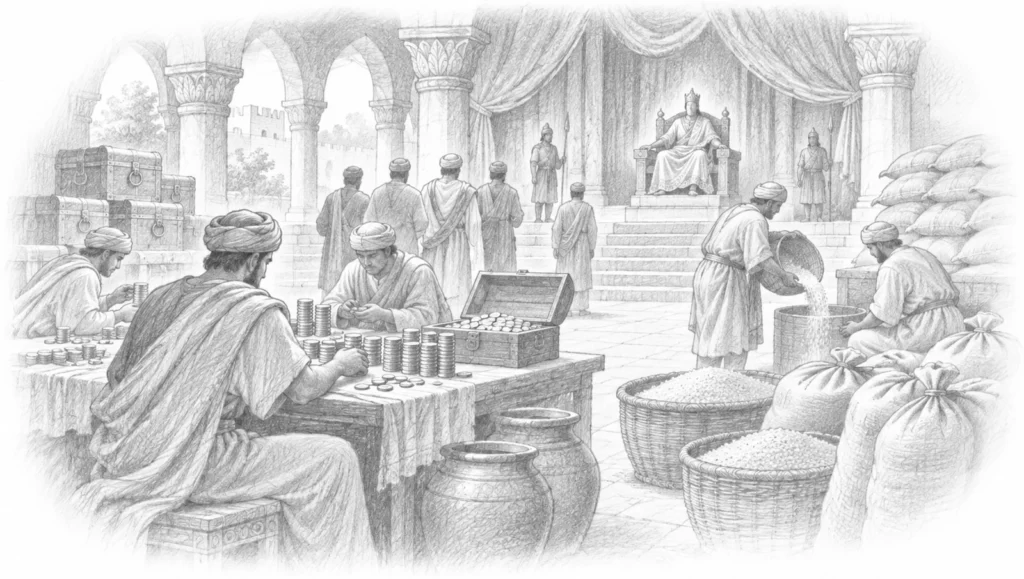
Semester III DSC-8 Ancient and Medieval Indian Political Thought
Unit IV · 20 min read · Updated 24 Nov 2026
As per the University of Delhi (DU) BA (Hons) Political Science syllabus
Contents
- 4.1 Shukra, the Aushanasa School and the Shukraniti
- 4.2 Talking Point: Debate on the Authenticity of Shukra-Niti
- 4.3 The Concept of Kingship in Shukra-Niti
- 4.4 The Concept of Statecraft in Shukra-Niti
- 4.5 Important Questions
- What was the concept of kingship and statecraft in the Shukraniti?
- Discuss the debate on the authenticity of the Shukraniti.
- Short Notes
स्वभागभृत्या दास्यत्वे प्रजानां च नृपः कृतः।
The king has been made the servant of the people, receiving his share of the produce as his wages.
— Shukraniti, Book I
SHUKRA, also called Usanas, was in Indian tradition the teacher of the asuras, as Brihaspati was the teacher of the gods. Like Brihaspati, he gave his name to a school of political science, the Aushanasa school, whose views Kautilya quotes. A text called the Shukranitisara or Shukraniti claims to preserve Shukra’s teaching. It is one of the most detailed works on kingship and administration in Indian literature, describing the king’s duties, his ten ministers, the army, taxation, justice and public works. But its date and authenticity are hotly debated. In this chapter we examine the debate on the authenticity of the Shukraniti and its concept of kingship and statecraft.
4.1 Shukra, the Aushanasa School and the Shukraniti
Kautilya’s Arthashastra records two views of the Aushanasa school. First, it held that dandaniti, the science of government, is the only science, since all other activities depend on it; this is an even more strongly power-centred view than that of the Barhaspatyas. Second, it favoured a council of twenty ministers. Shukra is also remembered as a master of niti, practical policy. The text known as the Shukranitisara, the ‘essence of Shukra’s policy’, is written in verse in four or five chapters and covers the duties of the king, the qualities of ministers and officials, the structure of the government, taxation, the army, forts, justice, inter-state relations, the arts and sciences, and the conduct of daily life. It was edited by Gustav Oppert (1882) and translated into English by Benoy Kumar Sarkar (1914).
Shukra in myth and tradition
In the Puranas and the Mahabharata, Shukra, also called Usanas or Kavya, is the son of the sage Bhrigu and the preceptor of the asuras, the rivals of the gods, just as Brihaspati is the preceptor of the gods. He is famous for his cunning counsel and for knowing the secret of reviving the dead. The Shantiparva tells how the vast original science of polity composed by Brahma was abridged in turn by Shiva, Indra, Brihaspati and Kavya (Shukra), which places Shukra in the line of the great teachers of dandaniti. The pairing of Brihaspati and Shukra as teachers of gods and asuras suggests that, in Indian tradition, both stood for the art of policy and power.
4.2 Talking Point: Debate on the Authenticity of Shukra-Niti
Is the Shukraniti an ancient text preserving the teaching of Shukra, or a much later work? Scholars have given different answers:
- The traditional view treats it as the work of the ancient sage Shukra, and therefore as one of the oldest texts of Indian political science.
- Early modern scholars such as Benoy Kumar Sarkar accepted that it contained ancient material, though with later additions, and used it to argue that ancient India had a developed science of administration.
- The late-medieval view: many historians observed that the text describes institutions, taxes and offices that belong to a much later period than Kautilya, and dated it to the later medieval centuries.
- The nineteenth-century thesis: Lallanji Gopal, in a well-known article of 1962, argued that the present text was composed as late as the nineteenth century, pointing to its references to firearms and gunpowder (nalika), its detailed descriptions of cannon and guns, and other features that could not belong to ancient India.
The present scholarly consensus is that the Shukranitisara in its current form is a late work, probably medieval or later, even if it draws on older ideas associated with the Aushanasa school. Its importance therefore lies less in what it tells us about ancient India than in its systematic picture of kingship and administration within the Indian niti tradition. S.V. Puntambekar (1948) and Vandana Nagar (1985) study it as a source of political ideas rather than as a historical record of a particular period.
Nationalist scholarship and the Shukraniti
The debate on the text’s date became heated partly because of its use in nationalist scholarship. In the early twentieth century, Indian scholars used the Shukraniti and the newly discovered Arthashastra, published by R. Shamasastry in 1909, to refute the colonial claim that India had known only religious thought and oriental despotism. Benoy Kumar Sarkar, who translated the Shukraniti in 1914, used it to argue that ancient Hindus had a positive, secular science of the state. Earlier, the German scholar Gustav Oppert, who published the Sanskrit text in 1882, had even used its passages on firearms to claim that ancient Indians knew gunpowder. When later historians argued that the text was late, they were therefore also questioning these claims about India’s past.
4.3 The Concept of Kingship in Shukra-Niti
Vandana Nagar, in Kingship in Shukra-Niti (1985), shows that the text combines the idea of the king’s greatness with strict limits on his conduct. Its main ideas are:
- Origin and nature: like Manu, the Shukraniti says that the king is made from the essence of the gods, Indra, Vayu, Yama, the Sun, Agni, Varuna, the Moon and Kubera, which explains his glory and authority.
- The king as servant: strikingly, it also declares that the king has been made the servant of the people, receiving his share of the produce, his taxes, as wages. Kingship is thus a function performed for the people, not a personal possession.
- Types of kings: kings are classified as sattvika (virtuous), who rule by dharma and win lasting glory; rajasika (passionate), who rule for their own enjoyment; and tamasika (dark), who are cruel and ruin their kingdoms.
- Qualities and training: the king must be learned, self-controlled, energetic, just and devoted to the welfare of the people; he should study the sciences and follow the advice of wise ministers.
- The king and his ministers: the king must not act on his own opinion alone; even a wise king should consult his ministers, and a king who ignores good advice brings ruin.
- Removal of a wicked king: the text allows that a king who is an enemy of virtue and the people may be removed, with the consent of the people and ministers, and replaced by a worthy member of his family.
The Shukraniti also uses an organic analogy for the seven limbs of the state: the king is the head, ministers the eyes, the friend the ears, the treasury the mouth, the army the mind, the fort the arms and the territory the legs. Kingship is thus central but limited by dharma, by ministers and by its purpose of serving the people.
Limits on the king and the right to remove him
The Shukraniti surrounds royal power with strong limits. The king must not act on his own opinion alone but must hear his ministers, whose written and sealed opinions are kept on record; a king who ignores good counsel soon loses his kingdom. He must be guided by dharma, by the shastras and by the customs of his people. Most strikingly, the text says that if a king is an enemy of virtue, morality and strength, and is of bad character, the people should expel him as a destroyer of the state, and the priest, with the consent of the subjects, should install a worthy member of his family in his place. This is one of the clearest statements in Indian political thought that kingship is conditional on good conduct and that the people’s consent matters.
4.4 The Concept of Statecraft in Shukra-Niti
A. The ten ministers
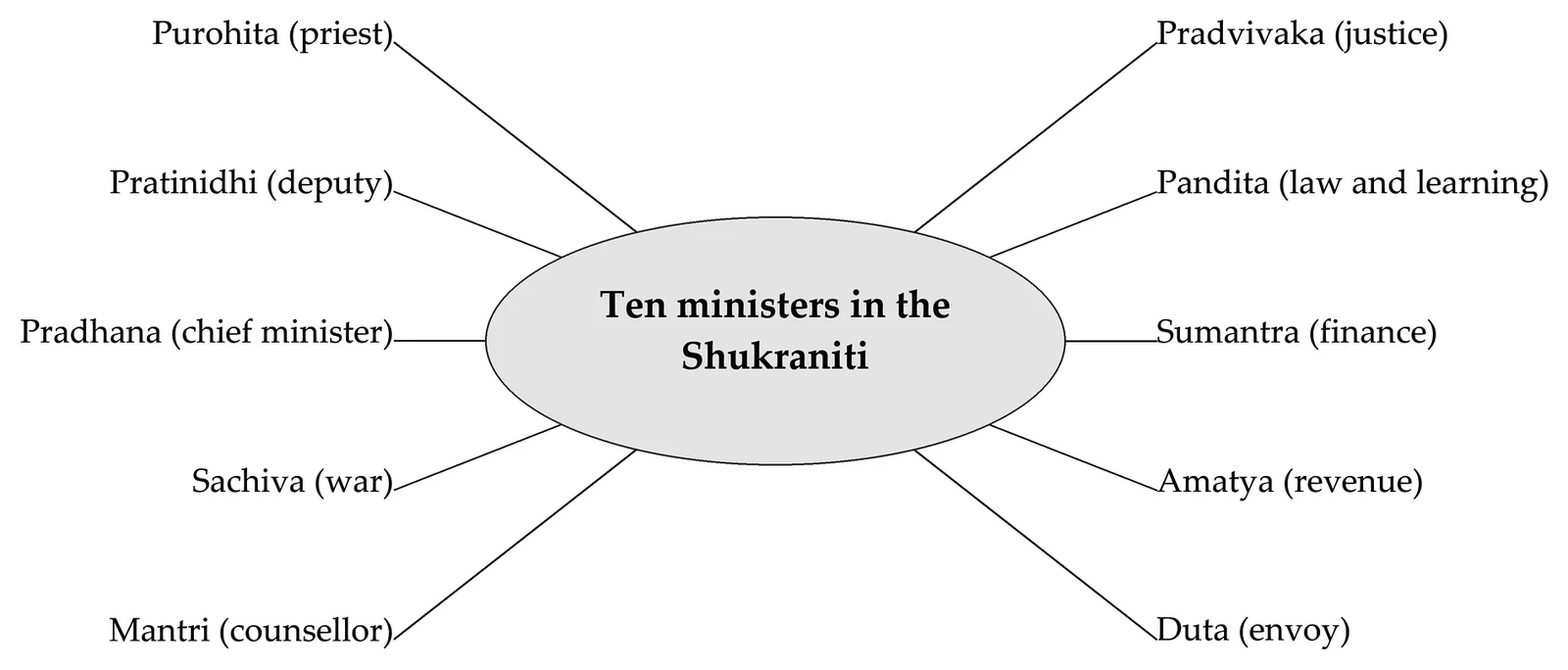
The Shukraniti describes a council of ten ministers (Figure 4.2): the Purohita (priest and adviser on dharma), Pratinidhi (deputy of the king), Pradhana (chief minister), Sachiva (minister of war), Mantri (counsellor on policy and foreign affairs), Pradvivaka (chief justice), Pandita (minister of learning and religious law), Sumantra (finance), Amatya (revenue and land records) and Duta (envoy). Each has defined qualifications and duties, and their opinions are recorded in writing and sealed, which suggests a highly organised bureaucracy.
B. Administration and public works
V.P. Varma, in ‘Some Aspects of Public Administration in the Sukraniti’ (1962), shows its detailed treatment of administration. It describes officials from the village headman upwards, the appointment and promotion of officials by merit, their salaries and pensions, and the inspection of their work. The king should collect taxes moderately, like a gardener who gathers flowers without harming the plant, and spend on public works such as roads, wells, tanks, rest-houses and temples. The army, its divisions and weapons, including firearms, forts, the treasury and the administration of justice are all treated in detail.
C. Justice and foreign policy
Justice is administered by the king with the Pradvivaka and judges, according to law and custom, with attention to evidence. In foreign affairs, the Shukraniti follows the Indian tradition of the mandala, the six-fold policy and the four upayas, stressing diplomacy, spies and alliances, and war only as a last resort. S.V. Puntambekar emphasised that Shukra combines practical statecraft with ethical restraint, so that the welfare of the people is the measure of good government.
D. The army and military science
The Shukraniti treats the army in great detail: its divisions of infantry, cavalry, chariots and elephants, the recruitment, pay, training and discipline of soldiers, the duties of commanders and the arrangement of troops in battle. Unusually for an Indian political text, it describes firearms, both small arms carried by soldiers and large guns drawn by carts, and gives a recipe for gunpowder made from saltpetre, sulphur and charcoal. These passages are a major reason why historians date the present text to a late period, since firearms came into wide use in India only from the late medieval centuries.
E. Officials and their accountability
The text insists that officials be appointed for their merit, character and skill rather than birth alone, and that they be paid regular salaries and, after long service, pensions. It warns that officials who stay too long in one post grow arrogant and corrupt, and so advises periodic transfers. Every order and transaction should be recorded in writing and sealed, and the king should check the work of officials through inspection and spies. V.P. Varma regarded this as one of the most developed accounts of public administration in pre-modern Indian literature, close in spirit to modern ideas of a professional bureaucracy.
F. Knowledge, arts and civic life
The Shukraniti lists thirty-two branches of learning (vidyas) and sixty-four arts (kalas), from the Vedas, law and medicine to music, architecture, weaving and the training of animals, and asks the king to patronise them. It also describes the planning of towns and villages, with roads, markets, wells and gardens. Government is thus seen not only as protection and punishment but as the promotion of knowledge, crafts and civic life.
4.5 Important Questions
- Question 1 What was the concept of kingship and statecraft in the Shukraniti?
- Question 2 Discuss the debate on the authenticity of the Shukraniti.
DU asks the same idea in different words. So learn one broad answer for each question below; the same answer works for every question joined by OR.
Important Question 1
What was the concept of kingship and statecraft in the Shukraniti?
OR
Discuss the theory of kingship in the Shukraniti.
OR
Examine the administrative ideas of the Shukraniti.
Model Answer
“The king has been made the servant of the people, receiving his share of the produce as his wages.”
— Shukraniti (Book I)
Introduction. The Shukraniti or Shukranitisara, attributed to Shukra or Usanas, the teacher of the asuras, is one of the most detailed Indian works on kingship and administration. Whatever its date, it presents a systematic vision of a king who is great but limited, served by an organised bureaucracy.
1. Divine Origin and Greatness
Following the Dharmashastras, the text says that the king is made from the essence of eight gods, which gives him glory and authority over the people. The eight gods are Indra, Vayu, Yama, Surya, Agni, Varuna, Chandra and Kubera, so the king protects like Indra, punishes like Yama and gives wealth like Kubera. The text uses divinity to describe the king’s functions rather than to place him above the law.
2. The King as Servant of the People
Yet it also declares that the king is the servant of the people, paid by his share of taxes as wages. Kingship is a function for the people’s welfare, not a personal possession. This is one of the clearest statements in Indian thought that taxes are a wage for service rather than a tribute owed to a master.
3. Kingship and Dharma
Like other Indian texts, the Shukraniti makes the king the protector of dharma and of the social order, but it stresses ethical qualities such as truthfulness, self-control and compassion more than ritual. A king who neglects dharma loses legitimacy, while one who follows it wins the love of his subjects.
4. Types of Kings
Kings are sattvika, rajasika or tamasika: the virtuous ruler wins lasting glory, the passionate one rules for pleasure and the cruel one destroys his kingdom. The classification follows the three gunas of Samkhya philosophy and teaches that a king’s character, not his birth, decides whether his rule is beneficial.
5. Qualities and Limits
The king must be learned, self-controlled and just, must consult his ministers rather than act alone, and may be removed with the consent of the people and ministers if he becomes an enemy of virtue. A king who ignores the advice of his ministers soon loses his kingdom, and a wicked king who is an enemy of virtue may be expelled by the people, with a worthy member of his family installed in his place.
6. The Organic State
The seven limbs of the state are compared to the body: the king is the head, ministers the eyes, the friend the ears, the treasury the mouth, the army the mind, the fort the arms and the territory the legs. The analogy shows that the limbs depend on one another: a head without eyes, ears or arms cannot act, so the king needs ministers, allies, a treasury and an army.
7. The Ten Ministers
Purohita, Pratinidhi, Pradhana, Sachiva, Mantri, Pradvivaka, Pandita, Sumantra, Amatya and Duta form a council with defined duties and written, sealed opinions. Written and sealed opinions created a record of advice, which made ministers responsible for their counsel and limited arbitrary royal decisions.
8. Administration and Public Works
Varma shows the detailed bureaucracy, appointment by merit, salaries and pensions, moderate taxation like a gardener gathering flowers, and spending on roads, wells, tanks and rest-houses. Officials were to be transferred periodically so that they would not become arrogant or corrupt in one post, and the king supervised them through inspection and spies.
9. Justice and Foreign Policy
Justice is administered with the chief justice according to law, custom and evidence; foreign policy follows the mandala, six-fold policy and upayas, with war as the last resort. The text also treats the army in detail, including infantry, cavalry and elephants and even firearms and gunpowder, which is one reason scholars date it late.
10. Taxation and Welfare
The Shukraniti advises moderate taxation that leaves the people prosperous, special relief in times of famine, and the use of revenue for the army, officials, charity and public works. A king who oppresses the people with heavy taxes destroys the roots of his own power, so welfare is the condition of strength. It also recommends dividing revenue in fixed shares among the army, charity, officials, the king’s personal expenses and a reserve fund, an early form of budgeting.
11. Shukraniti and Kautilya Compared
Both see the state as an organism of seven limbs and value an organised bureaucracy, espionage and diplomacy. But the Shukraniti places more emphasis on the king as servant of the people and on the moral classification of kings, and describes institutions, such as firearms and a council of ten ministers, that belong to a later age.
12. Evaluation
The Shukraniti presents a balanced theory of kingship: the king is great and powerful, but his power is limited by dharma, by his ministers and by the welfare of the people. Whatever its date, it shows the maturity of the Indian niti tradition in thinking about government as a service.
Conclusion. Thus, the Shukraniti presents kingship as a glorious but accountable office and statecraft as an organised, welfare-oriented administration within the Indian niti tradition.
Important Question 2
Discuss the debate on the authenticity of the Shukraniti.
OR
Is the Shukraniti an ancient text? Discuss.
Model Answer
“Some Aspects of Sukra’s Political Thought.”
— Title of S.V. Puntambekar’s study (1948)
Introduction. The Shukraniti claims to preserve the teaching of Shukra, but scholars have long debated whether it is ancient, medieval or even modern. The debate affects how we use it as a source.
1. Shukra and the Aushanasa School
Kautilya cites the Aushanasa school, which recognised only dandaniti as a science and favoured a council of twenty ministers. This shows that a Shukra tradition existed before Kautilya. In myth Shukra, or Usanas, was the son of Bhrigu and the teacher of the asuras, as Brihaspati was the teacher of the gods, and the Mahabharata names him among those who abridged the original science of polity composed by Brahma.
2. The Text
The Shukranitisara, edited by Oppert (1882) and translated by Sarkar (1914), covers kingship, ministers, administration, taxation, army, justice and foreign policy. Gustav Oppert, a German scholar teaching in Madras, published the Sanskrit text in 1882, and had earlier used its passages on firearms to argue that ancient Hindus knew gunpowder.
3. The Traditional View
Tradition treats it as the ancient teaching of Shukra, among the oldest works of political science. On this view the references to firearms proved the advanced military knowledge of ancient India rather than a late date.
4. Sarkar’s View
Sarkar accepted ancient material with later additions and used the text to show that ancient India had a developed science of administration. Writing in the nationalist atmosphere of the early twentieth century, Sarkar saw the text as evidence against the colonial claim that Indians had never developed a positive science of politics.
5. Nationalist Scholarship
In the early twentieth century, Indian scholars used the Shukraniti and the newly published Arthashastra (1909) to refute the colonial claim that India had known only oriental despotism and religious thought. This made the antiquity of the Shukraniti a matter of national pride, which partly explains the heat of the debate.
6. The Late-Medieval View
Historians noted that its institutions, offices and taxes belong to a much later period than Kautilya, and dated it to the later medieval centuries. Its offices, revenue terms and administrative practices resemble those of medieval kingdoms rather than those of the Mauryan age.
7. Lallanji Gopal’s Thesis
Gopal (1962) argued that the present text was composed in the nineteenth century, citing its references to firearms, gunpowder and cannon. His article, ‘The Śukranīti: A Nineteenth-Century Text’, appeared in the Bulletin of the School of Oriental and African Studies and argued that the work cannot be used as evidence for ancient India.

8. The Problem of Layers
Like many Sanskrit works, the Shukraniti may have grown over time, with old maxims surviving beside later additions. A text can therefore contain both ancient ideas and late material, which is why scholars distinguish the date of the present text from the age of the ideas it preserves.
9. Present Consensus
Most scholars regard the present text as late, though it may draw on older Aushanasa ideas; it is valued as a systematic statement of the niti tradition rather than as a record of ancient practice. Puntambekar and Nagar therefore study it as a statement of political ideas, while warning against using it as evidence of the institutions of any particular ancient period.
10. Why Dating Matters
If the text were ancient, it would show that India had a highly developed bureaucracy and military science long before the medieval period. If it is late, it tells us about later political ideas and institutions. Using it as evidence for ancient India without settling its date would therefore distort history. The debate is also a lesson in method: texts must be read in their historical context, and the wish to prove the antiquity of national achievements can distort scholarship.
11. Comparison with the Arthashastra
The comparison with Kautilya is telling. The Arthashastra, generally placed between the last centuries BCE and the early centuries CE, knows nothing of firearms and uses the administrative terms of its own age, while the Shukraniti reflects a later world of guns, new offices and different revenue practices.
12. Evidence from Content
Scholars point to the text’s detailed treatment of guns and gunpowder, its administrative terms, its references to later social practices and the absence of early quotations from it. These suggest that the present text was composed or heavily revised long after Kautilya.
13. Using a Late Text
A late date does not make the Shukraniti worthless. It shows how the niti tradition continued to develop, combining older ideas of kingship with later administrative experience, and it remains a valuable source for the history of Indian political ideas. Late texts remain valuable for understanding how ideas of kingship and administration were remembered, adapted and passed on in later Indian history.
14. Evaluation
The weight of evidence supports a late date for the present text, though some of its ideas may go back to the ancient Aushanasa school. Its value lies in its systematic treatment of kingship, ministers and administration, which shows the continuity of the niti tradition, rather than in evidence about any particular ancient age.
Conclusion. Thus, the Shukraniti is a late text with possibly ancient roots, important for its ideas on kingship and administration rather than as evidence of a particular age.
Short Notes
(a) The ten ministers of the Shukraniti
Purohita (priest), Pratinidhi (deputy), Pradhana (chief minister), Sachiva (war), Mantri (counsellor), Pradvivaka (justice), Pandita (learning and religious law), Sumantra (finance), Amatya (revenue) and Duta (envoy). Their opinions were recorded in writing, suggesting an organised bureaucracy.
(b) The Aushanasa school
The school of Usanas (Shukra), cited by Kautilya, which held that dandaniti, the science of government, is the only science and favoured a council of twenty ministers, expressing a strongly power-centred view of politics.
More notes: DSC-8 Ancient and Medieval Indian Political Thought
These notes are prepared by PADHO TO AISE for study help. They are not an official University of Delhi publication.