
Semester III DSC-8 Ancient and Medieval Indian Political Thought
Unit III · 21 min read · Updated 24 Nov 2026
As per the University of Delhi (DU) BA (Hons) Political Science syllabus
Contents
केवलं शास्त्रमाश्रित्य न कर्तव्यो विनिर्णयः। युक्तिहीने विचारे तु धर्महानिः प्रजायते॥
A decision should not be made by relying merely on the text of the shastra; when a case is decided without reasoning, justice is lost.
— Brihaspati Smriti, as cited by P.V. Kane
BRIHASPATI, in Indian tradition the teacher of the gods, gave his name to one of the oldest schools of Indian political thought, the Barhaspatya school. Its works have not survived as complete texts. We know its ideas mainly from the many places where Kautilya’s Arthashastra quotes and argues with it, from a later law book called the Brihaspati Smriti, and from fragments preserved in other works. Scholars such as P.V. Kane, Raghavendra Vajpeyi and Ashok Chousalkar have reconstructed this pre-Kautilyan tradition. It reveals a remarkably realist and rational approach: Brihaspati’s followers put economics and coercive power at the centre of politics and insisted that justice must be based on reasoning, not on the letter of the texts alone. In this chapter we study Brihaspati’s ideas on statecraft, justice and inter-state relations.
3.1 Brihaspati and the Barhaspatya School
Before Kautilya, several schools of Arthashastra, the science of polity and economy, already existed. Kautilya repeatedly records their views before giving his own, mentioning the schools of Manu, Brihaspati, Usanas (Shukra), Bharadvaja, Vishalaksha and Parashara. P.V. Kane, in ‘Rajyashastras of Brihaspati, Usanas, Bharadvaja and Vishalaksha’ (1940), collected these references, and Chousalkar shows that the pre-Kautilyan tradition was already sophisticated. The name of Brihaspati is also linked with the materialist Lokayata or Charvaka philosophy, which rejected the authority of the Vedas, and with a short later text of maxims called the Barhaspatya Sutra. The Brihaspati Smriti, probably composed in the early centuries CE, is a law book that survives in quotations and is admired for its treatment of legal procedure. Raghavendra Vajpeyi’s Barhaspatya Rajya-Vyavastha (1966) studies its political and legal system.
Three ‘Brihaspatis’
Students should distinguish three bodies of material that carry Brihaspati’s name. The first is the Barhaspatya school of arthashastra, known only from Kautilya’s quotations. The second is the Brihaspati Smriti, a Dharmashastra on law and legal procedure that survives only in quotations by later jurists; K.V. Rangaswami Aiyangar reconstructed it in 1941, and it is usually dated to the first half of the first millennium CE. The third is the Barhaspatya Sutra, a short and much later collection of political maxims edited by F.W. Thomas (1921). To these we may add the mythological figure of Brihaspati, the teacher (guru) of the gods, and the tradition that made him the founder of the materialist Lokayata school. These are not the work of one author, but together they show a recognisable outlook: practical, secular and concerned with power, wealth and reasoned justice.
3.2 Statecraft
A. Varta and dandaniti
The most famous view of the Barhaspatyas, recorded in the Arthashastra (1.2), concerns the sciences a king must learn. The school of Manu recognised three sciences: the Vedas (trayi), economics (varta) and the science of government (dandaniti). The Barhaspatyas recognised only two: varta and dandaniti, saying that the Vedas are merely a cover for those who know the ways of the world. The school of Usanas recognised only dandaniti. Kautilya himself added philosophy (anvikshiki) and accepted all four. The Barhaspatya view shows a strongly secular and realist orientation: politics depends on wealth and on coercive power, not on ritual or scripture.
B. The king, ministers and administration
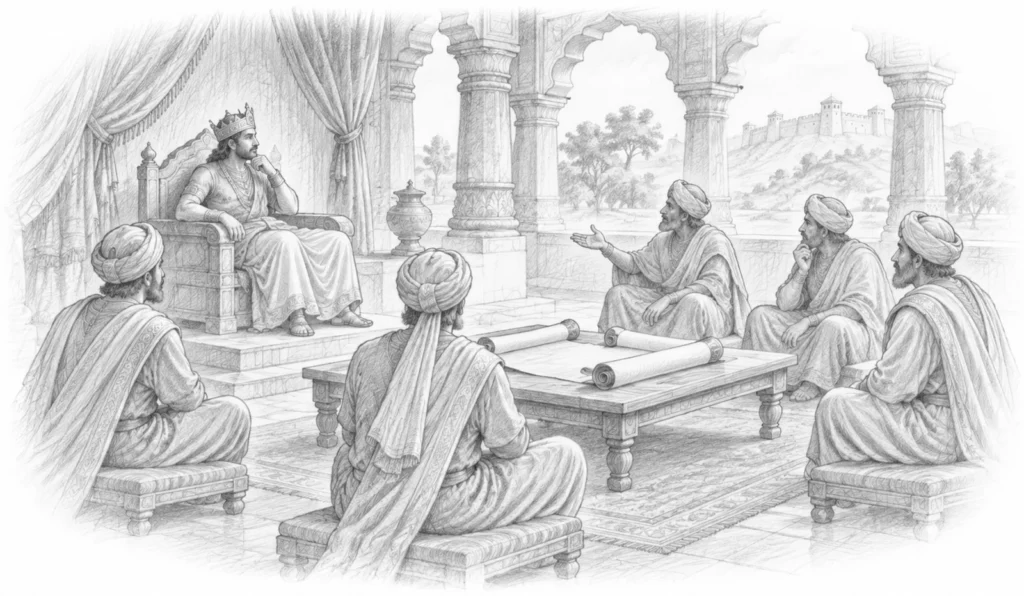
For Brihaspati’s school, the king is the centre of the state and must be energetic, disciplined and vigilant. Kautilya records that the Barhaspatyas favoured a council of sixteen ministers, while the Manavas preferred twelve and the Aushanasas twenty; Kautilya himself said the number should depend on the needs of the state. The Barhaspatyas stressed the treasury, the army, fortification and spies as the means of power, and treated artha, material prosperity, as the foundation of dharma and kama, since without wealth neither religious duties nor pleasures are possible. Danda must be used firmly to prevent the anarchy of matsyanyaya, but justly, so that the people do not rise against the king (Figure 3.2).

C. Brihaspati in the Mahabharata
In the Shantiparva of the Mahabharata, Brihaspati explains to King Vasumanas why kingship is necessary. Without a king, he says, people would prey on one another like fish in water, no one could say ‘this is mine’, families and property would be insecure and the Vedas would be forgotten. The king’s rod of punishment is therefore the basis of all order, and the king deserves honour as a protector. This dialogue links Brihaspati’s name with a strong theory of royal authority grounded in the need for security, the same idea of matsyanyaya that runs through the Arthashastra and the Dharmashastras.
D. Wealth, welfare and the economy
Because varta was one of the school’s two sciences, the economy was central to its idea of statecraft. Agriculture, cattle-rearing and trade produce the revenue on which the treasury, the army and public works depend. The king must therefore protect cultivators and traders, encourage the settlement of new land and avoid oppressive taxation, since an impoverished people cannot support a strong state. This economic realism links the Barhaspatyas with Kautilya’s detailed treatment of revenue, mines, trade and state enterprises.
3.3 Justice and Legal Procedure
The Brihaspati Smriti is particularly valued for its jurisprudence. Its main contributions are:
- Reasoning in judgement: a decision should not be made merely by relying on the text of the shastra; if a case is decided without reasoning (yukti), justice is lost. This principle anticipates the modern idea that judges must interpret the law in the light of facts and reason, not apply it mechanically.
- Civil and criminal law: Brihaspati divided the eighteen titles of law into disputes arising from property (dhanamula), such as debts, deposits and sales, and those arising from injury (himsamula), such as assault, defamation and theft, an early distinction between civil and criminal law.
- Stages of a trial: a lawsuit proceeds through the plaint, the reply of the defendant, the proof through evidence, and the decision.
- Evidence: proof is of two kinds, human, consisting of witnesses, documents and possession, and divine, consisting of ordeals, which should be used only when human evidence is lacking.
- Custom: local and caste customs (charitra) are recognised as sources of law alongside the shastras.
- Courts and judges: the king’s court is assisted by learned judges and assessors, and there is a hierarchy of courts from family and guild tribunals up to the royal court.
- Women’s property: Brihaspati is noted for recognising the property rights of women, including the right of a widow to inherit her husband’s estate in the absence of sons.
Justice for Brihaspati is therefore both substantive, upholding dharma and protecting rights to property and person, and procedural, requiring fair trial, evidence and reasoned judgement. Like other Dharmashastras, however, it also accepted the varna order and some differentiation of punishments.
Courts, judges and punishments
The Brihaspati Smriti describes a graded system of courts. Disputes were first heard by tribunals of families (kula), guilds (shreni) and assemblies (gana), and could rise on appeal to courts appointed by the king and finally to the king’s own court, where the king sat with a learned judge (pradvivaka) and assessors (sabhyas). A defendant could answer a plaint in four ways: by denial, by admission, by a special plea, or by pleading that the matter had already been decided. Brihaspati listed four kinds of punishment, admonition, censure, fine and corporal punishment, to be used in ascending order according to the gravity of the offence, which reflects a principle of proportionality.
Women and property
Brihaspati is often cited by later jurists for a comparatively liberal view of women’s property. He described the wife as half the body of her husband, sharing the fruit of his good and bad deeds, and used this to support the widow’s right to inherit her husband’s estate when there was no son. He also recognised several kinds of stridhana, property belonging to a woman. He disapproved of niyoga, the old custom of a widow bearing a son by her husband’s brother, saying that it was no longer suitable for the present age, which shows how moral views developed within the dharma tradition.
3.4 Inter-state Relations
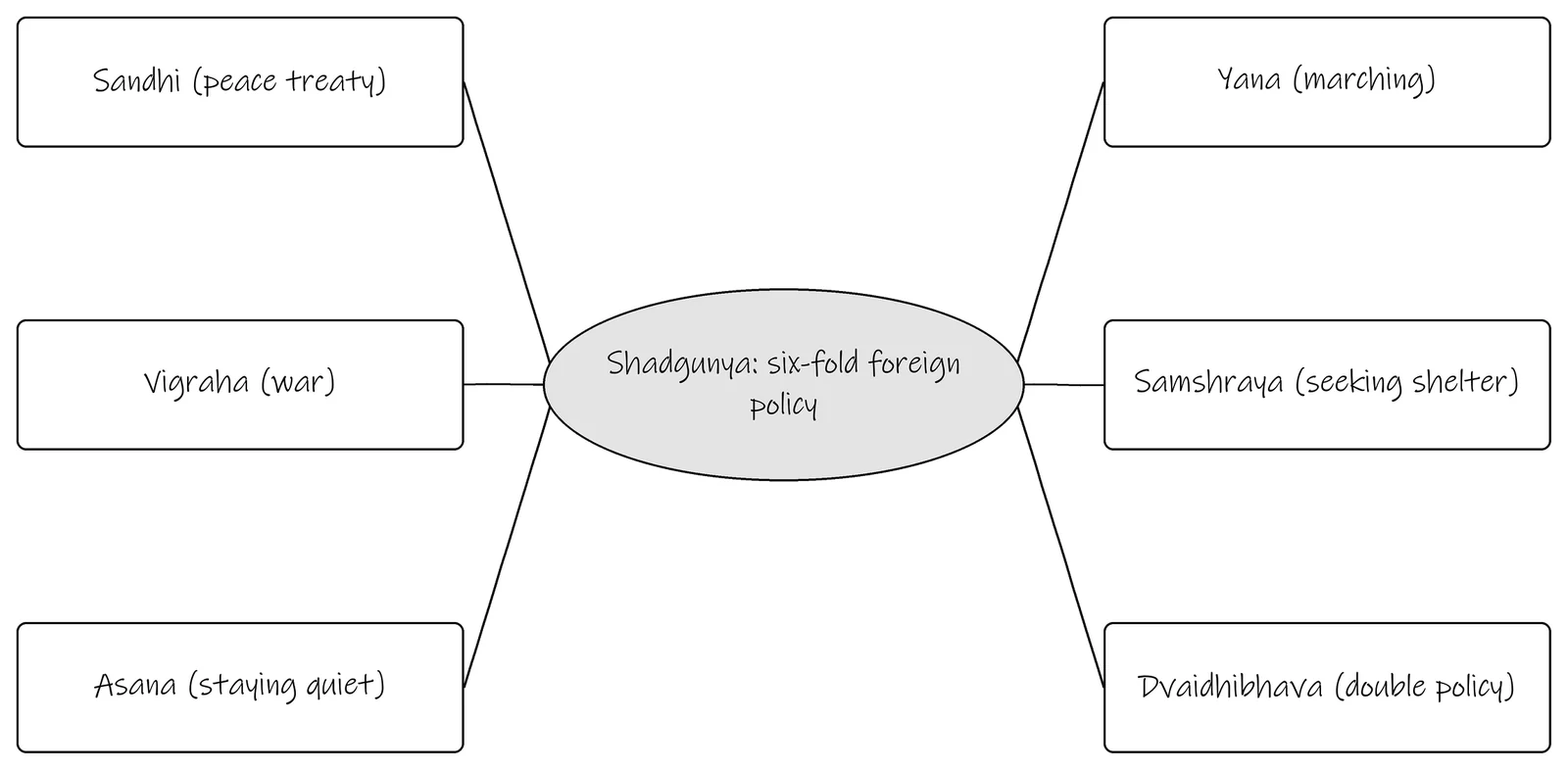
The Barhaspatya school took part in the early development of the theory of inter-state relations that Kautilya later systematised. Kautilya records disagreements among the schools on questions such as when to make peace and when to wage war, whom to choose as an ally, and how a weak king should deal with a strong one. Brihaspati’s school accepted the basic framework of the mandala, the circle of neighbouring states in which the immediate neighbour is a natural enemy and the neighbour’s neighbour a natural friend, and the six-fold policy (shadgunya): peace, war, neutrality, preparing to march, seeking shelter and the double policy. It stressed the use of diplomacy, alliances and spies, and the four upayas: conciliation, gifts, dissension and force. The guiding principle was the interest and security of one’s own state, a realist outlook that later writers associated especially with the Barhaspatyas.
The four upayas
Like the rest of the Indian tradition, the Barhaspatyas used four expedients (upayas) in dealing with other states and with enemies at home: sama (conciliation and persuasion), dana (gifts and concessions), bheda (creating division among opponents) and danda (force). The first two were preferred because they were cheaper and less risky; force was the last resort. Spies and envoys supplied the information on which the choice of expedient depended. This calculated approach shows that ancient Indian thinkers treated foreign policy as a matter of interest and power rather than of religious duty.
3.5 Evaluation
The Barhaspatya tradition shows that Indian political thought had a strong secular and realist current long before Kautilya. Its emphasis on economics and coercion, its scepticism towards the Vedas, its reasoned jurisprudence and its practical approach to diplomacy make it an important precursor of the Arthashastra. Its limitations lie in the fragmentary nature of the evidence, which makes reconstruction uncertain, and in its acceptance, in the law books, of the hierarchical social order. Chousalkar argues that recovering this pre-Kautilyan tradition helps us see Indian political thought as a living debate among schools rather than a single orthodoxy.
Brihaspati and the Lokayata tradition
Tradition names Brihaspati as the founder of the Lokayata or Charvaka school, the materialist philosophy of ancient India. It held that perception is the only reliable means of knowledge, that the body is the self, that there is no life after death, and that Vedic rituals are the inventions of priests for their livelihood. The school’s own texts are lost, and its views are known mainly from the accounts of its opponents, such as the fourteenth-century Sarvadarshanasangraha. Debiprasad Chattopadhyaya, in Lokayata (1959), argued that it expressed the outlook of ordinary working people. Whether or not the political Brihaspati and the materialist Brihaspati were the same, the association fits the Barhaspatya school’s rejection of the Vedas as a science of government, and Amartya Sen, in The Argumentative Indian (2005), cites the Lokayata as evidence of an old Indian tradition of scepticism and public reasoning.
3.6 Important Questions
- Question 1 Discuss Brihaspati’s ideas on statecraft, justice and inter-state relations.
- Question 2 Examine Brihaspati’s conception of justice and legal procedure.
DU asks the same idea in different words. So learn one broad answer for each question below; the same answer works for every question joined by OR.
Important Question 1
Discuss Brihaspati’s ideas on statecraft, justice and inter-state relations.
OR
Examine the contribution of the Barhaspatya school to ancient Indian political thought.
Model Answer
“The school of Brihaspati holds that there are only two sciences: varta and dandaniti, for the Vedas are only a cover for one who knows the ways of the world.”
— Kautilya, Arthashastra (1.2), on the Barhaspatyas
Introduction. Brihaspati gave his name to one of the oldest schools of Arthashastra. Its views survive mainly through Kautilya’s citations, the Brihaspati Smriti and other fragments, reconstructed by Kane, Vajpeyi and Chousalkar. It shows a realist and rational approach to politics.
1. The Barhaspatya School
Kautilya cites the Barhaspatyas along with the schools of Manu, Usanas, Bharadvaja, Vishalaksha and Parashara. Brihaspati is also linked with materialist Lokayata philosophy and with a later law book, the Brihaspati Smriti. Since no complete text of the school survives, its ideas must be reconstructed from Kautilya’s quotations, the reconstructed Brihaspati Smriti and later works, as P.V. Kane did in 1940.
2. Varta and Dandaniti
The Barhaspatyas recognised only two sciences, economics and the science of government, calling the Vedas a mere cover. This places wealth and power at the centre of statecraft, a strongly secular view. Varta covered agriculture, cattle-rearing and trade, which produce the wealth on which the state depends, while dandaniti dealt with acquiring, protecting and increasing territory through the proper use of coercion. By leaving out the Vedas, the school treated politics as an autonomous field of knowledge.
3. The King and the Council
The king must be energetic and vigilant; the Barhaspatyas favoured a council of sixteen ministers, and stressed treasury, army, forts and spies as instruments of power. A larger council meant wider consultation, and like Kautilya, who said that a single wheel cannot move a chariot, the school held that a king who acts without counsel invites ruin.
4. Artha and Danda
Artha is the foundation of dharma and kama. Danda must be firm to prevent matsyanyaya, but just, so that it does not provoke rebellion. This anticipates Kautilya’s famous statement that artha alone is supreme, because dharma and kama depend on it.
5. Wealth and Welfare
Because varta was one of its two sciences, the school made the economy central to statecraft: the king must protect cultivators and traders and avoid oppressive taxation, since an impoverished people cannot sustain a strong state.
6. Reasoned Justice
The Brihaspati Smriti holds that a case decided only by the letter of the shastra, without reasoning, results in injustice, anticipating the modern idea of reasoned judgement. This principle protected people against the mechanical or corrupt application of texts and required judges to examine facts, witnesses and circumstances.
7. Legal Procedure
Brihaspati distinguished disputes over property from those over injury, set out the stages of plaint, reply, proof and decision, and distinguished human from divine evidence, recognising custom as a source of law. He also described a hierarchy of courts, from tribunals of families, guilds and assemblies to the royal court, with appeals rising from lower to higher bodies.
8. Inter-state Relations
The school accepted the mandala and the six-fold policy, stressing diplomacy, alliances, spies and the four upayas, guided by the interest and security of the state. The aim of foreign policy was the security and prosperity of one’s own state, and the choice of policy depended on whether the king was stronger than, equal to or weaker than his neighbours. Kautilya records that the schools disagreed on whether a weak king should submit, seek shelter or fight, which shows that these questions were actively debated.
9. Brihaspati in the Mahabharata
In the Shantiparva, Brihaspati explains to King Vasumanas why kingship is necessary: without a king, people would prey on one another like fish, property and family would be insecure and the Vedas would be forgotten. The name of Brihaspati was thus linked with a strong theory of royal authority grounded in the need for order.
10. The Four Upayas
In dealing with enemies and allies the school relied on the four expedients, conciliation, gifts, dissension and force, preferring the cheaper and safer methods and using force only as a last resort. Spies and envoys supplied the information on which these choices depended.
11. Evaluation
The Barhaspatya tradition shows a realist current in Indian thought before Kautilya. Its fragmentary evidence makes reconstruction uncertain, and its law books accepted varna hierarchy. Its secular temper also shows that Indian thought was not wholly religious, as many Orientalist scholars once assumed.
12. Brihaspati and Kautilya Compared
Kautilya often begins a topic with the view of the Barhaspatyas and then gives his own. He shares their realism and their emphasis on economy and danda, but he adds philosophy (anvikshiki) and the Vedas to the sciences, and generally prefers a flexible, case-by-case judgement to fixed rules such as a council of exactly sixteen ministers. Kautilya accepted four sciences, including philosophy and the Vedas, and so placed realism within a wider framework of dharma.
13. Materialism and Politics
The association of Brihaspati with the materialist Lokayata school, which denied the authority of the Vedas and the existence of an afterlife, fits the secular emphasis of the Barhaspatya political school. Together they show a rationalist strand in Indian thought. Amartya Sen, in The Argumentative Indian (2005), cites the Lokayata tradition as evidence of a long Indian tradition of scepticism and public reasoning.
14. Relevance
The school’s realism resembles modern ideas of reason of state and national interest, and its view that wealth and coercion are the foundations of power remains a starting point for realist analysis of politics.
Conclusion. Thus, Brihaspati’s school offers a pragmatic and rational approach to statecraft, justice and diplomacy that prepared the ground for Kautilya’s Arthashastra.
Important Question 2
Examine Brihaspati’s conception of justice and legal procedure.
OR
Write a note on justice in Brihaspati.
Model Answer
“When a case is decided without reasoning, justice is lost.”
— Brihaspati Smriti
Introduction. The Brihaspati Smriti is among the most important ancient Indian works on law and judicial procedure. It combines the protection of dharma with a remarkable emphasis on reasoning, evidence and fair procedure.
1. Justice and Dharma
Justice means upholding dharma and protecting people’s rights to property and person through the king’s courts. The Brihaspati Smriti, which survives only in quotations collected by K.V. Rangaswami Aiyangar (1941), is usually dated to the first half of the first millennium CE and was one of the most cited authorities in later Hindu law.
2. Reasoning over Literalism
Brihaspati warns against deciding cases solely on the text of the shastras; without yukti, reasoning applied to the facts, justice fails. The principle allowed the judge to consider the intention of the parties, the circumstances of the case and the likely consequences of a decision, much like the modern idea of equity.
3. Civil and Criminal Disputes
He divided the titles of law into disputes rooted in property, such as debts and sales, and those rooted in injury, such as assault and theft. This distinction between disputes rooted in wealth (dhanamula) and those rooted in injury (himsamula) is one of the earliest classifications of civil and criminal law.
4. Stages of a Trial
A lawsuit proceeds through plaint, reply, proof and decision, ensuring that both parties are heard. The plaint had to state the time, place and matter in dispute, and the defendant could reply by denial, by admission, by a special plea or by pleading a previous judgment.
5. Evidence
Human evidence, witnesses, documents and possession, is preferred; divine evidence through ordeals is used only when human evidence is lacking. Brihaspati discusses the qualifications of witnesses and the validity of documents, and prefers written proof in matters of property.
6. Sources of Law
Brihaspati recognised the sacred texts, the conduct of good people, custom and the king’s orders as sources of law, and held that a decision must harmonise them through reasoning. Customs of regions, castes and guilds were binding unless they clearly violated dharma.
7. Custom and Courts
Local and caste customs are recognised as law; courts range from family and guild tribunals to the royal court with learned judges. Family (kula), guild (shreni) and assembly (gana) courts settled disputes first, with appeals rising to the royal court.
8. Debts, Contracts and Wages
Much of the Brihaspati Smriti deals with economic disputes: the recovery of debts, rates of interest, deposits, partnerships, the wages of labourers and the sale of goods. This reflects a commercial society in which courts had to protect property and enforce agreements.
9. Women’s Property
Brihaspati recognised women’s property and supported the widow’s right to inherit in the absence of sons. He described the wife as half the body of her husband, sharing the fruit of his deeds, an argument that later jurists used to defend the widow’s right of inheritance.
10. Kinds of Punishment
Brihaspati listed four kinds of punishment, admonition, censure, fine and corporal punishment, to be used in ascending order according to the gravity of the offence and the circumstances of the offender, which reflects a principle of proportionality.
11. Justice as Protection of the Weak
The king’s duty to do justice was tied to his duty of protection: by hearing complaints and punishing the strong who oppressed the weak, he prevented matsyanyaya and earned his right to taxes.
12. Limitations
Like other law books, it accepted the varna order and reliance on ordeals in some cases. Punishments still varied by varna, and ordeals by fire and water reflected a belief in divine judgement rather than rational proof.
13. Courts and Assessors
The king’s court was to be assisted by learned judges and assessors, so that decisions were not made by the king alone. Lower tribunals of families, guilds and communities settled many disputes, with appeals to higher courts, which reflects a layered system of justice. The assessors were expected to advise the king fearlessly, since a wrong decision brought sin upon every member of the court, a view common to the Dharmashastras.
14. Reason and Custom
Brihaspati combines reason with custom. Judges must apply the law to the facts with reasoning, and must respect the customs of regions, castes and guilds where these do not conflict with dharma, so that justice is sensitive to local life.
15. Brihaspati and Manu Compared
Both accept the eighteen titles of law and the king’s duty to do justice, but Brihaspati gives more attention to procedure, evidence and reasoning, and is more favourable to women’s property, which is why scholars regard his work as a more developed jurisprudence. Brihaspati also disapproved of niyoga, which Manu had discussed, saying it was unsuitable for the present age, which shows a development of moral thinking within the tradition.
16. Relevance Today
Brihaspati’s insistence that judges reason rather than apply texts mechanically, and his distinction between civil and criminal disputes, echo principles of modern jurisprudence and show the sophistication of ancient Indian legal thought. His recognition of custom also anticipates the place of customary law in modern India, especially for tribal communities.
17. Evaluation
Brihaspati’s jurisprudence is one of the most developed in ancient India, combining procedure, evidence, reasoning and custom. Its limitation lies in its acceptance of social hierarchy, but its emphasis on reasoned and fair adjudication makes it a significant contribution to Indian legal and political thought.
Conclusion. Thus, Brihaspati’s conception of justice combines dharma with rational, procedural fairness, making it one of the most advanced legal traditions of ancient India.
Short Notes
(a) Justice in Brihaspati
The Brihaspati Smriti holds that justice requires reasoned judgement, not mechanical application of texts; it distinguishes property-based from injury-based disputes, sets out the stages of plaint, reply, proof and decision, prefers human evidence to ordeals, recognises custom, and supports women’s property rights.
(b) The Barhaspatya view of the sciences
According to Kautilya, the school of Brihaspati recognised only two sciences, varta (economics) and dandaniti (politics), regarding the Vedas as a cover for worldly wisdom, while the Manavas accepted three, the Aushanasas only dandaniti, and Kautilya four, including anvikshiki.
More notes: DSC-8 Ancient and Medieval Indian Political Thought
These notes are prepared by PADHO TO AISE for study help. They are not an official University of Delhi publication.