
Semester III DSC-8 Ancient and Medieval Indian Political Thought
Unit II · 21 min read · Updated 24 Nov 2026
As per the University of Delhi (DU) BA (Hons) Political Science syllabus
Contents
- 2.1 The Manusmriti: An Introduction
- 2.2 Talking Point: Authenticity of Manu smriti
- 2.3 Social Laws: Varna, Ashrama, Women and Times of Adversity
- 2.4 Kingship, Danda and the Conception of Justice
- 2.5 Evaluation: Manu and His Critics
- 2.6 Important Questions
- Throw light on the authorship and contradictions in the Manusmriti.
- Discuss Manu’s social laws and conception of justice.
- Short Notes
धर्म एव हतो हन्ति धर्मो रक्षति रक्षितः।
Dharma, when violated, destroys; dharma, when protected, protects.
— Manusmriti, 8.15
THE MANUSMRITI, or Manava Dharmashastra, the ‘Treatise on Dharma of Manu’, is the most famous and the most controversial of the ancient Indian law books. For centuries it was treated as an authoritative guide to dharma; colonial rulers used it as the basis of ‘Hindu law’; and B.R. Ambedkar publicly burned it in 1927 as a symbol of caste oppression. To study Manu is therefore to study both a sophisticated vision of social and political order and a text that justified deep inequalities of caste and gender. In this chapter we examine the debate on the authenticity and authorship of the Manusmriti and its contradictions, its social laws, especially varna and the position of women, and its conception of justice, kingship and danda.
2.1 The Manusmriti: An Introduction
The Manusmriti belongs to the Dharmashastra literature, texts on dharma that followed the earlier, shorter Dharmasutras. It is written in verse and presents itself as the teaching of Manu, the primordial ancestor of humanity, conveyed to sages by the sage Bhrigu. Its twelve chapters cover the creation of the world, the duties of students, householders, forest-dwellers and renouncers, the duties of the four varnas, rules of purity, marriage and the position of women, the duties of the king and the administration of justice, the eighteen titles of law, mixed castes and times of adversity, penances, and karma and liberation. V.R. Mehta calls Manu’s outlook a cosmic vision: social and political order is part of a cosmic order in which each being has its place and duty.
Structure and commentaries
Patrick Olivelle shows that the text is carefully organised. After an account of creation and of the sources of dharma, it follows the life of a twice-born man through the samskaras (life-cycle rites), studentship, marriage and householdership, and the later stages of forest life and renunciation. Chapters 7 to 9, the longest part, deal with the king, his administration and the eighteen titles of law; chapter 10 with mixed castes and times of adversity; chapter 11 with penances; and chapter 12 with karma, rebirth and liberation. Law, ritual, morality and politics thus form one system of dharma. The text was read through commentaries: Medhatithi (around the ninth or tenth century) and, in the later medieval period, Kulluka Bhatta explained difficult verses and often reconciled harsh rules with the customs of their own times. Later legal digests (nibandhas) and, in the colonial period, the courts relied on these commentaries.
2.2 Talking Point: Authenticity of Manu smriti
A. Traditional and colonial views
Tradition attributed the text to Manu Svayambhuva, the first man and law-giver, which gave it great authority as smriti, remembered tradition second only to the Vedas. Commentators such as Medhatithi (9th–10th century) and Kulluka (15th century) interpreted it. In the colonial period, Warren Hastings sought to govern Hindus by their ‘own laws’, and William Jones translated the Manusmriti as the Institutes of Hindu Law (1794). Colonial courts treated it as the authoritative code of Hindus, giving it a rigid legal force it had not always had in practice, where local customs and many texts mattered.
B. The scholarly debate on authorship
Modern scholars agree that Manu was not a historical author. Nineteenth-century Indologists such as Georg Bühler (1886) saw the text as a compilation that grew over centuries in the Manava school, with additions and interpolations. Patrick Olivelle, in his critical edition Manu’s Code of Law (2005/2006), argued instead that the text has a deliberate, systematic structure, which suggests that it was composed by a single author or a small team, probably around the 2nd century CE, as a Brahmanical response to the challenges of Buddhism and of foreign rulers, and that later scribes added some verses.
C. Contradictions
The Manusmriti contains statements that seem to contradict each other. On women, it says that where women are honoured, there the gods rejoice (3.56), but also that a woman is guarded by her father in childhood, her husband in youth and her sons in old age, and is never fit for independence (9.3). It allows meat-eating in some verses (5.30) and praises abstaining from meat in others (5.48–56). It describes the practice of niyoga, a widow bearing a son by a brother-in-law (9.59), and then condemns it (9.64–68). It permits some marriages between varnas but condemns others. Scholars explain these contradictions in different ways: as interpolations by later hands; as the author’s practice of presenting opposing views before giving his own; as differences between rules for normal times and times of adversity; and as reflecting changing social practice. The contradictions show that the text was not a simple, uniform code.
2.3 Social Laws: Varna, Ashrama, Women and Times of Adversity
A. Varna and ashrama
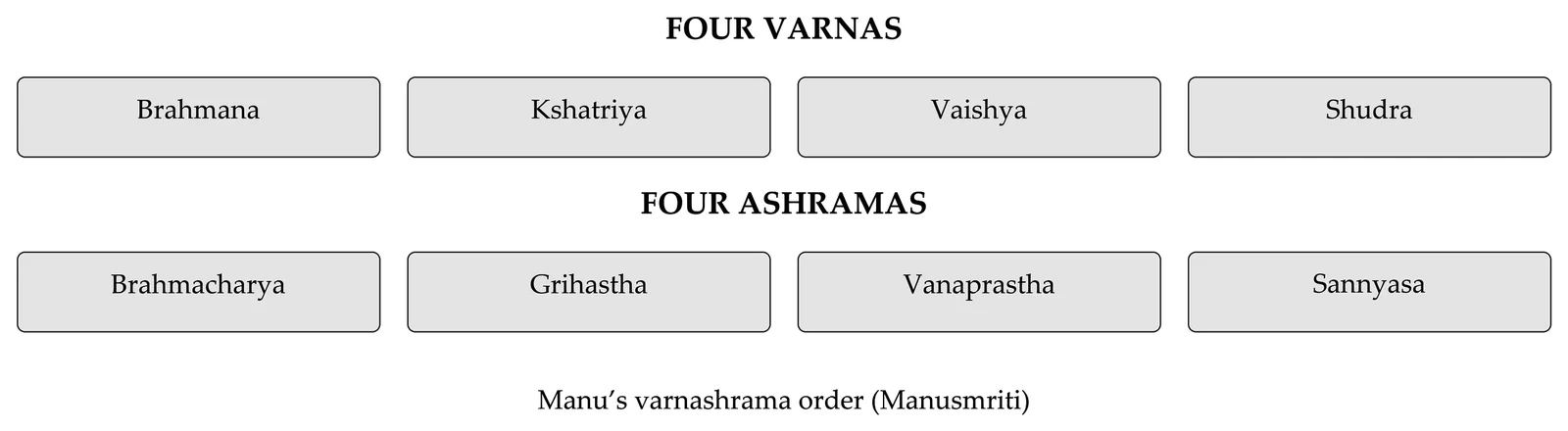
Manu’s social order rests on varnashrama dharma (Figure 2.2). Society is divided into four varnas, which Manu describes as created from the mouth, arms, thighs and feet of the cosmic being: Brahmanas, whose duties are studying and teaching the Veda and performing sacrifices; Kshatriyas, who protect the people; Vaishyas, who engage in trade, agriculture and cattle-rearing; and Shudras, whose duty is to serve the other three. Life is divided into four ashramas: student (brahmacharya), householder (grihastha), forest-dweller (vanaprastha) and renouncer (sannyasa). R.S. Sharma, in ‘Varna in Relation to Law and Politics’, shows that law in Manu is differentiated by varna: rights, punishments and privileges vary according to one’s varna, with Brahmanas privileged and Shudras subjected to many disabilities. Manu also explains the origin of numerous mixed castes from marriages between varnas.
B. Marriage, family and women
Manu describes eight forms of marriage, ranging from the approved Brahma marriage to the disapproved Paishacha. He lays down rules of inheritance and household duties. His view of women is ambivalent: he praises the honour of women within the household and wives as the light of the home, but he places women under the lifelong control of male relatives, restricts their property and religious roles, and prescribes strict duties of the wife.
C. Rules for times of adversity
Chapter 10 of the Manusmriti contains rules for times of adversity (apaddharma). When a person cannot live by the occupation of his own varna, he may adopt the livelihood of a lower varna: a Brahmana in distress may live by the occupation of a Kshatriya or even a Vaishya, though he must return to his own duties when the crisis passes. These rules show that Manu recognised that social reality could not always fit his ideal scheme, and they introduced flexibility into a rigid order.
D. The sources of dharma
Manu names four sources of dharma: the Veda, the tradition and practice of those who know the Veda, the conduct of good people (sadachara), and what is pleasing to oneself (2.6, 2.12). This list matters politically. It places Brahmanical learning at the top, but by recognising the conduct of good people and established practice, it also allows the customs of regions, castes, guilds and families to count as law. This is why Manu tells the king to inquire into the laws of castes, districts, guilds and families and to settle the particular law of each (8.41).
2.4 Kingship, Danda and the Conception of Justice
A. The king and danda
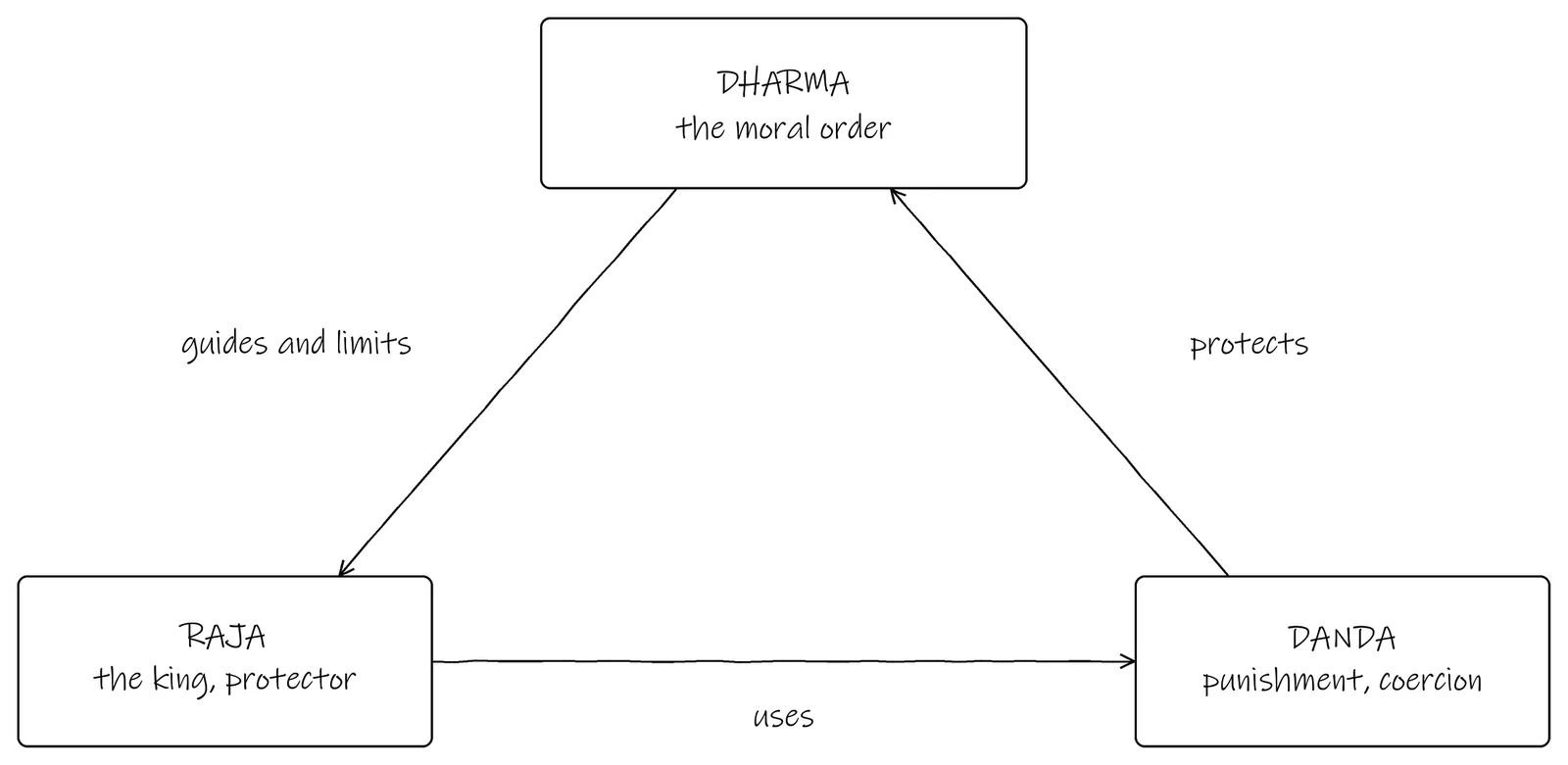
Manu’s theory of kingship begins from anarchy: when the world was without a king and people scattered in fear, the Lord created the king for the protection of all, from eternal particles of the gods Indra, Wind, Yama, the Sun, Fire, Varuna, the Moon and Kubera (7.3–4). The king is therefore glorious and must be obeyed, but his purpose is protection. Manu gives great importance to danda, punishment: he says that punishment is the real king, that punishment alone governs and protects all creatures and watches over them while they sleep (7.17–18). Danda must be used justly, after due consideration; unjust punishment destroys the king himself. The king should appoint seven or eight ministers, follow the advice of learned Brahmanas, control his senses and conduct diplomacy through the six-fold policy.
B. Justice and law
For Manu, justice means upholding dharma and the social order, giving each varna and person what is due according to their dharma. The king, assisted by Brahmana judges, decides disputes under eighteen titles of law (8.4–7), such as non-payment of debts, deposits, sale without ownership, partnership, wages, boundary disputes, defamation, assault, theft, violence, adultery and the duties of husband and wife. Evidence is given through witnesses, documents and, in some cases, ordeals. Manu famously states that dharma, when violated, destroys, and when protected, protects (8.15). But his justice is unequal: punishments for the same offence vary by varna, generally lighter for Brahmanas and harsher for Shudras, so that justice serves to preserve the hierarchy.
C. Rajadharma: the king’s duties and administration
Chapter 7 of the Manusmriti is a manual of rajadharma. The king must rise early, honour learned Brahmanas, avoid the vices born of desire and anger, such as hunting, gambling, drinking and wrath, and consult his ministers in secret on peace and war, the army, the treasury and the protection of the realm. He should build a capital protected by a fort, appoint a chief priest and send out spies and envoys. For local administration Manu describes a chain of officials, a lord of one village, of ten, of twenty, of a hundred and of a thousand villages, each reporting crimes and disorders to the one above (7.115–117). Taxes should be moderate: as the leech, the calf and the bee take their food little by little, so the king should draw moderate taxes from his realm (7.129), such as a sixth, an eighth or a twelfth part of grain (7.130). Learned Brahmanas were exempt, while artisans and labourers paid through a day’s work each month.
D. War and foreign policy
Manu advises the king to deal with other states through the four expedients (upayas), conciliation (sama), gifts (dana), dissension (bheda) and force (danda), preferring the first two because victory in battle is always uncertain (7.198–199). He describes the circle of states (mandala) and the six measures of foreign policy: peace, war, marching, waiting, dividing the forces and seeking shelter (7.160). His rules of war are humane for their time: a warrior should not strike an enemy who is unarmed, who surrenders with folded hands, or who is asleep, wounded, frightened or fleeing (7.91–93). After victory the king should honour the gods and laws of the conquered country and place a member of its own ruling family on the throne (7.201–203).
2.5 Evaluation: Manu and His Critics
Defenders read Manu in context, as a sophisticated attempt to codify social order, with ideas of royal duty, rule of law, judicial procedure and protection. Mehta emphasises his cosmic and holistic vision, and Olivelle shows the intellectual skill of the text. But critics have condemned its social laws. Jotirao Phule attacked Brahmanical texts as tools of domination. Ambedkar burned the Manusmriti at Mahad in 1927 and argued that it sanctified caste inequality and the degradation of Shudras and women. Feminist scholars such as Uma Chakravarti see it as the charter of Brahmanical patriarchy. The Constitution of India, with its equality of all citizens and its abolition of untouchability, rejected Manu’s hierarchical order, though the text remains important for understanding the history of Indian social and political ideas.
Manu in modern Indian debates
The Manusmriti has remained a living point of conflict. Colonial courts applied it, through Anglo-Hindu law, to inheritance, marriage and caste disputes until the Hindu law reforms of 1955–56, which followed the debates on Ambedkar’s Hindu Code Bill, replaced much of it with statute. Gandhi held that the text contained many interpolations and that whatever in it conflicted with truth and non-violence must be rejected. The installation of a statue of Manu in the premises of the Rajasthan High Court in 1989 provoked protests by Dalit and women’s groups that continue today. For political theory, the debate shows how an ancient text can be read either as a source of law and order or as a charter of hierarchy, and why the Constitution chose equal citizenship over varna.
2.6 Important Questions
- Question 1 Throw light on the authorship and contradictions in the Manusmriti.
- Question 2 Discuss Manu’s social laws and conception of justice.
DU asks the same idea in different words. So learn one broad answer for each question below; the same answer works for every question joined by OR.
Important Question 1
Throw light on the authorship and contradictions in the Manusmriti.
OR
Discuss the debate on the authenticity of the Manusmriti.
OR
Examine the place of the Manusmriti in Indian political thought.
Model Answer
“Where women are honoured, there the gods rejoice.”
— Manusmriti (3.56)
Introduction. The Manusmriti or Manava Dharmashastra is the most famous ancient Indian law book. Its authority, authorship and internal contradictions have been debated by traditional commentators, colonial administrators and modern scholars.
1. The Text
Written in verse in twelve chapters and about 2,700 verses, it covers creation, the ashramas, varna duties, marriage, women, rajadharma, law and justice, mixed castes, times of adversity, penance and liberation. Its full name is the Manava Dharmashastra, and it belongs to the second generation of dharma literature, after the Dharmasutras of Gautama, Baudhayana, Apastamba and Vasishtha. Its verse form and wide scope made it the model for later smritis such as those of Yajnavalkya and Narada.
2. The Traditional View
Tradition attributed it to Manu Svayambhuva, the first man and law-giver, taught to the sages through Bhrigu. As smriti it ranked just below the Vedas, and commentators such as Medhatithi and Kulluka interpreted it. The text itself uses a frame story in which the sages approach Manu, who entrusts the teaching to his pupil Bhrigu; this device places the law in a timeless, divine origin beyond human questioning.
3. The Colonial Elevation
Warren Hastings and William Jones, who translated it as the Institutes of Hindu Law (1794), treated it as the code of Hindus, giving it a rigid legal authority in colonial courts that it had not always had in practice. Jones believed that Manu was among the oldest law-givers in the world, and the text was soon translated into European languages, shaping both Orientalist scholarship and colonial legal administration.
4. Compilation Theory
Nineteenth-century Indologists such as Bühler argued that the text was compiled over centuries by the Manava school, with many interpolations, rather than written by one author. On this view, different layers reflect different periods, which would explain why some verses on women or Shudras are harsher or milder than others.
5. Olivelle’s Single-Author Thesis
Olivelle’s critical edition argues that the text’s deliberate structure points to a single author or team around the 2nd century CE, responding to Buddhism and foreign rule, with some later additions. Olivelle sees the text as a Brahmanical response to the challenge of Buddhist and other heterodox kingdoms, reasserting the authority of the Brahmanas and the varna order after the Mauryan period.
6. Contradictions on Women
Manu says that the gods rejoice where women are honoured, yet declares that a woman is never fit for independence and must be guarded by father, husband and sons. It also says that a faithful wife must worship her husband as a god even if he lacks virtue, while elsewhere it insists that daughters and wives be honoured with gifts and ornaments.
7. Other Contradictions
It both allows and discourages meat-eating, describes niyoga and then condemns it, and permits some inter-varna marriages while condemning others.
8. Explaining the Contradictions
Scholars explain them as interpolations, as the author presenting opposing views before his own, as differences between normal times and times of adversity, and as reflecting changing practice. The text is not a uniform code. Olivelle shows that some contradictions are deliberate: Manu often states a rule and then an exception, or reports the views of other authorities before giving his own.
9. The Historical Context
The text was composed in the centuries after the Mauryan empire, when Buddhist and Jain monasteries enjoyed royal patronage and foreign rulers such as the Shakas and Kushanas controlled parts of north India. Its insistence on Brahmana authority, varna duties and a dharmic king can be read as an attempt to restore the Brahmanical order in a time of social change.
10. Manu and Later Smritis
Later law books, such as the Yajnavalkya Smriti and the Narada Smriti, built on Manu but gave more attention to legal procedure and less to ritual, which shows that the dharma tradition kept developing rather than remaining fixed in one authoritative text.
11. Significance and Critique
The text shows a sophisticated attempt to systematise dharma, but its justification of caste and gender inequality led Phule and Ambedkar to reject it; Ambedkar burned it in 1927.
12. Colonial Codification and Its Consequences
By treating the Manusmriti as the binding code of Hindus, colonial courts gave Brahmanical norms a uniformity they had not had, when local customs, other smritis and caste councils had often governed social life. This made the text far more important in modern times than it had been in practice, and turned it into a symbol in later debates on caste.
13. Ambedkar’s Critique
Ambedkar argued that the Manusmriti sanctified the graded inequality of caste and the subordination of women and Shudras, and publicly burned it at Mahad on 25 December 1927 during the struggle for access to public water. For him, its contradictions did not soften its central message of hierarchy. In his unfinished Revolution and Counter-Revolution in Ancient India, he described the text as the code of a Brahmanical counter-revolution against the egalitarian revolution of Buddhism.
Conclusion. Thus, the Manusmriti is a composite and contested text whose authorship and contradictions reveal a complex history; its authority was magnified by colonial law and challenged by modern movements for equality.
Important Question 2
Discuss Manu’s social laws and conception of justice.
OR
Examine the concept of varna in Manu.
OR
Discuss Manu’s views on kingship and danda.
Model Answer
“Punishment alone governs all created beings, punishment alone protects them, punishment watches over them while they sleep.”
— Manusmriti (7.18)
Introduction. Manu’s Dharmashastra presents a vision of social and political order grounded in dharma. Its social laws organise society by varna and ashrama, and its conception of justice centres on the king’s duty to uphold dharma through danda.
1. Cosmic Vision
Mehta calls Manu’s outlook a cosmic vision: society is part of a cosmic order in which each being has its place and duty, and harmony depends on everyone performing that duty. V.R. Mehta, in Foundations of Indian Political Thought (1992), argues that for Manu the social order mirrors the cosmic order, so maintaining varna and ashrama is a religious as well as a political duty.
2. Varna
Society is divided into Brahmanas, Kshatriyas, Vaishyas and Shudras, described as born from different parts of the cosmic being, each with prescribed duties; Shudras are to serve the others. The Brahmana teaches and performs sacrifices, the Kshatriya protects, the Vaishya engages in trade, agriculture and cattle-rearing, and the Shudra serves the other three; birth rather than ability decides one’s varna.
3. Ashrama
Life passes through four stages, student, householder, forest-dweller and renouncer, with the householder as the support of society. The scheme regulates the life of twice-born men, combining worldly duties with the final pursuit of liberation, and Manu praises the householder because all other stages depend on him.
4. Law Differentiated by Varna
R.S. Sharma shows that rights, duties and punishments vary by varna, with Brahmanas privileged and Shudras subjected to disabilities, so law reinforces hierarchy. The penalty for defamation or assault, for example, depended on the varna of both offender and victim, with lighter penalties for a Brahmana and harsher ones for a Shudra.
5. Women and Marriage
Manu describes eight forms of marriage and household duties; he honours women at home but places them under male guardianship throughout life. Women had a right to maintenance and to stridhana, their own property, and Manu condemns those who mistreat women, but he denies them independence in law.
6. Times of Adversity
Apaddharma allows people in distress to take up the occupations of lower varnas temporarily, introducing flexibility into the order.
7. Kingship and Danda
The king was created from particles of the gods to protect the people from anarchy. Danda is the real king; it must be used justly, and unjust punishment destroys the ruler. Manu warns that if the king did not punish the guilty, the strong would roast the weak like fish on a spit, his version of matsyanyaya.
8. Justice
Justice means upholding dharma: the king and Brahmana judges decide disputes under eighteen titles of law, with witnesses and evidence. But punishments vary by varna, so justice preserves hierarchy. He insists that the king be impartial, says that an unjust judge shares in the sin, and even declares that where a common man would be fined one coin, the king should be fined a thousand for the same offence (8.336).
9. Manu and Kautilya Compared
Manu and Kautilya share the idea of the seven-limbed state, the central place of danda and the mandala of foreign policy. But Manu subordinates politics to dharma and Brahmana authority, while Kautilya gives primacy to artha and allows the king’s edict (rajashasana) to prevail when it conflicts with other sources of law.
10. Evaluation
Manu offers a systematic account of law, royal duty and judicial procedure, but his social laws sanctify caste and gender inequality, as Phule, Ambedkar and Chakravarti argued. Historians such as Olivelle and Romila Thapar read the text as a Brahmanical ideal rather than a description of how society actually worked, since many communities followed their own customs.
11. Rajadharma and Ministers
Manu requires the king to control his senses, study the sciences and appoint seven or eight trustworthy ministers, consulting them on matters of peace and war. He should protect his subjects as a father and collect taxes moderately, like a leech or a bee taking a little at a time, so that the people are not ruined.
12. The Eighteen Titles of Law
Manu lists eighteen titles of law, covering debts, deposits, sales, partnership, gifts, wages, contracts, boundaries, defamation, assault, theft, violence, adultery, the duties of husband and wife, inheritance and gambling. This shows a systematic legal order in which the king’s court resolves a wide range of disputes.
13. Women and Shudras in Manu’s Law
Women and Shudras are placed under special restrictions: women under male guardianship, and Shudras barred from Vedic study and assigned service, with harsher punishments for offences against higher varnas. These provisions make Manu’s justice hierarchical rather than equal.
Conclusion. Thus, Manu’s social laws and conception of justice express a hierarchical vision of dharma in which the king upholds order through danda, a vision rejected by modern constitutional equality.
Short Notes
(a) Varna in Manu
Manu divides society into four varnas, Brahmanas, Kshatriyas, Vaishyas and Shudras, described as created from the mouth, arms, thighs and feet of the cosmic being, each with prescribed duties. Law, rights and punishments differ by varna, with Brahmanas privileged and Shudras required to serve, which made varna the basis of a hierarchical legal order.
(b) Apaddharma
‘Dharma in times of adversity’, discussed in chapter 10 of the Manusmriti and in the Mahabharata. When a person cannot live by the occupation of his own varna, he may temporarily adopt that of a lower varna, returning to his own duties when the crisis passes. It shows a recognition of practical necessity within the dharmic order.
More notes: DSC-8 Ancient and Medieval Indian Political Thought
- Foundations of Indian Political Thought
- Brihaspati: Statecraft, Justice, Inter-state Relations
- Shukra/Usana
- Kautilya: Theory of State
- Aggannasutta (Digha Nikaya): Theory of kingship
- Tiruvalluvar: Ethical Life and Politics
- Basavanna
- Adi Shankaracharya: Advaita
- Kabir and Guru Nanak: Syncretism
- Abu’l Fazl: Monarchy
These notes are prepared by PADHO TO AISE for study help. They are not an official University of Delhi publication.