
Semester III DSC-8 Ancient and Medieval Indian Political Thought
Unit I · 21 min read · Updated 24 Nov 2026
As per the University of Delhi (DU) BA (Hons) Political Science syllabus
Contents
- 1.1 An Overview on Sources of Indian Political Thought
- 1.2 Cultural and Territorial Conception of India
- 1.3 The Premises of Indian Political Thought
- 1.4 Distinctive Features of Indian Political Thought
- 1.5 Important Questions
- Discuss the distinctive features of Indian political thought.
- Give an overview of the sources of Indian political thought.
- Discuss the cultural and territorial conception of India in ancient Indian thought.
- Short Notes
उत्तरं यत् समुद्रस्य हिमाद्रेश्चैव दक्षिणम्। वर्षं तद् भारतं नाम भारती यत्र संततिः॥
The country that lies north of the ocean and south of the snowy mountains is called Bharata, for there dwell the descendants of Bharata.
— Vishnu Purana, Book II, Chapter 3
FOR A LONG TIME it was claimed that political theory was a Western invention, born in Greece and developed in Europe, and that India had religion and philosophy but no real political thought. This claim is false. For more than two thousand years Indian thinkers wrote about kingship, statecraft, law, justice, war and diplomacy, in texts as different as the Vedas, the Dharmashastras, Kautilya’s Arthashastra, the epics, Buddhist and Jain scriptures, the Tamil Tirukkural and the medieval Ain-i-Akbari. But Indian political thought developed in its own way, from its own premises. In this chapter, which lays the foundation for the whole paper, we survey the sources of Indian political thought, the cultural and territorial conception of India, and the distinctive features that set Indian political thought apart.
1.1 An Overview on Sources of Indian Political Thought
Indian political ideas are scattered across many kinds of texts, written over two millennia in Sanskrit, Pali, Prakrit, Tamil, Persian and the regional languages. The main sources are (Figure 1.2):
- Vedic literature: the Vedas, Brahmanas and Upanishads describe early kingship, the assemblies sabha and samiti, the coronation rituals of kings and the idea of a cosmic moral order (rta), which later became dharma.
- Dharmasutras and Dharmashastras: law books such as the Manusmriti, Yajnavalkya Smriti, Narada Smriti and Brihaspati Smriti set out the duties of the king (rajadharma), the varna order, civil and criminal law and procedure.
- Arthashastra literature: Kautilya’s Arthashastra and the earlier schools it mentions, such as those of Brihaspati and Usanas (Shukra), deal with statecraft, administration, economy, war and diplomacy.
- Nitishastras: works on policy such as Kamandaka’s Nitisara and the Shukraniti give practical advice to kings.
- The epics and Puranas: the Mahabharata, especially its Shantiparva, where Bhishma instructs Yudhishthira on rajadharma, and the Ramayana, with its ideal of Ramarajya, shaped popular ideas of good kingship.
- Buddhist and Jain texts: the Pali canon, including the Aggañña Sutta of the Digha Nikaya, offers a contractual theory of kingship and ideas of righteous rule.
- Tamil literature: the Sangam poems and the Tirukkural of Tiruvalluvar combine ethics, economy and polity.
- Inscriptions and foreign accounts: Ashoka’s edicts on dhamma, the Allahabad pillar inscription of Samudragupta, and the accounts of Megasthenes, Fa-Hien and Xuanzang describe actual governance.
- Medieval sources: Persian works such as Barani’s Fatawa-i-Jahandari and Abu’l Fazl’s Akbarnama and Ain-i-Akbari, and the poetry of Bhakti and Sufi saints such as Basavanna, Kabir and Guru Nanak.
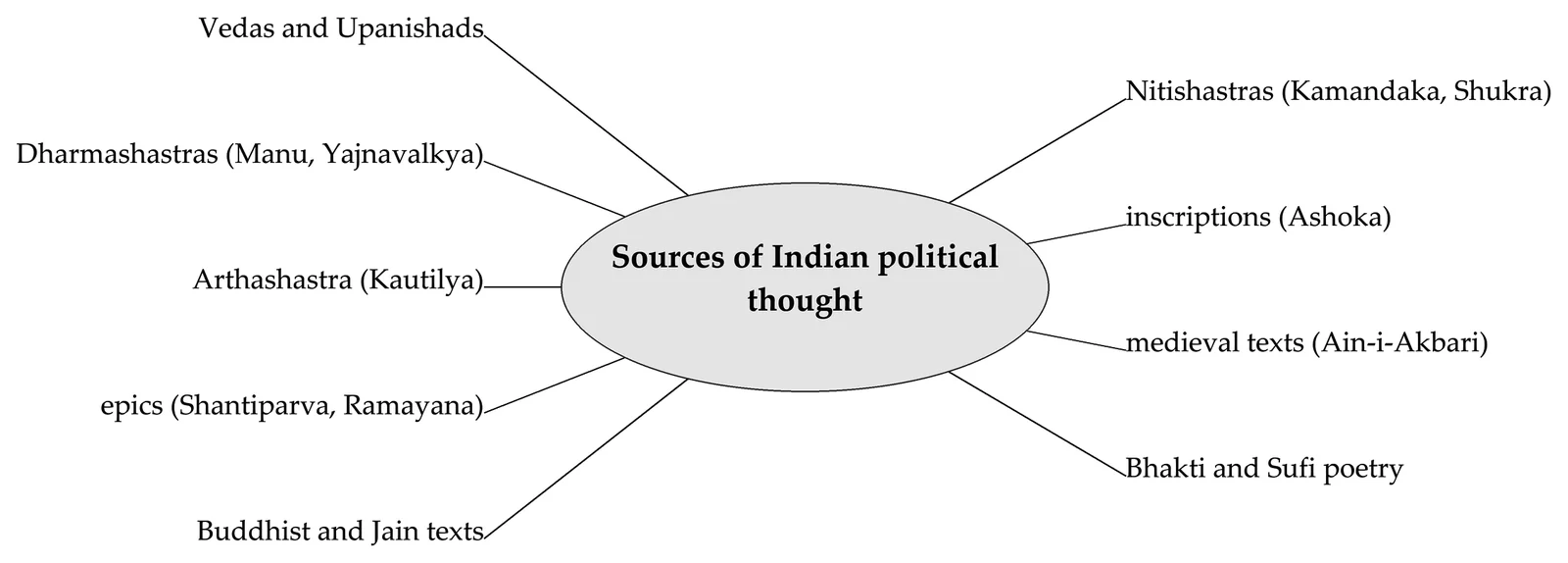
These sources differ in purpose: some are normative (prescribing ideal conduct), some pragmatic (advising rulers on how to succeed), and some devotional or ethical. Together they show that India had a rich tradition of reflection on power, authority and the good society.
1.2 Cultural and Territorial Conception of India
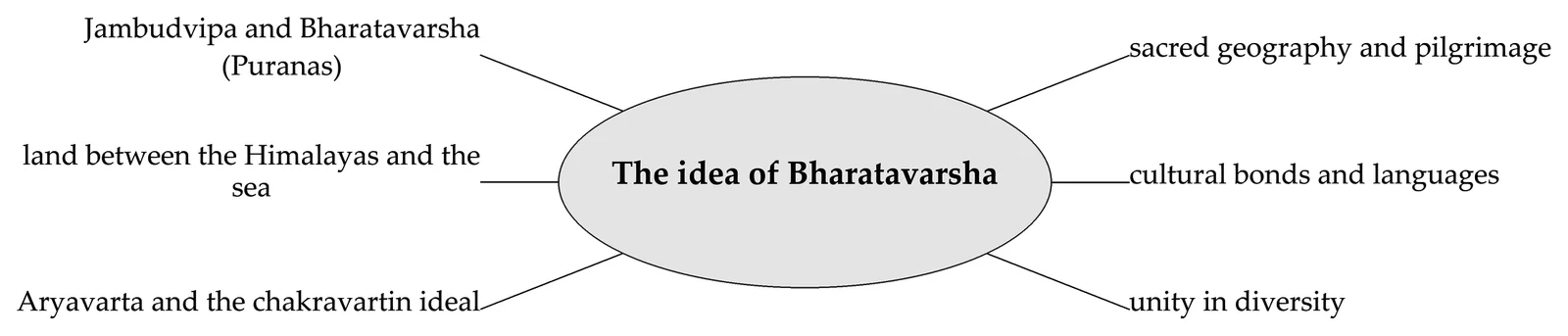
Long before the modern nation-state, Indian texts expressed an idea of India as a cultural and sacred space. The Puranas describe Bharatavarsha, the land north of the ocean and south of the Himalayas, as one of the divisions of Jambudvipa, the island continent of the world. Manu described Aryavarta as the land between the Himalayas and the Vindhyas, stretching from the eastern to the western sea, and Kautilya described the sphere of a chakravartin, a universal ruler, as the land from the Himalayas to the sea.
This conception was more cultural than political. India was rarely united under one ruler, but it was bound together by a shared sacred geography of rivers, mountains and pilgrimage sites, from Kashi to Kanyakumari and Dwarka to Puri; by Sanskrit as a common language of learning and ritual; by shared epics and festivals; and by networks of pilgrims, traders and scholars. Diana Eck has described India as a land knit together by pilgrimage, and the four monasteries traditionally attributed to Shankaracharya at the four corners of the subcontinent express this idea. Empires such as those of the Mauryas, Guptas and Mughals gave the idea political form at times. The cultural conception differs from the Western idea of a nation with fixed borders and a uniform identity: it allowed great diversity within a broad unity. During the freedom struggle, nationalists drew on it to argue that India had always been a nation, while critics warned against reading a modern nation back into the past.
1.3 The Premises of Indian Political Thought
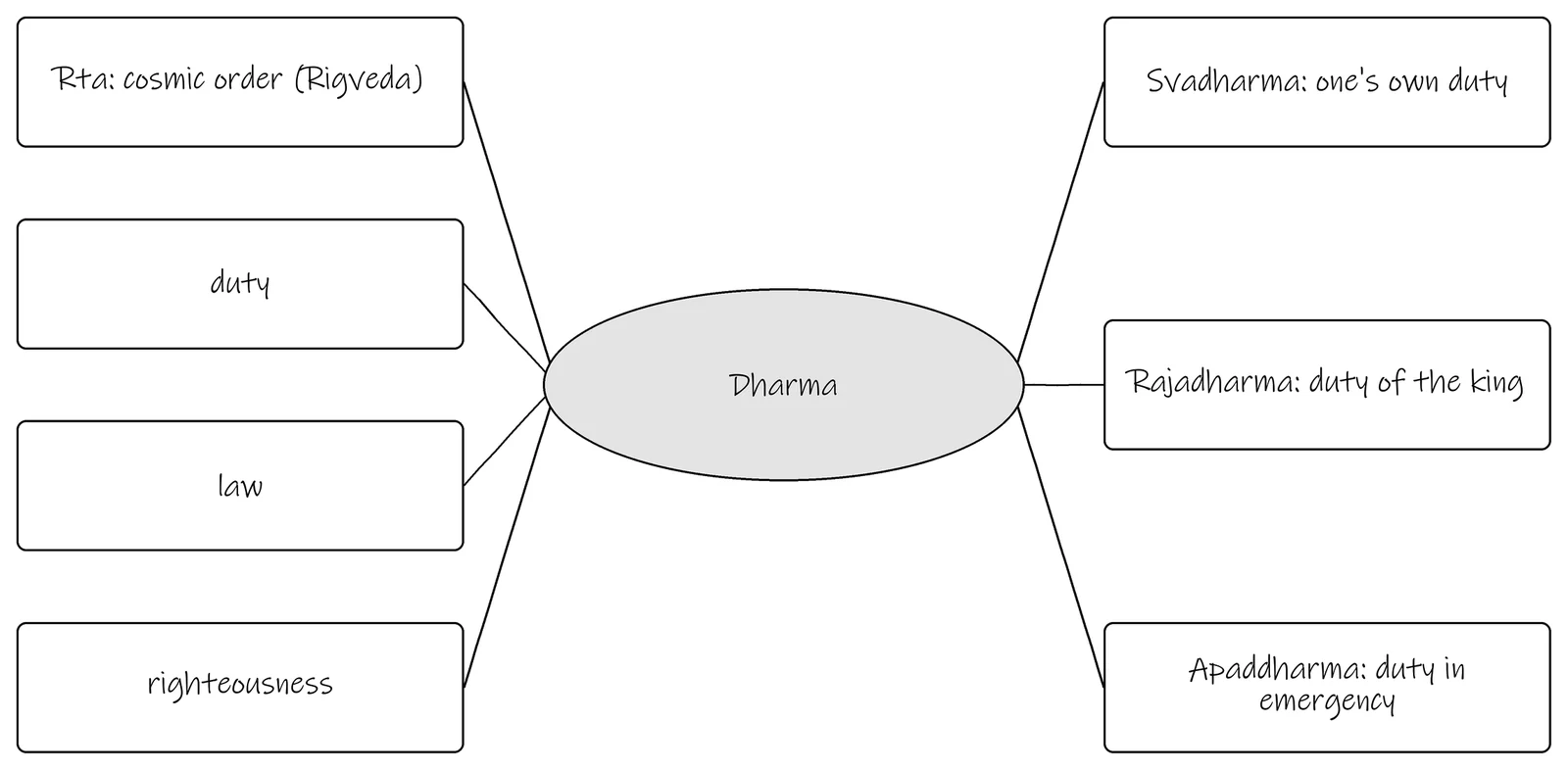
D. Mackenzie Brown, in ‘The Premises of Indian Political Thought’ (1953), identified the assumptions on which classical Indian thinkers built their ideas. The universe is governed by a moral order (rta, later dharma), and human society is part of this cosmic order. Society is organised into functional groups, the varnas, each with its own duties. Human nature is prone to disorder: without authority, the strong would devour the weak like big fish eating small ones, the condition called matsyanyaya. The king exists to prevent this by wielding danda, coercive authority, and to protect dharma. Political life serves the larger goals of human existence, the four purusharthas: dharma (righteousness), artha (wealth and power), kama (pleasure) and moksha (liberation). J.P. Suda showed that dharma had many meanings, cosmic law, duty, righteousness, law and justice, and that it limited the king, who was its protector, not its creator. V.P. Varma, in Studies in Hindu Political Thought and its Metaphysical Foundations, argued that Indian political ideas cannot be understood apart from their metaphysical foundations.
1.4 Distinctive Features of Indian Political Thought
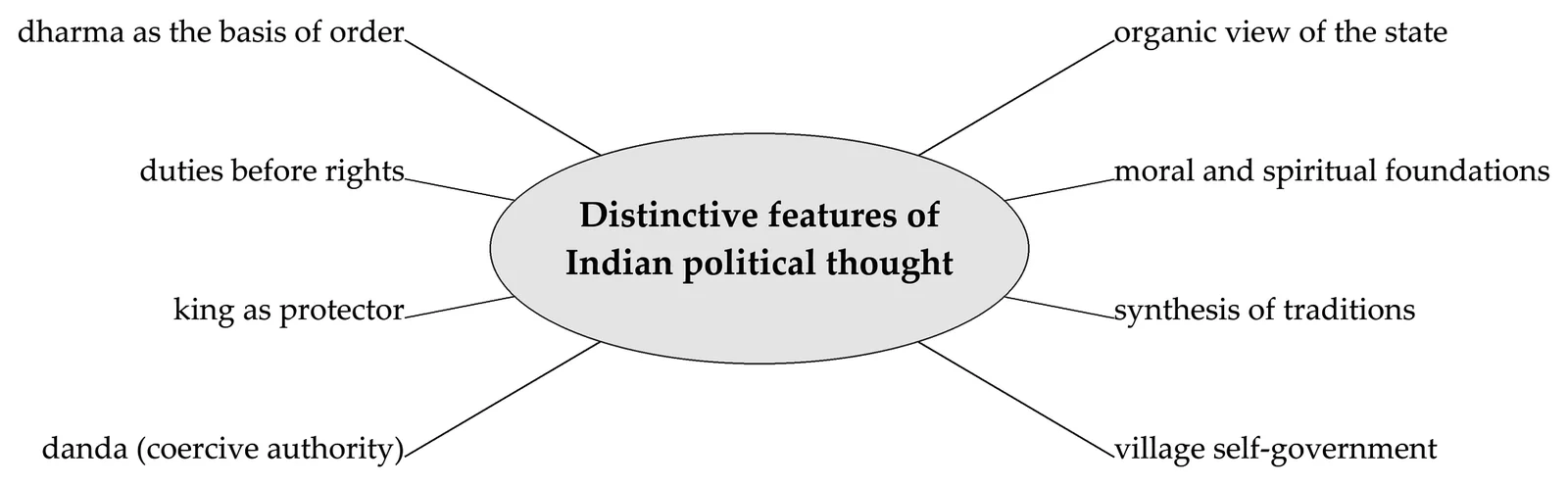
V.R. Mehta, in Foundations of Indian Political Thought (1992), argued that Indian thought offers an integral and pluralist vision, which seeks harmony among the different dimensions of human life rather than treating politics as a separate sphere. The distinctive features of Indian political thought are (Figure 1.4):
- Dharma as the basis of order: politics is subordinate to a moral and cosmic order; the state exists to uphold dharma, as Brown and Suda showed.
- Duties before rights: Indian thought speaks of svadharma, the duties of each person and group, and rajadharma, the duties of the king, rather than of individual rights.
- The king as protector: the king’s primary duty is raksha, protection of the people and of the social order; he is not above dharma, and texts allow resistance to or removal of unrighteous kings.
- Danda and realism: alongside idealism runs a strong realist tradition, from Brihaspati to Kautilya, which treats danda, artha and diplomacy as the instruments of a successful state.
- An organic view of the state: Kautilya’s saptanga theory sees the state as an organism of seven interdependent limbs.
- An integral view of human life: politics serves the four purusharthas, so material and spiritual goals are combined, as Mehta emphasises.
- Moral and spiritual foundations: political ideas rest on metaphysical beliefs about the self, the cosmos and liberation, as Varma argued.
- Plurality and synthesis: Vedic, Buddhist, Jain, Islamic, Bhakti and Sufi traditions coexisted and influenced each other; the Rigveda declares that truth is one, though the wise call it by many names.
- Decentralisation: villages, guilds (shrenis), caste councils and assemblies governed many affairs, so authority was dispersed.
- Hierarchy: the varna order made social and political life hierarchical, an aspect strongly criticised by Phule, Ambedkar and others.
Colonial scholars often described Indian kingship as ‘Oriental despotism’ and denied that India had political theory. Modern scholarship has shown both the richness of Indian thought and its limitations, especially its acceptance of caste hierarchy and the subordination of women.
1.5 Important Questions
- Question 1 Discuss the distinctive features of Indian political thought.
- Question 2 Give an overview of the sources of Indian political thought.
- Question 3 Discuss the cultural and territorial conception of India in ancient Indian thought.
DU asks the same idea in different words. So learn one broad answer for each question below; the same answer works for every question joined by OR.
Important Question 1
Discuss the distinctive features of Indian political thought.
OR
Examine the premises of Indian political thought.
OR
Did ancient India have a tradition of political thought? Discuss.
Model Answer
“Ekam sat vipra bahudha vadanti: Truth is one; the wise call it by many names.”
— Rigveda (1.164.46)
Introduction. Indian political thought developed over more than two thousand years in texts as varied as the Vedas, Dharmashastras, the Arthashastra, the epics, Buddhist and Jain scriptures, the Tirukkural and medieval Persian and devotional works. V.R. Mehta describes it as an integral and pluralist vision, and D. Mackenzie Brown has identified its premises. Its distinctive features set it apart from the Western tradition.
1. Dharma as the Foundation
Political life is part of a cosmic and moral order, dharma. The state does not create dharma but exists to protect it; Suda shows that dharma means cosmic law, duty, righteousness and justice, and that it limits rulers. Dharma covers moral, social, legal and religious duties, and Manu declares that dharma, when protected, protects.
2. Duties Rather than Rights
Indian thought speaks of the duties of each person and group, svadharma, and of the king, rajadharma. Social harmony is achieved when each performs his duty, not through claims of individual rights. Claims were not absent, but they arose from one’s place in the social order rather than from individual nature, which distinguishes Indian thought from modern liberal theory.
3. The King as Protector
The king’s first duty is raksha, protection of the people, property and the social order. He is the upholder, not the source, of dharma; texts such as the Mahabharata allow resistance to a king who fails in his duty. Manu warns that a king who takes taxes without protecting his subjects incurs sin, so legitimacy depends on protection.
4. Matsyanyaya and Danda
Without authority, the strong would devour the weak like big fish eating small ones. Danda, coercive power, prevents this anarchy and is therefore central to the state; Manu even calls danda the real king. The idea appears in the Mahabharata, Manu and Kautilya alike, and resembles Hobbes’s state of nature in which life is nasty, brutish and short.
5. Realism and Statecraft
Alongside idealism runs a pragmatic tradition of artha, from Brihaspati to Kautilya, concerned with administration, economy, espionage, war and diplomacy, showing that Indian thinkers analysed power realistically. Kautilya’s mandala theory and his use of spies show that Indian thinkers treated power and interest as legitimate subjects of study.
6. Organic and Integral Vision
Kautilya’s saptanga theory sees the state as an organism of seven limbs, and politics serves the four purusharthas, combining material and spiritual goals, which Mehta calls an integral vision. The four aims of life, dharma, artha, kama and moksha, are to be pursued in balance, and the state’s task is to make this balance possible.
7. Plurality and Synthesis
Vedic, Buddhist, Jain, Islamic, Bhakti and Sufi traditions coexisted and influenced one another, producing a pluralism expressed in the Rigvedic saying that truth is one though named in many ways. Akbar’s sulh-i-kul and the Bhakti and Sufi saints show that this pluralism continued into the medieval period.
8. Decentralisation
Village assemblies, guilds and caste councils governed many matters, so authority was dispersed rather than concentrated in a centralised state. Inscriptions from Uttaramerur in the Chola period even describe the selection of village committee members by lot.
9. Ethics and Politics United
Indian thinkers generally did not separate ethics from politics: the king’s personal virtue, self-control and training were considered essential to good government, from the Arthashastra’s emphasis on controlling the senses to the Tirukkural’s just sceptre.
10. Limitations
Indian thought accepted varna hierarchy and the subordination of women, which Phule and Ambedkar criticised; it rarely developed ideas of individual rights or popular sovereignty. Yet the colonial view of Oriental despotism was a distortion. Outside the ancient republics, it also lacked institutions such as assemblies with real power over the king.
11. Brown’s Premises
D. Mackenzie Brown showed that Indian thinkers started from shared premises: the universe is governed by a moral order; society is organised into groups with their own duties; human nature tends towards disorder; the king must use danda to protect dharma; and politics serves the four goals of life. These premises explain why Indian thought combined moral idealism with a realistic view of power.
12. Mehta’s Integral Vision
V.R. Mehta argued that Indian thought sees the individual, society and state as parts of a whole, and seeks harmony among the material, social and spiritual dimensions of life. The state is only one of many associations, alongside family, caste, guild and village, and is bound by dharma, an integral and pluralist vision different from the Western idea of the sovereign state.
13. Evaluation
Indian political thought thus has a distinctive character: it grounds politics in a moral order, combines idealism with realism, values harmony and pluralism and makes protection and welfare the purpose of the state. Its acceptance of hierarchy limits its relevance today, but its rich debates show a long tradition of reflection on power and justice.
Conclusion. Thus, Indian political thought is a rich tradition with its own premises: dharma, duty, protection, danda, an organic and integral view of life and pluralism, alongside a hierarchy that modern India has rejected.
Important Question 2
Give an overview of the sources of Indian political thought.
OR
Discuss the importance of the Dharmashastra and Arthashastra traditions.
Model Answer
“In the absence of a wielder of punishment, the stronger swallows the weaker.”
— Kautilya, Arthashastra (1.4), on matsyanyaya
Introduction. Indian political ideas are not found in a single treatise but in a vast body of literature written over two millennia in many languages. These sources together reveal a rich tradition of reflection on kingship, law, justice and statecraft.
1. Vedic Literature
The Vedas, Brahmanas and Upanishads describe early kingship, coronation rituals, the assemblies sabha and samiti, and the moral order rta, the ancestor of dharma. The Atharvaveda calls the sabha and samiti the two daughters of Prajapati, which shows the importance of assemblies in early Vedic polity.
2. Dharmashastras
The Manusmriti, Yajnavalkya Smriti, Narada Smriti and Brihaspati Smriti set out rajadharma, the varna order, civil and criminal law and judicial procedure. The Dharmasutras of Gautama, Baudhayana, Apastamba and Vasishtha preceded them and are the oldest prose texts on dharma.
3. Arthashastra Literature
Kautilya’s Arthashastra and the earlier schools of Brihaspati and Usanas deal pragmatically with administration, economy, war and diplomacy. Kautilya’s text, rediscovered in 1905 and published by R. Shamasastry in 1909, transformed the modern understanding of ancient Indian politics.
4. Nitishastras
Kamandaka’s Nitisara and the Shukraniti give practical advice on policy, ministers and kingship. Kamandaka’s Nitisara, probably of the Gupta period, restates Kautilya’s ideas in verse with greater emphasis on ethics.
5. Epics and Puranas
The Mahabharata’s Shantiparva, where Bhishma teaches rajadharma, and the Ramayana’s ideal of Ramarajya shaped ideas of righteous kingship; the Puranas describe Bharatavarsha. The Shantiparva also contains theories of the origin of kingship and discussions of the king’s duties in times of distress (apaddharma).
6. Buddhist, Jain and Tamil Texts
The Aggañña Sutta gives a contractual origin of kingship; Ashoka’s edicts describe rule by dhamma; the Tirukkural combines ethics and polity. Jain works such as Somadeva’s Nitivakyamrita (tenth century) also discuss statecraft, and Sangam poetry describes the ideals of Tamil kingship.
7. Inscriptions and Foreign Accounts
Ashokan edicts, the Allahabad pillar inscription and the accounts of Megasthenes, Fa-Hien and Xuanzang show how states actually worked. Megasthenes’ Indica, preserved only in fragments, describes Mauryan Pataliputra, while Xuanzang described Harsha’s kingdom in the seventh century.
8. Coins and Archaeology
Coins, seals and the remains of cities such as Mauryan Pataliputra supplement the texts by showing the extent of states, their economies and the symbols rulers used to claim legitimacy.
9. Medieval Sources
Barani’s Fatawa-i-Jahandari, Abu’l Fazl’s Ain-i-Akbari and the poetry of Basavanna, Kabir and Guru Nanak add Islamic, imperial and devotional perspectives. Persian chronicles such as Minhaj’s Tabaqat-i-Nasiri and Barani’s Tarikh-i-Firuz Shahi describe the politics of the Delhi Sultanate.
10. Oral and Regional Traditions
Alongside written texts, oral traditions, folk epics and regional literatures in Tamil, Kannada, Marathi and other languages preserved ideas of justice and kingship, including voices of lower castes and women that Sanskrit texts often left out.
11. Normative, Pragmatic and Devotional Sources
The sources can be grouped by purpose. The Dharmashastras are normative, prescribing what kings and subjects ought to do; the Arthashastra and Nitishastras are pragmatic, advising rulers how to succeed; and the Bhakti, Sufi and Buddhist texts are largely ethical and devotional, criticising power and hierarchy from the standpoint of faith and equality.
12. The Republics in the Sources
Buddhist and Jain texts, Panini’s grammar and Greek accounts describe ganas and sanghas, republics governed by assemblies of clan elders, such as the Shakyas, Licchavis and Vajjis. They show that ancient India knew forms of government other than monarchy.
13. Problems in Using the Sources
Historians face difficulties: many texts cannot be dated precisely; their authorship is uncertain; most were written by Brahmanical elites and reflect their interests; and they often prescribe ideals rather than describe practice. Inscriptions, coins and foreign accounts are therefore used to check the texts. The texts also describe ideals more than practice, so they must be checked against inscriptions, coins and archaeology.
14. Modern Scholarship
Modern scholars such as K.P. Jayaswal (Hindu Polity, 1924), A.S. Altekar, U.N. Ghoshal and R.P. Kangle used these sources to show that ancient India had developed political institutions and ideas, challenging colonial claims that India knew only despotism. More recent scholars such as Romila Thapar, Patrick Olivelle and Upinder Singh read these sources critically, attending to their social context and the interests they served.
15. Evaluation
The sources of Indian political thought are therefore rich and varied, from sacred texts and law books to treatises on statecraft, epics, inscriptions and devotional poetry. Used critically, they reveal a long and plural tradition of political reflection rather than a single orthodoxy.
Conclusion. Thus, the sources of Indian political thought are diverse, normative, pragmatic and devotional, and together form a long and varied tradition.
Important Question 3
Discuss the cultural and territorial conception of India in ancient Indian thought.
OR
Was India a nation in ancient times? Discuss.
Model Answer
“Some kind of a dream of unity has occupied the mind of India since the dawn of civilization.”
— Jawaharlal Nehru, The Discovery of India (1946)
Introduction. Ancient Indian texts expressed an idea of India as a distinct land and civilisation long before the modern nation-state. This conception was primarily cultural and sacred, though empires sometimes gave it political form.
1. Bharatavarsha and Jambudvipa
The Puranas describe Bharatavarsha as the land north of the ocean and south of the Himalayas, part of the continent Jambudvipa, inhabited by the descendants of Bharata. The Vishnu Purana describes Bharatavarsha as the land north of the ocean and south of the snowy mountains, where the descendants of Bharata dwell.
2. Aryavarta and the Chakravartin
Manu describes Aryavarta between the Himalayas and the Vindhyas; Kautilya describes the chakravartin’s sphere from the Himalayas to the sea, an ideal of a universal ruler over the whole land. Kautilya says that the region of the universal ruler extends from the Himalayas to the sea, a thousand yojanas across.
3. Sacred Geography
Rivers, mountains and pilgrimage sites across the subcontinent formed a shared sacred geography; Diana Eck describes India as a land knit together by pilgrimage, symbolised by the four monasteries attributed to Shankaracharya. In India: A Sacred Geography (2012), Eck shows how the twelve jyotirlingas, the shakti pithas and the four dhams map a single sacred landscape.
4. Cultural Bonds
Sanskrit, shared epics and festivals, and networks of pilgrims, traders and scholars created a common culture despite political fragmentation. The Ramayana and Mahabharata were retold in every regional language, creating shared stories across the subcontinent.
5. Language and Script
Sanskrit served as a pan-Indian language of learning, and Brahmi and the scripts descended from it spread across the subcontinent, so that scholars from Kashmir to Kerala could share texts and debates.
6. Political Unification
The Mauryan, Gupta and Mughal empires at times united much of the subcontinent, giving the cultural idea political form. Ashoka’s edicts, found from Afghanistan to Karnataka, show the reach of one political authority in the third century BCE.
7. Unity in Diversity
The ancient conception allowed great diversity of languages, sects and local customs within a broad cultural unity, unlike the uniform nation-state. Nehru, in The Discovery of India (1946), described India as an ancient palimpsest on which layer upon layer of thought had been written without any layer wholly erasing the earlier ones.
8. Regional Identities
Within this broad cultural unity, strong regional identities developed, such as the Tamil country celebrated in Sangam poetry and the kingdoms of Bengal, Kashmir and Maharashtra. Indian thought generally saw these as parts of a larger whole rather than as separate nations.
9. Nationalist Uses and Debates
Nationalists drew on this conception to argue that India had always been a nation; critics warn against reading the modern nation into the past and note the exclusions of caste and region. Historians such as Romila Thapar caution that Bharatavarsha was a cultural and religious geography, not a nation-state with fixed borders.
10. Puranic Cosmography
The Puranas describe the earth as made of concentric continents surrounded by oceans, with Jambudvipa at the centre and Bharatavarsha as its southern part, bounded by the Himalayas. This cosmography placed India within a sacred map of the universe and gave its inhabitants a shared sense of place. Such cosmology placed India at the centre of a sacred world rather than defining it by political boundaries.
11. The Chakravartin Ideal
The ideal of the chakravartin, the universal ruler whose wheel rolls unobstructed, expressed the aspiration to unite the whole land under righteous rule. Kautilya defined the chakravartin’s sphere as the land from the Himalayas to the sea, and Ashoka’s empire came closest to realising it. Ashoka’s conquest by dhamma and later imperial titles such as maharajadhiraja expressed this aspiration.
12. Cultural Unity in Practice
Pilgrimage circuits, the spread of Sanskrit and later of Persian as languages of administration, trade routes and the movements of saints and scholars created everyday links across regions, so that people of distant places shared stories, festivals and sacred sites.
13. The Idea of Bharat in the Constitution
Article 1 of the Constitution, ‘India, that is Bharat, shall be a Union of States’, links the modern republic with the ancient cultural idea of Bharatavarsha while defining the country in political and legal terms.
14. Evaluation
The ancient conception of India was cultural, religious and civilisational rather than political: a land knit together by sacred geography, shared stories and networks of exchange, within which political units rose and fell. This idea of unity in diversity later shaped Indian nationalism and the Constitution’s vision of India as a Union of States.
Conclusion. Thus, ancient India was a civilisational and cultural unity rather than a political nation, a legacy that shaped the modern idea of India.
Short Notes
(a) Purusharthas
The four goals of human life in Indian thought: dharma (righteousness and duty), artha (wealth, power and material well-being), kama (pleasure and desire) and moksha (liberation). Political life and the state serve these goals, with dharma regulating the pursuit of artha and kama.
(b) Matsyanyaya
The ‘law of the fishes’, the condition in which the strong devour the weak as big fish eat small ones, used in the Mahabharata, the Arthashastra and the Dharmashastras to describe anarchy in the absence of a king. It justified kingship and danda as necessary to protect the weak.
More notes: DSC-8 Ancient and Medieval Indian Political Thought
These notes are prepared by PADHO TO AISE for study help. They are not an official University of Delhi publication.