
Semester V DSC-15 Political Process in India
Unit V · 19 min read · Updated 24 Nov 2026
As per the University of Delhi (DU) BA (Hons) Political Science syllabus
Contents
- 5.1 Approaches to Tribal Policy
- 5.2 The Fifth and Sixth Schedules
- 5.3 The Forest Rights Act
- 5.4 Development and Displacement
- 5.5 Important Questions
- Discuss the provisions of the Fifth and Sixth Schedules of the Constitution and assess their working.
- Discuss the significance of the Forest Rights Act, 2006 and the challenges in its implementation.
- Examine the issues of development and displacement of tribal communities in India.
- Short Notes
लोगों को अपनी प्रतिभा के अनुरूप विकास करना चाहिए, और हमें उन पर कुछ भी थोपने से बचना चाहिए।
People should develop along the lines of their own genius and we should avoid imposing anything on them.
— Jawaharlal Nehru, Tribal Panchsheel, foreword to Verrier Elwin’s A Philosophy for NEFA (1959)
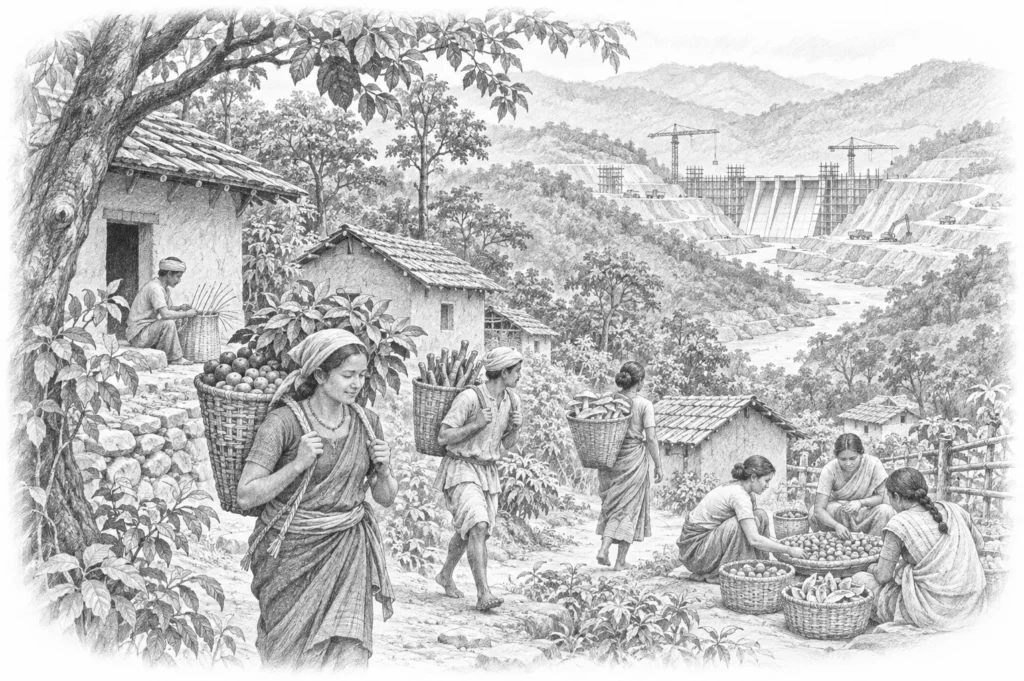
INDIA has more than 700 notified Scheduled Tribes, forming about 8.6 per cent of the population according to the 2011 Census. Adivasis live mainly in the forested hills of central and eastern India and in the north-east. The Constitution promised them protection of land, culture and self-government through the Fifth and Sixth Schedules, reservation and special laws. Yet Adivasis have also borne the heaviest costs of development, losing land and forests to dams, mines and industries. This unit studies the policies and challenges of tribal politics: the two Schedules, the Forest Rights Act of 2006, and the issues of development and displacement, with readings from B.D. Sharma, Virginius Xaxa and A. Kothari, N. Pathak and A. Bose.
5.1 Approaches to Tribal Policy
Three approaches have shaped tribal policy. Isolation, associated with the colonial excluded areas and with Verrier Elwin’s early writings, sought to protect tribes by keeping outsiders away. Assimilation, associated with G.S. Ghurye, who called tribes backward Hindus, sought to absorb them into the mainstream. Integration, Nehru’s approach, sought to bring tribes into the nation while respecting their culture. Nehru’s tribal Panchsheel asked that tribes develop along the lines of their own genius, that their rights in land and forests be respected, that their own people be trained for administration, that they not be over-administered, and that results be judged by the quality of human character rather than statistics.
Virginius Xaxa, in ‘Isolation, Inclusion and Exclusion: The Case of Adivasis in India’ (2019), argues that Adivasis moved from colonial isolation to constitutional inclusion through reservation and the Schedules, but in practice experienced exclusion: development took away their land and forests, and the institutions meant to protect them were weakly implemented. Xaxa also chaired the High Level Committee on the socio-economic status of tribal communities, which reported in 2014.

5.2 The Fifth and Sixth Schedules
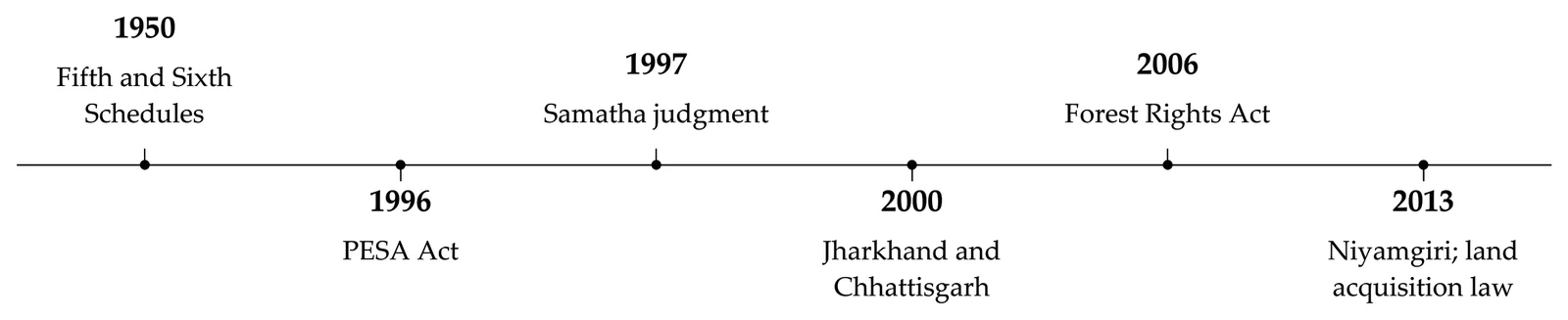
Under Article 244, the Fifth Schedule applies to Scheduled Areas in ten states, including Jharkhand, Chhattisgarh, Odisha, Madhya Pradesh and Maharashtra. The Governor has special responsibility: he may direct that any law shall not apply or shall apply with modifications, and may make regulations to prohibit the transfer of tribal land and regulate moneylending. A Tribes Advisory Council of up to twenty members, three-quarters of them ST legislators, advises on tribal welfare. The Panchayats (Extension to Scheduled Areas) Act (PESA), 1996, based on the Bhuria Committee, gave gram sabhas powers over minor forest produce, land alienation and consultation on acquisition.
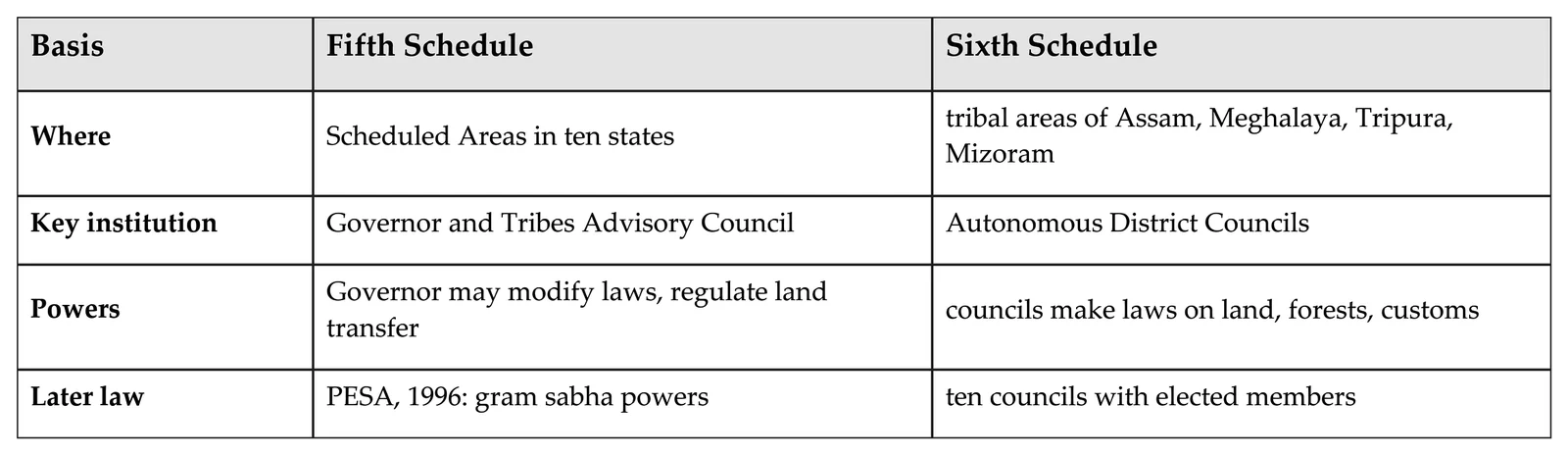
The Sixth Schedule applies to tribal areas of Assam, Meghalaya, Tripura and Mizoram, where ten Autonomous District Councils have legislative, executive and judicial powers over land, forests, shifting cultivation, village administration, inheritance, marriage and customs. B.D. Sharma, in Unbroken History of Broken Promises (2010), describes the 1990s as a decade of great expectations, when PESA promised self-rule, and the 2000s as a decade of unfathomable disillusionment, as states failed to implement PESA and handed tribal land to mining and industry.
5.3 The Forest Rights Act
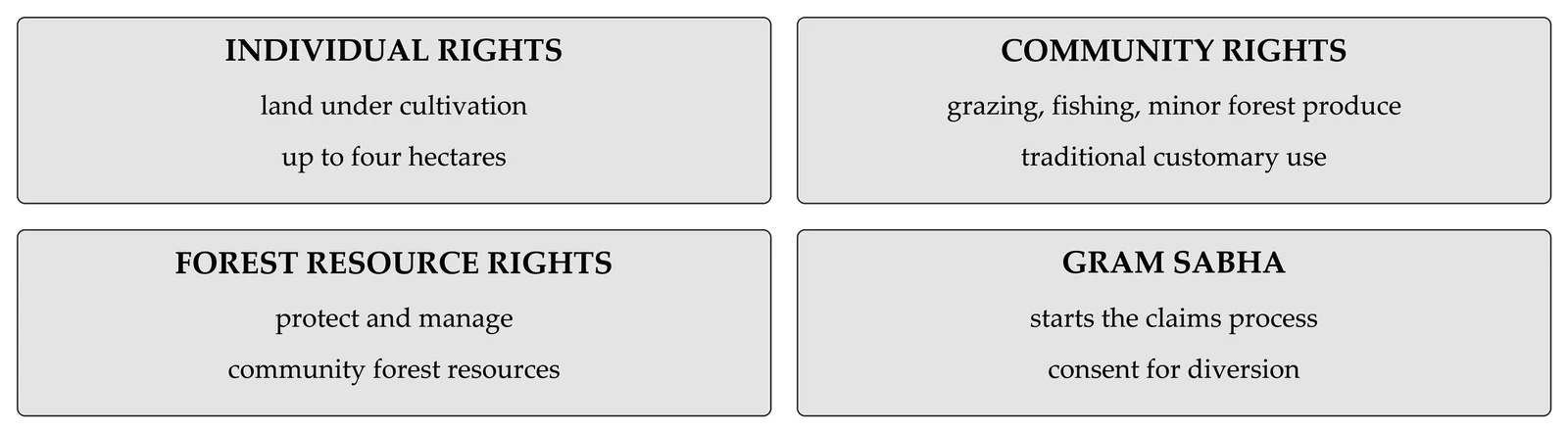
The Scheduled Tribes and Other Traditional Forest Dwellers (Recognition of Forest Rights) Act, 2006 begins by admitting a historical injustice: the forest rights of tribal communities were not recognised when state forests were consolidated in colonial and independent India. The Act recognises individual rights to land under cultivation, up to four hectares; community rights to grazing, fishing and minor forest produce; and the right to protect and manage community forest resources. The gram sabha starts the process of claims and must consent before forest land is diverted.
A. Kothari, N. Pathak and A. Bose, in ‘Forests, Rights and Conservation’ (2011), see the Act as a landmark in rights-based conservation, giving communities both rights and responsibilities. Villages such as Mendha-Lekha in Gadchiroli used community rights to manage and sell bamboo. But implementation has been weak: many claims have been rejected, community rights have lagged behind individual titles, and forest departments and some conservation groups have resisted the law.
5.4 Development and Displacement
Adivasi regions are rich in minerals, forests and rivers, so they became the sites of dams, mines, steel plants and industrial projects. Estimates suggest that tens of millions of people have been displaced by development since independence, and that Adivasis form a far larger share of them than their share of the population. Most were poorly compensated and never properly resettled. Movements such as the Narmada Bachao Andolan (from 1985) and the campaign against bauxite mining in Niyamgiri challenged this model. In 2013 the Supreme Court let the gram sabhas of Niyamgiri decide, and they rejected the mine.
The Right to Fair Compensation and Transparency in Land Acquisition, Rehabilitation and Resettlement Act, 2013 replaced the colonial Land Acquisition Act of 1894, requiring social impact assessment, consent for some projects and the consent of gram sabhas in Scheduled Areas. Displacement and dispossession have also fuelled conflict, including the Maoist insurgency in central India and state responses such as the Salwa Judum, which the Supreme Court declared unconstitutional in Nandini Sundar v. State of Chhattisgarh (2011).
5.5 Important Questions
- Question 1 Discuss the provisions of the Fifth and Sixth Schedules of the Constitution and assess their working.
- Question 2 Discuss the significance of the Forest Rights Act, 2006 and the challenges in its implementation.
- Question 3 Examine the issues of development and displacement of tribal communities in India.
DU asks the same idea in different words. So learn one broad answer for each question below; the same answer works for every question joined by OR.
Important Question 1
Discuss the provisions of the Fifth and Sixth Schedules of the Constitution and assess their working.
OR
Examine the constitutional safeguards for tribal self-governance in India.
OR
Discuss the significance of PESA, 1996 for tribal areas.
Model Answer
“The provisions of the Fifth Schedule shall apply to the administration and control of the Scheduled Areas and Scheduled Tribes in any State other than the States of Assam, Meghalaya, Tripura and Mizoram.”
— Constitution of India, Article 244(1)
Introduction. The framers of the Constitution recognised that tribal communities had distinct cultures, close ties to land and forests, and a history of exploitation by outsiders. They therefore created special arrangements for tribal areas in the Fifth and Sixth Schedules under Article 244. These Schedules, later supplemented by PESA (1996), aimed to protect tribal land and culture and to provide self-government.
1. Background
Under colonial rule, the Government of India Act, 1935 classified tribal regions as Excluded and Partially Excluded Areas, administered directly by the Governor. The Constituent Assembly, advised by committees including the Bordoloi sub-committee on the north-east, replaced these with the two Schedules.
2. Scheduled Areas
The President declares Scheduled Areas under the Fifth Schedule after consultation with the Governor. They now exist in ten states: Andhra Pradesh, Telangana, Chhattisgarh, Gujarat, Himachal Pradesh, Jharkhand, Madhya Pradesh, Maharashtra, Odisha and Rajasthan.
3. Role of the Governor
The Governor of each state with Scheduled Areas reports annually to the President on their administration, and the Union may give directions. The Governor may direct that any Act of Parliament or the state legislature shall not apply, or shall apply with modifications, to a Scheduled Area.
4. Regulations for Peace and Good Government
The Governor may make regulations to prohibit or restrict the transfer of land by or among tribal people, regulate the allotment of land and control moneylending to tribals. Such regulations aim to stop the alienation of tribal land to outsiders and moneylenders.
5. Tribes Advisory Council
Each state with Scheduled Areas must have a Tribes Advisory Council of not more than twenty members, three-quarters of whom are ST members of the state Assembly. It advises on matters of tribal welfare referred to it by the Governor.
6. The Sixth Schedule
The Sixth Schedule applies to tribal areas of Assam, Meghalaya, Tripura and Mizoram. It creates Autonomous District Councils with up to thirty members, most of them elected. There are ten such councils, including the Bodoland Territorial Council in Assam and the Khasi, Jaintia and Garo Hills councils in Meghalaya.
7. Powers of the District Councils
District Councils can make laws on land, forests other than reserved forests, shifting cultivation, village administration, inheritance, marriage and social customs. They can set up village courts to try cases under customary law and collect certain taxes. This gives a substantial degree of autonomy.
8. PESA, 1996
The 73rd Amendment did not automatically apply to Scheduled Areas. Following the Bhuria Committee, Parliament passed PESA in 1996, extending panchayats to Fifth Schedule areas with special powers for gram sabhas: ownership of minor forest produce, consultation before land acquisition, prevention of land alienation and control over moneylending and village markets.
9. Sharma’s Broken Promises
B.D. Sharma, a former Commissioner for Scheduled Castes and Scheduled Tribes, saw PESA as a promise of self-rule, captured in the slogan that the village government is above all. But he argues that states delayed making rules, ignored gram sabhas and continued to transfer tribal land, so that the promise was broken.
10. Working of the Fifth Schedule
Governors have rarely used their special powers, Tribes Advisory Councils meet infrequently, and land alienation has continued. In Samatha v. State of Andhra Pradesh (1997), the Supreme Court held that tribal land in Scheduled Areas could not be leased to private mining companies, but governments have often found ways around such protections.
11. Working of the Sixth Schedule
The Sixth Schedule has given real autonomy to tribes in the north-east, but District Councils have faced financial dependence on state governments, political conflicts and demands from other groups for similar councils or for separate states, as in Bodoland.
12. Evaluation
The two Schedules represent an important constitutional recognition of tribal autonomy. Their success depends on political will. Where implemented, they protect land and culture; where ignored, as Sharma and Xaxa show, Adivasis continue to lose land and control over their lives.
Conclusion. Thus, the Fifth Schedule protects Scheduled Areas through the Governor, Tribes Advisory Councils and land regulations, strengthened by PESA, while the Sixth Schedule gives autonomy through District Councils in the north-east. Both are significant, but weak implementation has limited their promise.
Important Question 2
Discuss the significance of the Forest Rights Act, 2006 and the challenges in its implementation.
OR
‘The Forest Rights Act seeks to undo a historical injustice.’ Discuss.
OR
Examine the relationship between forest rights and conservation in India.
Model Answer
“The forest rights on ancestral lands and their habitat were not adequately recognised … resulting in historical injustice to the forest dwelling Scheduled Tribes and other traditional forest dwellers.”
— Forest Rights Act, 2006, Preamble
Introduction. For more than a century, forest laws treated forests as state property and forest dwellers as encroachers. The Scheduled Tribes and Other Traditional Forest Dwellers (Recognition of Forest Rights) Act, 2006 sought to correct this historical injustice by recognising the rights of tribal and other forest communities. Kothari, Pathak and Bose analyse its promise and its problems.
1. Colonial Forest Policy
The Indian Forest Acts of 1865, 1878 and 1927 brought vast forests under state control, restricting the customary use of forest communities. Forests were managed for timber and revenue, and shifting cultivation and grazing were curtailed.
2. After Independence
The National Forest Policy of 1952 continued state control, and the Wildlife Protection Act (1972) and Forest Conservation Act (1980) created protected areas and restricted the use of forest land. Millions of forest dwellers remained without legal rights to land they had cultivated for generations.
3. Movements for Forest Rights
Adivasi organisations and campaigns, such as the Campaign for Survival and Dignity, demanded recognition of rights, especially after mass evictions in 2002–04 targeting encroachers. Their mobilisation led to the passage of the Act in December 2006.
4. Individual Rights
The Act recognises the right of Scheduled Tribes and other traditional forest dwellers to hold and live on forest land they cultivate, up to four hectares, if occupied before 13 December 2005. Other traditional forest dwellers must show residence for three generations, or seventy-five years.
5. Community Rights
Communities receive rights to collect and sell minor forest produce, graze cattle, fish and use water bodies, and to access biodiversity and traditional knowledge. Nomadic and pastoral communities also receive seasonal rights.
6. Community Forest Resource Rights
Most significantly, communities gain the right to protect, regenerate, conserve and manage their community forest resources. This makes them partners in conservation, not obstacles to it.
7. Role of the Gram Sabha
The gram sabha starts the process of determining rights, through a Forest Rights Committee, and its decisions are verified by sub-divisional and district committees. Gram sabhas must give consent before forest land is diverted for other purposes.
8. Rights-based Conservation
Kothari, Pathak and Bose argue that the Act represents a shift towards rights-based conservation. Communities that depend on forests have strong incentives to protect them. Mendha-Lekha in Maharashtra, among the first to receive community rights, earned income from bamboo while conserving its forest.
9. Implementation Problems
Implementation has been uneven. Many claims have been rejected, often without proper reasons; community and resource rights have been granted far less often than individual titles; and forest departments have resisted ceding control. Awareness among forest dwellers is often limited.
10. Conservation Conflicts
Some wildlife conservationists argue that the Act threatens forests and wildlife. In February 2019 the Supreme Court ordered the eviction of those whose claims had been rejected, affecting over a million families, but stayed its order within weeks after protests and a government review.
11. Development Pressures
Governments have sometimes bypassed gram sabha consent for mining and infrastructure projects. Amendments to forest conservation rules in 2022–23 raised concerns about weakening consent requirements.
12. Women’s Rights
The Act requires that land titles for married persons be registered jointly in the names of both spouses. This matters because Adivasi women do much of the work of collecting fuel, fodder and minor forest produce such as tendu leaves and mahua flowers. Joint titles give women security and a voice in household decisions, although in practice many titles have been issued only to men.
13. Minor Forest Produce
The Act defines minor forest produce broadly to include bamboo, tendu leaves, honey, lac, cane and medicinal plants, and gives communities ownership of it. Bamboo, earlier controlled by forest departments as timber, became a source of income for villages that won community rights. Fair prices and markets for such produce are essential if forest rights are to reduce poverty.
14. Evaluation
The Forest Rights Act is a landmark in recognising the rights of forest dwellers and democratising forest governance. Its promise depends on genuine implementation, especially of community rights, and on respecting gram sabhas.
Conclusion. Thus, the Forest Rights Act seeks to undo a historical injustice by recognising individual, community and resource rights of forest dwellers and empowering gram sabhas. As Kothari, Pathak and Bose show, it offers a model of rights-based conservation, but weak implementation remains a major challenge.
Important Question 3
Examine the issues of development and displacement of tribal communities in India.
OR
‘Adivasis have borne the cost of India’s development.’ Discuss.
OR
Discuss Virginius Xaxa’s view of isolation, inclusion and exclusion of Adivasis.
Model Answer
“If you are to suffer, you should suffer in the interest of the country.”
— Jawaharlal Nehru, to villagers displaced by the Hirakud dam (1948)
Introduction. India’s development since independence has relied on dams, mines, industries and infrastructure, many located in tribal regions rich in natural resources. Adivasis have therefore borne a disproportionate share of displacement and dispossession. Virginius Xaxa and B.D. Sharma show how inclusion in the Constitution coexisted with exclusion in practice.
1. Resource-rich Regions
Tribal regions of central and eastern India, such as Jharkhand, Chhattisgarh and Odisha, contain much of India’s coal, iron ore and bauxite, as well as forests and rivers suitable for dams. Development projects have therefore concentrated on Adivasi land.
2. Scale of Displacement
Estimates suggest that tens of millions of people have been displaced by development projects since independence, and Adivasis form a share several times larger than their share of the population. Most of them were never properly resettled.
3. Nehru’s Development Model
Nehru called dams the temples of modern India and asked displaced villagers at Hirakud to suffer in the national interest. The development model assumed that the gains for the nation justified the losses of local communities.
4. Inadequate Compensation
Under the Land Acquisition Act of 1894, compensation was paid only to those with legal titles, leaving out many Adivasis who held land under customary rights. Compensation was low, and rehabilitation was often absent.
5. Xaxa’s Framework
Xaxa argues that colonial policy isolated tribal areas, the Constitution included Adivasis through reservation and special provisions, but development produced exclusion: loss of land, forests and livelihoods, and marginalisation in the economy and politics of their own regions.
6. Cultural Loss
For Adivasis, land and forests are not only economic resources but the basis of identity, religion and community. Displacement breaks communities apart and destroys sacred sites and cultural practices, as the Dongria Kondh argued about the Niyamgiri hills.
7. Resistance Movements
The Narmada Bachao Andolan, led by Medha Patkar, opposed the Sardar Sarovar dam, though the Supreme Court allowed construction in 2000. Movements in Kalinganagar, Niyamgiri and elsewhere opposed mining and industrial projects, and Jharkhand protests in 2016–17 forced the withdrawal of amendments to tenancy laws.
8. Niyamgiri
In Orissa Mining Corporation v. Ministry of Environment and Forests (2013), the Supreme Court held that gram sabhas must decide whether bauxite mining affected the religious and cultural rights of the Dongria Kondh. All twelve gram sabhas consulted rejected the project, a landmark for tribal consent.
9. Sharma’s Disillusionment
B.D. Sharma describes the 2000s as a decade of disillusionment, when liberalisation led states to sign agreements with mining and steel companies, special economic zones were created and PESA was ignored. The state appeared as an agent of dispossession rather than protection.
10. The 2013 Land Acquisition Law
The 2013 Act requires social impact assessment, the consent of 80 per cent of affected families for private projects and 70 per cent for public-private projects, rehabilitation and resettlement, and the consent of gram sabhas in Scheduled Areas. Critics argue that states have diluted it through their own laws.
11. Conflict and Insurgency
Dispossession has fuelled the Maoist insurgency in central India, which presents itself as defending Adivasis. State responses, including the Salwa Judum militia, declared unconstitutional in 2011, have often caught Adivasis between insurgents and security forces.
12. Sharing Mining Benefits
In 2015 the mining law was amended to create District Mineral Foundations, funded by contributions from mining companies, to spend on the welfare of people affected by mining, and a national scheme was launched to guide their spending. Studies have found that much of this money has gone to general infrastructure rather than to affected Adivasi communities, who still have little say in how it is used.
13. Women and Displacement
Displacement affects women in particular ways. Compensation and resettlement land usually go to male heads of households, while women lose access to forests, common lands and the livelihoods they controlled. In resettlement colonies, women often face greater dependence, insecurity and the loss of community networks.
14. Evaluation
Development has brought national gains but heavy costs to Adivasis. A just development model requires free, prior and informed consent, fair compensation, real rehabilitation, implementation of PESA and the Forest Rights Act, and a share for Adivasis in the benefits of resources on their land.
Conclusion. Thus, Adivasis have borne a disproportionate burden of India’s development through displacement and dispossession. As Xaxa and Sharma show, constitutional inclusion has coexisted with exclusion in practice, and only consent-based, participatory development can resolve this contradiction.
Short Notes
(a) PESA, 1996
The Panchayats (Extension to Scheduled Areas) Act extended panchayati raj to Fifth Schedule areas with special powers for gram sabhas: ownership of minor forest produce, consultation before land acquisition, prevention of land alienation, control of moneylending and management of village markets. It was based on the Bhuria Committee’s recommendations.
(b) Samatha judgment
In Samatha v. State of Andhra Pradesh (1997), the Supreme Court held that government land in Scheduled Areas could not be leased to non-tribals, including private mining companies, because the Fifth Schedule aims to protect tribal land. It allowed mining only by state agencies or tribal cooperatives.
(c) Tribal Panchsheel
Nehru’s five principles of tribal policy, set out in his foreword to Verrier Elwin’s A Philosophy for NEFA: development along their own genius, respect for land and forest rights, training tribal people for administration, avoiding over-administration, and judging results by the quality of human character rather than statistics.
(d) Particularly Vulnerable Tribal Groups
Tribal communities identified as especially vulnerable because of pre-agricultural technology, very low literacy, declining or stagnant population and economic backwardness. There are seventy-five such groups, such as the Jarawas and Sentinelese of the Andaman Islands, and they receive special development schemes.
More notes: DSC-15 Political Process in India
These notes are prepared by PADHO TO AISE for study help. They are not an official University of Delhi publication.