
Semester V DSC-15 Political Process in India
Unit VI · 22 min read · Updated 24 Nov 2026
As per the University of Delhi (DU) BA (Hons) Political Science syllabus
Contents
- 6.1 The Welfare State
- 6.2 The Regulatory State
- 6.3 The Coercive State
- 6.4 Theories of the Indian State
- 6.5 Important Questions
- Discuss the nature of the welfare state in India. Has India moved from benevolence to rights?
- Examine the emergence and working of the regulatory state in India.
- Discuss the coercive dimension of the Indian state.
- Discuss the main theories of the Indian state.
- Short Notes
राज्य ऐसी सामाजिक व्यवस्था की, जिसमें सामाजिक, आर्थिक और राजनीतिक न्याय राष्ट्रीय जीवन की सभी संस्थाओं को अनुप्राणित करे, भरसक प्रभावी रूप में स्थापना और संरक्षण करके लोक कल्याण की अभिवृद्धि का प्रयास करेगा।
The State shall strive to promote the welfare of the people by securing and protecting as effectively as it may a social order in which justice, social, economic and political, shall inform all the institutions of the national life.
— Constitution of India, Article 38(1)
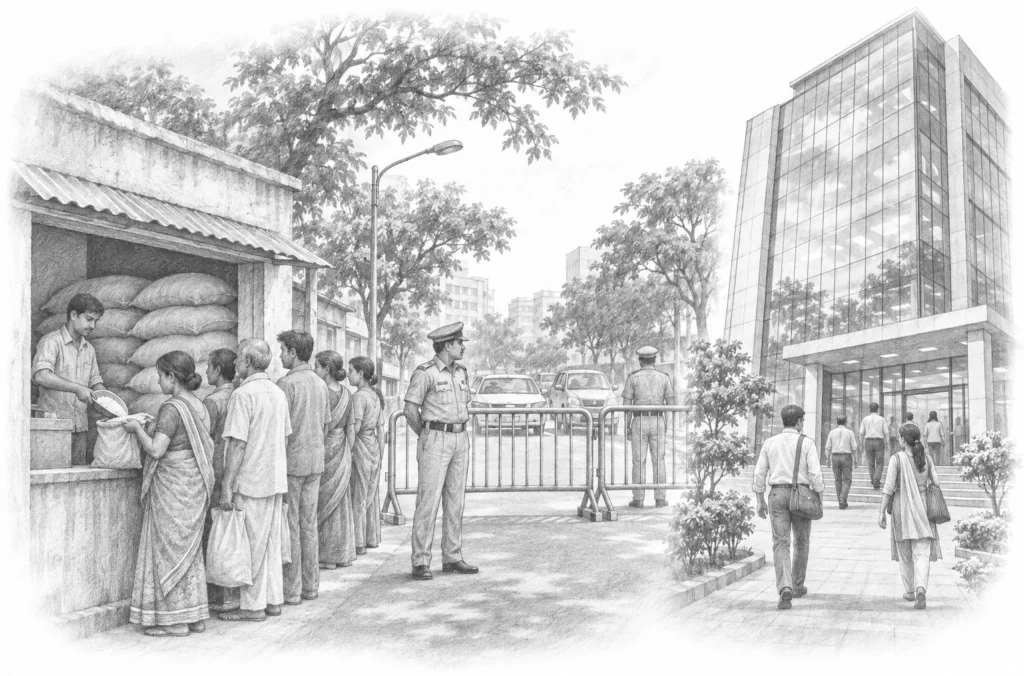
THE Indian state touches citizens’ lives in many ways. It feeds hundreds of millions through the public distribution system, guarantees rural employment and runs schools and hospitals; it regulates markets through independent bodies such as SEBI and TRAI; and it maintains order through the police, armed forces and special laws. This unit studies these three dimensions of the state, welfare, regulatory and coercive, and the theories that scholars have offered to understand the Indian state as a whole. The readings include Reetika Khera, Louise Tillin, Arun K. Thiruvengadam, Devesh Kapur and Madhav Khosla, Arvind Verma, Partha Chatterjee, M. Mohanty and Yogendra Yadav.

6.1 The Welfare State
The Directive Principles (Articles 38, 39, 41, 43 and 47) commit the state to welfare, but for decades welfare was a matter of benevolence: discretionary schemes that the state could expand or withdraw. Reetika Khera, in ‘India’s Welfare State: A Halting Shift from Benevolence to Rights’ (2020), shows how, under pressure from the Right to Food campaign and Supreme Court orders, India passed rights-based laws in 2005–13: the Right to Information, the rural employment guarantee, the Forest Rights Act, the Right to Education and the National Food Security Act. A. Chakraborty calls this a shift from passive beneficiaries to rights claimants.
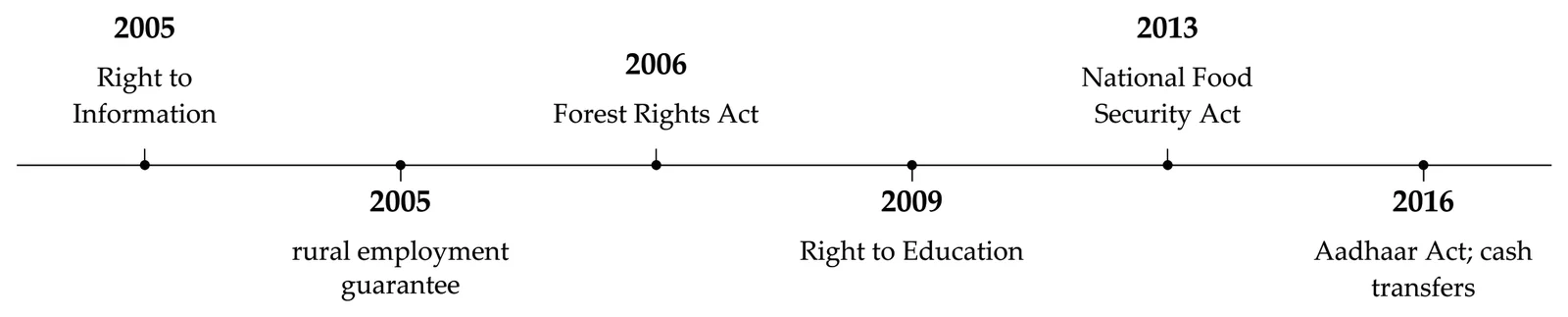
Khera calls the shift halting: since 2014, welfare has emphasised Aadhaar-linked delivery, direct cash transfers and the provision of private goods such as toilets, cooking gas, houses and bank accounts, which the economist Arvind Subramanian called the new welfarism, while rights-based programmes have faced funding delays and exclusion errors. Louise Tillin, with R. Deshpande and K.K. Kailash, shows that welfare also varies greatly across states: states such as Tamil Nadu and Kerala developed broad subnational welfare regimes shaped by their politics.
6.2 The Regulatory State
Before 1991, the Indian state controlled the economy directly through public ownership, planning and the licence-permit raj. Liberalisation shifted its role from owner to regulator. Independent regulatory agencies were created for securities (SEBI, statutory since 1992), telecom (TRAI, 1997), electricity (CERC, 1998), insurance (IRDA, 1999), competition (Competition Commission, 2003) and food safety (FSSAI, 2008). Arun K. Thiruvengadam, in ‘Flag-bearers of a New Era?’, traces their evolution from 1991 to 2016, noting that they were modelled on Western agencies but operate within Indian administrative traditions.

Devesh Kapur and Madhav Khosla, in Regulation in India (2019), describe ‘the reality of Indian regulation’: regulators are numerous but often weak. Problems lie in design (unclear mandates and ministries retaining key powers), capacity (shortages of staff and expertise, and many heads drawn from retired civil servants) and performance (delays, capture and limited accountability). Scandals over the allocation of telecom spectrum and coal blocks, cancelled by the Supreme Court in 2012 and 2014, showed the costs of weak regulation.
6.3 The Coercive State
Every state claims, in Max Weber’s words, a monopoly of the legitimate use of physical force. In India, policing is a state subject, but it is still largely governed by the colonial Police Act of 1861. Arvind Verma, in ‘Police Agencies and Coercive Power’ (2007), argues that the Indian police remains colonial in structure, under-staffed, politicised and often brutal, used by ruling parties against opponents. In Prakash Singh v. Union of India (2006), the Supreme Court ordered reforms such as State Security Commissions, fixed tenures for police chiefs and police complaints authorities, but most states have implemented them only partly.

The state also uses special laws: the Armed Forces (Special Powers) Act, 1958 in disturbed areas of the north-east and Jammu and Kashmir; preventive detention under the National Security Act, 1980; and anti-terror laws such as TADA (1985), POTA (2002) and the Unlawful Activities (Prevention) Act, strengthened in 2004, 2008 and 2019. M. Mohanty describes a duality in the state process: the state is democratic and welfare-oriented, yet also coercive towards movements of the poor and marginalised.
6.4 Theories of the Indian State
Scholars have offered many theories of the Indian state. Pranab Bardhan (1984) saw it as balancing three dominant proprietary classes: industrial capitalists, rich farmers and professionals including bureaucrats. Lloyd and Susanne Rudolph (1987) described a weak-strong state and a demand polity pressed by organised groups. Atul Kohli called India a fragmented multiclass state. Partha Chatterjee, in ‘The State’ (2010), traces the shift from a developmental state legitimised by planning to a state that governs populations through welfare schemes, negotiated by the poor in what he calls political society.
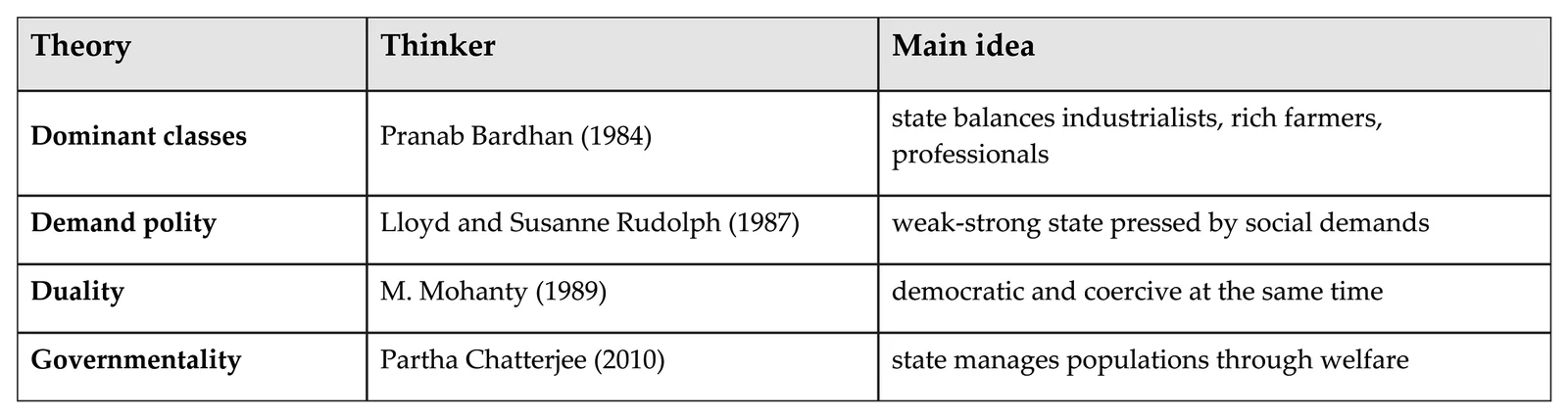
Yogendra Yadav, in ‘On Theories of the Indian State’ (2020), argues that most theories were borrowed from Marxist or Western liberal frameworks and fit Indian reality poorly; he calls for theories grounded in Indian experience. Madhav Khosla and Milan Vaishnav examine how the Indian state has changed in recent years, warning that majoritarian politics and pressure on institutional checks are reshaping its character.
6.5 Important Questions
- Question 1 Discuss the nature of the welfare state in India. Has India moved from benevolence to rights?
- Question 2 Examine the emergence and working of the regulatory state in India.
- Question 3 Discuss the coercive dimension of the Indian state.
- Question 4 Discuss the main theories of the Indian state.
DU asks the same idea in different words. So learn one broad answer for each question below; the same answer works for every question joined by OR.
Important Question 1
Discuss the nature of the welfare state in India. Has India moved from benevolence to rights?
OR
Examine Reetika Khera’s view of India’s welfare state.
OR
Discuss the rights-based approach to welfare in India.
Model Answer
“The State shall regard the raising of the level of nutrition and the standard of living of its people and the improvement of public health as among its primary duties.”
— Constitution of India, Article 47
Introduction. India’s Constitution commits the state to the welfare of its people, but how welfare is delivered has changed over time. Reetika Khera argues that India has made a halting shift from welfare as benevolence to welfare as rights. A. Chakraborty and Louise Tillin show how this shift changes citizens’ relations with the state and how it varies across states.
1. Constitutional Basis
The Directive Principles ask the state to secure a just social order (Article 38), adequate livelihood and equitable distribution of resources (Article 39), the right to work, education and public assistance (Article 41), a living wage (Article 43) and improved nutrition and public health (Article 47). They are not enforceable in courts but are fundamental in governance.
2. Welfare as Benevolence
For decades, welfare took the form of schemes run at the government’s discretion, such as the public distribution system and poverty-alleviation programmes. Beneficiaries had no legal entitlement, and schemes suffered from leakages, corruption and exclusion. Welfare was something the state gave, not something citizens could claim.
3. Courts and Campaigns
In the Right to Food case (PUCL v. Union of India, from 2001), the Supreme Court treated the right to food as part of the right to life under Article 21 and turned schemes such as midday meals into entitlements. Social movements such as the Right to Food campaign and the Right to Information movement pressed for legal rights.
4. Rights-based Laws
Between 2005 and 2013, Parliament passed a series of rights-based laws: the Right to Information Act (2005), the National Rural Employment Guarantee Act (2005), the Forest Rights Act (2006), the Right to Education Act (2009), following the 86th Amendment that added Article 21A, and the National Food Security Act (2013).
5. From Beneficiary to Claimant
Chakraborty argues that the rights-based approach changes the citizen from a passive beneficiary to a rights claimant. Rights create legal entitlements, timelines, grievance redress and accountability. Workers under NREGA, for example, are entitled to unemployment allowance if work is not provided within fifteen days.
6. Achievements
Studies show that the employment guarantee raised rural wages and reduced distress migration, that the food security law reduced hunger, and that RTI empowered citizens to question officials. Social audits in states such as Andhra Pradesh improved transparency.
7. Khera’s Halting Shift
Khera argues that the shift was halting and incomplete. Rights-based programmes faced underfunding, wage delays and dilution. Since 2014, the emphasis has moved towards technology-driven delivery and private goods, and rights have sometimes been weakened.
8. Aadhaar and Cash Transfers
Aadhaar-based authentication and direct benefit transfers aimed to reduce leakages. Supporters credit them with savings; critics, including Khera, document exclusion of genuine beneficiaries due to biometric failures and linking errors, which in some cases led to denial of rations.
9. New Welfarism
Economist Arvind Subramanian described recent policy as new welfarism: the provision of private goods such as toilets, cooking gas, houses, electricity and bank accounts, along with cash transfers to farmers and free grain. These have political appeal but give less attention to public goods such as health and education.
10. Subnational Welfare Regimes
Tillin, Deshpande and Kailash show that welfare varies across states. Tamil Nadu and Kerala built broad welfare systems through competitive politics and social movements, while others lagged. Tillin argues that states shape social policy and form distinct subnational welfare regimes.
11. Free Grain and the Pandemic
During the Covid-19 lockdown of 2020, the government launched a scheme of additional free grain for households covered by the food security law, and from January 2024 grain under the law became free for about 81 crore people for five years. This showed the strength of the public distribution system built over decades, but also the political appeal of welfare framed as the government’s gift rather than as citizens’ right.
12. Challenges
Challenges include low spending on health and education, large informal workforce without social security, exclusion errors, delays in payments and the tension between rights and discretionary schemes. The pandemic of 2020 highlighted both the importance of the food system and the gaps in protection for migrant workers.
13. Evaluation
India’s welfare state has expanded significantly and partly moved towards rights, but the shift remains incomplete. A genuine rights-based welfare state requires adequate funding, accountability and universal public services, not only targeted benefits.
Conclusion. Thus, India’s welfare state has moved, haltingly, from benevolent schemes to rights-based laws such as the employment guarantee and food security. As Khera and Chakraborty argue, rights make citizens claimants, but recent trends towards cash transfers and new welfarism show that the shift remains incomplete and uneven across states.
Important Question 2
Examine the emergence and working of the regulatory state in India.
OR
Discuss the role of independent regulatory institutions in India after 1991.
OR
‘Regulation in India is pervasive but weak.’ Discuss with reference to Kapur and Khosla.
Model Answer
“The State shall, in particular, direct its policy towards securing … that the operation of the economic system does not result in the concentration of wealth and means of production to the common detriment.”
— Constitution of India, Article 39(c)
Introduction. Economic liberalisation in 1991 changed the role of the Indian state from directly owning and controlling the economy to regulating markets. A new set of independent regulatory institutions was created. Arun K. Thiruvengadam traces their evolution, while Devesh Kapur and Madhav Khosla examine the reality of Indian regulation.
1. The Pre-1991 State
From the 1950s, the state controlled the commanding heights of the economy through public enterprises and planning. Private industry needed licences for capacity, location and imports, a system later called the licence-permit raj. The Monopolies and Restrictive Trade Practices Act (1969) limited the growth of large firms.
2. Liberalisation
The economic crisis of 1991 led to liberalisation: industrial licensing was largely abolished, foreign investment allowed and public monopolies opened to private competition. Markets needed rules and umpires, so the state became a regulator.
3. New Regulators
Parliament created independent agencies: SEBI for securities (statutory in 1992), TRAI for telecom (1997), CERC and state commissions for electricity (1998), IRDA for insurance (1999), the Competition Commission (established 2003), FSSAI for food safety (2008), and later RERA authorities for real estate (2016) and the Insolvency and Bankruptcy Board (2016).
4. Why Independent Regulators
Independent regulators are meant to provide expertise, stability and impartiality, insulated from day-to-day politics. They combine rule-making, licensing, investigation and adjudication within one sector, enabling specialised and flexible governance.
5. Thiruvengadam’s Analysis
Thiruvengadam argues that these regulators were modelled on Western, especially American and British, agencies. In India they raised constitutional questions about the separation of powers, since they exercise legislative, executive and judicial functions, and about their accountability to Parliament and the courts.
6. Tribunals and Courts
Appeals from regulators go to specialised tribunals such as the Securities Appellate Tribunal and the Appellate Tribunal for Electricity, and then to the Supreme Court. Courts have often intervened in regulatory matters, sometimes improving accountability and sometimes causing delays.
7. Kapur and Khosla: Design
Kapur and Khosla argue that many regulators suffer from poor design. Their mandates are unclear or overlapping, ministries retain powers over appointments, budgets and key policies, and governments sometimes bypass regulators altogether.
8. Capacity
Regulators often lack staff with technical expertise. Many are headed by retired civil servants rather than specialists, and salaries and career paths do not attract professionals. This limits their ability to understand complex markets.
9. Performance
Performance is mixed. SEBI and the telecom regulator have achieved notable successes, but failures in allocating telecom spectrum and coal blocks, cancelled by the Supreme Court in 2012 and 2014, and crises in non-bank finance and banks, showed weak oversight. Regulatory capture by powerful firms is a concern.
10. Pervasive but Weak
Kapur and Khosla suggest that regulation in India is pervasive, covering almost every sector, yet often weak in enforcement. The state regulates heavily on paper but lacks the capacity and independence to regulate well.
11. The Reserve Bank as Regulator
The Reserve Bank of India, established in 1935, is the oldest and most powerful regulator, supervising banks and conducting monetary policy. Since 2016 a Monetary Policy Committee sets interest rates with an inflation target of four per cent, within a band of two per cent either side. Public disagreements between the Reserve Bank and the government in 2018 showed how fragile regulatory independence can be.
12. Regulation and Democracy
Independent regulators raise questions of democratic accountability, since unelected experts make decisions affecting millions. Balancing independence with accountability, through parliamentary oversight and transparency, is a continuing challenge.
13. Evaluation
The regulatory state has become an essential dimension of the Indian state after liberalisation. Its effectiveness depends on clear design, adequate capacity, real independence and accountability.
Conclusion. Thus, after 1991 the Indian state shifted from owning and controlling the economy to regulating it through independent agencies such as SEBI, TRAI and the Competition Commission. As Thiruvengadam and Kapur and Khosla show, these institutions are important but often weak in design, capacity and performance.
Important Question 3
Discuss the coercive dimension of the Indian state.
OR
Examine the role of the police and special laws in the Indian state.
OR
Critically assess the need for police reforms in India with reference to Arvind Verma.
Model Answer
“A state is a human community that (successfully) claims the monopoly of the legitimate use of physical force within a given territory.”
— Max Weber, Politics as a Vocation (1919)
Introduction. Every state relies ultimately on coercion to maintain order, enforce laws and defend its territory. In a democracy, coercion must be lawful, accountable and limited by rights. In India, the coercive apparatus of police, armed forces and special laws has often been criticised for colonial structures, politicisation and abuse. Arvind Verma and M. Mohanty analyse this dimension.
1. Meaning of Coercion
Weber defined the state by its successful claim to the monopoly of legitimate physical force in a territory. Coercion includes policing, armed forces, prisons and laws that permit arrest and detention. Its legitimacy depends on law and consent.
2. Colonial Legacy
The Indian police was organised under the Police Act of 1861, after the revolt of 1857, to control the population rather than serve it. Independent India retained this Act in most states, along with colonial laws such as sedition.
3. Police as a State Subject
Police and public order are state subjects. Each state has its own police force under the state government, while the Union maintains central armed police forces such as the CRPF and BSF, and intelligence agencies.
4. Verma’s Analysis
Arvind Verma argues that the Indian police remains colonial in outlook, under-staffed relative to population, poorly trained and equipped, and subject to political interference. Ruling parties use it against opponents and protect their allies, which undermines the rule of law.
5. Police Abuse
Custodial violence, deaths in custody, fake encounters and corruption are persistent problems. In D.K. Basu v. State of West Bengal (1997), the Supreme Court laid down arrest guidelines. The National Human Rights Commission, created in 1993, receives many complaints against police.
6. Police Reforms
The National Police Commission (1977–81) recommended major reforms. In Prakash Singh v. Union of India (2006), the Supreme Court ordered State Security Commissions, a minimum tenure for police chiefs, separation of investigation from law and order, police establishment boards and police complaints authorities. Implementation has been partial.
7. Armed Forces and AFSPA
The Armed Forces (Special Powers) Act, 1958 gives the armed forces powers to search, arrest and use force in areas declared disturbed, with protection from prosecution without central sanction. The Jeevan Reddy Committee (2005) recommended its repeal, and it has been withdrawn from parts of the north-east in recent years.
8. Anti-terror and Preventive Laws
TADA (1985) and POTA (2002) were repealed after misuse. The Unlawful Activities (Prevention) Act has been strengthened, and since 2019 allows individuals to be designated as terrorists. The National Security Act allows preventive detention. Critics point to low conviction rates and long detention without trial.
9. Sedition and Speech
Sedition under Section 124A of the colonial Penal Code was put in abeyance by the Supreme Court in 2022. The Bharatiya Nyaya Sanhita (2023), in force from 2024, replaced the Code but includes a provision on acts endangering the sovereignty and unity of India, which critics see as sedition in another form.
10. Mohanty’s Duality
M. Mohanty argues that the Indian state has a dual character: it is democratic, protecting rights and offering welfare, but also coercive, particularly towards movements of workers, peasants, Adivasis and minorities that challenge dominant interests. Both faces operate at the same time.
11. Coercion and Insurgency
Coercion is most visible in conflict zones. In central India, the state has fought the Maoist insurgency with large deployments of central forces, and the Salwa Judum militia was declared unconstitutional in 2011. In Jammu and Kashmir, the removal of special status under Article 370 in August 2019 was accompanied by mass detentions and a long internet shutdown.
12. Central Agencies and Federalism
Central investigative agencies, such as the CBI, the Enforcement Directorate and the National Investigation Agency (2008), have grown in reach. Opposition parties accuse the Union government of using them against political rivals, and several states have withdrawn general consent for CBI investigations. This adds a federal dimension to debates on coercive power.
13. Checks on Coercion
Courts, human rights commissions, a free press and civil society act as checks. The Supreme Court has required that internet shutdowns be proportionate (Anuradha Bhasin, 2020) and has issued guidelines against mob lynching. Yet such checks often operate slowly.
14. Evaluation
Coercion is necessary for order, but in India it remains marked by colonial structures, politicisation and abuse. Democratic policing requires implementing reforms, ensuring accountability and limiting special laws to genuine emergencies.
Conclusion. Thus, the coercive dimension of the Indian state includes the police, armed forces and special laws. As Verma shows, policing remains colonial and politicised, and as Mohanty argues, the state combines democracy with coercion. Police reform and accountability are essential for a democratic state.
Important Question 4
Discuss the main theories of the Indian state.
OR
Examine Partha Chatterjee’s view of the Indian state.
OR
‘The Indian state cannot be understood through borrowed theories.’ Discuss with reference to Yogendra Yadav.
Model Answer
“The executive of the modern state is but a committee for managing the common affairs of the whole bourgeoisie.”
— Karl Marx and Friedrich Engels, The Communist Manifesto (1848)
Introduction. What kind of state is the Indian state? Whose interests does it serve, and how does it relate to society? Scholars have answered these questions in many ways, drawing on Marxist, liberal and other traditions. Partha Chatterjee, M. Mohanty and Yogendra Yadav offer important perspectives.
1. Why Theories Matter
Theories of the state help explain policy, the distribution of power and the relation between state and society. The Indian state is unusual: a post-colonial democracy in a poor, diverse society, combining a strong bureaucracy with intense democratic pressures.
2. Liberal Pluralist View
The liberal view sees the Indian state as a neutral arena in which many groups compete through elections and bargaining. Kothari’s Congress system and Rudolph and Rudolph’s idea of a demand polity reflect this pluralist emphasis on competition and accommodation.
3. Marxist Views
Marxists see the state as serving dominant classes. Indian Marxists debated whether the Indian state was bourgeois-landlord, and whether it was led by the bourgeoisie in alliance with landlords. Hamza Alavi’s idea of the overdeveloped post-colonial state influenced these debates.
4. Bardhan’s Dominant Classes
Pranab Bardhan argued in 1984 that the Indian state balanced three dominant proprietary classes, industrial capitalists, rich farmers and professionals including bureaucrats. To satisfy all of them, it spent on subsidies rather than investment, leading to slow growth.
5. The Rudolphs’ Demand Polity
Lloyd and Susanne Rudolph described the Indian state as a third actor, autonomous of class, and as a weak-strong state: strong in its formal powers but weak in implementing policy because of demand groups. They contrasted a demand polity, where social groups press the state, with a command polity, where the state directs.
6. Kohli’s Fragmented State
Atul Kohli described India as a fragmented multiclass state, in contrast to the cohesive capitalist states of East Asia. Fragmented authority and the need to satisfy many classes limited its capacity to drive rapid industrialisation.
7. Chatterjee: Passive Revolution
Partha Chatterjee, drawing on Gramsci, described the post-colonial state as a passive revolution: the bourgeoisie, lacking full hegemony, used the state to promote development while accommodating landed elites, with planning as the source of legitimacy.
8. Chatterjee: Governmentality
In later work, including his essay on the state, Chatterjee argues that the state increasingly governs populations through welfare and development schemes. The poor, who lack formal rights, negotiate with the state in political society, through collective claims and exceptions rather than civil society.
9. Mohanty’s Duality
M. Mohanty proposed the hypothesis of the duality of the state process: the Indian state is both democratic and authoritarian, both welfare-oriented and coercive, both promoting capitalist development and responding to popular struggles. Its character emerges from struggles within society.
10. Three Dimensions
Recent scholarship examines the state through its welfare, regulatory and coercive dimensions. Khosla and Vaishnav examine how majoritarian politics and pressure on institutions are reshaping the state, while others emphasise its growing capacity to deliver welfare through technology.
11. The Developmental State
After independence, the Indian state saw itself as a developmental state, using the Planning Commission (1950) and Five-Year Plans to industrialise and reduce poverty. Its legitimacy rested on its promise of development. The Planning Commission was replaced by NITI Aayog in 2015, reflecting the shift towards markets and cooperative federalism.
12. Evans’s Intermediate State
Peter Evans, in Embedded Autonomy (1995), compared states by their ability to promote industry. He called Korea a developmental state, with a cohesive bureaucracy closely linked to business, and Zaire a predatory state. India and Brazil were intermediate states, with pockets of efficiency but without the coherence needed for rapid transformation.
13. Yadav’s Critique
Yogendra Yadav argues that theories of the Indian state have mostly borrowed concepts from Marxism or Western liberalism, which fit Indian conditions poorly. He calls for theories grounded in Indian experience, attentive to the state’s democratic legitimacy, its social embeddedness and its varied forms across regions.
14. Evaluation
No single theory captures the Indian state. Each highlights one aspect: class interests, democratic demands, fragmentation, governmentality or duality. Together they show a state that is simultaneously powerful and weak, democratic and coercive.
Conclusion. Thus, theories of the Indian state range from pluralist and Marxist views to Bardhan’s dominant classes, the Rudolphs’ demand polity, Kohli’s fragmented state, Chatterjee’s passive revolution and governmentality, and Mohanty’s duality. As Yadav argues, understanding it requires theories grounded in Indian experience.
Short Notes
(a) Right to Food case
People’s Union for Civil Liberties v. Union of India, begun in 2001 during starvation deaths amid full grain stocks. The Supreme Court treated the right to food as part of Article 21 and issued orders converting schemes such as midday meals and food rations into entitlements. It helped lead to the National Food Security Act of 2013.
(b) Licence-permit raj
The system of industrial licences, permits and controls that governed the Indian economy from the 1950s until 1991. Firms needed government permission to start, expand or import. Critics blamed it for slow growth and corruption; the reforms of 1991 dismantled most of it.
(c) Prakash Singh judgment
In Prakash Singh v. Union of India (2006), the Supreme Court issued seven directives on police reform, including State Security Commissions, a minimum two-year tenure for the police chief, separation of investigation from law and order, police establishment boards and police complaints authorities. Most states have complied only partly.
(d) Political society
Partha Chatterjee’s term for the domain in which the poor and marginalised, who often lack formal legal rights, negotiate with the state through collective mobilisation, political connections and claims to welfare. It contrasts with civil society, the domain of rights-bearing citizens and formal associations.
More notes: DSC-15 Political Process in India
These notes are prepared by PADHO TO AISE for study help. They are not an official University of Delhi publication.