
Semester V DSC-15 Political Process in India
Unit IV · 22 min read · Updated 24 Nov 2026
As per the University of Delhi (DU) BA (Hons) Political Science syllabus
Contents
- 4.1 Caste in Politics and the Politicisation of Caste
- 4.2 Dalit and Backward-caste Politics
- 4.3 Reservation and Affirmative Action
- 4.4 Intersectionality of Caste, Class and Gender
- 4.5 Important Questions
- ‘It is not politics that gets caste-ridden; it is caste that gets politicised.’ Discuss with reference to Rajni Kothari.
- Critically examine the policy of reservation and affirmative action in India.
- Trace the growth of the Dalit movement and backward-caste politics in India.
- Discuss the intersectionality of caste, class and gender in Indian politics.
- Short Notes
जाति एक धारणा है; यह मन की एक अवस्था है।
Caste is a notion; it is a state of the mind.
— B.R. Ambedkar, Annihilation of Caste (1936)
CASTE is one of the oldest and most durable institutions of Indian society. Many expected that democracy and modernisation would weaken it. Instead, caste entered politics and politics entered caste. Castes formed associations, supported parties and became vote banks; lower castes used elections and reservations to struggle for equality; and new parties rose to represent Dalits and backward classes. At the same time, caste intersects with class and gender, so that Dalit women, for instance, face multiple disadvantages. This unit studies caste in politics and the politicisation of caste, the intersection of caste, class and gender, and reservation and affirmative action, with readings from Rajni Kothari, Myron Weiner, Gail Omvedt, Marc Galanter, Christophe Jaffrelot and Mary John.
4.1 Caste in Politics and the Politicisation of Caste
Rajni Kothari, in his introduction to Caste in Indian Politics (1970), rejected the simple complaint of casteism in politics. He argued that politics does not become caste-ridden; rather, caste becomes politicised. In a competitive democracy, politicians mobilise people through existing groupings, and caste is the most available one. This draws castes into the political system, changes them and integrates them. Kothari identified a secular aspect (castes form associations and compete for power), an integration aspect (castes are linked to parties and the wider system) and a consciousness aspect (castes acquire new political identities).

Lloyd and Susanne Rudolph, in The Modernity of Tradition (1967), showed how caste associations became modern interest groups. M.N. Srinivas described the dominant caste, numerically strong and owning land, which controlled village politics and votes. Myron Weiner, in ‘The Struggle for Equality’ (2001), argues that democracy became the main arena in which lower castes struggled for equality. Instead of seeking higher status through Sanskritisation, they organised collectively to win political power and state benefits, and in the process caste identities were strengthened rather than dissolved.
4.2 Dalit and Backward-caste Politics
Gail Omvedt, in ‘Ambedkar and After: The Dalit Movement in India’ (2002), traces the Dalit movement from Ambedkar’s campaigns, such as the Mahad satyagraha (1927), the Independent Labour Party (1936) and the Scheduled Castes Federation (1942), through the Republican Party of India (1957) and the radical Dalit Panthers (1972), to the Bahujan Samaj Party. Kanshi Ram built the BSP on the idea of the bahujan, the majority of oppressed castes, and Mayawati became Chief Minister of Uttar Pradesh four times, winning a majority in 2007.

Christophe Jaffrelot, in ‘The Politics of the OBCs’ (2005), shows how the Other Backward Classes rose to power in north India after the Mandal decision of 1990. Parties such as the Samajwadi Party and the Rashtriya Janata Dal mobilised OBCs, and their share of legislators rose sharply, a change Jaffrelot called India’s silent revolution. He also notes divisions between dominant OBCs, such as Yadavs and Kurmis, and the most backward classes, which later parties, including the BJP, have courted.
4.3 Reservation and Affirmative Action
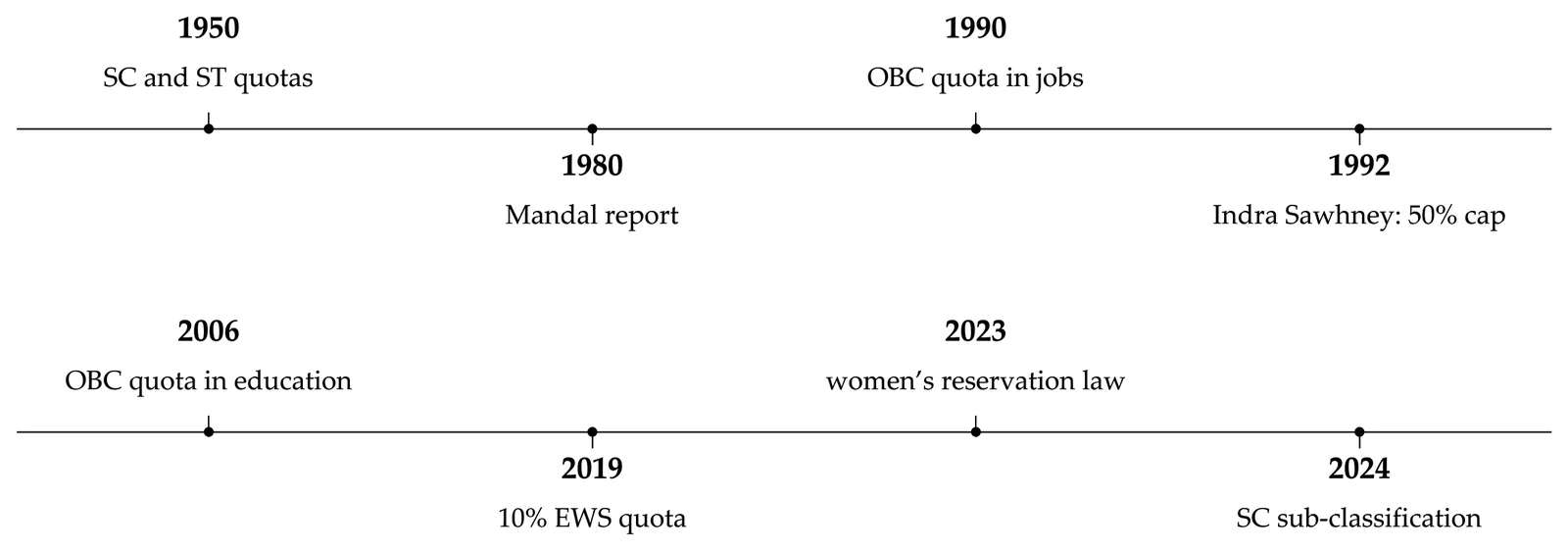
The Constitution provides reservation in legislatures (Articles 330 and 332), public employment (Article 16(4)) and education (Article 15(4) and 15(5)) for Scheduled Castes, Scheduled Tribes and, in jobs and education, OBCs. Central reservation stands at 15 per cent for SCs, 7.5 per cent for STs and 27 per cent for OBCs. In Indra Sawhney (1992), the Supreme Court upheld OBC reservation but fixed a 50 per cent ceiling and excluded the creamy layer. Since then, the 103rd Amendment (2019) added a 10 per cent quota for economically weaker sections among those not otherwise covered, upheld in 2022, and in 2024 the Court allowed states to sub-classify Scheduled Castes.
Marc Galanter, author of Competing Equalities (1984), describes ‘The Long Half-Life of Reservations’ (2002): policies meant to be temporary have persisted and expanded. Political reservation for SCs and STs, originally for ten years, has been extended every decade. Galanter sees reservations as a remarkable experiment in compensatory discrimination that has created a Dalit middle class and political leadership, though benefits are unevenly shared and caste identities have become entrenched.
4.4 Intersectionality of Caste, Class and Gender
Intersectionality, a term coined by Kimberlé Crenshaw in 1989, means that different forms of inequality combine to shape a person’s position. In India, caste overlaps with class, since landlessness and poverty are concentrated among Dalits and Adivasis, and with gender, since caste purity has been maintained through control of women’s sexuality and marriage. Dalit feminists such as Gopal Guru, in ‘Dalit Women Talk Differently’ (1995), and Sharmila Rege argued that Dalit women face a triple burden of caste, class and patriarchy, which neither the women’s movement nor the Dalit movement fully addressed.
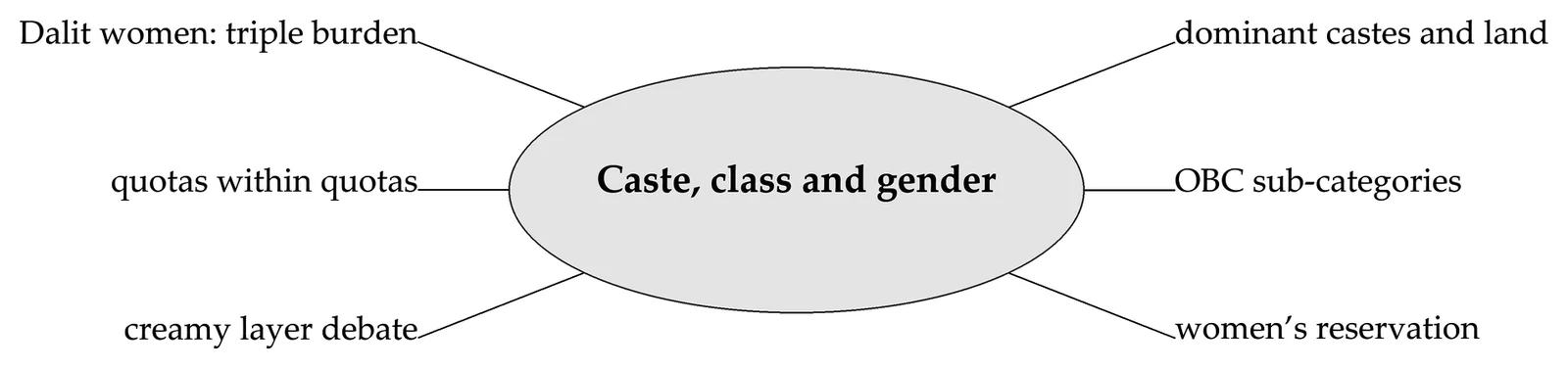
Mary John, in ‘The Politics of Quotas and the Women’s Reservation Bill in India’ (2011), examines the long debate on one-third reservation for women in legislatures, first introduced in 1996 and passed by the Rajya Sabha in 2010. OBC and Dalit parties demanded a quota within the quota, arguing that without it reservation would mainly benefit upper-caste women. The bill finally became the 106th Amendment in 2023, still without an OBC sub-quota, showing how caste and gender intersect in questions of representation.
4.5 Important Questions
- Question 1 ‘It is not politics that gets caste-ridden; it is caste that gets politicised.’ Discuss with reference to Rajni Kothari.
- Question 2 Critically examine the policy of reservation and affirmative action in India.
- Question 3 Trace the growth of the Dalit movement and backward-caste politics in India.
- Question 4 Discuss the intersectionality of caste, class and gender in Indian politics.
DU asks the same idea in different words. So learn one broad answer for each question below; the same answer works for every question joined by OR.
Important Question 1
‘It is not politics that gets caste-ridden; it is caste that gets politicised.’ Discuss with reference to Rajni Kothari.
OR
Examine the relationship between caste and politics in India.
OR
Discuss the role of caste in Indian politics and the politicisation of caste.
Model Answer
“It is not politics that gets caste-ridden; it is caste that gets politicized.”
— Rajni Kothari, Caste in Indian Politics (1970)
Introduction. The relationship between caste and politics has been central to the study of Indian democracy. Early observers feared that caste would corrupt democracy. Rajni Kothari argued instead that democracy transforms caste: in the process of political competition, caste becomes politicised, organised and integrated into the democratic system. Myron Weiner and others extended this analysis.
1. Caste as a Social System
Caste is a hierarchical system of endogamous groups, jatis, traditionally linked to occupation and ranked by ideas of purity and pollution. It shaped access to land, education and power. Untouchability placed Dalits at the bottom, excluded from temples, wells and dignity.
2. The Fear of Casteism
Many modernisers, including Nehru, believed that caste would decline with education, industrialisation and democracy, and they condemned casteism in politics as a sign of backwardness. They expected voters to vote as individuals on issues and programmes.
3. Kothari’s Argument
Kothari argued that this expectation misunderstood both politics and society. Politics is a competitive enterprise that must mobilise people through existing social groupings. Those who complain of casteism in politics are looking for a politics with no basis in society. Caste, the most available grouping, is drawn into politics and changed by it.
4. The Secular Aspect
Through politics, castes behave like secular interest groups. They form caste associations, federate with similar castes, bargain with parties and compete for jobs, education and power. Caste loses some of its ritual meaning and acquires a political one.
5. The Integration Aspect
Politics links castes to the wider political system. Parties build coalitions of castes, leaders from different castes enter government, and caste groups learn to work through democratic institutions. In this way caste politics integrates groups into the nation rather than dividing it.
6. The Consciousness Aspect
Politics also changes caste consciousness. Lower castes become aware of their numbers and rights, develop new collective identities and challenge the old hierarchy. Political awareness, rather than ritual status, becomes the basis of caste identity.
7. Caste Associations
Lloyd and Susanne Rudolph showed that caste associations, such as those of the Vanniyars in Tamil Nadu, acted as modern organisations that mobilised members, published newspapers and bargained with parties. They called this the modernity of tradition, since a traditional institution served modern democratic purposes.
8. Dominant Caste
M.N. Srinivas showed that dominant castes, numerically strong landowning castes such as the Jats, Marathas, Reddys and Patidars, controlled village power and delivered votes. The Congress system relied on alliances with such castes.
9. Weiner’s Struggle for Equality
Myron Weiner argues that Indian democracy became the arena of the lower castes’ struggle for equality. Instead of seeking higher status through Sanskritisation, they organised collectively to win power and state benefits through elections and reservations. This shifted power downwards but also hardened caste identities.
10. Caste and Parties
From the 1960s onwards, parties increasingly represented caste coalitions: the Congress’s coalition of upper castes, Dalits and Muslims; the Lok Dal’s peasant castes; the BSP’s Dalits; and the Samajwadi Party’s OBCs and Muslims. Today almost every party plans tickets and alliances on the basis of caste arithmetic.
11. Modes of Mobilisation
The Rudolphs distinguished three modes of political mobilisation. In vertical mobilisation, local notables and landlords deliver the votes of their dependents. In horizontal mobilisation, caste or class associations mobilise their own members directly. In differential mobilisation, parties win support through communal and caste solidarities. Over time, Indian politics moved from vertical towards horizontal mobilisation, as lower castes ceased to follow their patrons and organised on their own.
12. Limits of Caste Politics
Caste does not determine votes mechanically. Castes split their votes, class divisions exist within castes, and voters respond to leaders, issues and welfare. Critics argue that caste politics can also promote narrow identity politics and benefit caste elites more than the poor.
13. Evaluation
Kothari’s insight remains valuable: democracy has not abolished caste, but it has transformed it, turning it into a resource for political mobilisation and a means for lower castes to claim power. The challenge is to move from caste-based mobilisation to the annihilation of caste inequality.
Conclusion. Thus, Kothari argued that caste becomes politicised through democratic competition, acquiring secular, integrative and consciousness-raising aspects. Along with caste associations, dominant castes and the lower castes’ struggle for equality, this explains the enduring role of caste in Indian politics.
Important Question 2
Critically examine the policy of reservation and affirmative action in India.
OR
Discuss Marc Galanter’s view on the long half-life of reservations.
OR
Examine the debates on reservation for OBCs and economically weaker sections.
Model Answer
“Nothing in this article … shall prevent the State from making any special provision for the advancement of any socially and educationally backward classes of citizens or for the Scheduled Castes and the Scheduled Tribes.”
— Constitution of India, Article 15(4)
Introduction. Reservation is India’s main policy of affirmative action, designed to remedy centuries of caste-based exclusion. It reserves seats in legislatures, jobs and educational institutions for disadvantaged groups. It has transformed the representation of Dalits, Adivasis and backward classes, but it has also generated intense political and legal debate. Marc Galanter calls it a policy of compensatory discrimination with a long half-life.
1. Rationale
Formal equality alone cannot remove deep, historical inequality. The Constitution therefore permits special provisions for disadvantaged groups. Reservation aims to provide representation, opportunities and dignity to groups excluded by caste, and to make public institutions reflect India’s diversity.
2. Constitutional Provisions
Articles 15(4), 15(5) and 16(4) enable reservation in education and jobs; Article 16(4A) permits reservation in promotion for SCs and STs; Articles 330 and 332 reserve legislative seats; Article 335 requires efficiency of administration to be considered; and Article 340 provides for commissions on backward classes.
3. SC and ST Reservation
Since 1950, Scheduled Castes have received about 15 per cent and Scheduled Tribes 7.5 per cent of central government jobs and seats in central institutions, roughly in proportion to population. Political reservation in legislatures, originally for ten years, has been extended repeatedly, most recently to 2030.
4. OBC Reservation
The first Backward Classes Commission under Kaka Kalelkar reported in 1955, but its report was not implemented. The Mandal Commission (1979–80) identified 3,743 backward castes and recommended 27 per cent reservation. Prime Minister V.P. Singh implemented it in central jobs in 1990, sparking protests and transforming politics.
5. Indra Sawhney
In Indra Sawhney v. Union of India (1992), the Supreme Court upheld 27 per cent OBC reservation, held that caste can be a criterion of backwardness, fixed a 50 per cent ceiling on total reservation except in extraordinary situations, and excluded the creamy layer of advanced OBCs. It struck down a 10 per cent quota for the economically poor among forward castes.
6. Later Developments
The 93rd Amendment (2005) enabled OBC reservation in higher education, implemented in 2006. The 103rd Amendment (2019) created a 10 per cent quota for economically weaker sections not covered by other reservations, upheld in Janhit Abhiyan (2022). In State of Punjab v. Davinder Singh (2024), the Court allowed sub-classification within Scheduled Castes.
7. Galanter’s Half-life
Galanter argues that reservations have had a long half-life: designed as temporary, they have persisted and expanded because they serve real needs and create political constituencies. Once established, no party can easily abolish them, and new groups demand inclusion.
8. Achievements
Reservation has created a Dalit and Adivasi middle class, ensured their presence in legislatures, administration and universities, and given them political voice. Without it, public institutions would have remained almost entirely dominated by upper castes.
9. Criticisms
Critics argue that benefits go mainly to the better-off within each group, that reservation entrenches caste identities, that it may affect efficiency, and that it does little for the poorest who cannot reach higher education. Others note that jobs in the public sector are shrinking and that the private sector has no reservation.
10. Demands for Inclusion
Powerful landed castes, such as the Jats, Patidars and Marathas, have demanded backward status, and courts have struck down some such quotas, including Maratha reservation in 2021. These demands reflect agrarian distress and the attraction of public jobs.
11. Caste Census and Sub-categorisation
Debates continue over a caste census, to provide data for fair distribution, and over sub-categorisation of OBCs, examined by the Rohini Commission from 2017. Bihar’s caste survey of 2023 revived these debates, and in 2025 the Union government decided to include caste in the next census.
12. Evaluation
Reservation remains essential in a society where caste still shapes opportunities. Its effectiveness can be improved by better data, fair distribution within groups, strong education at the base and attention to the poorest, while recognising that reservation alone cannot end caste inequality.
Conclusion. Thus, reservation has been India’s principal tool of affirmative action, expanding from SCs and STs to OBCs and EWS. As Galanter shows, it has had a long half-life because it meets real needs, though questions of distribution, creamy layer and efficiency continue to be debated.
Important Question 3
Trace the growth of the Dalit movement and backward-caste politics in India.
OR
Discuss Gail Omvedt’s account of the Dalit movement after Ambedkar.
OR
Examine Christophe Jaffrelot’s view on the politics of the OBCs.
Model Answer
“‘Untouchability’ is abolished and its practice in any form is forbidden.”
— Constitution of India, Article 17
Introduction. The rise of Dalits and the Other Backward Classes is among the most important changes in Indian politics. Dalits, once excluded as untouchables, built movements and parties to claim dignity and power. OBCs, the middle castes of peasants and artisans, rose to power in north India after Mandal. Gail Omvedt and Christophe Jaffrelot study these movements.
1. Ambedkar’s Legacy
B.R. Ambedkar led the Mahad satyagraha for water rights (1927), burned the Manusmriti, founded the Independent Labour Party (1936) and the Scheduled Castes Federation (1942), drafted the Constitution and converted to Buddhism with lakhs of followers in 1956. Omvedt sees him as the founder of the modern Dalit movement.
2. Republican Party of India
After Ambedkar’s death, his followers formed the Republican Party of India in 1957. It was strong in Maharashtra but split repeatedly and often allied with the Congress, which weakened its independence.
3. Dalit Panthers
Inspired by the Black Panthers in the United States, young Dalit writers in Bombay formed the Dalit Panthers in 1972. They rejected compromise, produced powerful Dalit literature and used the word Dalit, meaning broken or oppressed, as a proud identity.
4. Kanshi Ram and the BSP
Kanshi Ram organised Dalit government employees through BAMCEF (1978) and DS4 (1981), and founded the Bahujan Samaj Party in 1984. He argued that the bahujan, the majority of oppressed castes, should capture political power rather than depend on others.
5. Mayawati and Power
Mayawati became Chief Minister of Uttar Pradesh in 1995, 1997, 2002 and 2007, the last time with a majority built on an alliance of Dalits with Brahmins and others, called sarvajan. This showed that Dalits could hold power in India’s largest state.
6. Omvedt’s Assessment
Omvedt argues that the Dalit movement combined struggles for dignity, land, education and power, and drew on traditions of anti-caste thought from Phule to Ambedkar. She notes its achievements and its fragmentation, and the tension between cultural assertion and economic struggle.
7. The Rise of OBCs
OBCs, including peasant castes such as the Yadavs and Kurmis, first rose through socialist parties and Charan Singh’s Lok Dal. The Mandal decision of 1990 politicised OBC identity across north India and brought leaders such as Mulayam Singh Yadav, Lalu Prasad and Nitish Kumar to power.
8. Jaffrelot’s Silent Revolution
Jaffrelot argues that the rise of OBCs and Dalits in north India amounted to a silent revolution: power shifted from upper castes to lower castes through elections, without violence. The share of OBC legislators in Hindi-belt states rose sharply in the 1990s.
9. Divisions among OBCs
Jaffrelot notes that OBC politics favoured dominant OBCs, such as Yadavs, while the most backward classes felt left out. These divisions created opportunities for other parties, and the BJP built support among non-Yadav OBCs and non-Jatav Dalits.
10. Southern Non-Brahmin Movements
In south India, backward-caste politics began much earlier. The Justice Party (1916) and E.V. Ramasamy Periyar’s Self-Respect Movement (1925) attacked Brahmin dominance in Madras Presidency, and the Dravidian parties that followed, the DMK and AIADMK, expanded reservation. Tamil Nadu’s 69 per cent reservation was protected by placing its law in the Ninth Schedule through the 76th Amendment (1994).
11. Atrocities and Assertion
Dalit assertion has often provoked violent backlash from dominant castes, as in the Khairlanji massacre in Maharashtra (2006). Such violence has in turn mobilised Dalit protest, including the nationwide agitation of April 2018 against a court ruling seen as diluting the Atrocities Act, which Parliament then restored by amendment.
12. Hindutva and Lower Castes
The BJP’s success since 2014 among OBCs and Dalits, often called social engineering, has complicated the politics of social justice. Some scholars see this as a weakening of caste-based parties; others see it as caste politics in a new form.
13. Continuing Challenges
Despite political gains, Dalits still face violence, landlessness and discrimination, as atrocities and manual scavenging show. The Scheduled Castes and Scheduled Tribes (Prevention of Atrocities) Act, 1989, strengthened in 2015 and 2018, remains important but is unevenly enforced.
14. Evaluation
The Dalit and OBC movements have democratised Indian politics, bringing new groups to power and challenging caste hierarchy. Yet political power has not removed social and economic inequality, and the movements face fragmentation and co-option.
Conclusion. Thus, from Ambedkar through the Republican Party, the Dalit Panthers and the BSP, Dalits built a powerful movement, while OBCs rose after Mandal in what Jaffrelot calls a silent revolution. Both transformed Indian politics, though caste inequality persists.
Important Question 4
Discuss the intersectionality of caste, class and gender in Indian politics.
OR
Examine the debate on women’s reservation with reference to Mary John.
OR
‘Dalit women face a triple burden.’ Discuss.
Model Answer
“Nothing in this article shall prevent the State from making any special provision for women and children.”
— Constitution of India, Article 15(3)
Introduction. Inequalities in India do not operate separately. Caste, class and gender intersect, so that a poor Dalit woman experiences disadvantages different from those of an upper-caste woman or a Dalit man. The concept of intersectionality helps explain these overlapping inequalities and their consequences for politics, especially for debates on quotas and representation.
1. Meaning of Intersectionality
Kimberlé Crenshaw coined the term intersectionality in 1989 to show how race and gender combined to shape the experiences of Black women in the United States. The idea is that forms of inequality are not simply added together but interact to produce distinct experiences.
2. Caste and Class
Caste and class overlap. Dalits and Adivasis are disproportionately landless, poor and engaged in insecure labour, while land and capital are concentrated among upper and dominant castes. Yet caste is not reducible to class: middle-class Dalits still face discrimination, and poor upper-caste people do not face untouchability.
3. Caste and Gender
Caste has been maintained through control of women. Endogamy, restrictions on women’s sexuality and violence against inter-caste couples protect caste boundaries. Uma Chakravarti calls this Brahmanical patriarchy, in which caste and gender hierarchies support each other.
4. Dalit Women’s Triple Burden
Dalit women face oppression as women, as Dalits and as poor workers. They suffer sexual violence used to humiliate their communities, work as agricultural labourers and sanitation workers, and face discrimination from upper-caste women as well as patriarchy within their own communities.
5. Dalit Women Talk Differently
Gopal Guru argued in 1995 that Dalit women talk differently, because their experience differs from that of upper-caste women and Dalit men. The National Federation of Dalit Women was formed in 1995. Sharmila Rege called for a Dalit feminist standpoint that would correct both the mainstream women’s movement and male-dominated Dalit politics.
6. The Women’s Reservation Bill
The proposal to reserve one-third of seats in the Lok Sabha and state Assemblies for women was first introduced in 1996. It was passed by the Rajya Sabha in 2010 but lapsed in the Lok Sabha, because of opposition from parties representing OBCs and Muslims.
7. Quota within Quota
These parties demanded a sub-quota for OBC and minority women, arguing that otherwise reserved seats would go to upper-caste, urban, educated women. Supporters of the bill feared that such demands were a way to block it. The SC and ST women were to be covered within existing reserved seats.
8. Mary John’s Analysis
Mary John shows that the debate revealed how gender and caste intersect in representation. Feminists were divided between those who insisted on gender justice first and those who accepted the need to address caste within gender quotas. Quotas raise the question of which women represent women.
9. The 106th Amendment
In 2023 Parliament passed the 106th Amendment, reserving one-third of seats for women in the Lok Sabha and Assemblies, including within SC and ST seats, for fifteen years. It takes effect after the next census and delimitation, and it does not include an OBC sub-quota.
10. Lessons from Local Government
Reservation for women in panchayats since 1993 has brought more than a million women into local office, including many Dalit and Adivasi women. Studies show both empowerment and constraints, such as proxy rule by male relatives and caste-based resistance to Dalit women leaders.
11. Violence and the Law
Sexual violence against lower-caste women has repeatedly exposed the intersection of caste and gender. Bhanwari Devi, a lower-caste village worker in Rajasthan, was gang-raped in 1992 for trying to stop a child marriage; her case led the Supreme Court to issue the Vishaka guidelines against sexual harassment at work in 1997. Cases such as Hathras (2020) show how caste power can obstruct justice for Dalit women.
12. Class within Castes
Intersectionality also applies within groups. The creamy layer debate and the sub-classification of SCs and OBCs reflect concerns that the better-off within disadvantaged groups capture benefits, leaving the poorest behind.
13. Evaluation
Intersectionality shows that policies addressing only one dimension of inequality may benefit the more privileged within each group. Effective representation and justice require attention to how caste, class and gender combine.
Conclusion. Thus, caste, class and gender intersect to create layered inequalities, most sharply for Dalit women. As Mary John shows, debates on women’s reservation and quotas within quotas reveal these intersections, which must be addressed for genuine equality.
Short Notes
(a) Creamy layer
The relatively advanced and well-off section of the Other Backward Classes, excluded from reservation benefits by the Supreme Court in Indra Sawhney (1992). It is defined by criteria such as parents’ income and position, so that benefits reach the genuinely backward within each OBC group.
(b) Mandal Commission
The Second Backward Classes Commission, chaired by B.P. Mandal, appointed in 1979 and reporting in 1980. It identified 3,743 castes as backward and recommended 27 per cent reservation in central jobs. V.P. Singh’s government implemented it in 1990, transforming Indian politics.
(c) Sanskritisation
M.N. Srinivas’s term for the process by which lower castes seek higher status by adopting the customs, rituals and lifestyle of upper castes, such as vegetarianism or wearing the sacred thread. Weiner argues that in democratic India collective political mobilisation replaced Sanskritisation as the main route to equality.
(d) Dominant caste
Srinivas’s concept for a caste that is numerically strong, owns much of the land and has economic and political power in a region, such as the Jats, Marathas or Reddys. Dominant castes controlled village politics and acted as vote banks for parties.
More notes: DSC-15 Political Process in India
These notes are prepared by PADHO TO AISE for study help. They are not an official University of Delhi publication.