
Semester V DSC-15 Political Process in India
Unit I · 23 min read · Updated 24 Nov 2026
As per the University of Delhi (DU) BA (Hons) Political Science syllabus
Contents
- 1.1 Political Parties: National and State Parties
- 1.2 The Congress System
- 1.3 From the Congress System to Coalitions
- 1.4 The Ascendancy of the BJP
- 1.5 Important Questions
- Discuss Rajni Kothari’s concept of the Congress system and explain the reasons for its decline.
- Trace the trends in the Indian party system from the Congress system to the ascendancy of the BJP.
- Explain the rise of the BJP as a dominant party in Indian politics.
- Examine the role of national and state parties in the Indian party system.
- Short Notes
राजनीतिक दलों ने लोकतंत्र को बनाया है, और आधुनिक लोकतंत्र की कल्पना दलों के बिना नहीं की जा सकती।
The political parties created democracy and modern democracy is unthinkable save in terms of the parties.
— E.E. Schattschneider, Party Government (1942)
POLITICAL parties link citizens to the state. They choose candidates, contest elections, form governments, represent social groups and give voters a choice of programmes. A party system is the pattern of competition and cooperation among parties: how many parties matter, how strong each is and how they relate to one another. India’s party system has changed dramatically since 1952. It began with the dominance of the Indian National Congress, which Rajni Kothari called the Congress system. Over the following decades it gave way to opposition challenges, coalitions and powerful state parties, and since 2014 to the ascendancy of the Bharatiya Janata Party (BJP). This unit studies national and state parties and these changing trends.
1.1 Political Parties: National and State Parties
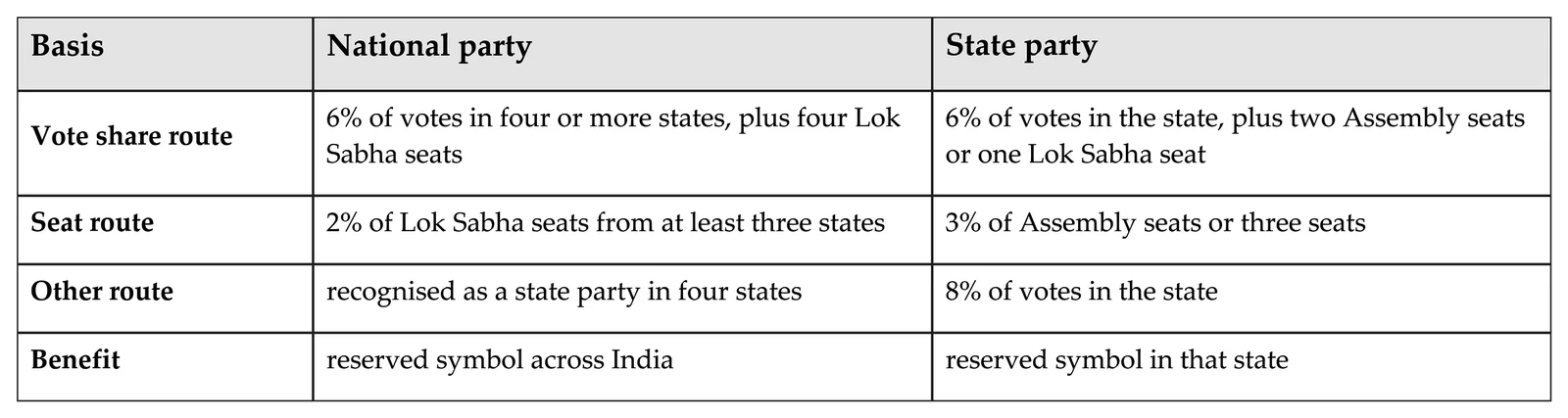
Indian parties are of two kinds. National parties have support in several states, while state parties (often called regional parties) are strong mainly in one state. The Election Commission of India recognises a party as national or state on the basis of its vote share and seats in Lok Sabha and Assembly elections. A recognised party gets a reserved symbol, free broadcast time and other benefits. Hundreds of other parties are registered but unrecognised. Recognition can change: in 2023 the Trinamool Congress, NCP and CPI lost national status while the Aam Aadmi Party gained it.
State parties have grown in importance since the 1960s. Some arose from regional or linguistic identity, such as the DMK (1949) and AIADMK in Tamil Nadu, the Akali Dal in Punjab and the Telugu Desam Party (1982). Others represent social groups, such as the Samajwadi Party and RJD for backward castes and the BSP, which began among Dalits. Still others are splinters of national parties, such as the Trinamool Congress (1998) and the NCP (1999). They have made Indian democracy more federal and representative, though many are dominated by a single leader or family.
1.2 The Congress System
In ‘The Congress System in India’ (1964), Rajni Kothari described the Indian party system of 1952–67 as a system of one-party dominance. Unlike a one-party state, it was a competitive system, but one in which a single party was dominant. The Congress was a party of consensus: a broad umbrella that contained many factions, interests and ideologies. The opposition parties were parties of pressure: they could not replace the Congress, but they influenced the factions within it from outside. Competition took place mainly within the Congress, among its factions, rather than between parties.

The system depended on a margin of pressure: a latent threat that if the Congress moved too far from public opinion, the opposition could take power. This kept the Congress responsive and accommodative. W.H. Morris-Jones made a similar point when he described dominance coexisting with competition. The Congress’s legitimacy came from its role in the freedom movement, its organisation in every district, its leaders such as Nehru, and its ability to accommodate local elites and vote banks through patronage.
1.3 From the Congress System to Coalitions
The Congress system began to break down in 1967, when the Congress lost power in several states to coalitions of opposition parties. The party split in 1969. Indira Gandhi’s Congress won a large victory in 1971 with the slogan of garibi hatao, but it became centralised and personalised. After the Emergency (1975–77), the Janata Party formed the first non-Congress government at the centre in 1977. The Congress returned in 1980 and won a record majority in 1984, but from 1989 no single party won a majority in the Lok Sabha for twenty-five years.
The period from 1989 to 2014 saw a multi-party system with coalition governments: the National Front (1989), the United Front (1996), the BJP-led National Democratic Alliance (1998–2004) and the Congress-led United Progressive Alliance (2004–14). Yogendra Yadav and Suhas Palshikar show that in these years the states became the real arenas of competition, with most states moving towards bipolar contests between two parties or alliances. They describe a shift from Congress hegemony to convergence: party systems across states became similar in form, and parties converged on policy, especially on economic reforms.
1.4 The Ascendancy of the BJP
The BJP, founded in 1980 as the successor of the Bharatiya Jana Sangh (1951), grew from two Lok Sabha seats in 1984 to become the largest party in 1996. Its rise was linked to the Ayodhya movement, the response to the Mandal Commission’s OBC reservations and the appeal of Hindu nationalism. In 2014, under Narendra Modi, it became the first party since 1984 to win a Lok Sabha majority on its own, and in 2019 it increased its tally to 303 seats. In 2024 it won 240 seats and governed with its NDA allies.
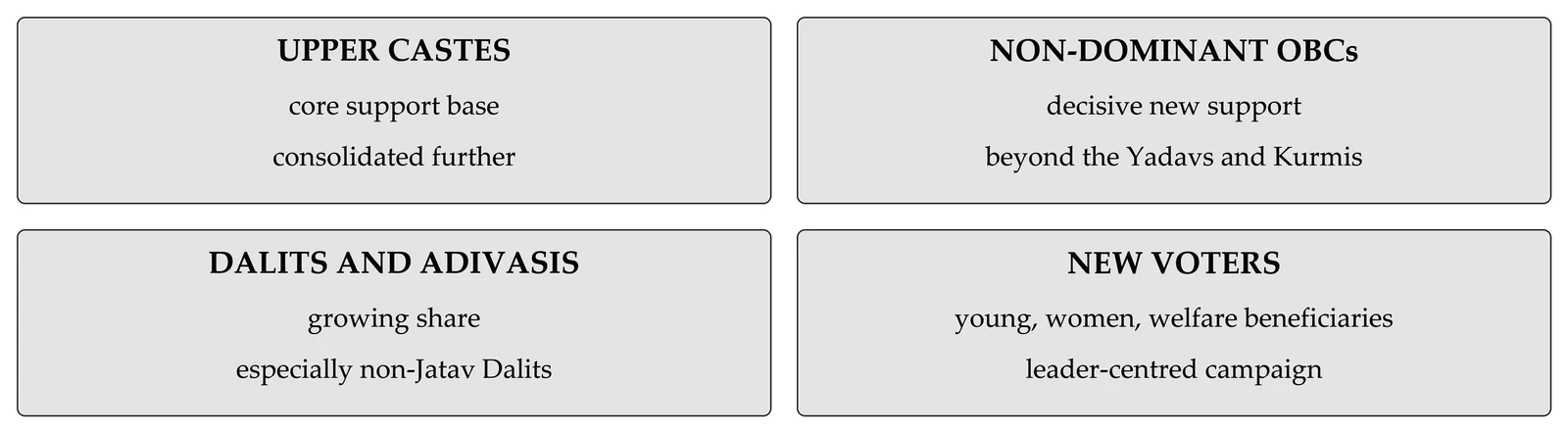
Milan Vaishnav and Jamie Hintson call this the fourth party system, with the BJP as the new dominant pole of national politics. Pradeep Chhibber and Rahul Verma speak of a second dominant party system built on a new social coalition of upper castes, non-dominant OBCs, Dalits and Adivasis. K.C. Suri links the BJP’s consolidation to social change among voters. Christophe Jaffrelot and Gilles Verniers ask whether India has a new party system or a new political system, marked by personalised leadership, centralisation and the weakening of institutional checks.
1.5 Important Questions
- Question 1 Discuss Rajni Kothari’s concept of the Congress system and explain the reasons for its decline.
- Question 2 Trace the trends in the Indian party system from the Congress system to the ascendancy of the BJP.
- Question 3 Explain the rise of the BJP as a dominant party in Indian politics.
- Question 4 Examine the role of national and state parties in the Indian party system.
DU asks the same idea in different words. So learn one broad answer for each question below; the same answer works for every question joined by OR.
Important Question 1
Discuss Rajni Kothari’s concept of the Congress system and explain the reasons for its decline.
OR
Examine the nature of one-party dominance in India during 1952–67.
OR
What was the Congress system? Why did it decline after 1967?
Model Answer
“A party is dominant when it is identified with an epoch; when its doctrines, ideas, methods, its style, so to speak, coincide with those of the epoch.”
— Maurice Duverger, Political Parties (1951)
Introduction. For the first two decades after independence, the Indian National Congress dominated Indian politics, winning every general election and ruling almost every state. Rajni Kothari, in his famous essay of 1964, explained this dominance as the Congress system, a competitive system of one-party dominance. The system declined from 1967 onwards, giving way to a more competitive and fragmented party system.
1. Background of Congress Dominance
The Congress inherited enormous legitimacy from the freedom movement. It had an organisation reaching every district and village, popular leaders such as Nehru and Patel, and a programme of national unity, democracy and development. In the general elections of 1952, 1957 and 1962, it won about three-quarters of Lok Sabha seats with around 45 per cent of the votes, because the opposition was divided.
2. Meaning of the Congress System
Kothari used the term Congress system to describe a party system in which one party was dominant but the system remained open and competitive. It was not a one-party state like the Soviet Union, since opposition parties existed freely and elections were genuine. But the Congress occupied the centre of the political space and set the terms of political debate.
3. Party of Consensus
The Congress was a party of consensus, a broad coalition that included the right and the left, landlords and peasants, industrialists and workers, and many castes, religions and regions. It absorbed conflicts within itself and reached compromises through internal bargaining. Its ideology was flexible enough to accommodate almost every interest.
4. Factions as Internal Competition
Because the Congress was so large, competition took place mainly within it, among factions organised around leaders, regions and interests. Factions provided internal democracy, allowed discontented groups to remain inside the party and brought new leaders forward. The party managed factional conflict through its high command and its leaders’ skill in bargaining.
5. Parties of Pressure
Opposition parties, such as the Socialists, the Communists, the Swatantra Party and the Jana Sangh, could not replace the Congress. They functioned as parties of pressure, influencing like-minded factions within the Congress from outside, criticising government policy and representing interests the Congress neglected.
6. Margin of Pressure
The system worked because of a latent threat. If the Congress lost touch with public opinion or ignored important groups, opposition parties could gain support and defeat it. This margin of pressure made the dominant party responsive and accommodating. Dominance was therefore conditional, not permanent.
7. Patronage and Vote Banks
The Congress built support through networks of local notables, landlords and caste leaders who delivered votes in return for patronage, such as licences, jobs and development funds. These vote banks linked the party to rural society, but they also meant that the party depended on dominant local elites.
8. Morris-Jones’s View
W.H. Morris-Jones similarly argued that India had a dominant party system in which dominance coexisted with competition. He also described the different languages of Indian politics, the modern, the traditional and the saintly, which the Congress could speak at once, helping it to reach diverse audiences.
9. The Crisis of 1967
In the fourth general election of 1967, the Congress retained power at the centre with a reduced majority but lost power in several states, where coalitions of opposition parties formed Samyukta Vidhayak Dal governments. Food shortages, inflation, the 1966 devaluation, the deaths of Nehru (1964) and Shastri (1966), and Lohia’s strategy of non-Congressism all contributed.
10. Causes of Decline
The decline had deeper causes. New social groups, especially the middle peasant castes and backward classes, became politically assertive and found Congress dominated by older elites. Regional and linguistic movements grew. The party’s split in 1969 and Indira Gandhi’s centralised, populist leadership weakened its internal democracy and its accommodative factional system.
11. The Later Congress
Kothari later argued that under Indira Gandhi the Congress shifted from a system of consensus to one of centralised personal leadership, relying on direct appeals to the masses rather than on local intermediaries. Although the Congress won in 1971, 1980 and 1984, it never recovered the accommodative character of the Congress system.
12. Evaluation
Kothari’s concept remains one of the most influential ideas in Indian political science. It showed how a dominant party could sustain democracy by internalising competition and accommodating diversity. Its decline opened the way to a more competitive, plural and federal party system.
Conclusion. Thus, the Congress system was a competitive system of one-party dominance, in which the Congress acted as a party of consensus and opposition parties as parties of pressure, held together by a margin of pressure. It declined after 1967 because of social change, the rise of new groups and the centralisation of the Congress itself.
Important Question 2
Trace the trends in the Indian party system from the Congress system to the ascendancy of the BJP.
OR
Discuss the different phases of the party system in India.
OR
Examine the view that India has moved from a ‘Congress system’ to a ‘fourth party system’.
Model Answer
“Parties are the central intermediate and intermediary structure between society and government.”
— Giovanni Sartori, Parties and Party Systems (1976)
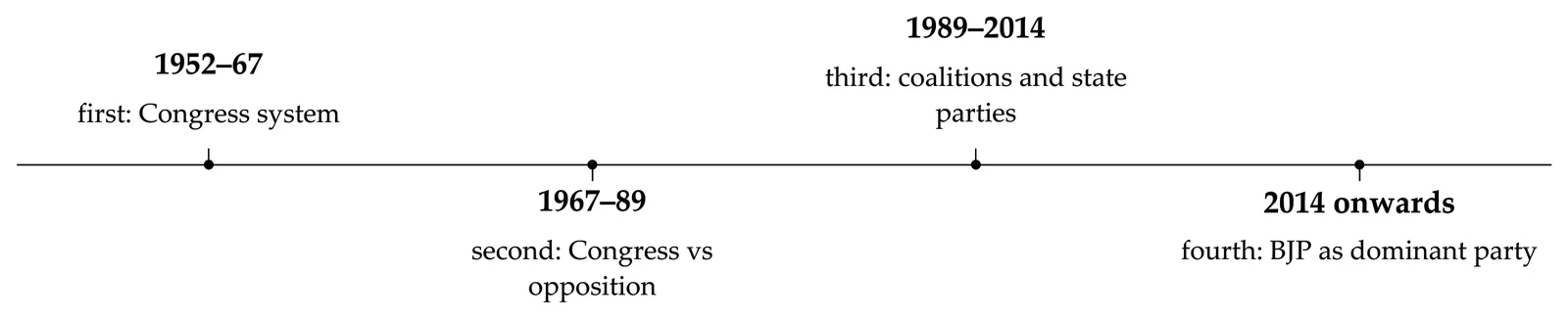
Introduction. India’s party system has changed more than once since independence. Scholars such as Yogendra Yadav, Suhas Palshikar, Milan Vaishnav and Jamie Hintson identify a sequence of party systems, each with its own pattern of competition. Broadly, India moved from Congress dominance to a competitive two-camp politics, then to coalitions and state parties, and most recently to the dominance of the BJP.
1. First Party System (1952–67)
The first party system was the Congress system described by Rajni Kothari. The Congress dominated both the centre and the states, opposition parties were fragmented, and competition occurred mainly within the Congress. The party enjoyed legitimacy from the freedom struggle and was supported by a broad coalition of social groups.
2. Second Party System (1967–89)
From 1967, the Congress faced serious competition. It lost several states, split in 1969 and was defeated at the centre in 1977 by the Janata Party, formed after the Emergency. Politics became a contest between the Congress and changing anti-Congress coalitions. The Congress returned in 1980 and 1984, but it was no longer unchallenged in the states.
3. Third Party System (1989–2014)
From 1989, no party won a Lok Sabha majority until 2014. Coalition governments became the norm, state parties became kingmakers, and the Congress declined steadily. Three issues, Mandal, Mandir and market, reshaped politics: OBC reservations, the Ayodhya movement and economic liberalisation after 1991.
4. Rise of State Parties
State parties won a growing share of votes and seats. Parties such as the DMK, AIADMK, TDP, Samajwadi Party, BSP, RJD, BJD, Trinamool Congress and Shiv Sena controlled state governments and joined national coalitions. National politics became more federal, as alliances depended on state-level partners.
5. From Hegemony to Convergence
Yadav and Palshikar studied state party systems from 1952 to 2002. They found that the national party system was increasingly an aggregation of state party systems. Most states moved from Congress hegemony to bipolar competition, and parties converged in their policies, offering fewer real choices while competing more intensely.
6. Coalition Politics
Coalitions such as the National Front, the United Front, the NDA and the UPA governed India between 1989 and 2014. They used common minimum programmes and coordination committees. Coalition politics increased the bargaining power of states and smaller parties, but it was also blamed for policy paralysis and corruption.
7. The Fourth Party System
Vaishnav and Hintson argue that since 2014 India has a fourth party system, with the BJP as the dominant national party. The BJP won majorities in 2014 and 2019, expanded into new regions and social groups, and made national elections more national, with voters focused on the Prime Minister and national issues.
8. Features of BJP Dominance
The BJP’s dominance rests on a strong organisation with the support of the Rashtriya Swayamsevak Sangh, a popular leader, a combination of Hindu nationalism and welfare delivery, and a broad social coalition. The Congress has declined to its lowest levels, while state parties remain strong in some states.
9. Second Dominant Party System
Chhibber and Verma call this the second dominant party system. Like the Congress earlier, the BJP sits at the centre of the political space and attracts a broad coalition. Unlike the Congress, however, its dominance rests on a clearer ideology of Hindu nationalism and a more centralised leadership.
10. New Political System
Jaffrelot and Verniers argue that the change goes beyond the party system. The 2019 election saw the personalisation of power around Modi, the nationalisation of campaigns, the return of upper castes to a larger share of Lok Sabha seats and pressure on independent institutions. They suggest that India may be moving towards a new political system, not just a new party system.
11. The 2024 Election
In 2024 the BJP lost its majority, winning 240 seats, while the Congress and its INDIA allies gained ground. The BJP formed a government with its NDA partners. This suggests that BJP dominance continues but is more contested, and that state parties remain important.
12. Evaluation
The trends show that India’s party system has responded to social change and democratic deepening. Each phase brought new groups into politics. Whether the current phase becomes a durable dominant party system or another transition remains an open question.
Conclusion. Thus, India’s party system has moved from the Congress system (1952–67) through Congress–opposition competition (1967–89) and coalition politics with powerful state parties (1989–2014) to the ascendancy of the BJP since 2014, which scholars describe as a fourth party system or a second dominant party system.
Important Question 3
Explain the rise of the BJP as a dominant party in Indian politics.
OR
Discuss Chhibber and Verma’s argument about the rise of a second dominant party system in India.
OR
Examine the social coalition behind the BJP’s victories in 2014 and 2019.
Model Answer
“Party is a body of men united, for promoting by their joint endeavours the national interest, upon some particular principle in which they are all agreed.”
— Edmund Burke, Thoughts on the Cause of the Present Discontents (1770)
Introduction. The rise of the Bharatiya Janata Party is the most significant change in Indian party politics in recent decades. From a party with two Lok Sabha seats in 1984, it became the dominant force in national politics, winning majorities in 2014 and 2019. Scholars such as Chhibber and Verma, Suri, and Jaffrelot and Verniers explain this rise in terms of ideology, social coalition, leadership and social change.
1. Origins
The BJP was founded in 1980 as the successor of the Bharatiya Jana Sangh, established in 1951 by Syama Prasad Mookerjee. The Jana Sangh had merged into the Janata Party in 1977. The BJP is closely linked to the Rashtriya Swayamsevak Sangh, which provides cadres and ideological direction.
2. Early Growth
The BJP grew rapidly in the late 1980s and 1990s through the Ram Janmabhoomi movement in Ayodhya, including L.K. Advani’s rath yatra of 1990. It became the largest party in the Lok Sabha in 1996 and led the NDA government under Atal Bihari Vajpayee from 1998 to 2004.
3. Majorities in 2014 and 2019
In 2014, campaigning under Narendra Modi on development, anti-corruption and decisive leadership, the BJP won 282 seats, the first single-party majority since 1984. In 2019, after the Pulwama attack and the Balakot strikes, it won 303 seats with about 37 per cent of the vote, reaching beyond its traditional strongholds in north and west India.
4. A New Social Coalition
Chhibber and Verma argue that the BJP’s success rests on a new social coalition. Beyond its core support among upper castes, it won large shares of non-dominant OBCs, many Dalits, especially non-Jatav groups, and Adivasis. This broad coalition across castes resembles the Congress’s earlier catch-all support.
5. Ideology
Unlike the Congress system, BJP dominance rests on a clear ideology of Hindu nationalism, combined with a strong state, national security and cultural pride. Chhibber and Verma’s research suggests that Indian voters hold ideological positions on issues such as the role of the state and the recognition of groups, and that the BJP has consolidated voters on these issues.
6. Leadership
The personal popularity of Narendra Modi was central to the BJP’s victories. Surveys showed that many voters chose the BJP because of Modi. Campaigns became presidential in style, focusing on the leader rather than local candidates, and this nationalised elections.
7. Welfare Delivery
The BJP government combined nationalism with welfare schemes delivered directly to beneficiaries, such as toilets under the Swachh Bharat Mission, cooking gas connections under Ujjwala, housing, bank accounts and cash transfers to farmers. Scholars describe this as a new welfarism that built support among poor voters, especially women.
8. Organisation
The BJP built a powerful organisation reaching down to the polling booth, supported by RSS volunteers and an extensive use of social media and data. Its resources far exceeded those of its rivals, partly because of its success in raising funds.
9. Suri on Social Change
K.C. Suri argues that the BJP’s consolidation reflects social change among voters: urbanisation, education, media exposure and the rise of young, aspirational voters. These voters were less tied to traditional caste-based parties and more responsive to leadership, development and nationalism.
10. Weakness of the Opposition
The decline of the Congress, which won only 44 seats in 2014 and 52 in 2019, and the fragmentation of opposition parties helped the BJP. State parties remained strong in their states but could not offer a national alternative.
11. Critical Views
Jaffrelot and Verniers argue that BJP dominance has been accompanied by the polarisation of voters along religious lines, very low representation of Muslims among BJP MPs, the centralisation of power and pressure on independent institutions. They suggest that India’s political system, not only its party system, is changing.
12. Evaluation
The BJP’s rise reflects a combination of ideology, leadership, organisation, welfare and a broad social coalition. The 2024 results, when it fell short of a majority, show that its dominance is real but not unchallenged, and that the party system remains dynamic.
Conclusion. Thus, the BJP rose from the margins to dominance through Hindu nationalism, the Ayodhya movement, the leadership of Narendra Modi, a strong organisation, welfare delivery and a new social coalition of upper castes, OBCs, Dalits and Adivasis, creating what Chhibber and Verma call a second dominant party system.
Important Question 4
Examine the role of national and state parties in the Indian party system.
OR
Discuss the rise of regional parties and their impact on Indian politics.
OR
How are national and state parties recognised in India? Discuss their significance.
Model Answer
“India, that is Bharat, shall be a Union of States.”
— Constitution of India, Article 1(1)
Introduction. India’s party system includes both national parties, with support across several states, and state parties, strong mainly in one state. Their interaction shapes elections, government formation and federalism. Since the 1960s state parties have become central to Indian politics, while national parties have had to build alliances with them.
1. Recognition by the Election Commission
The Election Commission recognises parties under the Election Symbols Order of 1968. A national party must, for example, win 6 per cent of the votes in four or more states plus four Lok Sabha seats, or 2 per cent of Lok Sabha seats from three states, or be recognised as a state party in four states. A state party must meet similar tests within its state.
2. Benefits of Recognition
Recognised parties receive reserved symbols, which matter greatly in a country where many voters identify parties by symbol. They also get free broadcast time on public media, copies of electoral rolls and the right to more star campaigners.
3. National Parties
National parties, such as the BJP and the Congress, compete across most of India and offer national programmes. In 2023 the Commission listed six national parties: BJP, Congress, BSP, CPI(M), Aam Aadmi Party and National People’s Party. Only the BJP and the Congress have a truly all-India presence.
4. Types of State Parties
State parties are of several kinds: parties of regional and linguistic identity, such as the DMK and Akali Dal; parties of social groups, such as the BSP, Samajwadi Party and RJD; and breakaway parties of national parties, such as the Trinamool Congress, NCP and YSR Congress. Some, such as the National Conference and the Asom Gana Parishad, express regional autonomy.
5. Causes of Their Rise
State parties grew because of India’s linguistic and cultural diversity, the reorganisation of states on linguistic lines, the rise of backward castes and Dalits, the decline of the Congress’s accommodative capacity, and the failure of national parties to address regional grievances.
6. State Parties in Coalitions
From 1989 to 2014, state parties were essential partners in national coalitions. Parties such as the TDP, DMK, Trinamool Congress and JD(U) joined NDA or UPA governments, influencing policy and securing resources for their states.
7. Impact on Federalism
State parties strengthened federalism by giving states a stronger voice at the centre, opposing misuse of Article 356 and demanding greater financial devolution. The S.R. Bommai judgment of 1994, which limited the dismissal of state governments, was partly a response to this federal politics.
8. Impact on Representation
State parties brought new social groups and regional leaders into power. The BSP gave Dalits political power in Uttar Pradesh, and parties such as the Samajwadi Party and RJD represented backward castes. This deepened democracy in the sense of Yogendra Yadav’s second democratic upsurge.
9. State Parties and Welfare
State parties have often pioneered popular welfare schemes. The DMK and AIADMK in Tamil Nadu built extensive programmes of subsidised food, midday meals and benefits for women, and N.T. Rama Rao’s TDP promised rice at two rupees a kilo in Andhra Pradesh. Such competitive welfare politics later influenced national parties and contributed to what scholars call subnational welfare regimes.
10. Language and Identity
Many state parties grew out of movements for language and regional dignity, such as the Dravidian movement’s opposition to the imposition of Hindi in the 1960s. They defend the culture, language and resources of their states, and they demand that national institutions respect India’s diversity rather than impose a single national culture.
11. Problems
Many state parties are dominated by a single leader or family, lack internal democracy and rely on caste or regional appeals. Critics argue that some encourage narrow regionalism or patronage, and that coalition bargaining sometimes made national policy unstable.
12. National Parties under Pressure
The Congress has declined in many states where state parties replaced it. The BJP has grown partly by allying with state parties and then expanding at their expense, but in states such as Tamil Nadu, Kerala and West Bengal it still faces strong state parties.
13. Nationalisation of Elections
Since 2014, Lok Sabha elections have become more nationalised, with voters voting on national leadership even in states where state parties win Assembly elections. Many voters now split their votes between parties in national and state elections. Yet the BJP’s defeats in several Assembly elections soon after its Lok Sabha victories show that state parties remain strong where they speak for regional identity and deliver welfare.
14. Evaluation
The interaction of national and state parties reflects India’s federal and diverse society. State parties ensure that regional voices are heard, while national parties provide integration. A healthy party system needs both.
Conclusion. Thus, national parties offer all-India programmes while state parties express regional, linguistic and social identities. Recognised by the Election Commission on the basis of votes and seats, state parties have deepened federalism and representation, though problems of personalisation and patronage remain.
Short Notes
(a) Margin of pressure
Rajni Kothari’s term for the latent threat in the Congress system. Although opposition parties could not defeat the Congress, the possibility that they would gain support if it ignored public opinion kept the dominant party responsive. This margin made one-party dominance compatible with democracy.
(b) Samyukta Vidhayak Dal
The coalitions of opposition parties, from socialists to the Jana Sangh, that formed state governments after the Congress lost its majority in several states in 1967. Many were unstable and fell within a few years, but they ended the Congress monopoly of power in the states.
(c) Anti-defection law
The Tenth Schedule, added by the 52nd Amendment in 1985, disqualifies legislators who voluntarily give up membership of their party or vote against its whip. It aimed to stop the frequent defections of the 1960s–80s. The 91st Amendment of 2003 removed the exemption for splits of one-third, allowing only mergers of two-thirds.
(d) Common minimum programme
A shared policy agenda agreed by the parties of a coalition government, such as the United Front (1996) and the UPA (2004). It made coalitions of parties with different ideologies workable by listing the policies all partners accepted.
More notes: DSC-15 Political Process in India
These notes are prepared by PADHO TO AISE for study help. They are not an official University of Delhi publication.