
Semester V DSC-15 Political Process in India
Unit III · 20 min read · Updated 24 Nov 2026
As per the University of Delhi (DU) BA (Hons) Political Science syllabus
Contents
- 3.1 Secularism in the Indian Constitution
- 3.2 Indian Secularism: Principled Distance
- 3.3 The Critics of Secularism
- 3.4 Communalism
- 3.5 Important Questions
- Discuss the nature of Indian secularism. How is it different from the Western model?
- Examine the main critiques of Indian secularism. Discuss Thomas Pantham’s view on learning from its critics.
- What is communalism? Discuss its causes and its impact on Indian politics.
- Short Notes
लोक व्यवस्था, सदाचार और स्वास्थ्य के अधीन रहते हुए, सभी व्यक्तियों को अंतःकरण की स्वतंत्रता का और धर्म को अबाध रूप से मानने, आचरण करने और प्रचार करने का समान हक होगा।
Subject to public order, morality and health … all persons are equally entitled to freedom of conscience and the right freely to profess, practise and propagate religion.
— Constitution of India, Article 25(1)
INDIA is home to almost every major religion of the world, and religion plays a large part in the lives of most Indians. How should a democratic state relate to religion in such a society? The Constitution answered with secularism, but Indian secularism differs from the strict separation of church and state found in the West. It has been criticised by scholars who find it alien to Indian traditions and by Hindu nationalists who call it pseudo-secularism. At the same time, communalism, the politicisation of religious identity against other communities, has produced Partition, riots and polarisation. This unit studies these debates with the help of Rajeev Bhargava, Neera Chandhoke and Thomas Pantham.
3.1 Secularism in the Indian Constitution
The Constitution did not originally use the word secular, but its provisions made India a secular state. Articles 14, 15 and 16 guarantee equality and forbid discrimination on grounds of religion. Article 25 guarantees freedom of conscience and the right to profess, practise and propagate religion, while allowing the state to regulate secular activities connected with religion and to carry out social reform, including opening Hindu temples to all castes. Article 26 lets religious denominations manage their own affairs, Article 27 forbids taxes to promote any religion, and Article 28 bars religious instruction in fully state-funded institutions. Articles 29 and 30 protect the cultural and educational rights of minorities.
3.2 Indian Secularism: Principled Distance
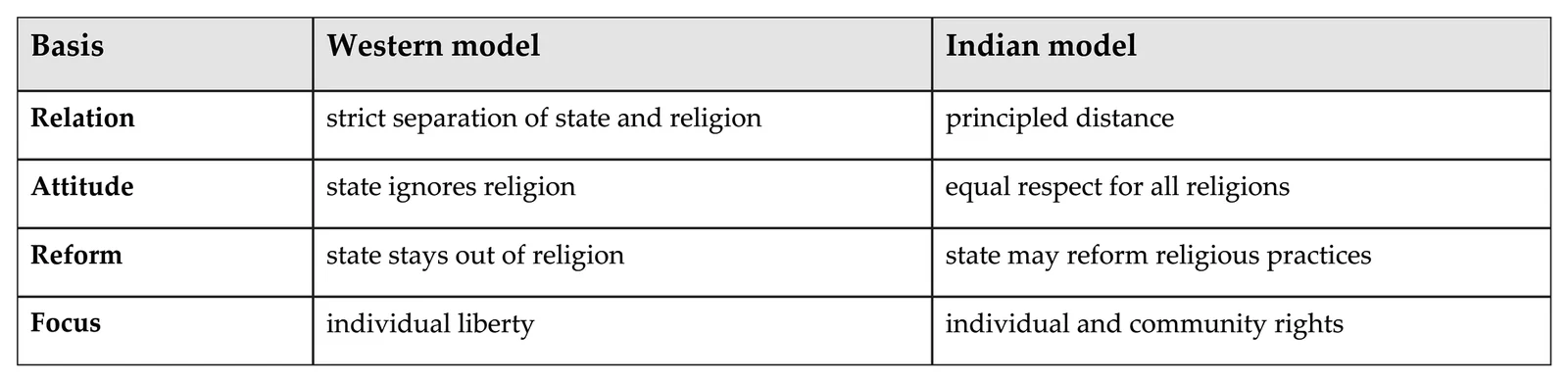
Rajeev Bhargava, in Secularism and its Critics (1998), argues that Indian secularism is a distinct model, not a poor copy of Western secularism. The American model builds a wall of separation between state and religion; the French model of laïcité keeps religion out of public life. Indian secularism instead follows principled distance: the state may keep away from religion or engage with it, depending on which better promotes freedom and equality. It may fund minority schools, reform caste practices in Hindu temples or ban untouchability. Bhargava calls this a contextual secularism that values both individual and community rights.
Neera Chandhoke, in her essay ‘Secularism’ (2010), argues that Indian secularism is best understood as a principle of equality among religious communities. In a plural society, secularism is needed so that no community dominates others and minorities enjoy equal citizenship. Its purpose is not hostility to religion but protection against majoritarianism. Indian secularism therefore combines equal respect for all religions (sarva dharma samabhava) with a state that does not identify with any religion.
3.3 The Critics of Secularism
Indian secularism has been attacked from several directions. T.N. Madan, in ‘Secularism in its Place’ (1987), argues that secularism is a product of Western Protestant Christianity and cannot be a shared credo for South Asians, whose faiths do not separate the sacred from the secular. Ashis Nandy, in ‘An Anti-Secularist Manifesto’ (1985), distinguishes religion as faith, tolerant and plural, from religion as ideology, used for political mobilisation. He argues that the modern secular state, by marginalising faith, has encouraged ideological religion and communal violence, and that tolerance must be recovered from India’s religious traditions.

Hindu nationalists criticise Indian secularism from another side, calling it pseudo-secularism: in their view, the state appeases minorities, as in the Shah Bano case (1985–86), while interfering in Hindu institutions. Partha Chatterjee argues for a politics of toleration that respects the right of minorities to be different. Thomas Pantham, in ‘Understanding Indian Secularism: Learning from its Recent Critics’ (2004), argues that defenders of secularism should learn from these critics and see Indian secularism as rooted in India’s own traditions of dialogue and tolerance, especially in Gandhi, rather than as an imported doctrine.
3.4 Communalism
Communalism is the ideology that a religious community has common political interests opposed to those of other communities. Bipan Chandra identified three stages: the belief that followers of one religion share secular interests; liberal communalism, which sees those interests as different but reconcilable; and extreme communalism, which sees them as hostile. Communalism grew under colonial rule through separate electorates (1909), the politics of the Muslim League and the Hindu Mahasabha, and culminated in Partition (1947).

After independence, communal violence continued in episodes such as the anti-Sikh violence of 1984, the riots after the demolition of the Babri Masjid in 1992–93, Gujarat in 2002 and Muzaffarnagar in 2013. Paul Brass described an institutionalised riot system in which local politicians and networks produce riots for political gain. Steven Wilkinson argues that riots are more likely where electoral competition rewards polarisation and governments lack incentives to protect minorities, while Ashutosh Varshney shows that cities with strong inter-communal civic associations have fewer riots.
3.5 Important Questions
- Question 1 Discuss the nature of Indian secularism. How is it different from the Western model?
- Question 2 Examine the main critiques of Indian secularism. Discuss Thomas Pantham’s view on learning from its critics.
- Question 3 What is communalism? Discuss its causes and its impact on Indian politics.
DU asks the same idea in different words. So learn one broad answer for each question below; the same answer works for every question joined by OR.
Important Question 1
Discuss the nature of Indian secularism. How is it different from the Western model?
OR
Explain Rajeev Bhargava’s idea of principled distance.
OR
‘Indian secularism is a distinct model, not a poor copy of Western secularism.’ Discuss.
Model Answer
“If I were a dictator, religion and State would be separate. I swear by my religion. I will die for it. But it is my personal affair. The State has nothing to do with it.”
— M.K. Gandhi, Harijan (1946)
Introduction. Secularism is one of the founding principles of the Indian Constitution. But Indian secularism has developed in a society where religion is central to life and where there are many religious communities with unequal power. As a result, it differs from the Western model of strict separation. Rajeev Bhargava and Neera Chandhoke explain its distinctive character.
1. Meaning of Secularism
In general, secularism means that the state does not belong to any religion, does not discriminate among citizens on grounds of religion and guarantees religious freedom. Its aim is to prevent domination by religious institutions and by religious majorities over individuals and minorities.
2. The Western Model
In the American model, a wall of separation divides church and state; the state neither supports nor interferes with religion. In the French model of laïcité, the state actively excludes religion from public institutions. Both treat religion mainly as a private matter of individual belief.
3. The Indian Context
India’s situation was different. Religion shapes social life, many communities coexist, Partition had produced terrible violence, and the dominant Hindu religion contained hierarchical practices such as untouchability. A secularism of mere non-interference would have left caste oppression untouched and minorities insecure.
4. Constitutional Provisions
The Constitution guarantees equality and non-discrimination (Articles 14–16), freedom of religion subject to public order, morality, health and social reform (Article 25), the autonomy of religious denominations (Article 26), no tax for any religion (Article 27), no religious instruction in state institutions (Article 28) and minority rights (Articles 29–30). Article 17 abolishes untouchability.
5. Principled Distance
Bhargava calls Indian secularism principled distance. The state keeps a distance from all religions, but the distance is flexible: it may intervene in or abstain from religious matters, and may treat religions differently, if this promotes freedom and equality. Intervention must follow principles, not partisan interest.
6. Equal Respect
Indian secularism also expresses equal respect for all religions, or sarva dharma samabhava, an idea associated with Gandhi. The state recognises religious festivals, holidays and personal laws of different communities, aiming at equality among them rather than indifference to them.
7. Reform and Intervention
Unlike the American model, the Indian state reformed religious practices: it abolished untouchability, opened temples to Dalits, enacted Hindu Code Bills in the 1950s and banned instant triple talaq in 2019 after the Supreme Court’s Shayara Bano judgment (2017). This reflects the Constitution’s commitment to equality within religions.
8. Community Rights
Indian secularism protects not only individuals but also communities: minorities may run their own educational institutions and follow personal laws. Bhargava sees this as a strength, recognising that individuals live within communities.
9. Chandhoke on Equality
Chandhoke argues that the core of Indian secularism is equality among communities and the protection of minorities against majoritarianism. Secularism is necessary because in a plural society one community may otherwise use the state to dominate others.
10. Basic Structure
In S.R. Bommai v. Union of India (1994), the Supreme Court held that secularism is part of the basic structure of the Constitution and that a state government acting against secularism could be dismissed. Secularism therefore cannot be removed even by constitutional amendment.
11. Nehru’s Secularism
Nehru saw secularism as the foundation of a modern, united India. For him it meant a state that did not identify with any religion, equal citizenship and a scientific temper in public life. He regarded communalism as the greatest danger to the nation after Partition, and he pushed through the Hindu Code Bills of 1955–56, which reformed Hindu marriage, divorce and inheritance law and gave women new rights.
12. State and Religious Institutions
The Indian state is closely involved with religious institutions. Several states administer Hindu temples through endowment departments, governments fund minority educational institutions, and pilgrimages have received state support. The Haj subsidy, for instance, was phased out in 2018 after the Supreme Court asked for its withdrawal in 2012. Such involvement is consistent with principled distance only if it is applied fairly to all communities.
13. Problems in Practice
Critics argue that in practice the state has been inconsistent: reforming Hindu personal law but not other personal laws, yielding to religious pressure in cases such as Shah Bano, and failing to prevent communal violence. Such inconsistency has fed charges of appeasement on one side and majoritarianism on the other.
14. Evaluation
Indian secularism is an original response to deep religious diversity. Its flexibility allows it to promote equality and reform, but this same flexibility can be misused for partisan ends. Its success depends on applying principled distance consistently and impartially.
Conclusion. Thus, Indian secularism differs from the Western model of strict separation. It combines principled distance, equal respect for all religions, state intervention for social reform and protection of community rights, with equality and freedom as its goals, as Bhargava and Chandhoke explain.
Important Question 2
Examine the main critiques of Indian secularism. Discuss Thomas Pantham’s view on learning from its critics.
OR
Discuss the critique of secularism by T.N. Madan and Ashis Nandy.
OR
Critically examine the debate between secularists and their critics in India.
Model Answer
“In the prevailing circumstances, secularism in South Asia as a generally shared credo of life is impossible, as a basis for state action impracticable, and as a blueprint for the foreseeable future impotent.”
— T.N. Madan, ‘Secularism in its Place’ (1987)
Introduction. Since the 1980s, the rise of religious mobilisation and communal violence led to a crisis of Indian secularism. Critics argued that secularism itself was part of the problem. These critiques came from very different directions: anti-modernist scholars such as T.N. Madan and Ashis Nandy, Hindu nationalists, and others. Thomas Pantham argues that defenders of secularism can learn from them.
1. The Crisis of Secularism
The 1980s saw the Shah Bano controversy, the opening of the locks at the Babri Masjid (1986), the Ram Janmabhoomi movement and the demolition of the mosque in 1992, followed by riots. These events raised doubts about whether secularism could hold in Indian society.
2. Madan: Secularism as Alien
T.N. Madan argues that secularism emerged from the Protestant Reformation and the European separation of the sacred and secular. South Asian religions do not make this separation; religion is a total way of life. Imposed by a modernised elite, secularism is impossible as a shared creed, impracticable for the state and impotent against fundamentalism.
3. Madan’s Alternative
Madan suggests that religious traditions themselves contain resources of tolerance. Instead of excluding religion, Indians should draw on the best in their faiths to build mutual respect. Secularism must be put in its place, as one value among others, not as an imposed doctrine.
4. Nandy: Faith and Ideology
Ashis Nandy distinguishes religion as faith, a way of life that is plural, tolerant and lived, from religion as ideology, a political identity used to mobilise people. He argues that modern secularism, by treating faith as backward, has strengthened religion as ideology and produced the very fanaticism it opposes.
5. Nandy’s Anti-secularism
In ‘An Anti-Secularist Manifesto’, Nandy argues that the modern state and its secular elites have been responsible for much violence, and that India should recover the traditions of tolerance found in everyday religion and in figures such as Gandhi, who was deeply religious but opposed to communalism.
6. The Hindu Nationalist Critique
Hindu nationalists argue that Indian secularism is pseudo-secularism: the state reforms Hindu laws and controls Hindu temples but allows minorities their own personal laws and privileges, appeasing them for votes. They call for a uniform civil code and a secularism that treats all communities identically.
7. Chatterjee on Toleration
Partha Chatterjee argues that the secular state cannot simply impose uniformity. Minorities should have the right to be different, but communities should give reasons for their practices in public, allowing democratic debate within them. He seeks a strategy of toleration rather than state-imposed reform.
8. Defenders’ Response
Bhargava replies that critics misunderstand Indian secularism, which was never the strict Western separation. Principled distance allows engagement with religion. Achin Vanaik and others argue that critics romanticise tradition and ignore the oppression within religious communities.
9. Pantham’s Argument
Thomas Pantham argues that defenders of secularism should not dismiss the critics but learn from them. The critics show that secularism cannot be an elite doctrine imposed from above and that religious traditions contain resources of tolerance. Indian secularism should be understood as a distinct, home-grown model.
10. A Dialogical Secularism
Pantham draws on Gandhi’s idea of equal respect and dialogue among religions. Indian secularism, in this view, involves both a state that does not discriminate and a society in which religions engage in dialogue, criticise their own injustices and respect one another.
11. Ambedkar’s Perspective
Ambedkar offered another view. In the Constituent Assembly he argued that religion should be confined to beliefs and to rituals that are essentially religious, so that the state could reform social institutions that religion had used to justify inequality. For Ambedkar, secularism had to serve equality and dignity, especially for Dalits, and could not simply defer to religious tradition.
12. Recent Debates
Since 2014 the debate has turned to the charge of majoritarianism. Critics point to the Citizenship (Amendment) Act of 2019, which offers faster citizenship to non-Muslim refugees from three neighbouring countries, to cow protection laws and to mob lynchings, which led the Supreme Court to issue guidelines in Tehseen Poonawalla (2018). Supporters reply that these measures correct earlier imbalances and protect persecuted minorities.
13. Evaluating the Critiques
The critics rightly point to the elitism of some secularists and the limits of state action. But abandoning secularism risks majoritarian domination. Many scholars conclude that India needs a secularism that is both principled and rooted in society.
14. Evaluation
The debate has enriched understanding of Indian secularism. It shows that secularism must win popular legitimacy, be applied consistently and draw on Indian traditions of tolerance, while continuing to guarantee equal citizenship.
Conclusion. Thus, Madan sees secularism as alien, Nandy blames it for encouraging ideological religion, and Hindu nationalists call it pseudo-secularism. Pantham argues that Indian secularism can learn from these critics by rooting itself in India’s traditions of dialogue and equal respect, while remaining committed to equality.
Important Question 3
What is communalism? Discuss its causes and its impact on Indian politics.
OR
Examine the nature of communal politics and communal violence in India.
OR
Discuss the relationship between religion, elections and communal violence in India.
Model Answer
“Communalism is the belief that because a group of people follow a particular religion they have, as a result, common social, political and economic interests.”
— Bipan Chandra, India’s Struggle for Independence (1988)
Introduction. Communalism has been one of the gravest challenges to Indian democracy. It divided the national movement, led to Partition and has produced recurring riots and polarisation since independence. Understanding communalism requires attention to its ideology, its historical roots and the political incentives that sustain it.
1. Meaning
Communalism is not religion or religious devotion as such. It is an ideology that treats a religious community as a political community with common secular interests, separate from and often opposed to those of other communities. It turns religious identity into a basis of political mobilisation and hostility.
2. Bipan Chandra’s Three Stages
Bipan Chandra identified three stages: first, the belief that followers of one religion share common secular interests; second, liberal communalism, which holds that these interests differ from those of other communities but can be reconciled; and third, extreme communalism, which holds that they are mutually hostile and incompatible.
3. Colonial Roots
Communalism grew under colonial rule. British census categories, the policy of divide and rule, separate electorates (1909), competition for jobs and representation, and religious revivalist movements hardened religious boundaries. The Muslim League (1906) and the Hindu Mahasabha (1915) represented communal politics.
4. Partition
The demand for Pakistan, based on the two-nation theory, led to Partition in 1947, accompanied by massive violence and migration. Partition shaped Indian secularism, which sought to ensure that the new state would not be defined by religion.
5. Communalism after Independence
Communal tensions continued, with riots in Ahmedabad (1969), Bhiwandi (1970), Moradabad (1980) and elsewhere. The 1980s brought a sharp rise in religious mobilisation, the anti-Sikh violence of 1984 after Indira Gandhi’s assassination, and the Ayodhya movement.
6. Ayodhya and After
The demolition of the Babri Masjid on 6 December 1992 led to riots in Mumbai and elsewhere. The Godhra train fire and the Gujarat violence of 2002, the Muzaffarnagar riots of 2013 and the Delhi riots of 2020 continued the pattern. In 2019 the Supreme Court awarded the disputed site in Ayodhya for a temple and directed land for a mosque elsewhere.
7. Brass: The Riot System
Paul Brass argues that riots are not spontaneous. An institutionalised riot system of politicians, activists, criminals and local networks produces riots, which are then explained away as spontaneous. Riots serve political purposes such as polarising voters.
8. Wilkinson: Votes and Violence
Steven Wilkinson argues that electoral incentives shape riots. Politicians may provoke riots to polarise voters where elections are close, while state governments that depend on minority votes have strong incentives to prevent them. Riots are less likely where parties compete for minority support.
9. Varshney: Civic Life
Ashutosh Varshney, comparing peaceful and riot-prone cities, found that inter-communal civic associations, such as business groups, trade unions and clubs with Hindu and Muslim members, help prevent riots by managing tensions. Purely intra-communal networks do not.
10. Impact on Politics
Communalism polarises voters, encourages identity politics, weakens secular institutions, marginalises minorities and undermines trust. It can also strengthen parties that mobilise along religious lines and weaken those that seek cross-community support.
11. Religion and Election Law
Section 123(3) of the Representation of the People Act, 1951 makes an appeal for votes on the ground of religion a corrupt practice. In Abhiram Singh v. C.D. Commachen (2017), the Supreme Court held by a majority that appeals on grounds of the religion, caste, race, community or language of either the candidate or the voters are forbidden. Enforcement, however, has been weak, and coded religious appeals remain common in campaigns.
12. Majority and Minority Communalism
Communalism exists among both majority and minority communities, and each feeds the other. Nehru warned that the communalism of the majority is more dangerous, because it can present itself as nationalism and use the power of the state. Minority communalism, in turn, can isolate a community and give majority communalists an excuse. Secular politics must oppose both while protecting the weaker side.
13. Remedies
Remedies include impartial and professional policing, prompt justice for riot victims, firm action against hate speech, inter-communal civic engagement, education in shared history, and political leadership committed to equal citizenship.
14. Evaluation
Communalism is a modern political phenomenon, not a natural product of religious difference. It is produced and sustained by political incentives and organisations, and it can be countered by democratic institutions, civic ties and principled leadership.
Conclusion. Thus, communalism is an ideology that turns religious identity into political hostility. Rooted in colonial politics and Partition, it continues through riots and polarisation, which Brass, Wilkinson and Varshney explain through riot systems, electoral incentives and the weakness of inter-communal civic life.
Short Notes
(a) Principled distance
Rajeev Bhargava’s description of Indian secularism. The state keeps a distance from all religions, but may intervene in or abstain from religious matters, and may treat religions differently, when this better promotes freedom and equality. It explains, for example, both state reform of Hindu temples and state support for minority schools.
(b) Shah Bano case
In Mohd. Ahmed Khan v. Shah Bano Begum (1985), the Supreme Court held that a divorced Muslim woman could claim maintenance under the Criminal Procedure Code. After protests, Parliament passed the Muslim Women (Protection of Rights on Divorce) Act, 1986, which critics saw as appeasement, fuelling the charge of pseudo-secularism.
(c) Uniform Civil Code
Article 44, a Directive Principle, asks the state to endeavour to secure a uniform civil code for all citizens, replacing separate religious personal laws on marriage, divorce and inheritance. Supporters see it as equality; critics fear it will impose majority norms. Goa has long had a common code, and Uttarakhand enacted one in 2024.
(d) Religion as faith and as ideology
Ashis Nandy’s distinction. Religion as faith is a way of life, plural, operational and tolerant. Religion as ideology is a sub-national, national or cross-national identifier of populations used for political or economic interests. Nandy argues that modern secular politics has strengthened ideological religion.
(e) Sarva dharma samabhava
Equal respect for all religions, an ideal associated with Gandhi and often used to describe Indian secularism. Rather than ignoring religion, the state and citizens show equal regard for every faith, recognise the festivals and traditions of all communities and refuse to privilege any one. Critics argue that equal respect must be combined with equal treatment of citizens, or it can slide into competitive appeasement.
More notes: DSC-15 Political Process in India
These notes are prepared by PADHO TO AISE for study help. They are not an official University of Delhi publication.