
Semester V DSC-15 Political Process in India
Unit II · 22 min read · Updated 24 Nov 2026
As per the University of Delhi (DU) BA (Hons) Political Science syllabus
Contents
- 2.1 The Electoral Process
- 2.2 Representation
- 2.3 Social Determinants of Voting Behaviour
- 2.4 The Election Commission and Electoral Reforms
- 2.5 Important Questions
- Discuss the powers and functions of the Election Commission of India and assess its role in conducting free and fair elections.
- Discuss the major electoral reforms in India and the challenges that remain.
- Discuss the social determinants of voting behaviour in India.
- Discuss the nature of representation in Indian democracy.
- Short Notes
लोक सभा और प्रत्येक राज्य की विधान सभा के लिए निर्वाचन वयस्क मताधिकार के आधार पर होंगे।
The elections to the House of the People and to the Legislative Assembly of every State shall be on the basis of adult suffrage.
— Constitution of India, Article 326
ELECTIONS are the heart of Indian democracy. In 1951–52 India held its first general election with universal adult suffrage, at a time when most voters could not read and many democracies still restricted the vote. Today nearly a billion people are registered voters. This unit studies the electoral process, the system of representation that turns votes into seats, the social determinants of voting behaviour, and the Election Commission of India and the electoral reforms that have tried to keep elections free and fair. The readings include Niraja Gopal Jayal, Yogendra Yadav, E. Sridharan and Milan Vaishnav, and Ujjwal Kumar Singh and Anupama Roy.

2.1 The Electoral Process
India uses the first-past-the-post (FPTP) system: the country is divided into single-member constituencies, and the candidate with the most votes wins, even without a majority. The electoral process has several stages: delimitation of constituencies by a Delimitation Commission; preparation of electoral rolls; announcement of the schedule, after which the Model Code of Conduct applies; nomination and scrutiny of candidates; campaigning; polling, now with electronic voting machines (EVMs) and VVPAT slips; and counting and declaration of results. Disputes are decided by High Courts through election petitions.
S. Kumar describes Indian elections as a festival of democracy and a huge administrative exercise, involving millions of officials and security personnel and lasting several weeks. Turnout has risen over time, from about 45 per cent in 1952 to over 65 per cent in recent elections. Voter education programmes such as SVEEP (2009), photo identity cards (1993) and EVMs have made voting easier and counting faster.
2.2 Representation
Representation means making the people present in the institutions that govern them. Yogendra Yadav, in his essay ‘Representation’, shows that the Indian Constitution combined territorial representation through FPTP with group representation through reserved constituencies for Scheduled Castes and Scheduled Tribes, elected by all voters in joint electorates. The Constituent Assembly rejected separate electorates, which it blamed for Partition, and also rejected proportional representation, preferring stable majorities. In 2023 the 106th Amendment provided for one-third reservation for women in the Lok Sabha and state Assemblies, to take effect after the next delimitation.

Niraja Gopal Jayal, in Representing India (2006), examines how far India’s public institutions reflect its ethnic and social diversity. She distinguishes descriptive representation, where legislators resemble the groups they represent, from substantive representation, where they act for those groups’ interests. India has done better than many democracies in including Dalits, Adivasis and, since the 1990s, backward castes, but women and Muslims remain under-represented. Christophe Jaffrelot described the rise of OBC legislators in north India as a silent revolution.
2.3 Social Determinants of Voting Behaviour
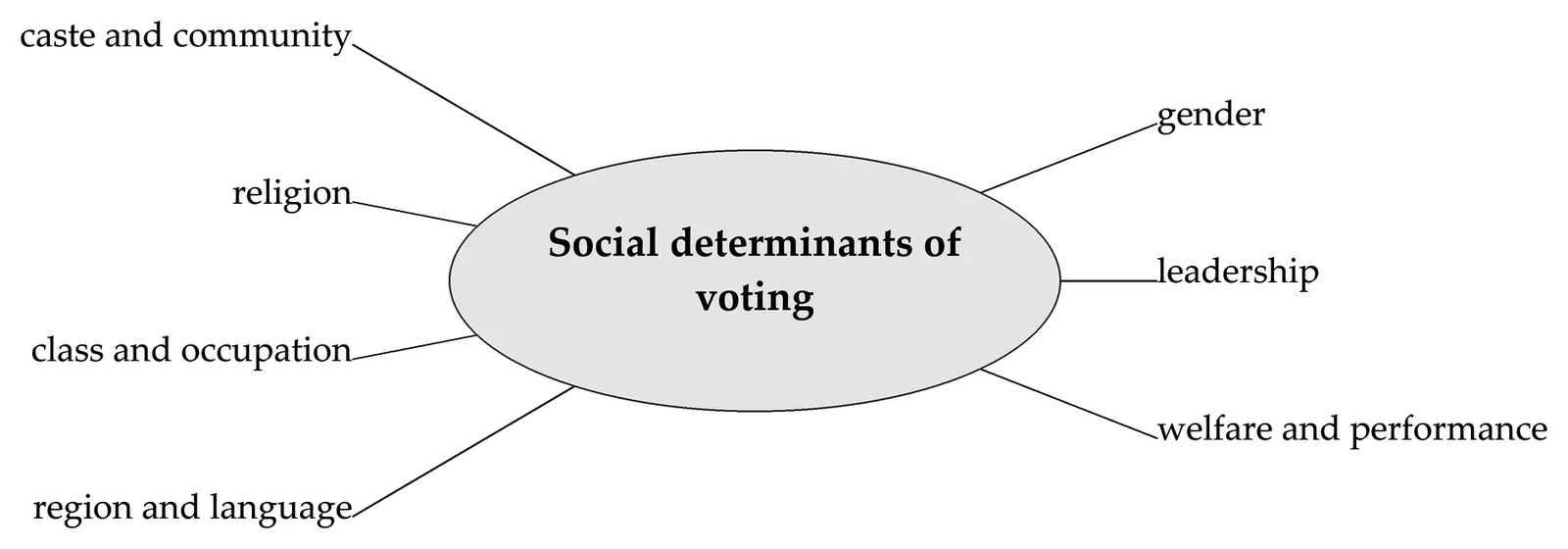
Voting behaviour is shaped by many factors. Caste has long been important, through caste associations, dominant castes and caste-based parties. Religion matters, especially in polarised contexts. Class, region, language, gender, age and urban or rural location also influence choices. Studies by the Lokniti–CSDS National Election Studies show that no single factor decides elections: voters also respond to leadership, party loyalty, government performance and welfare benefits. Since 2014, leadership and welfare delivery have become more important, while caste and community remain powerful.
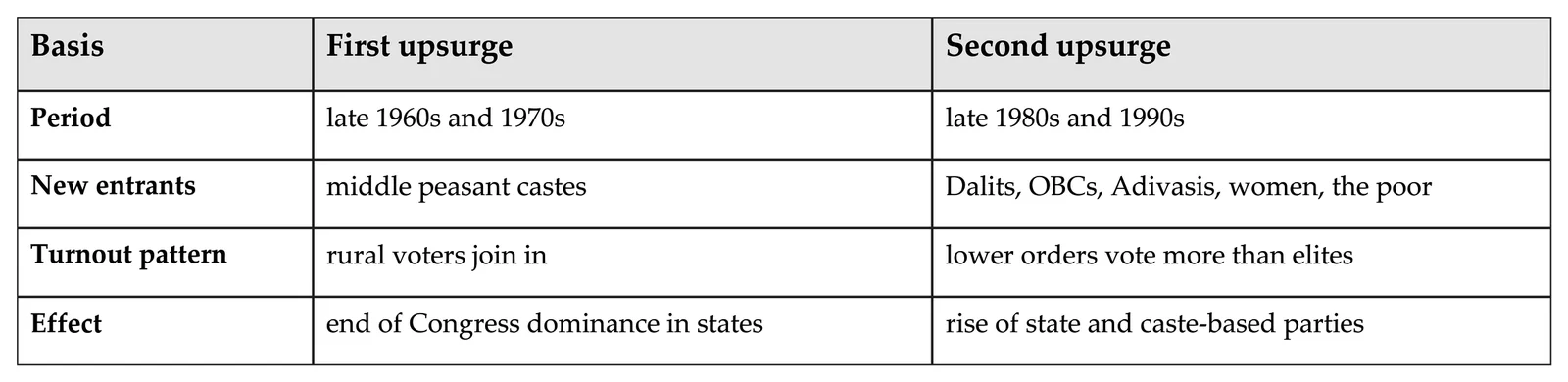
Yogendra Yadav, in ‘Understanding the Second Democratic Upsurge’ (2000), argues that the 1990s saw a dramatic increase in the participation of the lower orders: Dalits, Adivasis, OBCs, women and the rural poor began to vote at higher rates than the urban, educated upper castes. Unlike Western democracies, where the poor vote less, in India the poor became the most enthusiastic voters. This upsurge produced the rise of new parties and leaders representing these groups.
2.4 The Election Commission and Electoral Reforms
The Election Commission of India (ECI), created under Article 324, has the superintendence, direction and control of elections to Parliament, state legislatures and the offices of President and Vice-President. It was a single-member body until 1989 and has been multi-member since 1993, with a Chief Election Commissioner (CEC) and two Election Commissioners. The CEC can be removed only like a Supreme Court judge. E. Sridharan and Milan Vaishnav regard the ECI as one of India’s most credible institutions, while Ujjwal Kumar Singh and Anupama Roy show how it expanded its role into a regulator of the electoral domain, especially under T.N. Seshan (1990–96).

Electoral reforms have tried to deal with money power, criminalisation, defections and voter access. Important reforms include the anti-defection law (1985), voting at 18 (1989), EVMs, photo identity cards, disclosure of candidates’ criminal records and assets (2002–03), the immediate disqualification of convicted legislators (2013), NOTA and VVPAT (2013), and the Supreme Court’s striking down of electoral bonds in February 2024. Debates continue on state funding of elections, simultaneous elections and the appointment of Election Commissioners.
2.5 Important Questions
- Question 1 Discuss the powers and functions of the Election Commission of India and assess its role in conducting free and fair elections.
- Question 2 Discuss the major electoral reforms in India and the challenges that remain.
- Question 3 Discuss the social determinants of voting behaviour in India.
- Question 4 Discuss the nature of representation in Indian democracy.
DU asks the same idea in different words. So learn one broad answer for each question below; the same answer works for every question joined by OR.
Important Question 1
Discuss the powers and functions of the Election Commission of India and assess its role in conducting free and fair elections.
OR
Examine the independence and effectiveness of the Election Commission of India.
OR
‘The Election Commission has become a regulator of the electoral domain.’ Discuss.
Model Answer
“The superintendence, direction and control of the preparation of the electoral rolls for, and the conduct of, all elections … shall be vested in a Commission.”
— Constitution of India, Article 324(1)
Introduction. Free and fair elections are the foundation of democracy, and in India they are the responsibility of the Election Commission. Created by Article 324 of the Constitution, the Commission has conducted elections on a vast scale since 1951–52 and is widely regarded as one of India’s most trusted institutions. Scholars such as Sridharan and Vaishnav, and Singh and Roy, study its powers, independence and changing role.
1. Constitutional Basis
Article 324 vests in the Election Commission the superintendence, direction and control of the preparation of electoral rolls and the conduct of elections to Parliament, state legislatures and the offices of President and Vice-President. Articles 325 to 329 provide for a single electoral roll without discrimination, adult suffrage and the bar on courts interfering in electoral matters except through election petitions.
2. Composition
The Commission consists of a Chief Election Commissioner and other Election Commissioners appointed by the President. It was single-member until 1989, briefly multi-member in 1989–90, and permanently multi-member since 1993. The Supreme Court upheld this arrangement in 1995, holding that decisions should be taken by majority.
3. Appointment and Independence
The CEC can be removed only in the manner of a Supreme Court judge, and his service conditions cannot be varied to his disadvantage. In Anoop Baranwal v. Union of India (2023), the Supreme Court held that appointments should be made on the advice of a committee including the Chief Justice until Parliament made a law. Parliament’s 2023 Act replaced the Chief Justice with a Union minister, which critics say weakens independence.
4. Administrative Functions
The Commission prepares and revises electoral rolls, delimits constituencies for local purposes with the Delimitation Commission, issues voter identity cards, fixes the election schedule, appoints observers, supervises polling staff and security forces, and declares results. During elections, government officials engaged in election work come under its control.
5. Quasi-legislative and Quasi-judicial Functions
The Commission recognises political parties and allots symbols under the Election Symbols Order of 1968, decides disputes over party splits and symbols, and advises the President or Governor on disqualification of legislators. It also issues directions to fill gaps where the law is silent, a power the Supreme Court has recognised under Article 324.
6. Model Code of Conduct
The Model Code of Conduct, first used in Kerala in 1960 and later adopted nationally, guides parties, candidates and governments during elections. It forbids appeals to caste or religion, the misuse of official machinery and new schemes announced after the schedule. Though not a law, the Commission enforces it through warnings, campaign bans and transfers of officials.
7. The Seshan Era
T.N. Seshan, CEC from 1990 to 1996, transformed the Commission by strictly enforcing the Model Code, checking expenditure, insisting on photo identity cards and confronting governments. Singh and Roy argue that this period marked the Commission’s emergence as an assertive regulator of the electoral domain.
8. Sridharan and Vaishnav’s Assessment
Sridharan and Vaishnav describe the Commission as one of India’s most successful institutions, praised for conducting elections efficiently and impartially. They identify challenges: weak control over campaign finance, inability to deregister parties, limited power to act against criminal candidates, and dependence on the government for staff, funds and appointments.
9. Technology
The Commission introduced electronic voting machines, used nationally since 2004, and VVPAT slips, which allow voters to verify their vote. These reduced booth capturing and invalid votes, though some parties have questioned EVMs. The Supreme Court in 2024 rejected pleas to return to paper ballots.
10. Inclusion
Through SVEEP, the Commission has encouraged registration and turnout, especially of women, young people and marginalised groups. It sets up polling stations so that voters need not travel far, even in remote forests and mountains. Women’s turnout exceeded men’s in 2019.
11. Criticisms
Critics have questioned the Commission’s neutrality in recent years, pointing to delays in acting against leaders accused of violating the Model Code, the scheduling of elections, and the new appointment law. Others argue that it lacks sufficient legal powers to deal with money power and hate speech.
12. Evaluation
The Election Commission has made Indian elections broadly free, fair and credible, a remarkable achievement in a vast, diverse and poor country. Its strength depends on its independence and on public trust, both of which require transparent appointments and firm, impartial action.
Conclusion. Thus, the Election Commission, created by Article 324, administers elections, recognises parties, enforces the Model Code and regulates the electoral domain. It has earned high credibility, especially since the Seshan era, but questions about appointments, powers and neutrality show the need for continued reform.
Important Question 2
Discuss the major electoral reforms in India and the challenges that remain.
OR
Examine the problems of money power and criminalisation in Indian elections and the reforms to address them.
OR
Critically assess the need for electoral reforms in India.
Model Answer
“In politics we will be recognizing the principle of one man one vote and one vote one value.”
— B.R. Ambedkar, Constituent Assembly (25 November 1949)
Introduction. Indian elections are free and competitive, but they suffer from serious problems: the influence of money, criminalisation of politics, defections, misuse of government machinery and, at times, doubts about the fairness of procedures. Since the 1970s many committees, the Election Commission, the Law Commission and the Supreme Court have proposed and introduced electoral reforms.
1. Need for Reform
Elections in India have become very expensive, and candidates spend far more than the legal limits. Many legislators face criminal cases, including serious ones. Parties lack internal democracy and transparency in funding. Such problems weaken equality among voters and candidates and reduce public trust.
2. Reform Committees
Important bodies include the Tarkunde Committee (1975), the Dinesh Goswami Committee (1990), the Indrajit Gupta Committee on state funding (1998), the Law Commission’s 170th Report (1999) and the Election Commission’s proposals of 2004. Their recommendations covered funding, criminalisation, defection and the conduct of elections.
3. Anti-defection Law
The 52nd Amendment (1985) added the Tenth Schedule, disqualifying legislators who leave their party or defy its whip. The 91st Amendment (2003) removed the protection for splits. The law reduced defections, but critics say it weakened legislators’ independence, and Speakers have often delayed decisions.
4. Voting Age and Access
The 61st Amendment (1988) lowered the voting age from 21 to 18. Photo identity cards (1993), EVMs and the expansion of polling stations made voting easier and reduced impersonation and booth capturing.
5. Disclosure by Candidates
In Union of India v. Association for Democratic Reforms (2002) and PUCL v. Union of India (2003), the Supreme Court held that voters have a right to know about candidates. Candidates must now disclose criminal cases, assets, liabilities and educational qualifications in affidavits.
6. Criminalisation
In Lily Thomas v. Union of India (2013), the Court struck down the protection that allowed convicted legislators to continue while appealing, so a legislator convicted and sentenced to two years or more is disqualified at once. In 2020 it directed parties to publish the reasons for choosing candidates with criminal cases.
7. NOTA and VVPAT
In 2013 the Supreme Court introduced the None of the Above option, allowing voters to reject all candidates secretly, and ordered the phased introduction of VVPAT to make EVMs verifiable. NOTA has symbolic value, though it does not affect results.
8. Money Power
Expenditure limits apply to candidates, currently up to 95 lakh rupees for a Lok Sabha seat in larger states, but not to parties. Corporate funding and cash spending remain largely opaque. The Indrajit Gupta Committee recommended partial state funding, which has not been introduced.
9. Electoral Bonds
The electoral bond scheme of 2018 allowed anonymous donations to parties through bank instruments. In Association for Democratic Reforms v. Union of India (February 2024), the Supreme Court struck it down as violating voters’ right to information, and the details of bond purchases were made public.
10. Simultaneous Elections
A high-level committee headed by former President Ram Nath Kovind recommended in 2024 holding Lok Sabha and Assembly elections together, and a constitutional amendment bill was introduced in December 2024. Supporters cite savings and governance; critics fear harm to federalism and accountability.
11. Inner-party Democracy
Many reformers argue that clean elections need democratic parties. The Law Commission’s 170th Report (1999) recommended a law requiring parties to hold regular internal elections and to publish audited accounts. Parties have resisted such regulation, and the Election Commission has no power to deregister a party for failing to hold internal elections, so candidate selection often remains controlled by a few leaders.
12. Paid News and Social Media
Paid news, political advertising disguised as news, has been treated by the Election Commission as election expenditure; in 2011 it disqualified an Uttar Pradesh legislator, Umlesh Yadav, for failing to account for it. Candidates must declare their social media accounts, and in 2019 social media companies adopted a voluntary code of ethics for elections, but misinformation and online hate speech remain hard to regulate.
13. Remaining Challenges
Challenges include campaign finance transparency, inner-party democracy, regulation of social media and hate speech, criminal candidates, the independence of the Election Commission, and the registration of migrant workers who cannot vote where they work.
14. Evaluation
Electoral reforms have made voting more accessible and elections more transparent, often through the initiative of the Election Commission and the courts rather than Parliament. Deeper reforms of party finance and criminalisation require political will that parties have often lacked.
Conclusion. Thus, electoral reforms such as the anti-defection law, voting at 18, EVMs, candidate disclosure, NOTA, VVPAT and the ending of electoral bonds have strengthened Indian elections, but money power, criminalisation and questions of institutional independence remain serious challenges.
Important Question 3
Discuss the social determinants of voting behaviour in India.
OR
Examine the role of caste, religion and class in voting behaviour in India.
OR
What does Yogendra Yadav mean by the ‘second democratic upsurge’? Discuss.
Model Answer
“A person thinks, politically, as he is socially. Social characteristics determine political preference.”
— Paul Lazarsfeld, Bernard Berelson and Hazel Gaudet, The People’s Choice (1944)
Introduction. Voting behaviour refers to how and why people vote as they do. In India, voters belong to many castes, religions, classes, regions and languages, and these social identities shape their political choices. Yet voters also respond to leaders, performance and issues. Studies by Lokniti–CSDS, and the work of Yogendra Yadav and others, show the changing mix of these factors.
1. Approaches to Voting Behaviour
Scholars use several approaches. The sociological approach, following Lazarsfeld, links voting to social groups. The psychological approach emphasises party identification. The rational choice approach sees voters as weighing costs and benefits. In India, all three have some value.
2. Caste
Caste is the most studied determinant. Caste associations, dominant castes and caste-based parties mobilise votes, and many voters prefer candidates of their own caste. But caste voting is not uniform: castes split their votes, and large castes contain classes and factions. Parties build coalitions of castes rather than relying on one.
3. Religion
Religion shapes voting especially when politics is polarised, as during the Ayodhya movement and after communal riots. Muslims have often voted strategically for the party best placed to defeat the BJP, while the BJP has consolidated a large share of Hindu votes across castes since 2014.
4. Class
Class influences voting through income, occupation and welfare. The poor have often supported parties promising welfare, and the middle class has favoured parties associated with growth. Yet class voting in India is weaker than in Western democracies, because class overlaps with caste and community.
5. Region and Language
Regional identities and grievances explain the strength of state parties, such as the DMK in Tamil Nadu or the Trinamool Congress in West Bengal. Voters often support parties that defend their state’s language, culture and interests against the centre.
6. Gender
Women’s turnout has risen sharply and in 2019 slightly exceeded men’s. Parties now target women voters with schemes such as cooking gas connections, cash transfers and safety measures. Women increasingly make independent choices, though family influence remains.
7. Age and Urbanisation
Young and first-time voters, urban voters and those exposed to media and education are less tied to traditional loyalties and more responsive to leadership, aspiration and national issues. K.C. Suri links these changes to the BJP’s success.
8. Leadership and Performance
Voters also judge leaders and governments. Popular leaders such as Indira Gandhi in 1971 and Narendra Modi in 2014 and 2019 shaped national elections. Anti-incumbency, the tendency to vote out governments, has been strong in many states, while governments that deliver services are often re-elected.
9. Welfare and Beneficiaries
Direct benefit transfers and welfare schemes have created a new category of beneficiary voters. Surveys show that receipt of benefits influences voting, though voters often credit the leader rather than the local candidate.
10. The Second Democratic Upsurge
Yadav argues that the 1990s saw a second democratic upsurge. The first, in the late 1960s and 1970s, brought middle peasant castes into politics. The second brought Dalits, Adivasis, OBCs, women and the rural poor, whose turnout rose above that of the urban educated elite. In India, unlike in the West, the poor vote more than the rich.
11. Consequences
The upsurge produced the rise of parties such as the BSP, Samajwadi Party and RJD, the growth of OBC representation in legislatures, and a more competitive and plural democracy. It also intensified identity politics and the use of caste in elections.
12. Evaluation
Voting behaviour in India is shaped by a combination of social identity and political judgement. Caste and religion remain powerful, but leadership, welfare and performance increasingly matter. Indian voters are neither simply prisoners of identity nor purely rational calculators.
Conclusion. Thus, caste, religion, class, region, gender, age, leadership and welfare all influence voting behaviour in India. Yadav’s second democratic upsurge shows how the lower orders became the most active voters, transforming Indian democracy from below.
Important Question 4
Discuss the nature of representation in Indian democracy.
OR
Examine the system of territorial and group representation in India.
OR
How far do India’s representative institutions reflect its social diversity? Discuss with reference to Niraja Gopal Jayal.
Model Answer
“Representation … means the making present in some sense of something which is nevertheless not present literally or in fact.”
— Hanna Pitkin, The Concept of Representation (1967)
Introduction. In a democracy of over a billion people, citizens govern through representatives. The design of representation, how votes become seats and which groups find a place in legislatures, shapes the character of democracy. Yogendra Yadav and Niraja Gopal Jayal show that India combined territorial representation with special provisions for disadvantaged groups.
1. Meaning of Representation
Hanna Pitkin distinguished several meanings of representation: formal authorisation, descriptive representation, where representatives resemble the represented, symbolic representation and substantive representation, acting in the interests of the represented. Indian debates involve all of these.
2. Territorial Representation
India elects its Lok Sabha and state Assemblies from single-member territorial constituencies through first-past-the-post. Each constituency should have roughly equal population, and boundaries are drawn by the Delimitation Commission. The number of seats per state has been frozen on the 1971 census until after 2026.
3. Why First-past-the-post
The Constituent Assembly chose FPTP for its simplicity, familiarity and tendency to produce stable majorities. It rejected proportional representation as too complex for a largely illiterate electorate and likely to fragment the legislature. Yadav notes that FPTP can produce large gaps between votes and seats.
4. Group Representation
Articles 330 and 332 reserve seats for Scheduled Castes and Scheduled Tribes in proportion to their population. Candidates in these seats must belong to the group, but all voters elect them through joint electorates. The Assembly rejected separate electorates, which were associated with communal division and Partition.
5. The Poona Pact Legacy
The system of reserved seats in joint electorates goes back to the Poona Pact of 1932 between Ambedkar and Gandhi. Ambedkar had sought separate electorates for the Depressed Classes; the compromise gave them reserved seats with joint electorates. Critics argue that reserved-seat representatives depend on upper-caste votes.
6. Descriptive and Substantive Representation
Jayal distinguishes descriptive representation, the presence of groups, from substantive representation, the pursuit of their interests. Reservation has ensured the presence of Dalits and Adivasis, but critics debate whether their representatives can effectively voice group interests within party discipline.
7. Backward Castes
No seats are reserved for OBCs in legislatures, but their representation rose sharply after the 1990s. Jaffrelot called the rise of OBC legislators in north India a silent revolution, achieved through elections rather than quotas.
8. Women
Women formed under 15 per cent of the Lok Sabha for decades. The 73rd and 74th Amendments (1992) reserved one-third of local government seats for women. The 106th Amendment (2023) provides one-third reservation in the Lok Sabha and Assemblies, effective after the next census and delimitation.
9. Minorities
Muslims form about 14 per cent of the population but have usually held a smaller share of Lok Sabha seats, falling further in recent elections. Jayal and others argue that their under-representation weakens the inclusiveness of democracy, though there is no constitutional provision for minority reservation.
10. Representation in Institutions
Jayal extends the question of representation to the bureaucracy, judiciary and other public institutions. Reservation in public employment has increased the presence of Dalits and Adivasis in government, but higher judiciary and senior positions remain dominated by upper castes and men.
11. Local Government
Representation has widened most dramatically at the local level. The 73rd and 74th Amendments (1992) reserved seats in panchayats and municipalities for SCs and STs in proportion to population and one-third for women, and many states have raised women’s reservation to half. More than a million women now hold elected local office, and studies show that women leaders often give more attention to drinking water and other local needs.
12. Debates on Reform
Proposals include proportional or mixed electoral systems to reduce the gap between votes and seats, rotation of reserved constituencies, and measures for minority representation. Each raises questions about stability, identity politics and fairness.
13. Evaluation
India’s system of representation has been remarkably inclusive for a society of deep inequality, bringing Dalits, Adivasis and backward castes into power. Gaps remain for women and minorities, and the distortions of FPTP continue to be debated.
Conclusion. Thus, Indian democracy combines territorial representation through first-past-the-post with group representation through reserved seats for SCs and STs, now extended to women. As Jayal and Yadav show, it has widened representation but still faces gaps in the presence of women and minorities.
Short Notes
(a) Model Code of Conduct
A set of guidelines for parties, candidates and governments during elections, first used in Kerala in 1960. It bars appeals to caste and religion, misuse of official machinery and new government schemes after the schedule is announced. It is not a law, but the Election Commission enforces it through warnings, campaign bans and transfers.
(b) NOTA
‘None of the Above’, introduced by the Supreme Court in PUCL v. Union of India (2013). It lets voters reject all candidates while keeping their vote secret. Even if NOTA receives the most votes, the candidate with the highest votes wins, so it is mainly a form of protest.
(c) Delimitation
The redrawing of constituency boundaries by an independent Delimitation Commission whose orders cannot be challenged in court. The number of seats per state has been frozen on the basis of the 1971 census until after 2026, to avoid penalising states that controlled population growth; boundaries were redrawn on the 2001 census in 2008.
(d) VVPAT
Voter Verifiable Paper Audit Trail, a printer attached to the EVM that shows the voter a slip with the chosen candidate’s name and symbol for seven seconds. It was first used in 2013 and is now used everywhere, with slips from five machines per Assembly segment counted to verify results.
More notes: DSC-15 Political Process in India
These notes are prepared by PADHO TO AISE for study help. They are not an official University of Delhi publication.