
Semester II DSC-6 Introduction to International Relations
Unit I · 27 min read · Updated 24 Nov 2026
As per the University of Delhi (DU) BA (Hons) Political Science syllabus
Contents
- 1.1 What is IR
- 1.2 Reading the Big Bangs
- 1.3 Bringing in De-colonial Accounts
- 1.4 Understanding the Genealogy of IR Discipline in India
- 1.5 Important Questions
- What is International Relations? Discuss its nature, scope and significance.
- Critically examine the ‘big bangs’ of IR: 1648 and 1919.
- Discuss the decolonial and postcolonial critiques of International Relations.
- Trace the genealogy of the IR discipline in India.
- Short Notes
बीसवीं सदी की समस्या रंग-रेखा की समस्या है।
The problem of the twentieth century is the problem of the color-line.
— W.E.B. Du Bois, The Souls of Black Folk (1903)
EVERY DISCIPLINE tells a story about its own birth. The usual story of International Relations (IR) goes like this: modern international politics began in 1648, when the Peace of Westphalia created a system of sovereign states, and the academic discipline began in 1919, when the horrors of the First World War led to the first chair of International Politics at Aberystwyth in Wales. In recent years scholars have shown that both these ‘big bangs’ are largely myths, and that the story leaves out empire, race, colonialism and the experience of the non-Western world. In this chapter we ask what IR is and why we study it, re-read the big bangs of 1648 and 1919, bring in the decolonial accounts that challenge the conventional story, and trace how the discipline developed in India.
1.1 What is IR
International Relations is the study of relations across the borders of states: among states, and among non-state actors such as international organisations, multinational corporations, NGOs, social movements and terrorist networks. Its classic questions are about war and peace, conflict and co-operation, power and order; its newer questions include trade and finance, human rights, migration, climate change, pandemics and global inequality. Some scholars prefer the terms international politics, which stresses power among states, or world politics and global politics, which include all actors and processes across the globe.
A. Reasons to study IR
Robert Jackson and Georg Sørensen [सॉरेनसेन], in Introduction to International Relations, begin from the fact that almost everyone in the world lives in a state, and that the state system is meant to protect five core values: security, protection from violence; freedom, both personal and national independence; order and justice, stable and fair relations; and welfare, the economic well-being of people. But states can also threaten these values, both for their own citizens and for others, so the state system is a double-edged sword. IR studies how states and other actors pursue, protect and threaten these values. Michael Nicholson adds that IR matters because decisions taken far away, on war, trade or the environment, shape our daily lives.
B. The place, time and subject of IR
David Blaney, in ‘Where, When and What is IR?’ (2020), argues that these questions are not simple. Where is IR produced? Mostly in the United States and Britain, which gives it a Western standpoint. When did it begin? The answer depends on which story of origins we accept. What does it study? If IR is defined as the study of sovereign states, then empire, colonialism and race fall outside it, though they shaped the world for centuries. Seen from the Global South, IR looks different: its subject includes colonial conquest, racial hierarchy and the struggles for independence. Richard Devetak similarly shows that the agenda of the discipline has kept changing, from war and peace in 1919, through the Cold War and nuclear deterrence, to globalisation, human rights and terrorism.
1.2 Reading the Big Bangs
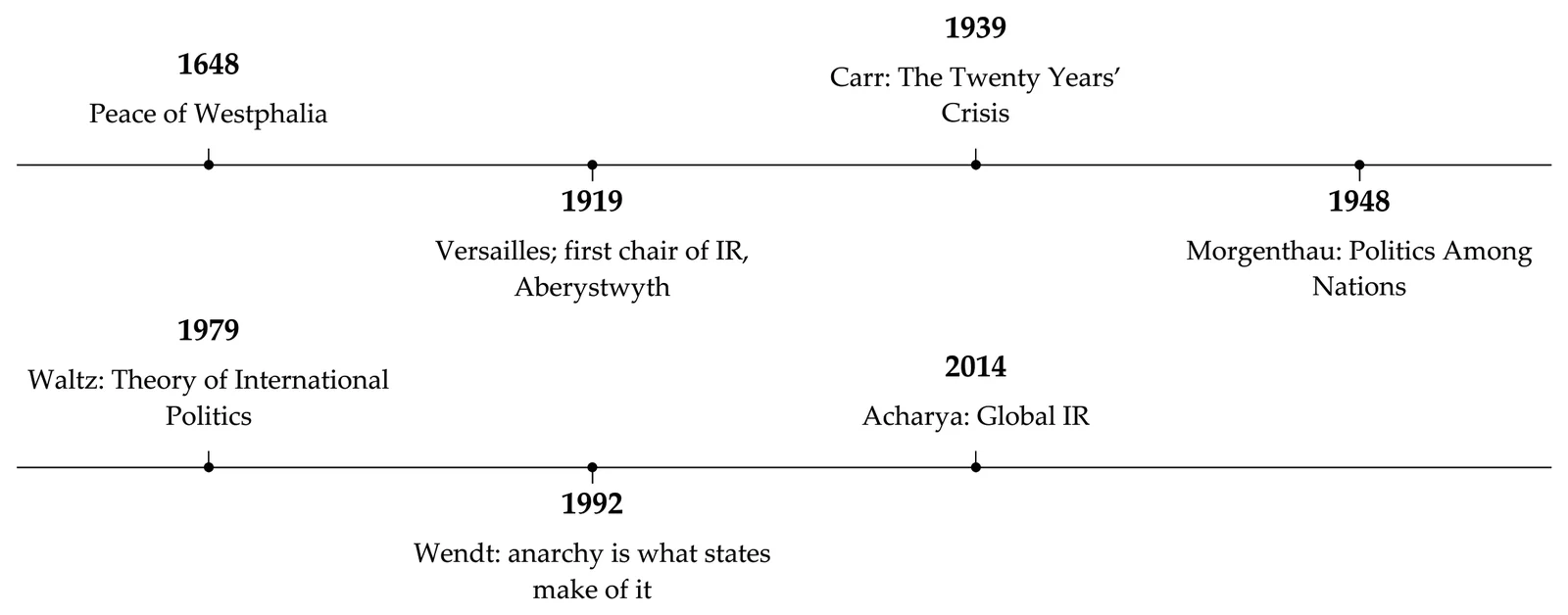
Benjamin de Carvalho, Halvard Leira and John Hobson, in ‘The Big Bangs of IR: The Myths That Your Teachers Still Tell You about 1648 and 1919’ (2011), argue that IR textbooks repeat two founding myths (Figure 1.2).
A. The myth of 1648
The textbook story says that the Peace of Westphalia [वेस्टफ़ेलिया] (1648), the treaties of Osnabrück [ओस्नाब्रुक] and Münster that ended the Thirty Years’ War, created the modern system of sovereign, equal states and the norm of non-intervention. Historians such as Andreas Osiander (2001) show that this is a myth. The treaties did not mention sovereignty; they were concerned with the constitution of the Holy Roman Empire, which continued to exist until 1806, and with the rights of its princes and religions. They even gave outside powers, Sweden and France, the right to guarantee the settlement inside the Empire, which is the opposite of non-intervention. John Havercroft (2012) asks whether Westphalia was ‘all that’ and shows that ideas of non-intervention developed in later debates. Sovereign statehood developed gradually over centuries and became the general European norm only in the nineteenth century. The 1648 myth was largely constructed by later scholars to give IR a neat starting point.
B. The myth of 1919
The second story says that the discipline of IR was born in 1919, when the Welsh politician David Davies founded the Woodrow Wilson Chair at Aberystwyth [एबरिस्टविथ] to study how to prevent another world war. The early scholars, so the story goes, were ‘idealists’ who believed in the League of Nations, until E.H. Carr’s The Twenty Years’ Crisis (1939) and the realists defeated them in the first great debate (Figure 1.3). De Carvalho, Leira and Hobson show that IR thinking existed long before 1919, in international law, political economy, colonial administration and theories of race; and that the ‘first great debate’ between idealists and realists was largely invented later, since the so-called idealists held varied and often realistic views. Robert Vitalis has shown that Foreign Affairs, America’s leading IR journal, began in 1910 as the Journal of Race Development.

C. The missing years
Kevin Blachford, in ‘From Thucydides to 1648: The “Missing” Years in IR and the Missing Voices in World History’ (2021), observes that IR textbooks jump from Thucydides [थ्यूसिडिडीज़]’ account of the Peloponnesian War (fifth century BCE) to Machiavelli, Hobbes and Westphalia, ignoring nearly two thousand years of world history: the Roman and Byzantine empires, the Islamic caliphates, the Mongol empire, the Chinese tributary system, the Mughal empire and Kautilya’s mandala. These ‘missing years’ contain many different ways of organising international life, such as empires, suzerain systems and trade networks, which show that the sovereign state system is only one historical possibility.
D. A better starting point
Amitav Acharya and Barry Buzan, in The Making of Global International Relations (2019), argue that IR thinking up to 1919 laid the foundations of the discipline, and that the most important origin of the modern international order was the global transformation of the nineteenth century, when industrialisation, the rational state and ideologies of progress gave Western states the power to dominate the world through empire. IR as a discipline was born in a world of empires, not of equal sovereign states.
1.3 Bringing in De-colonial Accounts
A. IR and the making of the white man’s world
Peter Vale and Vineet Thakur, in ‘IR and the Making of the White Man’s World’ (2020), show that the early discipline was closely linked to the British Empire and to racial thinking. The Round Table movement of Lionel Curtis and others, and statesmen such as Jan Smuts of South Africa, who helped design the League of Nations, were concerned with how the white, English-speaking peoples could manage a world of empires and keep their dominance. Institutions such as Chatham House (1920) grew out of these networks. The ‘international’ that early IR studied was a world ordered by race, in which the colonised were objects to be governed rather than members of international society. W.E.B. Du Bois had already declared in 1903 that the problem of the twentieth century was the problem of the colour line.
B. Postcolonialism
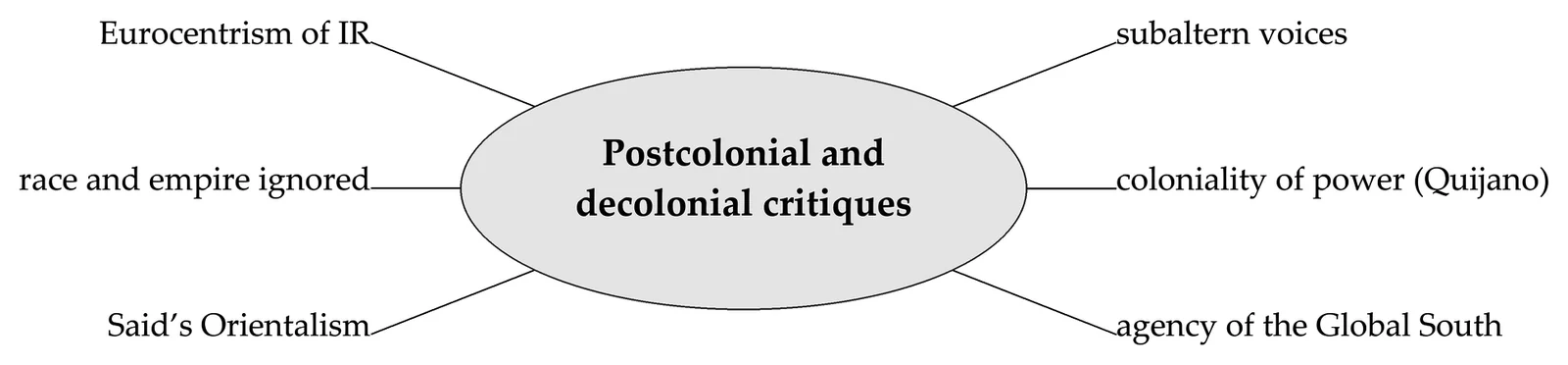
Shampa Biswas explains that postcolonialism studies how colonialism continues to shape the world after formal independence. It draws on Edward Said’s Orientalism (1978), which showed how Western knowledge constructed the East as backward and in need of Western rule; Gayatri Spivak’s question ‘Can the Subaltern Speak?’ (1988), about the silencing of the colonised; and Homi Bhabha’s idea of hybridity. For IR, postcolonialism argues that the discipline is Eurocentric: it treats European history as universal, ignores colonial violence, and presents the West as the source of order and progress. It insists that colonialism was not a side story but co-constitutive of European modernity, of the social sciences and of IR itself. Sankaran Krishna argued that IR’s preference for abstract theory allowed it to forget race and colonial violence. Decolonial thinkers from Latin America, such as Aníbal Quijano, speak of the coloniality of power, the persistence of colonial hierarchies of race, knowledge and labour.
C. Decolonisation and the rise of the Third World
As V.N. Khanna describes, the end of colonial empires after 1945 transformed international politics. India’s independence (1947) was followed by waves of decolonisation in Asia and Africa. The newly independent states asserted themselves at the Bandung Conference (1955) of Asian and African countries, formed the Non-Aligned Movement (1961) and the Group of 77 (1964), and demanded a New International Economic Order (1974). The UN grew from 51 members in 1945 to well over a hundred by the 1970s. The Third World thus became an actor in world politics, though IR theory continued to focus on the great powers.
D. The absence of non-Western IR theory
Acharya and Buzan (2007, revisited in 2017) asked why non-Western societies had produced so little IR theory. They suggested several reasons: Western theory is hegemonic in a Gramscian sense and appears to be common sense; it may simply have discovered the right path; non-Western theories exist but are hidden by language and by Western gatekeepers of journals; local conditions, such as scarce resources and close ties between scholars and governments, discourage theory; and the West had a head start. Zeynep Gülşah Çapan (2017) and Pinar Bilgin (2016) argue that remedying Eurocentrism requires more than adding non-Western cases: it requires rethinking IR’s concepts and its story of the world.
1.4 Understanding the Genealogy of IR Discipline in India
A. Institutions
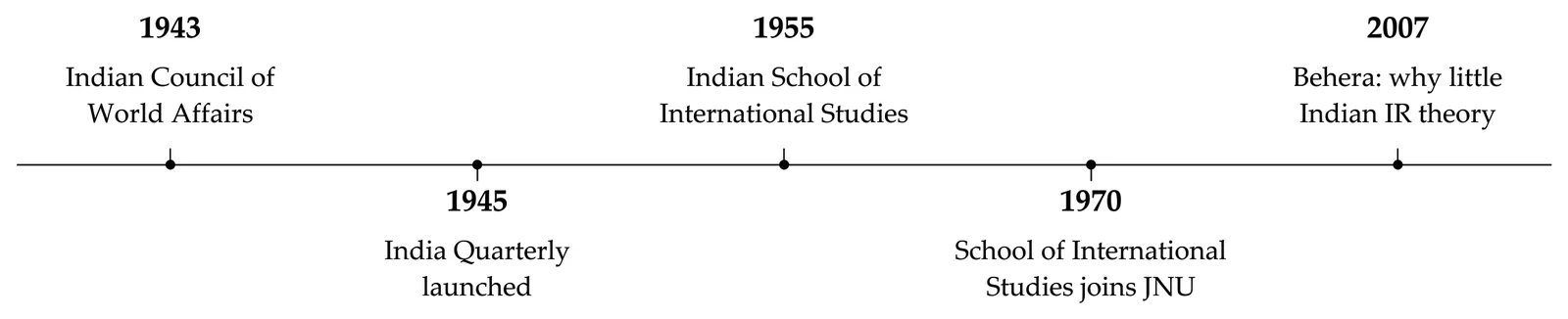
The study of international affairs in India began before independence. The Indian Council of World Affairs (ICWA) was founded in 1943, and Martin Bayly (2021) shows how its founders drew on the internationalism of the League of Nations era to educate Indians about world affairs. Its journal India Quarterly began in 1945. The Indian School of International Studies was founded in Delhi in 1955, with A. Appadorai as its first director, and became part of Jawaharlal Nehru University’s School of International Studies in 1970; its journal International Studies began in 1959.
B. Character of Indian IR
Navnita Chadha Behera, in ‘Re-imagining IR in India’ (2007), observes that IR in India developed mainly as foreign policy analysis and area studies, closely tied to the needs of the new state and its diplomacy, and produced little theory. She gives several reasons: the priority of nation-building and policy; the dominance of the state and its Westphalian categories; dependence on Western theories; limited funding and institutional support; and the perception that theory was a Western luxury. She calls for re-imagining IR in India by drawing on Indian intellectual traditions and the lived experiences of people, not only states.
C. Bringing theory back home
Kanti Bajpai and Siddharth Mallavarapu, in International Relations in India: Bringing Theory Back Home (2005), argue that Indian thinking about international affairs is richer than it appears. Classical texts such as Kautilya’s Arthashastra offered a theory of interstate relations; modern thinkers such as Rabindranath Tagore, whose lectures on Nationalism (1917) criticised the aggressive nation-state, Gandhi with his ideas of non-violence, and Nehru with his non-alignment and Panchsheel offered alternative visions of world order. Bajpai elsewhere identified three schools of Indian strategic thought, the Nehruvian, the neoliberal and the hyperrealist. T.V. Paul (2009) urged Indian scholars to engage more with global theory and methods, while Mallavarapu traced the development of IR theory in India.
1.5 Important Questions
- Question 1 What is International Relations? Discuss its nature, scope and significance.
- Question 2 Critically examine the ‘big bangs’ of IR: 1648 and 1919.
- Question 3 Discuss the decolonial and postcolonial critiques of International Relations.
- Question 4 Trace the genealogy of the IR discipline in India.
DU asks the same idea in different words. So learn one broad answer for each question below; the same answer works for every question joined by OR.
Important Question 1
What is International Relations? Discuss its nature, scope and significance.
OR
Why do we study IR? Discuss with reference to Jackson and Sørensen.
OR
Discuss the changing agendas of International Relations as a discipline.
Model Answer
“International theory is the theory of survival.”
— Martin Wight, ‘Why Is There No International Theory?’ (1966)
Introduction. International Relations is the study of relations across state borders, among states and non-state actors, concerning war and peace, conflict and co-operation, power and order, and an ever wider set of global issues. It became an academic discipline in the twentieth century, though thinking about relations among political communities is as old as Thucydides and Kautilya.
1. Meaning
IR studies how states and other actors interact across borders. ‘International politics’ stresses power among states; ‘world’ or ‘global politics’ includes all actors and processes across the globe. Jeremy Bentham coined the word ‘international’ in the 1780s.
2. Actors
States remain the main actors, but international organisations such as the UN, regional bodies, multinational corporations, NGOs, social movements and terrorist networks also shape world politics. Multinational corporations, NGOs such as Amnesty International, terrorist networks and even individuals now act across borders.
3. IR, International Politics and Foreign Policy
International politics studies interactions among states, foreign policy studies the decisions of a particular state, and IR is the broader field that includes both as well as non-state actors and global processes.
4. Scope
The classic subjects are war, peace, diplomacy, alliances and international law. The scope now includes international political economy, globalisation, human rights, migration, environment, pandemics, terrorism, cyber security and global inequality. It now includes international political economy, human rights, environment, migration, gender and cyber issues.
5. Anarchy as a Central Concept
Most IR theories begin from anarchy, the absence of a world government above states, but they disagree on whether anarchy produces conflict, cooperation or outcomes shaped by ideas.
6. Why Study IR: Core Values
Jackson and Sørensen argue that the state system exists to protect security, freedom, order, justice and welfare, but that states can also threaten these values. IR studies how they are protected and threatened. Decisions on war, trade or climate taken far away shape our daily lives.
7. Where, When and What
Blaney shows that IR is mostly produced in the West, that its story of origins is contested, and that defining it as the study of sovereign states excludes empire, race and colonialism. From the Global South, the subject of IR looks different.
8. Changing Agendas
Devetak shows how the agenda moved from preventing war after 1919, to power politics and nuclear deterrence in the Cold War, to interdependence and political economy in the 1970s, and to globalisation, human rights, terrorism and climate change after 1990.
9. Theoretical Diversity
IR contains many theories, realism, liberalism, Marxism, feminism, constructivism and postcolonialism, each offering a different lens on the same world, as Stephen Walt argued in ‘One World, Many Theories’ (1998). Each theory highlights different actors and causes.
10. IR and Global Problems
Problems such as climate change, pandemics, terrorism and financial crises cross borders and cannot be solved by any single state, which makes IR increasingly important.
11. Significance
IR helps citizens and policymakers understand the causes of war and conditions of peace, the effects of globalisation and the possibilities of co-operation. For a country like India, with large global interests, it is essential for informed foreign policy and public debate. For a country like India, IR knowledge is essential to navigate great-power rivalry, trade and security.
12. Limitations
The discipline has been criticised for Western bias, state-centrism and neglect of the experiences of the colonised, which recent decolonial and Global IR scholarship seeks to correct.
13. Levels of Analysis
J. David Singer (1961) argued that IR can explain events at different levels of analysis: the individual (leaders and their beliefs), the state (its regime, institutions and society) and the international system (the distribution of power). Waltz’s three images make the same point for the causes of war. Choosing a level is the first step in any explanation. Kenneth Waltz’s Man, the State and War (1959) had distinguished three ‘images’: the individual, the state and the international system.
14. An Interdisciplinary Field
IR draws on history, law, economics, sociology, geography and philosophy. It overlaps with foreign policy analysis, which studies how particular states make decisions, international history, international law and international political economy, but it is distinguished by its concern with the patterns of the system as a whole.
15. Evaluation
IR has become a broad, plural discipline that studies how a world of states and other actors manages power, conflict, cooperation and justice; its growing attention to the Global South makes it more relevant for countries like India.
Conclusion. Thus, IR is the study of how humanity organises its life across borders. Its nature is interdisciplinary and its scope ever-widening, and its own origins are a subject of debate.
Important Question 2
Critically examine the ‘big bangs’ of IR: 1648 and 1919.
OR
Is the Peace of Westphalia the beginning of the modern state system? Discuss.
OR
Discuss the ‘missing years’ in the history of International Relations.
Model Answer
“The Big Bangs of IR: The Myths That Your Teachers Still Tell You about 1648 and 1919.”
— Title of the article by de Carvalho, Leira and Hobson (2011)
Introduction. IR textbooks trace the modern international system to the Peace of Westphalia in 1648 and the discipline of IR to 1919. De Carvalho, Leira and Hobson call these the ‘big bangs’ of IR and argue that both are myths that hide the role of empire and the non-Western world.
1. The Conventional Story of 1648
The Peace of Westphalia, the treaties of Osnabrück and Münster that ended the Thirty Years’ War, is said to have created a system of sovereign, equal states and the norm of non-intervention. It ended the Thirty Years’ War (1618–48), one of Europe’s most destructive conflicts.
2. Why 1648 Is a Myth
The treaties did not mention sovereignty; they regulated the constitution of the Holy Roman Empire, which lasted until 1806; they allowed Sweden and France to guarantee the settlement, contrary to non-intervention. Osiander and Havercroft show that sovereignty and non-intervention developed gradually, becoming the European norm only in the nineteenth century. Andreas Osiander and Benno Teschke showed that the treaties preserved the Holy Roman Empire and dynastic rule rather than creating sovereign states.
3. The Conventional Story of 1919
IR is said to have been born at Aberystwyth in 1919 as a response to the First World War, dominated by idealists who were defeated by realists such as Carr in the first great debate. The Woodrow Wilson Chair at Aberystwyth was endowed by David Davies.
4. Why 1919 Is a Myth
IR thinking existed earlier in international law, political economy, colonial administration and race theory; Foreign Affairs began as the Journal of Race Development in 1910; and the idealist–realist debate was largely constructed later, since so-called idealists held diverse views. Brian Schmidt traced earlier American political science writing on international relations.
5. The Missing Years
Blachford shows that textbooks jump from Thucydides to Westphalia, ignoring the Roman, Islamic, Mongol, Chinese and Indian experiences, with their empires, tributary systems and mandalas.
6. Colonial Exclusions
The ‘society of states’ born in Europe excluded most of the world, which was divided into colonies and placed outside the ‘standard of civilisation’; for these peoples 1648 and 1919 meant continued domination.
7. What the Myths Hide
The myths present the international system as a society of equal sovereign states created in Europe, hiding empire, colonialism and racial hierarchy, which shaped the world while Westphalian sovereignty was confined to Europe.
8. The ‘Great Debates’
The myth of 1919 is linked to the story of a first ‘great debate’ between idealists and realists, which historians now regard as exaggerated, since the so-called idealists were varied and realist ideas existed earlier.
9. Alternative Origins
Acharya and Buzan point to IR thinking up to 1919 and to the nineteenth-century global transformation, industrialisation, the rational state and ideologies of progress, as the real foundation of modern international order, built through empire.
10. Significance of the Critique
Questioning the big bangs makes IR more historically accurate, opens space for non-Western histories, and shows that the sovereign state system is one historical form among many, not the natural order of the world.
11. Sovereignty for Some
Even when sovereignty became the European norm, it was not extended to the rest of the world. Gerrit Gong (1984) showed how European states applied a ‘standard of civilisation’ to decide which peoples deserved sovereignty. Colonies, protectorates and countries forced into unequal treaties, such as China and Japan, were placed in a hierarchy below the ‘civilised’ states. The international system was thus hierarchical, not a society of equals.
12. Why the Myths Persist
The myths survive because they are convenient for teaching, give the discipline a heroic identity as the science of peace, and make the European experience appear universal. Questioning them is therefore also a way of questioning Western centrality in IR.
13. Evaluation
The big bangs are useful simplifications, but treating them as true origins hides the role of empire, race and non-Western societies in the making of world politics.
Conclusion. Thus, 1648 and 1919 are convenient myths rather than true beginnings. A more accurate history of IR must include empire, colonialism and the wider world.
Important Question 3
Discuss the decolonial and postcolonial critiques of International Relations.
OR
Examine IR and the making of the ‘white man’s world’.
OR
Why is there no non-Western IR theory? Discuss.
Model Answer
“Orientalism [is] a Western style for dominating, restructuring, and having authority over the Orient.”
— Edward Said, Orientalism (1978)
Introduction. Decolonial and postcolonial scholars argue that IR was shaped by empire and race and continues to view the world from a Western standpoint. They seek to bring the experiences of the colonised into the centre of the discipline.
1. IR and Empire
Early IR in Britain and its dominions was concerned with managing the empire. Vale and Thakur show how the Round Table, Lionel Curtis and Jan Smuts sought to maintain the dominance of white, English-speaking peoples, and how institutions such as Chatham House grew from these networks. Round Table groups in Britain and the dominions discussed how to preserve the empire, and early Chatham House research reflected imperial concerns.
2. Race in Early IR
Race was central to early IR; Foreign Affairs began as the Journal of Race Development. Du Bois’s colour line described the global hierarchy that the discipline later forgot. Robert Vitalis documented this in White World Order, Black Power Politics (2015).
3. The Standard of Civilisation
Nineteenth-century European international law divided the world into ‘civilised’, ‘barbarous’ and ‘savage’ peoples, admitting only the first to full sovereignty, as Gerrit Gong showed.
4. Fanon and Césaire
Frantz Fanon and Aimé Césaire analysed colonial violence and racism, ideas that decolonial IR uses to show how the international order rested on domination.
5. Postcolonialism
Biswas explains postcolonialism’s debt to Said’s Orientalism, Spivak’s subaltern and Bhabha’s hybridity. It argues that colonialism is co-constitutive of modernity and of IR, and that IR’s concepts are Eurocentric. It also draws on Spivak and Bhabha to study representation and hybridity in world politics.
6. Decoloniality
Latin American thinkers such as Quijano and Mignolo speak of the coloniality of power, the persistence of colonial hierarchies of race, knowledge and labour after independence, and call for epistemic decolonisation. They argue that modernity and coloniality are two sides of the same coin.
7. Decolonisation and the Third World
After 1945, decolonisation created dozens of new states, which asserted themselves at Bandung (1955), in the Non-Aligned Movement (1961), the G-77 (1964) and the demand for a New International Economic Order (1974). The Bandung Conference (1955) brought Asian and African states together and led to the Non-Aligned Movement (1961).
8. The Absence of Non-Western IR Theory
Acharya and Buzan cite the hegemony of Western theory, the possibility that it found the right path, hidden non-Western theories, local conditions that discourage theory, and the West’s head start. They also note that non-Western theory may exist but go unrecognised because it is not written in Western forms.
9. Voices from the Global South
Scholars such as Siba Grovogui, Robbie Shilliam and Arlene Tickner have brought African, Caribbean and Latin American perspectives into IR.
10. Remedies
Çapan and Bilgin argue that adding non-Western cases is not enough; IR must rethink its concepts and history. Krishna shows how IR’s love of abstraction helped it forget colonial violence. They call for questioning the categories and history of IR itself.
11. Indian Perspectives Today
Indian scholars such as Navnita Chadha Behera and Siddharth Mallavarapu argue for decolonising Indian IR by drawing on Indian experience and thought.
12. Evaluation
These critiques have made IR more self-aware and inclusive. Critics warn against replacing one essentialism with another or rejecting all Western thought; the aim is a pluralistic discipline rather than a reversed hierarchy. They do not reject IR but ask it to become truly global.
13. Race in World Politics Today
Race still shapes migration regimes, global health inequalities and responses to conflicts, as the uneven treatment of refugees shows.
14. Race and the League of Nations
At the Paris Peace Conference of 1919, Japan proposed a clause on racial equality for the Covenant of the League of Nations; although a majority supported it, it was blocked, with Wilson ruling that unanimity was needed. The League’s mandate system classified the peoples of former German and Ottoman territories into A, B and C mandates according to their supposed stage of development, institutionalising a racial hierarchy of ‘civilisation’ within the new international order.
15. Indian Contributions to Decolonial Thought
Gandhi’s Hind Swaraj (1909) criticised modern Western civilisation itself, not only British rule; Nehru gave voice to Asian and African solidarity at Bandung; and Ashis Nandy’s The Intimate Enemy (1983) showed how colonialism colonised minds as well as territories, shaping the self-image of both coloniser and colonised. Ambedkar’s critique of caste also offers a lens on hierarchy in world politics.
Conclusion. Thus, decolonial and postcolonial critiques reveal the imperial and racial foundations of IR and demand a discipline that speaks from and for the whole world.
Important Question 4
Trace the genealogy of the IR discipline in India.
OR
Why has IR in India been weak in theory? Discuss.
OR
Discuss the contribution of Indian thinkers to International Relations.
Model Answer
“Nationalism is a great menace.”
— Rabindranath Tagore, Nationalism (1917)
Introduction. IR in India has a long intellectual background but a relatively short institutional history. It developed mainly as foreign policy analysis and area studies, and scholars have recently tried to recover and build Indian contributions to IR theory.
1. Ancient and Modern Roots
Kautilya’s Arthashastra offered a theory of interstate relations through the mandala and the six-fold policy. In the modern period Tagore criticised aggressive nationalism, Gandhi offered non-violence, and Nehru developed non-alignment and Panchsheel. Nehru’s Glimpses of World History (1934) and the internationalism of Tagore and Gandhi shaped early thinking.
2. Institutions
The ICWA (1943), India Quarterly (1945), the Indian School of International Studies (1955), which joined JNU in 1970, and the journal International Studies (1959) institutionalised the discipline. Bayly shows the influence of League-era internationalism on the ICWA. The Indian School of International Studies (1955) later became part of JNU’s School of International Studies.
3. Early Scholars
Early Indian scholars such as K.M. Panikkar, A. Appadorai and M.S. Rajan built the field through studies of Asian history, foreign policy and non-alignment.
4. Policy and Area Studies
Indian IR concentrated on India’s foreign policy, neighbours and regions, serving the needs of a new state and its diplomacy. Area studies centres on South Asia, China, the Soviet Union and other regions were set up with government support.
5. Non-Alignment as Theory
Non-alignment, developed by Nehru, can be read as an Indian contribution to IR thought: a strategy of autonomy for new and weak states in a bipolar world, combining realism with moral internationalism.
6. Behera on the Lack of Theory
Behera attributes the weakness of theory to nation-building priorities, state-centrism, dependence on Western theories, limited resources and the view that theory was a Western luxury. She calls for re-imagining IR through Indian traditions and people’s experiences. She also pointed to the dominance of the state’s agenda and limited funding.
7. Bringing Theory Back Home
Bajpai and Mallavarapu argue that Indian thinking on international affairs is richer than assumed, and seek to develop theory from Indian experience and thought. Their edited volumes, International Relations in India (2005), collected Indian writing on theory and practice.
8. Schools of Strategic Thought
Bajpai identified Nehruvian, neoliberal and hyperrealist schools in Indian strategic thinking, differing on the role of force, economics and co-operation. Nehruvians stress diplomacy and non-alignment, neoliberals economic interdependence and hyperrealists military power.
9. The Strategic Culture Debate
George Tanham’s essay on Indian strategic thought (1992) claimed that India lacked a strategic tradition, a view Indian scholars rejected by pointing to Kautilya, Nehru and later doctrine.
10. Journals and Debates
Journals such as India Quarterly and International Studies, and debates in the Economic and Political Weekly, gave Indian IR scholarship its forums.
11. Recent Directions
T.V. Paul urged engagement with global scholarship; scholars such as Deepshikha Shahi and Behera have explored Kautilya, Advaita and dharma as resources for IR theory, contributing to Global IR. Indian scholars increasingly contribute to Global IR and debates on non-Western theory.
12. Challenges Today
Indian IR still faces limited research funding, a focus on policy commentary and the need to engage critically with both Western theory and Indian traditions.
13. Evaluation
Indian IR has moved from policy description towards theory and from dependence on Western categories towards dialogue with Indian traditions. Its challenge is to build rigorous, globally relevant theory without becoming parochial. Its future lies in combining global engagement with indigenous resources.
14. Indian Resources for IR
Indian traditions offer many resources: Kautilya’s statecraft, Ashoka’s diplomacy of dhamma, Tagore’s universalism and critique of the nation, Gandhi’s non-violence and Nehru’s Panchsheel (1954), the five principles of mutual respect for territorial integrity and sovereignty, mutual non-aggression, mutual non-interference, equality and mutual benefit, and peaceful coexistence. Ashoka’s dhamma offers an ethical model of statecraft.
15. Institutions Today
IR is now taught in many Indian universities, and think tanks such as the Institute for Defence Studies and Analyses (1965) and the Observer Research Foundation (1990) contribute to research. Yet much of this work remains policy-driven, and the challenge identified by Behera, building theory from Indian experience beyond the Westphalian state, remains open. Think tanks such as the Observer Research Foundation and Carnegie India influence public debate.
Conclusion. Thus, the genealogy of IR in India shows a journey from policy-oriented study to an effort to bring theory back home and contribute to a global discipline.
Short Notes
(a) The Peace of Westphalia
The treaties of Osnabrück and Münster (1648) that ended the Thirty Years’ War. Traditionally seen as the origin of the sovereign state system, they actually dealt with the constitution of the Holy Roman Empire and religious rights; scholars such as Osiander call the ‘Westphalian’ origin of sovereignty a myth.
(b) The great debates
The conventional history of IR is told through four debates: idealism versus realism (1930s–40s), traditionalism versus behaviouralism (1960s), the inter-paradigm debate among realism, liberalism and Marxism (1970s–80s), and rationalism versus reflectivism (1990s). Critics argue that the first debate, especially, was constructed later.
(c) The Bandung Conference (1955)
The conference of twenty-nine Asian and African countries at Bandung, Indonesia, in April 1955, where leaders such as Nehru, Sukarno, Nasser and Zhou Enlai condemned colonialism and adopted principles of peaceful coexistence. It laid the foundation for the Non-Aligned Movement and the political voice of the Third World.
More notes: DSC-6 Introduction to International Relations
These notes are prepared by PADHO TO AISE for study help. They are not an official University of Delhi publication.