
Semester II DSC-6 Introduction to International Relations
Unit II · 34 min read · Updated 24 Nov 2026
As per the University of Delhi (DU) BA (Hons) Political Science syllabus
Contents
- 2.1 Introduction to IR Theories
- 2.2 Realpolitik (Kautilya)/ Realism/ Neo-Realism
- 2.3 Liberalism/ Neo-liberalism
- 2.4 Marxism/ Neo-Marxism
- 2.5 Feminism
- 2.6 Constructivism
- 2.7 Important Questions
- Critically examine realism and neo-realism as theories of International Relations.
- Discuss liberalism and neo-liberalism in International Relations.
- Examine the Marxist and neo-Marxist approaches to International Relations.
- Discuss the feminist perspective on International Relations.
- Explain the constructivist approach to International Relations.
- Short Notes
कोई एक दृष्टिकोण समकालीन विश्व राजनीति की पूरी जटिलता को नहीं पकड़ सकता।
No single approach can capture all the complexity of contemporary world politics.
— Stephen M. Walt, International Relations: One World, Many Theories (1998)
WHY DO STATES GO TO WAR? Why do they sometimes co-operate? Who really rules the world: states, markets or classes? Is the international system fixed by power, or can it be changed by ideas? Each theory of International Relations gives a different answer to these questions, because each looks at the world through a different lens. In this chapter we first ask what IR theory is and why we need many theories. We then study the main theories one by one: realism, beginning with Kautilya’s realpolitik and moving to classical realism and neo-realism; liberalism and neo-liberalism; Marxism and neo-Marxism; feminism; and constructivism. Read them as a conversation: each theory arose partly as an answer to the weaknesses of the others.
2.1 Introduction to IR Theories
A theory is a simplified picture of the world that tells us which facts matter and how they are connected. Stephen Walt, in ‘International Relations: One World, Many Theories’ (1998), compared theories to road maps: no map shows everything, but without one we would be lost. He argued that the three main traditions, realism, liberalism and constructivism, each capture part of reality, and that we are better off with a diversity of competing theories than with a single orthodoxy. Scholars also distinguish explanatory theories, which explain why things happen, from constitutive theories, which show how our concepts and identities shape the world, and from normative theories, which ask what ought to be done. Toni Erskine shows that normative IR theory deals with questions such as when war is just, whether humanitarian intervention is permitted, and whether our moral duties stop at the borders of our state.
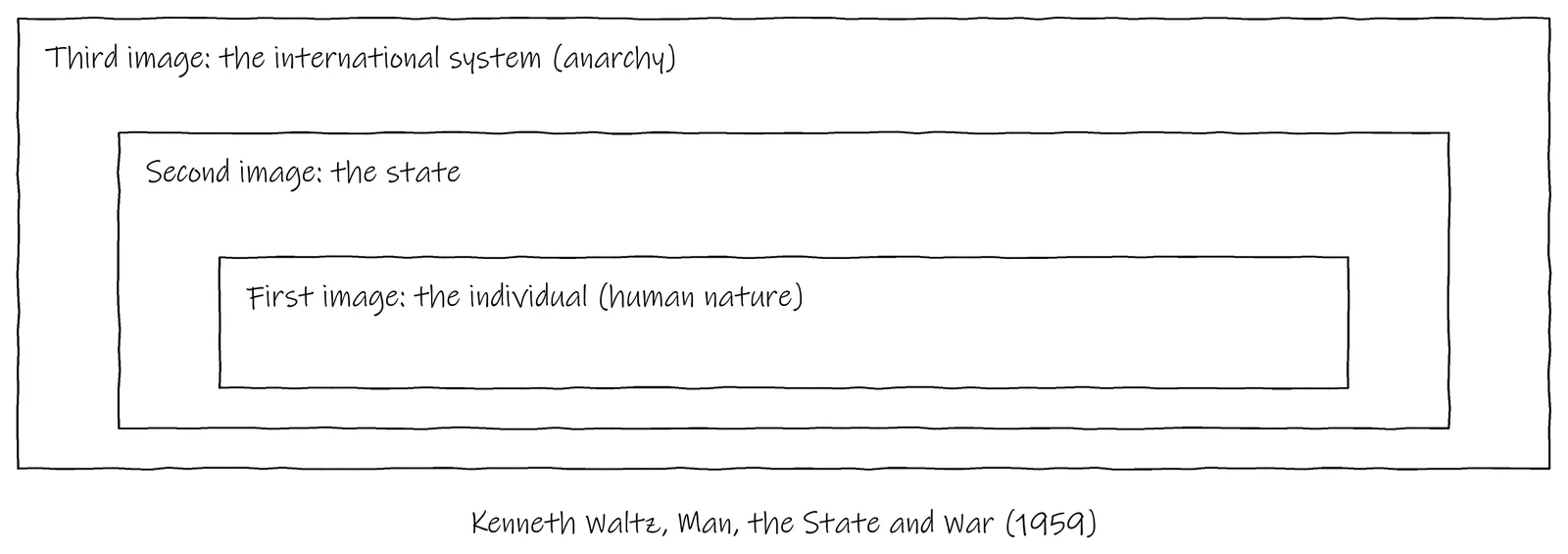
Theories also differ in their level of analysis. Kenneth Waltz, in Man, the State and War (1959), found three ‘images’ of the causes of war (Figure 2.2): the first image, human nature; the second image, the internal character of states; and the third image, the international system, whose anarchy permits war because nothing prevents it. Siddharth Mallavarapu (2009) traces how such theories were received and developed in India.
2.2 Realpolitik (Kautilya)/ Realism/ Neo-Realism
Realism is the oldest and most influential theory of IR. It sees international politics as a struggle for power among states in a world without a central government. The German word realpolitik, coined by Ludwig von Rochau in 1853, means politics based on practical considerations of power rather than ideals. Realists claim a long tradition: Thucydides’ account of the Melian dialogue, in which the Athenians tell the weak Melians that the strong do what they can and the weak suffer what they must; Machiavelli’s The Prince; and Hobbes’s state of nature. India has its own classic of realpolitik in Kautilya’s Arthashastra.
A. Kautilya’s realpolitik
Kautilya [कौटिल्य] saw interstate relations as a field of constant competition, where the aim of the king is the security, prosperity and expansion of his state. His theory has three main parts:
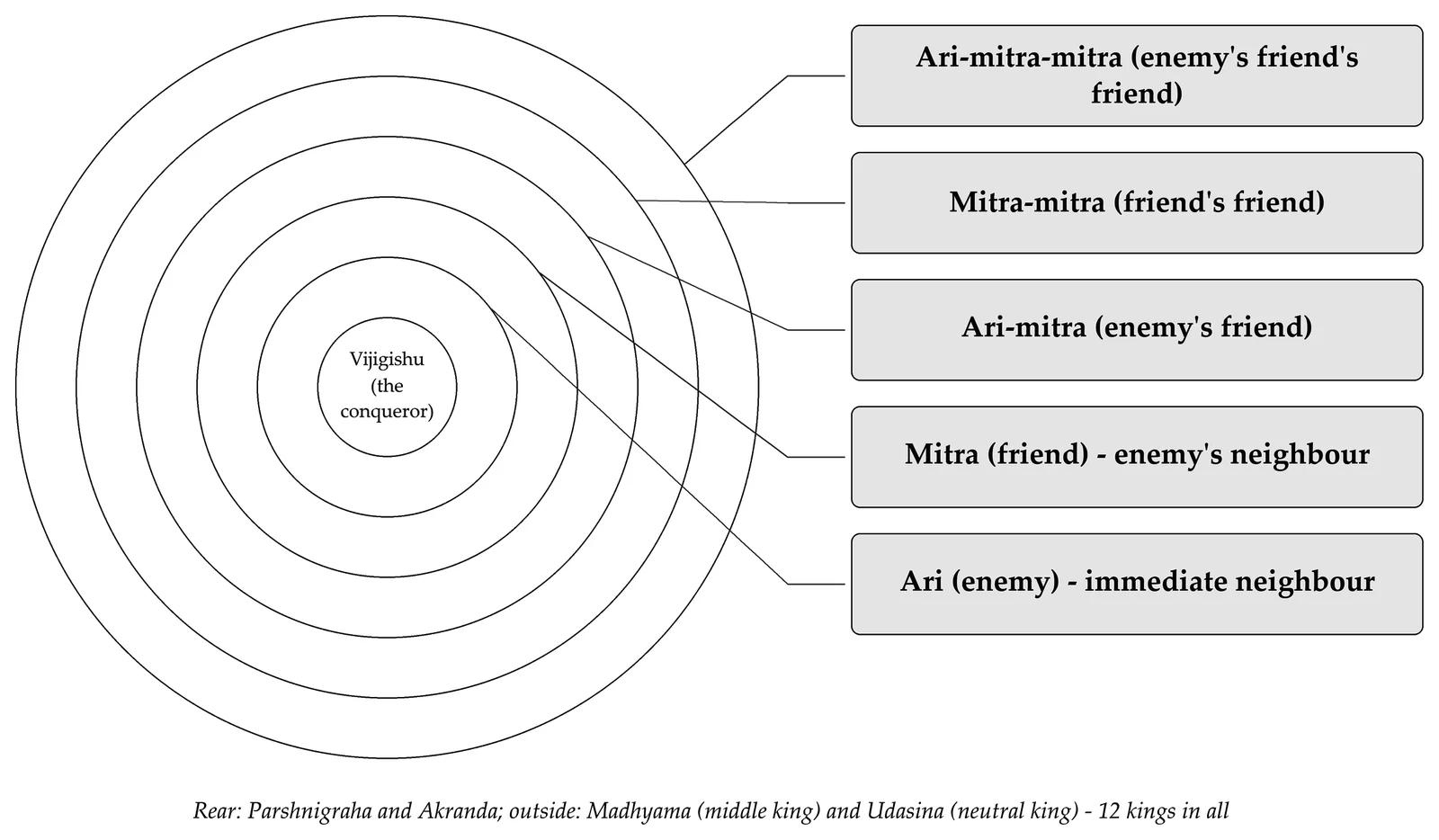
- Mandala theory (mandala [मण्डल]): the king who seeks conquest, the vijigishu [विजिगीषु], stands at the centre of a circle of states (Figure 2.3). His immediate neighbour is his natural enemy (ari); the state beyond the enemy is his natural friend (mitra); and so on in alternating rings. Two further kings, the middle king (madhyama) and the neutral king (udasina), are powerful enough to influence the whole circle. The idea anticipates the balance of power: ‘the enemy of my enemy is my friend’.
- The six-fold policy (shadgunya [षाड्गुण्य]): sandhi (peace treaty), vigraha (war), asana (staying quiet or neutral), yana (marching or preparing for war), samshraya (seeking shelter with a stronger king) and dvaidhibhava (the double policy of peace with one and war with another). The choice depends on whether the king is stronger than, equal to or weaker than his rival.
- The four upayas: sama (conciliation), dana (gifts), bheda (sowing dissension) and danda (force), used in that order, together with an elaborate system of spies and diplomacy.
Nirmal Jindal reads Kautilya as a realist who placed the survival and power of the state above everything, comparable to Machiavelli and Morgenthau. Deepshikha Shahi, in Kautilya and the Non-Western IR Theory (2019), warns against reducing him to realism: the Arthashastra also values prosperity, trade, alliances, welfare of the people and the restraint of dharma, so it supports an eclectic theory that combines realist, liberal and constructivist elements. Scholars such as S. Kalyanaraman and Medha Bisht have also urged the study of Kautilya as a living resource for Indian IR.
B. Classical realism
Twentieth-century classical realism was a reaction against the hopes of the inter-war period. E.H. Carr’s The Twenty Years’ Crisis (1939) criticised utopian thinking, and Hans Morgenthau [मॉर्गेन्थाऊ]’s Politics Among Nations (1948) gave realism its classic form in six principles: politics is governed by objective laws rooted in human nature; the key concept is interest defined as power; this concept is universal, though its content varies with circumstances; universal moral principles cannot be applied directly to state action, and prudence is the supreme political virtue; the moral aspirations of a nation must not be identified with universal moral law; and the political sphere is autonomous. Richard Ned Lebow argues that classical realists were not crude power-worshippers: they saw politics as tragic, warned against the hubris of the powerful and valued restraint and justice. The core of realism can be summarised in three ‘S’s: statism, the state as the main actor; survival, its first goal; and self-help, since no one else will protect it. The balance of power is its main mechanism of order.
C. Neo-realism (structural realism)
Kenneth Waltz, in Theory of International Politics (1979), developed neo-realism or structural realism. He explained state behaviour not by human nature but by the structure of the international system, defined by three elements: its ordering principle, which is anarchy, the absence of a world government; the functions of its units, which are alike, since every state must do the same things to survive; and the distribution of capabilities, the number of great powers (polarity). In anarchy states seek security; they balance against threatening power, and bipolar systems, like the Cold War, are more stable than multipolar ones. In ‘Realist Thought and Neorealist Theory’ (1990) Waltz explained that neo-realism is a theory of international politics, explaining recurring patterns, not a theory of foreign policy.
Neo-realists divide into two camps (Figure 2.4). Defensive realists, like Waltz, think that states seek enough power to be secure. Offensive realists, led by John Mearsheimer [मियरशाइमर] in The Tragedy of Great Power Politics (2001), argue from five assumptions, great powers are the main actors in an anarchic system, all have offensive capabilities, none can be sure of others’ intentions, survival is their main goal, and they are rational, that states seek to maximise power and become regional hegemons. Both see the security dilemma: measures one state takes for its own security make others feel insecure. Cynthia Weber questions realism’s central myth that international anarchy is the permissive cause of war.

Criticism: realism is state-centric and neglects non-state actors, economics and ideas; it underestimates co-operation and institutions; it failed to foresee the peaceful end of the Cold War; feminists call it masculinist; and constructivists argue that anarchy has no fixed logic.
2.3 Liberalism/ Neo-liberalism
Liberalism holds that human beings are capable of reason and co-operation, that progress is possible, and that democracy, trade and international institutions can make the world more peaceful. Its roots lie in Locke, Kant, Bentham, Adam Smith and Richard Cobden, who believed that free trade would bring peace. Immanuel Kant’s Perpetual Peace (1795) proposed three conditions for lasting peace: every state should have a republican constitution; states should form a federation of free states; and a cosmopolitan right of hospitality should apply to all. Woodrow Wilson’s Fourteen Points (1918) and the League of Nations applied these ideas (Figure 2.5).

A. Strands of liberalism
Jackson and Sørensen identify four strands. Sociological liberalism stresses transnational links among peoples; Karl Deutsch (1957) showed how such links create security communities in which war becomes unthinkable. Interdependence liberalism argues that economic interdependence makes war costly; Robert Keohane [कोहेन] and Joseph Nye’s Power and Interdependence (1977) described complex interdependence, with multiple channels of contact, no fixed hierarchy of issues and a declining role for military force. Institutional liberalism stresses international organisations. Republican liberalism holds that democracies are more peaceful.
B. The democratic peace
Michael Doyle (1983) revived Kant to show that liberal democracies have rarely if ever fought one another, though they fight non-democracies. Bruce Russett explains this by normative reasons, shared norms of peaceful compromise, and institutional reasons, checks and balances and public opinion that make war difficult. Russett and John Oneal’s Kantian triangle links three sources of peace: democracy, economic interdependence and international organisations.
C. Neo-liberal institutionalism
Neo-liberalism in IR, also called neo-liberal institutionalism, was developed by Keohane in After Hegemony (1984). Jennifer Sterling-Folker shows that it accepts several realist assumptions, anarchy and rational, self-interested states, but argues that co-operation is still possible because institutions and regimes help states overcome the obstacles to it. Stephen Krasner (1982) defined regimes as sets of principles, norms, rules and decision-making procedures around which actors’ expectations converge in an issue area. Institutions reduce transaction costs, provide information, monitor compliance and lengthen the ‘shadow of the future’ through repeated interaction. Neo-liberals argue that states care about absolute gains, whereas neo-realists such as Joseph Grieco (1988) argue that they care about relative gains, which makes co-operation harder. This ‘neo-neo debate’ dominated American IR in the 1980s and 1990s.
Criticism: realists like Mearsheimer called the promise of institutions false; critics argue that liberalism reflects the interests of powerful Western states, that the ‘liberal international order’ has been hypocritical towards the Global South, and that liberal ideas have been used to justify intervention.
2.4 Marxism/ Neo-Marxism
Marxism sees international relations through the lens of capitalism and class. Mark Rupert explains that, for Marxists, the world is shaped not mainly by the competition of states but by the global expansion of capitalism, which creates classes, inequality and conflict across borders. Marx and Engels wrote in the Communist Manifesto (1848) that the need for ever-expanding markets drives the bourgeoisie across the whole surface of the globe.
A. Classical Marxist theories of imperialism
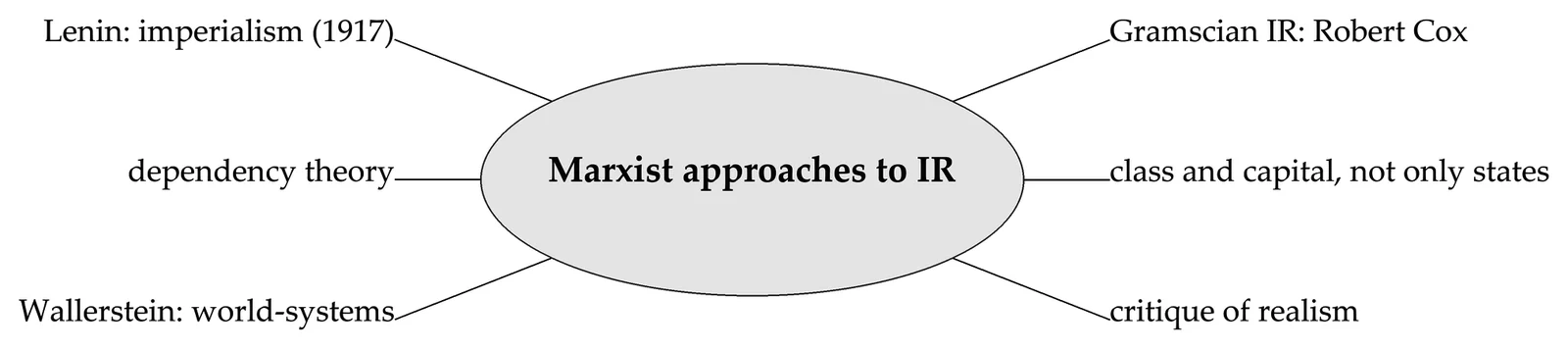
J.A. Hobson (1902) argued that imperialism arose from under-consumption at home. Lenin, in Imperialism, the Highest Stage of Capitalism (1916), argued that monopoly capitalism needs colonies for raw materials, markets and the export of capital; the division of the world among capitalist powers leads to inter-imperialist wars, such as the First World War. Rosa Luxemburg also linked capitalism to imperial expansion.
B. Neo-Marxism and critical theory
Neo-Marxist approaches developed in several directions. Dependency and world-systems theories (studied in DSC-5) explained the inequality between core and periphery. Robert Cox, drawing on Gramsci, wrote in ‘Social Forces, States and World Orders’ (1981) that theory is always for someone and for some purpose. He distinguished problem-solving theory, which takes the existing order for granted, from critical theory, which asks how that order came about and how it might change. He explained world orders through the interaction of material capabilities, ideas and institutions, and saw American hegemony as a world order based on consent as well as power. Andrew Linklater developed critical theory towards the goal of human emancipation.
C. Empire
Cynthia Weber asks whether Empire is the new world order. Michael Hardt and Antonio Negri [नेग्री], in Empire (2000), argued that globalisation has produced a new, decentred and deterritorialised form of sovereignty, a network of global capitalist power, states, corporations and institutions, that has no centre and no outside; it differs from the old imperialism of rival nation-states. Its opponent is the multitude, the diverse global networks of resistance. Criticism: Marxism is accused of economic reductionism, neglecting nationalism, the state and culture; the collapse of communist states weakened its appeal; and the Empire thesis was challenged by the unilateral American war on Iraq (2003).
2.5 Feminism
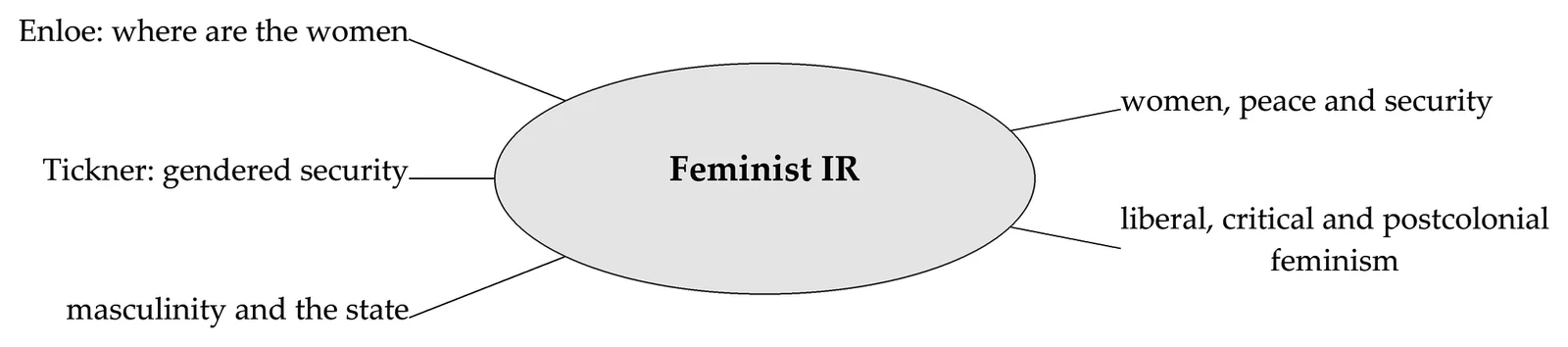
Feminist IR, which grew from the late 1980s, asks ‘Where are the women?’ in international politics and how gender shapes it. J. Ann Tickner, in ‘Gender in World Politics’ and with Laura Sjoberg, argues that the core concepts of IR, power, security, the state and rationality, are defined in masculine terms: realism’s autonomous, power-seeking state mirrors an idealised image of man, while qualities associated with women, such as care and co-operation, are excluded. In 1988 Tickner rewrote Morgenthau’s six principles from a feminist standpoint, arguing that objectivity is partial and that power can also mean collective empowerment.
Cynthia Enloe [एनलो]’s Bananas, Beaches and Bases (1989) showed that international politics depends on women in places ignored by IR: as diplomats’ wives, plantation workers, domestic workers who migrate abroad, and women working around military bases. She concluded that the personal is international. Feminists have redefined security to include structural violence, poverty and violence against women, and have shown how sexual violence has been used as a weapon of war, as in Bosnia and Rwanda. The UN Security Council’s Resolution 1325 (2000) on Women, Peace and Security reflected these ideas.
Feminist IR has several strands: liberal feminism, which seeks equal participation of women in institutions; critical and standpoint feminism, which study how gender hierarchies are produced; poststructural feminism, which examines gendered language and identities; and postcolonial feminism. Chandra Talpade Mohanty, in Feminism without Borders (2003), criticised Western feminism for portraying the ‘Third World woman’ as a single, passive victim, and called for a decolonial, anti-capitalist feminist solidarity across borders. Criticism: feminist IR is accused of essentialism, of focusing only on women, and of being normative; mainstream IR has often ignored it.
2.6 Constructivism
Constructivism became prominent after the end of the Cold War, which realism had failed to predict. Its central claim is that the international world is socially constructed: it is made by shared ideas, norms and identities, not only by material power. Michael Barnett explains its main ideas:
- Ideas matter: the meaning of material facts depends on shared understandings. Alexander Wendt [वेन्ट] observed that five hundred British nuclear weapons are less threatening to the United States than five North Korean ones, because Britain is seen as a friend.
- Identities shape interests: states do not have fixed interests; their interests depend on who they think they are, and identities are formed through interaction.
- Mutual constitution: agents (states) and structures (the international system) constitute each other; the structure shapes states, and states reproduce or change the structure through their practices.
- Norms: shared standards of appropriate behaviour, such as sovereignty, the taboo on using nuclear weapons or human rights, shape what states do. Martha Finnemore and Kathryn Sikkink (1998) described a norm life cycle of emergence, cascade and internalisation.
- Anarchy is what states make of it: in his famous essay (1992) and in Social Theory of International Politics (1999), Wendt argued that anarchy has no fixed logic. He described three cultures of anarchy: Hobbesian, in which states see each other as enemies; Lockean, in which they are rivals who respect each other’s existence; and Kantian, in which they are friends.
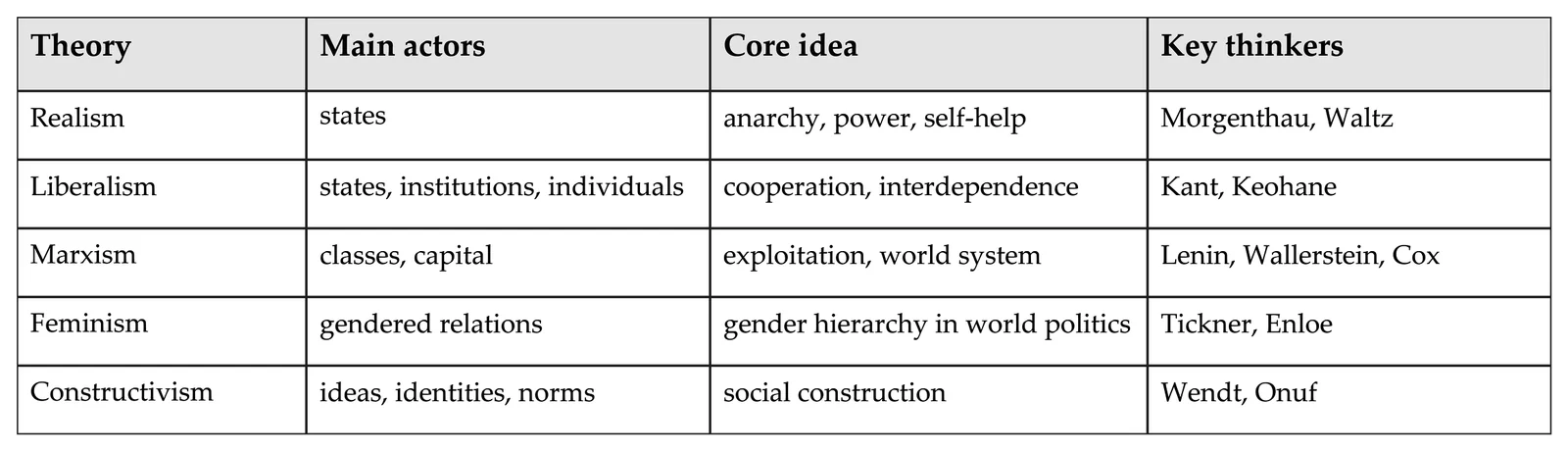
Nicholas Onuf introduced the term in World of Our Making (1989); Friedrich Kratochwil, Peter Katzenstein and Finnemore developed it. K.M. Fierke and Stephanie Lawson stress that constructivism is not a single theory but an approach that can be combined with others. Criticism: realists argue that it underestimates material power; others say it explains change after the fact but cannot predict; its concepts are vague; and it often neglects whose ideas count and why. The main theories are compared in Figure 2.6.
2.7 Important Questions
- Question 1 Critically examine realism and neo-realism as theories of International Relations.
- Question 2 Discuss liberalism and neo-liberalism in International Relations.
- Question 3 Examine the Marxist and neo-Marxist approaches to International Relations.
- Question 4 Discuss the feminist perspective on International Relations.
- Question 5 Explain the constructivist approach to International Relations.
DU asks the same idea in different words. So learn one broad answer for each question below; the same answer works for every question joined by OR.
Important Question 1
Critically examine realism and neo-realism as theories of International Relations.
OR
Discuss Kautilya’s realpolitik and its relevance to IR theory.
OR
Distinguish between classical realism and structural realism.
OR
Examine offensive and defensive realism.
Model Answer
“International politics, like all politics, is a struggle for power.”
— Hans Morgenthau, Politics Among Nations (1948)
Introduction. Realism is the oldest and most influential theory of International Relations. It holds that international politics is a struggle for power among states in an anarchic world without a central authority. It has an ancient lineage, from Thucydides and Kautilya to Machiavelli and Hobbes, and took modern form in the classical realism of Carr and Morgenthau and the neo-realism of Waltz and Mearsheimer.
1. Core Assumptions
Realists share three ‘S’s: statism, the state is the main actor; survival, the primary goal of states; and self-help, since no higher authority will protect them. They emphasise power, national interest and the balance of power, and are sceptical of morality and institutions in international politics. Dunne and Schmidt sum them up as statism, survival and self-help.
2. Kautilya’s Realpolitik
Kautilya’s mandala theory placed the would-be conqueror at the centre of a circle of states, where the neighbour is the enemy and the neighbour’s neighbour is a friend. His six-fold policy (peace, war, neutrality, marching, alliance, double policy) and four upayas (conciliation, gifts, dissension, force) offered a practical guide to statecraft. Jindal reads him as a realist; Shahi argues that his thought is eclectic, combining power with prosperity, alliances and dharma. The six-fold policy and the four upayas show careful calculation of relative power.
3. Classical Realism
Carr criticised inter-war utopianism; Morgenthau’s six principles grounded politics in human nature and defined interest as power, with prudence as the supreme virtue. Lebow shows that classical realists were also concerned with ethics, tragedy and the limits of power. Thucydides’ Melian dialogue, Machiavelli and Hobbes are earlier sources.
4. Neo-realism
Waltz explained state behaviour by the structure of the system: anarchy, like units and the distribution of capabilities. States seek security and balance against power; bipolarity is more stable. Waltz insisted that neo-realism is a theory of international politics, not of foreign policy. His Theory of International Politics (1979) argued that bipolarity is more stable than multipolarity.
5. Defensive and Offensive Realism
Defensive realists (Waltz) argue that states seek adequate security; offensive realists (Mearsheimer) argue that uncertainty about intentions drives states to maximise power and seek regional hegemony. Both recognise the security dilemma. Mearsheimer’s The Tragedy of Great Power Politics (2001) argued that great powers seek regional hegemony.
6. Classical and Structural Realism Compared
Classical realism locates the cause of conflict in human nature and stresses statesmanship; structural realism locates it in the anarchic structure of the system and stresses systemic constraints. The first is philosophical and historical, the second more scientific and parsimonious.
7. The Security Dilemma
John Herz described the security dilemma: when one state increases its security, others feel less secure and respond, so arms races result even when no state wants war.
8. Balance of Power and Threat
Realists see the balance of power as the main mechanism of order: states balance against threats through arms and alliances, a view Stephen Walt refined as balance of threat.
9. Strengths
Realism explains the persistence of war, alliances, arms races and great power rivalry, and remains influential in foreign policy, including in debates on India’s security towards China and Pakistan. It also explains the persistence of nuclear deterrence.
10. Criticism
It neglects non-state actors, economics, ideas and co-operation; it failed to predict the end of the Cold War; it is static and state-centric; feminists call it masculinist; and constructivists argue that anarchy has no fixed logic. It also failed to predict the peaceful end of the Cold War.
11. Neoclassical Realism
Gideon Rose (1998) described neoclassical realism, which accepts that the international system sets the broad limits of foreign policy but argues that systemic pressures are filtered through domestic factors, such as leaders’ perceptions, state capacity and domestic politics. It bridges classical and structural realism and explains why states in similar positions behave differently. Domestic factors such as leaders’ perceptions and state capacity filter systemic pressures.
12. Realism and India
Indian ‘hyperrealists’ argue for military strength and nuclear deterrence, as in the nuclear tests of 1998; Kautilyan ideas of statecraft are frequently invoked in strategic debates; and India’s balancing of China through partnerships such as the Quad can be read in realist terms. India’s nuclear tests of 1998 were often explained in realist terms.
13. Evaluation
Realism remains the most influential theory of power politics, war and alliances, but its neglect of ideas, institutions and non-state actors limits its explanation of cooperation and change.
Conclusion. Thus, realism remains a powerful lens for understanding power and conflict, from Kautilya to Mearsheimer, though it captures only part of the complexity of world politics.
Important Question 2
Discuss liberalism and neo-liberalism in International Relations.
OR
Explain the democratic peace thesis.
OR
How does neo-liberal institutionalism explain international co-operation?
Model Answer
“The civil constitution of every state shall be republican.”
— Immanuel Kant, Perpetual Peace (1795), First Definitive Article
Introduction. Liberalism is an optimistic theory of IR which holds that reason, democracy, trade and institutions can reduce conflict and promote co-operation and progress. Neo-liberalism, or neo-liberal institutionalism, is its modern version, which explains how co-operation is possible even under anarchy.
1. Roots
Liberal ideas come from Locke, Kant, Bentham, Smith and Cobden. Kant’s Perpetual Peace proposed republican constitutions, a federation of free states and cosmopolitan right. Wilson’s Fourteen Points and the League of Nations put liberal ideas into practice. Kant’s Perpetual Peace (1795) proposed republican constitutions, a federation of free states and cosmopolitan hospitality.
2. Core Assumptions
Human beings are rational and capable of co-operation; progress is possible; individuals and societies, not only states, matter; and domestic politics shapes foreign policy.
3. Strands
Sociological liberalism stresses transnational ties and Deutsch’s security communities; interdependence liberalism stresses trade and Keohane and Nye’s complex interdependence; institutional liberalism stresses international organisations; republican liberalism stresses democracy. Interdependence liberalism (Keohane and Nye, Power and Interdependence, 1977) and republican liberalism are other strands.
4. Complex Interdependence
Keohane and Nye described complex interdependence: multiple channels between societies, no hierarchy of issues and a minor role for military force among interdependent states.
5. The Democratic Peace
Doyle showed that liberal democracies rarely fight each other. Russett explains this by shared democratic norms and institutional constraints, and with Oneal links peace to the Kantian triangle of democracy, interdependence and international organisations. Explanations include shared norms, institutional constraints and economic ties.
6. Neo-liberal Institutionalism
Keohane’s After Hegemony (1984) accepted anarchy and rational egoist states but argued that institutions and regimes make co-operation possible by reducing transaction costs, providing information, monitoring compliance and extending the shadow of the future. Institutions reduce transaction costs, provide information and lengthen the ‘shadow of the future’.
7. Regimes
Krasner defined regimes as principles, norms, rules and procedures around which expectations converge. Trade, nuclear non-proliferation and climate regimes illustrate how states co-operate within rules. Examples include the nuclear non-proliferation regime and the trade regime of the WTO.
8. The Neo-Neo Debate
Neo-liberals argue that states seek absolute gains; neo-realists such as Grieco argue that they worry about relative gains, which limits co-operation. The debate showed how much the two theories share.
9. Liberalism and India
India’s support for multilateralism, the UN and global trade rules, and its democratic identity, show liberal elements in its foreign policy alongside realism.
10. Criticism
Realists call the promise of institutions false; critics argue that liberalism serves powerful Western states, that the liberal order has been selective and hypocritical towards the Global South, and that liberal ideas have justified intervention. Marxists argue that liberal institutions serve powerful capitalist states.
11. The Liberal International Order
After 1945 the United States led the creation of a liberal international order: the United Nations, the Bretton Woods institutions (IMF and World Bank, 1944), GATT and later the WTO (1995), and alliances such as NATO. John Ikenberry’s Liberal Leviathan (2011) described it as a hierarchical order in which American power was exercised through rules and institutions. It included the UN, the Bretton Woods institutions and NATO.
12. Liberalism and Realism Compared
Realism is pessimistic about human nature, focuses on states and power, sees co-operation as fragile and denies progress. Liberalism is optimistic, includes individuals, firms and institutions, sees co-operation as possible and believes in progress. Realists see institutions as reflections of power; liberals see them as ways of changing state behaviour.
13. Global Governance Today
Liberal ideas underlie global governance on trade, climate (the Paris Agreement, 2015), health and human rights, in which India participates actively while seeking reform of institutions to reflect the rise of the Global South. The G20 has become a key forum for economic coordination.
14. Evaluation
Liberalism explains cooperation, institutions and the democratic peace better than realism, but it may overestimate the power of institutions in times of great-power rivalry.
Conclusion. Thus, liberalism and neo-liberalism show that co-operation and peace are possible through democracy, trade and institutions, though power and inequality continue to limit them.
Important Question 3
Examine the Marxist and neo-Marxist approaches to International Relations.
OR
Discuss Robert Cox’s critical theory of world order.
OR
Is ‘Empire’ the new world order? Discuss.
Model Answer
“Theory is always for someone and for some purpose.”
— Robert Cox, ‘Social Forces, States and World Orders’ (1981)
Introduction. Marxist approaches see international relations as shaped by capitalism and class rather than by the competition of states alone. Neo-Marxist approaches, including dependency, world-systems, Gramscian critical theory and the theory of Empire, adapted these ideas to the twentieth and twenty-first centuries.
1. Historical Materialism
Marxism explains society through the mode of production and class struggle. Capitalism is global by nature: the Communist Manifesto described how the need for markets drives the bourgeoisie across the globe. International relations are seen as shaped by the global expansion of capitalism.
2. Theories of Imperialism
Hobson linked imperialism to under-consumption; Lenin argued that monopoly capitalism needs colonies and leads to inter-imperialist war; Luxemburg linked capitalism to expansion into non-capitalist areas. Lenin’s Imperialism, the Highest Stage of Capitalism (1916) linked monopoly capitalism and the export of capital to colonial rivalry and war.
3. Dependency and World-Systems
Dependency theory and Wallerstein’s world-systems theory explained the global division into core and periphery and the transfer of surplus from poor to rich regions. They show how global inequality is reproduced through trade and finance.
4. Cox’s Critical Theory
Cox distinguished problem-solving theory, which accepts the existing order, from critical theory, which asks how it arose and how it can change. He explained world orders through material capabilities, ideas and institutions, and saw hegemony as a combination of power and consent. His famous line was that theory is always for someone and for some purpose.
5. Gramscian Hegemony in World Order
Following Gramsci, Cox and Stephen Gill showed how American hegemony after 1945 rested on consent organised through institutions such as the IMF and World Bank and on the spread of liberal ideas, not only on force. This hegemony rested on consent through institutions such as the IMF and World Bank as well as on force.
6. Critical Theory and Emancipation
Critical theorists such as Andrew Linklater drew on the Frankfurt School to argue that IR theory should aim at human emancipation, widening moral community beyond the state.
7. Empire
Hardt and Negri argued that globalisation created Empire, a decentred, deterritorialised network of capitalist sovereignty without a centre or outside, opposed by the multitude. Weber asks whether this is the new world order. Their book Empire (2000) argued that power has become networked and global.
8. Uneven and Combined Development
Justin Rosenberg revived Trotsky’s idea of uneven and combined development to explain how societies at different stages interact and shape one another in world politics.
9. Marxism and the Cold War
During the Cold War, Marxist-Leninist states framed world politics as a struggle between capitalism and socialism, and Soviet support for national liberation movements shaped conflicts in Asia and Africa.
10. Contributions
Marxist approaches reveal the economic structures and inequalities behind world politics, link IR to global capitalism, and inspire critical questions about whose interests theories serve. They connect world politics with everyday economic life.
11. Marxism and India
Indian Marxists criticised dependence on Western capital and supported non-alignment and close ties with the Soviet Union, influencing debates on economic sovereignty.
12. Criticism
They are accused of economic reductionism, neglect of nationalism, culture and the state, and of failed predictions; communist states collapsed; and the Empire thesis was challenged by the unilateral power of the United States in Iraq. The collapse of communist states also weakened Marxism’s appeal.
13. Marxism and the Global South
Marxist ideas inspired anti-colonial movements. Lenin supported national liberation struggles, and at the Second Congress of the Communist International (1920) the Indian revolutionary M.N. Roy debated with Lenin on the role of colonial bourgeoisies. Later dependency theorists in Latin America and Africa built on Marxist foundations.
14. Globalisation and Inequality
Marxists interpret the neoliberal globalisation of the period since 1980 as a restoration of class power (David Harvey, A Brief History of Neoliberalism, 2005) and point to the rise of a transnational capitalist class (Leslie Sklair) and growing inequality within and among countries. David Harvey called neoliberalism a project to restore class power.
15. Ecological Marxism
Some Marxists link the climate crisis to capitalism’s need for endless growth, arguing that global environmental politics must address inequality between rich and poor countries.
16. Evaluation
Marxist approaches show that world politics cannot be separated from global capitalism and inequality; though often reductionist, they remain important for understanding imperialism, globalisation and the Global South.
Conclusion. Thus, Marxist and neo-Marxist approaches show that world politics cannot be separated from global capitalism, though they must be combined with attention to states, identity and culture.
Important Question 4
Discuss the feminist perspective on International Relations.
OR
‘Where are the women?’ Examine the feminist critique of mainstream IR.
OR
Discuss J. Ann Tickner’s contribution to feminist IR.
Model Answer
“The personal is international.”
— Cynthia Enloe, Bananas, Beaches and Bases (1989)
Introduction. Feminist International Relations, which developed from the late 1980s, argues that mainstream IR ignores women and that its core concepts are gendered. It asks where women are in world politics and how gender hierarchies shape war, security and the global economy.
1. Enloe: Locating Women
Enloe showed that international politics depends on women in roles ignored by IR: diplomats’ wives, plantation and factory workers, migrant domestic workers and women around military bases. Her Bananas, Beaches and Bases (1989) showed women as diplomats’ wives, plantation workers, sex workers near military bases and domestic workers.
2. Gendered Concepts
Tickner argues that power, security, the state and rationality are defined in masculine terms; the realist state mirrors an idealised autonomous, power-seeking man. Her Gender in International Relations (1992) set out this critique.
3. Tickner’s Reformulation of Morgenthau
Tickner rewrote Morgenthau’s six principles: objectivity is partial and gendered; national interest is multidimensional; power can mean collective empowerment rather than domination. National interest is multidimensional and cannot be defined by power alone.
4. Redefining Security
Feminists widen security to include structural violence, poverty and violence against women, and show how sexual violence has been a weapon of war in Bosnia and Rwanda. Human security, including protection from domestic violence, is central to feminist IR.
5. Sexual Violence in War
Feminists brought attention to rape as a weapon of war, which the international tribunals for Yugoslavia and Rwanda recognised as a war crime and a crime against humanity.
6. Strands of Feminism
Liberal feminism seeks equal participation; critical and standpoint feminism study gender hierarchy; poststructural feminism studies gendered language; postcolonial feminism studies the intersection of gender, race and empire. Postmodern feminists question the category ‘woman’ itself.
7. Postcolonial Feminism
Chandra Mohanty criticised Western feminism for portraying the ‘Third World woman’ as a single passive victim, and called for decolonial, anti-capitalist solidarity across borders.
8. Women as Peacebuilders
Research suggests that peace agreements last longer when women take part, as in Liberia, where the women’s peace movement led by Leymah Gbowee helped end the civil war.
9. Policy Impact
UN Security Council Resolution 1325 (2000) on Women, Peace and Security recognised women’s roles in conflict prevention and peace-building, reflecting feminist arguments. Sweden adopted a feminist foreign policy in 2014.
10. Feminist IR and India
Indian feminist scholars study women in Partition violence, conflict in Kashmir and the North-East and the gendered effects of globalisation, as in Urvashi Butalia’s The Other Side of Silence (1998).
11. Criticism
Critics accuse feminist IR of essentialism, focusing only on women, and being normative rather than explanatory; mainstream IR has often ignored it. Feminists reply that gender is a lens for understanding the whole of world politics. Others reply that gender analysis improves explanations of war and peace.
12. Gender, War and Nationalism
Feminists show how militarism depends on ideas of masculinity, how nations are imagined in gendered terms, with women as symbols of the nation’s honour, and how women’s bodies become sites of conflict. Urvashi Butalia’s The Other Side of Silence (1998) recovered the experiences of women during the Partition of India. Nationalist movements often present women as symbols of the nation’s honour, which can justify controlling them.
13. Gender and the Global Economy
Global production relies on the low-paid labour of women in export factories; migrant women form ‘global care chains’ (Arlie Hochschild, 2000) by caring for families in rich countries while leaving their own; and cuts under structural adjustment shifted burdens of care onto women. Remittances sent by women migrant workers are a major source of income for many developing countries.
14. Women in Diplomacy
Women remain few in diplomacy and peace negotiations. Some states, such as Sweden from 2014, adopted a ‘feminist foreign policy’ to place gender equality at the centre of their external relations. C.B. Muthamma, the first woman officer of the Indian Foreign Service, had to challenge discriminatory service rules in the Supreme Court in 1979.
15. Evaluation
Feminist IR has broadened the discipline by asking where women are and how gender shapes power, war and the economy; it is now an essential part of IR, though its insights are unevenly applied in policy.
Conclusion. Thus, feminism exposes the gendered foundations of IR and makes visible the people and forms of power that mainstream theories leave out.
Important Question 5
Explain the constructivist approach to International Relations.
OR
‘Anarchy is what states make of it.’ Discuss.
OR
How do ideas, norms and identities shape international politics?
Model Answer
“Anarchy is what states make of it.”
— Alexander Wendt, title of his article (1992)
Introduction. Constructivism holds that international relations are socially constructed through shared ideas, norms and identities. It rose to prominence after the end of the Cold War, which materialist theories had failed to anticipate, and is associated with Wendt, Onuf, Kratochwil, Katzenstein and Finnemore.
1. Social Construction
Material facts acquire meaning through shared understandings. Wendt noted that British nuclear weapons do not threaten the United States as North Korean ones do, because of identity and friendship. Wendt observed that five hundred British nuclear weapons are less threatening to the United States than five North Korean ones, because of shared understandings.
2. Onuf and Kratochwil
Nicholas Onuf, who coined the term in World of Our Making (1989), and Friedrich Kratochwil emphasised rules and language in constituting world politics.
3. Identities and Interests
States’ interests are not given by the system; they depend on their identities, which are formed through interaction. Changes in identity can change interests, as Gorbachev’s ‘new thinking’ helped end the Cold War. Identities are formed through interaction.
4. Agents and Structures
States and the international system constitute each other: structures shape states, and states reproduce or transform structures through practice. Structures do not exist apart from the practices that reproduce them.
5. Norms
Norms of sovereignty, non-use of nuclear weapons and human rights shape behaviour. Finnemore and Sikkink describe a norm life cycle of emergence, cascade and internalisation. Finnemore and Sikkink described a norm ‘life cycle’ of emergence, cascade and internalisation. The norm against chemical weapons is another example.
6. Norm Entrepreneurs
Individuals and NGOs act as norm entrepreneurs, as in the campaigns against landmines (1997) and for the International Criminal Court (1998).
7. Cultures of Anarchy
Wendt argued that anarchy has no fixed logic. Hobbesian anarchy is a culture of enmity, Lockean anarchy of rivalry and Kantian anarchy of friendship; which prevails depends on states’ practices. Wendt developed this in Social Theory of International Politics (1999).
8. Constructivism and Other Theories
Unlike realism and liberalism, which take interests as given, constructivism explains how interests arise. It can be combined with other theories, as Fierke and Lawson note.

9. Ontological Security
Some constructivists argue that states seek not only physical security but ontological security, a stable sense of identity, which can explain why they cling to conflicts.
10. Contributions
It explains change, the role of ideas and norms, the end of the Cold War, the spread of human rights and the formation of security communities such as the European Union. It also explains how the European Union developed a shared identity.
11. The End of the Cold War
Constructivists explained the peaceful end of the Cold War through Gorbachev’s ‘new thinking’, which redefined Soviet identity and interests.
12. Criticism
Realists argue that it underestimates material power; others say it explains after the fact, cannot predict, uses vague concepts, and neglects whose ideas prevail and why. Critical constructivists argue that Wendt remains too state-centric.
13. Security Communities
Emanuel Adler and Michael Barnett (1998) revived Deutsch’s idea of security communities, groups of states among whom war has become unthinkable because of shared identity, such as the European Union. Amitav Acharya (2001) showed how the ‘ASEAN way’ of consultation and consensus built a security community in Southeast Asia. ASEAN and the European Union are often cited as examples.
14. Between Rationalism and Reflectivism
In 1988 Keohane contrasted rationalist theories (realism and liberalism) with reflectivist approaches that study ideas and meaning. Adler (1997) argued that constructivism seizes the middle ground: it accepts that there is a real world to be explained but insists that it is socially constructed. Constructivism claimed the middle ground, as Emanuel Adler put it.
15. Constructivism and India
India’s identity as a postcolonial, non-aligned and civilisational state has shaped its interests: its commitment to strategic autonomy and its nuclear doctrine of no first use (2003) reflect a self-image as a responsible power as much as material calculation. Non-violence and strategic autonomy are part of this identity.
16. Evaluation
Constructivism showed that ideas, identities and norms matter in world politics and can change, making it one of the main approaches in IR today, though it must also account for material power.
Conclusion. Thus, constructivism shows that the international system is not fixed but made and remade by shared ideas, so that change in world politics is always possible.
Short Notes
(a) The security dilemma
The situation in which measures taken by one state to increase its own security, such as arms build-ups or alliances, make other states feel less secure, leading them to respond in kind, so that all end up less secure. It is central to realist explanations of arms races.
More notes: DSC-6 Introduction to International Relations
These notes are prepared by PADHO TO AISE for study help. They are not an official University of Delhi publication.