
Semester II DSC-6 Introduction to International Relations
Unit IV · 22 min read · Updated 24 Nov 2026
As per the University of Delhi (DU) BA (Hons) Political Science syllabus
Contents
- 4.1 Why IR Needs New Directions
- 4.2 Global IR
- 4.3 Critiques of Global IR: Problematising the ‘Global’
- 4.4 Indian Resources for Global IR: Advaita and Dharma
- 4.5 The Relational Turn
- 4.6 Important Questions
- What is Global IR? Discuss its main features and critiques.
- Discuss the contribution of Indian thought to Global IR with reference to Advaita and dharma.
- What is the ‘relational turn’ in International Relations? Discuss Qin Yaqing’s relational theory.
- Short Notes
अंतरराष्ट्रीय संबंध का विषय विश्व के अधिकांश समाजों और राज्यों की आवाज़ों, अनुभवों, ज्ञान-दावों और योगदानों को प्रतिबिंबित नहीं करता।
The discipline of International Relations does not reflect the voices, experiences, knowledge claims, and contributions of the vast majority of the societies and states in the world.
— Amitav Acharya, Global International Relations (IR) and Regional Worlds (2014)
AT ITS CENTENARY IN 2019, International Relations looked back on a hundred years and found a problem. Most of its theories, journals and leading scholars came from a small part of the world, the United States and Western Europe, while most of humanity, in Asia, Africa, Latin America and the Middle East, appeared in it only as objects, not as thinkers. The previous chapters showed how decolonial scholars exposed this bias. This chapter studies two attempts to chart the discipline’s future. The first is Global IR, proposed by Amitav Acharya, which seeks a discipline that includes the histories, ideas and agency of the whole world. The second is the relational turn, which asks whether IR should start not from separate states but from the relations that make them what they are, drawing on Chinese, Indian, African and Western ideas. The question mark in the syllabus, ‘A Relational Turn?’, reminds us that both are still debates.
4.1 Why IR Needs New Directions
Three problems have pushed IR to look for new directions. First, its Eurocentrism: as we saw in Chapter 1, its stories of origin, its concepts and its theories were built from European and American experience. Second, its state-centrism and substantialism: mainstream theories treat states as separate, self-contained units, like billiard balls, whose interests are fixed before they interact. Third, the world itself has changed: power is shifting towards Asia, new actors and global problems such as climate change and pandemics cut across borders, and countries of the Global South demand a say not only in institutions but also in the production of knowledge. Some scholars even spoke of ‘the end of IR theory’, meaning the end of the era of grand competing paradigms. Global IR and the relational turn are two responses.
4.2 Global IR
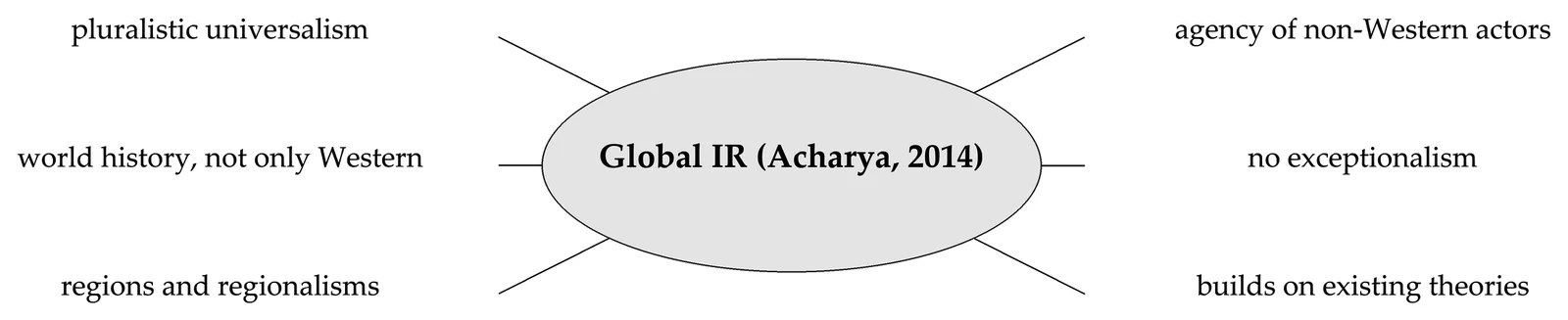
Amitav Acharya, an Indian-born scholar, launched the idea of Global International Relations in his presidential address to the International Studies Association in 2014, and developed it with Barry Buzan. Global IR is not a new theory but an aspiration and a framework for making the discipline truly global. Acharya identified six main dimensions (Figure 4.2):
- Pluralistic universalism: IR should be universal, but not in the sense of applying Western ideas to everyone. It should respect diversity and accept that universal knowledge can be built from many traditions.
- Grounded in world history: IR must be based on the history of the whole world, including the Chinese tributary system, Islamic empires, Indian statecraft and African political traditions, not only on European history from Westphalia.
- Subsumes rather than supplants: Global IR does not reject existing theories such as realism, liberalism and constructivism; it asks them to open up to non-Western ideas and experiences.
- Regions and regionalisms: regional worlds, such as Southeast Asia, Africa and Latin America, must be central, and area studies must be integrated with IR theory.
- Avoids exceptionalism: no civilisation, Western or non-Western, should be presented as uniquely superior; Global IR rejects both American exceptionalism and claims such as a uniquely benevolent Chinese or Indian order.
- Multiple forms of agency: agency is not only the material power of great powers; it includes resistance, norm-making and the local adaptation of global ideas. Acharya’s own idea of norm localisation (2004) showed how Southeast Asian states adapted international norms to their own traditions, and norm subsidiarity how weaker states create norms to protect their autonomy.
In practice, Global IR has encouraged non-Western theorising: in China, Yan Xuetong’s moral realism, Zhao Tingyang’s revival of tianxia [त्यानश्या] (‘all under heaven’) and Qin Yaqing’s relational theory; in India, renewed study of Kautilya, Advaita and dharma; in Africa, the ethics of ubuntu [उबुन्तु]; and in Latin America, theories of dependency and autonomy. Acharya and Buzan argue that IR in its second century must become a genuinely global conversation.
4.3 Critiques of Global IR: Problematising the ‘Global’
Felix Anderl [आंडर्ल] and Antonia Witt, in ‘Problematising the Global in Global IR’ (2020), welcome the aim of Global IR but warn that it may reproduce what it criticises. Their main arguments are:
- Adding without changing: Global IR may add non-Western cases and voices to the existing discipline without questioning its concepts and power structures, a form of liberal pluralism that leaves the centre untouched.
- The ‘global’ as a depoliticising word: speaking of the ‘global’ can hide the hierarchies and inequalities, of wealth, race and power, that structure the world.
- Inequalities in knowledge production: the dominance of English, Western universities, journals and funding decides whose knowledge counts. Diversity of ideas requires changing these material conditions.
- Co-optation: non-Western ideas may be absorbed into mainstream frameworks and lose their critical edge, or be used by governments to justify their own power, for example by presenting a national tradition as a model for world order.
- The tension with decoloniality: decolonial scholars want to challenge the foundations of Western knowledge, while Global IR seeks to include everyone within an expanded but continuous discipline.
Supporters reply that Global IR is a realistic, inclusive programme that can bring scholars from different worlds into dialogue without dividing the discipline into isolated national schools.
4.4 Indian Resources for Global IR: Advaita and Dharma
A. Advaita as a Global IR theory
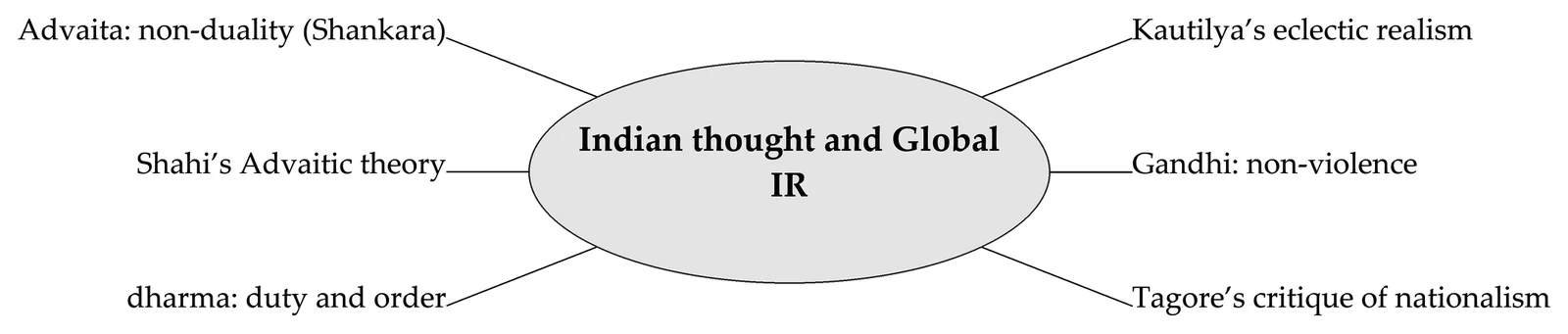
Deepshikha Shahi, in Advaita as a Global International Relations Theory (2019), draws on the Advaita [अद्वैत] Vedanta philosophy of non-dualism, associated with Shankaracharya, to propose a theory for Global IR. Western IR is built on dualisms: self and other, West and non-West, material and ideational, agent and structure. Advaita holds that apparent differences are expressions of one underlying reality. Shahi argues that an Advaitic perspective can reconcile dualism and monism, recognising diversity while seeing its underlying unity, and so offers a genuinely ‘global’ standpoint that goes beyond binaries such as Western and non-Western theory. It also supports an eclectic approach that combines insights from different theories, as she argued for Kautilya.
B. Provincialising IR through dharma
Giorgio Shani and Navnita Chadha Behera, in ‘Provincialising International Relations through a Reading of Dharma’ (2021), argue that Western IR concepts, such as sovereignty, secularism and the separation of religion and politics, are particular to European history, and should be ‘provincialised’, in Chakrabarty’s sense. Dharma, a concept of duty, ethical order and right conduct that binds rulers and ruled and links individuals, society and the cosmos, offers a relational and ethical understanding of order. It suggests that political authority is limited by duties and that order depends on right relationships rather than on sovereign power alone. They caution that dharma must be read critically, since it has also been used to justify caste hierarchy.
4.5 The Relational Turn
A. Substantialism and relationalism
Most mainstream IR theories are substantialist: they begin with entities, states with fixed properties and interests, and then study how they interact. Waltz compared states to firms in a market; realists often compare them to billiard balls. Relationalism reverses this order: it holds that relations come before entities. Actors do not exist first and then enter relations; they are constituted by their relations and change as relations change. Patrick Thaddeus Jackson and Daniel Nexon, in ‘Relations before States’ (1999), drawing on Mustafa Emirbayer’s relational sociology, argued for such a processual-relational approach in Western IR.
| Basis | Substantialism | Relationalism |
|---|---|---|
| Starting point | Entities (states) with fixed properties | Relations and processes |
| Identity and interests | Given before interaction | Formed through relationships |
| Logic | Either-or: self versus other | Both-and: self with other |
| Typical theories | Neo-realism, neo-liberalism | Relational theory (Qin), network analysis, ubuntu |
B. Qin Yaqing’s relational theory
The most influential relational theory comes from China. Qin Yaqing [चिन याचिंग], in A Relational Theory of World Politics (2018), draws on Confucian thought, in which a person is always a person-in-relations, defined by roles such as son, parent, ruler or friend. His main ideas are:
- Actors-in-relations: states are not isolated units; their identities and interests are shaped by their relationships.
- The logic of relationality: actors decide how to act according to their relationships with others, especially the degree of closeness or intimacy, rather than only according to the consequences of action or the appropriateness of norms.
- Yin–yang dialectics: the meta-relationship of the world is that of yin and yang, complementary opposites that contain each other and change into each other. This is a ‘both-and’ logic, unlike the Western ‘either-or’ logic of conflict between opposites, and it suggests that harmony is possible.
- Relational governance: order can be maintained by managing relationships, through trust, reciprocity and negotiation, as well as by enforcing rules. The Chinese idea of guanxi [ग्वानशी], networks of personal relationships, illustrates this.
C. Other relational traditions
Relational ideas are found in many traditions: the African philosophy of ubuntu, often expressed as ‘I am because we are’; Andean and indigenous Latin American thought, which sees humans and nature as interconnected; Indian ideas of dharma and Advaita; and Gandhi’s vision of the interdependence of all life. In Western social science, network analysis studies how the position of states in networks of trade, alliances and communication shapes their power. Relational thinking also helps IR address ecological crises, which reveal the dependence of humans on the natural world.
D. The meaning of the question mark
The syllabus asks whether there is really a relational turn. Critics raise several doubts. Constructivism and the English School were already relational in some ways, so the novelty may be exaggerated. Relational theories risk cultural essentialism, presenting ‘Chinese’ or ‘Indian’ thought as fixed and uniform. Relational ideas such as intimacy and harmony can be used to justify hierarchy, as critics say of nostalgic readings of the Chinese tributary system. And relational concepts are hard to measure and test. Supporters reply that relationalism opens IR to processes, change and the experiences of the non-Western world, and helps it move beyond state-centrism. The turn is best seen as an emerging conversation rather than a completed revolution.
4.6 Important Questions
- Question 1 What is Global IR? Discuss its main features and critiques.
- Question 2 Discuss the contribution of Indian thought to Global IR with reference to Advaita and dharma.
- Question 3 What is the ‘relational turn’ in International Relations? Discuss Qin Yaqing’s relational theory.
DU asks the same idea in different words. So learn one broad answer for each question below; the same answer works for every question joined by OR.
Important Question 1
What is Global IR? Discuss its main features and critiques.
OR
Discuss Amitav Acharya’s idea of Global International Relations.
OR
‘Problematising the global in Global IR.’ Discuss.
OR
Is Global IR an adequate answer to Eurocentrism in IR?
Model Answer
“Where the world has not been broken up into fragments by narrow domestic walls.”
— Rabindranath Tagore, Gitanjali (1912)
Introduction. Global International Relations is a project, launched by Amitav Acharya in 2014, to transform IR from a discipline centred on the West into one that reflects the histories, ideas and agency of the whole world. It responds to the decolonial and postcolonial critiques of Eurocentrism, but seeks inclusion and dialogue rather than separation.
1. The Problem
Acharya observed that IR does not reflect the voices, experiences and contributions of most of the world’s societies. Its origin stories, concepts and leading theories come from Europe and America, and the Global South appears mainly as an object of study rather than a source of ideas. He set out the agenda in his presidential address to the International Studies Association in 2014.
2. The Six Dimensions
Acharya listed six dimensions: pluralistic universalism, world history, subsuming existing theories, integrating regions, avoiding exceptionalism and recognising multiple forms of agency.
3. Pluralistic Universalism
Global IR seeks a universal discipline that respects diversity. Universality should not mean imposing Western ideas, but building shared knowledge from many traditions and experiences, so that what is universal is genuinely common to humanity. It rejects a single Western universalism without falling into relativism.
4. World History
IR should be grounded in world history, including the Chinese tributary system, Islamic empires, Indian statecraft and African political traditions, not only in European history since Westphalia. This corrects the myths of 1648 and 1919. Examples include the Chinese tributary system and the Indian Ocean trading world.
5. Subsuming Existing Theories
Global IR does not reject realism, liberalism or constructivism. It asks them to open up to non-Western ideas, for example by reading Kautilya alongside Morgenthau or Confucian ideas of relationality alongside constructivism. It asks them to include non-Western experience.
6. Regions, Exceptionalism and Agency
It integrates regional worlds and area studies, rejects exceptionalism of every kind, Western or non-Western, and recognises many forms of agency: resistance, norm-making and norm localisation, by which Southeast Asian states adapted international norms to local traditions, and norm subsidiarity, by which weaker states protect their autonomy. It warns against both Western and non-Western exceptionalism, such as claims that China or India is uniquely peaceful.
7. Agency of the Global South
Global IR stresses that non-Western actors helped create norms, such as non-alignment, the human rights principles affirmed at Bandung and protections of sovereignty.
8. Non-Western Theorising
Global IR has encouraged Chinese theories such as moral realism, tianxia and relational theory; Indian work on Kautilya, Advaita and dharma; African ubuntu ethics; and Latin American theories of autonomy. Indian scholars draw on Kautilya, Ashoka and Gandhi.
9. Critiques: Anderl and Witt
Anderl and Witt warn that Global IR may add diversity without changing the discipline’s concepts and power structures; that the word ‘global’ can hide hierarchy and inequality; that inequalities of language, journals and funding decide whose knowledge counts; and that non-Western ideas may be co-opted or used to legitimise state power. They argue that it must address material and institutional inequalities in knowledge production.
10. Global IR and Decoloniality
Decolonial scholars seek to challenge the foundations of Western knowledge, whereas Global IR seeks an expanded but continuous discipline. The two share the goal of ending Eurocentrism but differ on how radical the change must be. Decolonial scholars question whether reform from within is enough.
11. India and Global IR
India’s experiences of colonialism, non-alignment and democracy make it a rich source for Global IR, and Indian scholars play an active part in the debate.
12. Knowledge Production
Most IR journals, publishers and funding remain in the West, so Global IR also requires changes in who gets published, cited and funded.
13. Evaluation
Global IR has made the discipline more inclusive and has given scholars from the South a framework for contributing theory. Its success depends on changing the institutions of knowledge as well as adding voices. It remains a work in progress.
14. Deep Pluralism and IR’s Second Century
Acharya and Buzan argue that the world is moving towards deep pluralism: power, wealth and cultural authority are spreading among many states and civilisations, and no superpower will dominate as before. In such a world, IR in its second century must become a global conversation in which scholars from every region contribute to shared theory.
Conclusion. Thus, Global IR is an aspiration to make IR as wide as the world it studies. It is not yet complete, and its critics remind us that inclusion requires changes in power as well as in ideas.
Important Question 2
Discuss the contribution of Indian thought to Global IR with reference to Advaita and dharma.
OR
Examine Deepshikha Shahi’s Advaitic theory of International Relations.
OR
How can dharma help to provincialise International Relations?
Model Answer
“I want the cultures of all the lands to be blown about my house as freely as possible. But I refuse to be blown off my feet by any.”
— M.K. Gandhi, Young India (1 June 1921)
Introduction. Global IR invites scholars to draw on their own intellectual traditions to enrich the discipline. Indian scholars have turned to classical concepts such as Advaita and dharma, as well as Kautilya’s statecraft, to offer alternatives to the dualistic, state-centred assumptions of Western IR.
1. The Need for Indian Resources
As Behera and Bajpai argued, Indian IR long relied on Western theory and concentrated on policy. Global IR provides an opportunity to build theory from Indian thought while engaging in a global conversation. This created a gap between Indian experience and the concepts used to explain it.
2. The Dualisms of Western IR
Western IR is built on binaries: self and other, West and non-West, material and ideational, agent and structure, war and peace. These dualisms often produce either-or thinking and conflictual images of world politics. Such binaries make the other appear as a threat.
3. Advaita Vedanta
Advaita, the philosophy of non-dualism associated with Shankaracharya, holds that the diversity of the world expresses a single underlying reality. Difference is real at one level but not ultimate. It holds that Brahman alone is real and that the self is identical with it.
4. Non-dualism and Self–Other Relations
An Advaitic view sees self and other as ultimately one, which can encourage empathy and cooperation in place of the enmity built into self–other binaries.
5. Shahi’s Advaitic Theory
Deepshikha Shahi argues that an Advaitic perspective can reconcile dualism and monism, recognising diversity while seeing unity, and so offers a genuinely global standpoint beyond the binary of Western and non-Western theory. It supports eclecticism, combining insights from different theories. Her Advaita as a Global International Relations Theory (2019) develops this argument.
6. Kautilya as Eclectic Theory
Shahi also reads Kautilya’s Arthashastra as eclectic rather than purely realist, combining power politics with prosperity, alliances and ethical restraint. This reading challenges the image of Kautilya as only a realist.
7. Dharma
Dharma means duty, right conduct and ethical order, binding rulers and ruled and linking individuals, society and cosmos. Shani and Behera argue that it offers a relational, ethical understanding of order in which authority is limited by duties. In the Mahabharata, dharma guides both kings and warriors.
8. Provincialising IR
Reading IR through dharma shows that concepts such as sovereignty, secularism and the separation of religion and politics are particular to Europe. Provincialising them opens space for other ways of thinking about order and authority. Concepts such as sovereignty then appear historically specific rather than universal.
9. Gandhi’s Non-violence as IR Thought
Gandhi’s satyagraha offers a theory of conflict transformation and resistance without violence that has influenced movements worldwide.
10. Tagore’s Critique of Nationalism
Tagore warned that the Western nation-state organises people for power and profit, and argued for cooperation among civilisations.
11. Strategic Autonomy and Restraint
Some scholars see India’s strategic autonomy and preference for dialogue as shaped by ideas of restraint and duty rooted in dharma.
12. Cautions
These traditions must be read critically: dharma has also been used to justify caste hierarchy, and presenting a single ‘Indian’ view risks essentialism and nationalist misuse. Anderl and Witt’s warning about co-optation applies here. Political uses of these traditions to support exclusive nationalism also require caution.
13. Ashoka and the Plurality of Indian Traditions
Indian tradition is itself plural. Alongside Kautilya’s realpolitik stands Ashoka, who renounced conquest by war after Kalinga and proclaimed conquest by dhamma (dhammavijaya), an ethical alternative within Indian statecraft. Recognising this plurality guards against presenting a single ‘Indian view’. Buddhist and Jain traditions add ideas of non-violence and many-sidedness (anekantavada).
14. Modern Indian Thinkers
Tagore’s universalism and critique of the nation, Gandhi’s satyagraha and idea of swaraj as self-rule at every level, and Nehru’s non-alignment and Panchsheel offer modern Indian contributions to thinking about world order that Global IR can bring into dialogue with other traditions. Nehru’s non-alignment and Ambedkar’s internationalism are further resources.
15. Evaluation
Indian concepts such as Advaita and dharma can enrich Global IR by offering alternatives to Western binaries, but they must be used critically and combined with attention to power and history.
Conclusion. Thus, Advaita and dharma offer Indian resources for a more global and relational IR, provided they are used critically and in dialogue with other traditions.
Important Question 3
What is the ‘relational turn’ in International Relations? Discuss Qin Yaqing’s relational theory.
OR
Distinguish between substantialist and relational approaches to IR.
OR
‘A relational turn?’ Critically examine.
Model Answer
“I am, because we are; and since we are, therefore I am.”
— John Mbiti, African Religions and Philosophy (1969), on ubuntu
Introduction. The relational turn is a recent movement in IR which holds that relations, not separate entities, are the basic units of world politics. It draws on Western relational sociology as well as Chinese, Indian, African and indigenous thought, and is closely linked to the project of Global IR.
1. Substantialism in Mainstream IR
Mainstream theories treat states as self-contained units with fixed properties and interests, which then interact, like billiard balls or firms in a market. Waltz’s neo-realism is the clearest example. Realism, liberalism and much constructivism share this assumption.
2. Relationalism
Relationalism reverses the order: relations come first, and actors are constituted by their relations. Identities and interests are formed and changed through interaction and process. Identities and interests are produced in relationships.
3. Western Roots
Jackson and Nexon’s ‘Relations before States’ (1999), drawing on Emirbayer’s relational sociology, argued for a processual-relational IR. Network analysis studies how positions in networks shape power. It also draws on pragmatism and on the sociology of Norbert Elias and Pierre Bourdieu.
4. Qin Yaqing: Actors-in-Relations
Drawing on Confucianism, Qin argues that states, like persons, are actors-in-relations whose identities depend on their relationships. He develops this in A Relational Theory of World Politics (2018).
5. Confucian Roots
Qin draws on the Chinese idea of networks of personal relationships and on Confucian relational ethics, in which obligations depend on one’s relationships.
6. The Logic of Relationality
Actors act according to their relationships, especially the degree of closeness, rather than only the logic of consequences or of appropriateness. Actors cooperate more with those close to them in their circles of relations.
7. Yin–Yang and Relational Governance
The meta-relationship of the world is yin and yang, complementary opposites; this ‘both-and’ logic contrasts with Western ‘either-or’ thinking and suggests the possibility of harmony. Order can be maintained by managing relationships through trust and reciprocity, as guanxi illustrates, as well as by rules. Relational governance manages relationships through negotiation and trust rather than rules alone.
8. Other Relational Traditions
Ubuntu’s ‘I am because we are’, Andean relationality between humans and nature, dharma and Advaita, and Gandhi’s idea of interdependence show that relational thought is found across the world. Many indigenous traditions in the Americas also see humans as related to nature.

9. Relational Ideas in Indian Thought
Indian ideas such as dharma and Advaita also emphasise relations and interdependence, offering parallels to Qin’s Confucian relationalism.
10. The Meaning of the Question Mark
Critics argue that constructivism and the English School were already relational; that relational theories risk cultural essentialism; that ideas of intimacy and harmony can justify hierarchy, as with nostalgic views of the tributary system; and that relational concepts are hard to test.
11. Relational Power
Relational theory sees power as arising from positions in networks, so a state’s influence depends on the quality of its relationships, not only on its resources.
12. Significance
Relationalism moves IR beyond state-centrism, explains change and interdependence, and brings non-Western ideas into the core of theory, while helping IR address ecological interdependence. It also fits a globalised world of networks.
13. Relationalism and Constructivism
Constructivism stresses that shared ideas and norms shape identities, but it often still begins with states as actors. Relationalism goes further by treating relationships themselves as the basic reality. Qin adds a logic of relationality to the logic of consequences of rationalism and the logic of appropriateness of constructivism. Relationalism goes further by treating relations, not actors, as the basic unit.
14. Relational Ideas in Practice
The ASEAN way of consultation and consensus, China’s diplomacy of partnerships and India’s use of Vasudhaiva Kutumbakam, ‘the world is one family’, as the theme of its G20 presidency in 2023 (‘One Earth, One Family, One Future’) show how relational language enters diplomacy, though critics ask whether practice matches the rhetoric. India’s emphasis on civilisational ties with its neighbours also reflects relational thinking.
15. Evaluation
The relational turn invites IR to study relations and processes rather than fixed units and enriches theory with non-Western ideas, though critics ask how new it really is and whether it can explain power and conflict.
Conclusion. Thus, the relational turn is a promising but unfinished conversation. It asks IR to see the world as made of relationships, while its critics ask whose relationships and on what terms.
Short Notes
(a) Norm localisation
Amitav Acharya’s concept (2004) for the process by which local actors adapt international norms to fit their own beliefs and practices, rather than simply accepting or rejecting them. He showed how ASEAN states localised norms of security co-operation, which demonstrates the agency of non-Western actors.
(b) Pluralistic universalism
The first dimension of Global IR: the idea that IR should be universal, applicable to all, but built from the diverse histories and traditions of the world rather than by imposing Western concepts as the universal standard.
(c) Yin–yang dialectics
Qin Yaqing’s idea that the basic relationship in the world is between complementary opposites, yin and yang, which contain and transform into each other. It reflects a ‘both-and’ logic of co-existence rather than the ‘either-or’ logic of conflict.
More notes: DSC-6 Introduction to International Relations
These notes are prepared by PADHO TO AISE for study help. They are not an official University of Delhi publication.