
Semester II DSC-6 Introduction to International Relations
Unit III · 27 min read · Updated 24 Nov 2026
As per the University of Delhi (DU) BA (Hons) Political Science syllabus
Contents
- 3.1 Power
- 3.2 Sovereignty
- 3.3 Empire
- 3.4 International Order
- 3.5 Important Questions
- What is power in International Relations? Discuss its different forms.
- Discuss the concept of sovereignty and the challenges to it.
- What is empire? Distinguish between empire, imperialism and hegemony.
- What is international order? Discuss with reference to Global South and Indian perspectives.
- Short Notes
A के पास B पर उस सीमा तक शक्ति है जिस सीमा तक वह B से वह करवा सकता है जो B अन्यथा नहीं करता।
A has power over B to the extent that he can get B to do something that B would not otherwise do.
— Robert Dahl, The Concept of Power (1957)
EVERY THEORY of International Relations is built from a few basic concepts. Realists speak of power, liberals of institutions and order, Marxists of empire, and almost every theory assumes the sovereign state. But these words have no single meaning. Is power the possession of tanks and money, or the ability to make others want what you want? Is sovereignty the absolute authority of a state, or an ‘organised hypocrisy’ that powerful states ignore when convenient? Was the modern world a society of equal states or a world of empires? And whose order is the international order? In this chapter we study these four concepts, power, sovereignty, empire and international order, from mainstream as well as Global South and Indian perspectives.
3.1 Power
A. Power as resources and as relationship
Power is the central concept of IR, yet it is hard to define. One view treats power as resources: the capabilities a state possesses. Hans Morgenthau listed the elements of national power as geography, natural resources, industrial capacity, military preparedness, population, national character, national morale, the quality of diplomacy and the quality of government. Another view treats power as a relationship: Robert Dahl defined it as the ability of A to get B to do something B would not otherwise do. David Baldwin (2013) argues for this relational view. Power has several dimensions: its scope (which issues), domain (over whom), weight (how likely it is to succeed), costs and means. A state may be powerful in one area and weak in another, and resources do not automatically produce outcomes, the ‘paradox of unrealised power’, as the defeat of the United States in Vietnam showed.
B. Hard, soft and smart power
Joseph Nye distinguished three kinds of power (Figure 3.2). Hard power is the ability to make others act through military force or economic inducements and sanctions, ‘sticks and carrots’. Soft power, a term he introduced in Bound to Lead (1990) and developed in Soft Power (2004), is the ability to get what you want through attraction rather than coercion or payment. Its sources are a country’s culture, its political values when it lives up to them, and its foreign policies when they are seen as legitimate. Smart power is the skilful combination of both. India’s soft power includes its democracy, its diaspora, yoga, Buddhism, cinema and its tradition of non-alignment. H.W. Ohnesorge and Jan-Philipp Wagner note that soft power is slow, difficult to control by governments and works best when combined with hard power.

C. Barnett and Duvall: four types of power
Michael Barnett and Raymond Duvall, in ‘Power in International Politics’ (2005), argued that IR had focused too narrowly on one kind of power. They classified power along two dimensions: whether it works through interaction between actors or through the constitution of actors, and whether it is direct or diffuse. This produces four types:
- Compulsory power: direct control by one actor over another, as when a state uses force or threats; this is the realist conception.
- Institutional power: indirect control through institutions, as when powerful states shape the rules of the IMF or the UN Security Council to their advantage; this is linked to liberal institutionalism.
- Structural power: the direct constitution of actors’ positions and capacities by social structures, such as the relationship between capital and labour or between core and periphery.
- Productive power: the diffuse production of identities and meanings through discourse, as when categories such as ‘civilised’ and ‘backward’, ‘developed’ and ‘underdeveloped’, or ‘rogue state’ define who actors are and what is normal.
This taxonomy shows that power in world politics is not only about who wins a conflict but also about who sets the rules and who defines the terms of debate. The distribution of power among great powers also defines the polarity of the system: unipolar, bipolar or multipolar.
3.2 Sovereignty
A. Meaning
Sovereignty means supreme authority. Jean Bodin [बोदाँ] (1576) defined it as the absolute and perpetual power of a commonwealth, and Hobbes located it in the Leviathan. It has an internal aspect, supreme authority within a territory, and an external aspect, independence from outside control and recognition by other states. As we saw in Chapter 1, the claim that sovereignty was created at Westphalia in 1648 is largely a myth (Osiander, 2001).
B. Krasner: four meanings and organised hypocrisy
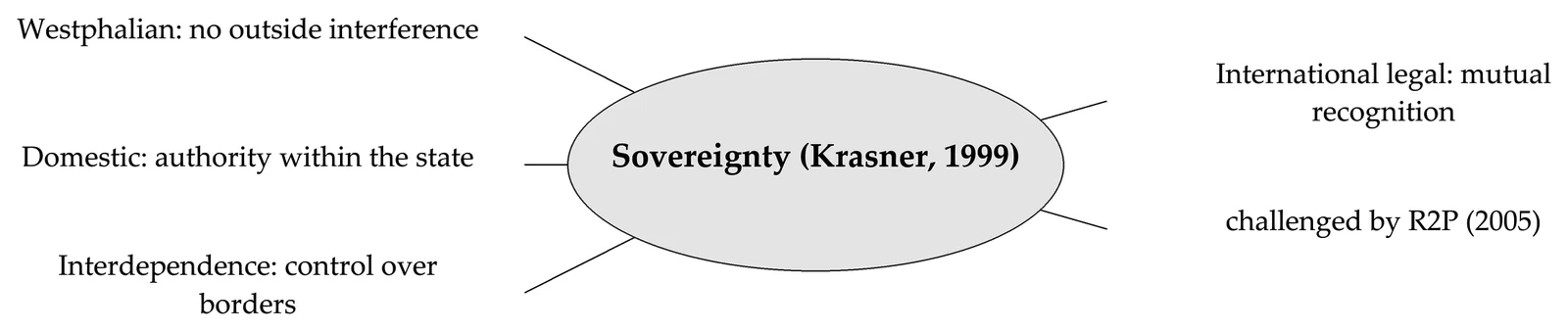
Stephen Krasner, in Sovereignty: Organized Hypocrisy (1999) and ‘Sovereignty’ (2001), distinguished four meanings (Figure 3.3): domestic sovereignty, the organisation and effectiveness of authority within a state; interdependence sovereignty, the ability to control flows across borders, such as goods, people, money and diseases; international legal sovereignty, the mutual recognition of states as juridically equal; and Westphalian sovereignty, the exclusion of external actors from domestic authority. These need not go together: a state may be recognised but unable to control its territory or borders. Krasner called sovereignty organised hypocrisy, because its norms are widely accepted but regularly violated when powerful rulers find it useful, through intervention, conditional aid or imposed constitutions.
C. Challenges to sovereignty
Globalisation has reduced states’ control over flows of capital, information and people. International human rights law limits what states may do to their citizens. Francis Deng described sovereignty as responsibility, and the International Commission on Intervention and State Sovereignty (2001) proposed the Responsibility to Protect (R2P), accepted by the UN World Summit in 2005: if a state fails to protect its people from genocide, war crimes, ethnic cleansing and crimes against humanity, the international community has a responsibility to act. The European Union pools sovereignty, and non-state actors and cyber attacks cross borders easily. Developing countries fear that such ideas can justify intervention by the powerful.
D. Global South and Indian perspectives
Navnita Chadha Behera, in ‘State and Sovereignty’ (2020), argues that the Westphalian model of the territorial, homogeneous sovereign state was imposed on the Global South through colonialism. Colonial powers drew borders across communities, and postcolonial states inherited them, which produced conflicts over territory and identity. Robert Jackson (1990) described many such states as quasi-states, with juridical sovereignty recognised by others but little empirical capacity. Behera calls for understanding the layered, overlapping and shared forms of authority that existed in pre-colonial societies and still exist at frontiers. Manish Kumar (2018) revisits sovereignty through ancient Indian notions of dharma: the king’s authority was not absolute but bound by rajadharma and by the dharma of the community, and political authority was plural and layered, as in the mandala and the ideal of the chakravartin. This suggests a duty-based, limited idea of sovereignty different from the Westphalian model.
3.3 Empire
A. Meaning of empire
Herfried Münkler [म्यूंकलर], in Empires (2007), explains that an empire is a large political order in which a centre dominates peripheries that are unequal to it. It differs from a state in several ways: states have clear borders, while empires have open frontiers; states are formally equal, while empires create graded hierarchies of rule; and empires usually claim a mission, to civilise, convert or bring order, that justifies their rule. Münkler describes the ‘Augustan threshold’, the point at which an empire moves from expansion and plunder to consolidation and good administration, and the danger of imperial overstretch, a term Paul Kennedy used in The Rise and Fall of the Great Powers (1987).
B. Empire, imperialism and hegemony
Münkler insists on a necessary distinction. Empire is a structure of rule in which the centre controls the internal and external policies of subordinate units. Imperialism is the policy or will to create or expand an empire. Hegemony is leadership among formally equal states, based on superiority and often on consent, without controlling their internal affairs. Empires may be formal, ruling colonies directly, as Britain ruled India, or informal, controlling other countries economically and politically without annexing them (Figure 3.4). John Gallagher and Ronald Robinson’s ‘The Imperialism of Free Trade’ (1953) showed that Britain preferred informal control through trade where possible and formal rule only when necessary.

C. Why empire matters for IR
Tarak Barkawi [बरकावी] argues that mainstream IR, by focusing on sovereign states, has ignored the fact that for most of modern history the world was organised by empires. In ‘Retrieving the Imperial’ (2002), Barkawi and Mark Laffey argue that the core concepts of IR, sovereignty, war, security, order, were shaped by imperial relations; for example, the ‘long peace’ among great powers during the Cold War coincided with many wars in the Third World linked to imperial and superpower intervention. In ‘Empire and Order in International Relations and Security Studies’ (2010), Barkawi shows that imperial forms of order, hierarchical, unequal and violent, continued after decolonisation. Debates on whether the United States is an empire, informal and based on military bases, finance and alliances, and Hardt and Negri’s idea of a decentred Empire, show that the concept remains alive. Yale Ferguson and Richard Mansbach distinguish superpower, hegemony and empire as different degrees of dominance.
3.4 International Order
A. Bull and the anarchical society
Hedley Bull, in The Anarchical Society (1977), the classic text of the English School, argued that even without a world government, states form an international society when they share common interests and values, see themselves as bound by common rules and share in common institutions. International order is a pattern of activity that sustains the basic goals of this society: preserving the system of states, maintaining the independence of states, limiting violence, keeping promises and protecting possessions. Its institutions are the balance of power, international law, diplomacy, war (regulated by rules) and the special role of the great powers.
B. Historical orders
International orders have changed over time (Figure 3.5): the Westphalian order of European states; the Concert of Europe after 1815; the Versailles order and League of Nations after 1919; the bipolar Cold War order; the liberal international order led by the United States after 1945 and especially after 1991, based on the UN, Bretton Woods institutions, free trade and alliances; and today a contested multipolar order, in which China, India and other powers rise and liberal norms are challenged. Scholars such as Rainer Baumann and Klaus Dingwerth (2015) argue that world order is moving at once towards heterarchy, with overlapping authorities of global governance, and towards hierarchy, with renewed forms of domination.

C. Order, ordering and disorder: a Global South view
Karen Smith, in ‘Order, Ordering and Disorder’ (2020), argues that the ‘order’ celebrated by Western IR was experienced by much of the world as disorder: colonial conquest, slavery, partition and Cold War proxy wars. Order is not neutral; it serves some and harms others. She prefers to speak of ordering, a continuing process in which many actors, including those of the Global South, take part. Bandung (1955), the Non-Aligned Movement and the demand for a New International Economic Order were attempts by the South to reorder the world. Upendra Baxi, examining the American ‘war on terror’ after 2001, warned that powerful states were trying to create a new international law and order that permitted them to use force selectively, an argument of Third World Approaches to International Law.
D. India and international order
Kanti Bajpai and Siddharth Mallavarapu, in India, the West, and International Order (2019), show that India has been both a participant in and a critic of the Western-led order. It has accepted core elements such as sovereignty, the UN and international law, but contested others: the nuclear non-proliferation order, which it saw as discriminatory and refused to join through the NPT; the composition of the UN Security Council; trade rules that hurt developing countries; and climate arrangements that ignored historical responsibility. India’s approach has been mainly reformist: it seeks a more representative, multipolar order rather than the overthrow of the existing one.
3.5 Important Questions
- Question 1 What is power in International Relations? Discuss its different forms.
- Question 2 Discuss the concept of sovereignty and the challenges to it.
- Question 3 What is empire? Distinguish between empire, imperialism and hegemony.
- Question 4 What is international order? Discuss with reference to Global South and Indian perspectives.
DU asks the same idea in different words. So learn one broad answer for each question below; the same answer works for every question joined by OR.
Important Question 1
What is power in International Relations? Discuss its different forms.
OR
Distinguish between hard power, soft power and smart power.
OR
Discuss Barnett and Duvall’s taxonomy of power.
Model Answer
“Soft power is the ability to get what you want through attraction rather than coercion or payments.”
— Joseph Nye, Soft Power (2004)
Introduction. Power is the central concept of International Relations: realists define politics as a struggle for power, and every theory has its own idea of what power is and how it works. Yet power is hard to define and measure, and scholars have moved from seeing it as a possession to seeing it as a relationship with many forms.
1. Power as Resources
The traditional view treats power as the capabilities a state possesses. Morgenthau listed geography, natural resources, industrial capacity, military preparedness, population, national character, morale, the quality of diplomacy and the quality of government. This view allows states to be ranked, but resources do not always produce results. Morgenthau listed geography, natural resources, industrial capacity, military preparedness, population, national character, national morale and the quality of diplomacy and government.
2. Power as Relationship
Dahl defined power as A’s ability to get B to do what B would not otherwise do. Baldwin argues that power is relational and multidimensional, varying in scope, domain, weight, costs and means. The ‘paradox of unrealised power’, as in Vietnam, shows that great resources may not bring victory. Resources do not automatically produce outcomes, as the American defeat in Vietnam showed.
3. Hard Power
Hard power is the ability to command through military force, threats, sanctions and economic inducements. It remains essential for security and deterrence, as nuclear weapons and military alliances show. Economic sanctions are also a form of hard power.
4. Soft Power
Nye defined soft power as the ability to attract and persuade. Its sources are culture, political values and legitimate foreign policies. It is slow and hard for governments to control, but it shapes others’ preferences. India’s democracy, diaspora, yoga, Buddhism and cinema are sources of its soft power. India’s soft power includes yoga, its films, its democracy and its diaspora.
5. Smart Power
Smart power combines hard and soft power in effective strategies. Nye argued that the United States weakened its soft power by relying too heavily on force in Iraq, while successful powers combine coercion, persuasion and attraction. The term was popularised by Nye and used by US Secretary of State Hillary Clinton.
6. Barnett and Duvall’s Four Types
Compulsory power is direct control of one actor over another; institutional power works indirectly through rules and institutions; structural power constitutes actors’ positions, as between capital and labour; and productive power creates identities and meanings through discourse, such as ‘developed’ and ‘rogue state’.
7. Structural Power
Susan Strange identified structural power, the power to shape the frameworks within which others act, in security, production, finance and knowledge.
8. Power and Polarity
The distribution of power among great powers defines polarity: unipolar after 1991, bipolar during the Cold War, multipolar before 1945 and, many argue, increasingly today. Power transition theory (Organski, 1958) warns of conflict when a rising power approaches a dominant one.
9. Power Transition
Power transition theory, associated with A.F.K. Organski, argues that war is most likely when a rising challenger approaches the power of a dominant state, a debate revived by the rise of China.
10. Power in India’s Foreign Policy
India combines growing hard power, including nuclear weapons and economic size, with soft power and diplomatic coalitions, illustrating smart power in practice.
11. Evaluation
Realists stress hard and compulsory power; liberals add institutional power and soft power; Marxists stress structural power; constructivists and postcolonial scholars stress productive power. A full understanding needs all these dimensions. Power is therefore multidimensional and relational.
12. Measuring Power
Scholars measure power with indices such as the Composite Index of National Capability of the Correlates of War project, which combines population, industry and military figures, or with GDP and defence spending. But power is not fully fungible: military strength cannot easily be converted into influence on trade or climate negotiations, which is why rankings often mislead.
13. Lukes’s Three Dimensions
Steven Lukes, in Power: A Radical View (1974), distinguished three dimensions: power in open decision-making; power to keep issues off the agenda (the ‘second face’ described by Bachrach and Baratz, 1962); and power to shape people’s very preferences and beliefs. These parallel Barnett and Duvall’s compulsory, institutional and productive power.
Conclusion. Thus, power in IR is not only the possession of force but a many-sided relationship that includes attraction, rules, structures and meanings.
Important Question 2
Discuss the concept of sovereignty and the challenges to it.
OR
Examine Krasner’s four meanings of sovereignty.
OR
Discuss non-Western and Indian notions of sovereignty.
Model Answer
“Sovereignty is the absolute and perpetual power of a commonwealth.”
— Jean Bodin, Six Books of the Commonwealth (1576)
Introduction. Sovereignty, the supreme authority of the state within its territory and its independence from outside control, is the foundation of the modern international system. Yet its origins, meanings and limits are all contested, and Global South scholars argue that the Westphalian idea of sovereignty does not fit their history.
1. Meaning
Bodin defined sovereignty as absolute and perpetual power; Hobbes located it in the Leviathan. It has an internal aspect, supreme authority within the state, and an external aspect, independence and recognition by other states. Westphalian sovereignty means non-interference in domestic affairs.
2. Popular Sovereignty
Since the American and French revolutions, sovereignty has been seen as belonging to the people, which links external sovereignty with democratic legitimacy.
3. The Westphalian Myth
The Peace of Westphalia (1648) is usually said to have created sovereignty, but Osiander shows that the treaties did not mention it and that sovereignty developed gradually, becoming a European norm in the nineteenth century while being denied to colonised peoples.
4. Krasner’s Four Meanings
Domestic sovereignty concerns effective authority within the state; interdependence sovereignty the control of cross-border flows; international legal sovereignty mutual recognition; and Westphalian sovereignty the exclusion of external actors. They need not coincide. The four are domestic, interdependence, international legal and Westphalian sovereignty.
5. Organised Hypocrisy
Krasner argued that sovereignty norms are accepted but violated when powerful actors find it useful, through intervention, conditional loans or imposed constitutions. Sovereignty is a norm, not a fact. Rulers violate sovereignty norms when it suits their interests.
6. Sovereignty and Human Rights
International human rights law limits sovereignty by recognising that how a state treats its own people is a matter of international concern.
7. Challenges
Globalisation reduces control over capital, information and people; human rights law limits what states may do; the EU pools sovereignty; and non-state actors and cyber threats cross borders. Deng’s ‘sovereignty as responsibility’ and the Responsibility to Protect (2005) make sovereignty conditional on protecting citizens. The Responsibility to Protect (2005) argued that sovereignty includes a responsibility to protect populations from mass atrocities.
8. Pooled Sovereignty
Members of the European Union pool sovereignty in common institutions, showing that sovereignty can be shared rather than absolute.
9. Digital Sovereignty
Data flows, cyber attacks and global platforms challenge state control, leading to debates on ‘digital sovereignty’ and data localisation, including in India.
10. Global South Perspectives
Behera shows that the Westphalian state was imposed through colonialism; colonial borders divided communities and produced conflicts. Jackson’s ‘quasi-states’ have legal sovereignty but little capacity. The South defends sovereignty as protection against intervention while recognising its colonial origins.
11. Indian Notions: Dharma
Manish Kumar argues that in ancient India the king’s authority was bound by rajadharma and the dharma of society, and political authority was plural and layered, as in the mandala. Sovereignty was duty-based and limited, unlike the absolute Westphalian model. Authority was bound by duty rather than absolute.
12. Evaluation
Sovereignty remains the basic principle of international law and the UN Charter, but it is neither absolute nor uniform. It is best seen as a changing social institution shaped by power, norms and history. It is being redefined rather than disappearing.
13. Sovereignty and Self-Determination
Decolonisation made sovereignty universal. The UN General Assembly’s Declaration on the Granting of Independence to Colonial Countries and Peoples (Resolution 1514, 1960) proclaimed the right of self-determination. New states generally accepted colonial borders under the principle of uti possidetis, as the Organisation of African Unity resolved in 1964, to avoid endless conflicts, though this also froze arbitrary divisions. Resolution 1514 (1960) declared the right of colonial peoples to independence.
14. India’s Position
India strongly defends sovereignty and non-interference, as in Panchsheel, and has been cautious about R2P and humanitarian intervention, fearing their selective use; it abstained on the Security Council resolution that authorised force in Libya in 2011. India has been cautious about the Responsibility to Protect and humanitarian intervention.
Conclusion. Thus, sovereignty is a central but contested concept: a protection for weak states, a norm violated by the strong, and an idea that non-Western traditions can help to rethink.
Important Question 3
What is empire? Distinguish between empire, imperialism and hegemony.
OR
Why is the concept of empire important for International Relations?
OR
Discuss formal and informal empire.
Model Answer
“Trade with informal control if possible; trade with rule when necessary.”
— John Gallagher and Ronald Robinson, ‘The Imperialism of Free Trade’ (1953)
Introduction. For most of modern history the world was organised not by equal sovereign states but by empires. Yet mainstream IR long ignored empire. Scholars such as Münkler, Barkawi and Laffey have brought the concept back to the centre of the discipline.
1. Meaning of Empire
Münkler defines empire as a large political order in which a centre dominates unequal peripheries. Empires have frontiers rather than borders, graded hierarchies rather than formal equality, and a claimed mission, to civilise or bring order, that justifies rule. Empires are marked by unequal relations between centre and periphery and by a claim to universal order.
2. Dynamics of Empire
Münkler’s ‘Augustan threshold’ marks the move from expansion to consolidation and good governance; Kennedy’s ‘imperial overstretch’ describes the decline that follows when commitments exceed resources. Crossing the threshold means turning conquest into stable administration.
3. Pre-modern Empires
The Roman, Chinese, Mughal and Ottoman empires show that empire, not the nation-state, was the normal form of large-scale political order for most of history.
4. Empire and Imperialism
Empire is the structure of rule; imperialism is the policy or drive to build and expand it. Marxists such as Lenin explained imperialism by the needs of monopoly capitalism. Imperialism may be colonial or economic.
5. Empire and Hegemony
Hegemony is leadership among formally equal states, often based on consent and superiority, without control of their internal affairs. Empire controls both internal and external policies of subordinate units. Ferguson and Mansbach distinguish superpower, hegemony and empire as degrees of dominance. Hegemony relies more on consent and leadership than on direct rule.
6. Formal and Informal Empire
Formal empire rules colonies directly, as Britain ruled India; informal empire controls other countries through trade, finance and political influence without annexation, as Britain did in Latin America and China. Gallagher and Robinson showed that Britain preferred informal control where possible. Gallagher and Robinson’s ‘imperialism of free trade’ (1953) described Britain’s informal empire in Latin America.
7. Decolonisation
After 1945, nationalist movements, the weakening of European powers and the UN principle of self-determination ended most formal empires, though economic dependence continued.
8. Empire and International Law
International law developed partly to justify empire, through doctrines such as terra nullius and the standard of civilisation, as Antony Anghie shows.
9. Why Empire Matters for IR
Barkawi and Laffey argue that IR’s core concepts were shaped by imperial relations; the Cold War ‘long peace’ coexisted with wars in the Third World. Barkawi shows that imperial forms of order continued after decolonisation. Concepts such as development and security emerged in imperial contexts.
10. Neo-colonialism
Kwame Nkrumah’s Neo-Colonialism (1965) argued that formally independent states remained under external economic control, a form of informal empire.
11. Contemporary Debates
Scholars debate whether the United States is an empire, based on military bases, finance and alliances. Hardt and Negri describe a decentred global Empire. Rising powers and economic dependence revive questions of informal empire. Niall Ferguson called the United States an empire in denial.
12. China and Empire Debates
Some scholars ask whether China’s Belt and Road Initiative creates new forms of influence resembling informal empire, while others see it as ordinary economic statecraft.
13. Evaluation
Bringing empire into IR corrects the myth of a world of equal states and reveals the hierarchies of race and power behind international order, though critics warn that the term can be stretched too far. It also helps explain inequalities that persist after empire.
14. Empire in India
British rule in India combined direct rule over British provinces after 1858 with indirect rule over more than five hundred princely states under the doctrine of paramountcy, a layered sovereignty typical of empire. India supplied revenue, markets and soldiers: Barkawi’s Soldiers of Empire (2017) shows how the Indian Army fought across the empire in the world wars. The princely states were ruled indirectly through British residents.
15. Empire and Race
Empires justified themselves through racial hierarchy and the ‘civilising mission’, which Kipling called ‘the white man’s burden’ (1899). The ‘standard of civilisation’ decided which peoples could be sovereign, linking empire directly to the racial ordering of the world. The ‘civilising mission’ justified colonial rule as uplifting supposedly backward peoples.
Conclusion. Thus, empire is a structure of unequal rule distinct from imperialism and hegemony. Recovering it helps IR understand the hierarchies that still shape world politics.
Important Question 4
What is international order? Discuss with reference to Global South and Indian perspectives.
OR
Discuss Hedley Bull’s concept of order in the anarchical society.
OR
Examine India’s approach to the international order.
Model Answer
“A society of states exists when a group of states, conscious of certain common interests and common values, form a society in the sense that they conceive themselves to be bound by a common set of rules.”
— Hedley Bull, The Anarchical Society (1977)
Introduction. International order refers to the patterns, rules and institutions that give stability and predictability to relations among states in the absence of world government. Who creates order, whose interests it serves and how it changes are central questions of IR.
1. Bull’s Anarchical Society
Bull argued that states form an international society when they share interests, values, rules and institutions. Order sustains its basic goals: preserving the system, the independence of states, peace, keeping promises and protecting possessions. His The Anarchical Society (1977) distinguished an international system from an international society.
2. Institutions of Order
Bull identified the balance of power, international law, diplomacy, war under rules and the great powers as the institutions that maintain order. The five institutions are the balance of power, international law, diplomacy, war and the great powers.
3. Historical Orders
The Westphalian order, the Concert of Europe, the Versailles order, the Cold War order and the liberal international order after 1945 each rested on particular distributions of power and rules. Each order reflected the balance of power and the values of its leading states.
4. Hegemonic Stability
Some argue that order depends on a hegemon that provides public goods, as Britain did in the nineteenth century and the United States after 1945.
5. The Liberal International Order and Its Crisis
The liberal order rested on the UN, Bretton Woods institutions, free trade and alliances under American leadership. It now faces challenges from rising powers, populism and great power rivalry, producing a contested multipolar order. Baumann and Dingwerth see movement towards both heterarchy and hierarchy. Its crisis is linked to the rise of China, populism and wars in Ukraine and the Middle East.
6. A Multiplex World
Amitav Acharya describes the emerging world as a ‘multiplex’ order with many actors and centres of influence rather than a single hegemon.
7. A Global South View: Order and Disorder
Karen Smith argues that Western order was experienced as disorder in the South: conquest, slavery, partition and proxy wars. She prefers ‘ordering’, a process in which the South has also acted, through Bandung, NAM and the NIEO.
8. Law and Order after 2001
Upendra Baxi warned that the war on terror sought to remake international law to permit selective use of force by the powerful, a concern of Third World Approaches to International Law.
9. India and International Order
Bajpai and Mallavarapu show India as both participant and critic: it accepts sovereignty, the UN and international law, but contests the nuclear order, the composition of the Security Council, trade rules and climate arrangements. Its approach is reformist, seeking a representative, multipolar order. India seeks reform of the UN Security Council and a multipolar order.
10. Order and Justice
Bull noted a tension between order and justice: an order that ignores the demands of the weak for justice may not last.
11. Evaluation
Order is necessary for peace and co-operation, but it is never neutral. A legitimate order must include the voices and interests of the Global South, which now has the weight to shape it. Every order reflects the interests and values of those who make it.
12. The English School
The English School stands between realism and revolutionism. Martin Wight distinguished three traditions: realism (Hobbes and Machiavelli), rationalism (Grotius, the tradition of international society) and revolutionism (Kant, the idea of a world community). Bull’s international society belongs to the rationalist tradition. Its key thinkers include Martin Wight, Hedley Bull and Robert Jackson.
13. Pluralism and Solidarism
Within the English School, pluralists such as Bull and Robert Jackson stress sovereignty and non-intervention as the basis of order among different states; solidarists such as Nicholas Wheeler (Saving Strangers, 2000) argue that shared values can justify humanitarian intervention.
14. New Institutions of the Rising South
Rising powers have created new institutions alongside the old: BRICS (first summit 2009), its New Development Bank (2014), the Asian Infrastructure Investment Bank (2016) and the Shanghai Co-operation Organisation, which India joined in 2017. They signal a more plural order rather than a complete break. These include the BRICS New Development Bank (2014) and the Asian Infrastructure Investment Bank (2016).
Conclusion. Thus, international order is a structure of rules and power that has changed through history. Seen from the South, the question is not only how to preserve order but whose order it is.
Short Notes
(a) Responsibility to Protect (R2P)
A principle proposed by the International Commission on Intervention and State Sovereignty (2001) and accepted at the UN World Summit (2005): states have a responsibility to protect their people from genocide, war crimes, ethnic cleansing and crimes against humanity; if they fail, the international community has a responsibility to act, by force as a last resort through the Security Council. Its use in Libya (2011) made many Southern states suspicious.
(b) Quasi-states
Robert Jackson’s term (1990) for postcolonial states that enjoy juridical sovereignty, recognition by other states, but lack empirical sovereignty, the capacity to control their territory and provide for their people. Critics say the term ignores how colonial borders and the world economy created these weaknesses.
(c) International society
The English School’s concept, developed by Hedley Bull, for a group of states that share common interests, values, rules and institutions, so that anarchy does not mean chaos. It lies between the realist view of an international system of competing states and the cosmopolitan idea of a world society.
More notes: DSC-6 Introduction to International Relations
These notes are prepared by PADHO TO AISE for study help. They are not an official University of Delhi publication.