
Semester VIII MDSE-17 Corporate Citizenship and Governance
Unit IV · 24 min read · Updated 24 Nov 2026
As per the University of Delhi (DU) BA (Hons) Political Science syllabus
Contents
- 4.1 MNCs as Transnational Actors
- The Rise of Multinational Corporations
- Features of MNCs as Transnational Actors
- Indian Multinationals
- 4.2 Regulatory Arbitrage and Policy Capture
- Tax Avoidance and Global Responses
- Race to the Bottom or Trading Up
- Lobbying and Policy Capture
- 4.3 Failures of Corporate Responsibility
- Major Corporate Failures in Detail
- Lessons from Corporate Failures
- 4.4 Important Questions
- Discuss multinational corporations as transnational actors in world politics.
- What is regulatory arbitrage? Discuss its implications for corporate responsibility.
- Discuss the failures of corporate responsibility with reference to Union Carbide, Shell, Nike and BP.
- Discuss the Enron and Satyam scandals and their lessons for corporate governance.
- Short Notes
एक ही व्यापार के लोग शायद ही कभी मिलते हैं, पर उनकी बातचीत जनता के विरुद्ध किसी षड्यंत्र पर समाप्त होती है।
People of the same trade seldom meet together, even for merriment and diversion, but the conversation ends in a conspiracy against the public.
— Adam Smith, The Wealth of Nations (1776)
MMULTINATIONAL corporations (MNCs) are among the most powerful transnational actors in world politics. They move capital, goods and technology across borders, shape policies through lobbying and exploit differences between national rules through regulatory arbitrage. When they fail in their responsibilities, the costs can be enormous, as the cases of Union Carbide, Nike, BP, Enron, Shell and Satyam show. This chapter examines the debates on power and responsibility of MNCs, drawing on Robert Keohane and Joseph Nye, Susan Strange and Peter Utting.

4.1 MNCs as Transnational Actors
Transnational actors are non-state actors whose activities cross national borders. Multinational corporations own or control production in more than one country, and the largest have revenues greater than the economies of many states. Robert Keohane and Joseph Nye showed that such actors change world politics, and Susan Strange argued that power has shifted from states to markets and firms.
The Rise of Multinational Corporations
Early forms of multinational business include the English East India Company, chartered in 1600, and the Dutch East India Company (VOC) of 1602, which raised capital from shareholders, waged war and governed territories. Modern multinationals spread after the Second World War, led by American firms, and later by European, Japanese and, since the 2000s, Chinese and Indian firms. Raymond Vernon, in Sovereignty at Bay (1971), argued that multinationals were challenging the power of states, and John Dunning’s eclectic paradigm (OLI) explained foreign investment by ownership advantages, location advantages and the benefits of internalising operations within the firm.
Features of MNCs as Transnational Actors
- Economic size. The revenues of the largest companies exceed the GDP of many countries, giving them great bargaining power.
- Mobility. They can move capital, production and profits across borders, which allows them to play states against one another.
- Control of technology. They own much of the world’s advanced technology, patents and brands.
- Structural power. Susan Strange, in States and Markets (1988) and The Retreat of the State (1996), argued that power over production, finance and knowledge had shifted from states to markets and firms.
- Political influence. They lobby governments and international organisations and shape rules through standard-setting and expertise.
- Transnational relations. Robert Keohane and Joseph Nye, in Transnational Relations and World Politics (1971), showed how such actors complicate the state-centred view of international politics.
Indian Multinationals
Indian companies have become multinationals themselves. Tata acquired Tetley tea in 2000, the Anglo-Dutch steelmaker Corus in 2007 and Jaguar Land Rover in 2008, and Indian IT companies such as TCS, Infosys and Wipro operate worldwide. Pharmaceutical companies supply affordable generic medicines across the developing world. As they grow abroad, Indian multinationals face the same expectations of responsibility as Western firms regarding labour, environment and community relations, and Indian law now requires large companies to report on business responsibility and sustainability.
4.2 Regulatory Arbitrage and Policy Capture
Regulatory arbitrage means exploiting differences between national rules on taxes, labour or environment to reduce costs, for example by shifting profits to tax havens or production to places with weak rules. MNCs also influence rules through lobbying and policy capture, raising questions about the balance between corporate power and responsibility.

Tax Avoidance and Global Responses
- Profit shifting. Multinationals use transfer pricing, royalties and intra-group loans to shift profits to low-tax jurisdictions; leaks such as the Panama Papers (2016), Paradise Papers (2017) and Pandora Papers (2021) exposed the scale of offshore wealth.
- The BEPS project. In 2013, the OECD and G20 launched the Base Erosion and Profit Shifting project, which produced fifteen actions in 2015 to align taxation with real economic activity.
- The global minimum tax. In October 2021, more than 130 countries agreed on a two-pillar solution, including a minimum effective tax rate of fifteen per cent for large multinationals, which many countries began implementing from 2024.
- India’s measures. India introduced an equalisation levy on digital services in 2016 and 2020 but later abolished it, and in 2021 it repealed the retrospective taxation that had led to disputes with Vodafone and Cairn.
Race to the Bottom or Trading Up
Critics fear a race to the bottom, in which countries lower labour, environmental and tax standards to attract investment, and the pollution haven hypothesis holds that polluting industries move to countries with weak rules. Others argue that the opposite can happen. David Vogel, in Trading Up (1995), described a California effect, in which strict standards in large markets spread because exporters must meet them, and Anu Bradford, in The Brussels Effect (2020), showed how European Union rules on data, chemicals and competition shape global corporate behaviour. Evidence is mixed: some industries, such as ship-breaking at Alang in Gujarat, moved to places with weaker rules, prompting the Hong Kong Convention on ship recycling, which India joined in 2019 and which came into force in 2025.
Lobbying and Policy Capture
Large corporations spend heavily on lobbying in Washington and Brussels, and technology companies are now among the biggest spenders. Policy capture occurs when regulators and lawmakers come to serve corporate rather than public interests, through lobbying, campaign finance, the revolving door between government and business, and control of expertise. In 2012, disclosures filed in the US Senate showed that Walmart had spent money lobbying on issues including access to India’s retail market, sparking controversy in India. Remedies include lobbying registers, cooling-off periods for officials, transparency in political funding and stronger, better-resourced regulators.
4.3 Failures of Corporate Responsibility
Major cases show the costs of failed corporate responsibility: the Bhopal gas disaster caused by Union Carbide in 1984, Shell’s record in Nigeria, Nike’s sweatshops in the 1990s, Enron’s accounting fraud in 2001, Satyam’s fraud in 2009 and BP’s oil spill in 2010. Each led to reforms in law and corporate practice.

Major Corporate Failures in Detail
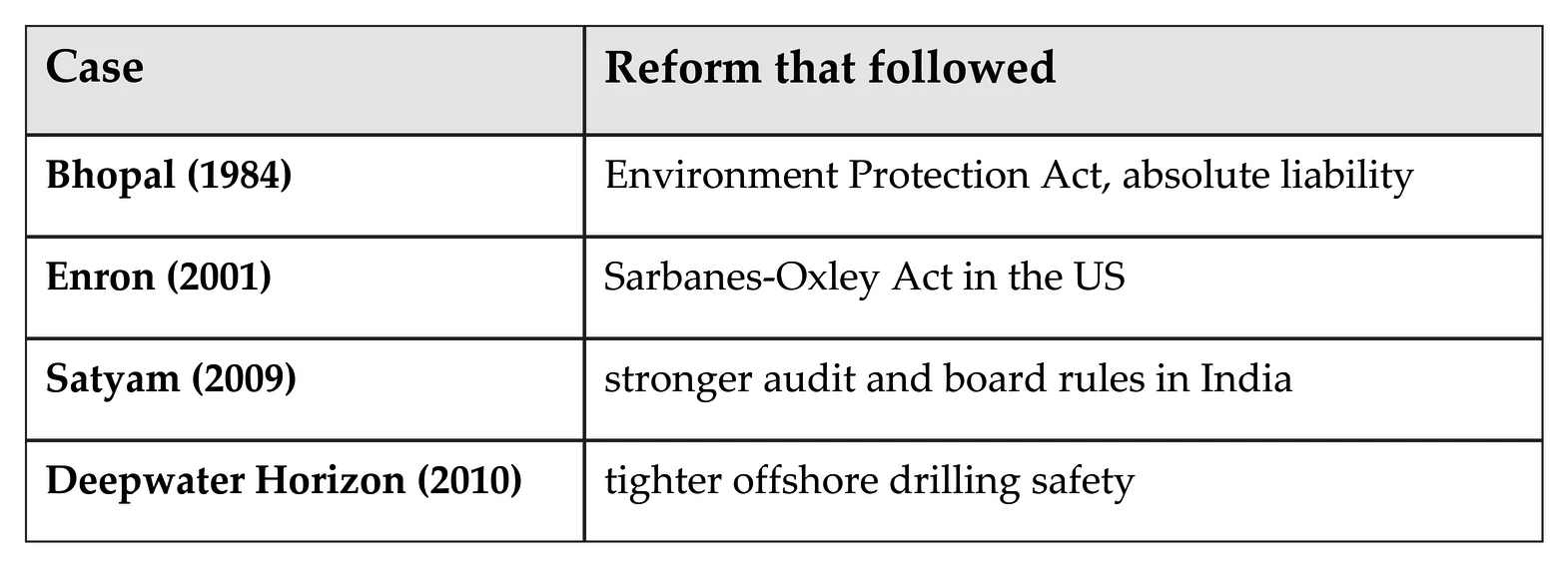
- Bhopal, 1984. On the night of 2 to 3 December, methyl isocyanate gas leaked from Union Carbide India’s pesticide plant, killing thousands within days and harming hundreds of thousands; Union Carbide paid 470 million dollars in a settlement of 1989, Indian executives were convicted only in 2010, and toxic waste was finally removed from the site in 2025.
- Shell in Nigeria. Oil spills in the Niger Delta and the execution of Ken Saro-Wiwa in 1995 made Shell a symbol of corporate complicity; a Dutch court ordered Shell in 2021 to cut emissions sharply, but the order was overturned on appeal in 2024.
- Nike in the 1990s. Reports of low wages and child labour in Asian supplier factories led to boycotts, and in 1998 Nike promised reforms, later publishing its list of supplier factories.
- Enron, 2001. The American energy company’s accounting fraud led to its bankruptcy, the collapse of its auditor Arthur Andersen and the Sarbanes-Oxley Act of 2002.
- Satyam, 2009. The chairman’s confession of a massive accounting fraud led the government to replace the board; the company was sold to Tech Mahindra and the founder was convicted in 2015.
- BP, 2010. The explosion on the Deepwater Horizon rig in the Gulf of Mexico killed eleven workers and caused the largest marine oil spill in US history, costing BP tens of billions of dollars.
- Volkswagen, 2015. The company admitted installing software in about eleven million diesel cars to cheat emissions tests.
Lessons from Corporate Failures
These cases teach several lessons. Voluntary codes are not enough without enforceable regulation and independent oversight. Multinationals often escape responsibility through the separate legal identity of subsidiaries, so legal systems are developing ways to hold parent companies liable. Victims, especially in poor countries, struggle to obtain justice and compensation, as the long struggle of the Bhopal survivors shows. Strong corporate governance, honest auditing, protection for whistle-blowers and a free press are essential. Above all, Keith Davis’s iron law of responsibility holds: companies that abuse their power eventually face public backlash, stricter laws and loss of their licence to operate.
4.4 Important Questions
- Question 1 Discuss multinational corporations as transnational actors in world politics.
- Question 2 What is regulatory arbitrage? Discuss its implications for corporate responsibility.
- Question 3 Discuss the failures of corporate responsibility with reference to Union Carbide, Shell, Nike and BP.
- Question 4 Discuss the Enron and Satyam scandals and their lessons for corporate governance.
DU asks the same idea in different words. So learn one broad answer for each question below; the same answer works for every question joined by OR.
Important Question 1
Discuss multinational corporations as transnational actors in world politics.
OR
Examine the debate on the power and responsibility of MNCs.
OR
How do MNCs influence public policy through lobbying?
Model Answer
“Contacts, coalitions, and interactions across state boundaries that are not controlled by the central foreign policy organs of governments.”
— Robert O. Keohane and Joseph S. Nye, Transnational Relations and World Politics (1971), defining transnational relations
Introduction. Traditional theories of international relations focused on states as the main actors. From the 1970s, scholars such as Robert Keohane and Joseph Nye drew attention to transnational actors, including multinational corporations, which operate across borders and influence world politics. Today, MNCs shape trade, investment, technology, labour conditions and the environment, raising debates about their power and responsibility.
1. Meaning of MNCs
A multinational corporation is a company that owns or controls production or services in more than one country, with headquarters in one country and subsidiaries or suppliers in many others. Tens of thousands of such companies operate worldwide.
2. Transnational Relations
Keohane and Nye defined transnational relations as contacts and interactions across borders not controlled by governments’ foreign policy organs. MNCs are central to these relations, linking economies and societies.
3. Economic Size
The largest MNCs have annual revenues larger than the economies of many countries, giving them great bargaining power with governments, especially in developing countries seeking investment.
4. Strange on Power
Susan Strange argued in The Retreat of the State (1996) that power has shifted from states to markets and firms, which now exercise authority over production, finance and knowledge that once belonged to governments.
5. Mobility
MNCs can move capital and production across borders, which gives them leverage over governments that fear losing investment and jobs, a form of structural power.
6. Lobbying
MNCs lobby governments and international organisations to shape laws on trade, taxes, intellectual property, labour and environment. Peter Utting and José Carlos Marques show how business influences public policy in many ways.
7. Policy Capture
Policy capture occurs when regulators or governments serve the interests of the industries they regulate rather than the public. George Stigler argued in 1971 that regulation is often designed for the benefit of industry.
8. Positive Contributions
MNCs also bring investment, jobs, technology, management skills and access to global markets, which have contributed to growth in countries such as India and China.
9. India’s Experience
India restricted foreign companies through the Foreign Exchange Regulation Act of 1973, after which some, such as Coca-Cola and IBM, left in 1977. Since the reforms of 1991, India has welcomed MNCs, which now play a major role in its economy.
10. The Iron Law of Responsibility
Keith Davis argued in 1960 that the social responsibilities of business must be commensurate with its social power, and that business which does not use power responsibly will lose it.
11. Power and Responsibility
The power and responsibility taxonomy asks whether MNCs’ responsibilities match their power. Critics argue that MNCs enjoy great power with little accountability, since they are answerable mainly to shareholders.
12. Costs of Failure
When MNCs fail in their responsibilities, the costs can be borne by workers, communities and the environment, often in poor countries with weak legal systems.
13. Home and Host States
Home states, where MNCs are based, and host states, where they operate, share responsibility for regulating them. Some home states now require their companies to prevent abuses abroad.
14. Global Rules
Global rules, such as the OECD Guidelines and the UN Guiding Principles, seek to make MNCs responsible across borders, though enforcement remains weak.
15. Technology Giants
A few technology companies now control search, social media, cloud computing and online commerce for billions of users. Their control of data and platforms gives them influence over information, markets and even elections, leading governments in Europe, India and elsewhere to pass laws on data protection, competition and online content.
16. Indian Multinationals
Indian companies such as Tata, Infosys and Reliance have themselves become multinationals, investing abroad and acquiring foreign firms, such as Tata Steel’s purchase of Corus in 2007 and Tata Motors’ purchase of Jaguar Land Rover in 2008. They too face expectations of responsible conduct in the countries where they operate.
17. Evaluation
MNCs are powerful transnational actors whose influence requires matching responsibility and accountability.
Conclusion. Thus, MNCs are transnational actors, as Keohane and Nye showed, whose economic size, mobility and lobbying give them great power, which Strange saw as a shift from states to markets. They bring investment but also risk policy capture, so Davis’s iron law of responsibility and global rules demand that their responsibility match their power.
Important Question 2
What is regulatory arbitrage? Discuss its implications for corporate responsibility.
OR
Examine tax avoidance by MNCs and international responses.
OR
Does globalisation lead to a race to the bottom in regulation? Discuss.
Model Answer
“Base erosion and profit shifting refers to tax planning strategies that exploit gaps and mismatches in tax rules to artificially shift profits to low or no-tax locations.”
— Organisation for Economic Co-operation and Development (OECD)
Introduction. Because laws differ from country to country, multinational corporations can choose where to locate activities, profits and risks to minimise costs. This practice is called regulatory arbitrage. It allows companies to reduce taxes and avoid strict labour or environmental rules, raising concerns about a race to the bottom and the erosion of states’ capacity to regulate.
1. Meaning
Regulatory arbitrage means taking advantage of differences between regulatory regimes in different countries, by locating activities or structuring transactions to fall under the most favourable rules.
2. Tax Arbitrage
MNCs shift profits to low-tax countries or tax havens through transfer pricing, intellectual property arrangements and intra-group loans, reducing taxes in the countries where they actually do business.
3. Tax Havens
Leaks such as the Panama Papers of 2016 and the Paradise Papers of 2017 revealed how companies and wealthy individuals use offshore entities to hide wealth and avoid taxes.
4. The BEPS Project
The OECD and G20 launched the Base Erosion and Profit Shifting project, which in 2015 produced fifteen actions to close loopholes and require companies to report their activities country by country.
5. Global Minimum Tax
In 2021, more than 130 countries agreed on a global minimum corporate tax rate of 15 per cent for large MNCs, aiming to end the race to lower corporate taxes.
6. Labour Arbitrage
MNCs move production to countries with low wages and weak labour protection, as in the global garment industry, which can bring jobs but also exploitation and unsafe conditions.
7. Environmental Arbitrage
The pollution haven hypothesis suggests that polluting industries move to countries with weak environmental rules, though evidence on its extent is mixed.
8. Race to the Bottom
Critics argue that competition for investment leads governments to lower taxes and standards, a race to the bottom that weakens protection for workers and the environment.
9. Trading Up
David Vogel argued that in some cases trade leads to higher standards, a California effect, when large markets with strict rules require exporters to meet them.
10. Financial Arbitrage
Before the crisis of 2008, banks used shadow banking and off-balance-sheet entities to avoid capital rules, contributing to the crisis and showing the dangers of regulatory arbitrage.
11. India’s Experience
India has faced tax disputes with MNCs, such as the Vodafone case, in which a retrospective tax amendment of 2012 caused controversy until it was withdrawn in 2021, and has renegotiated tax treaties with Mauritius and others to curb treaty shopping.
12. Digital Companies
Digital companies earn revenue in countries where they have little physical presence. India introduced an equalisation levy on online advertising in 2016 to tax such income.
13. Ethics of Tax Avoidance
Tax avoidance may be legal but is increasingly seen as irresponsible, since it deprives societies of revenue for public services. Fair taxation is now treated as part of corporate citizenship.
14. Responses
Responses include international tax cooperation, disclosure requirements, home-state regulation, due diligence laws and pressure from civil society and investors.
15. Transfer Pricing
Transfer pricing refers to the prices charged in transactions between companies of the same group in different countries. By setting high or low prices for goods, services or royalties, MNCs can shift profits to low-tax countries. Tax authorities, including India’s, use the arm’s length principle to check that such prices match those between independent parties.
16. Home-State Regulation
Some home countries regulate their companies’ conduct abroad. The United States’ Foreign Corrupt Practices Act of 1977 and Britain’s Bribery Act of 2010 punish bribery of foreign officials, reducing the ability of companies to escape anti-corruption rules by operating in countries with weak enforcement.
17. Investment Treaties
Bilateral investment treaties allow foreign investors to sue governments before international tribunals if regulations harm their investments. Critics argue that this can discourage governments from adopting strong health or environmental rules, and India adopted a new model treaty in 2016 to limit such claims.
18. Evaluation
Regulatory arbitrage shows how MNCs can escape national rules, requiring international cooperation and a broader view of corporate responsibility.
Conclusion. Thus, regulatory arbitrage allows MNCs to exploit differences in tax, labour, environmental and financial rules, revealed in the Panama Papers and the 2008 crisis. The BEPS project, the 15 per cent global minimum tax of 2021 and India’s treaty changes respond to it, while debates continue between the race to the bottom and trading up.
Important Question 3
Discuss the failures of corporate responsibility with reference to Union Carbide, Shell, Nike and BP.
OR
What lessons does the Bhopal gas disaster teach about corporate responsibility?
OR
Examine the human rights and environmental costs of failed corporate responsibility.
Model Answer
“An enterprise which is engaged in a hazardous or inherently dangerous industry which poses a potential threat to the health and safety of the persons working in the factory and residing in the surrounding areas owes an absolute and non-delegable duty to the community.”
— Supreme Court of India, M.C. Mehta v. Union of India (1987)
Introduction. Failures of corporate responsibility have caused some of the worst industrial disasters and human rights abuses of modern times. The Bhopal gas disaster, Shell’s operations in Nigeria, Nike’s sweatshops and BP’s Deepwater Horizon oil spill show how corporate negligence, weak regulation and the pursuit of profit can harm workers, communities and the environment, and how these failures led to reforms.
1. The Bhopal Disaster
On the night of 2–3 December 1984, methyl isocyanate gas leaked from Union Carbide’s pesticide plant in Bhopal, killing thousands of people and injuring hundreds of thousands, one of the worst industrial disasters in history.
2. Causes of Bhopal
Investigations found that safety systems were not working, staff had been reduced and warnings ignored, showing cost-cutting and weak oversight by both the company and regulators.
3. Justice after Bhopal
The Indian government took over victims’ claims under a law of 1985 and accepted a settlement of 470 million dollars from Union Carbide in 1989, widely criticised as inadequate. Victims still struggle for compensation, health care and clean-up.
4. Legal Reforms in India
Bhopal led to the Environment (Protection) Act of 1986, the Supreme Court’s principle of absolute liability for hazardous industries in 1987 and the Public Liability Insurance Act of 1991.
5. Shell in Nigeria
Shell’s oil operations in Nigeria’s Niger Delta caused pollution of land and water in Ogoniland. When the writer and activist Ken Saro-Wiwa and others campaigned against this, they were executed by Nigeria’s military government in 1995, and Shell was accused of complicity, which it denied, later settling a lawsuit in 2009.
6. Brent Spar
In 1995, Greenpeace campaigned against Shell’s plan to sink the Brent Spar oil platform in the North Sea, and consumer boycotts forced Shell to change its plan, showing the power of public pressure.
7. Nike and Sweatshops
In the 1990s, campaigners exposed low wages, long hours and child labour in factories making Nike products in Asia. In 1998, Nike’s chief Phil Knight pledged to raise minimum ages, improve safety and allow independent monitoring.
8. Supply Chain Transparency
Nike later published the list of its supplier factories in 2005, setting an example of transparency, though campaigners argue that problems in global supply chains persist.
9. BP’s Deepwater Horizon
In April 2010, an explosion on the Deepwater Horizon rig in the Gulf of Mexico killed eleven workers and caused one of the largest marine oil spills, lasting about three months and damaging coasts and fisheries.
10. Consequences for BP
Investigations found failures in safety and risk management. BP paid tens of billions of dollars in fines, compensation and clean-up costs, including a settlement of about 20 billion dollars in 2016.
11. Common Lessons
These cases show that cost-cutting, weak safety culture, poor oversight of subsidiaries and suppliers, and weak regulation in host countries lead to disasters.
12. Accountability across Borders
Victims often struggle to hold parent companies accountable, since harms occur through subsidiaries in other countries. Bhopal victims, for example, found it hard to pursue Union Carbide in the United States.
13. Civil Society
Activists, NGOs and journalists played key roles in exposing these failures and pressing for remedies, from Bhopal survivors’ groups to anti-sweatshop campaigns.
14. Reforms
These failures led to stronger safety laws, environmental regulations, supply chain monitoring, human rights due diligence and corporate codes of conduct.
15. Bhopal’s Continuing Legacy
Decades after the disaster, toxic waste at the Bhopal site and contaminated groundwater continued to affect nearby residents, and survivors suffered long-term illnesses. Waste from the site was finally moved for disposal in 2025, but campaigners argue that full justice, compensation and clean-up have never been achieved.
16. Rana Plaza
The collapse of the Rana Plaza building in Bangladesh in 2013, which killed more than eleven hundred garment workers making clothes for global brands, showed that the problems exposed by the anti-sweatshop campaigns of the 1990s persisted, and led to a legally binding accord between brands and unions on factory safety.
17. Evaluation
Failures of corporate responsibility have caused immense harm, and they show the need for strong regulation, accountability and a culture of safety and rights.
Conclusion. Thus, Union Carbide’s Bhopal disaster, Shell’s record in Ogoniland, Nike’s sweatshops and BP’s Deepwater Horizon spill show the human and environmental costs of failed corporate responsibility. They led to reforms such as absolute liability, India’s Environment Act, supply chain transparency and stricter safety rules, though accountability across borders remains weak.
Important Question 4
Discuss the Enron and Satyam scandals and their lessons for corporate governance.
OR
What were the causes and consequences of the Enron collapse?
OR
How did the Satyam fraud change corporate governance in India?
Model Answer
“It was like riding a tiger, not knowing how to get off without being eaten.”
— B. Ramalinga Raju, letter to the board of Satyam Computer Services (2009)
Introduction. Corporate governance failures can destroy companies, harm investors and employees and shake confidence in markets. The collapse of Enron in the United States in 2001 and the Satyam fraud in India in 2009 are among the most famous cases. Both involved accounting fraud, failures of boards and auditors and led to major reforms of corporate governance.
1. Enron’s Rise
Enron, a Houston-based energy company, grew rapidly in the 1990s into one of America’s largest companies, trading energy and other commodities and praised as innovative.
2. Enron’s Fraud
Enron used accounting tricks, such as recording expected future profits immediately and hiding debts in special purpose entities, to inflate its earnings and conceal losses.
3. Enron’s Collapse
When the truth emerged in 2001, Enron’s share price collapsed and it filed for bankruptcy in December 2001, one of the largest in US history. Employees lost jobs and retirement savings.
4. Role of Auditors
Enron’s auditor, Arthur Andersen, which also earned consulting fees from Enron, failed to report the fraud and destroyed documents. The firm collapsed in 2002, showing the danger of conflicts of interest among gatekeepers.
5. Enron in India
Enron also built the Dabhol power project in Maharashtra in the 1990s, which became controversial because of its high power prices and the terms of its agreement with the state.
6. Sarbanes-Oxley
The United States passed the Sarbanes-Oxley Act in 2002, requiring chief executives and finance officers to certify financial statements, strengthening audit committees and creating an independent board to oversee auditors.
7. Satyam’s Fraud
In January 2009, B. Ramalinga Raju, chairman of Satyam Computer Services, one of India’s leading IT companies, confessed that he had inflated the company’s cash and profits by thousands of crores of rupees over several years.
8. Failures at Satyam
Satyam’s independent directors and its auditors, PricewaterhouseCoopers, failed to detect the fraud, raising questions about the effectiveness of boards and audits in India.
9. Response to Satyam
The government replaced Satyam’s board with its own nominees, and the company was sold to Tech Mahindra in 2009, saving jobs. Raju and others were convicted in 2015.
10. Reforms in India
Satyam influenced the Companies Act of 2013, which strengthened the role and liability of independent directors, required rotation of auditors, gave statutory powers to the Serious Fraud Investigation Office and allowed class action suits by shareholders.
11. Audit Oversight
India later created the National Financial Reporting Authority in 2018 to regulate auditors, responding to repeated audit failures.
12. Common Lessons
Both cases show the dangers of dominant leaders, weak boards, compromised auditors, pressure to meet earnings targets and a corporate culture that tolerates deception.
13. Gatekeepers
Auditors, rating agencies, lawyers and analysts are gatekeepers who should detect fraud, but conflicts of interest can lead them to fail, so their independence must be protected.
14. Whistle-Blowers
Whistle-blowers, such as Sherron Watkins at Enron, play key roles in exposing fraud, making protection for those who report wrongdoing an important part of governance.
15. Corporate Culture
Studies of Enron describe a culture that rewarded aggressive risk-taking and punished doubt, with bonuses tied to reported profits. Experts argue that rules alone cannot prevent fraud unless companies build cultures of integrity, in which employees feel able to question wrongdoing.
16. Recent Indian Cases
Later cases in India, such as the collapse of the infrastructure finance group IL&FS in 2018, showed that governance failures continue. The government took over the IL&FS board, and the case led to closer scrutiny of rating agencies, auditors and boards of large financial companies.
17. Evaluation
Enron and Satyam show that governance failures can destroy even admired companies, and both led to stronger laws on boards, audits and disclosure.
Conclusion. Thus, Enron’s accounting fraud and collapse in 2001, aided by its auditor, led to the Sarbanes-Oxley Act of 2002, while Satyam’s fraud of 2009, revealed in Raju’s letter, led to stronger provisions on independent directors, auditor rotation and fraud investigation in India’s Companies Act of 2013 and the NFRA.
Short Notes
(a) Regulatory arbitrage
Exploiting differences between national rules on taxes, labour or environment to reduce costs, for example by shifting profits to tax havens.
(b) Absolute liability
The principle laid down by the Supreme Court in 1987 that hazardous industries are fully liable for harm caused by their activities, without exceptions.
(c) Sarbanes-Oxley Act
The US law of 2002, passed after Enron’s collapse, that strengthened financial reporting, audit committees and oversight of auditors.
More notes: MDSE-17 Corporate Citizenship and Governance
These notes are prepared by PADHO TO AISE for study help. They are not an official University of Delhi publication.