

Semester VIII MDSE-17 Corporate Citizenship and Governance
Unit I · 23 min read · Updated 24 Nov 2026
As per the University of Delhi (DU) BA (Hons) Political Science syllabus
Contents
- 1.1 Meaning of Corporate Citizenship
- Early Thinkers of CSR
- Features of Corporate Citizenship
- The Extended View and Political CSR
- 1.2 Drivers and History
- Historical Milestones of Corporate Responsibility
- Drivers in Practice
- 1.3 Corporate Governance
- Agency Theory and Models of Governance
- Milestones of Corporate Governance
- Continuing Challenges
- 1.4 Important Questions
- What is corporate citizenship? Discuss its meaning and different views.
- Discuss the drivers of corporate citizenship.
- Trace the historical development of corporate citizenship.
- What is corporate governance? Discuss its development in India.
- Short Notes
मेरा अधिकार केवल सम्मानजनक आजीविका पर है, जो करोड़ों अन्य लोगों से बेहतर न हो। मेरी बाकी संपत्ति समुदाय की है और उसे समुदाय के कल्याण में लगाया जाना चाहिए।
What belongs to me is the right to an honourable livelihood, no better than that enjoyed by millions of others. The rest of my wealth belongs to the community and must be used for the welfare of the community.
— M.K. Gandhi, Harijan (1939)
CCORPORATIONS are among the most powerful actors in the modern world, shaping jobs, prices, technology, the environment and even politics. Corporate citizenship is the idea that companies, like citizens, have responsibilities to the society in which they operate, while corporate governance concerns how companies are directed and controlled. This chapter explains the definitions and drivers of corporate citizenship and governance, their historical development and their practice in India, drawing on Archie Carroll, Dirk Matten, Andrew Crane and Jeremy Moon, Andreas Georg Scherer and Guido Palazzo.
1.1 Meaning of Corporate Citizenship
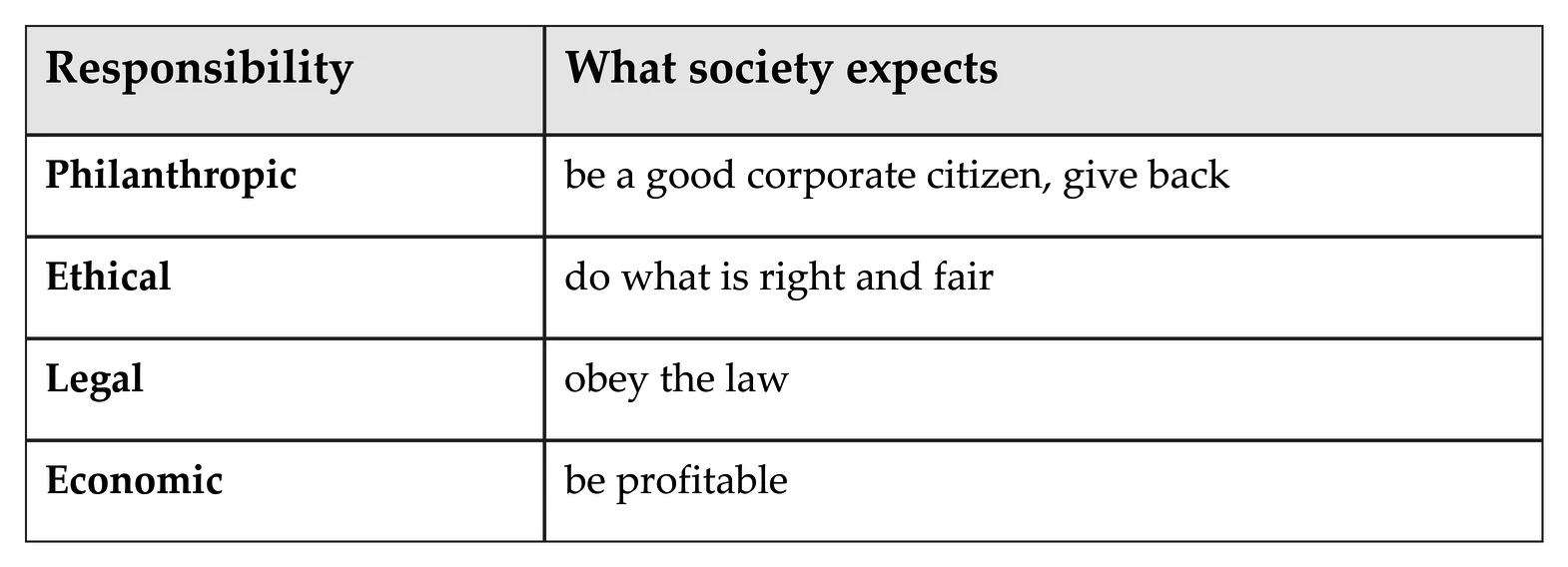
Corporate citizenship treats a company as a member of society with rights and responsibilities beyond making profits. It overlaps with corporate social responsibility (CSR), which Archie Carroll described as a pyramid of economic, legal, ethical and philanthropic responsibilities. Dirk Matten, Andrew Crane and Jeremy Moon distinguish limited, equivalent and extended views, the last seeing corporations as actors that help administer citizens’ rights.
Early Thinkers of CSR
- Bowen. Howard Bowen, in Social Responsibilities of the Businessman (1953), often called the father of CSR, argued that business decisions affect society and should follow its values and objectives.
- Davis. Keith Davis stated an iron law of responsibility in 1960: in the long run, those who do not use power in a way society considers responsible will tend to lose it.
- Carroll. Archie Carroll defined CSR in 1979 as covering economic, legal, ethical and discretionary responsibilities, and drew them as a pyramid in 1991, with economic responsibility as the base and philanthropy at the top.
- Elkington. John Elkington coined the triple bottom line of people, planet and profit in 1994.
- Porter and Kramer. Michael Porter and Mark Kramer, in Creating Shared Value (2011), argued that firms can create economic value by addressing social needs.
Features of Corporate Citizenship
- Membership of society. The company is seen as a member of the community, with obligations as well as rights.
- Beyond compliance. Good corporate citizens go beyond obeying the law, acting ethically and contributing to social welfare.
- Stakeholder orientation. They consider employees, customers, suppliers, communities and the environment, not only shareholders.
- Integration into strategy. Responsibility is built into the core business, not limited to charity.
- Accountability and reporting. Companies report on their social and environmental performance and engage with critics.
- Global reach. Multinational companies are expected to apply responsible standards across their supply chains and countries of operation.
The Extended View and Political CSR
Dirk Matten and Andrew Crane, in an article of 2005, argued that the limited view equates corporate citizenship with philanthropy and the equivalent view with CSR, but that an extended view is needed because corporations increasingly administer citizenship rights where governments fail to do so. Andreas Scherer and Guido Palazzo, writing from 2007, developed political CSR, arguing that in a globalised world companies take part in making public rules and providing public goods, so they must gain legitimacy through open deliberation with civil society. Critics reply that corporations are not democratic actors and cannot be true citizens, since they lack the vote, the duties and the shared fate of human citizens.
1.2 Drivers and History
Corporate citizenship is driven by globalisation, pressure from consumers, investors, employees and civil society, regulation and concern for reputation. Its history runs from nineteenth-century company welfare and Gandhi’s idea of trusteeship to debates between Milton Friedman’s view that business should only make profits and R. Edward Freeman’s stakeholder theory.
Historical Milestones of Corporate Responsibility
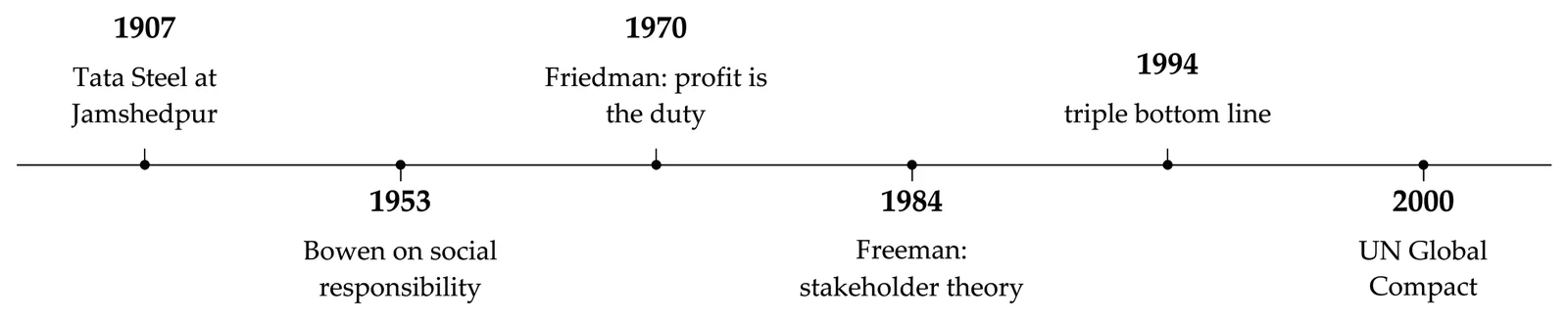
- Industrial paternalism. In the nineteenth century, Robert Owen at New Lanark in Scotland, the Cadbury brothers at Bournville and William Lever at Port Sunlight built housing, schools and welfare facilities for workers.
- Tata Steel. Following Jamsetji Tata’s vision, Tata Steel introduced an eight-hour working day in 1912, leave with pay and a provident fund in 1920 and maternity benefits in 1928, long before the law required them; Tata Trusts own a majority of Tata Sons, so profits support philanthropy.
- Gandhian trusteeship. Gandhi argued that the rich should hold their wealth as trustees for society, and a Practical Trusteeship Formula drafted by his associates set out the idea; industrialists such as Jamnalal Bajaj and G.D. Birla supported the freedom movement and social causes.
- Friedman’s challenge. Milton Friedman, in a New York Times Magazine article of 13 September 1970, argued that the social responsibility of business is to increase its profits within the rules of the game.
- Stakeholder theory. R. Edward Freeman, in Strategic Management: A Stakeholder Approach (1984), argued that managers must consider all groups who affect or are affected by the firm.
- Corporate purpose. In August 2019, the Business Roundtable of leading American chief executives declared that companies should serve all stakeholders, not shareholders alone.
Drivers in Practice
Several forces push companies towards responsibility. Civil society campaigns, such as those against sweatshops in the 1990s and Greenpeace’s campaign over Shell’s plan to dump the Brent Spar oil platform at sea in 1995, damaged reputations. Consumers buy fair trade products, certified since the Max Havelaar label of 1988. Investors apply environmental, social and governance (ESG) criteria, encouraged by the UN Principles for Responsible Investment of 2006. Regulation has grown: India’s Companies Act of 2013 made CSR spending mandatory for large companies, and SEBI requires the top thousand listed companies to publish a Business Responsibility and Sustainability Report from 2022–23. Employees, especially young professionals, prefer to work for responsible firms.
1.3 Corporate Governance
Corporate governance is the system of rules and practices by which companies are directed and controlled, balancing the interests of shareholders, managers and other stakeholders. In India, a series of committees, SEBI rules and the Companies Act of 2013 have strengthened boards, audit and disclosure, especially after corporate scandals.

Agency Theory and Models of Governance
Adolf Berle and Gardiner Means, in The Modern Corporation and Private Property (1932), showed that in large companies ownership by scattered shareholders is separated from control by professional managers, who may pursue their own interests. Michael Jensen and William Meckling (1976) called the resulting costs agency costs. Countries have developed different models of governance. The Anglo-American model relies on dispersed shareholders, independent directors and the market for corporate control; the German model has two-tier boards, with workers represented on supervisory boards under co-determination laws; and the Japanese model relied on groups of firms (keiretsu) linked with a main bank. In India, many companies are controlled by promoter families, so the main problem is protecting minority shareholders from controlling shareholders.
Milestones of Corporate Governance
- 1992 → Britain’s Cadbury Report produced the first modern code of corporate governance.
- 1998 and 1999 → The CII issued a voluntary code, and SEBI’s Kumar Mangalam Birla Committee led to Clause 49 of the listing agreement on board composition and audit committees.
- 2002 → After the Enron and WorldCom scandals, the United States passed the Sarbanes-Oxley Act, and India’s Naresh Chandra Committee examined auditor independence.
- 2009 → The Satyam fraud, in which the chairman confessed to inflating accounts by thousands of crores, shook confidence in Indian governance.
- 2013 → The Companies Act required listed companies to have at least one-third independent directors and at least one woman director, mandated rotation of auditors and created class action suits.
- 2015 to 2018 → SEBI’s Listing Obligations and Disclosure Requirements Regulations (2015), the Uday Kotak Committee (2017) and the National Financial Reporting Authority (2018) further tightened rules.
Continuing Challenges
Corporate governance in India still faces challenges. Independent directors are often chosen by promoters and may not act independently. The collapse of the infrastructure finance company IL&FS in 2018 exposed weak oversight, and allegations made by a US short-seller against a major business group in 2023 led to a Supreme Court-appointed expert committee and SEBI investigations, reviving debates on disclosure and regulatory capacity. The Insolvency and Bankruptcy Code of 2016 has strengthened creditors’ rights. Good governance, transparency and accountability are now seen as the foundation of genuine corporate citizenship.
1.4 Important Questions
- Question 1 What is corporate citizenship? Discuss its meaning and different views.
- Question 2 Discuss the drivers of corporate citizenship.
- Question 3 Trace the historical development of corporate citizenship.
- Question 4 What is corporate governance? Discuss its development in India.
DU asks the same idea in different words. So learn one broad answer for each question below; the same answer works for every question joined by OR.
Important Question 1
What is corporate citizenship? Discuss its meaning and different views.
OR
Distinguish between corporate citizenship and corporate social responsibility.
OR
Examine the limited, equivalent and extended views of corporate citizenship.
Model Answer
“The CSR firm should strive to make a profit, obey the law, be ethical, and be a good corporate citizen.”
— Archie B. Carroll, The Pyramid of Corporate Social Responsibility (1991)
Introduction. Businesses are not separate from society; they depend on workers, consumers, communities, natural resources and public institutions. The idea of corporate citizenship holds that companies should behave as responsible members of society. The term became popular in the 1990s and is closely linked with corporate social responsibility. Scholars such as Archie Carroll and Dirk Matten, Andrew Crane and Jeremy Moon have clarified its meanings.
1. Meaning
Corporate citizenship refers to the role of a company as a member of society, with responsibilities to its stakeholders and the wider community. It involves behaving ethically, obeying the law, respecting human rights and the environment, and contributing to social welfare, in addition to earning profits for owners.
2. Corporate Social Responsibility
Corporate social responsibility is the idea that businesses have obligations to society beyond profit. It includes treating workers fairly, protecting the environment, being honest with consumers and supporting communities. Corporate citizenship is often used as another term for CSR, though some scholars give it a wider political meaning.
3. Carroll’s Pyramid
Archie Carroll described CSR as a pyramid. At the base are economic responsibilities, being profitable; then legal responsibilities, obeying the law; then ethical responsibilities, doing what is fair beyond the law; and at the top philanthropic responsibilities, contributing to the community as a good corporate citizen.
4. The Limited View
Matten, Crane and Moon describe a limited view, in which corporate citizenship means charitable giving and philanthropy, especially in local communities, often motivated by the company’s own interest in a good reputation and a healthy business environment.
5. The Equivalent View
In the equivalent view, corporate citizenship simply means the same as corporate social responsibility, covering the company’s economic, legal, ethical and philanthropic duties. Many companies use the term in this sense in their reports.
6. The Extended View
In the extended view, corporations take on a political role, helping administer citizenship rights when governments fail or are absent. They may provide social rights such as health and education, protect or threaten civil rights, and channel political participation.
7. Can Corporations Be Citizens
Matten, Moon and Crane ask whether corporations can really be citizens, since they cannot vote or hold office. They argue that corporate citizenship is best understood as a metaphor for business participation in society and its growing role in governance.
8. Scherer and Palazzo
Andreas Georg Scherer and Guido Palazzo argue that globalisation has created governance gaps, where national governments cannot regulate global business, so corporations increasingly take part in making and enforcing rules, which requires a political understanding of corporate citizenship.
9. Corporate Governance
Corporate governance, the system by which companies are directed and controlled, is closely linked with corporate citizenship, because good governance makes companies accountable to shareholders and stakeholders and ensures responsible decision-making.
10. Stakeholders
Corporate citizenship is based on the idea that companies have stakeholders, such as employees, customers, suppliers, communities and the environment, whose interests must be considered alongside those of shareholders.
11. Indian Traditions
In India, ideas of business responsibility draw on traditions of charity, Gandhi’s doctrine of trusteeship and the example of business families such as the Tatas, who invested in education, health and research.
12. Mandatory CSR in India
India became the first country to make CSR spending mandatory, when the Companies Act of 2013 required large companies to spend two per cent of their average profits on social activities.
13. Criticisms
Critics argue that corporate citizenship can be public relations or greenwashing, used to improve image without changing harmful practices, and that it may shift public responsibilities onto private firms without democratic accountability.
14. Importance
As corporations grow in size and influence, their responsibilities to society become more important for human rights, the environment, development and democracy.
15. Evaluation
Corporate citizenship expresses the idea that companies are members of society with responsibilities, though its meaning ranges from charity to a political role.
Conclusion. Thus, corporate citizenship means that companies act as responsible members of society. Carroll’s pyramid sets out economic, legal, ethical and philanthropic responsibilities, while Matten, Crane and Moon distinguish limited, equivalent and extended views, and Scherer and Palazzo show its political role in a globalised world.
Important Question 2
Discuss the drivers of corporate citizenship.
OR
Why have companies become more concerned with corporate citizenship?
OR
Examine the role of stakeholders in promoting corporate responsibility.
Model Answer
“I propose that you, the business leaders gathered in Davos, and we, the United Nations, initiate a global compact of shared values and principles, which will give a human face to the global market.”
— Kofi Annan, World Economic Forum, Davos (1999)
Introduction. Why do companies engage in corporate citizenship? Some do so out of ethical commitment, but most respond to pressures and incentives from their environment. Globalisation, stakeholders, regulation, reputation and long-term business interests all drive corporate citizenship. Understanding these drivers explains why corporate responsibility has grown so rapidly since the 1990s.
1. Globalisation
Globalisation has allowed companies to operate across many countries, often where regulation is weak. This has created governance gaps and exposed companies to criticism for abuses in their supply chains, pushing them to adopt responsible practices.
2. Governance Gaps
Scherer and Palazzo argue that national governments cannot fully regulate global business, so companies are expected to fill gaps by setting and following voluntary standards on labour, environment and human rights.
3. Civil Society Pressure
Non-governmental organisations, trade unions and activists campaign against corporate abuses, using reports, protests and boycotts. Campaigns against sweatshops in the 1990s forced companies such as Nike to change their practices.
4. Consumers
Many consumers prefer products made responsibly, such as fair trade or eco-friendly goods, and may boycott companies associated with pollution, child labour or animal cruelty.
5. Investors
Investors increasingly consider environmental, social and governance (ESG) factors, believing that responsible companies are less risky. The UN Principles for Responsible Investment, launched in 2006, encourage this approach.
6. Employees
Talented employees, especially young people, prefer to work for companies with good values, so corporate citizenship helps attract and retain staff and builds morale.
7. Regulation
Governments increasingly require responsible behaviour, such as India’s mandatory CSR spending under the Companies Act of 2013 and SEBI’s Business Responsibility and Sustainability Reporting for large listed companies from 2021.
8. Reputation
A company’s reputation is a valuable asset. Scandals and disasters can destroy trust and value, while a record of responsibility can protect a company in difficult times.
9. Licence to Operate
Companies need the acceptance of local communities and governments to operate, especially in mining and infrastructure. Responsible behaviour helps secure this social licence to operate.
10. Shared Value
Michael Porter and Mark Kramer argued in 2011 that companies can create shared value by addressing social problems in ways that also create business opportunities, linking responsibility with competitiveness.
11. Climate Change
The threat of climate change has made environmental responsibility a central driver, as companies face pressure to reduce emissions and disclose climate risks.
12. Ethical Commitment
Some business leaders act from personal or religious values. Jamsetji Tata built institutions for science and welfare, and Gandhi’s trusteeship inspired Indian industrialists such as Jamnalal Bajaj.
13. Media and Technology
Social media spreads news of corporate misconduct quickly, increasing pressure on companies to behave responsibly and to respond to criticism.
14. Limits of Drivers
These drivers are uneven: companies facing little public scrutiny, or operating where regulation and civil society are weak, may have few incentives to act responsibly.
15. Supply Chain Responsibility
Large brands are now held responsible for conditions in factories of their suppliers, even when they do not own them. After the collapse of the Rana Plaza garment building in Bangladesh in 2013, which killed more than a thousand workers, global clothing companies signed an accord on fire and building safety, showing how disasters drive responsibility across supply chains.
16. Sustainability Reporting
Rules requiring companies to report on their social and environmental performance push them to measure and improve it. In India, SEBI’s Business Responsibility and Sustainability Report, mandatory for the top one thousand listed companies from 2022–23, requires disclosure on employees, communities, environment and governance, making responsibility visible to investors and the public.
17. Evaluation
Corporate citizenship is driven by a mix of external pressures, regulation, business interest and values, which together explain its growth.
Conclusion. Thus, corporate citizenship is driven by globalisation and governance gaps, pressure from civil society, consumers, investors and employees, regulation such as India’s mandatory CSR, reputation, the need for a licence to operate and ideas of shared value, as well as the ethical commitment of business leaders, as Kofi Annan’s call for a Global Compact showed.
Important Question 3
Trace the historical development of corporate citizenship.
OR
Discuss the debate between Friedman’s shareholder view and Freeman’s stakeholder theory.
OR
Examine the emergence of corporate citizenship as an idea.
Model Answer
“There is one and only one social responsibility of business, to use its resources and engage in activities designed to increase its profits so long as it stays within the rules of the game.”
— Milton Friedman, New York Times Magazine (1970)
Introduction. The idea that business has responsibilities to society is old, but the language of corporate social responsibility and corporate citizenship developed mainly in the twentieth century. Andrew Crane, Dirk Matten and Jeremy Moon trace the emergence of corporate citizenship, showing how it grew from paternalism and philanthropy to debates about the role of business in society and governance.
1. Ancient and Religious Ideas
Many traditions expected traders to be honest and charitable. Indian texts set rules for merchants and guilds, and religious teachings encouraged giving, laying early foundations for business responsibility.
2. Industrial Paternalism
In the nineteenth century, some industrialists built model towns for workers, such as Cadbury’s Bournville and Lever’s Port Sunlight in Britain, providing housing, schools and health care, though partly to control workers.
3. Tata and Jamshedpur
In India, Tata Steel built Jamshedpur from 1907 as a planned town and introduced welfare measures such as an eight-hour working day in 1912, long before they were required by law.
4. Gandhi’s Trusteeship
Gandhi argued that the rich should treat their wealth as a trust for the community, keeping only what they need, an idea that influenced industrialists such as G.D. Birla and Jamnalal Bajaj.
5. Bowen and Early CSR
Howard Bowen’s Social Responsibilities of the Businessman (1953) is often seen as the beginning of modern CSR thinking, arguing that businesses should pursue policies desirable for society.
6. Friedman’s Challenge
In 1970, Milton Friedman argued that the only social responsibility of business is to increase profits within the rules of the game, since managers spending company money on social causes are spending shareholders’ money without their consent.
7. Freeman’s Stakeholder Theory
R. Edward Freeman, in 1984, argued that managers must consider all stakeholders, those who affect or are affected by the company, such as employees, customers, suppliers and communities, not only shareholders.
8. Carroll’s Pyramid
Archie Carroll’s pyramid of 1991 combined economic, legal, ethical and philanthropic responsibilities into a widely used framework.
9. The Triple Bottom Line
In 1994, John Elkington proposed the triple bottom line, measuring business performance by its impact on people, planet and profit.
10. Emergence of Corporate Citizenship
Crane, Matten and Moon show that the term corporate citizenship became popular among businesses and governments in the 1990s, partly because it sounded more positive than social responsibility and suggested membership of the community.
11. Global Initiatives
The UN Global Compact of 2000 invited companies to commit to ten principles on human rights, labour, environment and anti-corruption, and the UN Guiding Principles on Business and Human Rights of 2011 set global expectations.
12. Political CSR
From the 2000s, scholars such as Scherer and Palazzo developed political CSR, arguing that corporations had become political actors in global governance and should be subject to democratic accountability.
13. India’s Mandatory CSR
In 2013, India made CSR spending mandatory for large companies, a unique step that moved CSR from voluntary to legal obligation.
14. Recent Trends
Today, ESG investing, sustainability reporting and climate commitments have become central to corporate responsibility, while critics warn of greenwashing.
15. Public Sector as Model Employer
After independence, the Indian state expected public sector enterprises to be model employers and to support development, building townships, schools and hospitals around steel plants and other projects. This state-led model shaped Indian expectations that business should contribute to national development, not only to profit.
16. Corporate Philanthropy in India
Indian business families created foundations and institutions, such as the Tata Institute of Social Sciences in 1936, the Indian Institute of Science supported by Jamsetji Tata’s endowment, and Birla-funded colleges and temples. Such philanthropy shows the long Indian tradition of business giving before CSR became a legal duty.
17. Evaluation
Corporate citizenship has evolved from paternalism and charity to stakeholder thinking and a political role in global governance.
Conclusion. Thus, corporate citizenship developed from religious ideas and industrial paternalism, Tata’s Jamshedpur and Gandhi’s trusteeship to Bowen’s CSR, Friedman’s profit view and Freeman’s stakeholder theory. Carroll’s pyramid, the triple bottom line and the Global Compact, as Crane, Matten and Moon show, made it a global idea.
Important Question 4
What is corporate governance? Discuss its development in India.
OR
Examine the role of SEBI and the Companies Act of 2013 in corporate governance.
OR
Why is good corporate governance important? Discuss.
Model Answer
“Corporate governance is the system by which companies are directed and controlled.”
— Report of the Committee on the Financial Aspects of Corporate Governance (Cadbury Report, 1992)
Introduction. Corporate governance concerns how companies are directed and controlled, and how those who run them are held accountable. Good governance protects shareholders and stakeholders, prevents fraud and builds trust in markets. In India, corporate governance reforms began in the late 1990s and were strengthened after scandals such as Satyam in 2009, culminating in the Companies Act of 2013 and SEBI’s listing rules.
1. Meaning
The Cadbury Report of 1992 defined corporate governance as the system by which companies are directed and controlled. It involves the relationships among shareholders, the board of directors, management and other stakeholders.
2. The Agency Problem
Adolf Berle and Gardiner Means showed in 1932 that ownership and control had separated in large companies. Managers, as agents, may pursue their own interests rather than those of shareholders, creating the agency problem that governance seeks to solve.
3. Principles
Good corporate governance rests on accountability, transparency, fairness to all shareholders, responsibility to stakeholders and independent oversight of management, as set out in the OECD Principles of Corporate Governance first adopted in 1999.
4. Board of Directors
The board oversees management, sets strategy and protects shareholders. Independent directors, not linked to management or promoters, are expected to provide objective judgement.
5. Early Reforms in India
The Confederation of Indian Industry issued a voluntary code in 1998, and the Kumar Mangalam Birla Committee of 1999 recommended reforms, which SEBI adopted as Clause 49 of the listing agreement in 2000.
6. The Murthy Committee
The N.R. Narayana Murthy Committee of 2003 recommended strengthening audit committees, the role of independent directors and disclosure of risks.
7. The Satyam Shock
In 2009, the chairman of Satyam Computer Services confessed to inflating profits and cash by thousands of crores, exposing failures of the board, auditors and regulators, and prompting stronger reforms.
8. Companies Act, 2013
The Companies Act of 2013 required independent directors on boards, at least one woman director in certain companies, audit committees, rotation of auditors, rules against fraud and mandatory CSR spending.
9. SEBI Listing Regulations
SEBI’s Listing Obligations and Disclosure Requirements Regulations of 2015 set detailed governance rules for listed companies, and the Uday Kotak Committee of 2017 recommended further improvements.
10. Audit Oversight
The National Financial Reporting Authority was set up in 2018 to oversee auditors and accounting standards, strengthening checks on financial reporting.
11. Promoter-Dominated Firms
Many Indian companies are controlled by promoter families, so a key governance issue is protecting minority shareholders from decisions that benefit promoters at their expense.
12. Governance and Citizenship
Good governance supports corporate citizenship, since accountable and transparent companies are more likely to respect stakeholders, obey the law and act responsibly.
13. Importance
Good governance attracts investment, lowers the cost of capital, prevents fraud and builds public trust in business and markets.
14. Challenges
Challenges include the independence of independent directors, weak enforcement, related-party transactions and the capture of boards by promoters.
15. Shareholder Activism
Institutional investors and proxy advisory firms in India increasingly scrutinise company decisions and vote against resolutions they consider harmful to minority shareholders, such as excessive executive pay or unfair related-party transactions. This shareholder activism adds a market-based check to regulatory rules.
16. Governance in Public Sector Enterprises
Public sector enterprises in India follow governance guidelines issued by the Department of Public Enterprises, but critics note that government control over appointments, pricing and investment can weaken board independence. Listed public sector companies must also meet SEBI’s rules, and their governance affects millions of citizens as both shareholders and users of services.
17. Evaluation
India has built a strong framework of corporate governance, though enforcement and the independence of boards remain concerns.
Conclusion. Thus, corporate governance, defined by the Cadbury Report as the system by which companies are directed and controlled, addresses the agency problem through boards, audit and disclosure. India developed it through the CII code, the Birla and Murthy Committees, the Companies Act of 2013, SEBI’s 2015 rules and the NFRA, though enforcement remains a challenge.
Short Notes
(a) Trusteeship
Gandhi’s idea that the rich should hold their wealth in trust for society, keeping only what they need for an honourable livelihood.
(b) Stakeholder theory
R. Edward Freeman’s view (1984) that managers must consider all who affect or are affected by a company, not only shareholders.
(c) Agency problem
The conflict of interest that arises when managers, as agents, may act in their own interest rather than that of the shareholders who own the company.
More notes: MDSE-17 Corporate Citizenship and Governance
These notes are prepared by PADHO TO AISE for study help. They are not an official University of Delhi publication.