

Semester VIII MDSE-17 Corporate Citizenship and Governance
Unit III · 21 min read · Updated 24 Nov 2026
As per the University of Delhi (DU) BA (Hons) Political Science syllabus
Contents
- 3.1 Corporations and Economic Society
- Types and Salience of Stakeholders
- Corporate Social Performance
- Indian Examples of Stakeholder Engagement
- 3.2 Corporations and Political Society
- How Corporations Administer Citizenship
- Social Contract Theories of Business
- Business and Human Rights Cases
- 3.3 Corporations and Governance
- Forms of Private Regulation
- Legitimacy and Accountability of Private Governance
- The State and Corporate Governance Roles
- 3.4 Important Questions
- Discuss the social responsibility of corporations in economic society with reference to stakeholder theory.
- Discuss the civil responsibility of corporations in political society with reference to citizenship rights.
- Discuss the political role of corporations in governance and global public rules.
- Discuss corporate citizenship in developing countries with reference to partnerships.
- Short Notes
कॉर्पोरेट नागरिकता व्यक्तियों के लिए नागरिकता अधिकारों के प्रशासन में निगम की भूमिका का वर्णन करती है।
Corporate citizenship describes the role of the corporation in administering citizenship rights for individuals.
— Dirk Matten and Andrew Crane, Corporate Citizenship: Toward an Extended Theoretical Conceptualization (2005)
CCORPORATIONS today do more than produce goods and services. They shape the lives of workers and communities, provide services that states once provided, affect citizens’ rights and take part in making global rules. This chapter examines a typology of corporate responsibility: corporations in economic society, with social responsibilities to stakeholders; in political society, with civil responsibilities for citizenship rights; and in governance, with a political role in making public rules. It also examines corporate citizenship in developing countries, drawing on Dirk Matten, Andrew Crane and Jeremy Moon, R. Edward Freeman, Marc Orlitzky and Peter Utting.
3.1 Corporations and Economic Society
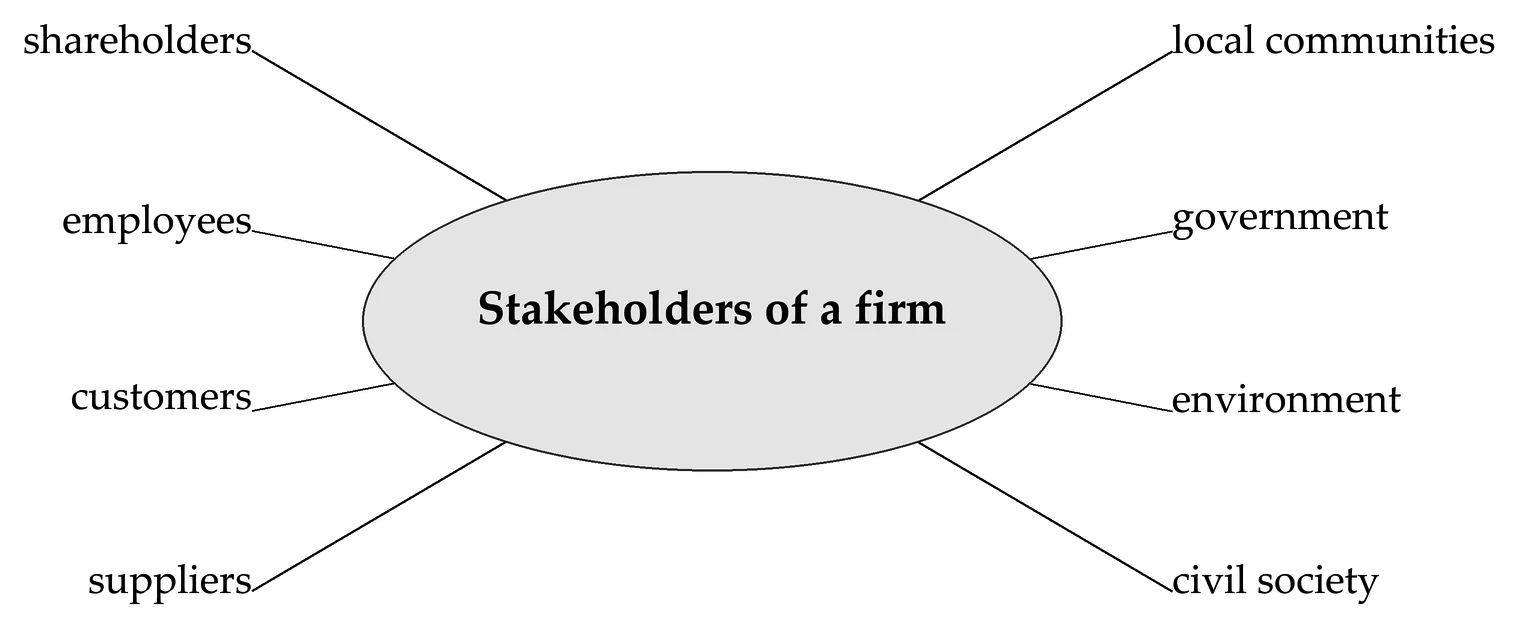
In economic society, corporations have social responsibilities to their stakeholders: employees, customers, suppliers, communities and the environment, as well as shareholders. R. Edward Freeman’s stakeholder theory and research on corporate social performance by Marc Orlitzky and Diane Swanson explain how firms can integrate these responsibilities into their business.
Types and Salience of Stakeholders
- Three uses of the theory. Thomas Donaldson and Lee Preston (1995) distinguished descriptive stakeholder theory, which describes how firms behave, instrumental theory, which shows that considering stakeholders improves performance, and normative theory, which holds that stakeholders’ interests have intrinsic value.
- Primary and secondary stakeholders. Max Clarkson (1995) separated primary stakeholders, such as employees, customers, suppliers and investors, without whom the firm cannot survive, from secondary stakeholders, such as the media and NGOs.
- Salience. Ronald Mitchell, Bradley Agle and Donna Wood (1997) argued that managers pay attention to stakeholders according to their power, legitimacy and urgency.
- India’s law. Section 166(2) of the Companies Act of 2013 requires directors to act in good faith in the best interests of the company, its employees, shareholders, the community and the environment, giving stakeholder thinking legal recognition.
Corporate Social Performance
The idea of corporate social performance asks how well firms actually meet their responsibilities. Carroll’s three-dimensional model of 1979 combined categories of responsibility, social issues and modes of response, ranging from reaction and defence to accommodation and proaction. Donna Wood (1991) reformulated it as principles of responsibility, processes of responsiveness and outcomes of behaviour. A meta-analysis by Marc Orlitzky, Frank Schmidt and Sara Rynes, published in 2003 and covering fifty-two studies, found a generally positive relationship between corporate social performance and financial performance, though the link is debated, and Diane Swanson argued for integrating values into corporate decision-making.
Indian Examples of Stakeholder Engagement
- Amul. Founded in 1946 and built by Verghese Kurien, the dairy cooperative is owned by millions of milk producers, showing a stakeholder-owned model of business.
- ITC e-Choupal. Launched in 2000, it provided internet kiosks that gave farmers price information and direct access to buyers.
- Hindustan Unilever’s Project Shakti. Begun in 2001, it trained rural women as distributors, combining business expansion with income for women.
- Mahindra’s Nanhi Kali. Started in 1996, it supports the education of girls from poor families.
- Infosys Foundation. Set up in 1996, it supports education, health and rural development.
3.2 Corporations and Political Society
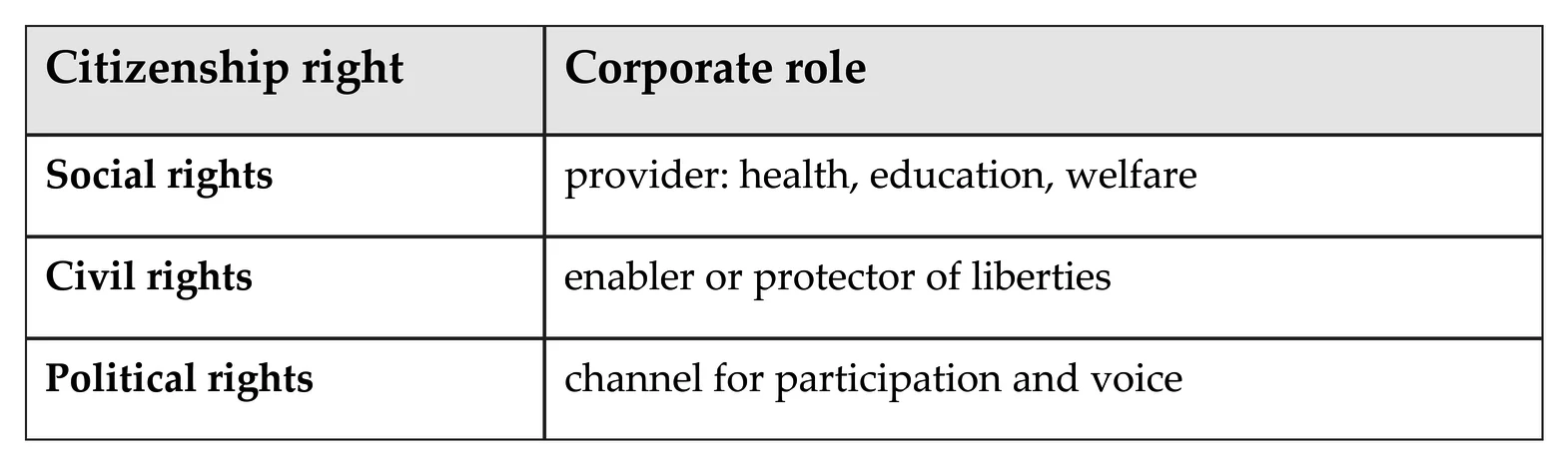
In political society, corporations take on civil responsibilities. Matten and Crane argue that corporations increasingly administer citizenship rights: they provide social rights such as health and education, enable or threaten civil rights such as privacy and speech, and channel political rights through lobbying and dialogue.
How Corporations Administer Citizenship
Matten and Crane argue that corporations administer citizenship rights in three situations: where governments cease to provide them, for example after privatisation of utilities; where governments have not yet provided them, as in poor countries where companies build schools and clinics; and where rights lie beyond the reach of the nation-state, as in global supply chains and cyberspace. Social rights include company provision of housing, health care and education, as in Jamshedpur, built around Tata Steel. Civil rights are affected by technology companies that moderate speech and hold personal data. Political rights are shaped by corporate lobbying and political funding; the US Supreme Court in Citizens United (2010) allowed unlimited independent political spending by corporations, while India’s Supreme Court in 2024 struck down electoral bonds for hiding the sources of political funding.
Social Contract Theories of Business
Thomas Donaldson and Thomas Dunfee developed Integrative Social Contracts Theory in 1994 and in Ties That Bind (1999). They argued that business ethics rests on a hypothetical macrosocial contract among rational people, which allows communities to form their own microsocial norms, provided these respect hypernorms, fundamental principles such as basic human rights that apply everywhere. The theory helps multinational companies decide when to respect local practices and when to refuse them, for example when local norms permit child labour or bribery.
Business and Human Rights Cases
- Shell in Nigeria. The execution of the writer and activist Ken Saro-Wiwa in 1995, after he led protests by the Ogoni people against oil pollution, raised accusations of corporate complicity.
- Kiobel v. Royal Dutch Petroleum (2013). The US Supreme Court limited the use of the Alien Tort Statute to sue companies for abuses abroad.
- Vedanta v. Lungowe (2019). The UK Supreme Court allowed Zambian villagers to sue a British parent company for pollution by its Zambian subsidiary, recognising a possible duty of care.
- Niyamgiri (2013). India’s Supreme Court required the consent of gram sabhas before bauxite mining by a Vedanta company in Odisha, and all twelve consulted villages rejected it.
3.3 Corporations and Governance
In governance, corporations play a political role, taking part in making and enforcing global public rules through private standards, certification schemes and multi-stakeholder initiatives. Scholars of political CSR argue that this role must be subject to democratic accountability, and Peter Utting links CSR with public regulation for inclusive development.

Forms of Private Regulation
- Certification schemes. The Forest Stewardship Council (1993), the Marine Stewardship Council (1997), Fairtrade labels and the Roundtable on Sustainable Palm Oil (2004) certify products that meet social and environmental standards.
- Conflict resources. The Kimberley Process Certification Scheme of 2003 seeks to keep conflict diamonds out of global trade.
- Transparency initiatives. The Extractive Industries Transparency Initiative, launched in 2003, requires companies and governments to publish payments for oil, gas and minerals.
- Finance. The Equator Principles of 2003 commit banks to assess social and environmental risks in project finance.
- Labour codes. The Ethical Trading Initiative of 1998 brings together companies, unions and NGOs to improve working conditions in supply chains.
Legitimacy and Accountability of Private Governance
When corporations make rules, questions of legitimacy arise. Scherer and Palazzo, drawing on Habermas, argue that companies can gain moral legitimacy only through open deliberation with affected stakeholders and civil society, rather than through mere compliance or public relations. Critics point to a democratic deficit: standards are often designed by Northern companies and NGOs, with little voice for workers and communities in the South, and monitoring by paid auditors may be weak, as factory disasters that occurred after audits showed. Peter Utting, writing for the UN Research Institute for Social Development, argued that voluntary CSR must be combined with public regulation, collective bargaining and social policy if it is to contribute to equality and inclusive development.
The State and Corporate Governance Roles
Scholars increasingly see private and public regulation as complementary. Governments can make voluntary standards mandatory, as when India made CSR spending compulsory or the European Union required sustainability reporting. Public procurement can favour responsible suppliers, and trade agreements can include labour and environmental chapters. The challenge for the twenty-first century is to ensure that the growing political role of corporations in global governance strengthens rather than weakens democratic control and human rights.
3.4 Important Questions
- Question 1 Discuss the social responsibility of corporations in economic society with reference to stakeholder theory.
- Question 2 Discuss the civil responsibility of corporations in political society with reference to citizenship rights.
- Question 3 Discuss the political role of corporations in governance and global public rules.
- Question 4 Discuss corporate citizenship in developing countries with reference to partnerships.
DU asks the same idea in different words. So learn one broad answer for each question below; the same answer works for every question joined by OR.
Important Question 1
Discuss the social responsibility of corporations in economic society with reference to stakeholder theory.
OR
Examine stakeholder theory and corporate social performance.
OR
Does corporate social responsibility pay? Discuss.
Model Answer
“Any group or individual who can affect or is affected by the achievement of the organization’s objectives.”
— R. Edward Freeman, Strategic Management: A Stakeholder Approach (1984), defining a stakeholder
Introduction. In economic society, corporations interact with many groups: they employ workers, sell to customers, buy from suppliers, use natural resources and affect local communities. Their social responsibility concerns how they treat these groups. Stakeholder theory, developed by R. Edward Freeman, and research on corporate social performance, such as that of Marc Orlitzky and Diane Swanson, explain this responsibility.
1. Economic Society
Economic society refers to the sphere of production, exchange and work, in which corporations are central actors. Their decisions affect livelihoods, prices, product safety and the environment, giving them responsibilities beyond profit.
2. Stakeholder Theory
R. Edward Freeman defined stakeholders as any group or individual who can affect or is affected by the achievement of a company’s objectives. He argued that managers must balance the interests of all stakeholders, not only shareholders.
3. Types of Stakeholder Theory
Thomas Donaldson and Lee Preston distinguished descriptive stakeholder theory, how firms actually behave; instrumental theory, how attending to stakeholders improves performance; and normative theory, why firms ought to consider stakeholders for moral reasons.
4. Employees
Responsibilities to employees include fair wages, safe working conditions, freedom of association, non-discrimination and opportunities for development, especially important where labour laws are weakly enforced.
5. Customers and Suppliers
Responsibilities to customers include safe products, honest advertising and fair prices, while responsibilities to suppliers include fair contracts, timely payment and help in meeting standards.
6. Communities
Robert Phillips and R. Edward Freeman show that local communities are important stakeholders, affected by a company’s operations, pollution, employment and investment, and able to grant or withhold a social licence to operate.
7. Environment
Although nature cannot speak for itself, many scholars treat the environment as a stakeholder, requiring companies to reduce pollution, conserve resources and address climate change.
8. Corporate Social Performance
Corporate social performance refers to how well a company meets its social responsibilities. Donna Wood described it in terms of principles of responsibility, processes of responsiveness and outcomes for society.
9. Integrative Corporate Citizenship
Marc Orlitzky and Diane Swanson argue for integrative corporate citizenship, in which social responsibility is built into the company’s values, decisions and culture rather than added as separate programmes.
10. Does CSR Pay
A meta-analysis by Marc Orlitzky and colleagues in 2003 found a generally positive relationship between corporate social performance and financial performance, suggesting that responsibility and profit can go together.
11. Shareholder Primacy
Critics, following Milton Friedman, argue that managers should serve shareholders and that balancing many stakeholders makes managers unaccountable. Stakeholder theorists reply that long-term shareholder value depends on good stakeholder relations.
12. Indian Examples
Indian companies such as the Tata group have long emphasised employee welfare and community development, while others have faced criticism for poor labour conditions and environmental damage.
13. Stakeholder Engagement
Stakeholder engagement involves consulting stakeholders, responding to their concerns and reporting on performance, which builds trust and helps companies anticipate risks.
14. Limits
Stakeholders differ in power, so the interests of weak groups, such as informal workers or future generations, may be ignored unless law or civil society protects them.
15. Evaluation
In economic society, corporate responsibility means balancing the interests of all stakeholders, which stakeholder theory and corporate social performance research help guide.
Conclusion. Thus, corporations in economic society have social responsibilities to employees, customers, suppliers, communities and the environment. Freeman’s stakeholder theory, Phillips and Freeman’s community stakeholders, and Orlitzky and Swanson’s integrative corporate citizenship explain these duties, and research suggests that responsibility can also support financial performance.
Important Question 2
Discuss the civil responsibility of corporations in political society with reference to citizenship rights.
OR
Can corporations be citizens? Discuss.
OR
Examine Matten and Crane’s extended view of corporate citizenship.
Model Answer
“Business enterprises should respect human rights. This means that they should avoid infringing on the human rights of others and should address adverse human rights impacts with which they are involved.”
— UN Guiding Principles on Business and Human Rights, Principle 11 (2011)
Introduction. Citizenship traditionally concerns the relationship between individuals and the state, which grants and protects rights. In a globalised world, however, corporations increasingly affect citizens’ rights, sometimes providing services, sometimes protecting or threatening liberties and sometimes shaping political participation. Dirk Matten, Andrew Crane and Jeremy Moon developed an extended view of corporate citizenship to capture this civil and political role.
1. Political Society
Political society refers to the sphere of rights, public authority and participation, traditionally the domain of the state. Corporations now act in this sphere, which gives them civil responsibilities.
2. Citizenship Rights
T.H. Marshall described citizenship as consisting of civil rights, such as liberty and property; political rights, such as voting; and social rights, such as education and welfare. Matten and Crane use this framework to analyse corporate roles.
3. The Extended View
Matten and Crane argue that corporate citizenship describes the role of corporations in administering citizenship rights for individuals, especially where governments fail to do so or where rights extend beyond the reach of the nation-state.
4. Social Rights
Corporations may provide social rights, such as health care, education and housing, especially in company towns or in countries with weak states, as Tata Steel did in Jamshedpur.
5. Civil Rights
Corporations can enable or threaten civil rights. Technology companies, for example, control platforms through which people speak and share information, and hold vast amounts of personal data, affecting freedom of expression and privacy.
6. Political Rights
Corporations channel political rights by lobbying governments, funding campaigns and taking part in policy dialogues, which can either amplify or crowd out the voices of citizens.
7. Can Corporations Be Citizens
Matten, Moon and Crane argue that corporations are not citizens in the full sense, since they do not vote or bear all duties, but that corporate citizenship is a useful metaphor for their participation in society and governance.
8. Social Contract
Jesús Conill, Christoph Luetge and Tatjana Schönwälder-Kuntze examine corporate citizenship through contractarian ethics, seeing corporations as parties to an implicit social contract with society that defines their rights and duties.
9. Integrative Social Contracts
Thomas Donaldson and Thomas Dunfee proposed integrative social contracts theory, in which companies must respect universal hypernorms, such as basic human rights, while following local community norms.
10. Business and Human Rights
The UN Guiding Principles of 2011 state that businesses have a responsibility to respect human rights, avoiding harm and addressing impacts in which they are involved, through due diligence and remedies.
11. Examples
Corporate involvement in rights issues includes mining companies’ effects on indigenous land rights, technology firms’ role in surveillance and censorship, and garment brands’ responsibility for workers’ rights in supply chains.
12. Risks
Critics warn that when corporations administer rights, citizens may lose democratic control, since corporations are accountable to shareholders rather than voters, and rights may depend on profitability.
13. Accountability
Accountability mechanisms include human rights due diligence, grievance mechanisms, reporting, independent audits and, increasingly, binding laws and court cases against corporate abuses.
14. India
In India, corporations affect citizens’ rights through land acquisition, employment, data collection and services, and courts have sometimes held private bodies performing public functions accountable for rights.
15. Evaluation
The extended view shows that corporations now play a civil and political role in administering rights, which requires new forms of accountability.
Conclusion. Thus, Matten and Crane’s extended view sees corporations administering citizenship rights, providing social rights, enabling or threatening civil rights and channelling political rights. Matten, Moon and Crane treat corporate citizenship as a metaphor, while contractarian theories and the UN Guiding Principles define corporations’ civil responsibilities and the need for accountability.
Important Question 3
Discuss the political role of corporations in governance and global public rules.
OR
What is political corporate social responsibility?
OR
Examine the role of private regulation and multi-stakeholder initiatives in global governance.
Model Answer
“Businesses should work against corruption in all its forms, including extortion and bribery.”
— UN Global Compact, Principle 10
Introduction. In a globalised world, rules governing trade, labour, environment and human rights are no longer made only by states. Corporations increasingly take part in making and enforcing global public rules through private standards, certification schemes and partnerships with governments and NGOs. Scholars of political corporate social responsibility, such as Andreas Georg Scherer and Guido Palazzo, and Peter Utting and José Carlos Marques, examine this political role.
1. Global Governance
Global governance refers to the rules and institutions that manage global issues in the absence of a world government. It involves states, international organisations, NGOs and corporations.
2. Political CSR
Andreas Georg Scherer and Guido Palazzo argued that corporations have become political actors that help regulate global issues, and that their legitimacy should rest on democratic deliberation with stakeholders, drawing on Habermas.
3. Private Regulation
Corporations and NGOs have created private standards and certification schemes, such as the Forest Stewardship Council of 1993 for sustainable timber, the Marine Stewardship Council for fisheries and Fairtrade labels for fair prices to producers.
4. Multi-Stakeholder Initiatives
Multi-stakeholder initiatives bring together companies, NGOs, unions and sometimes governments to set and monitor standards, such as the Kimberley Process of 2003 to stop trade in conflict diamonds.
5. Public-Private Partnerships
Corporations work with governments and international organisations in partnerships to deliver public goods, such as vaccines through Gavi, the Vaccine Alliance, and infrastructure projects.
6. Standard-Setting
Corporations take part in setting technical and management standards through bodies such as the International Organization for Standardization, shaping rules that affect markets and societies worldwide.
7. Lobbying and Policy
Corporations influence public rules by lobbying governments and international organisations, which can support good policies but also lead to policy capture, where rules serve narrow corporate interests.
8. Utting and Marques on Regulation
Peter Utting and José Carlos Marques argue that voluntary CSR alone cannot achieve inclusive development, and that it must be connected with public regulation, labour rights and social policy, an approach sometimes called articulated regulation.
9. Business, Politics and Public Policy
Utting and Marques also show that business influences public policy in many ways, from partnerships to political funding, raising questions about the balance of power between business and the public.
10. Legitimacy
Corporate rule-making raises questions of legitimacy, since corporations are not elected and may pursue profit rather than the public good. Political CSR scholars call for transparency, participation and accountability.
11. Anti-Corruption
Corporations are expected to work against corruption, as the Global Compact’s tenth principle states, and laws such as the US Foreign Corrupt Practices Act and India’s Prevention of Corruption Act apply to business.
12. Digital Governance
Large technology companies make rules for online speech, privacy and commerce affecting billions of users, acting as private governors of digital public spaces.
13. Criticisms
Critics argue that private regulation is often weak, voluntary and controlled by companies, and that it can pre-empt stronger public regulation.
14. India
In India, industry associations participate in policy consultations, and companies join standard-setting and partnerships, while debates continue about lobbying, political funding and crony capitalism.
15. Evaluation
Corporations now play a political role in making global public rules, which can fill governance gaps but requires democratic accountability and public regulation.
Conclusion. Thus, corporations take part in governance through private regulation such as the Forest Stewardship Council, multi-stakeholder initiatives such as the Kimberley Process, partnerships, standard-setting and lobbying. Scherer and Palazzo’s political CSR calls for deliberative legitimacy, while Utting and Marques argue that CSR must be linked with public regulation.
Important Question 4
Discuss corporate citizenship in developing countries with reference to partnerships.
OR
How do partnerships among business, government and civil society promote development?
OR
Examine CSR initiatives of Indian companies that are integrated with business strategy.
Model Answer
“If we stop thinking of the poor as victims or as a burden and start recognizing them as resilient and creative entrepreneurs and value-conscious consumers, a whole new world of opportunity will open up.”
— C.K. Prahalad, The Fortune at the Bottom of the Pyramid (2004)
Introduction. Corporate citizenship takes different forms in developing countries, where states may be weak, poverty widespread and informal work common. Here, companies often focus on development, through philanthropy, partnerships and business models that serve the poor. Mahad Huniche and Esben Rahbek Pedersen examine partnerships in developing countries, and Munmun Dey and Shouvik Sircar study Indian companies.
1. Context of Developing Countries
In developing countries, weak regulation, poverty, poor infrastructure and limited public services shape what is expected of business, making development contributions more central to corporate citizenship.
2. Visser’s Pyramid
Wayne Visser argued that in developing countries the order of Carroll’s pyramid differs: economic responsibilities come first, followed by philanthropic, then legal and finally ethical responsibilities, reflecting local priorities.
3. Partnerships
Mahad Huniche and Esben Rahbek Pedersen examine new partnership perspectives, in which companies work with governments, NGOs and communities to address development problems, combining their resources and skills.
4. Beyond Philanthropy
Paul Tracey, Nelson Phillips and Helen Haugh argue that companies can go beyond philanthropy by partnering with community enterprises, helping build local organisations that create lasting social and economic value.
5. The Bottom of the Pyramid
C.K. Prahalad argued that the poor are a large market and can be served profitably with affordable products and new business models, turning poverty reduction into a business opportunity.
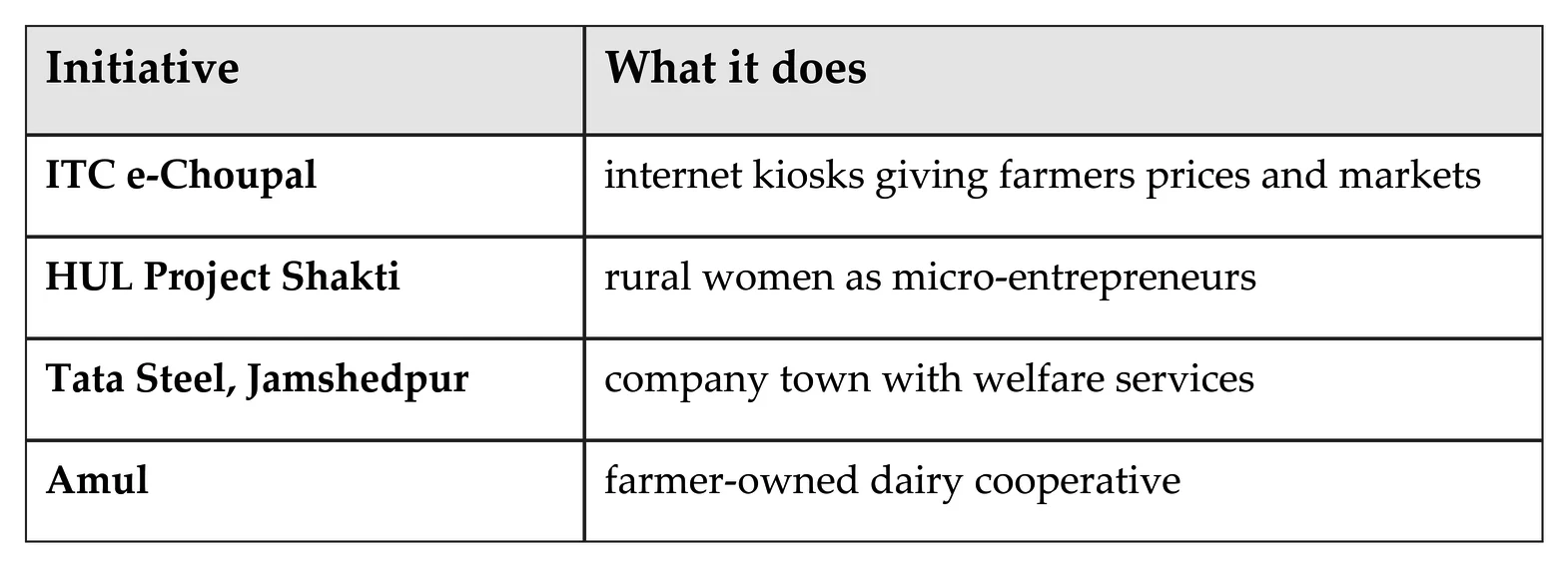
6. ITC e-Choupal
ITC’s e-Choupal, launched in 2000, set up internet kiosks in villages, giving farmers information on prices and weather and allowing them to sell directly, cutting out middlemen while securing supplies for ITC.
7. HUL Project Shakti
Hindustan Unilever’s Project Shakti, begun in 2001, trained rural women as micro-entrepreneurs selling the company’s products in villages, providing them income while expanding the company’s rural reach.
8. Tata Steel
Tata Steel’s Jamshedpur and its community programmes in health, education and tribal welfare show long-term corporate investment in surrounding communities.
9. Dey and Sircar
Munmun Dey and Shouvik Sircar found that Indian companies that integrate CSR initiatives with business strategy achieve better and more sustainable results than those treating CSR as separate charity.
10. Cooperatives and Social Enterprise
Cooperatives such as Amul and social enterprises show alternative models in which business serves members and communities, combining economic and social goals.
11. Role of Government
Governments shape corporate citizenship in developing countries through regulation, incentives and partnerships, as India’s mandatory CSR law shows.
12. Role of NGOs
NGOs help companies reach communities, design programmes and monitor impact, while also holding companies accountable for harms.
13. Challenges
Challenges include corruption, weak monitoring, the risk that companies replace rather than support public services, and power imbalances between large companies and poor communities.
14. Criticisms of BOP
Critics warn that bottom-of-the-pyramid strategies may sell unnecessary products to the poor or shift risks onto them, and that real poverty reduction requires jobs and rights, not only markets.
15. Evaluation
Corporate citizenship in developing countries works best through partnerships and initiatives integrated with business strategy and accountable to communities.
Conclusion. Thus, corporate citizenship in developing countries emphasises economic and philanthropic roles, as Visser argues, and partnerships, as Huniche and Pedersen show. Prahalad’s bottom of the pyramid, ITC e-Choupal, HUL’s Project Shakti and Tata Steel illustrate integrated initiatives, which Dey and Sircar find most effective, though accountability remains essential.
Short Notes
(a) Extended view of corporate citizenship
Matten and Crane’s view that corporations administer citizenship rights, providing social rights and affecting civil and political rights.
(b) Political CSR
Scherer and Palazzo’s idea that corporations act as political actors in global governance and must gain legitimacy through deliberation.
(c) Bottom of the pyramid
C.K. Prahalad’s idea that the world’s poor form a large market that companies can serve profitably while reducing poverty.
More notes: MDSE-17 Corporate Citizenship and Governance
These notes are prepared by PADHO TO AISE for study help. They are not an official University of Delhi publication.