

Semester VIII MDSE-17 Corporate Citizenship and Governance
Unit II · 23 min read · Updated 24 Nov 2026
As per the University of Delhi (DU) BA (Hons) Political Science syllabus
Contents
- 2.1 Globalisation and CSR
- Global Standards for Responsible Business
- Supply Chains and Due Diligence
- Implicit and Explicit CSR
- 2.2 Crisis, Inequality and Responsible Capitalism
- The Financial Crisis of 2008
- Inequality and Its Critics
- Varieties of Responsible Capitalism
- Critics of Responsible Capitalism
- 2.3 The Triple Bottom Line and CSR in India
- The Triple Bottom Line Revisited
- Features of India’s CSR Law
- Assessment of Mandatory CSR
- 2.4 Important Questions
- How has globalisation affected corporate social responsibility? Discuss.
- Discuss the debate on responsible capitalism after the economic crisis.
- Discuss the triple bottom line and the Rio+20 debates on corporate sustainability.
- Discuss corporate social responsibility in India.
- Short Notes
व्यापार और मानवाधिकार की आज की समस्या की जड़ वैश्वीकरण से पैदा हुई शासन की खाइयों में है।
The root cause of the business and human rights predicament today lies in the governance gaps created by globalization.
— John Ruggie, Protect, Respect and Remedy, report to the UN Human Rights Council (2008)
GGLOBALISATION has transformed corporate social responsibility. Companies now operate across many countries through global supply chains, often where governments are weak, creating what John Ruggie called governance gaps. The financial crisis of 2008 and rising inequality led to debates about responsible and conscious capitalism, while the triple bottom line and the Rio+20 conference of 2012 asked companies to report on people and planet as well as profit. This chapter examines these developments and CSR in India, drawing on Bidyut Chakrabarty, Dirk Matten and Jeremy Moon, and Fabrizio Panozzo.
2.1 Globalisation and CSR
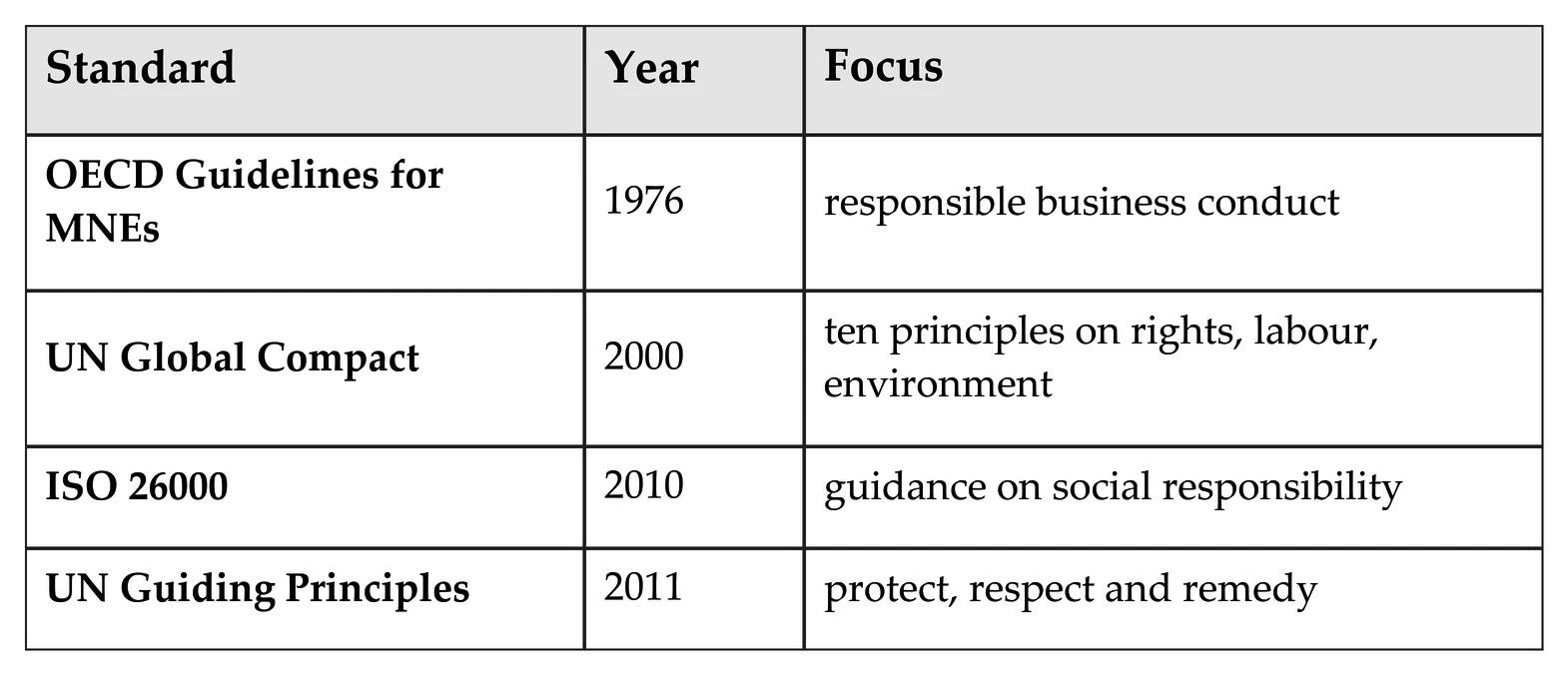
Globalisation has increased the power and reach of multinational corporations, which organise production through global value chains. National governments often cannot regulate them fully, so international standards such as the UN Global Compact, the OECD Guidelines and the UN Guiding Principles on Business and Human Rights have emerged, along with pressure from civil society across borders.
Global Standards for Responsible Business
- OECD Guidelines (1976). Recommendations to multinational enterprises on disclosure, employment, environment, bribery and consumer interests, updated in 2011 and 2023, with National Contact Points to handle complaints.
- ILO Tripartite Declaration (1977). Principles on employment, training and labour relations for multinationals.
- UN Global Compact (2000). Launched by Secretary-General Kofi Annan, it asks companies to follow ten principles on human rights, labour, environment and, from 2004, anti-corruption.
- UN Guiding Principles on Business and Human Rights (2011). Developed by John Ruggie, they rest on three pillars: the state duty to protect, the corporate responsibility to respect and access to remedy.
- ISO 26000 (2010) and the GRI. The ISO guidance on social responsibility and the Global Reporting Initiative, founded in 1997, help companies manage and report their impacts.
- A binding treaty. Since 2014, the UN Human Rights Council has negotiated a legally binding instrument on business and human rights.
Supply Chains and Due Diligence
Globalisation has spread production across global value chains, in which brands in rich countries source goods from factories in poorer ones. The collapse of the Rana Plaza garment factory building near Dhaka on 24 April 2013, which killed more than 1,100 workers, exposed the dangers of this system and led to the Accord on Fire and Building Safety in Bangladesh, signed by brands and unions. Earlier, the suicides of workers at Foxconn factories in China in 2010 raised questions about electronics supply chains. Governments have begun to require human rights due diligence: France passed a Duty of Vigilance law in 2017, Germany a Supply Chain Act in 2021 and the European Union a Corporate Sustainability Due Diligence Directive in 2024, whose scope it moved to narrow in 2025.
Implicit and Explicit CSR
Dirk Matten and Jeremy Moon (2008) distinguished implicit CSR, in which responsibilities are embedded in a country’s institutions, laws and norms, as in continental Europe’s welfare states, from explicit CSR, in which companies voluntarily announce policies and programmes, as is common in the United States. Globalisation has spread explicit CSR worldwide. India combines both: traditions of business philanthropy and trusteeship, and since 2014 a legal mandate. India’s National Guidelines on Responsible Business Conduct of 2019 set out nine principles for companies, aligned with the UN Guiding Principles.
2.2 Crisis, Inequality and Responsible Capitalism
The financial crisis of 2008 exposed reckless risk-taking, excessive executive pay and weak regulation, and was followed by protests against inequality. In response, ideas of responsible capitalism, shared value and conscious capitalism argued that business must serve stakeholders and society, not only shareholders.

The Financial Crisis of 2008
The crisis began in the American housing market, where banks had made subprime loans to borrowers who could not repay and packaged them into complex securities sold around the world. When house prices fell, these securities collapsed in value. The investment bank Lehman Brothers filed for bankruptcy on 15 September 2008, triggering a global panic. Governments rescued banks with huge bailouts, including the American Troubled Asset Relief Program of 700 billion dollars, while millions lost homes and jobs. Public anger grew at bankers’ bonuses and at the fact that taxpayers bore the costs; the Occupy Wall Street movement of September 2011 used the slogan We are the 99 per cent. New regulations followed, such as the Dodd-Frank Act of 2010 in the United States and the Basel III capital standards for banks.
Inequality and Its Critics
Thomas Piketty, in Capital in the Twenty-First Century (2013), argued that when the rate of return on capital exceeds the rate of economic growth, wealth concentrates in the hands of the few, and showed that inequality in many countries had returned to levels seen a century earlier. Reports by Oxfam and the World Inequality Lab documented the growing wealth of the richest. Executive pay rose to hundreds of times the pay of ordinary workers in many large firms. These trends led to demands that companies pay fair wages, pay their share of taxes and restrain executive pay; India’s Companies Act limits managerial remuneration as a share of profits unless shareholders approve more.
Varieties of Responsible Capitalism
- Conscious capitalism. John Mackey and Raj Sisodia, in Conscious Capitalism (2013), proposed four tenets: a higher purpose, stakeholder orientation, conscious leadership and a conscious culture.
- Stakeholder capitalism. Klaus Schwab, founder of the World Economic Forum, promoted stakeholder capitalism from the Davos Manifesto of 1973 to an updated manifesto in 2020.
- Purposeful business. Colin Mayer, in Prosperity (2018), argued that the purpose of companies is to produce profitable solutions to the problems of people and planet, not profits from causing problems.
- Benefit corporations. New legal forms, such as benefit corporations first recognised in Maryland in 2010, and certified B Corporations require companies to consider social and environmental impact.
- ESG investing. Investors increasingly assess environmental, social and governance performance, though ESG faced a political backlash in parts of the United States after 2022.
Critics of Responsible Capitalism
Critics question whether voluntary responsibility can change capitalism. Robert Reich, in Supercapitalism (2007), argued that companies respond mainly to consumers and investors, so social goals must be achieved through democratic regulation rather than corporate goodwill. Anand Giridharadas, in Winners Take All (2018), argued that elite philanthropy and social enterprise allow the powerful to appear generous while preserving the system that benefits them. Others warn of greenwashing and purpose-washing, in which companies advertise good intentions without changing their practices. Supporters reply that market pressure, regulation and corporate leadership can reinforce each other.
2.3 The Triple Bottom Line and CSR in India
The triple bottom line asks companies to measure their impact on people, planet and profit, and the Rio+20 conference of 2012 encouraged sustainability reporting. In India, the Companies Act of 2013 made CSR spending mandatory for large companies, a step Bidyut Chakrabarty places in the long evolution of Indian business responsibility.

The Triple Bottom Line Revisited
John Elkington introduced the triple bottom line in 1994 and developed it in Cannibals with Forks (1997), urging companies to measure social and environmental performance alongside profits. Twenty-five years later, in 2018, he wrote in the Harvard Business Review that the idea had been reduced to an accounting tool and called for a kind of product recall, arguing that its real aim had been to transform capitalism, not merely balance trade-offs. Reporting has developed nonetheless: the Rio+20 outcome document of 2012 encouraged companies to integrate sustainability information into their reporting, the Global Reporting Initiative issued standards in 2016 and the International Sustainability Standards Board issued its first standards in 2023.
Features of India’s CSR Law
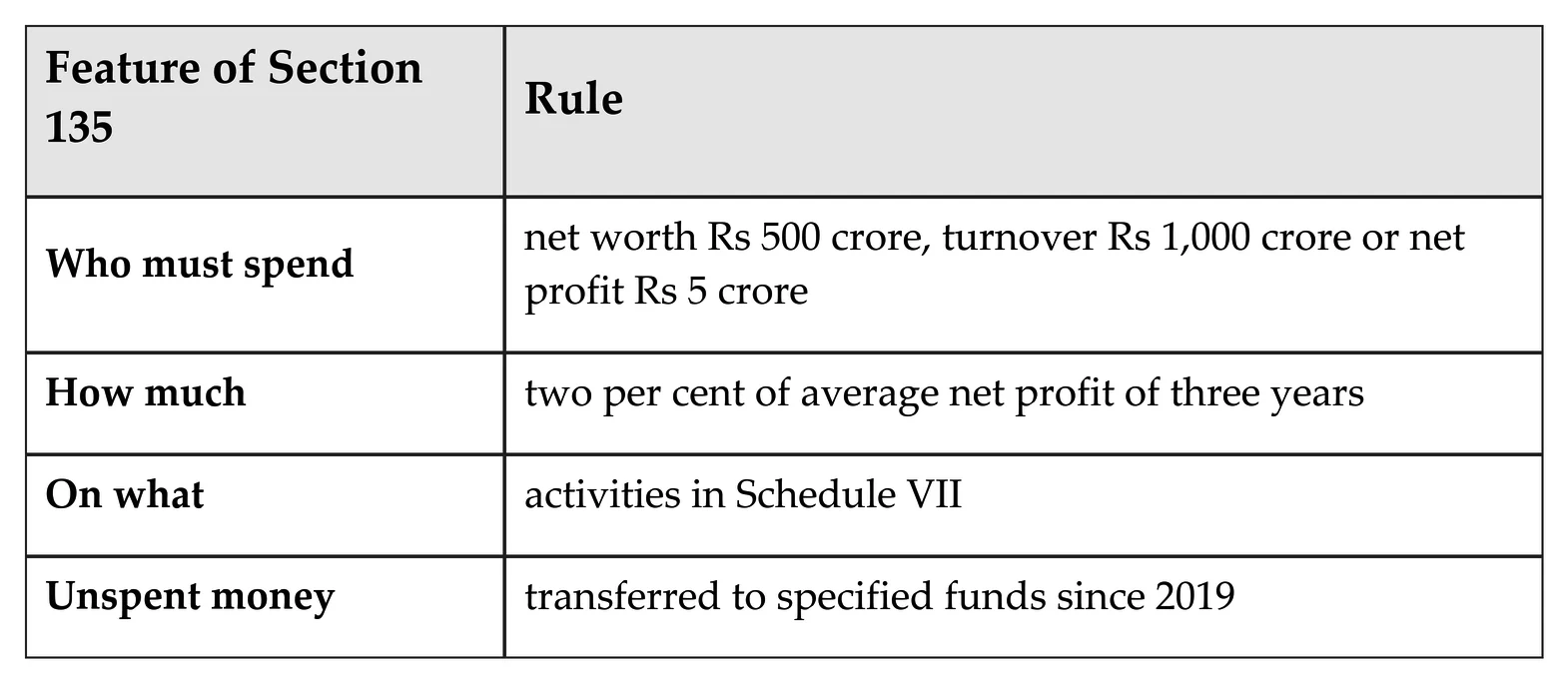
- Coverage. Section 135 of the Companies Act of 2013, in force from 1 April 2014, applies to companies with a net worth of at least Rs 500 crore, a turnover of at least Rs 1,000 crore or a net profit of at least Rs 5 crore.
- Spending. Such companies must spend at least two per cent of their average net profits of the previous three years on CSR.
- Activities. Schedule VII lists permitted activities, such as eradicating hunger and poverty, education, health, gender equality, environmental sustainability, rural development, protection of heritage and contributions to specified funds.
- Governance. Companies must form a CSR committee of the board and publish a CSR policy and annual report.
- From comply or explain to comply or pay. Amendments of 2019, in force from 2021, require unspent amounts to be transferred to specified funds or a special account, with penalties for failure.
Assessment of Mandatory CSR
Mandatory CSR has channelled large sums, around thirty thousand crore rupees a year in recent years, into social causes, especially education and health. However, spending is concentrated in industrialised states such as Maharashtra, Karnataka and Gujarat, while the poorest districts receive little. Critics argue that the law treats CSR as a tax rather than as responsible conduct in the core business, and that it encourages companies to fund their own foundations or government-favoured funds, such as contributions to PM CARES allowed in 2020. Bidyut Chakrabarty, in Corporate Social Responsibility in India (2011), places the law in the long evolution of Indian business responsibility, from philanthropy and trusteeship to stakeholder engagement.
2.4 Important Questions
- Question 1 How has globalisation affected corporate social responsibility? Discuss.
- Question 2 Discuss the debate on responsible capitalism after the economic crisis.
- Question 3 Discuss the triple bottom line and the Rio+20 debates on corporate sustainability.
- Question 4 Discuss corporate social responsibility in India.
DU asks the same idea in different words. So learn one broad answer for each question below; the same answer works for every question joined by OR.
Important Question 1
How has globalisation affected corporate social responsibility? Discuss.
OR
Examine the interaction between globalisation and CSR.
OR
Discuss global standards of responsible business conduct.
Model Answer
“Businesses should support and respect the protection of internationally proclaimed human rights.”
— UN Global Compact, Principle 1 (2000)
Introduction. Globalisation, the growing integration of economies through trade, investment, finance and technology, has changed the context of corporate social responsibility. Multinational corporations now operate across many countries and organise production through global supply chains. This has created new responsibilities and new pressures, as well as international standards to guide business conduct.
1. Globalisation and MNCs
Globalisation has allowed multinational corporations to locate production wherever costs are lowest, sourcing from suppliers across the world. Many large corporations have revenues greater than the economies of many countries, giving them great power over workers, communities and governments.
2. Governance Gaps
John Ruggie argued that globalisation created governance gaps between the reach of global business and the capacity of states to regulate it. In these gaps, abuses of workers, communities and the environment could occur without effective remedy.
3. Global Value Chains
In global value chains, brands in rich countries buy from suppliers in developing countries. Pressure for low prices can lead to poor wages, unsafe conditions and child labour, raising questions of responsibility for suppliers’ practices.
4. Transnational Activism
Non-governmental organisations, unions and consumers across borders campaign against corporate abuses, using media and boycotts. Such campaigns forced brands to adopt codes of conduct and monitor their suppliers.
5. The OECD Guidelines
The OECD Guidelines for Multinational Enterprises, first adopted in 1976 and revised several times, set recommendations on human rights, labour, environment and anti-corruption, with national contact points to handle complaints.
6. The UN Global Compact
The UN Global Compact, launched in 2000 after Kofi Annan’s call at Davos, invites companies to commit to ten principles on human rights, labour, environment and anti-corruption, and has thousands of participants worldwide.
7. The UN Guiding Principles
The UN Guiding Principles on Business and Human Rights, endorsed in 2011, rest on three pillars: the state duty to protect human rights, the corporate responsibility to respect them and access to remedy for victims.
8. ISO 26000
ISO 26000, published in 2010, gives voluntary guidance on social responsibility for organisations, covering governance, human rights, labour, environment, fair operating practices, consumers and community development.
9. Implicit and Explicit CSR
Dirk Matten and Jeremy Moon distinguished explicit CSR, voluntary programmes common in the United States, from implicit CSR, responsibilities built into laws and institutions in Europe, and argued that globalisation spread explicit CSR worldwide.
10. Rana Plaza
The collapse of the Rana Plaza garment factory in Bangladesh in 2013, which killed more than a thousand workers, showed the human cost of global supply chains and led to a binding accord on building safety.
11. Due Diligence Laws
Some countries now require companies to identify and prevent human rights and environmental harms in their supply chains, such as France’s duty of vigilance law of 2017 and the European Union’s directive on corporate sustainability due diligence of 2024.
12. Race to the Bottom
Critics argue that globalisation encourages a race to the bottom, as countries compete for investment by lowering labour and environmental standards, which voluntary CSR cannot fully prevent.
13. Developing Countries
In developing countries, globalisation brought jobs and investment but also exposed workers and communities to harm, making CSR important for development as well as rights.
14. Limits of Voluntary CSR
Voluntary CSR often lacks enforcement and depends on corporate goodwill, so many argue for binding international rules, such as a proposed treaty on business and human rights.
15. Evaluation
Globalisation has both increased the need for CSR and shaped its form, moving from voluntary codes towards binding due diligence.
Conclusion. Thus, globalisation increased the power of MNCs and created governance gaps, as Ruggie argued, leading to transnational activism and global standards such as the OECD Guidelines, the Global Compact, ISO 26000 and the UN Guiding Principles. Matten and Moon show the spread of explicit CSR, and Rana Plaza led to binding supply chain rules.
Important Question 2
Discuss the debate on responsible capitalism after the economic crisis.
OR
How did the financial crisis of 2008 and rising inequality affect ideas of CSR?
OR
Examine the idea of conscious capitalism.
Model Answer
“While each of our individual companies serves its own corporate purpose, we share a fundamental commitment to all of our stakeholders.”
— Business Roundtable, Statement on the Purpose of a Corporation (2019)
Introduction. The global financial crisis of 2008 shook confidence in capitalism, as reckless behaviour by banks led to a worldwide recession, job losses and public bailouts. Combined with rising inequality, it led to intense debate about the purpose of business. Ideas of responsible capitalism, shared value, stakeholder capitalism and conscious capitalism sought to reform business so that it serves society as well as shareholders.
1. The Financial Crisis
The crisis began in the United States with risky mortgage lending and complex financial products, and spread globally after the collapse of Lehman Brothers in September 2008, causing a deep recession.
2. Causes
Causes included excessive risk-taking, executive pay that rewarded short-term gains, weak regulation and failures of corporate governance at banks and rating agencies.
3. Public Anger
Governments used public money to rescue banks while ordinary people lost jobs and homes. The Occupy Wall Street movement of 2011, with its slogan of the 99 per cent, expressed anger at inequality and corporate power.
4. Rising Inequality
Economists such as Thomas Piketty, in Capital in the Twenty-First Century (2013), showed rising concentration of wealth and income at the top, raising questions about the fairness of the economic system.
5. Responsible Capitalism
Responsible capitalism argues that business should create long-term value, treat workers and communities fairly, pay taxes and avoid harmful short-term practices, so that capitalism retains public legitimacy.
6. Shared Value
Michael Porter and Mark Kramer argued in 2011 that companies should create shared value, finding business opportunities in solving social problems, rather than treating CSR as separate from strategy.
7. Conscious Capitalism
John Mackey and Raj Sisodia, in Conscious Capitalism (2013), proposed four tenets: a higher purpose beyond profit, a stakeholder orientation, conscious leadership and a conscious culture.
8. Stakeholder Capitalism
In 2019, the Business Roundtable of leading US companies declared a commitment to all stakeholders, and the World Economic Forum’s Davos Manifesto of 2020 promoted stakeholder capitalism, departing from the shareholder-first view.
9. Friedman Revisited
Defenders of Friedman’s view argue that managers should focus on profit and leave social goals to governments, warning that stakeholder capitalism makes managers unaccountable.
10. ESG Investing
After the crisis, investors increasingly used environmental, social and governance criteria, and ESG funds grew rapidly, though they have faced criticism and political backlash in recent years.
11. Regulation after the Crisis
Governments introduced stricter financial regulation, such as higher capital requirements for banks, and limits on bankers’ bonuses in some countries, showing that responsible capitalism also needs law.
12. Critics of Responsible Capitalism
Critics on the left argue that responsible capitalism leaves corporate power and inequality untouched, offering public relations rather than structural reform.
13. India’s Experience
India was less affected by the 2008 crisis but has faced its own corporate scandals and debates about crony capitalism, in which close ties between business and politicians distort markets.
14. CSR and Legitimacy
The debate shows that CSR is linked with the legitimacy of capitalism itself: companies that ignore society risk losing public support and facing stricter regulation.
15. Executive Pay
The gap between the pay of chief executives and ordinary workers widened greatly in many countries, becoming a symbol of inequality. Rules requiring disclosure of pay ratios and shareholder votes on pay, introduced in several countries including India through SEBI disclosures, aim to make companies justify executive rewards to owners and the public.
16. Evaluation
The crisis and inequality pushed business towards stakeholder and conscious capitalism, though critics doubt that voluntary reforms are enough.
Conclusion. Thus, the financial crisis of 2008 and rising inequality, documented by Piketty, led to debates on responsible capitalism. Shared value, conscious capitalism with its four tenets and stakeholder capitalism, as in the Business Roundtable statement of 2019, challenged Friedman’s view, though critics see them as insufficient without regulation.
Important Question 3
Discuss the triple bottom line and the Rio+20 debates on corporate sustainability.
OR
What is the triple bottom line? Examine its strengths and limitations.
OR
How did Rio+20 encourage corporate sustainability reporting?
Model Answer
“We acknowledge the importance of corporate sustainability reporting and encourage companies, where appropriate, especially publicly listed and large companies, to consider integrating sustainability information into their reporting cycle.”
— The Future We Want, Rio+20 Outcome Document (2012), paragraph 47
Introduction. Traditional accounting measures business success by profit. The triple bottom line, proposed by John Elkington in 1994, argued that companies should also be judged by their social and environmental performance. The Rio+20 conference of 2012 encouraged companies to report on sustainability, and accounting tools have tried to make corporate impacts measurable, as Fabrizio Panozzo discusses.
1. Meaning
The triple bottom line holds that companies have three bottom lines: profit, the economic value created; people, the social impact on workers and communities; and planet, the environmental impact.
2. Elkington’s Idea
John Elkington introduced the concept in 1994 and developed it in his book Cannibals with Forks (1997), arguing that sustainable companies must balance economic, social and environmental goals.
3. Sustainability Reporting
The triple bottom line encouraged sustainability reporting. The Global Reporting Initiative, founded in 1997, developed widely used standards for reporting on economic, social and environmental impacts.
4. Panozzo on Commensurability
Fabrizio Panozzo shows how tools such as the triple bottom line, standards and balanced scorecards try to make private firms commensurable with the public good, translating social and environmental impacts into measurable terms.
5. Strengths
The triple bottom line broadens the idea of business success, makes social and environmental impacts visible, encourages long-term thinking and gives stakeholders information to hold companies accountable.
6. Limitations
Social and environmental impacts are hard to measure and compare with profit, companies may report selectively, and trade-offs between the three bottom lines are often ignored.
7. Elkington’s Rethink
In 2018, Elkington called for rethinking the triple bottom line, arguing that it had become an accounting tool rather than a means of transforming capitalism towards sustainability.
8. Rio+20
The UN Conference on Sustainable Development, Rio+20, held in Rio de Janeiro in June 2012, produced the document The Future We Want, which launched the process of creating the Sustainable Development Goals and discussed the green economy.
9. Paragraph 47
Paragraph 47 of The Future We Want encouraged large and listed companies to integrate sustainability information into their reporting, and a group of countries formed to promote this commitment.
10. Business at Rio+20
Business took part in Rio+20 through a Corporate Sustainability Forum organised by the UN Global Compact, where companies announced commitments, though critics questioned their depth.
11. Integrated Reporting
Integrated reporting combines financial and sustainability information in one report, showing how a company creates value over time for investors and stakeholders.
12. India’s BRSR
In India, SEBI’s Business Responsibility and Sustainability Report requires large listed companies to disclose environmental, social and governance information, reflecting the spread of sustainability reporting.
13. The SDGs and Business
The Sustainable Development Goals of 2015 gave business a framework for aligning strategies with global goals such as clean energy, decent work and climate action.
14. Greenwashing
Critics warn of greenwashing, where companies exaggerate their environmental and social achievements in reports, making independent assurance and regulation important.
15. Climate Disclosure
Since the Paris Agreement, investors have demanded disclosure of climate risks. The Task Force on Climate-related Financial Disclosures, set up in 2015, recommended reporting on governance, strategy, risk and targets, and new international sustainability standards issued in 2023 build on this, extending the logic of the triple bottom line to climate.
16. Evaluation
The triple bottom line and Rio+20 broadened corporate accountability, though measurement and greenwashing remain challenges.
Conclusion. Thus, Elkington’s triple bottom line measures business by people, planet and profit, encouraging sustainability reporting through the GRI, while Panozzo shows how such tools make firms commensurable with the public good. Rio+20’s paragraph 47 promoted corporate sustainability reporting, though measurement problems and greenwashing remain.
Important Question 4
Discuss corporate social responsibility in India.
OR
Examine the provisions of Section 135 of the Companies Act, 2013.
OR
Has mandatory CSR succeeded in India? Discuss.
Model Answer
“The Board of every company shall ensure that the company spends, in every financial year, at least two per cent of the average net profits of the company made during the three immediately preceding financial years, in pursuance of its Corporate Social Responsibility Policy.”
— Companies Act, 2013, Section 135(5)
Introduction. India has a long tradition of business philanthropy, rooted in religion, community and Gandhi’s trusteeship. In 2013, India became the first country to make CSR spending mandatory for large companies through Section 135 of the Companies Act. Bidyut Chakrabarty traces the evolution of CSR in India and its relationship with the state and development.
1. Traditional Philanthropy
Indian merchants and business families have long supported temples, schools, wells and rest houses as religious and social duty, a tradition that continued in modern business houses.
2. Gandhian Trusteeship
Gandhi’s idea of trusteeship asked the wealthy to hold their wealth for the good of society. Industrialists such as G.D. Birla and Jamnalal Bajaj supported the national movement and social causes.
3. Chakrabarty’s Phases
Bidyut Chakrabarty describes the evolution of Indian CSR from philanthropy before independence, through the state-led model in which public enterprises acted as model employers, to the liberalised economy, where companies were expected to contribute to inclusive growth.
4. Voluntary Guidelines
Before the 2013 law, the government issued voluntary CSR guidelines in 2009 and National Voluntary Guidelines on the social, environmental and economic responsibilities of business in 2011.
5. Section 135
Section 135 applies to companies with a net worth of at least Rs 500 crore, a turnover of at least Rs 1,000 crore or a net profit of at least Rs 5 crore. They must form a CSR committee and spend at least two per cent of their average net profit of the previous three years on CSR.
6. Schedule VII
Schedule VII lists eligible activities, such as eradicating hunger and poverty, promoting health and education, gender equality, environmental sustainability, protection of heritage, rural development and disaster relief.
7. Amendments
Amendments in 2019 and rules in 2021 required unspent CSR money to be transferred to specified funds or a separate account, introduced penalties for non-compliance and required impact assessment for large projects.
8. Scale of Spending
Indian companies now spend tens of thousands of crores of rupees a year on CSR, mainly on education, health, livelihoods and environment.
9. Achievements
Mandatory CSR has increased corporate spending on social causes, encouraged partnerships with NGOs and government, and made companies more aware of their social role.
10. Geographical Concentration
CSR spending is concentrated in more developed states where companies are based, such as Maharashtra, Karnataka and Gujarat, while poorer states receive less.
11. Compliance Mindset
Critics argue that mandatory CSR has created a compliance mindset, treating CSR as a tax to be paid rather than integrating responsibility into business practices.
12. Dey and Sircar
Munmun Dey and Shouvik Sircar studied Indian companies and found that the most effective CSR initiatives are those integrated with business strategy, creating value for both company and society.
13. Examples
Examples include ITC’s e-Choupal and watershed programmes, Hindustan Unilever’s Project Shakti for rural women, and the Tata group’s work in health and education.
14. Debates
Debates continue over whether CSR should be mandatory, how to measure impact, whether contributions to government funds should count as CSR and how to prevent misuse.
15. CSR during the Pandemic
During the Covid-19 pandemic, the government allowed spending on Covid relief, vaccines and contributions to the PM CARES Fund to count as CSR. Companies supplied oxygen, hospital beds and food, showing how CSR can be mobilised in emergencies, though critics questioned the counting of contributions to a government fund as corporate responsibility.
16. Evaluation
India’s mandatory CSR is a unique experiment that has increased social spending, though its quality and distribution need improvement.
Conclusion. Thus, CSR in India evolved from traditional philanthropy and Gandhian trusteeship, as Chakrabarty shows, to the mandatory regime of Section 135 of the Companies Act, 2013, requiring two per cent of profits on Schedule VII activities. It has increased spending, but concentration, a compliance mindset and weak impact assessment remain concerns.
Short Notes
(a) Governance gaps
John Ruggie’s term for the gap between the reach of global business and the capacity of states to regulate it.
(b) Conscious capitalism
Mackey and Sisodia’s idea of business guided by a higher purpose, stakeholder orientation, conscious leadership and conscious culture.
(c) Triple bottom line
John Elkington’s idea that companies should measure performance by people, planet and profit.
More notes: MDSE-17 Corporate Citizenship and Governance
These notes are prepared by PADHO TO AISE for study help. They are not an official University of Delhi publication.