
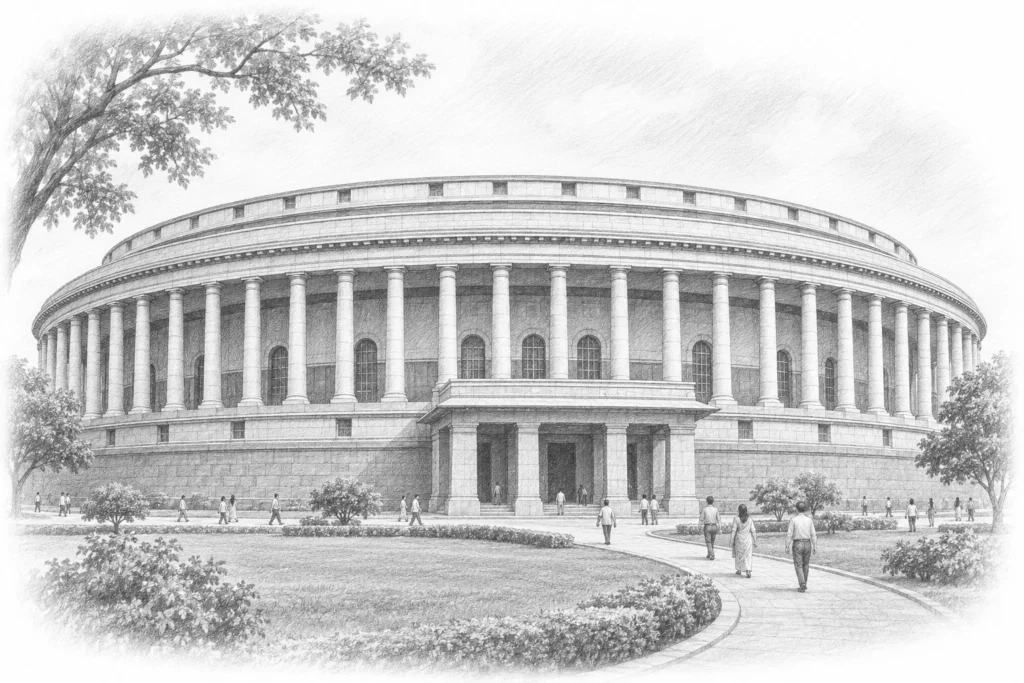
Generic Electives (GE) GE-12 Parliamentary Procedures and Practices
Unit 1 · 25 min read · Updated 27 Nov 2026
As per the University of Delhi (DU) Generic Elective (GE) syllabus offered by the Department of Political Science
Contents
- 1.1 Composition and Functions of the Lok Sabha and Rajya Sabha
- The Lok Sabha
- The Rajya Sabha
- Functions of Parliament
- 1.2 Members: Qualifications, Disqualifications and Privileges
- Qualifications
- Disqualifications
- Parliamentary Privileges
- 1.3 Presiding Officers and the Parliamentary Secretariat
- The Speaker of the Lok Sabha
- The Chairman and Deputy Presiding Officers
- Parliamentary Secretariat and Support Systems
- 1.4 Important Questions
- Discuss the composition and functions of the Lok Sabha and the Rajya Sabha.
- Discuss the qualifications and disqualifications of members of Parliament.
- Examine the powers and role of the Speaker of the Lok Sabha.
- Discuss the parliamentary privileges and immunities of members of Parliament.
- Short Notes
संघ के लिए एक संसद होगी जो राष्ट्रपति और दो सदनों से मिलकर बनेगी, जिनके नाम क्रमशः राज्य सभा और लोक सभा होंगे।
There shall be a Parliament for the Union which shall consist of the President and two Houses to be known respectively as the Council of States and the House of the People.
— Constitution of India, Article 79
PPARLIAMENT is the supreme legislative body of India and the centre of its parliamentary democracy. It makes laws, controls public finance, holds the government accountable and represents the people and the states. This chapter studies the composition and functions of the Lok Sabha and the Rajya Sabha, the qualifications and disqualifications of members, the powers and responsibilities of the Speaker and the Chairman, the privileges and immunities of members, and the Parliamentary Secretariats and support systems that help Parliament work.

1.1 Composition and Functions of the Lok Sabha and Rajya Sabha
Under Article 79, Parliament consists of the President and two Houses: the Rajya Sabha (Council of States) and the Lok Sabha (House of the People). The President is part of Parliament because no bill becomes law without his assent and he summons and prorogues the Houses and may dissolve the Lok Sabha. India adopted bicameralism, i.e. a legislature with two houses, so that the Lok Sabha would represent the people directly and the Rajya Sabha would represent the states and provide a second look at legislation.
The Lok Sabha
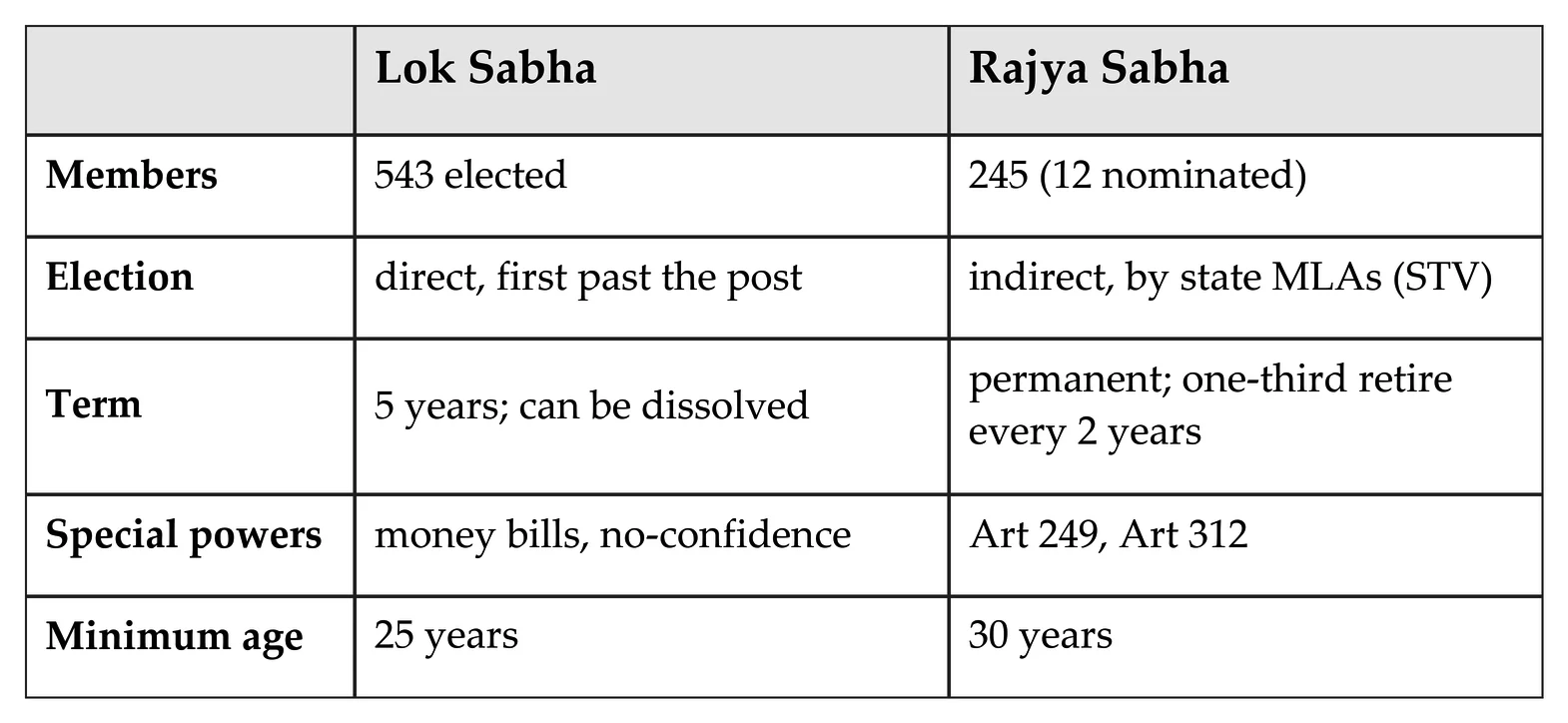
- Composition. Under Article 81, the Lok Sabha may have up to 550 elected members; at present it has 543 members elected from single-member constituencies by first past the post. The 104th Amendment ended the nomination of two Anglo-Indian members from 2020.
- Term. It is elected for five years (Article 83), unless dissolved earlier; during a national emergency its term can be extended by one year at a time.
- Reserved seats. Seats are reserved for Scheduled Castes and Scheduled Tribes (Article 330), and the 106th Amendment of 2023 provides for reservation of one-third of seats for women after the next delimitation.
- Special powers. The Council of Ministers is collectively responsible to the Lok Sabha (Article 75(3)); money bills can be introduced only in it, and only it can pass a vote of no confidence.
The Rajya Sabha
- Composition. Under Article 80, the Rajya Sabha may have up to 250 members: up to 238 representatives of states and Union territories and 12 nominated by the President for their knowledge of literature, science, art and social service; at present it has 245 members.
- Election. State representatives are elected by the elected members of state assemblies by the single transferable vote; since 2003, voting is by open ballot.
- Permanence. It is a permanent house that cannot be dissolved; one-third of its members retire every two years, and each member serves six years.
- Special powers. Under Article 249, it can authorise Parliament to make laws on a State List subject in the national interest by a two-thirds vote, and under Article 312 it can create new all-India services.
Functions of Parliament
- Legislative. Parliament makes laws on subjects in the Union List and Concurrent List, and in some situations on the State List.
- Financial. No tax can be levied and no money spent without its approval; it passes the budget, the Finance Bill and the Appropriation Bill.
- Control over the executive. Through questions, debates, motions and committees, Parliament holds the government accountable, and the Lok Sabha can remove it by a vote of no confidence.
- Constituent. It can amend the Constitution under Article 368.
- Electoral. Members elect the President (with state legislators) and the Vice-President.
- Judicial. It can impeach the President and remove judges of the Supreme Court and High Courts and other high officials.
- Deliberative and representative. It debates national issues and gives voice to the concerns of citizens and states.
1.2 Members: Qualifications, Disqualifications and Privileges
Qualifications
Under Article 84, a person can be a member of Parliament only if he or she is a citizen of India, takes an oath or affirmation before an authority appointed by the Election Commission, is at least twenty-five years old for the Lok Sabha and thirty years for the Rajya Sabha, and has other qualifications prescribed by law. The Representation of the People Act of 1951 requires a candidate to be registered as a voter in a parliamentary constituency.
Disqualifications
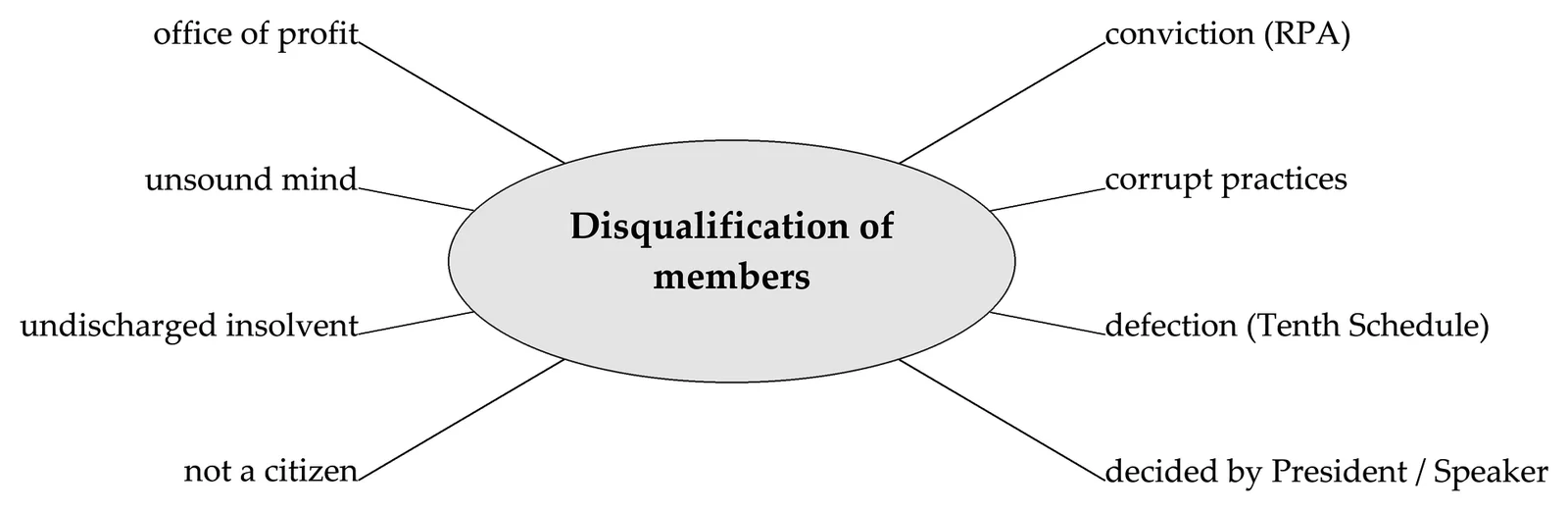
- Office of profit. Under Article 102(1)(a), a person is disqualified if he holds an office of profit under the Union or a state government, other than offices exempted by Parliament through the Parliament (Prevention of Disqualification) Act of 1959; in 2006, Jaya Bachchan was disqualified from the Rajya Sabha on this ground.
- Unsound mind and insolvency. Persons declared of unsound mind by a court and undischarged insolvents are disqualified.
- Citizenship. A person who is not a citizen or has voluntarily acquired foreign citizenship is disqualified.
- Disqualification by law. Under the Representation of the People Act, persons convicted of certain offences, found guilty of corrupt practices or failing to submit election accounts are disqualified; in Lily Thomas (2013), the Supreme Court held that conviction leads to immediate disqualification.
- Defection. Under Article 102(2) and the Tenth Schedule, members who voluntarily give up party membership or defy the party whip are disqualified.
- Decision. Questions of disqualification under Article 102(1) are decided by the President on the opinion of the Election Commission (Article 103), while defection cases are decided by the Speaker or Chairman, subject to judicial review, as held in Kihoto Hollohan (1992).
Parliamentary Privileges
Parliamentary privileges are special rights and immunities enjoyed by each House and its members, without which they could not perform their functions freely. Article 105 guarantees freedom of speech in Parliament and immunity from court proceedings for anything said or any vote given in Parliament or its committees, and protects publications made under the authority of the House. Other privileges, not yet codified by law, are those that existed when the Constitution came into force, largely based on British practice.
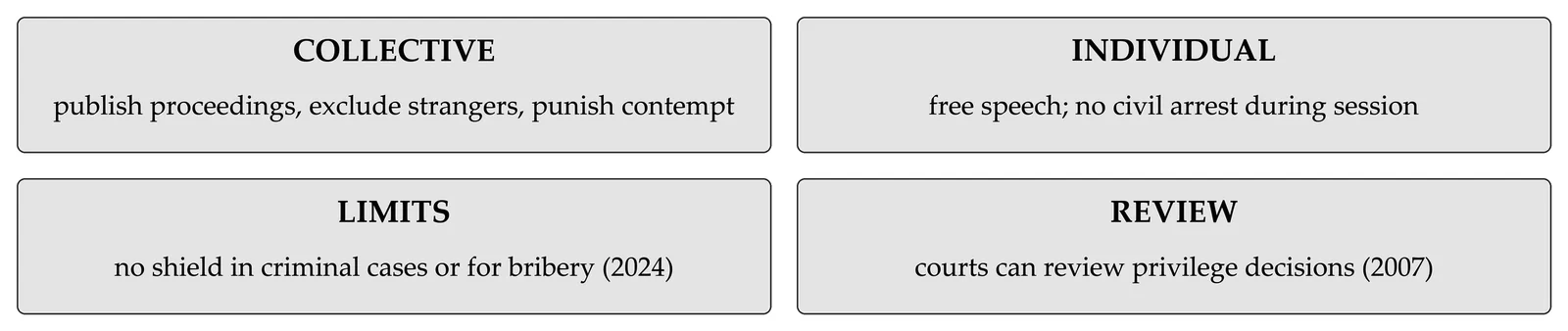
- Collective privileges. The right to publish or prohibit publication of its proceedings, to exclude strangers, to regulate its internal affairs and to punish members and outsiders for breach of privilege or contempt.
- Individual privileges. Freedom of speech in the House, freedom from arrest in civil cases forty days before, during and forty days after a session, and exemption from attending as a witness or juror when Parliament is in session.
- Limits. Privileges do not protect members from arrest in criminal cases or preventive detention; in Sita Soren v. Union of India (2024), a seven-judge bench held that members who take bribes to vote or speak are not protected, overruling the P.V. Narasimha Rao judgment of 1998.
- Expulsion. In Raja Ram Pal (2007), the Supreme Court upheld the expulsion of MPs caught in a cash-for-questions sting, while asserting judicial review of privilege decisions.
1.3 Presiding Officers and the Parliamentary Secretariat
The Speaker of the Lok Sabha
The Speaker is elected by the members of the Lok Sabha from among themselves (Article 93) and holds office until the next Lok Sabha meets, unless removed earlier by a resolution passed by a majority of all the then members after fourteen days’ notice (Article 94). The first Speaker, G.V. Mavalankar, is called the father of the Lok Sabha for establishing its traditions. Jawaharlal Nehru described the Speaker as representing the dignity and freedom of the House and, since the House represents the nation, as a symbol of the nation’s freedom and liberty.
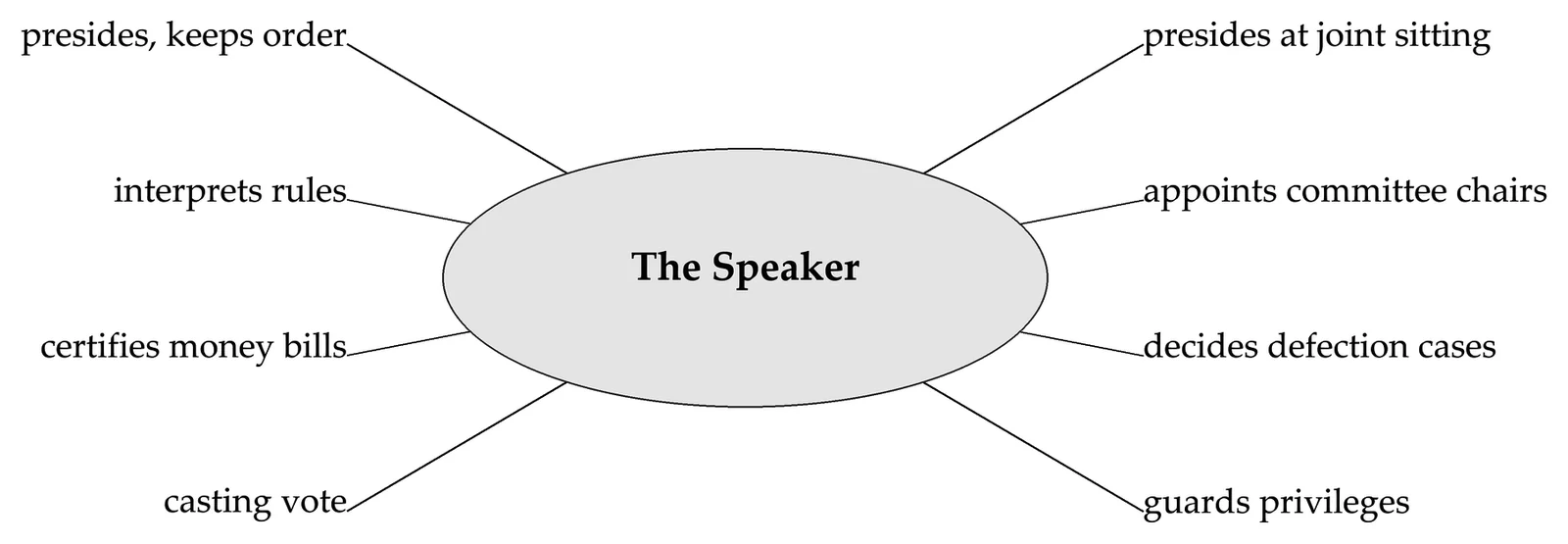
- Presiding. The Speaker presides over the House, maintains order and decorum and can suspend or name members for misconduct.
- Interpreting rules. The Speaker interprets the Constitution, the Rules of Procedure and parliamentary precedents within the House, and these rulings are final.
- Money bills. Under Article 110(3), the Speaker certifies whether a bill is a money bill, and this decision is final, though courts have held it subject to limited review.
- Casting vote. The Speaker does not vote in the first instance but has a casting vote in a tie (Article 100).
- Joint sittings. The Speaker presides over joint sittings of the two Houses (Article 108).
- Committees. The Speaker appoints chairpersons of Lok Sabha committees and is the head of the Lok Sabha Secretariat.
- Anti-defection. Under the Tenth Schedule, the Speaker decides questions of disqualification for defection; in Keisham Meghachandra Singh (2020), the Supreme Court said such petitions should be decided within three months.
- Leader of the Opposition. The Speaker recognises the Leader of the Opposition, by convention a party with at least a tenth of the seats.
The Chairman and Deputy Presiding Officers
The Vice-President is the ex officio Chairman of the Rajya Sabha (Article 89) and has similar powers to the Speaker, except that he does not certify money bills and, not being a member, has only a casting vote. The Lok Sabha elects a Deputy Speaker and the Rajya Sabha a Deputy Chairman, who preside in their absence. A panel of chairpersons assists them. When a new Lok Sabha meets, a Speaker pro tem, usually the senior-most member, administers oaths and presides over the election of the Speaker. Debates continue about the Speaker’s neutrality, since unlike the British Speaker, the Indian Speaker remains a party member and may seek re-election on a party ticket.
Parliamentary Secretariat and Support Systems
Under Article 98, each House has a separate secretariat, headed by a Secretary-General, to keep its independence from the executive. The secretariats prepare agendas, record proceedings, service committees, manage questions and maintain records. The Library and Reference, Research, Documentation and Information Service provides research briefs to members, and Sansad TV, formed in 2021 by merging Lok Sabha TV and Rajya Sabha TV, broadcasts proceedings. Independent organisations such as PRS Legislative Research (2005) also analyse bills and parliamentary performance. Members, unlike in some countries, have limited personal research staff, which scholars argue weakens scrutiny.
1.4 Important Questions
- Question 1 Discuss the composition and functions of the Lok Sabha and the Rajya Sabha.
- Question 2 Discuss the qualifications and disqualifications of members of Parliament.
- Question 3 Examine the powers and role of the Speaker of the Lok Sabha.
- Question 4 Discuss the parliamentary privileges and immunities of members of Parliament.
DU asks the same idea in different words. So learn one broad answer for each question below; the same answer works for every question joined by OR.
Important Question 1
Discuss the composition and functions of the Lok Sabha and the Rajya Sabha.
OR
Compare the powers of the Lok Sabha and the Rajya Sabha.
OR
What is the role of the Rajya Sabha in Indian federalism? Discuss.
Model Answer
“The Council of Ministers shall be collectively responsible to the House of the People.”
— Constitution of India, Article 75(3)
Introduction. India has a bicameral Parliament consisting of the President, the Rajya Sabha and the Lok Sabha. The Lok Sabha represents the people directly and is the more powerful house, controlling the government and finance. The Rajya Sabha represents the states and acts as a revising chamber. Together they make laws, control the executive and represent the diverse interests of the nation.
1. Bicameralism
India adopted a two-house legislature so that the people would be represented directly in the Lok Sabha and the states in the Rajya Sabha, and so that legislation would receive careful second consideration, as in many federal countries.
2. Composition of the Lok Sabha
The Lok Sabha has 543 members elected directly by voters in single-member constituencies through first past the post. Seats are reserved for Scheduled Castes and Scheduled Tribes, and the 106th Amendment of 2023 provides for women’s reservation.
3. Term of the Lok Sabha
The Lok Sabha is elected for five years unless dissolved earlier by the President on the advice of the Prime Minister. Its term can be extended by one year at a time during a national emergency.
4. Composition of the Rajya Sabha
The Rajya Sabha has up to 250 members, at present 245: representatives of states and Union territories elected by state legislators through the single transferable vote, and twelve members nominated by the President for expertise in literature, science, art and social service.
5. A Permanent House
The Rajya Sabha cannot be dissolved; one-third of its members retire every two years, and members serve six-year terms, giving it continuity.
6. Legislative Functions
Both Houses pass ordinary bills, which require the approval of both. In case of disagreement, the President may summon a joint sitting, where the larger Lok Sabha usually prevails, as with the Dowry Prohibition Act of 1961.
7. Financial Functions
Money bills can be introduced only in the Lok Sabha. The Rajya Sabha can only recommend changes within fourteen days, which the Lok Sabha may reject, so the Lok Sabha controls the purse.
8. Control over the Executive
The Council of Ministers is collectively responsible to the Lok Sabha, which can remove it by a vote of no confidence. Both Houses scrutinise the government through questions, debates and committees.
9. Constituent Functions
Both Houses have equal powers in amending the Constitution under Article 368; an amendment must be passed by each House separately by a special majority, with no joint sitting.
10. Electoral and Judicial Functions
Elected members of both Houses take part in electing the President, all members elect the Vice-President, and both Houses take part in impeaching the President and removing judges.
11. Special Powers of the Rajya Sabha
The Rajya Sabha can authorise Parliament to legislate on a State List subject in the national interest (Article 249) and to create new all-India services (Article 312), reflecting its role as the house of the states.
12. The Rajya Sabha and Federalism
The Rajya Sabha represents states, but seats are allocated by population, not equally as in the US Senate, and since 2003 members need not be residents of the state they represent, which critics say weakens its federal character.
13. Value of the Rajya Sabha
Supporters argue that the Rajya Sabha provides expertise, continuity and a check on hasty legislation, while critics see it as an obstacle when the government lacks a majority there.
14. Evaluation
The two Houses together balance popular representation and federal representation, with the Lok Sabha dominant in finance and control of government and the Rajya Sabha valuable as a revising and federal chamber.
Conclusion. Thus, the Lok Sabha, directly elected for five years, controls finance and the government, while the Rajya Sabha, a permanent house representing the states, revises legislation and has special federal powers. Together with the President, they make laws, control the executive, amend the Constitution and represent the people and states of India.
Important Question 2
Discuss the qualifications and disqualifications of members of Parliament.
OR
What is an office of profit? Discuss with reference to disqualification of members.
OR
Examine the role of the Speaker and the Election Commission in deciding disqualifications.
Model Answer
“If he holds any office of profit under the Government of India or the Government of any State, other than an office declared by Parliament by law not to disqualify its holder.”
— Constitution of India, Article 102(1)(a)
Introduction. The Constitution and the Representation of the People Act lay down who may become a member of Parliament and on what grounds a member may be disqualified. These rules aim to ensure that members are citizens of mature age, independent of the executive, of sound mind and free from serious crime and corruption, and that they remain loyal to the parties on whose tickets they are elected.
1. Constitutional Qualifications
Under Article 84, a member must be a citizen of India, make an oath or affirmation, and be at least twenty-five years old for the Lok Sabha and thirty for the Rajya Sabha, besides having any other qualifications prescribed by Parliament.
2. Statutory Qualifications
The Representation of the People Act of 1951 requires a candidate to be registered as a voter in a parliamentary constituency and, for reserved seats, to belong to a Scheduled Caste or Scheduled Tribe.
3. Office of Profit
Under Article 102(1)(a), a member is disqualified if he holds an office of profit under the government, so that legislators do not become dependent on the executive they are supposed to control. Parliament exempts certain offices through the Prevention of Disqualification Act of 1959.
4. The Jaya Bachchan Case
In 2006, Jaya Bachchan was disqualified from the Rajya Sabha because she held the post of chairperson of the Uttar Pradesh Film Development Council, an office of profit. The controversy led Parliament to amend the exemption list.
5. Unsound Mind and Insolvency
Persons declared of unsound mind by a competent court and undischarged insolvents are disqualified, since they cannot be expected to perform legislative duties responsibly.
6. Citizenship
A person who is not a citizen of India or has voluntarily acquired the citizenship of another country is disqualified, reflecting the requirement of loyalty to the nation.
7. Disqualification by Law
Under the Representation of the People Act, persons convicted of certain offences, found guilty of corrupt practices, failing to submit election accounts or dismissed from government service for corruption are disqualified for specified periods.
8. The Lily Thomas Judgment
In Lily Thomas (2013), the Supreme Court struck down a provision that allowed convicted legislators to remain in office while appealing, holding that conviction with a sentence of two years or more leads to immediate disqualification.
9. Defection
Under Article 102(2) and the Tenth Schedule, a member is disqualified for voluntarily giving up membership of his party or voting against the party whip without permission, and nominated members are disqualified if they join a party after six months.
10. Who Decides
Disqualification under Article 102(1) is decided by the President, who must act on the opinion of the Election Commission (Article 103). Defection cases are decided by the Speaker or Chairman.
11. Judicial Review of Defection Decisions
In Kihoto Hollohan (1992), the Supreme Court upheld the Tenth Schedule but held that the Speaker’s decisions are subject to judicial review. In Keisham Meghachandra Singh (2020), it said petitions should be decided within three months.
12. Criticisms
Critics point to delays by Speakers in deciding defection cases, the vague concept of office of profit and the large number of members with pending criminal cases who are not disqualified until convicted.
13. Proposed Reforms
Suggestions include giving the power to decide defections to the Election Commission or an independent tribunal, defining office of profit clearly and barring candidates charged with serious crimes.
14. Disqualification and the Speaker’s Delay
In Keisham Meghachandra Singh (2020), the Supreme Court held that Speakers should normally decide disqualification petitions under the Tenth Schedule within three months, since long delays allow defectors to continue as members and even become ministers. The Court suggested that Parliament consider giving this power to an independent tribunal.
15. Evaluation
The rules on qualifications and disqualifications protect the integrity and independence of Parliament, but their effectiveness depends on timely and impartial decisions.
Conclusion. Thus, members of Parliament must be citizens of the required age who take an oath, and they are disqualified for holding an office of profit, unsoundness of mind, insolvency, foreign citizenship, conviction or defection. Decisions lie with the President on the Election Commission’s advice or with the presiding officers, subject to judicial review, though delays and gaps remain.
Important Question 3
Examine the powers and role of the Speaker of the Lok Sabha.
OR
Discuss the importance of the neutrality of the Speaker.
OR
Compare the Speaker of the Lok Sabha with the Chairman of the Rajya Sabha.
Model Answer
“The Speaker represents the House. He represents the dignity of the House, the freedom of the House.”
— Jawaharlal Nehru, on the office of Speaker (1958)
Introduction. The Speaker is the presiding officer of the Lok Sabha and the guardian of its dignity, rules and rights. Elected by the House, the Speaker conducts its proceedings, interprets its rules, decides on money bills and defection cases and represents it in its relations with the other organs of government. The Speaker’s impartiality is essential for the House to function as a forum of free debate.
1. Election
The Speaker is elected by the Lok Sabha from among its members under Article 93, usually from the ruling party or alliance, soon after a new House meets. A Speaker pro tem presides over the election.
2. Tenure and Removal
The Speaker holds office until the first meeting of the next Lok Sabha, unless removed by a resolution passed by a majority of all the then members after fourteen days’ notice, under Article 94.
3. Presiding over the House
The Speaker presides over the House, decides who may speak, maintains order and decorum, and may suspend or name members for disorderly conduct, ensuring that proceedings are orderly.
4. Interpreting Rules
The Speaker is the final interpreter of the Constitution, the Rules of Procedure and parliamentary conventions within the House, and the Speaker’s rulings create precedents for future proceedings.
5. Money Bills
Under Article 110(3), the Speaker decides whether a bill is a money bill. This is important because the Rajya Sabha cannot reject money bills; controversies arose when the Aadhaar Act of 2016 was certified as a money bill.
6. Casting Vote
The Speaker does not vote in the first instance, which preserves neutrality, but exercises a casting vote in case of a tie under Article 100.
7. Joint Sittings
The Speaker presides over joint sittings of the two Houses under Article 108, called by the President when the Houses disagree on an ordinary bill.
8. Committees and Secretariat
The Speaker appoints chairpersons of Lok Sabha committees, refers matters to them and heads the Lok Sabha Secretariat, giving the Speaker significant administrative authority.
9. Anti-Defection Decisions
Under the Tenth Schedule, the Speaker decides whether a member is disqualified for defection. These decisions are subject to judicial review, and delays have been criticised by the Supreme Court.
10. Guardian of Privileges
The Speaker protects the privileges of the House and its members, refers breaches of privilege to the Committee of Privileges and represents the House in its relations with the executive and judiciary.
11. Recognition of the Opposition
The Speaker recognises the Leader of the Opposition, by convention a party with at least a tenth of the seats. In 2014 and 2019, no party met this test, and no Leader of the Opposition was recognised until 2024.
12. Neutrality
In Britain, the Speaker resigns from his party and is usually re-elected unopposed. In India, the Speaker remains a party member and may contest on a party ticket, which raises questions about impartiality, especially in defection cases.
13. The Chairman of the Rajya Sabha
The Vice-President is the ex officio Chairman of the Rajya Sabha, with similar powers to the Speaker in conducting proceedings, but without the power to certify money bills, and, not being a member, with only a casting vote.
14. The Speaker and the Deputy Speaker
Article 93 provides that the Lok Sabha shall choose a Deputy Speaker, who presides in the Speaker’s absence. By convention the post has often gone to the opposition, but it remained vacant throughout the 17th Lok Sabha (2019–24), which critics said weakened the House’s institutional balance.
15. Evaluation
The Speaker has wide powers that are vital for the functioning of the Lok Sabha, and the credibility of Parliament depends on the Speaker exercising them impartially.
Conclusion. Thus, the Speaker presides over the Lok Sabha, maintains order, interprets rules, certifies money bills, exercises a casting vote, presides over joint sittings, decides defection cases and guards privileges. As Nehru said, the Speaker represents the dignity and freedom of the House, so impartiality is the foundation of the office’s authority.
Important Question 4
Discuss the parliamentary privileges and immunities of members of Parliament.
OR
Should parliamentary privileges be codified? Discuss.
OR
Examine the Sita Soren judgment on parliamentary immunity.
Model Answer
“No member of Parliament shall be liable to any proceedings in any court in respect of anything said or any vote given by him in Parliament or any committee thereof.”
— Constitution of India, Article 105(2)
Introduction. Parliamentary privileges are special rights and immunities enjoyed by each House of Parliament and its members to enable them to perform their functions without obstruction. They are found in Article 105 of the Constitution and in practices inherited from the British House of Commons. While essential for free debate, privileges must be balanced with the rights of citizens and the rule of law.
1. Meaning of Privileges
Privileges are rights that belong to Parliament and its members which are not enjoyed by ordinary citizens, given so that Parliament can debate freely, control its proceedings and protect its authority.
2. Constitutional Basis
Article 105 guarantees freedom of speech in Parliament, immunity from court proceedings for anything said or any vote given, and protection of publications made under the House’s authority. Article 194 gives similar privileges to state legislatures.
3. Uncodified Privileges
Other privileges are those that existed when the Constitution came into force, based on British practice. The 44th Amendment of 1978 removed the direct reference to the House of Commons, but privileges remain largely uncodified.
4. Freedom of Speech in Parliament
Members can speak freely in Parliament without fear of legal action for defamation or otherwise, subject to the rules of the House, which prohibit discussing the conduct of judges and matters that are sub judice.
5. Immunity for Votes and Speeches
No member can be sued or prosecuted for any speech or vote in Parliament or its committees, protecting the independence of legislators from intimidation by the executive or private parties.
6. Collective Privileges
Each House has the right to publish or prohibit publication of its proceedings, exclude strangers, regulate its internal affairs, and punish members and outsiders for breach of privilege or contempt.
7. Individual Privileges
Members enjoy freedom from arrest in civil cases forty days before and after a session and during it, and exemption from attending as witnesses or jurors while Parliament is in session.
8. Limits of Privileges
Privileges do not protect members from arrest in criminal cases or under preventive detention, and the presiding officer must be informed of any arrest. Privileges cannot override Fundamental Rights arbitrarily.
9. The Narasimha Rao Case (1998)
In P.V. Narasimha Rao (1998), the Supreme Court held that MPs who took bribes to vote against a no-confidence motion in 1993 were immune from prosecution because their acts related to votes in Parliament, a decision widely criticised.
10. Sita Soren (2024)
In Sita Soren v. Union of India (March 2024), a seven-judge bench overruled the Narasimha Rao judgment, holding that bribery is not protected by parliamentary privilege, since taking a bribe is complete before any vote or speech.
11. Expulsion and Judicial Review
In Raja Ram Pal (2007), the Court upheld the expulsion of eleven MPs caught taking money to ask questions, while holding that privilege decisions are subject to judicial review for illegality or unconstitutionality.
12. Privileges and the Press
Conflicts have arisen when legislatures have used privileges against journalists for critical reporting, raising tension between privileges and freedom of the press under Article 19(1)(a).
13. The Codification Debate
Many scholars and the media have called for codifying privileges to make them clear and prevent misuse, while legislators argue that codification would bring them under judicial scrutiny and reduce flexibility.
14. Privileges and the Media
The media may publish substantially true reports of parliamentary proceedings without fear of legal action under Article 361A, added by the 44th Amendment of 1978, unless the report is made with malice. However, publishing expunged portions or misreporting proceedings may amount to a breach of privilege.
15. Evaluation
Privileges are essential for an independent Parliament, but they must be used to protect parliamentary functions, not to shield corruption or punish criticism, as recent judgments emphasise.
Conclusion. Thus, parliamentary privileges under Article 105 protect free speech in Parliament, immunity for votes and speeches, and the collective rights of each House, while individual members enjoy freedom from civil arrest. Judgments such as Raja Ram Pal (2007) and Sita Soren (2024) have limited privileges where they protect corruption, strengthening the case for codification.
Short Notes
(a) Office of profit
A position under the government that carries remuneration or benefits; holding one disqualifies a member under Article 102 unless Parliament has exempted it by law.
(b) Speaker pro tem
A temporary Speaker, usually the senior-most member, appointed by the President to administer oaths and preside over the election of the Speaker of a new Lok Sabha.
(c) Sita Soren case (2024)
The Supreme Court judgment that held that legislators who accept bribes to vote or speak are not protected by parliamentary privilege, overruling the 1998 Narasimha Rao judgment.
(d) Office of profit
A position under the government that carries remuneration or benefits; under Article 102(1)(a), a member who holds an office of profit under the Union or a state government, other than an office exempted by Parliament by law, is disqualified from membership. The Parliament (Prevention of Disqualification) Act, 1959, lists exempted offices.
(e) Casting vote
The vote the Speaker may exercise under Article 100 in the case of a tie; the Speaker does not vote in the first instance, which helps preserve the impartiality of the office.
More notes: GE-12 Parliamentary Procedures and Practices
These notes are prepared by PADHO TO AISE for study help. They are not an official publication.