
Generic Electives (GE) GE-12 Parliamentary Procedures and Practices
Unit 3 · 25 min read · Updated 27 Nov 2026
As per the University of Delhi (DU) Generic Elective (GE) syllabus offered by the Department of Political Science
Contents
- 3.1 Question Hour, Zero Hour and Short Duration Discussion
- Kinds of Questions
- Zero Hour
- Short Duration Discussion
- 3.2 Motions: Calling Attention, Adjournment and No-Confidence
- Calling Attention Motion
- Adjournment Motion
- No-Confidence Motion
- Censure and Other Motions
- 3.3 The Budget and the Appropriation Bill
- Stages of the Budget
- Other Grants
- Effectiveness of Financial Control
- 3.4 Important Questions
- Examine the role of Question Hour and Zero Hour in ensuring the accountability of the executive.
- Discuss the adjournment motion and the calling attention motion as devices of parliamentary control.
- Discuss the no-confidence motion as an instrument of parliamentary control over the executive.
- Describe the process by which the Budget is passed in Parliament. How effective is parliamentary control over public finance?
- Short Notes
मंत्रिपरिषद् लोक सभा के प्रति सामूहिक रूप से उत्तरदायी होगी।
The Council of Ministers shall be collectively responsible to the House of the People.
— Constitution of India, Article 75(3)
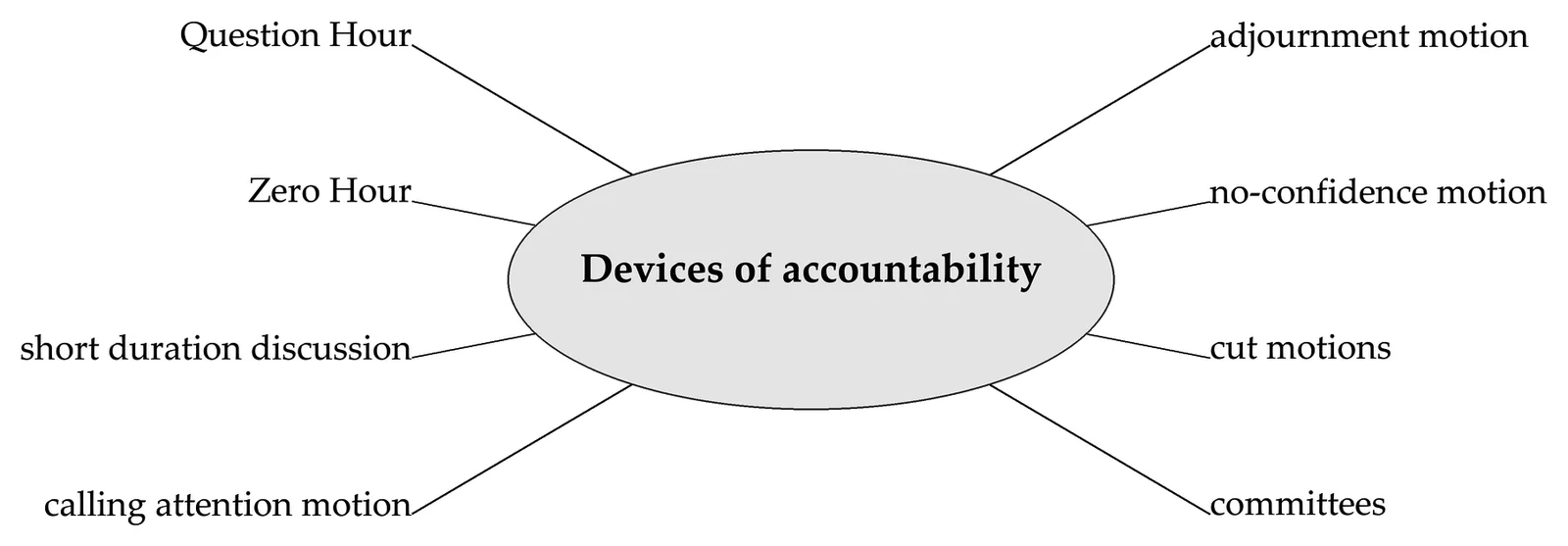
IIN a parliamentary system, the government holds office only as long as it enjoys the confidence of the Lok Sabha. Parliament therefore needs regular ways to question, criticise and control the executive. These are the parliamentary devices: Question Hour, Zero Hour, short duration discussions, and motions such as calling attention, adjournment and no-confidence motions. Parliament also controls public money through the Budget and the Appropriation Bill. This chapter explains each device, how it works under the Rules of Procedure, and how effective it is in making the government accountable.
3.1 Question Hour, Zero Hour and Short Duration Discussion
Collective responsibility under Article 75(3) means that ministers must answer to Parliament for the work of their departments. The most regular device for this is the Question Hour, the first hour of every sitting in both Houses, when members ask ministers questions about the administration and policies of the government. Questions bring information into the public domain, expose lapses and keep ministers alert.
Kinds of Questions
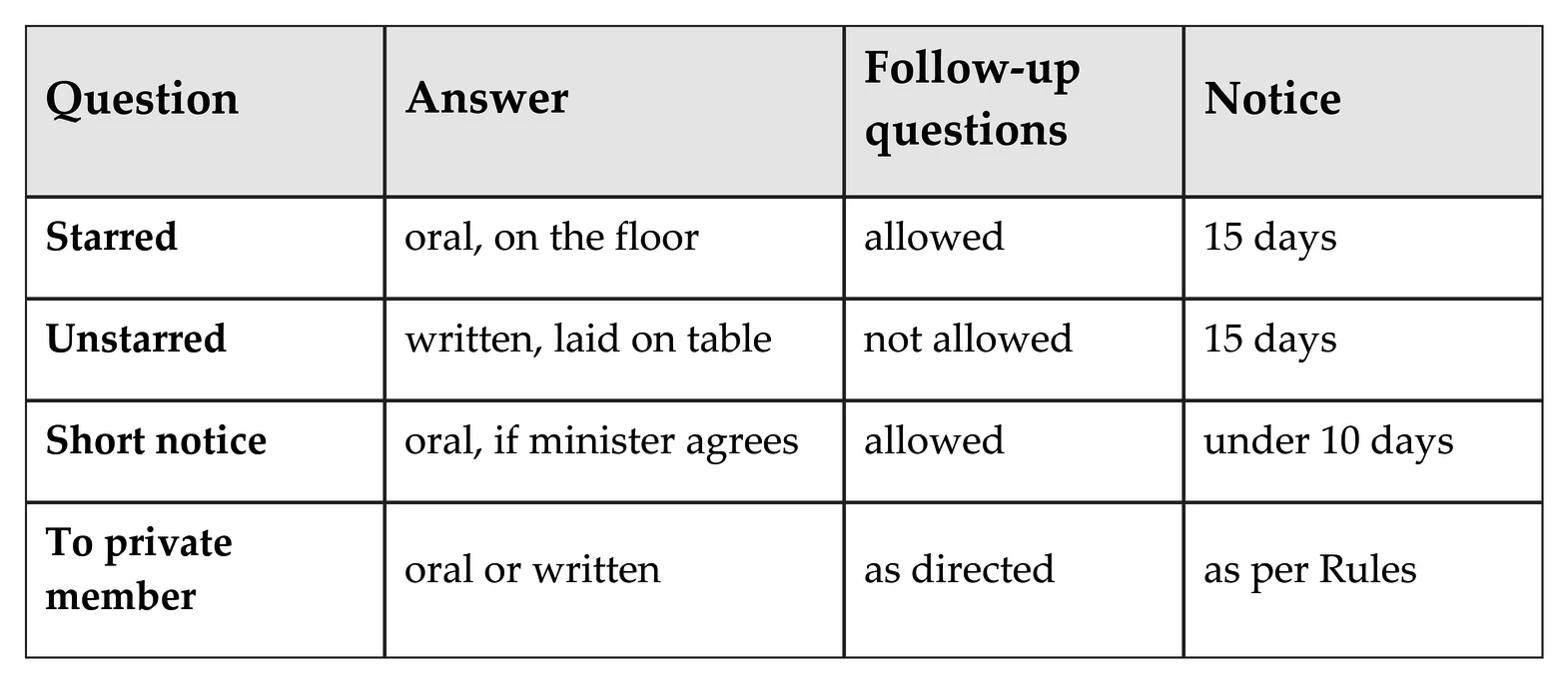
- Starred questions. These require an oral answer on the floor, and members may ask supplementary questions after the answer; a member can ask only one starred question a day, and twenty are listed each day in the Lok Sabha.
- Unstarred questions. These receive written answers placed on the table of the House, with no supplementaries; up to 230 are answered daily in the Lok Sabha.
- Short notice questions. These relate to matters of urgent public importance, can be asked with less than ten days’ notice and are answered orally if the minister agrees.
- Questions to private members. These may be addressed to a member responsible for a bill, resolution or other business of the House.
The Speaker decides whether a question is admissible under the Rules; questions must be precise, factual and within the responsibility of the government. Answers that are incomplete or misleading may lead to a half-an-hour discussion, which a member can raise on a matter arising from the answer to a question, usually on three days a week in the last half hour of the sitting.
Zero Hour
Zero Hour begins immediately after Question Hour, around twelve noon, which explains its name. It is an Indian innovation from the early 1960s and is not provided for in the Rules of Procedure. Members raise urgent matters of public importance with the Speaker’s permission, often without prior notice in the past, though notice is now required. Zero Hour allows members to draw attention to issues in their constituencies and to sudden events, but because there is no formal reply from the government it is mainly a device of publicity rather than control. In recent years, the Lok Sabha has extended Zero Hour to allow more members to speak.
Short Duration Discussion
Under Rule 193 of the Lok Sabha Rules (Rule 176 in the Rajya Sabha), members may raise a discussion on a matter of urgent public importance for a short duration, normally up to two and a half hours. There is no formal motion before the House and no voting; the minister concerned replies at the end. Such discussions have been held on price rise, drought, communal violence and foreign policy, and they are often accepted by governments as an alternative to an adjournment motion, which involves a vote.
3.2 Motions: Calling Attention, Adjournment and No-Confidence
A motion is a formal proposal by a member for a decision of the House. Every matter decided by the House comes before it through a motion. Some motions are especially important as devices of accountability.
Calling Attention Motion
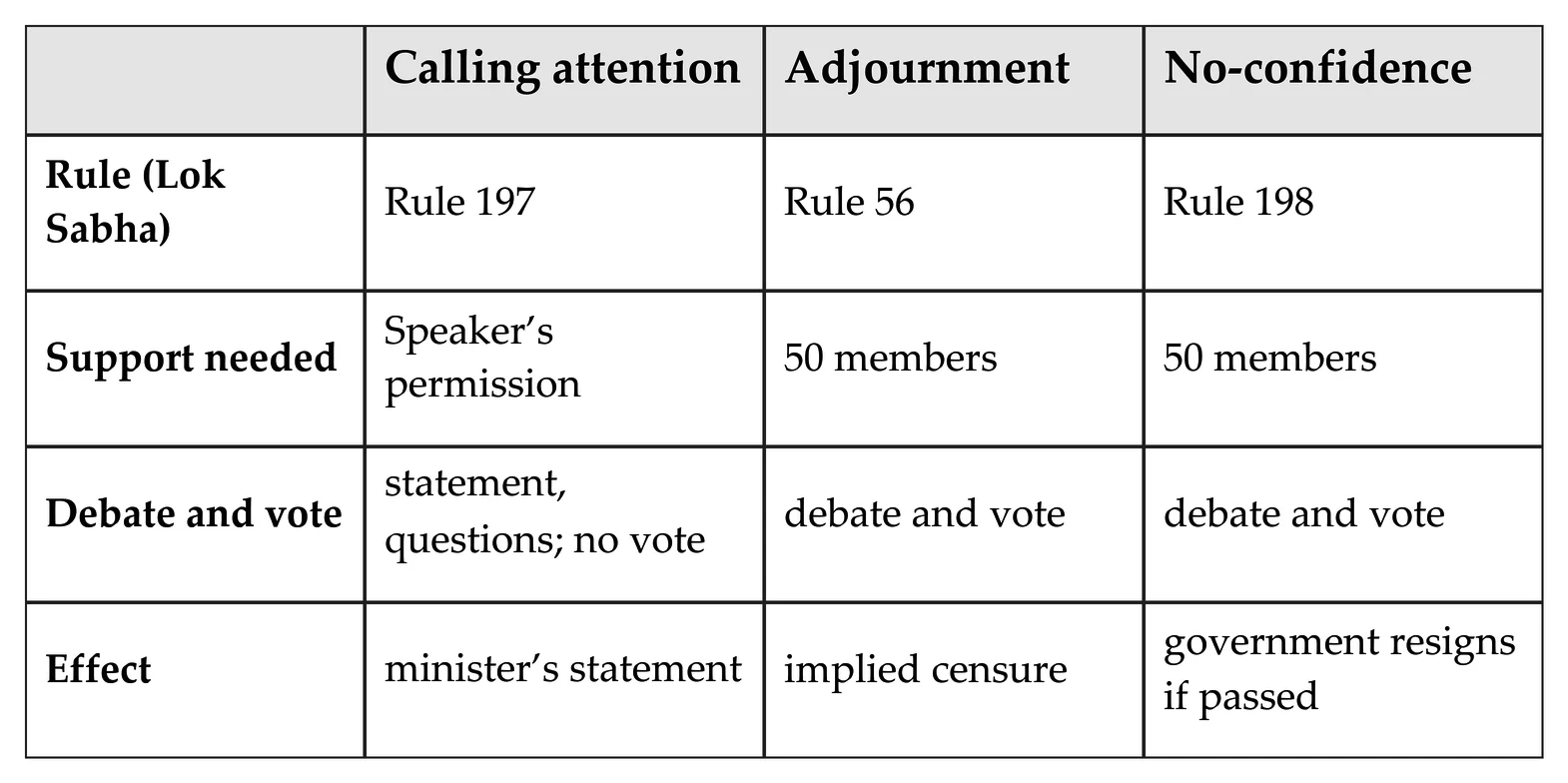
Under Rule 197 of the Lok Sabha Rules, a member may, with the Speaker’s permission, call the attention of a minister to a matter of urgent public importance, and the minister may make a brief statement or ask for time. Members may then ask clarifying questions, but there is no debate or vote. The calling attention motion is also an Indian innovation, in use since 1954. It is less severe than an adjournment motion, so governments find it easier to accept, and it allows urgent issues to be raised quickly.
Adjournment Motion
- Purpose. An adjournment motion is moved in the Lok Sabha to adjourn the business of the House in order to discuss a definite matter of urgent public importance.
- Support. It needs the support of fifty members to be admitted.
- Conditions. The matter must be definite, factual, urgent and of public importance; it must not be under adjudication, revive a matter already discussed in the session, or deal with a matter that is not the responsibility of the government.
- Censure element. Because it interrupts normal business and ends with a vote, an adjournment motion carries an element of censure of the government, and governments therefore resist it.
- Rajya Sabha. The Rajya Sabha does not use the adjournment motion, since it cannot remove the government.
No-Confidence Motion
Article 75(3) makes the Council of Ministers collectively responsible to the Lok Sabha. Under Rule 198, a member may move a motion of no-confidence in the Council of Ministers with the support of at least fifty members. The motion need not state reasons, and if it is adopted the government must resign. The first no-confidence motion was moved by Acharya J.B. Kripalani against the Nehru government in 1963. Only one government has fallen through a no-confidence motion: that of Morarji Desai in 1979, which resigned before the vote. Governments have also fallen by losing confidence motions moved by themselves, such as V.P. Singh’s in 1990, H.D. Deve Gowda’s in 1997 and A.B. Vajpayee’s in 1999, which was lost by one vote. In practice, no-confidence motions also serve the opposition as an opportunity for a wide-ranging debate on the government’s record, as in July 2018 and August 2023.
Censure and Other Motions
A censure motion expresses disapproval of a particular policy or act of the government and must state reasons; if adopted, the government must seek the confidence of the House. Cut motions are used during the Budget to reduce demands for grants, and the motion of thanks on the President’s Address is debated at the start of each year, its defeat amounting to a defeat of the government.
3.3 The Budget and the Appropriation Bill
Parliament’s control over finance is the oldest basis of legislative power. Article 265 provides that no tax shall be levied or collected except by authority of law, and Articles 114 and 266 provide that no money shall be withdrawn from the Consolidated Fund of India except under appropriation made by law. The Constitution calls the Budget the Annual Financial Statement (Article 112), a statement of the estimated receipts and expenditure of the government for the financial year.
Stages of the Budget
- Presentation. The Finance Minister presents the Budget in the Lok Sabha, since 2017 on 1 February, and it is laid before the Rajya Sabha; the Railway Budget was merged with the General Budget in 2017.
- General discussion. Both Houses discuss the Budget as a whole for a few days, without any voting.
- Scrutiny by committees. The House adjourns for some weeks while the Departmentally Related Standing Committees examine the demands for grants of each ministry.
- Voting on demands for grants. The Lok Sabha votes on the demands for grants of each ministry under Article 113; the Rajya Sabha has no power to vote on them. Expenditure charged on the Consolidated Fund, such as the salaries of the President and judges, is not voted upon. Members may move cut motions: a disapproval of policy cut (reduce the demand to Re 1), an economy cut (reduce it by a specified amount) or a token cut (reduce it by Rs 100 to raise a grievance). Remaining demands are put to vote together on the last day by the guillotine.
- Appropriation Bill. Under Article 114, an Appropriation Bill is introduced to authorise withdrawal of the voted grants and charged expenditure from the Consolidated Fund; no amendment varying the amount of a grant can be moved.
- Finance Bill. The Finance Bill gives effect to the tax proposals for the year and must be passed within seventy-five days under the Provisional Collection of Taxes Act, 1931.
Other Grants
- Vote on account (Article 116). Since the Budget cannot be passed before the financial year begins on 1 April, the Lok Sabha grants an advance to the government to meet expenditure for part of the year, usually two months.
- Supplementary and excess grants (Article 115). These are granted when the authorised amount proves insufficient or when money has been spent beyond the grant.
- Vote of credit, exceptional grant and token grant. These meet unexpected or exceptional demands, such as in an emergency.
Effectiveness of Financial Control
Parliament’s financial control is significant in law, but in practice most demands are passed by guillotine without discussion: PRS Legislative Research has found that in several recent years, the large majority of the Budget was passed without debate. Ex post control is exercised by the Comptroller and Auditor General (Article 148) and the Public Accounts Committee, which examine whether money was spent as authorised. Critics suggest more time for debate on demands and stronger committee scrutiny of the Budget.

3.4 Important Questions
- Question 1 Examine the role of Question Hour and Zero Hour in ensuring the accountability of the executive.
- Question 2 Discuss the adjournment motion and the calling attention motion as devices of parliamentary control.
- Question 3 Discuss the no-confidence motion as an instrument of parliamentary control over the executive.
- Question 4 Describe the process by which the Budget is passed in Parliament. How effective is parliamentary control over public finance?
DU asks the same idea in different words. So learn one broad answer for each question below; the same answer works for every question joined by OR.
Important Question 1
Examine the role of Question Hour and Zero Hour in ensuring the accountability of the executive.
OR
What are the different kinds of questions asked in Parliament? How effective is Question Hour?
OR
Write a note on Zero Hour and short duration discussion.
Model Answer
“Unless the Speaker otherwise directs, the first hour of every sitting shall be available for the asking and answering of questions.”
— Rules of Procedure and Conduct of Business in Lok Sabha, Rule 32
Introduction. In a parliamentary democracy, the government must answer to the legislature for its actions every day. The Question Hour, the first hour of each sitting, is the most direct device for this, while Zero Hour and short duration discussions allow members to raise urgent issues. Together, these devices put the collective responsibility of Article 75(3) into practice.
1. Accountability in a Parliamentary System
Unlike the presidential system, the Indian executive is drawn from and responsible to Parliament. Ministers must explain their policies and actions to members, who represent the people, and the daily procedures of the House make this possible.
2. Question Hour
The first hour of every sitting is Question Hour, when ministers answer questions about their departments. Questions are allotted to ministries by rotation on different days, so every ministry faces questions regularly.
3. Starred Questions
Starred questions require oral answers on the floor, followed by supplementary questions from members, which test the minister’s knowledge and can expose weaknesses in the government’s case. Twenty are listed each day in the Lok Sabha.
4. Unstarred Questions
Unstarred questions are answered in writing, with no supplementaries. They provide a large amount of detailed information about government programmes, which members, researchers and journalists use.
5. Short Notice Questions
Short notice questions on urgent matters can be asked with less than ten days’ notice and are answered orally if the minister agrees to answer at short notice.
6. Half-an-Hour Discussion
If an answer is unsatisfactory, a member may raise a half-an-hour discussion on the matter, allowing a fuller examination of the issue than Question Hour permits.
7. Value of Question Hour
Questions bring information into the public domain, expose administrative lapses and corruption, keep ministers well prepared and signal public concerns to the government. Many scandals first came to light through parliamentary questions.
8. Zero Hour
Zero Hour begins at noon after Question Hour. It is an Indian innovation of the early 1960s, not mentioned in the Rules, in which members raise urgent matters with the Speaker’s permission.
9. Value of Zero Hour
Zero Hour lets members raise constituency problems and sudden events quickly, giving voice to backbenchers. But since there is no formal reply from the government, it mainly publicises issues rather than enforcing accountability.
10. Short Duration Discussion
Under Rule 193 of the Lok Sabha, members can discuss an urgent matter for up to two and a half hours without a formal motion or vote, and the minister replies at the end.
11. Disruption of Question Hour
Question Hour is frequently lost to disruptions and adjournments. Studies by PRS Legislative Research show that in some sessions, only a small fraction of starred questions were answered orally in the Lok Sabha.
12. Suspension in 2020
Question Hour was suspended during the 2020 monsoon session because of the pandemic, with only written answers allowed, which the opposition criticised as weakening accountability.
13. Reforms
Reformers suggest protecting Question Hour from disruption, adopting a weekly Prime Minister’s Question Time as in Britain, and requiring timely and complete answers from ministries.
14. Evaluation
Question Hour, Zero Hour and short duration discussions are vital tools of accountability, but their effectiveness depends on regular functioning of the House and the willingness of both government and opposition to use them seriously.
Conclusion. Thus, Question Hour enables members to obtain information and hold ministers responsible through starred, unstarred and short notice questions, while Zero Hour and short duration discussions allow urgent issues to be raised. These devices give daily meaning to collective responsibility under Article 75(3), though disruptions have weakened them.
Important Question 2
Discuss the adjournment motion and the calling attention motion as devices of parliamentary control.
OR
Distinguish between an adjournment motion and a calling attention motion.
OR
Write a note on motions in the Indian Parliament.
Model Answer
“A motion for an adjournment of the business of the House for the purpose of discussing a definite matter of urgent public importance may be made with the consent of the Speaker.”
— Rules of Procedure and Conduct of Business in Lok Sabha, Rule 56 (abridged)
Introduction. A motion is a formal proposal placed before the House for its decision. Among the many motions used in Parliament, the adjournment motion and the calling attention motion are important devices for raising urgent matters and holding the government to account. The adjournment motion is a strong device with an element of censure, while the calling attention motion is a milder Indian innovation.
1. Meaning of a Motion
Every decision of the House is taken on a motion. Motions may be substantive (self-contained proposals), substitute (moved in place of another) or subsidiary (dependent on another motion), and they are governed by the Rules of Procedure.
2. The Adjournment Motion
An adjournment motion proposes to set aside the normal business of the Lok Sabha to discuss a definite matter of urgent public importance. It requires the support of fifty members to be admitted.
3. Conditions for Admission
The matter must be definite, factual, urgent and of public importance. It must not be under adjudication by a court, must not revive a discussion held earlier in the session and must concern the responsibility of the government.
4. Element of Censure
Because the motion interrupts the business of the House and ends with a vote, it implies censure of the government for failing to act. Governments therefore resist adjournment motions, and the Speaker admits them rarely.
5. Not in the Rajya Sabha
The Rajya Sabha does not use the adjournment motion, since the government is not responsible to it and the motion involves an element of censure.
6. Examples
Adjournment motions have been admitted on issues such as the Chinese aggression and later on major scams and disasters, leading to intense debates in which the government had to defend its record.
7. The Calling Attention Motion
Under Rule 197, a member may call the attention of a minister to an urgent matter, and the minister makes a statement. Members may ask clarifying questions, but there is no debate or vote.
8. An Indian Innovation
The calling attention motion has been used since 1954 and is an Indian contribution to parliamentary procedure, combining features of a question and a short discussion.
9. Differences between the Two Motions
The adjournment motion leads to a debate and vote and implies censure, while the calling attention motion involves only a statement and clarifications. The first needs fifty members’ support; the second needs only the Speaker’s permission.
10. Value of the Calling Attention Motion
Since it implies no censure, the government accepts it more readily, so urgent issues can be raised frequently and the government is made to place its position on record.
11. Rule 193 as an Alternative
Governments often offer a short duration discussion under Rule 193 in place of an adjournment motion, since it involves no vote, leading to disputes between the government and opposition.
12. Disputes over Admission
The opposition often accuses presiding officers of refusing adjournment motions, and the resulting protests sometimes disrupt the House for days, reducing the time for business.
13. Other Motions
Other motions include the censure motion, which must state reasons, cut motions on budget demands, and the motion of thanks on the President’s Address.
14. Special Mentions in the Rajya Sabha
Since the Rajya Sabha does not use the adjournment motion, its members raise urgent matters through special mentions, calling attention motions and short duration discussions under Rule 176. These devices allow the upper House to draw the government’s attention to urgent issues without threatening its survival.
15. Motions and the Opposition’s Strategy
The opposition often gives notices of adjournment motions on the same issue for several days to keep it in the public eye. Even when the Speaker refuses them, the notices and protests signal the opposition’s priorities to the public, showing that motions are also instruments of political communication.
16. Evaluation
The adjournment and calling attention motions together provide a graded set of tools for raising urgent matters, from mild to severe, ensuring that the government responds to public concerns.
Conclusion. Thus, the adjournment motion, needing fifty members’ support, interrupts business for an urgent debate and implies censure, while the calling attention motion, an Indian innovation of 1954, makes ministers state their position without a vote. Both embody the principle that the government must answer to the House, though disputes over their admission often lead to disruption.
Important Question 3
Discuss the no-confidence motion as an instrument of parliamentary control over the executive.
OR
Examine the significance of the no-confidence motion in the Indian parliamentary system.
OR
Distinguish between a no-confidence motion, a censure motion and a confidence motion.
Model Answer
“The House of Commons is an electoral chamber; it is the assembly which chooses our president.”
— Walter Bagehot, The English Constitution (1867)
Introduction. The most powerful device of parliamentary control is the no-confidence motion. Since the Council of Ministers is collectively responsible to the Lok Sabha under Article 75(3), the House can remove the government by passing a motion expressing want of confidence. Though governments rarely fall this way, the motion is the ultimate guarantee of executive responsibility.
1. Constitutional Basis
Article 75(3) makes the Council of Ministers collectively responsible to the Lok Sabha. The no-confidence motion is not mentioned in the Constitution but is provided for under Rule 198 of the Lok Sabha Rules.
2. Procedure
A member gives written notice, and the motion is admitted if at least fifty members support it. The Speaker fixes a date for discussion within ten days, and the motion is put to vote at the end of the debate.

3. No Reasons Required
Unlike a censure motion, a no-confidence motion need not state reasons. It is directed against the entire Council of Ministers, not an individual minister.
4. Effect of Adoption
If the motion is adopted, the government must resign. This is the ultimate sanction of collective responsibility, ensuring that no government can stay in office without the support of the Lok Sabha.
5. Only in the Lok Sabha
A no-confidence motion can be moved only in the Lok Sabha, since the Council of Ministers is responsible only to it; the Rajya Sabha cannot remove the government.
6. The First Motion
The first no-confidence motion was moved by Acharya J.B. Kripalani against the Nehru government in August 1963 after the war with China. It was defeated, but it allowed a wide debate on the government’s failures.
7. Governments that Fell
Only the Morarji Desai government fell because of a no-confidence motion, resigning in 1979 before the vote. Other governments fell by losing confidence motions, such as V.P. Singh’s (1990), Deve Gowda’s (1997) and Vajpayee’s (1999), lost by one vote.
8. Confidence Motions
A confidence motion is moved by the government itself to prove its majority, often when the President asks a new government to do so or when allies withdraw support, as in 2008 over the India–US nuclear deal.
9. Censure Motion
A censure motion must state reasons and may target an individual minister or a policy. If adopted, the government is expected to seek a vote of confidence, but resignation is not automatic.
10. A Tool for Debate
Even when the government has a clear majority, the opposition uses no-confidence motions to force a wide-ranging debate on the government’s record, as in July 2018 and August 2023.
11. The Anti-Defection Law
The Tenth Schedule, added in 1985, disqualifies members who vote against their party’s whip, which makes it harder for governments to fall through floor-crossing and strengthens party discipline in such votes.
12. Comparison with Germany
Germany uses a constructive vote of no-confidence, under which the Bundestag can remove the Chancellor only by electing a successor. Some Indian reformers have suggested this to ensure stability.
13. Limitations
With stable majorities and strict party discipline, no-confidence motions rarely threaten governments, so their main value today lies in the debate they enable rather than their outcome.
14. No-Confidence Motions in the States
State legislative assemblies follow similar rules, and the Council of Ministers in a state is collectively responsible to the Legislative Assembly under Article 164(2). Floor tests in state assemblies have often decided the fate of governments, and in S.R. Bommai (1994) the Supreme Court held that the floor of the House, not the Governor’s opinion, is the proper place to test a government’s majority.
15. Evaluation
The no-confidence motion is the foundation of responsible government, reminding the executive that it holds office only with the support of the people’s representatives.
Conclusion. Thus, the no-confidence motion under Rule 198, needing fifty members’ support and no stated reasons, can remove the entire Council of Ministers, embodying the collective responsibility of Article 75(3). Though it has toppled only one government, it keeps alive what Bagehot called the elective function of the legislature and remains the ultimate check on the executive and a powerful platform for the opposition.
Important Question 4
Describe the process by which the Budget is passed in Parliament. How effective is parliamentary control over public finance?
OR
Discuss the role of the Appropriation Bill and cut motions in parliamentary financial control.
OR
Examine parliamentary control over public finance in India.
Model Answer
“No tax shall be levied or collected except by authority of law.”
— Constitution of India, Article 265
Introduction. Control over public money is one of Parliament’s most important powers. The Constitution requires that no tax be levied without law (Article 265) and no money be spent from the Consolidated Fund without appropriation by law (Articles 114 and 266). The Budget, presented every year, is the main occasion for Parliament to examine and approve the government’s financial plans.
1. Constitutional Provisions
Article 112 requires the government to lay an Annual Financial Statement before Parliament. Articles 113 and 114 deal with demands for grants and the Appropriation Bill, and Articles 115 and 116 deal with supplementary grants and votes on account.
2. Presentation of the Budget
The Finance Minister presents the Budget in the Lok Sabha, since 2017 on 1 February, so that it can be passed before the financial year begins. The Railway Budget was merged with the General Budget in 2017.
3. General Discussion
Both Houses hold a general discussion on the Budget as a whole, in which members comment on the government’s economic policies, but no voting takes place at this stage.
4. Scrutiny by Standing Committees
The House adjourns for a few weeks while the Departmentally Related Standing Committees examine the demands for grants of each ministry and report to the House.
5. Voting on Demands for Grants
The Lok Sabha votes on the demands for grants of each ministry. The Rajya Sabha can discuss but not vote on them, and charged expenditure, such as judges’ salaries, is not voted upon.
6. Cut Motions
Members may move cut motions: a policy cut reduces a demand to Re 1 to show disapproval of policy, an economy cut reduces it by a specified amount, and a token cut reduces it by Rs 100 to raise a grievance.
7. The Guillotine
On the last day allotted for demands, the Speaker puts all remaining demands to vote together, whether discussed or not. This guillotine means that most demands are passed without debate.
8. The Appropriation Bill
Under Article 114, the Appropriation Bill authorises withdrawal of voted grants and charged expenditure from the Consolidated Fund. No amendment changing the amount of a grant is allowed.
9. The Finance Bill
The Finance Bill gives legal effect to the tax proposals. Under the Provisional Collection of Taxes Act, 1931, it must be passed within seventy-five days, though tax changes take effect immediately.
10. Vote on Account and Other Grants
A vote on account under Article 116 allows spending for part of the year before the Budget is passed, while supplementary, excess and exceptional grants meet additional needs.
11. Ex Post Control
The Comptroller and Auditor General audits government accounts under Article 148, and the Public Accounts Committee examines the audit reports, ensuring that money was spent as authorised.
12. Limitations
In practice, most demands are guillotined, cut motions are rarely adopted since the government has a majority, and members lack research support to examine complex budgets.
13. Reforms
Reformers suggest more days for budget debate, stronger committee scrutiny, a parliamentary budget office to give independent analysis and better use of outcome budgets.
14. Role of the Rajya Sabha
The Rajya Sabha discusses the Budget in general and can make recommendations on the Appropriation and Finance Bills within fourteen days, since both are money bills. It cannot vote on demands for grants, which reflects the principle that the House elected directly by the people controls the purse.
15. Outcome and Gender Budgeting
Since 2005–06, the government has presented an outcome budget linking spending to physical targets and a gender budget statement showing allocations for women. These documents help members judge not only how much is spent but what results are achieved, though they are rarely discussed in detail.
16. Fiscal Responsibility
The Fiscal Responsibility and Budget Management Act, 2003, requires the government to lay statements on fiscal policy and targets for the fiscal deficit before Parliament along with the Budget, which allows members to judge whether the government is borrowing responsibly.
17. Evaluation
Parliament’s financial control is strong in law and important in principle, but its practical effectiveness is limited by the guillotine, executive dominance and lack of expertise.
Conclusion. Thus, the Budget passes through presentation, general discussion, committee scrutiny, voting on demands with cut motions, the Appropriation Bill and the Finance Bill, giving effect to Articles 265 and 266. Parliamentary control over finance is real in law, but the guillotine and executive dominance show the need for reform.
Short Notes
(a) Zero Hour
The time immediately after Question Hour, starting at noon, when members raise urgent matters with the Speaker’s permission; it is an Indian innovation not mentioned in the Rules of Procedure.
(b) Cut motion
A motion to reduce a demand for grant during the Budget: a policy cut (to Re 1), an economy cut (by a specified amount) or a token cut (by Rs 100).
(c) Vote on account
An advance grant by the Lok Sabha under Article 116 to meet government expenditure for part of the financial year before the Budget is passed.
More notes: GE-12 Parliamentary Procedures and Practices
These notes are prepared by PADHO TO AISE for study help. They are not an official publication.