
Generic Electives (GE) GE-12 Parliamentary Procedures and Practices
Unit 4 · 24 min read · Updated 27 Nov 2026
As per the University of Delhi (DU) Generic Elective (GE) syllabus offered by the Department of Political Science
Contents
- 4.1 Meaning and Kinds of Parliamentary Committees
- Why Committees Are Needed
- Standing Committees
- Ad Hoc Committees
- Joint Parliamentary Committees
- 4.2 Departmentally Related Standing Committees
- Composition
- Functions
- Limitations
- 4.3 Financial Committees: PAC, Estimates Committee and COPU
- Public Accounts Committee (PAC)
- Estimates Committee
- Committee on Public Undertakings (COPU)
- Limitations of Financial Committees
- 4.4 Important Questions
- What are parliamentary committees? Discuss the different kinds of committees and their importance.
- Examine the composition and functions of the Departmentally Related Standing Committees.
- Discuss the role of the Public Accounts Committee in ensuring financial accountability.
- Compare the Estimates Committee and the Committee on Public Undertakings. How effective are the financial committees of Parliament?
- Short Notes
अन्य बातों में संसद के प्रत्येक सदन की और प्रत्येक सदन के सदस्यों और समितियों की शक्तियाँ, विशेषाधिकार और उन्मुक्तियाँ ऐसी होंगी जो संसद, समय-समय पर, विधि द्वारा परिनिश्चित करे।
In other respects, the powers, privileges and immunities of each House of Parliament, and of the members and the committees of each House, shall be such as may from time to time be defined by Parliament by law.
— Constitution of India, Article 105(3)
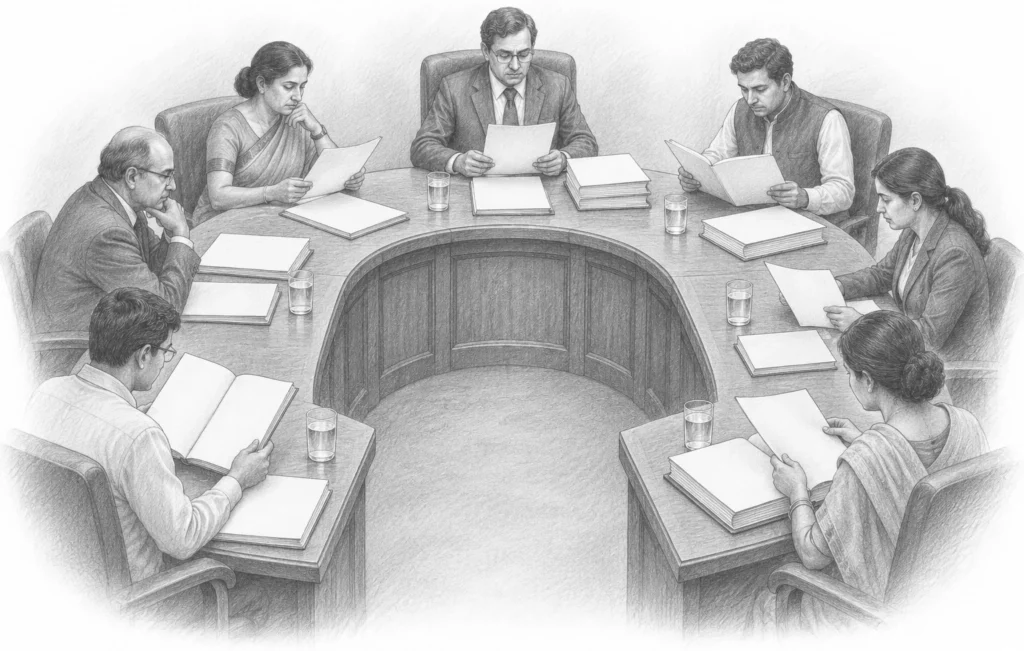
PPARLIAMENT has hundreds of members and limited time, but the work of modern government is vast and technical. Much of Parliament’s detailed work is therefore done by committees, small groups of members drawn from different parties, which examine bills, scrutinise spending and investigate the working of ministries. The Constitution mentions committees only in passing, and they are set up under the Rules of Procedure made under Article 118. This chapter explains the difference between standing and ad hoc committees, the Departmentally Related Standing Committees, and the three financial committees: the Public Accounts Committee, the Estimates Committee and the Committee on Public Undertakings.
4.1 Meaning and Kinds of Parliamentary Committees
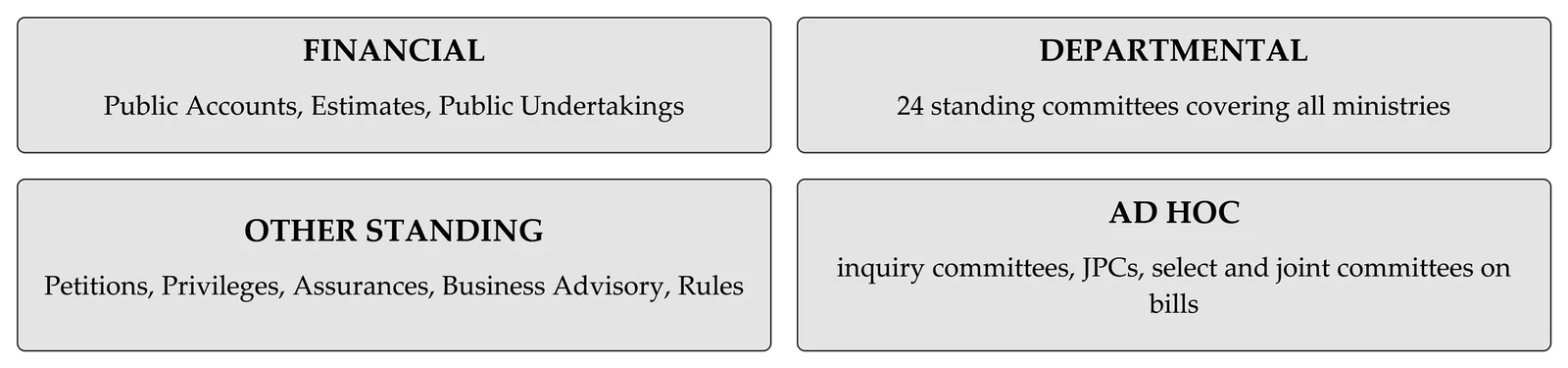
A parliamentary committee is a committee appointed or elected by the House, or nominated by the Speaker or Chairman, which works under the direction of the presiding officer and presents its report to the House or the presiding officer, and which has a secretariat provided by the Lok Sabha or Rajya Sabha Secretariat. Committees are often called mini-Parliaments, since their membership reflects the strength of parties in the House. The Constitution refers to committees in Articles 105 and 118, but their structure is set by the Rules of Procedure and Conduct of Business of each House and the directions of the presiding officers.
Why Committees Are Needed
- Shortage of time. Parliament meets for only around 60 to 70 days a year and cannot discuss every bill and every demand for grants in detail on the floor.
- Technical complexity. Modern legislation and budgets involve technical matters that need careful, specialised examination.
- Specialisation. Committees allow members to develop expertise in particular areas over time.
- Consensus. Committee meetings are held in private, away from the media, so members can discuss issues on merit and reach agreement across party lines.
- Consultation. Committees can take evidence from officials, experts and the public, bringing more voices into law-making.
- Accountability. Committees scrutinise the executive continuously, between and during sessions.
Standing Committees
Standing committees are permanent and are constituted every year or periodically; they work continuously. They can be classified by function: financial committees (Public Accounts, Estimates and Public Undertakings); Departmentally Related Standing Committees; committees to inquire, such as the Committee on Petitions and the Committee of Privileges; committees to scrutinise and control, such as the Committee on Government Assurances, the Committee on Subordinate Legislation and the Committee on the Welfare of Scheduled Castes and Scheduled Tribes; committees on the day-to-day business of the House, such as the Business Advisory Committee and the Rules Committee; and house-keeping committees, such as the House Committee and the Joint Committee on Salaries and Allowances of Members.
Ad Hoc Committees
Ad hoc committees are temporary and cease to exist once they complete their task. They are of two kinds. Inquiry committees are set up to inquire into particular matters, such as the Joint Parliamentary Committees on the Bofors deal (1987), the stock market scams (1992 and 2001), the soft drinks pesticide issue (2003) and the 2G spectrum allocation (2011). Advisory committees are select or joint committees on bills, appointed to examine and report on particular bills, such as the Joint Committee on the Personal Data Protection Bill (2019–21) and the Joint Committee on the Waqf (Amendment) Bill (2024–25).
Joint Parliamentary Committees
A Joint Parliamentary Committee (JPC) includes members of both Houses, usually in a ratio of two Lok Sabha members to one Rajya Sabha member. It is set up by a motion passed in one House and agreed to by the other. JPCs examine bills or investigate scandals, can summon officials and documents, and report to Parliament, but their recommendations are not binding on the government. The opposition often demands JPCs on major controversies, as with the 2G case, where the government initially resisted the demand and Parliament was disrupted for an entire session in 2010.
4.2 Departmentally Related Standing Committees
In 1989, the Lok Sabha set up three subject committees on agriculture, science and technology, and environment and forests. On the recommendation of the Rules Committee, seventeen Departmentally Related Standing Committees (DRSCs) were set up in 1993, when Shivraj Patil was Speaker. Their number was raised to twenty-four in 2004. Each DRSC covers one or more ministries, so that every ministry is under continuous scrutiny.
Composition
- Membership. Each DRSC has 31 members: 21 from the Lok Sabha, nominated by the Speaker, and 10 from the Rajya Sabha, nominated by the Chairman.
- Distribution. Of the 24 committees, 16 work under the Lok Sabha and 8 under the Rajya Sabha.
- Ministers excluded. A minister cannot be a member, and a member who becomes a minister ceases to be a member.
- Term. The term of members is up to one year, though committees are reconstituted regularly.
- Chairs. Chairs are appointed by the presiding officers and are distributed among parties roughly in proportion to their strength, so some committees are chaired by opposition members.
Functions
- Examining the demands for grants of the ministries concerned and reporting on them before they are voted upon in the Lok Sabha.
- Examining bills referred to them by the Speaker or Chairman.
- Considering the annual reports of ministries.
- Considering national basic long-term policy documents presented to the Houses and referred to them.
- Examining subjects selected by the committee itself, on which it may prepare reports.
Limitations
The DRSCs do not consider matters of day-to-day administration, and their reports are recommendatory. The government reports on action taken on their recommendations, but rarely accepts all of them. Referral of bills to DRSCs is at the discretion of the presiding officer, and PRS Legislative Research has shown that the share of bills referred fell from a large majority in the 15th Lok Sabha to under a fifth in the 17th. Low attendance, lack of research staff and the absence of debate on committee reports in the House are other limitations.

4.3 Financial Committees: PAC, Estimates Committee and COPU
Parliament grants money to the government, and it must also check whether the money was spent wisely and as authorised. This is the task of the three financial committees, which are the most powerful standing committees.
Public Accounts Committee (PAC)
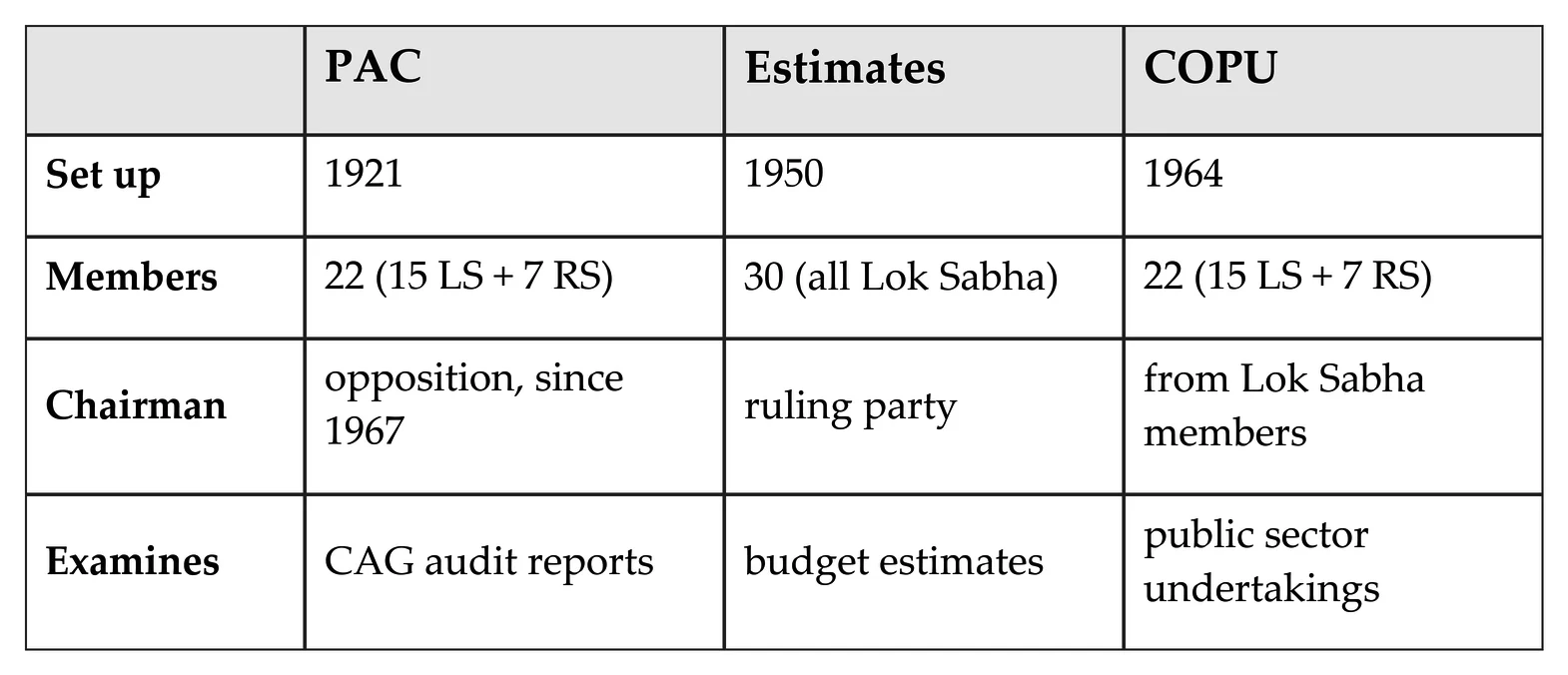
- Origin. The PAC was first set up in 1921 under the Government of India Act, 1919 (the Montagu-Chelmsford Reforms), and has existed since.
- Composition. It has 22 members: 15 from the Lok Sabha and 7 from the Rajya Sabha, elected every year by proportional representation by means of the single transferable vote. Ministers cannot be members.
- Chairman. The Speaker appoints the chairman from among its Lok Sabha members. Since 1967, by convention, the chairman has been a member of the opposition.
- Function. It examines the audit reports of the Comptroller and Auditor General (CAG) on the appropriation and finance accounts of the government, and checks whether money was spent within the grants and for the purposes authorised. It also examines cases of waste, loss, corruption and inefficiency.
- Friend and guide. The CAG acts as the friend, philosopher and guide of the PAC, assisting it in its work.
- Notable reports. The PAC has examined the CAG’s reports on the 2G spectrum allocation and the Commonwealth Games, among others.
Estimates Committee
- Origin. Its predecessor was the Standing Finance Committee of 1921; the Estimates Committee was set up in 1950 on the recommendation of John Mathai, then Finance Minister.
- Composition. It has 30 members, all from the Lok Sabha, elected every year by proportional representation; the Rajya Sabha has no representation. Ministers cannot be members.
- Chairman. The Speaker appoints the chairman, who is invariably from the ruling party.
- Function. It examines the estimates included in the Budget and suggests economies in public expenditure, improvements in organisation and efficiency, and alternative policies to bring about efficiency. It also examines whether money is well laid out within the limits of the policy implied in the estimates.
- Called the continuous economy committee. It is often described as a continuous economy committee, since it examines the estimates of selected ministries throughout the year.
Committee on Public Undertakings (COPU)
- Origin. It was created in 1964 on the recommendation of the Krishna Menon Committee.
- Composition. It has 22 members: 15 from the Lok Sabha and 7 from the Rajya Sabha, elected every year by proportional representation. Ministers cannot be members.
- Chairman. The Speaker appoints the chairman from among its Lok Sabha members.
- Function. It examines the reports and accounts of public sector undertakings and the CAG’s reports on them, and checks whether they are run according to sound business principles and prudent commercial practices.
- Limits. It does not examine matters of major government policy or day-to-day administration of the undertakings, and it can examine only a few of the many public sector undertakings each year.
Limitations of Financial Committees
The financial committees perform ex post scrutiny: the PAC examines spending after it has taken place, often years later, and can only point out lapses. Their recommendations are advisory, and the government may delay action. The Estimates Committee examines only a few ministries each year, and none of the committees can question policy as such. Still, through their detailed reports, they act as a powerful check on waste and irregularities and keep the bureaucracy alert.
4.4 Important Questions
- Question 1 What are parliamentary committees? Discuss the different kinds of committees and their importance.
- Question 2 Examine the composition and functions of the Departmentally Related Standing Committees.
- Question 3 Discuss the role of the Public Accounts Committee in ensuring financial accountability.
- Question 4 Compare the Estimates Committee and the Committee on Public Undertakings. How effective are the financial committees of Parliament?
DU asks the same idea in different words. So learn one broad answer for each question below; the same answer works for every question joined by OR.
Important Question 1
What are parliamentary committees? Discuss the different kinds of committees and their importance.
OR
Distinguish between standing and ad hoc committees of Parliament.
OR
Why are parliamentary committees called mini-Parliaments? Discuss their role.
Model Answer
“Instead of the function of governing, for which it is radically unfit, the proper office of a representative assembly is to watch and control the government.”
— J.S. Mill, Considerations on Representative Government (1861)
Introduction. Modern parliaments cannot do all their work on the floor of the House. Committees, small groups of members drawn from all parties, do much of the detailed work of examining bills, scrutinising spending and investigating the executive. The Indian Parliament has many committees, classified into standing and ad hoc committees, which are set up under the Rules of Procedure made under Article 118.
1. Meaning
A parliamentary committee is appointed or elected by the House or nominated by the presiding officer, works under the presiding officer’s direction, presents its report to the House or presiding officer, and is served by the parliamentary secretariat. It is distinct from committees set up by the government.
2. Constitutional and Legal Basis
The Constitution refers to committees only in passing, in Articles 105 and 118. Their structure and functioning are set by the Rules of Procedure and Conduct of Business of each House and the directions of the Speaker and Chairman.
3. Need for Committees
Parliament meets for limited days, while bills and budgets are complex and technical. Committees allow detailed, specialised examination and continuous scrutiny of the executive, which the whole House cannot provide.
4. Standing Committees
Standing committees are permanent and work continuously. They include the financial committees, the Departmentally Related Standing Committees and committees to inquire, scrutinise and control, and to manage the business of the House.
5. Financial Committees
The Public Accounts Committee, the Estimates Committee and the Committee on Public Undertakings examine public spending, budget estimates and public sector undertakings, acting as Parliament’s financial watchdogs.
6. Committees to Inquire
The Committee on Petitions examines petitions from citizens, and the Committee of Privileges examines cases of breach of privilege and contempt of the House referred to it.
7. Committees to Scrutinise and Control
The Committee on Government Assurances checks whether ministers fulfil promises made in the House, and the Committee on Subordinate Legislation checks whether rules made by the executive stay within the powers delegated by Parliament.
8. Committees on the Business of the House
The Business Advisory Committee allots time for bills and other business, and the Rules Committee considers changes to the Rules of Procedure, while house-keeping committees deal with members’ facilities.
9. Ad Hoc Committees
Ad hoc committees are temporary and end when their task is complete. They include inquiry committees on particular matters and select or joint committees on bills.
10. Joint Parliamentary Committees
JPCs have members from both Houses and have investigated the Bofors deal (1987), the stock market scams (1992 and 2001) and the 2G spectrum allocation (2011), or examined major bills such as the Personal Data Protection Bill.
11. Mini-Parliaments
Committees are called mini-Parliaments because their membership reflects party strength in the House. Yet in committee, members often set aside party loyalties and work on the basis of evidence and argument.
12. Importance: Scrutiny and Expertise
Committees examine bills clause by clause, take evidence from experts and stakeholders, and develop specialised knowledge, improving the quality of laws and policies.
13. Importance: Accountability
Committees scrutinise ministries throughout the year, examine audit reports and check whether assurances are kept, making the executive continuously answerable to Parliament.
14. Limitations
Committee reports are only recommendatory, referral of bills is discretionary, attendance is often low, research support is limited, and reports are rarely debated in the House.
15. Reforms
Reformers suggest compulsory referral of bills, better research staff, public hearings on important subjects and time in the House to debate committee reports.
16. Evaluation
Committees are the workshops of Parliament, where its most careful work is done. Their strength determines how effectively Parliament can scrutinise legislation and the executive.
Conclusion. Thus, parliamentary committees, standing and ad hoc, enable Parliament to examine bills, spending and administration in detail, consult experts and the public, and build consensus as mini-Parliaments. As Mill argued, the proper office of a representative assembly is to watch and control the government; committees are its chief means of doing so, and strengthening them is essential for a strong Parliament.
Important Question 2
Examine the composition and functions of the Departmentally Related Standing Committees.
OR
Discuss the role of Departmentally Related Standing Committees in strengthening parliamentary control over the executive.
OR
Write a note on the decline of committee scrutiny of bills in India.
Model Answer
“Each House of Parliament may make rules for regulating, subject to the provisions of this Constitution, its procedure and the conduct of its business.”
— Constitution of India, Article 118(1)
Introduction. The Departmentally Related Standing Committees, set up in 1993, are among the most important reforms in the working of the Indian Parliament. Each committee covers one or more ministries and examines their budgets, bills, annual reports and policies, providing continuous and specialised scrutiny of the executive throughout the year.
1. Background
Before 1993, Parliament had no system of subject committees covering all ministries. In 1989, three subject committees were set up on an experimental basis, covering agriculture, science and technology, and environment and forests.
2. Establishment in 1993
On the recommendation of the Rules Committee, seventeen DRSCs were set up in 1993, when Shivraj Patil was Speaker. Their number was raised to twenty-four in 2004, so that all ministries came under their scrutiny.
3. Composition
Each committee has 31 members: 21 from the Lok Sabha nominated by the Speaker and 10 from the Rajya Sabha nominated by the Chairman. Sixteen committees work under the Lok Sabha and eight under the Rajya Sabha.
4. Exclusion of Ministers
Ministers cannot be members, and a member who becomes a minister leaves the committee. This ensures that the committees scrutinise the executive independently.
5. Distribution of Chairs
Committee chairs are distributed among parties roughly in proportion to their strength in the House, so that opposition members also chair several committees.
6. Examining Demands for Grants
The committees examine the demands for grants of their ministries during the budget recess and report to the House before the demands are voted on, providing detailed financial scrutiny that the House cannot provide.
7. Examining Bills
Bills referred by the Speaker or Chairman are examined clause by clause. The committees invite memoranda from the public and evidence from experts, officials and stakeholders, and recommend amendments.
8. Annual Reports and Policy Documents
The committees consider the annual reports of ministries and national long-term policy documents referred to them, examining whether ministries are achieving their goals.
9. Subjects of Their Own Choice
Committees may select subjects within their ministries for detailed study, such as the functioning of particular schemes, and report on them to the House.
10. Action Taken Reports
The government must report on the action taken on committee recommendations, and committees present action taken reports noting which recommendations were accepted or rejected.
11. Contributions
DRSC reports have led to important changes in bills on subjects such as food security, land acquisition and consumer protection, and have exposed weaknesses in the implementation of government schemes.
12. Limitations
The committees do not consider day-to-day administration, their reports are recommendatory, and the time available to examine demands for grants is short. Attendance is often low.
13. Decline in Referral of Bills
PRS Legislative Research shows that the share of bills referred to committees fell from a large majority in the 15th Lok Sabha to under a fifth in the 17th, weakening legislative scrutiny.
14. Lack of Research Support
Unlike committees in the United States Congress, Indian committees have limited research staff and must rely heavily on information supplied by the ministries they scrutinise.
15. Reforms
Suggested reforms include compulsory referral of all bills, longer terms for members to build expertise, better research support and debate on committee reports in the House.
16. Committees between Sessions
DRSCs continue to meet when Parliament is not in session, so scrutiny of the executive is continuous. During the Covid-19 lockdown of 2020, however, committees could not meet for several months because virtual meetings were not permitted under the rules on confidentiality, which showed the need to modernise their procedures.
17. Evaluation
The DRSCs have greatly strengthened parliamentary scrutiny by covering every ministry continuously, but their full potential depends on regular referral of bills and stronger support.
Conclusion. Thus, the Departmentally Related Standing Committees, set up in 1993 and now twenty-four in number with 31 members each, examine the demands for grants, bills, annual reports and policies of ministries. They have strengthened parliamentary control over the executive, though declining referrals and limited resources show the need for reform.
Important Question 3
Discuss the role of the Public Accounts Committee in ensuring financial accountability.
OR
Examine the relationship between the Comptroller and Auditor General and the Public Accounts Committee.
OR
Write a note on the Public Accounts Committee.
Model Answer
“The reports of the Comptroller and Auditor-General of India relating to the accounts of the Union shall be submitted to the President, who shall cause them to be laid before each House of Parliament.”
— Constitution of India, Article 151(1)
Introduction. Parliament authorises the government to spend public money, and it must also ensure that the money was spent as authorised. The Public Accounts Committee (PAC), the oldest of the financial committees, examines the audit reports of the Comptroller and Auditor General and holds the executive accountable for its spending.
1. Origin
The PAC was first set up in 1921 under the Government of India Act, 1919. It was then chaired by the Finance Member, but after independence it became a committee of Parliament with a non-official chairman.
2. Composition
It has 22 members, 15 from the Lok Sabha and 7 from the Rajya Sabha, elected every year by proportional representation by means of the single transferable vote. Ministers cannot be members.
3. Opposition Chairman
The Speaker appoints the chairman from among its Lok Sabha members. Since 1967, by convention, the chairman has been a member of the opposition, strengthening the committee’s independence from the government.
4. Examination of CAG Reports
Under Article 151, the CAG’s audit reports are laid before Parliament, and the PAC examines them in detail. It examines the appropriation accounts, the finance accounts and other accounts of the government.
5. Legality and Regularity
The PAC checks whether money was spent within the grants voted by Parliament and for the purposes authorised, and whether excess expenditure needs regularisation by Parliament.
6. Propriety and Efficiency
Beyond legality, the PAC examines cases of waste, loss, extravagance and inefficiency, and whether expenditure was wise and prudent, which brings it close to examining the efficiency of administration.
7. The CAG as Friend and Guide
The CAG is called the friend, philosopher and guide of the PAC. He assists it by identifying important audit findings, and officials of his department attend committee meetings.
8. Taking Evidence
The PAC summons the secretaries of ministries to explain irregularities pointed out in audit reports, and its questioning makes senior officials personally answerable.
9. Reports and Action Taken
The PAC presents its reports to the Lok Sabha, and the government must report on action taken on its recommendations, which the committee examines in later reports.
10. Important Investigations
The PAC has examined major audit reports, such as those on the 2G spectrum allocation and the Commonwealth Games, which led to wide public debate on corruption and accountability.
11. Ex Post Character
The PAC examines spending after it has taken place, often several years later, so it can expose lapses and suggest improvements but cannot prevent irregular spending.
12. Limits on Policy
The PAC does not question government policy as such; it examines only whether policy was implemented with regularity, economy and efficiency.
13. Recommendatory Nature
Its recommendations are not binding, and governments sometimes delay action, though the committee’s reports carry great moral authority and attract media attention.
14. Political Disputes
At times, as with the 2G report in 2011, divisions between government and opposition members have prevented the committee from adopting a unanimous report, weakening its authority.
15. Reforms
Suggestions include faster examination of audit reports, stronger follow-up on action taken, more research support and greater publicity for its findings.
16. Evaluation
The PAC is Parliament’s most important financial watchdog. With the CAG’s support, it ensures that the bureaucracy knows its spending will be examined, which itself promotes financial discipline.
Conclusion. Thus, the Public Accounts Committee, set up in 1921 and chaired by an opposition member since 1967, examines the CAG’s audit reports under Article 151 and checks the legality, propriety and efficiency of public spending. Though its scrutiny is ex post and recommendatory, it remains a vital instrument of financial accountability.
Important Question 4
Compare the Estimates Committee and the Committee on Public Undertakings. How effective are the financial committees of Parliament?
OR
Discuss the role of the Estimates Committee as a continuous economy committee.
OR
Examine the role of financial committees in parliamentary control over public finance.
Model Answer
“Subject to the provisions of articles 115 and 116, no money shall be withdrawn from the Consolidated Fund of India except under appropriation made by law passed in accordance with the provisions of this article.”
— Constitution of India, Article 114(3)
Introduction. Besides the Public Accounts Committee, Parliament has two other financial committees: the Estimates Committee, which examines budget estimates and suggests economies, and the Committee on Public Undertakings, which examines the working of public sector enterprises. Together, the three committees form Parliament’s machinery for detailed financial scrutiny.
1. Need for Financial Committees
The Lok Sabha votes on hundreds of demands for grants, mostly by guillotine, and cannot examine them closely. Financial committees supply the detailed scrutiny that the House as a whole cannot.
2. Origin of the Estimates Committee
The Estimates Committee grew from the Standing Finance Committee of 1921. It was set up in 1950 on the recommendation of John Mathai, then Finance Minister.
3. Composition of the Estimates Committee
It has 30 members, all from the Lok Sabha, elected every year by proportional representation. The Rajya Sabha has no members, reflecting the Lok Sabha’s primacy in finance. Ministers cannot be members.
4. Functions of the Estimates Committee
It examines the estimates included in the Budget, suggests economies and improvements in organisation and efficiency, and proposes alternative policies to achieve efficiency within the framework of policy.
5. A Continuous Economy Committee
Since it examines the estimates of selected ministries throughout the year, it is called a continuous economy committee. Its reports have led to reorganisation of departments and savings.
6. Limits of the Estimates Committee
It examines estimates only after they are voted, it can examine only a few ministries each year, and it cannot question the policy laid down by Parliament.
7. Origin of COPU
The Committee on Public Undertakings was set up in 1964 on the recommendation of the Krishna Menon Committee, when public sector enterprises had grown greatly in number and importance.
8. Composition of COPU
It has 22 members, 15 from the Lok Sabha and 7 from the Rajya Sabha, elected every year by proportional representation; the chairman is appointed by the Speaker from its Lok Sabha members.
9. Functions of COPU
It examines the reports and accounts of public sector undertakings and the CAG’s reports on them, and checks whether they are managed according to sound business principles and prudent commercial practices.
10. Limits of COPU
It does not examine major government policy or day-to-day administration, and it can examine only a small number of the many undertakings each year.
11. Comparison of the Two Committees
The Estimates Committee examines government departments before and during spending and has only Lok Sabha members, while COPU examines autonomous public enterprises after the fact and includes Rajya Sabha members.
12. Relationship with the PAC
The PAC examines past spending through audit, the Estimates Committee examines estimates for economy, and COPU examines public enterprises, so together they cover the whole cycle of public finance.
13. Strengths
The financial committees work in a non-partisan spirit, take evidence from senior officials and produce detailed reports that keep the bureaucracy alert to the possibility of scrutiny.
14. Weaknesses
Their scrutiny is largely after the fact, their recommendations are advisory, their reports are seldom debated in the House, and they lack independent research support.
15. Reforms
Reformers suggest a parliamentary budget office for independent analysis, more time for committee work, debate on major reports and stronger follow-up on recommendations.
16. Evaluation
The financial committees make Parliament’s control over finance real rather than formal, though their effectiveness is limited by their advisory character and the executive’s dominance.
Conclusion. Thus, the Estimates Committee, an all-Lok Sabha body of 30 members set up in 1950, acts as a continuous economy committee, while COPU, set up in 1964, examines public sector undertakings. Along with the PAC, they give effect to Parliament’s control over the Consolidated Fund, though their advisory role limits their impact.
Short Notes
(a) Joint Parliamentary Committee
An ad hoc committee with members of both Houses, set up to examine a bill or investigate a matter, such as the JPCs on the Bofors deal (1987) and the 2G spectrum allocation (2011).
(b) Estimates Committee
A financial committee of 30 Lok Sabha members, set up in 1950, which examines budget estimates and suggests economies; it is called a continuous economy committee.
(c) Committee on Government Assurances
A standing committee that checks whether ministers fulfil the promises and undertakings given on the floor of the House, and reports on delays.
More notes: GE-12 Parliamentary Procedures and Practices
These notes are prepared by PADHO TO AISE for study help. They are not an official publication.