
Generic Electives (GE) GE-12 Parliamentary Procedures and Practices
Unit 2 · 24 min read · Updated 27 Nov 2026
As per the University of Delhi (DU) Generic Elective (GE) syllabus offered by the Department of Political Science
Contents
- 2.1 Stages of a Bill: From Introduction to Assent
- The Stages in the First House
- In the Second House and Joint Sittings
- Presidential Assent
- 2.2 Types of Bills
- Ordinary Bills
- Money Bills
- Financial Bills
- Constitutional Amendment Bills
- 2.3 Committees, the Opposition and Coalition Dynamics
- Role of Committees in Law-Making
- Role of the Opposition
- Coalition Dynamics
- 2.4 Important Questions
- Describe the stages through which an ordinary bill passes in Parliament before becoming law.
- Distinguish between ordinary bills, money bills, financial bills and constitutional amendment bills.
- Examine the role of parliamentary committees in the legislative process.
- Discuss the role of the opposition and coalition dynamics in the law-making process.
- Short Notes
धन विधेयकों और अन्य वित्त विधेयकों संबंधी उपबंधों के अधीन रहते हुए, कोई विधेयक संसद के किसी भी सदन में आरंभ हो सकेगा।
Subject to the provisions of articles 109 and 117 with respect to Money Bills and other financial Bills, a Bill may originate in either House of Parliament.
— Constitution of India, Article 107(1)
MMAKING laws is the primary function of Parliament. A proposal for a law, called a bill, must pass through several stages in both Houses and receive the President’s assent before it becomes an Act. Different kinds of bills follow different procedures: ordinary bills, money bills, financial bills and constitutional amendment bills. This chapter studies the stages of a bill from introduction to assent, the types of bills, the role of committees in examining legislation, and the influence of the opposition and coalition dynamics on law-making.
2.1 Stages of a Bill: From Introduction to Assent
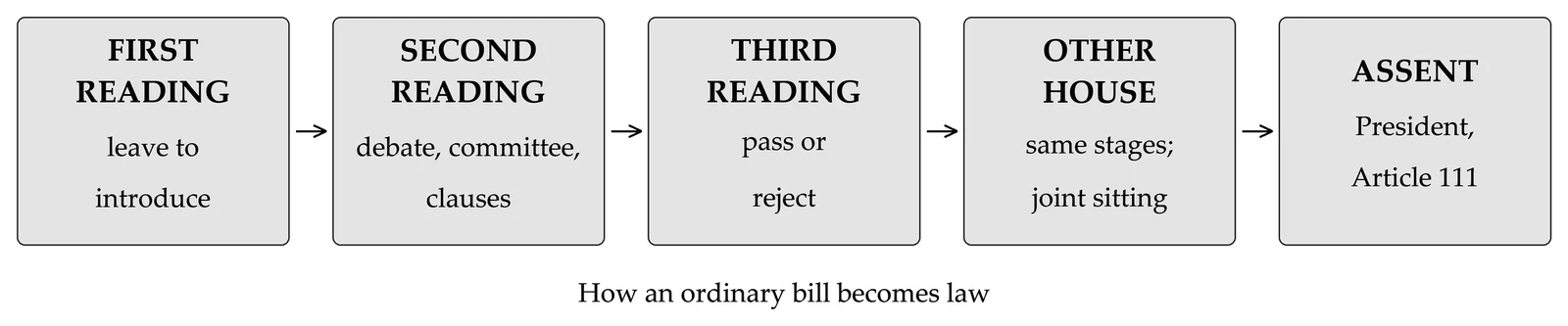
A bill is a draft of a proposed law presented to Parliament. Bills introduced by ministers are government bills, while those introduced by other members are private members’ bills, discussed mainly on Fridays; only fourteen private members’ bills have ever become law, the last in 1970. Before introduction, a government bill is drafted by the ministry concerned with the help of the Ministry of Law, approved by the Cabinet and, under the Pre-Legislative Consultation Policy of 2014, ideally published for public comment, though this is often not done.
The Stages in the First House
- First reading (introduction). The member asks for leave to introduce the bill; if granted, the title is read and the bill is published in the Gazette. There is usually no debate at this stage, though members may oppose introduction on grounds such as lack of legislative competence.
- Second reading, first stage (general discussion). The principles of the bill are debated, and the House may decide to take it into consideration at once, refer it to a select committee of the House or a joint committee of both Houses, or circulate it to elicit public opinion; bills are also often referred to the Departmentally Related Standing Committees.
- Committee stage. The committee examines the bill clause by clause, hears experts and stakeholders and reports to the House, often with amendments.
- Second reading, second stage (clause-by-clause consideration). The House considers each clause, and members move amendments, which are accepted or rejected by vote.
- Third reading. The House debates whether to pass the bill as a whole; only formal or verbal amendments are allowed, and the bill is passed or rejected.
In the Second House and Joint Sittings
The bill then goes to the other House, where it passes through the same stages. The second House may pass it as it is, pass it with amendments (which return to the first House), reject it, or take no action. If the Houses disagree, or if six months pass without the second House passing the bill, the President may summon a joint sitting under Article 108, presided over by the Speaker, where the bill is decided by a majority of members present and voting of both Houses together. Because the Lok Sabha is larger, it usually prevails. Joint sittings have been held only three times: for the Dowry Prohibition Bill (1961), the Banking Service Commission (Repeal) Bill (1978) and the Prevention of Terrorism Bill (2002).
Presidential Assent
- Assent. Under Article 111, when a bill passed by both Houses is presented to the President, he may give assent, after which it becomes an Act.
- Withholding assent. He may withhold assent, which ends the bill, though this is rare and must follow ministerial advice.
- Return for reconsideration. He may return a bill, other than a money bill, for reconsideration once; if Parliament passes it again, with or without changes, he must give assent.
- Pocket veto. Since the Constitution sets no time limit, the President can delay action; in 1986, President Zail Singh kept the Indian Post Office (Amendment) Bill pending without decision.
- Lapse of bills. When the Lok Sabha is dissolved, bills pending in it lapse, while bills pending in the Rajya Sabha that the Lok Sabha has not passed do not lapse.
2.2 Types of Bills
Ordinary Bills
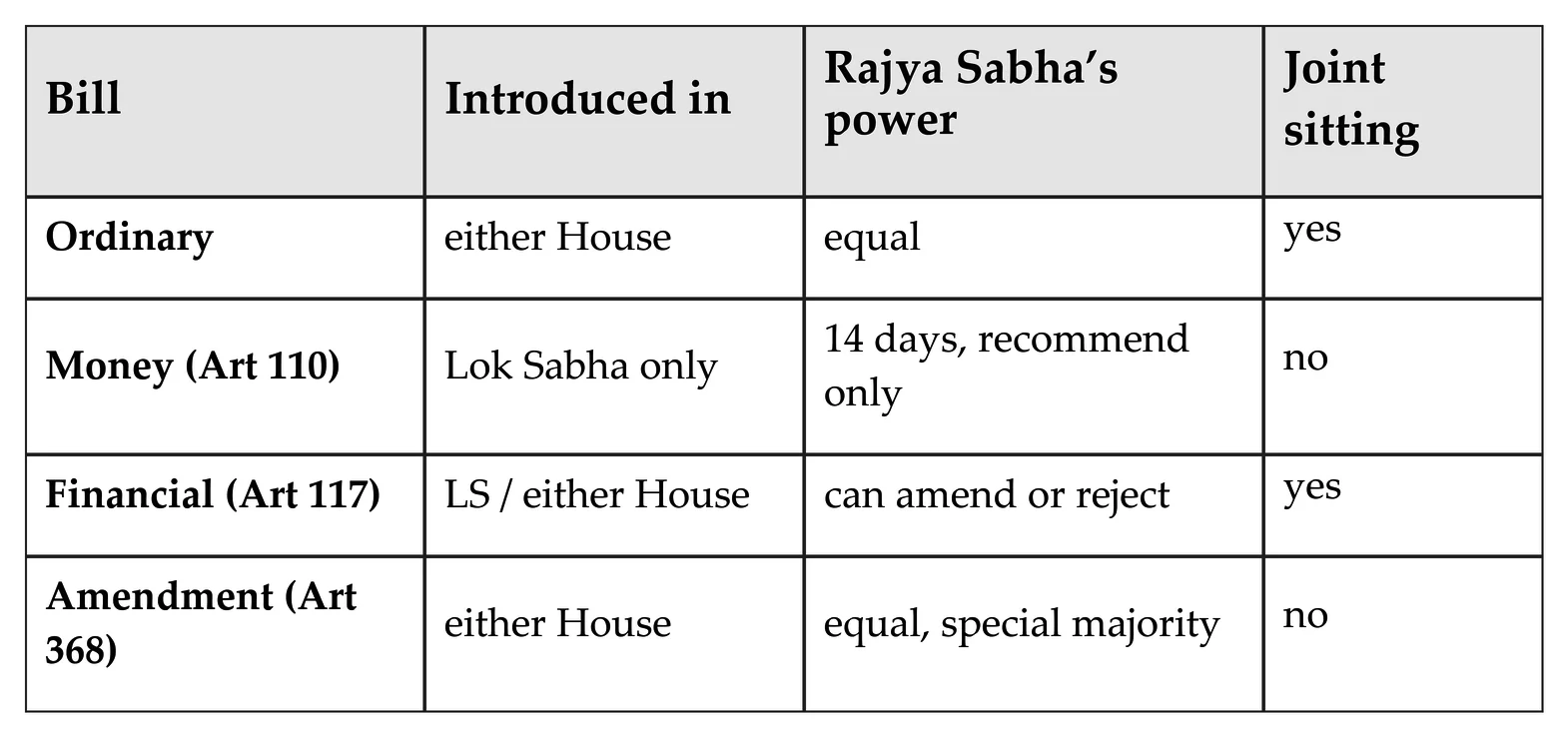
Ordinary bills deal with any matter other than finance or constitutional amendment. They can be introduced in either House, by a minister or a private member, and need a simple majority in each House. Both Houses have equal powers over them, and deadlocks are resolved by joint sittings.
Money Bills
- Definition. Under Article 110, a money bill deals only with taxation, government borrowing, the custody of the Consolidated Fund or Contingency Fund, appropriation from the Consolidated Fund, expenditure charged on it, receipts of money and related matters.
- Introduction. It can be introduced only in the Lok Sabha, only by a minister and only with the President’s recommendation.
- Role of the Rajya Sabha. The Rajya Sabha cannot reject or amend a money bill; it can only make recommendations within fourteen days, which the Lok Sabha may accept or reject.
- Speaker’s certificate. The Speaker decides whether a bill is a money bill, and the decision is final under Article 110(3).
- Assent. The President cannot return a money bill for reconsideration, since it is introduced with his recommendation.
- Controversy. The certification of the Aadhaar Act of 2016 as a money bill was upheld by the majority in Puttaswamy (2018), with Justice Chandrachud dissenting that it was a fraud on the Constitution; in Rojer Mathew (2019), the question was referred to a larger bench.
Financial Bills
Financial bills under Article 117 deal with fiscal matters but are not purely money bills. A financial bill of the first category (Article 117(1)) contains money-bill matters along with other provisions; like a money bill, it can be introduced only in the Lok Sabha with the President’s recommendation, but the Rajya Sabha can amend or reject it, and deadlocks go to a joint sitting. A financial bill of the second category (Article 117(3)) involves expenditure from the Consolidated Fund but no money-bill matters; it can be introduced in either House, but cannot be passed unless the President recommends its consideration.
Constitutional Amendment Bills
Constitutional amendment bills under Article 368 can be introduced in either House by a minister or private member without the President’s prior permission. Each House must pass them separately by a special majority, i.e. a majority of the total membership and two-thirds of members present and voting, and amendments affecting federal provisions also need ratification by half the state legislatures. There is no joint sitting for them, and since the 24th Amendment of 1971 the President must give assent.
2.3 Committees, the Opposition and Coalition Dynamics
Role of Committees in Law-Making
Parliament meets for limited days and cannot examine complex bills in detail on the floor. Committees therefore play a vital role: they examine bills clause by clause, consult experts and stakeholders, build consensus across parties away from the publicity of the floor, and suggest improvements. Since 1993, Departmentally Related Standing Committees examine bills referred to them along with the budgets of ministries. Select and joint committees examine particular bills, such as the Joint Committee on the Personal Data Protection Bill (2019–21). However, research by PRS Legislative Research shows that the share of bills referred to committees fell sharply, from a large majority in the 15th Lok Sabha (2009–14) to under a fifth in the 17th (2019–24), which critics say has weakened scrutiny.
Role of the Opposition
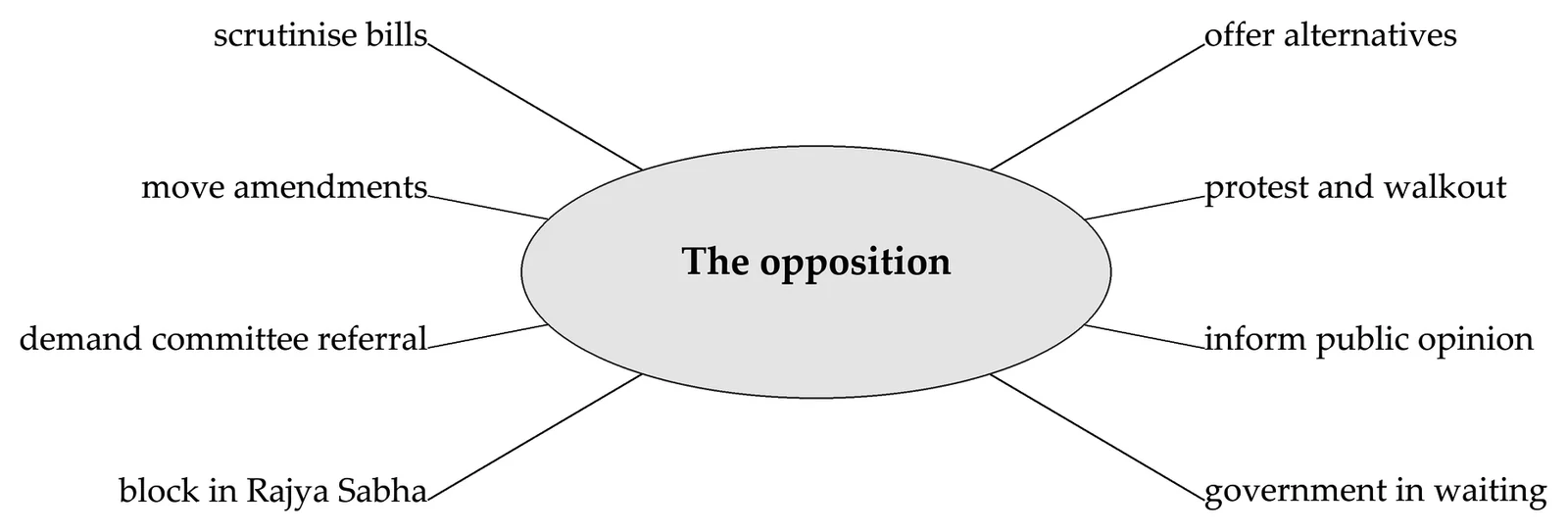
- Scrutiny. The opposition examines bills critically, exposes weaknesses and proposes amendments.
- Debate and alternatives. It presents alternative viewpoints and policies, informing public opinion.
- Delay and pressure. It can demand referral to committees and, where the government lacks a majority in the Rajya Sabha, block or amend bills.
- Protest. Walkouts and disruptions are used to draw attention to issues, though frequent disruptions reduce the time available for legislation.
- Leader of the Opposition. The Leader of the Opposition takes part in appointments to bodies such as the Central Vigilance Commission and the Lokpal; there was no recognised Leader of the Opposition in the Lok Sabha from 2014 to 2024.
Coalition Dynamics
From 1989 to 2014, coalition governments shaped law-making. Allies negotiated common minimum programmes, and bills often needed the support of regional parties, which could delay or block measures; the Women’s Reservation Bill, passed by the Rajya Sabha in 2010, lapsed because some allies opposed it, and was finally enacted in 2023. Governments without a majority in the Rajya Sabha have used ordinances under Article 123 and the money bill route to bypass it, practices criticised by the Supreme Court in cases on repeated re-promulgation of ordinances, such as D.C. Wadhwa (1987) and Krishna Kumar Singh (2017). Since 2014, single-party majorities have made law-making faster, but critics note fewer committee referrals and less debate, as when the farm laws were passed in 2020 amid protests and repealed in 2021.
2.4 Important Questions
- Question 1 Describe the stages through which an ordinary bill passes in Parliament before becoming law.
- Question 2 Distinguish between ordinary bills, money bills, financial bills and constitutional amendment bills.
- Question 3 Examine the role of parliamentary committees in the legislative process.
- Question 4 Discuss the role of the opposition and coalition dynamics in the law-making process.
DU asks the same idea in different words. So learn one broad answer for each question below; the same answer works for every question joined by OR.
Important Question 1
Describe the stages through which an ordinary bill passes in Parliament before becoming law.
OR
Explain the law-making process in the Indian Parliament.
OR
Discuss the role of the President in the law-making process.
Model Answer
“The President shall declare either that he assents to the Bill, or that he withholds assent therefrom.”
— Constitution of India, Article 111 (abridged)
Introduction. Law-making is the central function of Parliament. An ordinary bill must pass through three readings and a committee stage in each House, be agreed to by both Houses and receive the President’s assent before it becomes an Act. This detailed procedure ensures that laws are debated, examined and refined, and that both Houses and the President have a role.
1. Drafting and Consultation
A government bill is drafted by the ministry concerned, vetted by the Ministry of Law and approved by the Cabinet. Under the Pre-Legislative Consultation Policy of 2014, draft bills should be placed in the public domain for at least thirty days, though this is often not followed.
2. Government and Private Members’ Bills
Government bills are introduced by ministers and usually pass, while private members’ bills are introduced by other members on Fridays; only fourteen have become law, showing that law-making is dominated by the executive.
3. First Reading
The member seeks leave of the House to introduce the bill; once granted, its title is read and it is published in the Gazette. Debate at this stage is rare, though members may oppose introduction on constitutional grounds.
4. Second Reading: General Discussion
The House discusses the principles of the bill and decides whether to consider it at once, refer it to a select or joint committee, or circulate it for public opinion. Many bills are referred to Departmentally Related Standing Committees.
5. Committee Stage
The committee examines the bill clause by clause, takes evidence from experts and stakeholders and reports to the House with recommendations, often improving the bill through cross-party consensus.
6. Second Reading: Clause-by-Clause Consideration
The House considers each clause, and members move amendments, which are voted upon. This is the stage of detailed scrutiny on the floor of the House.
7. Third Reading
The House debates whether to pass the bill as a whole. Only formal or verbal amendments are allowed, and the bill is passed by a simple majority of members present and voting.
8. In the Other House
The bill goes to the other House, where it passes through the same stages. That House may pass it, amend it, reject it or keep it pending; amendments must be agreed to by the first House.
9. Joint Sitting
If the Houses disagree, or the second House does not pass the bill within six months, the President may summon a joint sitting under Article 108. This has happened only three times, in 1961, 1978 and 2002.
10. Presidential Assent
Under Article 111, the President may give assent, withhold it, or return the bill for reconsideration once. If Parliament passes it again, he must assent, so the President’s veto is suspensive.
11. Pocket Veto
Since no time limit is fixed, the President can keep a bill pending, as President Zail Singh did with the Indian Post Office (Amendment) Bill in 1986, an action called a pocket veto.
12. Lapse of Bills
When the Lok Sabha is dissolved, bills pending in it lapse, while bills pending in the Rajya Sabha that the Lok Sabha has not passed survive, reflecting the Rajya Sabha’s permanence.
13. Weaknesses
Critics point to declining committee referrals, bills passed with little debate, frequent disruptions and the dominance of the executive in law-making.
14. Ordinances as an Alternative Route
When Parliament is not in session, the President may issue an ordinance under Article 123 on the advice of the government. It has the force of law but must be approved by Parliament within six weeks of its reassembly. Frequent use of ordinances bypasses the normal stages of law-making and has been criticised by the Supreme Court, as in Krishna Kumar Singh (2017).
15. Delegated Legislation
Many Acts allow the executive to make detailed rules and regulations. These are laid before Parliament and examined by the Committees on Subordinate Legislation of each House, which check that the rules stay within the limits of the parent Act, so Parliament retains some control over law-making by the executive.
16. Evaluation
The law-making process is designed to combine deliberation, scrutiny and consent, but its quality depends on the use of committees and the willingness of the government and opposition to debate seriously.
Conclusion. Thus, an ordinary bill passes through introduction, general discussion, committee examination, clause-by-clause consideration and third reading in each House, with joint sittings to resolve deadlocks and the President’s assent under Article 111. This process aims to ensure careful, deliberative law-making, though declining scrutiny is a concern.
Important Question 2
Distinguish between ordinary bills, money bills, financial bills and constitutional amendment bills.
OR
What is a money bill? Discuss the controversy over the certification of money bills.
OR
Examine the role of the Rajya Sabha in financial legislation.
Model Answer
“If any question arises whether a Bill is a Money Bill or not, the decision of the Speaker of the House of the People thereon shall be final.”
— Constitution of India, Article 110(3)
Introduction. The Constitution prescribes different procedures for different kinds of bills. Ordinary bills follow the general procedure, money bills and financial bills follow special procedures that give the Lok Sabha primacy over finance, and constitutional amendment bills require special majorities. Understanding these differences is essential to understanding the balance between the two Houses.
1. Ordinary Bills
Ordinary bills deal with matters other than finance and constitutional amendment. They can be introduced in either House by any member, require a simple majority and give both Houses equal powers, with joint sittings to resolve deadlocks.
2. Definition of Money Bills
Under Article 110, a money bill contains only provisions on taxation, borrowing, the Consolidated and Contingency Funds, appropriation, charged expenditure, receipts of money and incidental matters.
3. Procedure for Money Bills
A money bill can be introduced only in the Lok Sabha by a minister with the President’s recommendation. The Rajya Sabha can only make recommendations within fourteen days, which the Lok Sabha may accept or reject.
4. The Speaker’s Certificate
The Speaker certifies whether a bill is a money bill, and this decision is final under Article 110(3). This gives the Speaker great power over the role of the Rajya Sabha in legislation.
5. The Aadhaar Controversy
The Aadhaar Act of 2016 was passed as a money bill, bypassing the Rajya Sabha. In Puttaswamy (2018), the majority upheld this, but Justice Chandrachud called it a fraud on the Constitution.
6. Later Developments
In Rojer Mathew (2019), the Supreme Court referred the question of judicial review of money bill certification to a larger bench, showing continuing concern about misuse of the procedure.
7. Financial Bills of the First Category
Under Article 117(1), a financial bill containing money-bill matters along with other provisions can be introduced only in the Lok Sabha with the President’s recommendation, but the Rajya Sabha can amend or reject it like an ordinary bill.
8. Financial Bills of the Second Category
Under Article 117(3), a bill involving expenditure from the Consolidated Fund but no money-bill matters can be introduced in either House, but cannot be passed unless the President recommends its consideration.
9. Constitutional Amendment Bills
Under Article 368, amendment bills can be introduced in either House without the President’s permission and must be passed by each House by a special majority, with state ratification for federal provisions.
10. No Joint Sitting for Amendments
If the Houses disagree on an amendment bill, it fails, since joint sittings are not allowed; this gives the Rajya Sabha equal power over constitutional change.
11. Presidential Assent
The President can return ordinary bills for reconsideration, cannot return money bills, and must give assent to constitutional amendment bills since the 24th Amendment of 1971.
12. Primacy of the Lok Sabha in Finance
The special procedures for money and financial bills reflect the principle, inherited from Britain, that the directly elected house controls the purse and the government responsible to it.
13. The Rajya Sabha’s Role
Although the Rajya Sabha cannot block money bills, it debates the budget and can delay financial bills of the first category, so it retains an important deliberative role.
14. The Budget and the Finance Bill
Every year, the Finance Bill, which gives effect to the government’s tax proposals, and the Appropriation Bill, which authorises spending from the Consolidated Fund, are passed as money bills. Under the Provisional Collection of Taxes Act, 1931, tax changes in the Finance Bill can take effect immediately, but the bill must be passed within seventy-five days.
15. Comparative Perspective
The Indian provisions follow the British Parliament Act of 1911, under which the House of Lords can delay money bills for only one month and the Speaker of the House of Commons certifies them. Unlike Britain, however, the Indian Constitution also lists the matters that a money bill may contain, which makes judicial review of certification possible.
16. Evaluation
The classification of bills balances the Lok Sabha’s financial primacy with the Rajya Sabha’s role in ordinary and constitutional legislation, but misuse of the money bill route threatens this balance.
Conclusion. Thus, ordinary bills follow the general procedure with equal powers for both Houses; money bills, certified by the Speaker, give the Lok Sabha primacy; financial bills follow intermediate procedures under Article 117; and constitutional amendment bills require special majorities in each House. The Aadhaar controversy shows why the boundaries between them matter.
Important Question 3
Examine the role of parliamentary committees in the legislative process.
OR
Why are parliamentary committees called mini-Parliaments? Discuss.
OR
Discuss the decline in committee scrutiny of bills in India.
Model Answer
“Congress in session is Congress on public exhibition, whilst Congress in its committee-rooms is Congress at work.”
— Woodrow Wilson, Congressional Government (1885)
Introduction. Parliament has limited time and its members cannot examine every bill in detail on the floor of the House. Committees, smaller groups of members drawn from different parties, therefore play a crucial role in examining bills, scrutinising government spending and building consensus. They have been called mini-Parliaments because they reflect the party composition of the House while working more deliberately.
1. Need for Committees
Bills are often technical and complex, and Parliament sits for limited days. Committees allow detailed examination by members who can specialise in particular subjects.
2. Types of Committees in Law-Making
Bills may be examined by select committees of one House, joint committees of both Houses or the Departmentally Related Standing Committees, which also examine ministries’ budgets.

3. Departmentally Related Standing Committees
Since 1993, Departmentally Related Standing Committees, each covering one or more ministries, have examined bills referred to them, demands for grants and annual reports, providing continuous scrutiny of the executive.
4. Clause-by-Clause Examination
Committees examine bills clause by clause, identify ambiguities and inconsistencies and propose amendments, which often improve the quality of laws.
5. Expert and Public Consultation
Committees invite written memoranda from the public and oral evidence from experts, officials and affected groups, bringing more voices into law-making than floor debates allow.
6. Building Consensus
Committee meetings are held in private, away from the media, so members can discuss issues on merit and reach compromises across party lines more easily than in the House.
7. Examples of Committee Work
Committees examined bills such as the Lokpal Bill and the Goods and Services Tax Bill, and the Joint Committee on the Personal Data Protection Bill (2019–21) proposed major changes, showing their influence.
8. Financial Scrutiny
Financial committees such as the Public Accounts Committee and Estimates Committee scrutinise government spending, complementing the legislative committees.
9. Recommendatory Role
Committee reports are recommendations, not binding, and the government may accept or reject them, but they carry moral weight and shape the final law.
10. Decline in Referrals
PRS Legislative Research shows that the share of bills referred to committees fell from a large majority in the 15th Lok Sabha to under a fifth in the 17th, as governments with majorities passed bills directly.
11. Consequences of Decline
Bills passed without committee scrutiny may contain errors, ignore stakeholders and face legal challenges or public protest, as with the farm laws of 2020, which were repealed in 2021.
12. Other Weaknesses
Committees often lack research staff, attendance is irregular, and their reports are rarely debated in the House, limiting their impact.
13. Reforms
Reformers suggest mandatory referral of bills to committees, more research support, public hearings and debates on committee reports, following practices in other parliaments.
14. Committees and the Rajya Sabha
Rajya Sabha members sit on Departmentally Related Standing Committees along with Lok Sabha members, and eight of the twenty-four committees are chaired by the Rajya Sabha. Committees thus give the upper House an important role in examining legislation, including bills that it cannot amend on the floor.
15. Comparison with Other Legislatures
In the United States Congress, committees can rewrite or kill bills, and in the British Parliament every government bill goes to a public bill committee after second reading. In India, referral is at the discretion of the Speaker or Chairman, which explains why the share of bills examined by committees varies so much between Lok Sabhas.
16. Evaluation
Committees are the workshops of Parliament where detailed law-making takes place, and strengthening them is essential for good legislation and executive accountability.
Conclusion. Thus, parliamentary committees examine bills in detail, consult experts and the public, build consensus and scrutinise spending, acting as mini-Parliaments where, as Woodrow Wilson said, the legislature is at work. The decline in referrals since 2014 has weakened scrutiny, making their revival an important reform.
Important Question 4
Discuss the role of the opposition and coalition dynamics in the law-making process.
OR
How do coalition governments affect law-making in India?
OR
Examine the role of the opposition in a parliamentary democracy.
Model Answer
“No government can be long secure without a formidable Opposition.”
— Benjamin Disraeli, Coningsby (1844)
Introduction. Law-making in a parliamentary democracy is shaped not only by procedures but also by political forces: the strength of the government, the role of the opposition and, in times of coalition, the bargaining among allies. In India, the coalition era of 1989–2014 and the period of single-party majorities since 2014 have shown different patterns of law-making.
1. Meaning of the Opposition
The opposition consists of parties not in government. In a parliamentary system, it acts as a government in waiting, scrutinising and criticising the government and offering alternatives.
2. Scrutiny of Bills
The opposition examines bills critically, exposes their weaknesses and moves amendments, improving legislation even when its amendments are defeated.
3. Demanding Committee Referral
The opposition often demands that bills be sent to committees for detailed examination, which can lead to better laws and broader consensus.
4. Power in the Rajya Sabha
When the government lacks a majority in the Rajya Sabha, the opposition can block or amend bills, as happened with the Land Acquisition Amendment Bill in 2015, which the government eventually abandoned.
5. Protest and Disruption
Walkouts and protests draw public attention, but frequent disruptions reduce the time for debate and lead to bills being passed without discussion.
6. The Leader of the Opposition
The Leader of the Opposition leads criticism of the government and sits on committees for key appointments. There was no recognised Leader of the Opposition in the Lok Sabha from 2014 to 2024, which critics said weakened institutional checks.
7. Coalition Governments
From 1989 to 2014, no party won a Lok Sabha majority, and coalitions governed, requiring the agreement of allies for legislation.
8. Common Minimum Programmes
Coalitions negotiated common minimum programmes, such as the UPA’s programme of 2004, which led to laws on rural employment (2005), right to information (2005) and education (2009).
9. Allies as Veto Players
Allies could delay or block bills they opposed; the Women’s Reservation Bill, passed by the Rajya Sabha in 2010, lapsed due to opposition from some parties and was enacted only in 2023.
10. Ordinances and Money Bills
Governments facing opposition in the Rajya Sabha have used ordinances under Article 123 and the money bill route. The Supreme Court criticised repeated re-promulgation of ordinances in D.C. Wadhwa (1987) and Krishna Kumar Singh (2017).
11. Single-Party Majorities
Since 2014, majority governments have passed laws quickly, but critics note fewer committee referrals, short debates and the passage of bills amid protests.
12. The Farm Laws Example
The three farm laws of 2020 were passed by voice vote in the Rajya Sabha amid opposition protests, faced a year-long farmers’ agitation and were repealed in 2021, showing the costs of law-making without consensus.
13. Balance between Efficiency and Deliberation
Coalitions slowed law-making but encouraged consultation, while majorities speed it up but risk weaker scrutiny; good law-making needs both efficiency and deliberation.
14. The Opposition in Committees
Opposition members chair several committees, including the Public Accounts Committee, which by convention since 1967 is chaired by a member of the opposition. Inside committees, government and opposition members often work together on reports, showing that the opposition’s role extends beyond confrontation on the floor.
15. Coalitions and Federalism
Coalition governments gave regional parties influence over national legislation and policies affecting states, strengthening federalism. Laws such as the Goods and Services Tax, enacted through the 101st Amendment of 2016, required broad agreement among parties ruling different states, showing the continued need for consensus.
16. Evaluation
A strong opposition and a deliberative culture are as important as a stable government for good law-making, whether in coalition or majority periods.
Conclusion. Thus, the opposition scrutinises bills, demands committee referral, uses its strength in the Rajya Sabha and protests to influence law-making, while coalitions required consensus among allies through common minimum programmes. Since 2014, majority governments have legislated faster but with less scrutiny, showing that, as Disraeli said, a formidable opposition is essential to good government.
Short Notes
(a) Joint sitting
A sitting of both Houses of Parliament summoned by the President under Article 108 to resolve a deadlock on an ordinary bill; it has been held only three times, in 1961, 1978 and 2002.
(b) Money bill
A bill dealing only with taxation, borrowing, the Consolidated Fund and related matters, which can be introduced only in the Lok Sabha and which the Rajya Sabha can delay for only fourteen days.
(c) Pocket veto
The President’s ability to delay action on a bill indefinitely because the Constitution sets no time limit, as President Zail Singh did in 1986.
(d) Private member’s bill
A bill introduced by a member of Parliament who is not a minister, usually discussed on Fridays; only fourteen such bills have become law, the last in 1970.
More notes: GE-12 Parliamentary Procedures and Practices
These notes are prepared by PADHO TO AISE for study help. They are not an official publication.