
Semester IV DSC-11 Concepts in Comparative Political Analysis
Unit V · 31 min read · Updated 24 Nov 2026
As per the University of Delhi (DU) BA (Hons) Political Science syllabus
Contents
- 5.1 State and Regime: Concepts and Types
- 5.2 The Capitalist State
- 5.3 The Welfare State
- 5.4 Populism and the Populist State
- 5.5 The Security State
- 5.6 Important Questions
- Discuss the nature of the capitalist state with reference to Ralph Miliband.
- What is a welfare state? Discuss its origins, types and challenges.
- What is populism? Discuss its main features and its relationship with democracy.
- Discuss the evolution of the security state. How does the surveillance state affect liberty?
- Distinguish between authoritarian and totalitarian regimes. Discuss the types of authoritarian regimes.
- Short Notes
आधुनिक राज्य की कार्यपालिका पूरे बुर्जुआ वर्ग के साझा मामलों का प्रबंधन करने वाली एक समिति मात्र है।
The executive of the modern state is but a committee for managing the common affairs of the whole bourgeoisie.
— Karl Marx and Friedrich Engels, The Communist Manifesto (1848)
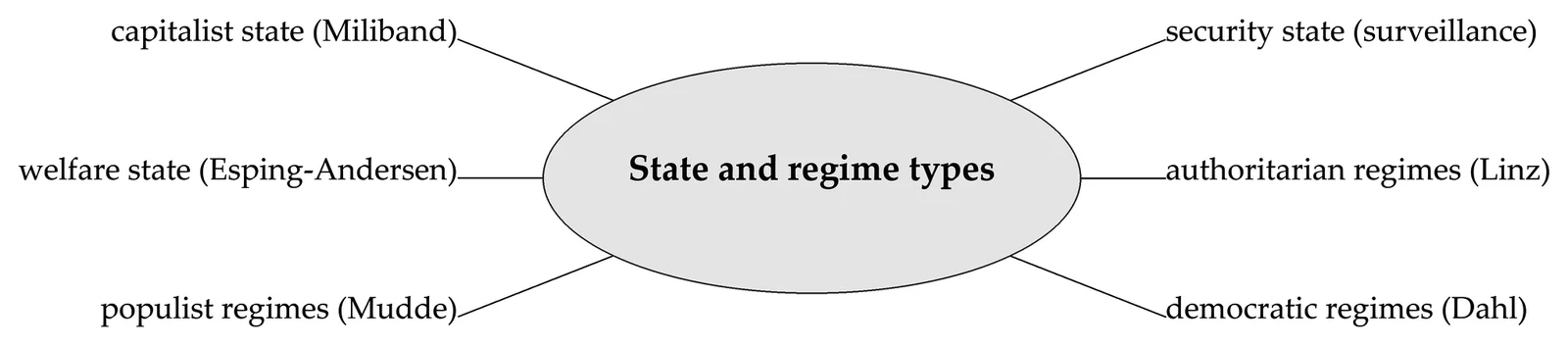
THE modern state is the most powerful organisation in human history, but states differ greatly in what they do and how they rule. Some protect property and markets above all; some guarantee citizens education, health care and pensions; some are led by leaders who claim to speak for ‘the people’ against ‘the elite’; and some give priority to security, surveillance and emergency powers. This unit studies these types of state, the capitalist, welfare, populist and security state, together with the main regime types, democratic, authoritarian and totalitarian, that comparative politics uses to classify how states are governed.
5.1 State and Regime: Concepts and Types
The state is a political association that claims sovereign authority over a territory and its people, with permanent institutions such as the bureaucracy, army, police and courts. A regime is the set of rules, institutions and practices that determine how power is acquired and exercised: governments change at elections, but the regime, for example a parliamentary democracy, persists. Rod Hague and Martin Harrop, discussing the state in a global context, note that states face pressure from globalisation, international organisations and transnational forces, yet remain the central units of world politics; Mark Kesselman similarly argues that globalisation reshapes rather than abolishes the state.
Regime types
- Democratic regimes: free and fair elections, civil liberties and the rule of law; Robert Dahl called real-world democracies polyarchies, based on participation and contestation.
- Authoritarian regimes: Juan Linz defined them as systems with limited, not responsible, political pluralism, without an elaborate guiding ideology, without intensive mass mobilisation, in which a leader or small group exercises power within ill-defined but predictable limits. Natasha Lindstaedt classifies them as monarchies, military regimes, single-party regimes and personalist regimes, and notes the spread of hybrid or competitive authoritarian regimes that hold elections but tilt the playing field.
- Totalitarian regimes: Carl Friedrich and Zbigniew Brzezinski (1956) listed six features: an official ideology, a single mass party usually led by one man, terroristic police control, monopoly of communications, monopoly of weapons and a centrally directed economy. Hannah Arendt (The Origins of Totalitarianism, 1951) saw terror and ideology as their essence. E. Webb shows how totalitarianism seeks to control all of social life, whereas authoritarianism leaves some areas autonomous.
5.2 The Capitalist State
The idea of the capitalist state comes from Marxist theory, which holds that the state in a capitalist society serves to protect private property and reproduce the conditions for capital accumulation. Ralph Miliband, in The State in Capitalist Society (1969), tested the liberal pluralist claim that power is widely dispersed. He showed that in Western democracies the state elite, senior civil servants, judges, military officers and ministers, comes largely from the same upper and middle classes as the economic elite, shares its outlook and is tied to it through education, family and careers. Business also enjoys superior resources for lobbying and influence over the media. The state, therefore, though not a simple tool, acts in the interests of the capitalist class. This view is called instrumentalist.
Nicos Poulantzas replied in the famous Miliband–Poulantzas debate (1969–70) that the class background of officials is irrelevant. The capitalist state is structurally bound to serve capital whoever runs it, because it must maintain social cohesion and economic growth. It has relative autonomy from particular capitalists, which allows it to make concessions to workers and to organise the long-term interests of capital as a whole. Fred Block and Claus Offe added that governments depend on business confidence and tax revenues, and Charles Lindblom, in Politics and Markets (1977), argued that business occupies a privileged position in market democracies. Pluralists reply that elections, interest groups and labour movements give other classes real influence.
5.3 The Welfare State
A welfare state is a state that takes responsibility for the basic well-being of its citizens through social insurance (pensions, unemployment and sickness benefits), social assistance for the poor, and public services such as health care, education and housing. David Garland, in The Welfare State: A Very Short Introduction (2016), argues that it is not simply charity for the poor but a basic institutional feature of all modern capitalist societies, which manages economic risks and governs the market economy. Kees van Kersbergen and Philip Manow trace its rise from the late nineteenth century.
- Origins: Bismarck introduced social insurance in Germany in the 1880s partly to weaken socialism; Britain’s Liberal reforms followed after 1906.
- Expansion: the Beveridge Report (1942) proposed to attack the five giants of Want, Disease, Ignorance, Squalor and Idleness, leading to the National Health Service (1948); Keynesian policies aimed at full employment.
- Social citizenship: T.H. Marshall, in Citizenship and Social Class (1950), saw social rights as the third stage of citizenship after civil and political rights.
- Three worlds: Gøsta Esping-Andersen classified welfare regimes by decommodification, the degree to which people can live without depending on the market: liberal (means-tested, market-based: USA, UK), conservative (status-based social insurance tied to work: Germany, France) and social democratic (universal and generous: Sweden, Norway).
- Crisis and retrenchment: from the 1970s, slow growth, ageing populations, globalisation and neo-liberal ideas led to cuts and reforms; Paul Pierson (1994) found, however, that welfare states proved resilient because benefits create supportive constituencies.
- Criticisms: the New Right claimed it caused dependency and inefficiency; Marxists such as James O’Connor (1973) pointed to the fiscal crisis of the state; feminists criticised its male-breadwinner assumptions.

Kenneth Newton and Jan van Deth note that welfare spending varies widely across democracies, reflecting differences in party politics, trade union strength and political culture. In India, the Directive Principles commit the state to welfare, and rights-based laws such as MGNREGA (2005), the Right to Education Act (2009) and the National Food Security Act (2013) have expanded social protection.
5.4 Populism and the Populist State
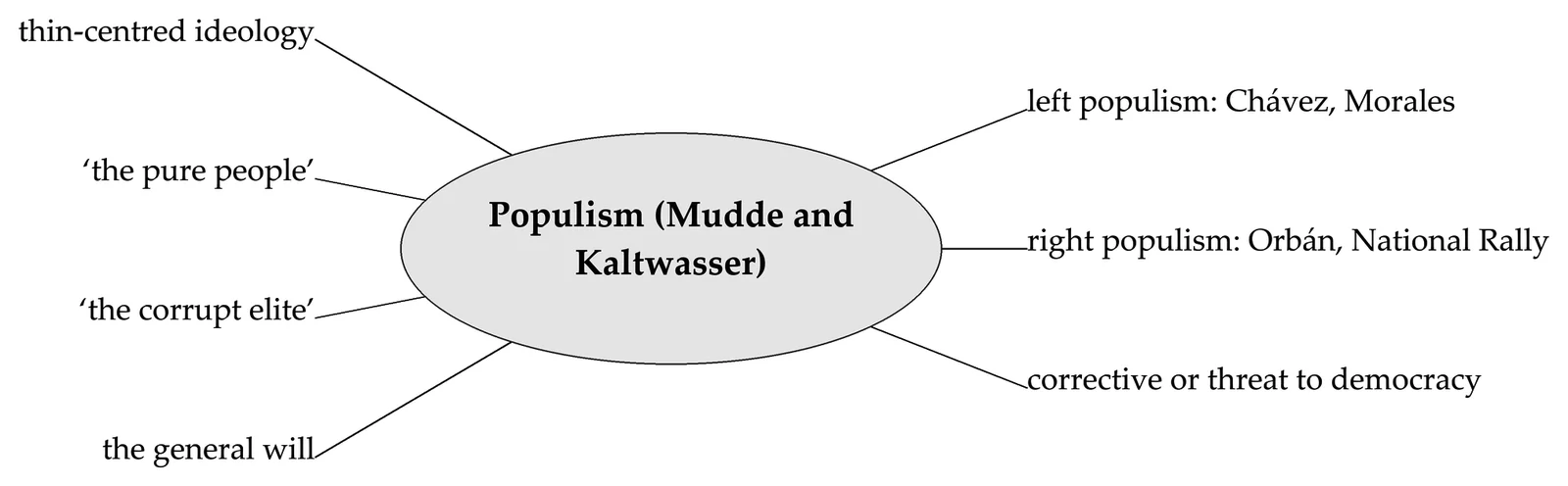
Cas Mudde and Cristóbal Rovira Kaltwasser, in Populism: A Very Short Introduction (2017), define populism as a thin-centred ideology that considers society to be separated into two homogeneous and antagonistic camps, ‘the pure people’ versus ‘the corrupt elite’, and argues that politics should be an expression of the general will of the people. Because it is thin-centred, populism attaches itself to fuller ideologies, producing left-wing populism, which defines the people in economic terms against the rich, and right-wing populism, which defines the people in national or cultural terms against immigrants and minorities.
- North America: the People’s Party of the 1890s defended farmers against banks and railways; Donald Trump’s campaigns revived anti-elite nationalism.
- Latin America: classic populists such as Juan Perón in Argentina built mass movements of workers; later leaders such as Hugo Chávez in Venezuela and Evo Morales in Bolivia promoted inclusionary left-wing populism.
- Europe: radical right parties such as France’s National Rally and Viktor Orbán’s Fidesz in Hungary combine populism with nativism, while Syriza in Greece and Podemos in Spain represent left populism.
- Populist regimes in power: populist governments often attack independent courts, media and electoral bodies as obstacles to the people’s will, concentrate power in the leader and rewrite constitutions.
- Populism and democracy: Mudde and Kaltwasser argue that populism can be a corrective, giving voice to excluded groups and raising neglected issues, but also a threat, because it rejects pluralism and the protection of minorities.
5.5 The Security State
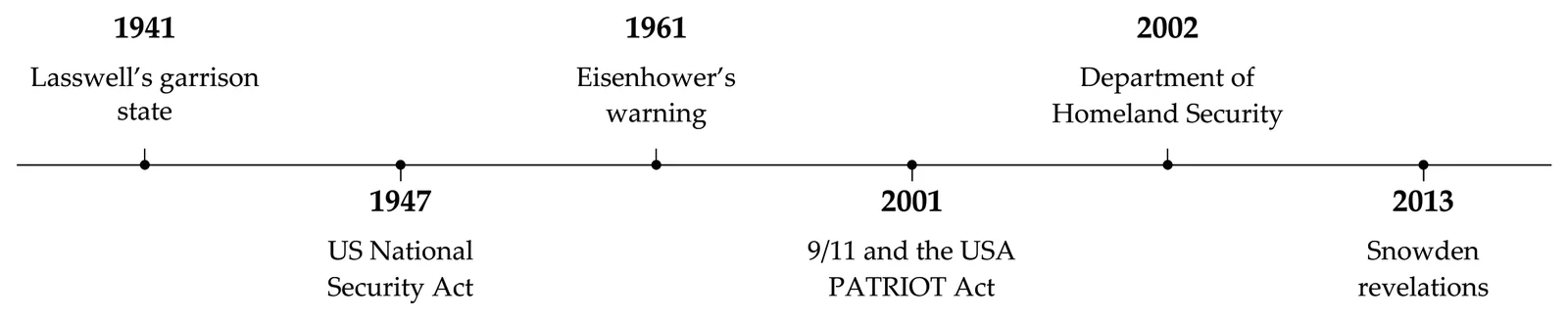
The security state, or national security state, is a state in which national security becomes the organising priority, justifying large military and intelligence establishments, secrecy, surveillance and emergency powers. Harold Lasswell warned in 1941 of a garrison state dominated by specialists in violence. During the Cold War, the US National Security Act (1947) created the National Security Council and the CIA and unified the armed services, building what Andreas Busch describes as the architecture of the national security state. Bruce Mabee shows that the provision of security has evolved from the territorial defence of the state to new forms shaped by globalisation, including privatised security and transnational threats such as terrorism.
After the attacks of 11 September 2001, the USA PATRIOT Act (2001) and the Department of Homeland Security (2002) expanded surveillance and detention powers, and many democracies passed similar laws. Paul Rosenzweig examines the surveillance state created by big data, in which governments can collect and analyse vast amounts of personal information; Edward Snowden’s revelations (2013) exposed the mass collection of communications data by the US National Security Agency. The central debate is whether security and liberty must be traded off. Giorgio Agamben warned that the state of exception has become a permanent technique of government, while the Copenhagen School explains how issues are securitised, removed from normal politics by being presented as existential threats. In India, laws such as AFSPA (1958) and UAPA (1967) raise similar questions.
5.6 Important Questions
- Question 1 Discuss the nature of the capitalist state with reference to Ralph Miliband.
- Question 2 What is a welfare state? Discuss its origins, types and challenges.
- Question 3 What is populism? Discuss its main features and its relationship with democracy.
- Question 4 Discuss the evolution of the security state. How does the surveillance state affect liberty?
- Question 5 Distinguish between authoritarian and totalitarian regimes. Discuss the types of authoritarian regimes.
DU asks the same idea in different words. So learn one broad answer for each question below; the same answer works for every question joined by OR.
Important Question 1
Discuss the nature of the capitalist state with reference to Ralph Miliband.
OR
Examine the Miliband–Poulantzas debate on the capitalist state.
OR
‘The state in capitalist society serves the interests of the dominant class.’ Discuss.
Model Answer
“The executive of the modern state is but a committee for managing the common affairs of the whole bourgeoisie.”
— Karl Marx and Friedrich Engels, The Communist Manifesto (1848)
Introduction. Who does the state serve in a capitalist democracy? Liberal pluralists argue that power is dispersed among many competing groups and the state is a neutral arbiter. Marxists argue that the state in capitalist society is a capitalist state, which protects private property and the interests of the dominant class. Ralph Miliband’s The State in Capitalist Society (1969) revived this debate and provoked a famous exchange with Nicos Poulantzas.
1. Marx and Engels on the State
Marx and Engels saw the state as an instrument of class rule that arises from class conflict. In the Communist Manifesto they described the executive of the modern state as a committee for managing the common affairs of the bourgeoisie. Elsewhere, as in The Eighteenth Brumaire of Louis Bonaparte (1852), Marx recognised that the state could acquire some independence when classes were evenly balanced.
2. Miliband’s Challenge to Pluralism
Miliband wrote against pluralist theorists such as Robert Dahl, who argued that power in Western democracies is competitive and widely shared. He set out to show empirically that a dominant economic class exists, owning and controlling a large share of wealth, and that this class exercises decisive influence over the state, despite elections and competing interest groups. He accepted that Western states are democratic in form, with elections, parties and civil liberties, but argued that these formal freedoms coexist with a deep inequality of power rooted in the ownership of property.
3. The State System
Miliband distinguished the government from the wider state system: the administration, the military and police, the judiciary, sub-central governments and parliamentary assemblies. Power lies with the state elite that occupies the top positions in these institutions, not just with elected ministers. Real decisions are often made by permanent officials who are not accountable to voters.
4. Social Background of the State Elite
Miliband showed that senior civil servants, judges, military officers and many ministers come disproportionately from the upper and middle classes, attend the same elite schools and universities, and move between government and business. Sharing a common social background and outlook with the business class, they naturally see the national interest as identical with the health of capitalist enterprise. He did not claim a conspiracy; rather, shared assumptions led officials to treat the needs of business as the needs of the nation.
5. Business Influence and Ideology
Business has unequal resources for lobbying, funding parties and shaping public opinion through ownership of the media and advertising. Miliband also stressed the role of legitimation: education, religion and the mass media spread ideas that present capitalism as natural and the only possible system, which he called a process of political socialisation.

6. Constraints on Reformist Governments
Even social democratic governments that wish to reform capitalism face pressure from business confidence, capital flight and the bureaucracy. Miliband argued that this is why labour and socialist parties in power often moderate their programmes and end up managing capitalism rather than transforming it. The experience of the British Labour governments and the French Socialists in the early 1980s, who reversed radical programmes under market pressure, is often cited as illustrating this argument.
7. Poulantzas’s Structuralist Critique
Nicos Poulantzas criticised Miliband for focusing on individuals and their backgrounds, which he saw as a concession to pluralist methods. For Poulantzas the capitalist state serves capital because of its objective structural position, whatever the class origin of its personnel. Its function is to maintain the cohesion of a class-divided society and organise the dominant class, which is divided into competing fractions.
8. Relative Autonomy
Poulantzas argued that the state has relative autonomy from particular capitalists. This allows it to act against the short-term interests of some businesses, for example by introducing welfare or regulation, in order to secure the long-term interests of capitalism as a whole and to win the consent of the working class.
9. Later Contributions
Fred Block argued that state managers depend on business confidence and tax revenue, so they promote accumulation without being instructed by capitalists. Claus Offe and James O’Connor showed that the capitalist state faces contradictions between accumulation and legitimation. Charles Lindblom, a former pluralist, conceded that business occupies a privileged position in market democracies. Bob Jessop later described the state as a social relation whose policies depend on the balance of class forces and political strategies at a given time.
10. Evaluation
Pluralists reply that trade unions, social movements and elections have won real gains, such as welfare states and labour rights, showing that the state is not merely an instrument of capital. Others note that globalisation has increased the structural power of mobile capital over national states. The debate remains central to understanding the relationship between democracy and capitalism. For comparative politics the debate is useful because it shows that the character of a state cannot be read only from its constitution; it must also be studied in relation to the economic structure in which it operates.
Conclusion. Thus, Miliband showed that the state in capitalist society is closely linked to the dominant class through personnel, influence and ideology, while Poulantzas showed that its capitalist character is built into its structure. Together they explain why democratic states operate within the limits set by capitalism.
Important Question 2
What is a welfare state? Discuss its origins, types and challenges.
OR
Explain Esping-Andersen’s three worlds of welfare capitalism.
OR
Is the welfare state in crisis? Discuss.
Model Answer
“Want is one only of five giants on the road of reconstruction and in some ways the easiest to attack. The others are Disease, Ignorance, Squalor and Idleness.”
— William Beveridge, Social Insurance and Allied Services (1942)
Introduction. The welfare state is one of the defining achievements of twentieth-century politics. It refers to a state that accepts responsibility for protecting citizens against the risks of illness, unemployment, old age and poverty, and for providing basic services such as education and health care. Welfare states differ widely in their design and generosity, and since the 1970s they have faced pressures for reform.
1. Meaning
A welfare state uses public resources to guarantee citizens a minimum standard of living and security. Its main instruments are social insurance financed by contributions, social assistance for those in need, universal public services and policies for full employment. David Garland argues that the welfare state is not only aid to the poor but a basic feature of how all modern capitalist societies are governed, managing risks that markets cannot handle. In this sense the welfare state protects the middle classes as well as the poor, which helps explain its broad political support.
2. Origins
Kersbergen and Manow trace the welfare state to industrialisation, urbanisation and the rise of the working class. In Germany, Bismarck introduced health insurance (1883), accident insurance (1884) and old-age pensions (1889) to strengthen loyalty to the state and undercut socialism. Britain introduced old-age pensions (1908) and national insurance (1911), and the New Deal in the USA responded to the Great Depression.
3. The Post-war Expansion
The Beveridge Report (1942) proposed a comprehensive system of social security to defeat Want, Disease, Ignorance, Squalor and Idleness. After 1945 Britain created the National Health Service (1948), and across Western Europe welfare states expanded alongside Keynesian economic management, full employment and strong trade unions, in what is often called the golden age of the welfare state.
4. Social Citizenship
T.H. Marshall argued that citizenship developed in three stages: civil rights in the eighteenth century, political rights in the nineteenth and social rights in the twentieth. Social rights, from a modicum of economic welfare to the right to share in the full social heritage, made equal citizenship meaningful in a class-divided society.
5. Esping-Andersen’s Three Worlds
Esping-Andersen classified welfare regimes by decommodification, the extent to which citizens can maintain a decent life independently of the market, and by their effects on social stratification. Liberal regimes, such as the USA and UK, offer modest, means-tested benefits and encourage private provision. Conservative or corporatist regimes, such as Germany and France, provide social insurance linked to occupation and preserve status differences, often supporting the traditional family. Social democratic regimes, such as Sweden and Norway, provide universal, generous benefits and promote equality.
6. Other Welfare Models
Scholars have added a Southern European model, with strong family support and fragmented benefits, and an East Asian productivist model, in which welfare serves economic growth. Newton and van Deth show that differences in welfare spending reflect the strength of left parties and unions, religious traditions and political institutions. Garland notes that all rich democracies are welfare states in this broad sense; what differs is the mix of public, market and family provision.
7. The Crisis Debate
From the 1970s, slow growth, oil shocks and high unemployment strained welfare budgets. The New Right, inspired by Hayek and Friedman, argued that welfare caused dependency, high taxes and inefficiency. Marxists such as James O’Connor argued that the state faced a fiscal crisis because it had to support both accumulation and legitimation. Critics on the left, such as Claus Offe, observed the paradox that capitalism cannot coexist with the welfare state, yet neither can it exist without it.
8. Retrenchment and Resilience
Governments such as Thatcher’s and Reagan’s attempted to cut welfare. Paul Pierson found, however, that welfare states proved resilient, because programmes create large constituencies of beneficiaries who resist cuts. Instead of dismantling, many countries recalibrated welfare, tightening eligibility, privatising some services and promoting activation policies that push people into work.
9. New Challenges
Kersbergen and Manow highlight new pressures: globalisation and tax competition, ageing populations, post-industrial labour markets with insecure jobs, migration and new social risks such as single parenthood and long-term care. Feminist scholars criticised the male-breadwinner model and pushed for childcare and parental leave.
10. Welfare in Developing Countries
In developing countries, large informal sectors limit social insurance. India has combined Directive Principles with rights-based programmes such as MGNREGA, the Right to Education and the National Food Security Act, along with direct benefit transfers. Debates continue on whether universal basic services or targeted cash transfers are the best path.
Conclusion. Thus, the welfare state grew from social insurance in Bismarck’s Germany to comprehensive systems of social citizenship. It takes liberal, conservative and social democratic forms, and while it faces serious challenges, it remains a central institution of modern states.
Important Question 3
What is populism? Discuss its main features and its relationship with democracy.
OR
Examine populist regimes around the world with reference to Mudde and Kaltwasser.
OR
Is populism a corrective or a threat to democracy? Discuss.
Model Answer
“Populism is a thin-centered ideology that considers society to be ultimately separated into two homogeneous and antagonistic camps, ‘the pure people’ versus ‘the corrupt elite’.”
— Cas Mudde and Cristóbal Rovira Kaltwasser, Populism: A Very Short Introduction (2017)
Introduction. Populism has become one of the most discussed phenomena in contemporary politics. From Latin America to Europe, the United States and Asia, leaders and parties claiming to speak for the ordinary people against corrupt elites have won elections and transformed political systems. Cas Mudde and Cristóbal Rovira Kaltwasser offer the most widely used definition and survey populism around the world.
1. Approaches to Populism
Scholars have understood populism in different ways: as a political strategy used by charismatic leaders to mobilise mass support directly, as a style of communication that is simple, emotional and anti-elitist, and, in the approach of Mudde and Kaltwasser, as an ideology. Ernesto Laclau saw populism as a political logic that constructs ‘the people’ by uniting diverse demands against a common enemy.
2. The Ideational Definition
Mudde and Kaltwasser define populism as a thin-centred ideology that divides society into two homogeneous and antagonistic camps, the pure people and the corrupt elite, and holds that politics should express the general will of the people. Because it is thin, populism cannot stand alone; it combines with host ideologies such as socialism or nationalism, producing very different populisms.
3. The People
The people is a flexible construction. It can mean the sovereign people as the source of power, the common people defined by class or status, or the nation defined by culture or ethnicity. Populists claim to represent the people as a single, morally pure unit, ignoring its internal diversity. This moral claim is what makes populism anti-pluralist: those who disagree are not seen as legitimate opponents but as part of the elite or enemies of the people.
4. The Elite and the General Will
The elite is defined morally as corrupt, whether politicians, big business, intellectuals, the media or foreign powers. Populists claim that elites have betrayed the people. Drawing on Rousseau’s idea of the general will, they argue that the people’s will is obvious and that intermediaries such as courts, experts and parliaments should not obstruct it. This explains the populist preference for referendums and plebiscites, which seem to let the people decide directly without the mediation of representatives.
5. Left and Right Populism
Left-wing or inclusionary populism, common in Latin America, defines the people in socio-economic terms and seeks to include the poor and indigenous groups, as under Hugo Chávez in Venezuela and Evo Morales in Bolivia. Right-wing or exclusionary populism, common in Europe, defines the people in national or cultural terms and targets immigrants and minorities, as in France’s National Rally or Hungary’s Fidesz.
6. Populism around the World
In the USA the People’s Party of the 1890s represented farmers against banks and railroads, and later movements and leaders, including Donald Trump, used anti-elite rhetoric. In Latin America, classic populists such as Perón and Vargas mobilised urban workers, and neo-liberal populists such as Fujimori in Peru appeared in the 1990s. Populist parties have also grown in Central and Eastern Europe, Asia and Africa.
7. Populist Leaders and Mobilisation
Many populist movements are led by charismatic leaders who claim a direct bond with the people, bypassing parties and institutions. Some rely on social movements, and others on loosely organised parties. Social media has made direct communication between leaders and followers easier. Jan-Werner Müller stresses that populists claim a moral monopoly of representation: only they truly represent the people.
8. Populism as a Corrective
Mudde and Kaltwasser argue that populism can act as a corrective for democracy. It can give voice to groups ignored by established parties, raise issues such as inequality, corruption or immigration that elites avoid, increase political participation and make politics more responsive.
9. Populism as a Threat
At the same time, populism can threaten liberal democracy. Because it sees the people as homogeneous and the elite as illegitimate, it rejects pluralism and the legitimacy of opposition. In power, populists may weaken courts, the media, electoral commissions and minority rights, as in Hungary after 2010 and Venezuela under Chávez and Maduro, leading to competitive authoritarianism.
10. Populism in Asia and India
Populist leaders and parties have also appeared in Asia, for example Thaksin Shinawatra in Thailand and Rodrigo Duterte in the Philippines. In India, scholars have discussed populist styles in the welfare schemes and direct appeals of leaders across parties, and in campaigns that contrast the honest common people with corrupt or elitist rivals. Such cases show that populism is a global phenomenon that adapts to local cultures and party systems.
11. Responses to Populism
Mudde and Kaltwasser suggest that liberal democrats should engage with populist voters and address their grievances rather than simply exclude populist parties. Strengthening institutions, civic education and responsive politics may reduce the appeal of populism without suppressing legitimate demands.
Conclusion. Thus, populism is a thin-centred ideology that pits the pure people against the corrupt elite. It takes left and right forms across the world and can both correct and threaten democracy, depending on whether it respects pluralism and constitutional limits.
Important Question 4
Discuss the evolution of the security state. How does the surveillance state affect liberty?
OR
Examine the changing architecture of the national security state.
OR
‘Security and liberty need not be opposed.’ Discuss with reference to the surveillance state.
Model Answer
“They who can give up essential liberty to obtain a little temporary safety deserve neither liberty nor safety.”
— Benjamin Franklin, Pennsylvania Assembly (1755)
Introduction. Providing security is the oldest function of the state. Thomas Hobbes argued that people give up their natural liberty to a sovereign to escape a life that is nasty, brutish and short. But when national security becomes the overriding priority, the state may grow large military and intelligence agencies, act in secrecy and limit freedoms. The security state and its modern form, the surveillance state, raise central questions about liberty and democracy.
1. Meaning of the Security State
A security state, or national security state, is a state in which security concerns dominate policy and institutions. It is marked by large standing militaries and intelligence services, secrecy, emergency powers, and the expansion of surveillance. Bruce Mabee treats it as a stage in the evolution of the state’s role as a provider of security. Its logic is that external and internal threats are so serious that ordinary politics and legal limits must sometimes give way.
2. Historical Evolution
Early modern states developed standing armies and police to monopolise violence, as Weber emphasised. The two world wars created mass armies and total mobilisation of society. Harold Lasswell warned in 1941 of the garrison state, a world in which specialists in violence would become the most powerful group in society.
3. The Cold War National Security State
In the United States, the National Security Act of 1947 created the National Security Council and the CIA and unified the military establishment. The Cold War produced permanent mobilisation, nuclear arsenals, a large defence industry, which President Eisenhower in 1961 called the military-industrial complex, and domestic loyalty programmes. Andreas Busch shows how this architecture shaped the modern Western state.
4. After the Cold War
With the end of the Cold War, threats were redefined to include terrorism, organised crime, drugs, migration and cyber attacks. Mabee shows that globalisation transformed security provision: states increasingly cooperate internationally, rely on private military and security companies and target non-state actors rather than other states.
5. The Impact of 9/11
The attacks of 11 September 2001 led to the USA PATRIOT Act (2001), which expanded surveillance and detention powers, the creation of the Department of Homeland Security (2002), the detention camp at Guantánamo Bay and the global war on terror. Many other states, including the UK and India, passed new anti-terror laws. Practices such as extraordinary rendition and harsh interrogation were later criticised by courts and human rights bodies as violations of international law.
6. The Surveillance State
Paul Rosenzweig examines how digital technology and big data have created a surveillance state. Governments can collect and analyse vast amounts of information on communications, travel, finances and online activity. Edward Snowden’s revelations in 2013 showed that the US National Security Agency collected telephone metadata in bulk and accessed data from internet companies.
7. Security versus Liberty
Critics argue that mass surveillance violates privacy, chills free speech and association, and can be used against journalists, activists and minorities. Rosenzweig asks whether security and liberty must be traded off, and suggests that well-designed legal limits and oversight can protect both, while badly designed policies may deliver neither security nor liberty. Supporters of surveillance reply that intelligence gathered in this way has helped prevent terrorist attacks and that modern threats require modern tools.
8. Theories of Exception and Securitisation
Giorgio Agamben argued that the state of exception, in which normal law is suspended in the name of emergency, has become a permanent paradigm of government. The Copenhagen School of Barry Buzan and Ole Wæver explains securitisation, the process by which leaders present an issue as an existential threat in order to justify extraordinary measures beyond normal politics.
9. Indian Experience
India has used security laws such as the Armed Forces (Special Powers) Act (1958), the Unlawful Activities (Prevention) Act (1967) and preventive detention laws. Debates over Aadhaar and data protection culminated in the Puttaswamy judgment (2017), which recognised privacy as a fundamental right and required that restrictions be legal, necessary and proportionate.
10. Privatisation and Technology
The security state increasingly works with private actors. Private military and security companies, such as those used in Iraq and Afghanistan, perform functions once reserved for soldiers, and technology firms supply data, facial recognition and spyware to governments. This blurs the line between public and private power and makes accountability more difficult, as revealed by controversies over the Pegasus spyware in several countries.
11. Democratic Oversight
Democracies try to control the security state through parliamentary intelligence committees, judicial warrants, independent oversight bodies, sunset clauses on emergency laws and a free press. Their effectiveness determines whether the security state remains accountable.
Conclusion. Thus, the security state evolved from the Cold War national security state to today’s surveillance state. While security is essential, democratic states must ensure that surveillance and emergency powers remain subject to law, oversight and respect for liberty.
Important Question 5
Distinguish between authoritarian and totalitarian regimes. Discuss the types of authoritarian regimes.
OR
Examine Juan Linz’s definition of authoritarianism.
OR
What are hybrid regimes? Discuss with examples.
Model Answer
“Authoritarian regimes are political systems with limited, not responsible, political pluralism, without elaborate and guiding ideology.”
— Juan Linz, ‘An Authoritarian Regime: Spain’ (1964)
Introduction. Not all states are democracies. For much of history and in many countries today, power is held by rulers who are not chosen in free elections and are not accountable to citizens. Comparative politics distinguishes different kinds of non-democratic regimes, especially authoritarian and totalitarian ones, and studies how they gain and keep power.
1. Regime and Regime Types
A regime is the set of rules and institutions that determine who holds power and how it is exercised. Democracies allow free competition for power and protect civil liberties. Non-democratic regimes restrict competition and rights, but they differ in how far they control society, what ideology they use and who rules.
2. Totalitarianism
Totalitarian regimes seek total control over state and society. Friedrich and Brzezinski listed six features: an elaborate official ideology, a single mass party usually led by one man, a system of terror by the secret police, a monopoly of mass communication, a monopoly of weapons and central direction of the economy. Hannah Arendt saw ideology and terror as the essence of totalitarianism, aiming to transform human nature. Nazi Germany and the Soviet Union under Stalin are classic cases. Critics argue that the concept was shaped by Cold War politics and overstated the uniformity of control, since even Stalin’s regime faced informal resistance.
3. Linz’s Definition of Authoritarianism
Juan Linz, studying Franco’s Spain, defined authoritarian regimes as systems with limited, not responsible, political pluralism, without an elaborate guiding ideology but with distinctive mentalities, without intensive or extensive mobilisation except at some points, and in which a leader or occasionally a small group exercises power within formally ill-defined but predictable limits. Linz emphasised that authoritarianism is a distinct regime type with its own logic, not merely a transitional stage between democracy and totalitarianism.
4. Differences between the Two
E. Webb explains that totalitarian regimes try to politicise all of life and mobilise the population constantly, while authoritarian regimes are content with passive obedience and allow some autonomy to the church, business, family and other institutions. Totalitarian regimes use an all-embracing ideology; authoritarian regimes rely on vaguer mentalities such as order, nation or religion. Authoritarianism tolerates limited pluralism, totalitarianism none.
5. Military Regimes
Natasha Lindstaedt describes military regimes as rule by the armed forces as an institution, often after a coup, as in Latin America in the 1960s–80s, Pakistan under Zia-ul-Haq and Myanmar. They justify themselves by order and national security and are often short-lived, because the military prefers to return to barracks to protect its unity. Samuel Finer’s The Man on Horseback (1962) studied why militaries intervene in politics, pointing to weak political cultures and civilian institutions.
6. Single-party Regimes
In single-party regimes one party dominates access to power and controls the state, as in China, Vietnam and the former Soviet Union, or Mexico under the PRI before 2000. Parties provide channels for elite bargaining and patronage, making these regimes the most durable type of authoritarianism.
7. Personalist Regimes and Monarchies
Personalist regimes concentrate power in one leader who controls the military, party and state through loyalty and patronage, as under Saddam Hussein in Iraq or Mobutu in Zaire. Ruling monarchies such as Saudi Arabia rely on a royal family, religion and oil wealth. Personalist regimes are often unstable and end violently.
8. Hybrid Regimes
Since the 1990s many regimes combine democratic forms with authoritarian practices. Steven Levitsky and Lucan Way call them competitive authoritarian regimes: elections are held and opposition parties exist, but incumbents abuse state resources, control the media and harass opponents, so the playing field is uneven. Russia under Putin and Venezuela are frequently cited examples. Larry Diamond and others call such systems electoral authoritarian regimes, and indices such as those of Freedom House classify many states as partly free.
9. How Authoritarian Regimes Survive
Authoritarian rulers rely on repression, co-optation of elites through patronage, legitimation through performance, nationalism or religion, and control of information, increasingly through digital surveillance. Lindstaedt notes that regimes that share power with elites through parties or legislatures tend to last longer.
10. Significance
Classifying regimes helps explain how they rule, why some democratise and others persist, and how they may break down. Understanding authoritarianism is also important because democratic backsliding has shown that democracies can gradually turn into hybrid regimes.
Conclusion. Thus, totalitarian regimes seek total control through ideology and terror, while authoritarian regimes allow limited pluralism and rely on passive obedience. Military, single-party, personalist, monarchical and hybrid regimes show the variety of non-democratic rule in the modern world.
Short Notes
(a) Decommodification
Esping-Andersen’s term for the degree to which a welfare state allows individuals or families to maintain a socially acceptable standard of living independently of market participation, for example through pensions, sickness and unemployment benefits. Social democratic regimes have high decommodification, liberal regimes low.
(b) Relative autonomy of the state
Nicos Poulantzas’s idea that the capitalist state is not directly controlled by capitalists but has some independence from them. This allows it to act against the short-term interests of particular capitalists, for example by introducing welfare or regulation, in order to secure the long-term interests of capitalism and maintain social cohesion.
(c) Securitisation
A concept of the Copenhagen School (Buzan, Wæver and de Wilde, 1998): the process by which an issue, such as migration or disease, is presented by political leaders as an existential threat requiring emergency measures beyond normal politics. Securitisation succeeds when the audience accepts the claim.
More notes: DSC-11 Concepts in Comparative Political Analysis
These notes are prepared by PADHO TO AISE for study help. They are not an official University of Delhi publication.