
Semester IV DSC-11 Concepts in Comparative Political Analysis
Unit I · 29 min read · Updated 24 Nov 2026
As per the University of Delhi (DU) BA (Hons) Political Science syllabus
Contents
- 1.1 Why Socio-Economic Structures Matter
- 1.2 Capitalism: Meaning, Origins and Evolution
- 1.3 Socialism and Communist States
- 1.4 Colonialism and Imperialism
- 1.5 Neo-liberalism
- 1.6 Important Questions
- What is capitalism? Discuss the debates on the origin of capitalism.
- Explain the idea of socialism. What are the defining features of a communist system and why did communist states collapse?
- Discuss colonialism as a socio-economic structure. How did it shape the colonised societies?
- What is neo-liberalism? Critically examine its impact on developing countries.
- Short Notes
अब तक के समस्त समाज का इतिहास वर्ग संघर्षों का इतिहास है।
The history of all hitherto existing society is the history of class struggles.
— Karl Marx and Friedrich Engels, The Communist Manifesto (1848)
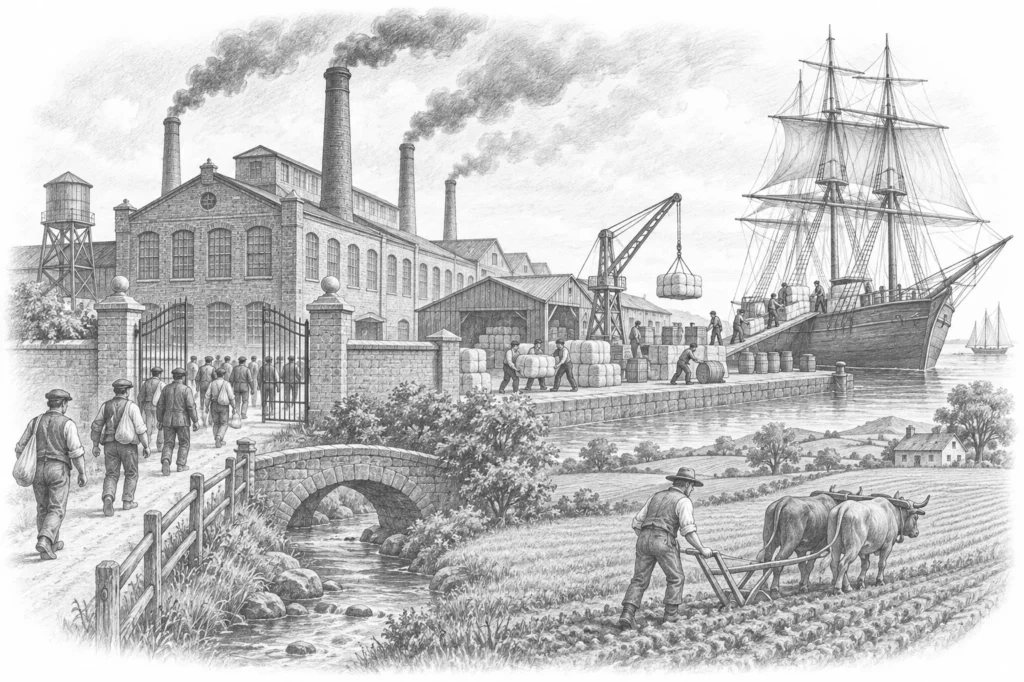
EVERY political system rests on an economic and social foundation. Who owns land and factories, how goods are produced, who works for whom and how wealth flows between countries shape the kind of state, parties and conflicts a society has. Comparative politics therefore begins with socio-economic structures: the broad and lasting patterns of production, ownership and exchange. This unit studies four such structures that have shaped the modern world: capitalism, socialism, colonialism and neo-liberalism. Each is both an economic system and a political project, and each has been defended and criticised by major thinkers.
1.1 Why Socio-Economic Structures Matter
A socio-economic structure is the organised pattern of economic relations in a society: the ownership of resources, the way production and distribution are organised and the social classes that result. Marx called this the economic base on which the legal and political superstructure rests. Even scholars who reject Marx’s determinism accept that economic structures influence politics. Barrington Moore, in Social Origins of Dictatorship and Democracy (1966), showed that the paths of countries to democracy, fascism or communism depended on how landlords, peasants and the bourgeoisie related to each other.
For comparative politics these structures matter in three ways. First, they explain differences between states: liberal democracies grew in capitalist societies, communist party-states in socialist economies and many post-colonial states in economies shaped by colonial rule. Second, they explain political conflict: class, land, labour and trade are recurring sources of party competition and social movements. Third, they explain global inequality: the division of the world into rich and poor countries, which George Ritzer and Ankie Hoogvelt link to the history of capitalist expansion and colonialism.
1.2 Capitalism: Meaning, Origins and Evolution
A. Meaning and features
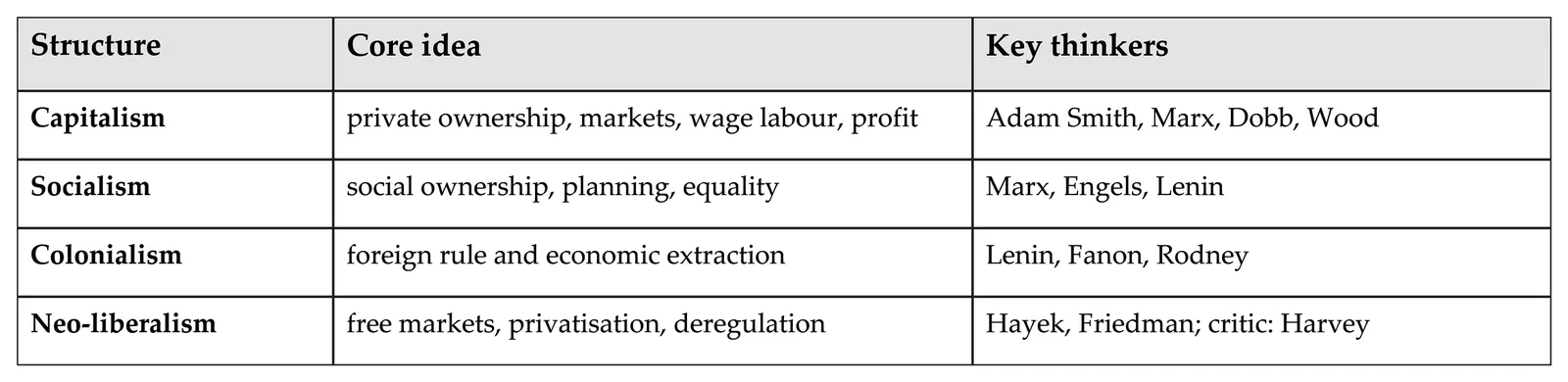
Capitalism is an economic system in which the means of production are privately owned and production is carried out for profit through markets, using wage labour. R. Suresh, in Economy and Society: Evolution of Capitalism (2010), describes it as a system in which the pursuit of profit and the accumulation of capital drive economic activity. Its main features are:
- Private ownership: land, factories, machines and capital belong to private individuals or companies, not to the community.
- Wage labour: workers who own no means of production sell their labour power for wages; for Marx this turns labour itself into a commodity.
- Production for profit: goods are produced not for the producer’s own use but for sale, and profit is the motive of production.
- Market and competition: prices are set mainly by supply and demand, and firms compete for customers, which drives innovation.
- Accumulation: profits are reinvested to expand production; Marx wrote of the capitalist’s drive to ‘accumulate, accumulate’.
- Limited state role: classical liberals such as Adam Smith argued that the ‘invisible hand’ of the market serves the common good and the state should protect property, enforce contracts and provide defence.
B. Debates on its origin
Maurice Dobb, in Studies in the Development of Capitalism (1946), rejected definitions of capitalism as simply trade or the profit motive, since trade and money existed in many earlier societies. For Dobb capitalism is a mode of production in which labour power has become a commodity bought and sold in the market. He traced its origin to the internal crisis of feudalism in Western Europe, when lords’ excessive demands drove peasants to flight and revolt, and small producers began to separate into capitalists and wage labourers. The American economist Paul Sweezy replied that the growth of long-distance trade and towns dissolved feudalism from outside, beginning the famous transition debate of the 1950s.
Ellen Meiksins Wood, in The Origin of Capitalism: A Longer View (2002), criticised the ‘commercialisation model’ that sees capitalism as the natural expansion of trade once its obstacles are removed. Following Robert Brenner, she argued that capitalism first emerged in the English countryside from the sixteenth century. Landlords leased land to capitalist tenant farmers, who had to compete in the market to pay rent, and these farmers employed landless labourers. Enclosures pushed peasants off common land. Because producers depended on the market for survival, they faced market imperatives: competition, productivity and profit maximisation. Agrarian capitalism then created the home market and labour force for the Industrial Revolution.
C. The stages of capitalism
- Merchant capitalism (c. 1500–1750): profit from trade, banking and plunder, supported by mercantilist states and chartered companies such as the English East India Company (1600).
- Industrial capitalism (c. 1750–1870): the factory system, steam power and wage labour in Britain and then Europe and North America, with laissez-faire as its ideology.
- Monopoly and finance capitalism (c. 1870–1914): large corporations, banks and cartels; Rudolf Hilferding’s Finance Capital (1910) and Lenin linked it to imperialism.
- Managed or welfare capitalism (1945–1973): Keynesian demand management, the welfare state and Bretton Woods institutions produced a ‘golden age’ of growth in the West.
- Neo-liberal global capitalism (since the 1970s): deregulation, privatisation, free movement of capital and global production chains.
Capitalism is not uniform. Peter Hall and David Soskice, in Varieties of Capitalism (2001), distinguished liberal market economies such as the USA and UK, which rely on markets, from coordinated market economies such as Germany and Japan, where firms cooperate with unions, banks and the state. Max Weber, in The Protestant Ethic and the Spirit of Capitalism (1905), stressed the cultural roots of capitalism in a disciplined ethic of work and saving.
1.3 Socialism and Communist States
A. The idea of socialism
Socialism is a doctrine and system based on social ownership of the means of production, production for need rather than profit, economic planning and greater equality. It arose in the early nineteenth century as a response to the misery of industrial capitalism. Utopian socialists such as Robert Owen, Charles Fourier and Henri de Saint-Simon imagined cooperative communities. Karl Marx and Friedrich Engels called their own theory scientific socialism: capitalism, they argued, would be overthrown by the working class, leading first to socialism (from each according to ability, to each according to work) and finally to communism, a classless and stateless society (from each according to ability, to each according to needs).
Socialism later divided into two main streams. Revolutionary socialism or communism, developed by Lenin, insisted on a vanguard party and the dictatorship of the proletariat. Democratic socialism or social democracy, influenced by Eduard Bernstein’s revisionism and the British Fabian Society (1884), sought gradual reform through elections, nationalisation and the welfare state. Debates in the 1950s, to which the economist Ronald Meek contributed, asked whether socialism should be defined by its means, social ownership and planning, or by its ends, equality and welfare. India’s Constitution added the word ‘socialist’ to the Preamble in 1976, reflecting Nehru’s democratic and mixed-economy socialism.
B. The communist system
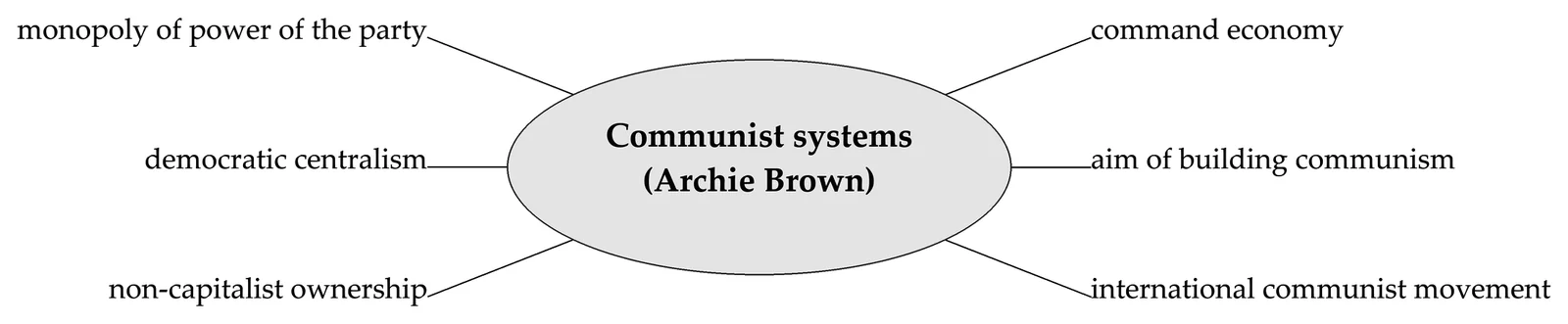
Archie Brown, in The Rise and Fall of Communism (2009), identifies six defining features of communist systems: two political, the monopoly of power of the communist party and democratic centralism, under which decisions of higher party bodies bind lower ones; two economic, non-capitalist ownership of the means of production and a command economy directed by central plans; and two ideological, the declared aim of building communism and a sense of belonging to an international communist movement. John McCormick (2007) adds that communist states controlled the media, restricted civil society and relied on the secret police.
- USSR: the Bolshevik Revolution (1917) created the first communist state; Stalin’s Five-Year Plans (from 1928) and forced collectivisation industrialised the country at enormous human cost.
- Expansion: after 1945 communist regimes were established in Eastern Europe, China (1949), North Korea, Vietnam and Cuba (1959); at their height they ruled about a third of humanity.
- Achievements: rapid industrialisation, mass literacy, full employment and social security.
- Problems: inefficiency of central planning, shortages, lack of political freedom and repression.
- Collapse: Gorbachev’s reforms of glasnost and perestroika (from 1985) loosened control; Eastern European regimes fell in 1989 and the USSR dissolved in 1991.
- Reform communism: China under Deng Xiaoping (from 1978) introduced markets while keeping one-party rule, calling it socialism with Chinese characteristics.
McCormick describes the former Soviet bloc as post-communist states, which have followed different paths: some, such as Poland and the Czech Republic, became democracies and joined the European Union; others, such as Russia and Belarus, developed authoritarian regimes.
1.4 Colonialism and Imperialism
Colonialism is the direct political control of one territory and people by a foreign power, usually involving settlement or administration and economic exploitation. Imperialism is the broader policy of extending power and domination over other territories, whether through formal colonies or informal economic and political control. George Ritzer, in Globalization: A Basic Text (2010), treats imperialism, colonialism, development, westernisation and easternisation as processes related to globalisation; colonialism is the narrower idea of establishing colonies, while imperialism can operate without them.
A. Phases of capitalist expansion
Ankie Hoogvelt links colonialism to the history of capitalist expansion into the Third World. She identifies a mercantilist phase (c. 1500–1800) of plunder, slave trade and trading monopolies; a colonial phase (c. 1800–1950) in which colonies became suppliers of raw materials and markets for manufactured goods; a neo-colonial phase (c. 1950–1970) in which formally independent states remained economically dependent; and a phase of globalisation after the 1970s. Through these phases the colonised world was incorporated into a global capitalist economy on unequal terms.
B. Theories and effects
- Economic drain: Dadabhai Naoroji, in Poverty and Un-British Rule in India (1901), argued that Britain drained India’s wealth through home charges, salaries and profits.
- Imperialism as a stage of capitalism: J.A. Hobson (1902) blamed under-consumption and surplus capital at home; Lenin, in Imperialism, the Highest Stage of Capitalism (1917), saw imperialism as the monopoly stage of capitalism, when the export of capital and the division of the world among great powers led to war.
- Underdevelopment: Andre Gunder Frank spoke of the ‘development of underdevelopment’, and Walter Rodney’s How Europe Underdeveloped Africa (1972) showed how colonialism distorted African economies.
- Deindustrialisation and monoculture: traditional crafts declined, and colonies were made to grow cash crops such as indigo, cotton and rubber.
- Social and cultural effects: colonial rule created new elites, divided communities through classification, and, as Frantz Fanon argued, produced psychological domination.
- Political legacy: arbitrary borders, centralised bureaucracies, armies and laws inherited by post-colonial states.
1.5 Neo-liberalism
Neo-liberalism is a set of ideas and policies that favour free markets, private enterprise, free trade and a limited role for the state in the economy. David Harvey, in A Brief History of Neoliberalism (2005), defines it as a theory that human well-being is best advanced by liberating individual entrepreneurial freedoms within a framework of strong private property rights, free markets and free trade. Its intellectual roots lie in Friedrich Hayek’s The Road to Serfdom (1944), the Mont Pelerin Society (1947) and Milton Friedman’s monetarism.
- Rise: the crisis of the Keynesian welfare state in the 1970s, with stagflation and oil shocks, opened the way; Chile after 1973, Margaret Thatcher in Britain (1979) and Ronald Reagan in the USA (1981) were early cases.
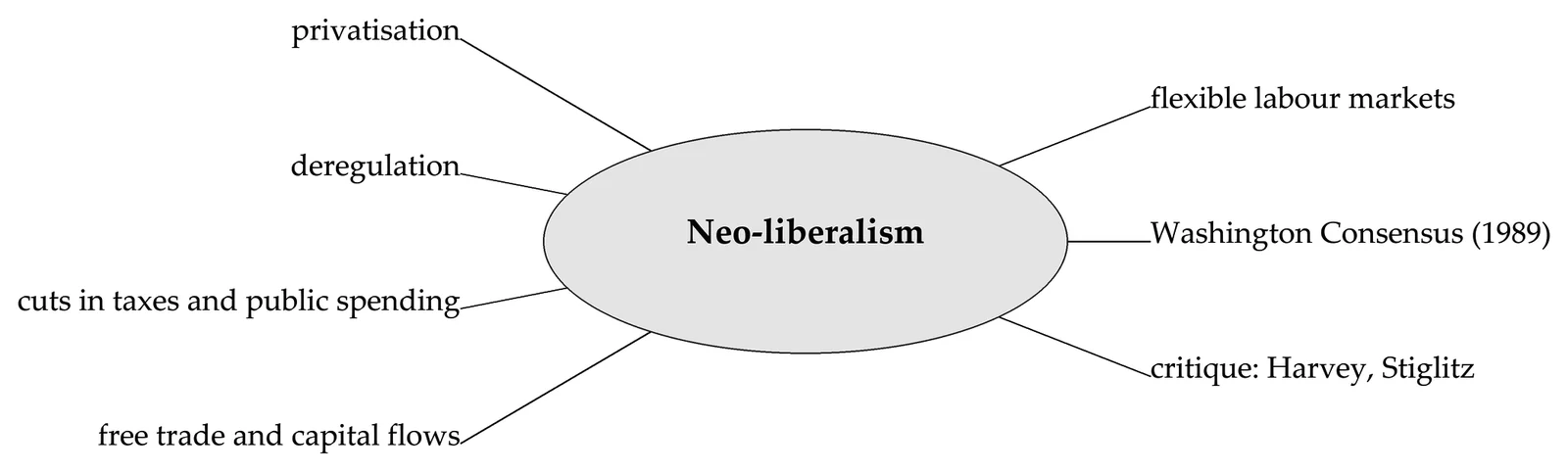
- Policies: privatisation, deregulation, tax cuts, control of inflation, cuts in public spending, flexible labour markets and opening to trade and foreign investment.
- Washington Consensus: John Williamson (1989) summarised the policy package promoted by the IMF, World Bank and US Treasury for developing countries.
- Structural adjustment: in the 1980s and 1990s many indebted countries in Africa and Latin America had to adopt these policies as loan conditions.
- India: the balance of payments crisis of 1991 led to liberalisation, privatisation and globalisation (LPG) under P.V. Narasimha Rao and Manmohan Singh.
- Critique: Harvey sees neo-liberalism as a project to restore class power through ‘accumulation by dispossession’; critics point to rising inequality, financial crises such as 2008, and the weakening of labour and welfare.
1.6 Important Questions
- Question 1 What is capitalism? Discuss the debates on the origin of capitalism.
- Question 2 Explain the idea of socialism. What are the defining features of a communist system and why did communist states collapse?
- Question 3 Discuss colonialism as a socio-economic structure. How did it shape the colonised societies?
- Question 4 What is neo-liberalism? Critically examine its impact on developing countries.
DU asks the same idea in different words. So learn one broad answer for each question below; the same answer works for every question joined by OR.
Important Question 1
What is capitalism? Discuss the debates on the origin of capitalism.
OR
Trace the evolution of capitalism as a socio-economic structure.
OR
Compare the views of Maurice Dobb and Ellen Meiksins Wood on the origins of capitalism.
Model Answer
“It is not from the benevolence of the butcher, the brewer, or the baker that we expect our dinner, but from their regard to their own interest.”
— Adam Smith, The Wealth of Nations (1776)
Introduction. Capitalism is the dominant socio-economic structure of the modern world. It is an economic system in which the means of production are privately owned and production is organised for profit through the market, using wage labour. Its origins, features and stages have been debated by economists, historians and political scientists, because the way capitalism emerged shapes how we understand its nature and its future.
1. Meaning of Capitalism
R. Suresh explains capitalism as a system driven by the pursuit of profit and the accumulation of capital. It is more than markets or money, which existed in ancient and medieval societies. What is distinctive is that the means of production belong to a class of owners while the majority must sell their labour power to live. Production is for sale, competition forces firms to innovate, and profits are reinvested to expand output.
2. Main Features
The core features are private property in productive resources, wage labour, production for profit, market exchange and competition, and continuous accumulation. Adam Smith, in The Wealth of Nations (1776), argued that the ‘invisible hand’ of the market turns self-interest into public benefit through the division of labour. Marx agreed that capitalism was enormously productive but argued that it rests on exploitation, since workers produce more value than they receive as wages, and the surplus value becomes profit.
3. Dobb’s Definition
Maurice Dobb rejected the view, associated with Werner Sombart and Max Weber, that capitalism is a spirit of enterprise or a rational attitude, and the view that it is simply trade for profit. He defined capitalism as a mode of production in which labour power has itself become a commodity. Capitalism therefore began only when a large class of propertyless labourers emerged, separated from the land and tools, and a class of capitalists employed them.
4. Dobb on the Decline of Feudalism
For Dobb the origin lay in the internal contradictions of feudalism. The growing demands of feudal lords for revenue led to over-exploitation of serfs, flight from the land and peasant revolts in the fourteenth century. As feudal ties loosened, small producers became differentiated: some prospered and employed others, while others lost their land. Out of this differentiation, rather than from merchants, the first industrial capitalists emerged.
5. The Transition Debate
Paul Sweezy challenged Dobb, arguing that feudalism was a stable system dissolved from outside by the growth of long-distance trade and towns, which created markets and drew peasants away. This Dobb–Sweezy debate, joined by historians such as Rodney Hilton and Christopher Hill, became known as the transition debate and raised a basic question: did capitalism grow from changes in production relations or from the expansion of commerce?
6. Wood’s Critique of the Commercialisation Model
Ellen Meiksins Wood argued that most accounts assume what they need to explain. The commercialisation model treats capitalism as the natural result of trade and towns once feudal obstacles are removed, as if people always had capitalist motives. For Wood, trade existed for millennia without producing capitalism; what was new was a system in which producers were forced to depend on the market for their survival.
7. The Agrarian Origin
Following Robert Brenner, Wood located the origin of capitalism in the English countryside from the sixteenth century. English landlords did not rely on coercive feudal dues; they leased land to tenant farmers whose rents were set by market conditions. To pay competitive rents, tenants had to raise productivity, invest in improvements and hire wage labourers. Enclosures removed common rights and created a landless class. These market imperatives of competition and profit-maximisation, not merely opportunities, were the essence of capitalism.
8. From Agrarian to Industrial Capitalism
Wood argued that agrarian capitalism produced a large home market, a mobile labour force and growing food supplies, which made possible the Industrial Revolution in Britain from the late eighteenth century. Industrial capitalism then brought the factory system, urbanisation and a new working class, whose conditions Engels described in The Condition of the Working Class in England (1845).
9. Later Stages
Capitalism has passed through merchant, industrial, monopoly or finance, welfare and neo-liberal stages. Ankie Hoogvelt shows how each phase expanded capitalism into the non-European world through trade, colonies and later global investment. In the twentieth century Keynesian welfare capitalism moderated market instability, while from the 1970s neo-liberal capitalism restored the dominance of markets and finance.
10. Varieties and Criticisms
Hall and Soskice show that capitalism takes different institutional forms, such as the liberal market economies of the USA and UK and the coordinated market economies of Germany and Japan. Critics, from Marx to contemporary thinkers, point to inequality, periodic crises, environmental damage and the commodification of social life, while defenders credit capitalism with unprecedented growth and the reduction of poverty.
Conclusion. Thus, capitalism is best understood as a system of private ownership, wage labour and market imperatives. Dobb traced its origins to the crisis of feudal production relations and Wood to the agrarian transformation of England, and both show that capitalism is a historically specific structure that continues to evolve.
Important Question 2
Explain the idea of socialism. What are the defining features of a communist system and why did communist states collapse?
OR
Discuss the rise and fall of communism with reference to Archie Brown.
OR
Distinguish between socialism, communism and social democracy.
Model Answer
“From each according to his ability, to each according to his needs!”
— Karl Marx, Critique of the Gotha Programme (1875)
Introduction. Socialism emerged in the nineteenth century as the main critique of and alternative to capitalism. It promised to replace private ownership and market competition with social ownership, planning and equality. In the twentieth century, communist parties built states claiming to realise this vision, and for several decades they ruled a large part of the world before most of them collapsed between 1989 and 1991.
1. Meaning of Socialism
Socialism is a doctrine and system based on the social ownership and democratic control of the means of production, production to meet human needs rather than for profit, economic planning and greater equality of income and status. It values cooperation over competition and treats human beings as members of a community rather than isolated individuals.
2. Utopian and Scientific Socialism
Early socialists such as Robert Owen, Charles Fourier and Saint-Simon imagined ideal cooperative communities and appealed to reason and goodwill. Marx and Engels called this utopian socialism and claimed that their own theory was scientific because it was based on the laws of historical development. Class struggle, the contradictions of capitalism and the growth of the working class would make socialist revolution inevitable.
3. Socialism and Communism in Marx
Marx distinguished two phases of post-capitalist society. In the first, socialism, the means of production are socially owned, but people are paid according to their work and the state still exists as the dictatorship of the proletariat. In the higher phase, communism, abundance and the end of classes allow distribution according to need, and the state withers away.
4. Two Streams of Socialism
After Marx, socialism divided. Lenin’s revolutionary communism stressed a disciplined vanguard party and the seizure of power, as in the Bolshevik Revolution of 1917. Democratic socialists, influenced by Eduard Bernstein’s revisionism and the Fabian Society, believed socialism could be achieved gradually through elections, trade unions, nationalisation and the welfare state. Debates in the 1950s, to which Ronald Meek contributed, asked whether socialism should be defined by its means, social ownership and planning, or by its ends, equality and welfare.
5. Brown’s Six Features of Communist Systems
Archie Brown identifies six defining features. Politically, a communist party holds a monopoly of power, and democratic centralism requires lower party bodies to obey higher ones. Economically, the means of production are under non-capitalist ownership, mainly state ownership, and the economy is a command economy directed by central plans. Ideologically, the party proclaims the goal of building communism and sees itself as part of an international communist movement.
6. Other Features
John McCormick adds that communist states controlled the media and education, allowed little independent civil society, used secret police to suppress dissent and often built a personality cult around the leader, as under Stalin and Mao. The party, the state and the economy were fused into a single hierarchy.
7. Rise and Achievements
From the Soviet Union, communism spread after 1945 to Eastern Europe, China (1949), North Korea, Vietnam and Cuba. These regimes achieved rapid industrialisation, mass literacy, full employment, free health care and education, and the USSR became a superpower that defeated Nazi Germany and launched the first satellite in 1957.
8. Problems of Communist Systems
Central planning could mobilise resources for heavy industry but struggled with consumer goods, innovation and efficiency, leading to shortages and stagnation by the 1970s. The absence of free elections and a free press meant that errors were not corrected and repression, such as Stalin’s purges and labour camps, caused immense suffering. Nationalist resentment against Soviet domination grew in Eastern Europe and the non-Russian republics. Economists such as János Kornai described these systems as shortage economies, in which firms faced soft budget constraints and had little incentive to economise.
9. The Collapse
Brown emphasises the role of political reform and leadership. Mikhail Gorbachev, who became leader in 1985, introduced glasnost (openness) and perestroika (restructuring) to revive the system, but these reforms released criticism and national movements he could not control. When the USSR refused to use force in 1989, regimes in Poland, Hungary, East Germany, Czechoslovakia and elsewhere fell, the Berlin Wall came down, and the Soviet Union itself dissolved in December 1991.
10. After Communism
Post-communist states took different paths: some became market democracies and joined the European Union, while Russia and others moved towards authoritarianism. China, Vietnam, Laos, Cuba and North Korea retain communist party rule; China under Deng Xiaoping combined one-party rule with market reforms. Social democracy in Western Europe, by contrast, built welfare states within capitalism.
Conclusion. Thus, socialism offered a powerful vision of equality and social ownership, and communist states achieved rapid modernisation. Yet the combination of a party monopoly, a command economy and the suppression of freedom made them rigid, and their collapse shows that economic equality cannot be sustained without democracy and accountability.
Important Question 3
Discuss colonialism as a socio-economic structure. How did it shape the colonised societies?
OR
Distinguish between colonialism and imperialism. Discuss Hoogvelt’s phases of capitalist expansion.
OR
Examine the impact of colonialism on the economy and polity of the Third World.
Model Answer
“Europe is literally the creation of the Third World.”
— Frantz Fanon, The Wretched of the Earth (1961)
Introduction. Between the sixteenth and twentieth centuries a handful of European powers brought most of Asia, Africa and Latin America under their rule. Colonialism was not only political domination but a socio-economic structure that reorganised production, trade, land and labour in the colonies to serve the needs of the colonial powers. Its effects continue to shape the politics and economies of post-colonial states.
1. Meaning of Colonialism
Colonialism is the direct political, economic and cultural control of one territory and its people by a foreign state. It involves the establishment of colonial administrations, sometimes settlers, and the exploitation of land, labour and resources. George Ritzer describes it as one of the processes related to globalisation, through which Western powers extended their influence across the world. Settler colonies, such as those in North America, Australia and South Africa, involved large-scale European settlement and the dispossession of indigenous peoples, while colonies of exploitation, such as India, were governed by a small foreign elite for economic gain.
2. Colonialism and Imperialism
Imperialism is the broader policy or practice of extending power over other territories, through formal colonies or informal domination such as economic control, unequal treaties or military pressure. Ritzer notes that colonialism is a narrower concept involving the creation of colonies, while imperialism can exist without them. Lenin used imperialism to describe a stage of capitalism, while neo-colonialism, a term popularised by Kwame Nkrumah (1965), describes continued domination after formal independence.
3. Hoogvelt’s Phases
Ankie Hoogvelt links colonialism to the history of capitalist expansion. In the mercantilist phase (c. 1500–1800) Europeans gained wealth through plunder, the Atlantic slave trade and trading monopolies. In the colonial phase (c. 1800–1950) colonies were organised as producers of raw materials and markets for industrial goods. In the neo-colonial phase (c. 1950–1970) newly independent states remained economically dependent, and from the 1970s globalisation created new forms of integration and exclusion.
4. Economic Restructuring
Colonial economies were reshaped to export primary products. Peasants were pushed to grow cash crops such as indigo, cotton, jute, coffee and rubber, often at the expense of food crops. Mines and plantations used coerced or indentured labour. Railways and ports were built to move goods to the coast rather than to integrate domestic markets. This export orientation left colonies vulnerable to world price fluctuations and helps explain why many post-colonial economies still depend on a few primary commodities.
5. Drain and Deindustrialisation
Dadabhai Naoroji’s drain theory argued that India’s wealth was transferred to Britain through home charges, salaries, pensions and profits without any return. Cheap British manufactures destroyed traditional handicrafts such as Indian textiles, leading to deindustrialisation and greater pressure on agriculture. Revenue systems such as the Permanent Settlement (1793) created new landlord classes and indebted peasants.

6. Theories of Imperialism
J.A. Hobson (1902) argued that under-consumption at home pushed capitalists to invest abroad. Lenin, in Imperialism, the Highest Stage of Capitalism (1917), saw imperialism as the monopoly stage of capitalism, marked by finance capital, the export of capital and the division of the world among great powers, which led to the First World War.
7. Underdevelopment and Dependency
Andre Gunder Frank argued that the same process that developed the metropolitan centres underdeveloped the satellites, the ‘development of underdevelopment’. Walter Rodney, in How Europe Underdeveloped Africa (1972), showed how the slave trade and colonial rule drained Africa’s resources and distorted its development. Immanuel Wallerstein’s world-systems theory placed the colonies in the periphery of a capitalist world economy.
8. Social and Cultural Effects
Colonial rule created Western-educated elites, introduced new laws and institutions, and classified populations through censuses by caste, tribe and religion, sometimes hardening divisions. Fanon described the psychological damage of colonial racism, while Edward Said’s Orientalism (1978) showed how Western knowledge represented the East as backward to justify domination.
9. Political Legacy
Post-colonial states inherited arbitrary borders, especially in Africa after the Berlin Conference (1884–85), centralised bureaucracies, armies and legal systems designed for control rather than participation. Many faced ethnic conflicts, military coups and economic dependence, though countries like India adapted colonial institutions to democratic purposes. Hamza Alavi described the post-colonial state as overdeveloped, because its bureaucratic and military apparatus, built to control the whole colonial society, remained more powerful than the social classes it governed.
10. Evaluation
Some historians argue that colonialism brought railways, modern education and the rule of law. Critics reply that these served colonial interests and that the costs in famine, poverty and lost development were enormous. Today, the legacy of colonialism is discussed in debates on reparations, the decolonisation of knowledge and inequalities in the global economy. For comparative politics, the colonial experience explains why post-colonial states share common problems of state-building, development and national integration despite their differences.
Conclusion. Thus, colonialism was a socio-economic structure that incorporated the colonies into the capitalist world economy on unequal terms. It restructured their economies, societies and states, and its legacy of dependence and inequality remains central to comparative politics.
Important Question 4
What is neo-liberalism? Critically examine its impact on developing countries.
OR
Discuss the main features of neo-liberalism and the Washington Consensus.
OR
‘Neo-liberalism is a project to restore class power.’ Discuss with reference to David Harvey.
Model Answer
“There is no such thing as society. There are individual men and women and there are families.”
— Margaret Thatcher, interview in Woman’s Own (1987)
Introduction. Since the 1970s neo-liberalism has been the dominant economic ideology in much of the world. It holds that free markets, private enterprise and free trade produce the greatest prosperity and freedom, and that the state should withdraw from direct economic activity. Its policies have transformed economies from Britain to Chile and India, but have also generated intense debate over inequality, crises and democracy.
1. Meaning
David Harvey defines neo-liberalism as a theory of political-economic practices which proposes that human well-being is best advanced by liberating individual entrepreneurial freedoms and skills within an institutional framework of strong private property rights, free markets and free trade. The role of the state is to create and protect this framework, not to plan the economy or own enterprises.
2. Intellectual Roots
Neo-liberalism grew from the ideas of Friedrich Hayek, whose The Road to Serfdom (1944) warned that central planning leads to tyranny, and of Milton Friedman and the Chicago School, who argued for monetarism and minimal government. The Mont Pelerin Society, founded in 1947, connected these thinkers. Public choice theorists criticised bureaucracy and government failure.
3. The Crisis of Keynesianism
After 1945 Western states followed Keynesian policies of full employment, welfare and regulation. In the 1970s, oil shocks, stagflation and fiscal crises discredited this model. Neo-liberals blamed high taxes, strong unions and state intervention for the crisis, and their ideas offered an alternative.
4. Early Experiments
Chile after the military coup of 1973 became the first laboratory, as economists trained in Chicago introduced privatisation and free markets under Pinochet. Margaret Thatcher (1979) in Britain and Ronald Reagan (1981) in the USA cut taxes, privatised industries, deregulated finance and confronted trade unions.
5. Main Policies
Neo-liberal policies include privatisation of public enterprises, deregulation of markets and finance, reduction of public spending and subsidies, tax cuts, control of inflation, flexible labour markets, liberalisation of trade and capital flows, and the encouragement of foreign investment. The market is extended into areas such as health, education and utilities. The neo-liberal state is not weak: it actively creates markets, protects investors and enforces contracts, and may become authoritarian when it faces resistance to market reforms.
6. The Washington Consensus
In 1989 John Williamson summarised ten policies promoted by Washington-based institutions for Latin America, including fiscal discipline, tax reform, trade liberalisation, privatisation, deregulation and secure property rights. Through the IMF and World Bank these became loan conditions known as structural adjustment programmes, imposed on indebted countries in Africa, Latin America and Asia. Critics argued that these programmes reduced the policy autonomy of developing countries, since governments elected by their people had to follow conditions set by unelected international institutions.
7. Neo-liberalism in India
Facing a balance of payments crisis in 1991, India adopted liberalisation, privatisation and globalisation: the licence raj was dismantled, tariffs were cut, the rupee was devalued and foreign investment was welcomed. Growth accelerated and a large middle class emerged, but critics point to agrarian distress, informal employment and rising inequality.
8. Positive Impact
Supporters argue that market reforms ended inefficient state monopolies, raised growth, attracted investment and technology, and lifted millions out of poverty, especially in East Asia, China and India. Consumers gained choice, and integration into global trade created jobs in manufacturing and services. Defenders also point out that the countries that grew fastest, such as China and South Korea, did so by integrating into world markets, even if they did not follow every neo-liberal prescription.
9. Critique
Harvey argues that neo-liberalism was a political project to restore the power of economic elites, achieved through accumulation by dispossession: privatisation of public assets, financialisation, and the transfer of land and resources from the poor. Joseph Stiglitz criticised the IMF’s one-size-fits-all policies. Structural adjustment often cut health and education spending, hurting the poor, and financial deregulation contributed to crises such as the East Asian crisis (1997) and the global financial crisis (2008). Inequality within countries rose sharply, as Thomas Piketty’s Capital in the Twenty-First Century (2013) documented, and the share of labour in national income declined in many economies.
10. Neo-liberalism Today
After 2008, states rescued banks and expanded spending, and the COVID-19 pandemic and the rise of economic nationalism have further challenged neo-liberal orthodoxy. Yet market principles remain influential in trade, finance and public management, and debates continue over how to balance markets with welfare and democracy.
Conclusion. Thus, neo-liberalism has reshaped the global economy by expanding markets and reducing the state’s economic role. It has promoted growth in many places, but its costs in inequality, insecurity and crises show that markets need regulation and social protection to serve developing societies.
Short Notes
(a) Washington Consensus
A term coined by the economist John Williamson in 1989 for ten policy reforms that Washington-based institutions, the IMF, the World Bank and the US Treasury, recommended to Latin American countries: fiscal discipline, reordering of public spending, tax reform, liberalised interest rates, competitive exchange rates, trade liberalisation, openness to foreign investment, privatisation, deregulation and secure property rights. It became shorthand for neo-liberal structural adjustment.
(b) Mixed economy
An economy in which the public and private sectors coexist, with the state owning key industries and planning development while private enterprise operates in other areas. India adopted it after 1947 through the Industrial Policy Resolution of 1956 and the Five-Year Plans, aiming at a socialistic pattern of society. Since 1991 the role of the private sector has greatly expanded.
(c) Dependency theory
A theory developed in Latin America in the 1960s by thinkers such as Raúl Prebisch, Andre Gunder Frank and Fernando Henrique Cardoso. It argues that underdevelopment in the periphery results from its dependent position in the capitalist world economy, where it exports raw materials and imports manufactures on unequal terms, so the development of the core is linked to the underdevelopment of the periphery.
More notes: DSC-11 Concepts in Comparative Political Analysis
These notes are prepared by PADHO TO AISE for study help. They are not an official University of Delhi publication.