
Semester IV DSC-11 Concepts in Comparative Political Analysis
Unit VII · 26 min read · Updated 24 Nov 2026
As per the University of Delhi (DU) BA (Hons) Political Science syllabus
Contents
- 7.1 Meaning and Functions of Political Parties
- 7.2 Historical Contexts of the Emergence of Parties
- 7.3 Types of Parties
- 7.4 Types of Party Systems
- 7.5 Change and Crisis in Parties and Party Systems
- 7.6 Important Questions
- Discuss the historical contexts of the emergence of political parties.
- Classify political parties. Trace the evolution from cadre and mass parties to catch-all and cartel parties.
- What is a party system? Discuss Sartori’s classification of party systems.
- Examine the changing nature of the party system in India in comparative perspective.
- Short Notes
राजनीतिक दलों ने लोकतंत्र का निर्माण किया, और आधुनिक लोकतंत्र दलों के बिना अकल्पनीय है।
The political parties created democracy and modern democracy is unthinkable save in terms of the parties.
— E.E. Schattschneider, Party Government (1942)
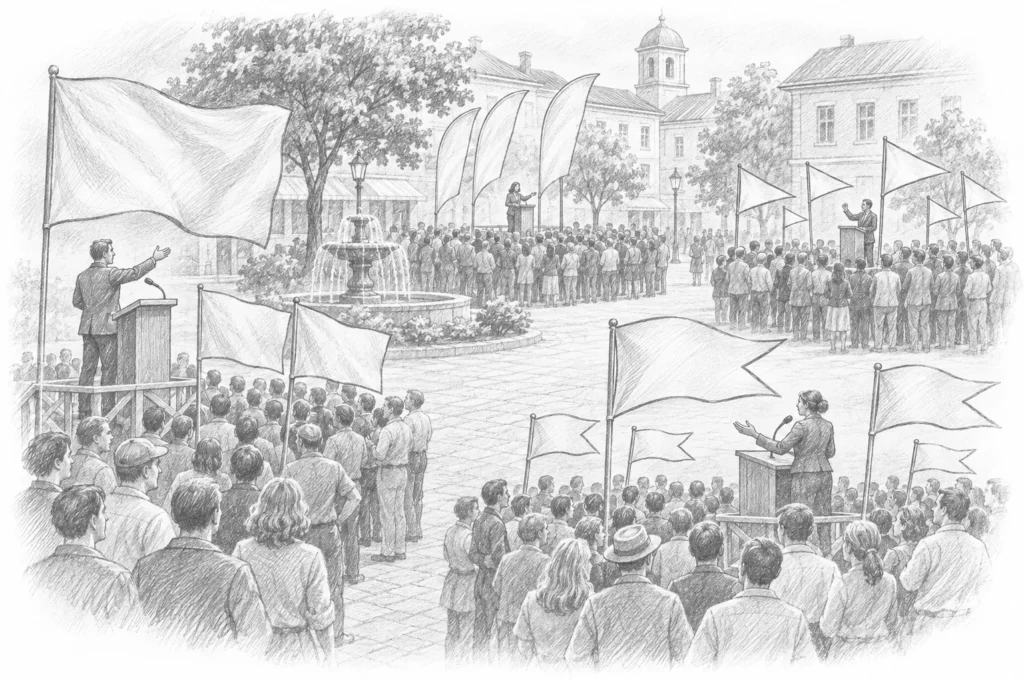
POLITICAL parties are the main link between citizens and government in modern democracies. They select candidates, offer programmes, mobilise voters, form governments and organise opposition. Yet parties are relatively recent: they emerged only in the eighteenth and nineteenth centuries, as parliaments gained power and the right to vote expanded. Parties also interact with one another, forming a party system whose shape, one dominant party, two major parties or many parties, affects how democracy works. This unit studies the historical contexts in which parties emerged, the main types of parties and the classification of party systems, with examples from Europe, Israel and India.
7.1 Meaning and Functions of Political Parties
Edmund Burke defined a party as a body of men united for promoting by their joint endeavours the national interest upon some particular principle in which they are all agreed. Modern definitions are less idealistic. Giovanni Sartori defined a party as any political group that presents candidates at elections and is capable of placing them in public office. Andrew Heywood defines a party as a group of people organised to win government power, usually by electoral means, that adopts a broad issue focus and is united by shared political preferences. Parties differ from interest groups, which seek to influence government without taking office.
The main functions of parties are: representation of the views of voters; elite recruitment of candidates and leaders; goal formulation through manifestos and programmes; interest articulation and aggregation, combining many demands into coherent policies; socialisation and mobilisation of citizens; and the organisation of government, providing a governing team and a loyal opposition. Alistair Cole notes that party organisations vary from loose networks of notables to mass bureaucratic structures. Robert Michels, studying the German Social Democrats, argued that organisation inevitably produces oligarchy: who says organisation, says oligarchy.
7.2 Historical Contexts of the Emergence of Parties
- Institutional context: Maurice Duverger distinguished parties of internal origin, created inside parliaments as groups of legislators, such as the British Whigs and Tories, from parties of external origin, created outside parliament by trade unions, churches or social movements, such as the British Labour Party (1900). The growth of parliamentary power and the extension of suffrage forced legislative factions to organise voters.
- Historical crises: Joseph LaPalombara and Myron Weiner (1966) linked the emergence of parties to crises of legitimacy, integration and participation during modernisation and nation-building.
- Social cleavages: Seymour Martin Lipset and Stein Rokkan (1967) argued that European party systems arose from four cleavages produced by two revolutions. The national revolution produced the centre–periphery cleavage (dominant culture against regional and linguistic minorities) and the state–church cleavage (secular state against church). The industrial revolution produced the land–industry cleavage (agrarian against urban interests) and the owner–worker cleavage (capital against labour), which gave rise to socialist and labour parties.
- Freezing hypothesis: Lipset and Rokkan claimed that the party systems of the 1960s reflected, with few exceptions, the cleavage structures of the 1920s, when universal suffrage was introduced.
- New cleavages: Ronald Inglehart’s The Silent Revolution (1977) showed how post-materialist values produced Green parties, and the globalisation cleavage between winners and losers has fuelled populist radical right parties.
- Post-colonial contexts: in India the Indian National Congress (1885) emerged from the national movement, while caste, regional, religious and ideological cleavages produced other parties. Sunil K. Choudhary, comparing Israel and India, shows that in both countries parties grew out of national movements, a dominant party ruled at first (Mapai in Israel, Congress in India), and later fragmentation brought religious, ethnic and regional parties to the fore.
7.3 Types of Parties
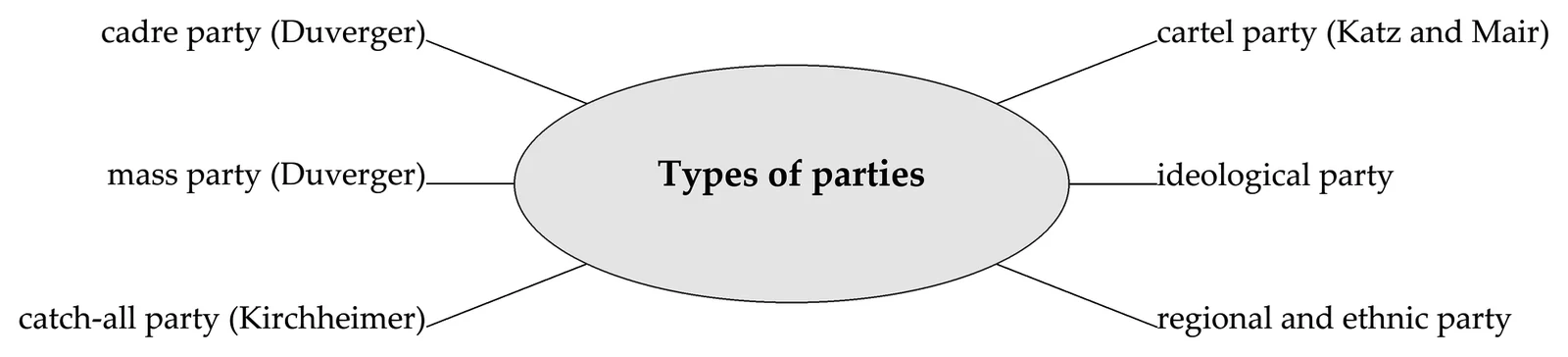
- Cadre parties: Duverger’s term for parties of notables, run by a small group of politicians and local elites, with little formal membership, typical of nineteenth-century liberal and conservative parties.
- Mass parties: parties with large dues-paying memberships, strong organisation, ideological programmes and affiliated organisations, pioneered by socialist parties such as the German SPD. Sigmund Neumann called them parties of integration, which shape the whole life of members, unlike parties of individual representation.
- Catch-all parties: Otto Kirchheimer (1966) observed that after 1945 mass parties diluted their ideology to appeal to all voters, strengthened their leaders, reduced the role of members and courted many interest groups, as with the German CDU and SPD.
- Cartel parties: Richard Katz and Peter Mair (1995) argued that established parties increasingly depend on the state for funding and media access, collude to limit competition, and become agents of the state rather than of society.
- Other types: ideological or programmatic parties; regional and ethnic parties representing territorial or communal groups, such as the DMK or Shiv Sena in India; single-issue parties; personalist or business-firm parties built around a leader; and movement parties emerging from protests.
- Heywood’s classifications: constitutional and revolutionary parties; left-wing and right-wing parties; representative and integrative parties.
7.4 Types of Party Systems
A party system is the network of relationships among parties in a political system, shaped by their number, relative size and ideological distance. Daniele Caramani emphasises that party systems are structured by the number of parties, their strength, the cleavages they represent and the patterns of competition and cooperation among them. Duverger used a simple numerical classification into one-party, two-party and multi-party systems.
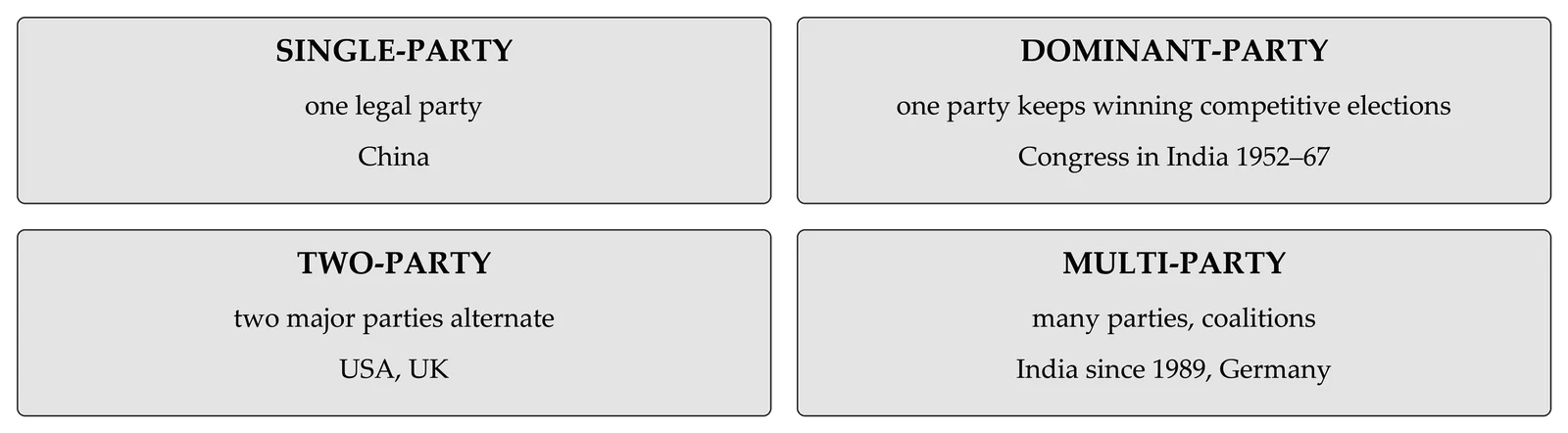
Sartori’s classification counts only relevant parties, those with coalition potential or blackmail potential, and considers ideological distance. Among non-competitive systems he distinguished one-party systems (only one legal party, as in China) and hegemonic party systems (other parties exist but cannot win, as in Mexico under the PRI). Among competitive systems he identified: a predominant-party system, in which one party wins an absolute majority over several elections (India under Congress, Japan under the LDP, Sweden under the Social Democrats); a two-party system (USA, UK historically); moderate pluralism, with three to five relevant parties and small ideological distance, producing coalitions (Germany, the Netherlands); and polarised pluralism, with more than five parties, anti-system parties at both extremes, a centre party and centrifugal competition (Weimar Germany, Italy before 1990, Chile before 1973). Markku Laakso and Rein Taagepera (1979) devised the effective number of parties, which weights parties by their vote or seat share.
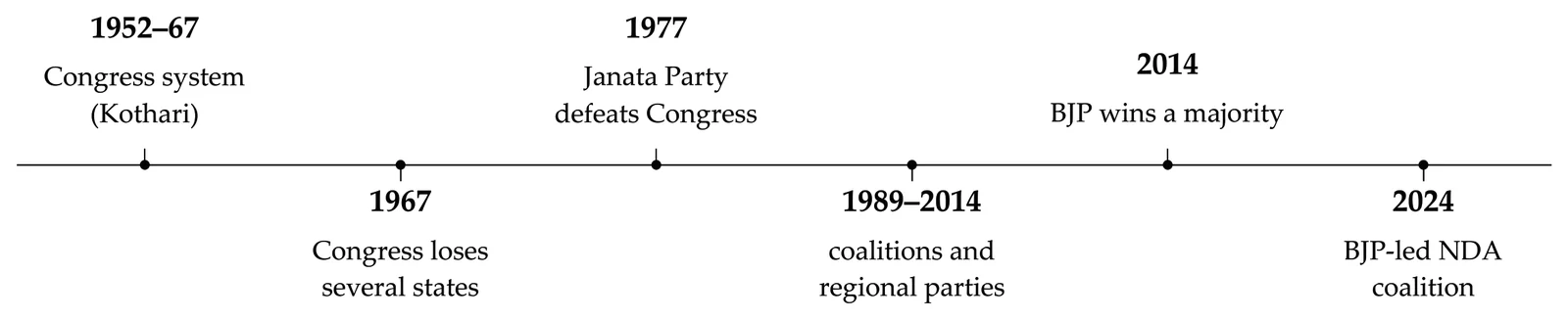
In India, Rajni Kothari (1964) described the Congress system of one-party dominance (1952–67), in which Congress was a broad coalition containing internal factions, while opposition parties acted as a ‘margin of pressure’. W.H. Morris-Jones called it dominance coexisting with competition. After 1967 and especially after 1989, a multi-party system with coalition governments emerged, and since 2014 some scholars have described a new phase of BJP dominance.
7.5 Change and Crisis in Parties and Party Systems
- Dealignment: voters are less attached to parties, and electoral volatility has increased.
- Declining membership: party membership in Western Europe has fallen sharply since the 1960s.
- Hollowing of democracy: Peter Mair, in Ruling the Void (2013), argued that parties have withdrawn from society into the state, while citizens have withdrawn from parties.
- New challengers: Green, populist and anti-establishment parties have fragmented party systems.
- Personalisation and media: leaders, television and social media have become more important than party organisations.
7.6 Important Questions
- Question 1 Discuss the historical contexts of the emergence of political parties.
- Question 2 Classify political parties. Trace the evolution from cadre and mass parties to catch-all and cartel parties.
- Question 3 What is a party system? Discuss Sartori’s classification of party systems.
- Question 4 Examine the changing nature of the party system in India in comparative perspective.
DU asks the same idea in different words. So learn one broad answer for each question below; the same answer works for every question joined by OR.
Important Question 1
Discuss the historical contexts of the emergence of political parties.
OR
Examine Lipset and Rokkan’s cleavage theory of party systems.
OR
How did the extension of suffrage and social cleavages give rise to modern political parties?
Model Answer
“Party is a body of men united, for promoting by their joint endeavours the national interest, upon some particular principle in which they are all agreed.”
— Edmund Burke, Thoughts on the Cause of the Present Discontents (1770)
Introduction. Political parties are so central to modern democracy that it is easy to forget they are a recent invention. Before the eighteenth century, politics was dominated by monarchs, aristocratic factions and religious bodies. Parties emerged in particular historical contexts: the growth of parliaments, the extension of suffrage, the crises of modernisation and the social conflicts produced by national and industrial revolutions. Understanding these contexts explains why party systems differ across countries.
1. From Factions to Parties
Early thinkers distrusted parties as factions that divided the community. James Madison, in The Federalist No. 10, warned against the mischiefs of faction. Burke was among the first to defend parties as honourable associations united by principle. The shift from factions to parties came as political competition became open and legitimate. George Washington’s Farewell Address (1796) likewise warned against the spirit of party, yet within a few years the Federalists and Democratic-Republicans were organising openly.
2. Parliamentary Origins
Duverger argued that many parties began inside legislatures. In eighteenth-century Britain, groups of members of Parliament known as Whigs and Tories formed around leaders and issues. As Parliament gained power over the Crown, these groups needed stable organisation to win votes in the House and form governments. Such parties of internal origin were typically cadre parties of notables.
3. The Extension of Suffrage
The expansion of the franchise in the nineteenth and early twentieth centuries forced parliamentary groups to create constituency organisations to register and mobilise voters. In Britain the Reform Acts of 1832, 1867 and 1884 led to local associations and national party organisations. In the United States, the Democratic Party under Andrew Jackson built a mass electoral machine in the 1820s and 1830s.
4. Parties of External Origin
Other parties were created outside parliament by groups excluded from power. Trade unions created labour and socialist parties, such as the British Labour Party in 1900; churches created Christian democratic parties; and farmers created agrarian parties. Duverger observed that such parties were usually more centralised, disciplined and ideological than parties of internal origin.
5. Crises of Modernisation
LaPalombara and Weiner argued that parties emerged when societies faced crises of legitimacy, integration and participation during modernisation. New groups demanded a share of power, national unity had to be built and the authority of rulers had to be justified. Parties channelled these demands and helped manage the transition to mass politics.
6. Lipset and Rokkan’s Cleavages
Lipset and Rokkan explained European party systems through four cleavages. The national revolution produced the centre–periphery cleavage between nation-builders and regional or linguistic minorities, and the state–church cleavage between the secular state and the church, especially over education. The industrial revolution produced the land–industry cleavage between agrarian and urban commercial interests, and the owner–worker cleavage between capital and labour.
7. The Freezing Hypothesis
Lipset and Rokkan argued that once universal suffrage was achieved around the 1920s, the main parties had captured the available voters, and the party systems of the 1960s still reflected the cleavage structures of the 1920s. This explains the remarkable stability of European party systems for decades.
8. New Cleavages and Parties
From the 1970s, Ronald Inglehart’s post-materialist values, concerned with environment, peace and self-expression, gave rise to Green parties. More recently, a cleavage between the winners and losers of globalisation, and between cosmopolitan and nationalist values, has fuelled populist radical right parties. Caramani notes that party systems have unfrozen, with greater volatility and new parties.
9. Parties in Post-colonial Societies
In many post-colonial countries parties grew out of national movements, such as the Indian National Congress (1885), which became the dominant party after independence. Sunil Choudhary shows that in Israel and India, parties emerged from national movements, a dominant party ruled initially, and religious, ethnic and regional cleavages later produced new parties. In India, caste, language, region and religion created parties such as the DMK, the Akali Dal, the BSP and the BJP.
10. Evaluation
Institutional explanations stress the role of parliaments and electoral rules, while sociological explanations stress social cleavages. Most scholars combine both: cleavages provide the raw material for parties, while institutions and political entrepreneurs shape which cleavages become politically organised.
Conclusion. Thus, political parties emerged from the growth of parliaments, the extension of suffrage, the crises of modernisation and the social cleavages of national and industrial revolutions. These historical contexts explain the variety and persistence of party systems across the world.
Important Question 2
Classify political parties. Trace the evolution from cadre and mass parties to catch-all and cartel parties.
OR
Discuss Kirchheimer’s idea of the catch-all party.
OR
What is a cartel party? Discuss with reference to Katz and Mair.
Model Answer
“It is organization which gives birth to the domination of the elected over the electors… Who says organization, says oligarchy.”
— Robert Michels, Political Parties (1911)
Introduction. Political parties differ in their organisation, membership, ideology and relationship with society and the state. Political scientists have developed several typologies to classify them, and some of these describe a historical evolution: from the cadre parties of the nineteenth century to mass parties, catch-all parties and, more recently, cartel parties. These types help us understand how parties have adapted to social and political change.
1. Bases of Classification
Parties can be classified by organisation (cadre or mass), function (representation or integration), ideology (left or right, constitutional or revolutionary), social base (class, religion, region or ethnicity) and strategy (programmatic or catch-all). Heywood notes that no single classification captures all differences, so several are used together.
2. Cadre Parties
Duverger described cadre parties as parties of notables: small groups of influential politicians, local elites and financiers, with little formal membership. They were typical of nineteenth-century liberal and conservative parties when the franchise was restricted and elections depended on personal influence and money rather than mass mobilisation. Their organisation consisted mainly of committees of local influentials who came together at election time, and their finance came from a few wealthy supporters.
3. Mass Parties
With universal suffrage, socialist parties developed the mass party model: large memberships paying regular dues, branches across the country, strong central organisation, clear ideology and links with trade unions and other organisations. The German Social Democratic Party was the classic example. Mass parties financed themselves through members rather than wealthy patrons. Duverger saw the mass party as the modern form of party organisation, which other parties would have to imitate, a phenomenon he called contagion from the left.
4. Parties of Integration
Sigmund Neumann distinguished parties of individual representation, which simply represent voters in parliament, from parties of integration, which shape the whole life of members through newspapers, clubs, youth wings and welfare organisations. Socialist and Christian democratic parties were parties of democratic integration, while fascist and communist parties sought total integration.
5. The Catch-all Party
Otto Kirchheimer argued in 1966 that after the Second World War mass parties were transformed into catch-all parties. Rising prosperity, the decline of class conflict and television encouraged parties to drastically reduce their ideological baggage, strengthen top leaders, reduce the role of individual members, de-emphasise a particular class base and seek access to many interest groups. The German CDU and SPD and the British Labour and Conservative parties illustrate this trend.
6. Consequences of Catch-all Parties
Catch-all parties made electoral competition more centrist and pragmatic, but Kirchheimer worried that they reduced meaningful choices for voters and weakened the role of parties as channels of popular participation. Angelo Panebianco later described the related electoral-professional party, dominated by professionals in marketing and media rather than party bureaucrats.
7. The Cartel Party
Richard Katz and Peter Mair argued in 1995 that parties had moved closer to the state. Facing declining membership, established parties increasingly relied on state subsidies, regulation and access to state media. They collude rather than compete fiercely, sharing resources and limiting the entry of new parties, and become semi-state agencies rather than representatives of civil society. State funding of parties, now common in Europe, and rules on access to broadcasting and ballots can make it harder for newcomers to enter, which is why Katz and Mair used the economic image of a cartel.
8. Criticisms of the Cartel Thesis
Critics argue that the cartel thesis overstates collusion, since parties still compete intensely, and that new parties, such as Greens and populists, have successfully challenged established ones. Yet the thesis helps explain anti-party sentiment and the rise of populist challengers who denounce the established parties as a cartel.
9. Other Types of Parties
Other types include ideological parties committed to a doctrine, such as communist parties; regional and ethnic parties, such as the Scottish National Party or India’s DMK and Shiromani Akali Dal; single-issue parties; personalist parties built around a leader, such as Forza Italia; and movement parties that grow out of protests, such as Podemos in Spain. Many Indian parties combine regional, caste and personal bases. In India, scholars have also described parties as vehicles for patronage and clientelism, distributing benefits to supporters in exchange for votes.
10. Evaluation
Alistair Cole notes that these types are ideal types; real parties often combine features of several. Their sequence nevertheless shows how parties adapted to mass suffrage, prosperity, television and state funding, and how their relationship with society has weakened over time.
Conclusion. Thus, political parties have evolved from cadre parties of notables to mass parties of integration, catch-all parties seeking all voters, and cartel parties dependent on the state. Each type reflects a stage in the relationship between parties, society and the state.
Important Question 3
What is a party system? Discuss Sartori’s classification of party systems.
OR
Distinguish between one-party, dominant-party, two-party and multi-party systems with examples.
OR
Examine the differences between moderate and polarised pluralism.
Model Answer
“Parties make for a ‘system’, then, only when they are parts (in the plural); and a party system is precisely the system of interactions resulting from inter-party competition.”
— Giovanni Sartori, Parties and Party Systems (1976)
Introduction. Parties do not exist in isolation; they compete and cooperate with each other. A party system is the pattern of relationships among the parties of a political system. The type of party system shapes the formation and stability of governments, the nature of electoral competition and the quality of democracy. Giovanni Sartori’s classification remains the most influential way of comparing party systems.
1. Meaning of Party System
Caramani defines a party system as the set of parties that interact in patterned ways, characterised by their number, relative strength, ideological positions and the patterns of competition and coalition among them. Party systems are shaped by social cleavages, electoral systems and historical events. Party systems matter because they determine whether voters face clear alternatives, whether governments are single-party or coalitions and how easily new demands can enter politics.
2. Duverger’s Numerical Classification
Duverger classified party systems simply by the number of parties into one-party, two-party and multi-party systems, and linked them to electoral rules: plurality rules favour two-party systems, and PR favours multi-party systems. Critics noted that counting parties is misleading, since some parties are tiny and irrelevant while others are crucial.
3. Sartori’s Rules for Counting
Sartori counted only relevant parties. A party is relevant if it has coalition potential, meaning it is needed to form governing coalitions, or blackmail potential, meaning its presence affects the tactics of competition even if it never governs, as with large communist parties in Western Europe. He combined this count with the ideological distance between parties.
4. Non-competitive Systems
In one-party systems only one party is legally allowed, as in China or the former Soviet Union. In hegemonic party systems other parties exist but cannot challenge the ruling party, as in Mexico under the PRI for most of the twentieth century. These systems do not allow alternation in power.
5. Predominant-party Systems
In predominant-party systems, elections are competitive but one party wins an absolute majority over at least three consecutive elections. Examples include India under Congress (1952–67), Japan under the Liberal Democratic Party and Sweden under the Social Democrats. Rajni Kothari described India’s Congress system, in which factions within Congress provided internal competition and opposition parties acted as a margin of pressure. Unlike a hegemonic system, a predominant-party system can turn into another type if the dominant party loses, as happened in India in 1977 and Japan in 1993.
6. Two-party Systems
In two-party systems two major parties compete for a majority and alternate in power, while other parties remain marginal. The United States, with Democrats and Republicans, and Britain for much of the twentieth century are classic examples. Such systems produce single-party governments and centripetal competition for the median voter. Sartori stressed that a two-party system does not mean only two parties exist; it means two parties are able to compete for an absolute majority of seats and one of them actually governs alone.
7. Moderate Pluralism
Moderate or limited pluralism has three to five relevant parties with small ideological distances among them. Competition is centripetal, and governments are formed by coalitions of parties that can cooperate, as in Germany, the Netherlands, Belgium and the Nordic countries. Such systems are usually stable. Sartori called it bipolar, because coalitions tend to form around two alternative blocs, as with centre-left and centre-right alliances in Germany.
8. Polarised Pluralism
Polarised pluralism has more than five relevant parties, anti-system parties at both extremes, a party or parties occupying the centre, bilateral oppositions that cannot combine, centrifugal competition and irresponsible outbidding. Weimar Germany, the French Fourth Republic, Italy before the 1990s and Chile before 1973 are examples. Sartori saw such systems as unstable and prone to breakdown.
9. Effective Number of Parties
Laakso and Taagepera devised the effective number of parties, which counts parties weighted by their share of votes or seats. A system with two equal parties has an effective number of two, while a system with one large and many tiny parties has a lower number than the raw count. It allows precise comparison over time and across countries.
10. Evaluation
Sartori’s classification is valuable because it combines number and ideology, explaining why some multi-party systems are stable and others collapse. Critics note that it is difficult to measure ideological distance and that party systems in developing countries, with personalist and regional parties, may not fit European categories. Still, it remains the starting point for comparing party systems.
Conclusion. Thus, a party system is the pattern of interactions among parties. Sartori’s classification into one-party, hegemonic, predominant, two-party, moderate and polarised pluralist systems shows that both the number of parties and the ideological distance between them shape democratic stability.
Important Question 4
Examine the changing nature of the party system in India in comparative perspective.
OR
Discuss the ‘Congress system’ and its decline.
OR
Compare the evolution of party systems in India and Israel.
Model Answer
“Parties are inevitable. No free large country has been without them. No one has shown how representative government could be worked without them.”
— James Bryce, Modern Democracies (1921)
Introduction. India’s party system has changed dramatically since independence: from the dominance of the Congress to multi-party competition and coalition governments, and more recently to a new phase of dominance by the BJP. Comparing India with other democracies, especially Israel, as Sunil K. Choudhary does, shows how national movements, social cleavages and electoral institutions shape party systems in post-colonial societies.
1. Origins in the National Movement
The Indian National Congress, founded in 1885, became a broad umbrella movement during the freedom struggle, including groups with different ideologies, regions and social bases. After independence it inherited the prestige of the national movement and an organisation across the country, which gave it a huge advantage in early elections.
2. The Congress System (1952–67)
Rajni Kothari described the Congress system as one-party dominance in a competitive democracy. Congress was a party of consensus containing internal factions that represented diverse interests, while opposition parties, such as the Socialists, Communists, Swatantra and Jana Sangh, acted as parties of pressure that influenced Congress factions from outside. W.H. Morris-Jones called this dominance coexisting with competition.
3. The Decline of Congress Dominance
In 1967 Congress lost power in several states to opposition coalitions, and its 1969 split weakened its organisation. Indira Gandhi centralised power and appealed directly to voters, winning in 1971, but the Emergency led to the defeat of Congress by the Janata Party in 1977. Congress returned in 1980 and won a huge majority in 1984. Morris-Jones and others noted that the Congress organisation, once rooted in local leaders and factions, was hollowed out as power was centralised around the leader.
4. The Rise of Multi-party Competition
From 1989 no party won a Lok Sabha majority until 2014. The rise of OBC-based parties after the Mandal Commission, Dalit parties such as the BSP, regional parties such as the TDP, DMK and Trinamool, and the BJP’s Hindutva mobilisation fragmented the party system. Yogendra Yadav described this as the third electoral system, marked by regionalisation and coalition governments.
5. Coalition Politics
Coalitions such as the National Front, United Front, BJP-led NDA and Congress-led UPA governed the Union from 1989 to 2014. Regional parties gained influence at the centre, federalism was strengthened and governments had to negotiate common minimum programmes. Critics noted instability in the 1990s, but the NDA and UPA governments completed full terms.
6. A New Dominance after 2014
In 2014 the BJP won a majority on its own, the first party to do so since 1984, and increased it in 2019. Milan Vaishnav and Jamie Hintson described this as the dawn of a fourth party system centred on the BJP. In 2024 the BJP fell short of a majority and formed the government with NDA allies, showing that coalition dynamics remain important.
7. Social Cleavages and Parties
Indian parties reflect cleavages of caste, religion, region, language and class. Lipset and Rokkan’s centre–periphery and religious cleavages have parallels in regional and religious parties, while caste has produced a distinct pattern of party competition. Under FPTP, regionally concentrated support allows many parties to win seats, so India does not follow Duverger’s law at the national level.
8. Comparison with Israel
Choudhary compares India with Israel. Both party systems grew out of national movements, and both began with a dominant party: Congress in India and Mapai, the Labour party of David Ben-Gurion, in Israel until 1977. Both later saw fragmentation, the rise of right-wing nationalist parties, Likud in Israel and the BJP in India, and the importance of religious and ethnic parties. However, Israel’s nationwide list PR produces many small parties and fragile coalitions, while India’s FPTP produces large seat bonuses for winners.
9. Party Organisation
Many Indian parties are highly centralised and personalised, with weak internal democracy, dynastic leadership and limited membership participation, supporting Michels’s iron law of oligarchy. The BJP, by contrast, relies on a cadre-based organisation linked to the RSS. The anti-defection law (1985) strengthened party leaders’ control over legislators.
10. Regional Parties and Federalism
Regional parties have become a lasting feature of Indian politics. Parties such as the DMK and AIADMK in Tamil Nadu, the Trinamool Congress in West Bengal, the BJD in Odisha and the TDP in Andhra Pradesh dominate their states and bargain with national parties at the centre. Their rise reflects linguistic federalism, regional identities and the decline of Congress, and it has made Indian federalism more competitive and the party system multi-layered, with different patterns of competition in different states.
11. Evaluation
India’s party system shows that dominance and competition can alternate in a democracy. It has accommodated vast social diversity and brought marginalised groups into politics, though concerns remain about money power, criminalisation, dynastic politics and weak internal democracy.
Conclusion. Thus, India’s party system has moved from the Congress system to multi-party coalitions and a new phase of BJP-led dominance. Comparison with Israel shows that national movements, social cleavages and electoral rules together shape the evolution of party systems.
Short Notes
(a) Iron law of oligarchy
Robert Michels’s thesis in Political Parties (1911), based on a study of the German Social Democratic Party. Large organisations need leaders, experts and bureaucracies, and leaders gain control over information and resources, so even democratic and socialist parties come to be ruled by a small oligarchy. His famous summary was: who says organisation, says oligarchy.
(b) Catch-all party
Otto Kirchheimer’s term (1966) for parties that abandoned narrow class or religious appeals to seek votes from all sections of society. Such parties reduce ideology, strengthen leaders, downgrade members, de-emphasise a particular class base and seek links with many interest groups. Examples include the German CDU and SPD.
(c) Polarised pluralism
Sartori’s term for a party system with more than five relevant parties, including anti-system parties on both left and right, a centre party, bilateral oppositions, centrifugal competition and irresponsible outbidding. Weimar Germany and Italy before the 1990s are examples. Sartori saw it as prone to instability and breakdown.
(d) Effective number of parties
A measure devised by Markku Laakso and Rein Taagepera (1979) to count parties while taking their size into account. It is calculated as one divided by the sum of the squares of each party’s share of votes or seats. Two equal parties give an effective number of two; a system with one large party and many tiny ones gives a figure much lower than the raw number of parties. It allows precise comparison of party systems over time and across countries.
More notes: DSC-11 Concepts in Comparative Political Analysis
These notes are prepared by PADHO TO AISE for study help. They are not an official University of Delhi publication.