

Semester IV DSC-11 Concepts in Comparative Political Analysis
Unit IV · 25 min read · Updated 24 Nov 2026
As per the University of Delhi (DU) BA (Hons) Political Science syllabus
Contents
- 4.1 Meaning of Federalism and Federation
- 4.2 Historical Context
- 4.3 Federation and Confederation
- 4.4 Debates around the Territorial Division of Power
- 4.5 Important Questions
- Discuss the historical context in which federalism emerged. Why do states adopt federal systems?
- Distinguish between federation and confederation. Discuss with examples.
- Discuss the debates around the territorial division of power in federal systems.
- Examine the nature of Indian federalism in comparative perspective.
- Short Notes
संघीय सिद्धांत से मेरा अभिप्राय शक्तियों के विभाजन की उस पद्धति से है जिससे सामान्य और क्षेत्रीय सरकारें, प्रत्येक अपने क्षेत्र में, समन्वित और स्वतंत्र होती हैं।
By the federal principle I mean the method of dividing powers so that the general and regional governments are each, within a sphere, co-ordinate and independent.
— K.C. Wheare, Federal Government (1946)
HOW can people with different languages, religions, histories and regional interests live together in one state without either breaking apart or being dominated by the centre? Federalism is one of the oldest and most important answers. It divides power between a central government and regional governments, each with its own constitutional authority. About twenty-five countries, home to around forty per cent of the world’s population, including India, the USA, Germany, Brazil and Nigeria, are federations. This unit studies the historical context in which federalism emerged, the distinction between federation and confederation, and the debates around the territorial division of power.
4.1 Meaning of Federalism and Federation
Michael Burgess, in Comparative Federalism: Theory and Practice (2006), following Preston King, distinguishes federalism from federation. Federalism is a normative idea or ideology: the belief that political organisation should combine unity with respect for diversity and the autonomy of constituent communities. Federation is an institutional fact: a particular kind of state in which power is constitutionally divided between a central government and regional units. Daniel Elazar summed up the federal idea as self-rule plus shared rule: regional units govern themselves in some matters and share in governing the whole in others.
Ronald Watts, in Comparing Federal Systems (2008), uses federal political systems as a broad category that includes many forms: unions, constitutionally decentralised unions, federations, confederations, federacies, associated states, condominiums, leagues and joint functional authorities. Among these, federations and confederations are the most important. Watts lists the common structural features of federations:
- two orders of government, each acting directly on its citizens;
- a formal constitutional distribution of legislative, executive and revenue powers, giving each order some genuine autonomy;
- representation of regional views in federal institutions, usually through a second chamber;
- a supreme written constitution that cannot be amended unilaterally by one order of government;
- an umpire, usually a court, to settle disputes between governments;
- processes and institutions for intergovernmental collaboration in areas of shared or overlapping responsibility.
K.C. Wheare, in Federal Government (1946), defined the federal principle as a division of powers in which general and regional governments are each, within a sphere, co-ordinate and independent. On this strict test he described India as quasi-federal, because of the strong powers of the Union.
4.2 Historical Context
Federal ideas are old, but federations as we know them are modern. Their emergence can be traced in several phases.
- Ancient leagues: Greek city-states formed leagues such as the Achaean and Aetolian Leagues for common defence, keeping their independence.
- Early confederations: the Swiss Confederation began in 1291 as an alliance of cantons, and the Dutch United Provinces were formed by the Union of Utrecht (1579). Johannes Althusius, in Politica (1603), theorised society as a series of consensual associations, from family and guild to province and commonwealth, and is often called the father of federal theory.
- The American founding: the Articles of Confederation (1781) created a weak confederation that could not tax or raise armies. The Philadelphia Convention (1787) replaced it with a federal constitution, defended in The Federalist Papers by Hamilton, Madison and Jay. Madison described the new system as partly national and partly federal.
- Nineteenth century: Switzerland became a federation in 1848, Canada in 1867, the German Empire in 1871 and Australia in 1901, often to combine economic integration and defence with regional identities.
- Decolonisation: after 1945 federal constitutions were adopted in India (1950), Malaysia (1963) and Nigeria, while several colonial federations failed, such as the West Indies Federation (1958–62) and the Federation of Rhodesia and Nyasaland (1953–63).
- After the Cold War: communist federations such as the USSR, Yugoslavia and Czechoslovakia broke up, while Belgium (1993) and Spain, Italy and the UK through devolution moved towards federal arrangements. The European Union combines federal and confederal features.
William Riker, in Federalism: Origin, Operation, Significance (1964), explained federations as a bargain between politicians who wish to expand territory, usually to meet an external military or diplomatic threat, and regional leaders who accept union for security. Alfred Stepan (1999) added that federations can be coming-together (independent units pooling sovereignty, as in the USA and Switzerland), holding-together (a unitary state decentralising to keep a diverse country united, as in India, Belgium and Spain) or putting-together (forced union, as in the USSR). Rekha Saxena, in Varieties of Federal Governance (2011), shows that federations differ widely in origin and design.
4.3 Federation and Confederation
A confederation is a union of sovereign states that create a common body for limited purposes, such as defence or trade, while keeping their sovereignty. The common government depends on the member states, is made up of their delegates and usually acts on states rather than directly on citizens. Decisions often require unanimity, and members can leave. A federation, by contrast, is a single sovereign state in which a central government and regional governments each derive their powers from the constitution and act directly on citizens.
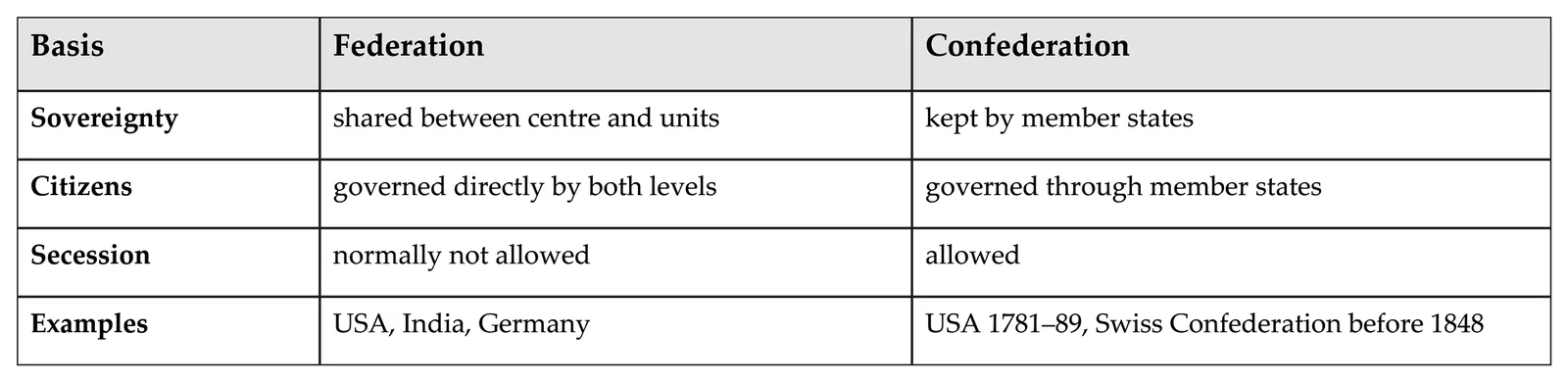
Historical examples of confederations include the United States under the Articles of Confederation (1781–89), the Swiss Confederation before 1848 and the German Confederation (1815–66). Their weakness, as the American founders discovered, was that the central body could not raise revenue or enforce its decisions. Today, the European Union is often described as a hybrid: its single market, common currency for many members and the direct effect of EU law are federal features, while unanimity on foreign policy and taxation and the right of withdrawal, used by the UK in 2020, are confederal. The Commonwealth of Independent States formed after the USSR is a loose confederal association.
4.4 Debates around the Territorial Division of Power
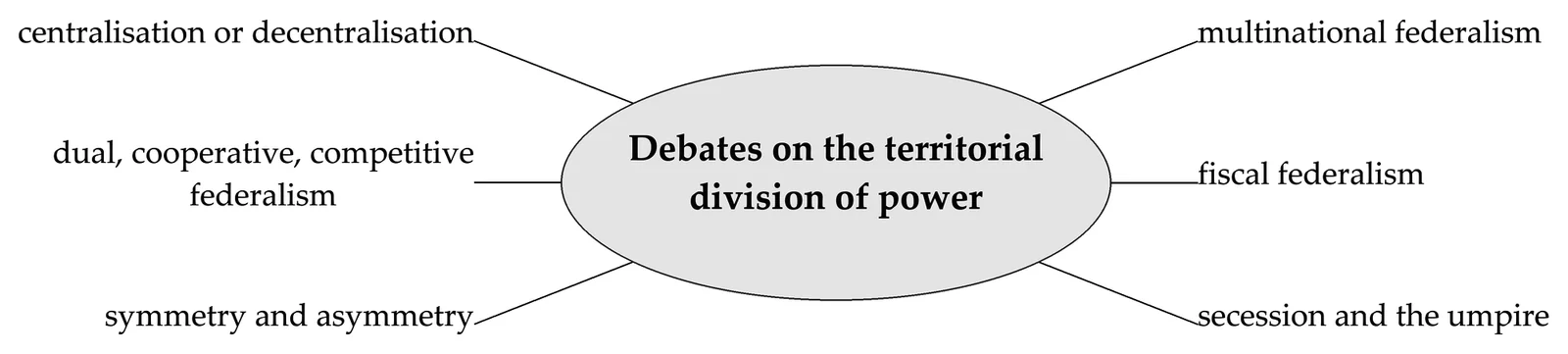
- Centralisation versus decentralisation: how much power should the centre hold? Strong centres can ensure unity, redistribution and national standards; decentralisation brings government closer to the people and protects diversity. Wheare and many later scholars note that federations have tended to centralise over time through wars, economic crises and fiscal dominance.
- Dual, cooperative and competitive federalism: dual federalism treats the two orders as separate spheres; cooperative federalism stresses shared programmes and intergovernmental bargaining; competitive federalism encourages units to compete for investment and better governance.
- Symmetry and asymmetry: in symmetrical federations all units have equal powers; asymmetrical federations give special status to some units, as Quebec in Canada, Scotland in the UK’s devolution, or special provisions for certain states in India.
- Multinational federalism: federalism can accommodate national and ethnic minorities by giving them their own units, as with India’s linguistic states (1956) or Belgium’s communities. Critics warn that ethnic units may strengthen separatism, as in the breakup of Yugoslavia; supporters reply that denial of autonomy is more dangerous.
- Fiscal federalism: the division of taxes and transfers often matters more than the formal division of legislative powers. Vertical imbalance arises when the centre collects more revenue than it needs, so it must transfer funds to regional units.
- Secession and the umpire: most federations forbid unilateral secession, and courts or intergovernmental bodies settle disputes; the Supreme Court of Canada’s Quebec Secession Reference (1998) held that secession requires negotiation after a clear majority on a clear question.
4.5 Important Questions
- Question 1 Discuss the historical context in which federalism emerged. Why do states adopt federal systems?
- Question 2 Distinguish between federation and confederation. Discuss with examples.
- Question 3 Discuss the debates around the territorial division of power in federal systems.
- Question 4 Examine the nature of Indian federalism in comparative perspective.
DU asks the same idea in different words. So learn one broad answer for each question below; the same answer works for every question joined by OR.
Important Question 1
Discuss the historical context in which federalism emerged. Why do states adopt federal systems?
OR
Trace the evolution of federal political systems from confederations to modern federations.
OR
Explain Riker’s and Stepan’s views on the origin of federations.
Model Answer
“The proposed Constitution, therefore, is, in strictness, neither a national nor a federal Constitution, but a composition of both.”
— James Madison, The Federalist No. 39 (1788)
Introduction. Federalism is a way of organising a state so that unity and diversity can coexist. Although modern federations date from the American Constitution of 1787, the federal idea of a covenant among communities is much older. The historical context in which federations emerged explains both their design and their variety, and theories of why states federate help us understand federalism in countries as different as the USA, Switzerland and India.
1. Meaning of the Federal Idea
The word federal comes from the Latin foedus, a covenant or treaty. The federal idea is that separate communities can join together for common purposes while retaining autonomy in others. Daniel Elazar called it self-rule plus shared rule. Burgess distinguishes federalism, the normative commitment to this idea, from federation, the institutional form a state takes when power is constitutionally divided between two orders of government.
2. Ancient Leagues
Greek city-states formed leagues such as the Achaean and Aetolian Leagues for defence against powerful neighbours. These were alliances with common councils, but member cities remained largely independent. They show the early origin of the idea that small communities can unite for security without being absorbed.
3. Medieval and Early Modern Confederations
The Swiss Confederation began in 1291 as a defensive alliance of three cantons and gradually expanded. The Dutch United Provinces, formed by the Union of Utrecht (1579) during the revolt against Spain, created a common government for war and foreign affairs. Johannes Althusius, in Politica (1603), theorised the polity as a union of associations bound by consent, laying intellectual foundations for federal thought.
4. The American Founding
After independence, the thirteen American states formed a confederation under the Articles of Confederation (1781). Congress could not levy taxes, regulate trade or enforce laws, and the union was weak. The Philadelphia Convention (1787) created a new constitution in which a national government acted directly on citizens while states kept their own powers. In The Federalist Papers Madison described the system as a composition of national and federal features, and argued that a large republic would control the dangers of faction.
5. Nineteenth-century Federations
Switzerland adopted a federal constitution in 1848 after a brief civil war, Canada became a federation in 1867 to unite British colonies and resist American expansion, Germany united as a federal empire under Prussian leadership in 1871, and Australia federated in 1901. In each case federation served economic integration, defence and nation-building while recognising regional identities.
6. Federalism after Decolonisation
After 1945, large and diverse post-colonial states such as India, Malaysia and Nigeria adopted federal constitutions to hold together many linguistic, religious and ethnic groups. Several British-sponsored federations, such as the West Indies Federation and the Federation of Rhodesia and Nyasaland, collapsed quickly, showing that federations need a shared political will to survive.
7. Riker’s Federal Bargain
William Riker argued that federations result from a bargain between politicians at the centre, who want to expand their territory to meet a military or diplomatic threat, and regional politicians, who accept union for protection but insist on keeping autonomy. Critics say his theory fits the American case but neglects cultural, economic and ideological motives, and cannot explain holding-together federations.
8. Stepan’s Typology
Alfred Stepan distinguished coming-together federations, formed by previously sovereign units pooling sovereignty, such as the USA, Switzerland and Australia; holding-together federations, created when a unitary state decides to devolve power to keep a diverse country united, such as India, Belgium and Spain; and putting-together federations, imposed by coercion, as in the Soviet Union. Holding-together federations tend to be asymmetrical and give the centre more power.
9. Reasons for Adopting Federalism
States adopt federalism for security and defence, economic integration and a larger market, the management of large territories, the accommodation of linguistic, religious and ethnic diversity, protection against tyranny through divided power, and democratic participation closer to citizens. Rekha Saxena emphasises that federations combine these motives differently, producing great variety in federal governance.
10. Contemporary Trends
Since the 1990s some federations have broken up, such as the USSR and Yugoslavia, while unitary states such as Belgium, Spain and the UK have moved towards federal or devolved arrangements. The European Union shows federal features emerging among sovereign states. Federalism has thus become a widely used tool for governing diverse societies.
Conclusion. Thus, federalism emerged from ancient leagues and early confederations to the modern federation pioneered by the USA. States federate for security, economic integration and the accommodation of diversity, and the historical context of each federation, whether coming together or holding together, shapes its character.
Important Question 2
Distinguish between federation and confederation. Discuss with examples.
OR
What are the essential features of a federation according to Ronald Watts?
OR
Is the European Union a federation or a confederation? Discuss.
Model Answer
“The simplest possible definition is self-rule plus shared rule.”
— Daniel Elazar, Exploring Federalism (1987)
Introduction. Federation and confederation are both forms of union among territorial communities, and both belong to the family that Ronald Watts calls federal political systems. But they differ fundamentally in where sovereignty lies and how the common government relates to citizens. Understanding this difference helps us classify states such as the USA, Switzerland and India, and unions such as the European Union.
1. Federal Political Systems
Watts uses federal political systems as a broad term for all arrangements combining shared rule and regional self-rule. It includes unions, constitutionally decentralised unions, federations, confederations, federacies (where a small unit has special autonomy, such as Puerto Rico with the USA), associated states, condominiums, leagues and joint functional authorities. Federation and confederation are two distinct species within this genus.
2. Meaning of Federation
A federation is a compound polity in which neither the federal nor the constituent units of government are constitutionally subordinate to the other. Each has sovereign powers derived from the constitution rather than from another level of government, each can legislate, tax and administer directly over its citizens, and each is directly elected. Examples include the USA, Switzerland, Canada, Australia, Germany, Brazil and India.
3. Features of a Federation
Watts identifies common features: two orders of government acting directly on citizens; a constitutional division of legislative, executive and revenue powers; representation of regional views in federal institutions, usually a second chamber; a supreme written constitution not amendable by one order alone; an umpire, usually a court, to resolve disputes; and mechanisms for intergovernmental collaboration.
4. Meaning of Confederation
A confederation is a union of sovereign states that establish a common government for limited purposes, mainly defence, foreign affairs or trade. The common government depends on the member governments, is composed of their delegates and normally acts through them rather than directly on citizens. Its decisions often require unanimity, it usually lacks independent taxing power and members may withdraw.
5. Sovereignty
The key difference concerns sovereignty. In a federation sovereignty is shared or divided by the constitution, and the federation is itself a sovereign state in international law. In a confederation sovereignty remains with the member states, which delegate limited powers to the common body and can take them back. This is why a confederation is normally created by a treaty among states, while a federation is created by a constitution adopted in the name of a people.
6. Relationship with Citizens
In a federation citizens are directly governed by both orders of government and have dual citizenship in practice, voting in both federal and state elections. In a confederation the common authority generally acts on member states, which then implement decisions; citizens relate to it indirectly through their own governments.
7. Powers, Finance and Secession
Federal governments have independent revenue sources and can enforce their laws through their own agencies and courts. Confederal bodies usually depend on contributions from members and cannot coerce them. Federations normally do not allow unilateral secession, while in a confederation members retain the right to withdraw.
8. Historical Examples
The United States under the Articles of Confederation (1781–89) was a confederation in which Congress could not tax and needed the agreement of nine states for major decisions; its weakness led to the federal Constitution of 1787. The Swiss Confederation remained a confederation until 1848, and the German Confederation of 1815–66 was a loose union of princes. Many confederations have either collapsed or evolved into federations.
9. The European Union
The European Union is a hybrid. Its federal-like features include a directly elected European Parliament, the supremacy and direct effect of EU law, a Court of Justice, a single market and, for many members, a common currency managed by the European Central Bank. Its confederal features include unanimity in foreign policy and taxation, limited own revenues, the central role of national governments in the Council and the right of withdrawal under Article 50, used by the UK. Scholars therefore describe it as a sui generis union.
10. Significance of the Distinction
The distinction shows that unions of territorial communities lie on a spectrum from loose alliances to integrated states. Confederations preserve the sovereignty of members but are often too weak to act effectively, while federations combine effective common government with constitutional protection for regional autonomy. The choice depends on how much unity and how much diversity a society wants.
Conclusion. Thus, a federation is a single sovereign state with constitutionally divided powers acting directly on citizens, while a confederation is a league of sovereign states with a dependent common authority. Most modern unions, including India, are federations, while the EU remains a hybrid of federal and confederal features.
Important Question 3
Discuss the debates around the territorial division of power in federal systems.
OR
Is federalism a solution to the problems of ethnic and linguistic diversity? Discuss.
OR
Examine the debates on centralisation, asymmetry and fiscal federalism.
Model Answer
“… Parliament has exclusive power to make laws with respect to any of the matters enumerated in List I in the Seventh Schedule.”
— Article 246(1), Constitution of India
Introduction. Every federation must decide how power is divided between the centre and the regions, and the answer is never final. Wars, economic crises, social movements and party politics constantly shift the balance. The debates around the territorial division of power concern how centralised a federation should be, whether units should have equal or special powers, whether federal units should follow ethnic or linguistic lines, and how revenues should be shared.
1. Constitutional Division of Powers
Federal constitutions divide legislative powers in different ways. The US Constitution lists federal powers and leaves the rest to the states; Canada lists both and gives residuary powers to the centre; India has Union, State and Concurrent Lists with residuary powers vested in the Union. Germany assigns legislation mainly to the federation and administration mainly to the Länder, a model of administrative federalism.
2. Centralisation versus Decentralisation
Supporters of centralisation argue that a strong centre ensures national unity, economic management, defence and redistribution between rich and poor regions. Advocates of decentralisation argue that it brings government closer to citizens, allows policy experiments and protects minorities. Many scholars observe a long-term centralising tendency in federations, driven by wars, depressions, welfare states and the centre’s superior financial resources. The principle of subsidiarity, prominent in the European Union, suggests that decisions should be taken at the lowest level capable of handling them effectively, with higher levels acting only when necessary.
3. Dual and Cooperative Federalism
Dual federalism, sometimes compared to a layer cake, treats federal and state governments as separate and independent spheres, as in early American thinking. Cooperative federalism, compared to a marble cake, emphasises overlapping responsibilities and joint programmes. Germany’s system is strongly cooperative, and India’s planning and centrally sponsored schemes created cooperative but centralised relations.
4. Competitive Federalism
Competitive federalism encourages units to compete with each other for investment, people and better governance, and to experiment with policies. In India after 1991, states began competing for private investment, and rankings of states on ease of doing business reflect this trend. Critics warn that competition can widen regional inequalities and lead to a race to the bottom in labour and environmental standards.
5. Symmetry and Asymmetry
In symmetrical federations all units have identical powers. Asymmetrical federations give special status to some units for historical, cultural or political reasons, such as Quebec in Canada or the special provisions for Nagaland, Mizoram and other states under Article 371 in India. Supporters see asymmetry as a way to accommodate distinct nations within a state; critics argue that it creates inequality and resentment among other units.
6. Multinational and Ethnic Federalism
In diverse societies, federal boundaries can be drawn to give national, linguistic or ethnic groups their own units. India’s linguistic reorganisation of states in 1956, Belgium’s language communities, Switzerland’s cantons and Ethiopia’s ethnic federalism are examples. Supporters, such as Alfred Stepan, argue that this accommodates minorities and reduces conflict; critics argue that it institutionalises ethnic identity and can provide the resources for secession.
7. Federalism and Secession
The collapse of the Soviet Union, Yugoslavia and Czechoslovakia, all ethnically based federations, led some scholars to argue that ethnic federalism encourages break-up. Others reply that these were authoritarian pseudo-federations and that democratic federations such as India, Switzerland and Canada have managed diversity successfully. Most federations prohibit unilateral secession, but Canada’s Supreme Court held in 1998 that a clear vote for secession would require negotiation. The lesson drawn by many comparativists is that federal institutions work best when combined with democratic competition, national parties that cut across regional lines and a shared sense of belonging.
8. Fiscal Federalism
The division of taxing power and transfers is crucial. Central governments usually control the most productive taxes, creating vertical fiscal imbalance, while regions differ in wealth, creating horizontal imbalance. Federations use equalisation grants and revenue sharing to address this, such as India’s Finance Commission under Article 280 and the GST Council created in 2016–17 as a body of shared fiscal decision-making. Debates on fiscal federalism also concern conditional grants, which allow the centre to shape policies in areas constitutionally assigned to the regions.
9. Second Chambers and Shared Rule
Shared rule requires that regional units participate in central decision-making. Second chambers such as the US Senate, with equal representation of states, or Germany’s Bundesrat, composed of Länder government delegates, give regions a voice. India’s Rajya Sabha represents states according to population and has weaker powers, which critics argue limits shared rule.
10. The Indian Debate
India’s federation has a strong Union, with powers under Articles 3, 249, 250, 352 and 356. Critics called it quasi-federal or centralised, especially after misuse of President’s Rule. The Sarkaria Commission (1988) and the S.R. Bommai judgment (1994), which limited Article 356, strengthened federal balance. Coalition governments after 1989 increased the influence of states, while recent single-party majorities and centralised schemes have revived debates on centralisation.
Conclusion. Thus, the territorial division of power in federations is a continuing negotiation between unity and diversity. Debates on centralisation, asymmetry, ethnic federalism and fiscal sharing show that successful federations depend not only on constitutional design but on democratic practice, intergovernmental cooperation and mutual trust.
Important Question 4
Examine the nature of Indian federalism in comparative perspective.
OR
‘India is a holding-together federation with a strong centre.’ Discuss.
OR
Is India a quasi-federal state? Give reasons.
Model Answer
“The Draft Constitution is a Federal Constitution inasmuch as it establishes what may be called a Dual Polity.”
— B.R. Ambedkar, Constituent Assembly (4 November 1948)
Introduction. India is one of the largest and most diverse federations in the world. Its founders chose a federal structure to accommodate linguistic, religious and regional diversity, but also gave the Union strong powers to preserve unity after Partition. Comparing India with other federations, such as the USA, Canada and Germany, helps us understand its distinctive character, which Rekha Saxena and others describe as a holding-together and increasingly multilevel federation.
1. Constitutional Framework
Article 1 describes India as a Union of States. Ambedkar explained that the federation was not the result of an agreement among states and that no state has a right to secede. The Constitution divides legislative powers into the Union, State and Concurrent Lists in the Seventh Schedule, gives residuary powers to the Union, and creates a supreme Constitution interpreted by an independent Supreme Court.
2. Federal Features
India has two orders of government with their own elected legislatures and executives, a written and supreme constitution, a division of powers and revenues, an independent judiciary to resolve Centre–state disputes under Article 131, a second chamber representing states, and amendment of federal provisions requiring ratification by half the state legislatures under Article 368.
3. Unitary Features
At the same time, the Union can create or change states under Article 3 without their consent, legislate on state subjects in the national interest (Article 249) or during emergencies (Article 250), impose President’s Rule (Article 356), and appoint governors. India has single citizenship, a single integrated judiciary and All India Services. These features led K.C. Wheare to call India quasi-federal. During a national emergency under Article 352 the federal structure can become virtually unitary, as the Union may direct states and Parliament may legislate on any subject.
4. A Holding-together Federation
In Stepan’s terms, India is a holding-together federation: a centralised state that devolved power to keep a diverse country united, unlike the coming-together federation of the USA. This explains the Union’s power to redraw state boundaries, which allowed the linguistic reorganisation of 1956 and the creation of new states such as Jharkhand, Chhattisgarh, Uttarakhand (2000) and Telangana (2014).
5. Comparison with the USA
The US federation emerged from an agreement among states, gives residuary powers to the states, has dual citizenship and separate state constitutions and courts, and gives each state equal representation in the Senate. India, by contrast, gives the Union residuary powers, has single citizenship, a common constitution for the Union and states (except the former state of Jammu and Kashmir until 2019), and representation by population in the Rajya Sabha.

6. Comparison with Canada and Germany
Like Canada, India has a strong centre and parliamentary government, and like Canada it practises asymmetry, through Article 371 provisions for particular states. Like Germany, it relies heavily on cooperative arrangements and administrative federalism, though India’s Rajya Sabha is weaker than Germany’s Bundesrat. These comparisons show that India combines features from several federal traditions.
7. Linguistic Federalism and Diversity
The reorganisation of states on linguistic lines in 1956, following the States Reorganisation Commission, was initially feared as divisive, but it strengthened democracy by allowing people to be governed in their own languages. Scholars widely regard it as a successful example of accommodating diversity through federalism, alongside the Fifth and Sixth Schedules for tribal areas.
8. Phases of Indian Federalism
Under one-party dominance (1950–67) Congress managed Centre–state relations within the party. After 1967, the rise of regional parties and frequent use of Article 356 created conflicts. From 1989 to 2014, coalition governments dependent on regional parties gave states greater influence. Since 2014, the return of single-party majorities has again strengthened the Union, while cooperative bodies such as NITI Aayog and the GST Council have been created. Scholars such as Louise Tillin and Rekha Saxena note that party systems, more than constitutional texts, have shaped the real balance of power between the Union and the states.
9. Judicial and Fiscal Developments
In S.R. Bommai (1994) the Supreme Court declared federalism part of the basic structure and subjected President’s Rule to judicial review. The Finance Commission devolves a share of central taxes to states, and the GST (2017) created a system of shared sovereignty over indirect taxes. Critics point to the growth of cesses and surcharges not shared with states and the conditions attached to central schemes.
10. Evaluation
Granville Austin called Indian federalism cooperative federalism, and later scholars describe it as a multilevel federation after the 73rd and 74th Amendments created a third tier of local government. India’s federation has survived immense diversity, though tensions over governors, central agencies, finances and language continue. Recurring disputes, such as those over the role of governors in assenting to state bills, show that federal balance in India depends on constitutional conventions as well as courts.
Conclusion. Thus, India is a holding-together federation with a strong Union and significant unitary features, but in comparative perspective it has developed a flexible and resilient federalism that accommodates diversity while preserving unity.
Short Notes
(a) Self-rule and shared rule
Daniel Elazar’s formula for the essence of federalism. Self-rule means that regional units govern themselves in matters assigned to them by the constitution; shared rule means that they participate in governing the whole, for example through a second chamber or intergovernmental councils. A federation needs both to balance unity and diversity.
(b) Coming-together and holding-together federations
Alfred Stepan’s distinction. Coming-together federations are formed when sovereign units voluntarily pool their sovereignty, as in the USA, Switzerland and Australia. Holding-together federations arise when a unitary state devolves power to keep a diverse population united, as in India, Belgium and Spain. Stepan also identified putting-together federations created by force, such as the USSR.
(c) Asymmetrical federalism
A federal arrangement in which some constituent units have different powers or status from others because of their distinct culture, history or political situation. Examples include Quebec in Canada and the special provisions for several states under Article 371 of the Indian Constitution. It accommodates diversity but may create perceptions of unequal treatment.
More notes: DSC-11 Concepts in Comparative Political Analysis
These notes are prepared by PADHO TO AISE for study help. They are not an official University of Delhi publication.