

Semester IV DSC-11 Concepts in Comparative Political Analysis
Unit III · 23 min read · Updated 24 Nov 2026
As per the University of Delhi (DU) BA (Hons) Political Science syllabus
Contents
- 3.1 Constitution and Constitutionalism
- 3.2 Evolution of the Idea of Constitutionalism
- 3.3 Post-colonial Constitutionalism
- 3.4 Contemporary Challenges
- 3.5 Important Questions
- What is constitutionalism? Trace the evolution of the idea of constitutionalism.
- Discuss the nature of post-colonial constitutionalism with reference to Upendra Baxi’s idea of postcolonial legality.
- Examine the principles of constitutionalism and the challenges it faces in contemporary democracies.
- Short Notes
संविधानवाद का एक अनिवार्य गुण है: यह सरकार पर एक कानूनी सीमा है; यह मनमाने शासन का विरोधी है।
Constitutionalism has one essential quality: it is a legal limitation on government; it is the antithesis of arbitrary rule.
— Charles Howard McIlwain, Constitutionalism: Ancient and Modern (1940)
ALMOST every state in the world today has a written constitution, but not every state practises constitutionalism. A dictator may rule under a constitution that he changes or ignores at will. Constitutionalism is the idea that government must be limited by law, that power must be divided, rights protected and rulers made accountable. This unit traces how this idea evolved from ancient Greece and Rome through medieval England to the modern written constitutions of the United States, France and India, and then examines post-colonial constitutionalism: the attempt by newly independent states in Asia and Africa to use constitutions to build nations, transform unequal societies and overcome the legacy of colonial law.
3.1 Constitution and Constitutionalism
A constitution is the body of fundamental rules, written or unwritten, that establishes the institutions of a state, distributes power among them and defines the relationship between the state and citizens. Britain has an uncodified constitution made of statutes, conventions and judicial decisions; most other states have a single written document. Constitutionalism, by contrast, is a political doctrine and practice: the belief that government should be limited by law and accountable to the people. As Giovanni Sartori argued, a constitution in the proper sense is a ‘garantiste’ framework that protects liberty; a document that merely organises power without limiting it is only a ‘nominal’ or ‘façade’ constitution.
The core principles of constitutionalism are:
- Limited government: the state’s power is defined and restricted by a higher law.
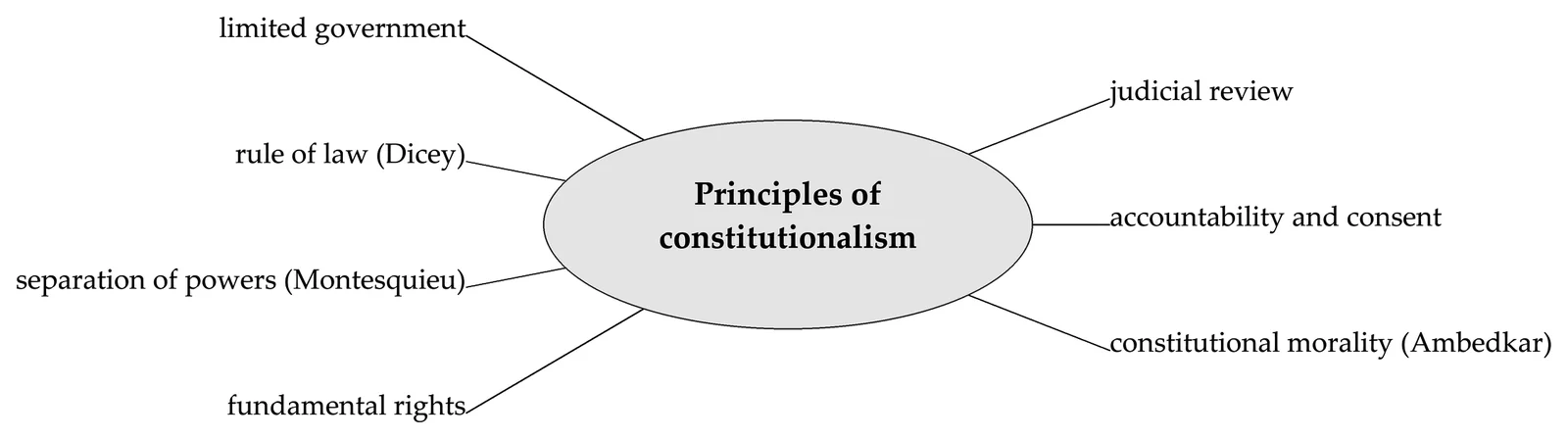
- Rule of law: rulers and ruled are equally subject to known general laws, as A.V. Dicey emphasised in 1885.
- Separation of powers and checks and balances: Montesquieu’s The Spirit of the Laws (1748) argued that liberty requires legislative, executive and judicial powers to be held by different bodies.
- Fundamental rights: a protected sphere of individual liberty that the state cannot violate.
- Judicial review and independent courts: to enforce constitutional limits.
- Accountability and consent: government responsible to the governed through elections and representation.
- Difficult amendment: the constitution is a higher law, harder to change than ordinary laws.
Carl J. Friedrich described constitutionalism as a system of effective, regularised restraints on government. McIlwain summed it up in two correlative elements: legal limits on arbitrary power and the full political responsibility of government to the governed.
3.2 Evolution of the Idea of Constitutionalism
Charles Howard McIlwain, in Constitutionalism: Ancient and Modern (1940), traced the idea through four broad phases. The meaning of ‘constitution’ itself changed: from a description of how a state is actually organised to a fundamental law that limits government.
A. Ancient constitutionalism
For the Greeks the politeia was the whole way of life and organisation of the city-state, not a legal limit on rulers. Aristotle, who studied 158 constitutions, classified them by whether one, few or many ruled and whether they ruled for the common good. He favoured a mixed constitution (polity) combining oligarchic and democratic elements. The Roman historian Polybius praised Rome’s mixed constitution of consuls, Senate and assemblies, and Cicero described the commonwealth (res publica) as the property of the people bound by law. McIlwain stressed Rome’s contribution of the idea that the authority of the ruler ultimately derives from the people.
B. Medieval constitutionalism
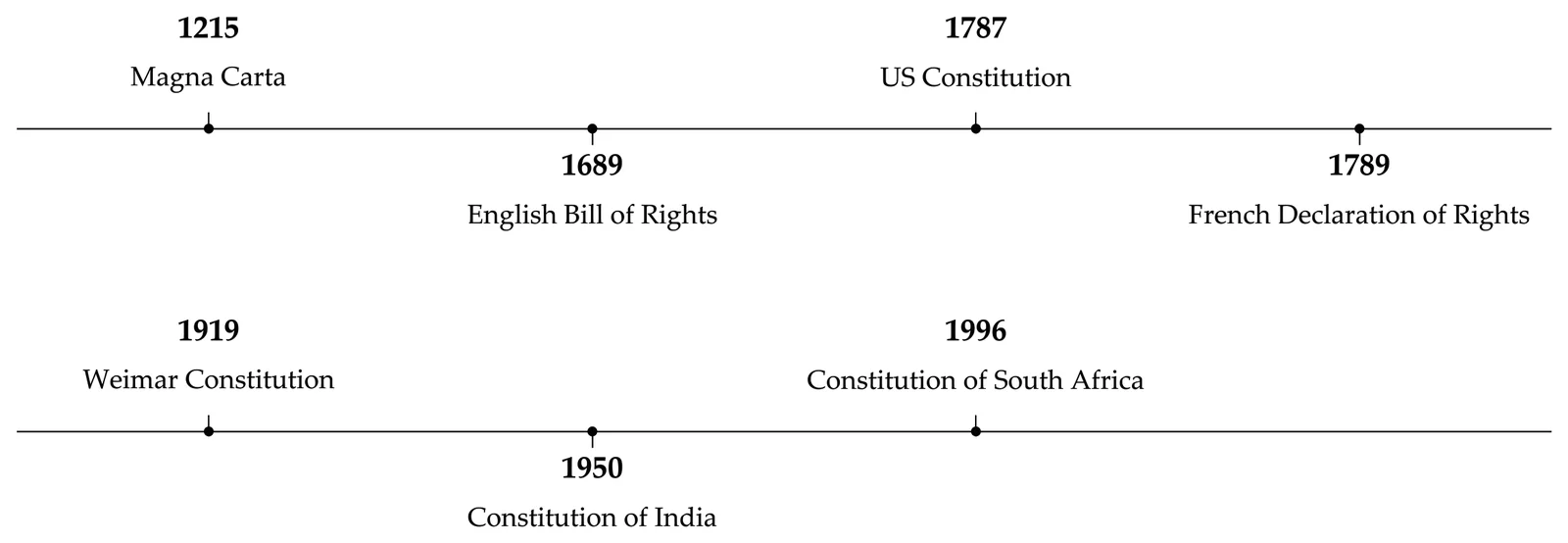
Medieval thought held that the king was under God and the law. The thirteenth-century English jurist Henry de Bracton wrote that the king should be under no man but under God and the law, because the law makes the king. McIlwain drew from Bracton a key distinction between gubernaculum, the sphere of government in which the king had discretion, and jurisdictio, the sphere of law and rights which the king could not override. Magna Carta (1215), forced on King John by the barons, promised that no free man would be imprisoned or deprived of property except by the lawful judgment of his peers or the law of the land.
C. Modern constitutionalism
- England: the struggle between Parliament and the Stuart kings, the Glorious Revolution (1688) and the Bill of Rights (1689) established parliamentary supremacy and limited monarchy. John Locke’s Two Treatises of Government (1689) grounded government in consent and the protection of natural rights.
- America: the US Constitution (1787) created the first written national constitution as a supreme law made by ‘We the People’, with federalism, separation of powers and a Bill of Rights (1791). In Marbury v. Madison (1803) Chief Justice John Marshall established judicial review.
- France: the Declaration of the Rights of Man and of the Citizen (1789) declared that a society without guaranteed rights and separation of powers has no constitution.
- Thomas Paine (Rights of Man, 1791) argued that a constitution is the act of a people constituting a government, not of a government itself.
D. Twentieth-century constitutionalism
The Weimar Constitution (1919) added social and economic rights, but its emergency provisions (Article 48) helped Hitler destroy it, a lesson in the fragility of constitutions. After 1945, new constitutions such as Germany’s Basic Law (1949) protected human dignity, created powerful constitutional courts and made some principles unamendable. The Universal Declaration of Human Rights (1948) internationalised the idea of rights, and decolonisation spread written constitutions across Asia and Africa.
3.3 Post-colonial Constitutionalism
Post-colonial constitutionalism refers to the constitutions and constitutional practices of states that emerged from colonial rule, mainly after 1945. These constitutions had to do more than limit power: they had to create a nation, legitimise a new state, include diverse communities and promise social and economic transformation.
A. Baxi and postcolonial legality
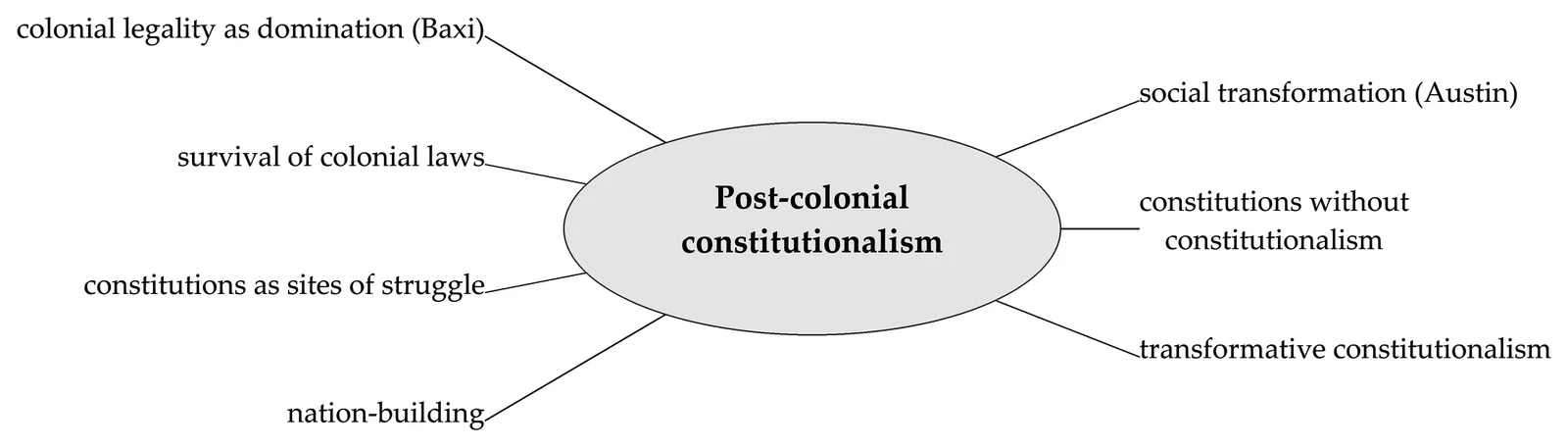
Upendra Baxi, in ‘Postcolonial Legality’ (2000), argues that colonial law was not the neutral rule of law it claimed to be but an instrument of conquest and domination: law served to extract revenue, discipline subjects and divide communities, offering legality without legitimacy. Postcolonial legality must therefore deal with this legacy. Many colonial laws, such as those on sedition, preventive detention and police powers, survived independence. At the same time, Baxi emphasises that post-colonial constitutions became sites of struggle: the oppressed used constitutional rights and courts to make new claims, and human rights were reshaped by the struggles of the peoples of the global South rather than simply imported from the West.
B. Features of post-colonial constitutions
- Nation-building: constitutions defined citizenship, national symbols and official languages, and sought to unite diverse peoples within colonial boundaries.
- Social transformation: the Indian Constitution, which Granville Austin called a social document committed to a social revolution, abolished untouchability (Article 17), provided reservations and included Directive Principles of State Policy.
- Borrowing and adaptation: constitutions drew on Westminster, American, Irish and other models, adapting them to local needs.
- Strong states and emergency powers: many inherited centralised colonial structures and provided wide emergency powers.
- Diversity and group rights: provisions for minorities, federalism and special regimes for tribal areas.
C. Constitutions without constitutionalism
In many post-colonial states constitutions failed to limit power. The Kenyan scholar H.W.O. Okoth-Ogendo (1991) described this as ‘constitutions without constitutionalism’: constitutions were frequently amended or suspended to create one-party states, presidential dominance and military rule. Pakistan’s constitutions were abrogated by coups in 1958 and 1977, and many African constitutions were replaced after independence. India’s Emergency (1975–77) showed that even a stable democracy could suspend rights through constitutional means.
D. Transformative constitutionalism
South Africa’s 1996 Constitution, adopted after apartheid, is the model of transformative constitutionalism, a term used by Karl Klare (1998) for a long-term project of using constitutional law to transform political and social institutions in a democratic, egalitarian direction. It includes justiciable socio-economic rights to housing, health and water, as in the Grootboom case (2000). Indian courts have similarly expanded the right to life under Article 21, developed public interest litigation, and through the basic structure doctrine in Kesavananda Bharati (1973) limited Parliament’s power to amend the Constitution, a doctrine later followed in Bangladesh and elsewhere.
3.4 Contemporary Challenges
- Abusive constitutionalism: David Landau (2013) described how elected leaders use constitutional amendments and replacement to weaken courts and opposition, as in Venezuela and Hungary.
- Emergency and security laws: anti-terror and emergency laws can expand executive power at the expense of rights.
- Populism: populist leaders may claim that the will of the people overrides constitutional limits and independent institutions.
- Judicial overreach: critics argue that powerful courts can substitute their own preferences for those of elected bodies.
- New constitutionalism in the South: Ecuador (2008) recognised the rights of nature and Bolivia (2009) defined itself as a plurinational state, expanding the idea of constitutionalism beyond Western models.
3.5 Important Questions
- Question 1 What is constitutionalism? Trace the evolution of the idea of constitutionalism.
- Question 2 Discuss the nature of post-colonial constitutionalism with reference to Upendra Baxi’s idea of postcolonial legality.
- Question 3 Examine the principles of constitutionalism and the challenges it faces in contemporary democracies.
DU asks the same idea in different words. So learn one broad answer for each question below; the same answer works for every question joined by OR.
Important Question 1
What is constitutionalism? Trace the evolution of the idea of constitutionalism.
OR
Discuss McIlwain’s account of ancient, medieval and modern constitutionalism.
OR
Distinguish between a constitution and constitutionalism. What are the essential features of constitutionalism?
Model Answer
“A constitution is not the act of a government, but of a people constituting a government, and a government without a constitution is power without right.”
— Thomas Paine, Rights of Man (1791)
Introduction. Constitutionalism is the idea that government must be limited by law and accountable to the people. It is one of the central achievements of political thought and the foundation of liberal democracy. The idea did not appear suddenly but evolved over more than two thousand years, from Greek reflections on the best constitution to medieval ideas of the king under law and the modern written constitutions of the United States, France and India.
1. Constitution and Constitutionalism
A constitution is the set of fundamental rules that establishes the institutions of a state and regulates their relationships with each other and with citizens. Every state has a constitution in this sense, even an absolute monarchy. Constitutionalism is a normative doctrine that government should be limited and its power exercised according to law. Sartori distinguished genuine ‘garantiste’ constitutions, which protect liberty, from nominal and façade constitutions, which merely describe or disguise unlimited power.
2. Essential Features
The essential features of constitutionalism include limited government, the rule of law, separation of powers with checks and balances, fundamental rights, an independent judiciary with power of review, government by consent and accountability, and a difficult procedure of amendment. Carl Friedrich called it a system of effective, regularised restraints on government, while McIlwain stressed legal limits on arbitrary power combined with the political responsibility of rulers to the governed.
3. McIlwain’s Approach
Charles McIlwain argued that in all its phases constitutionalism has one essential quality: it is a legal limitation on government and the antithesis of arbitrary rule, whose opposite is despotic government, the government of will instead of law. He traced how the meaning of the word ‘constitution’ changed from a description of the actual arrangement of a state to a fundamental law, superior to ordinary laws, which binds rulers.
4. Greek Contribution
For the Greeks the politeia meant the whole organisation and way of life of the polis. Aristotle studied 158 constitutions and classified them into good forms, monarchy, aristocracy and polity, which serve the common good, and corrupt forms, tyranny, oligarchy and democracy, which serve the rulers. He preferred the polity, a mixed constitution based on the middle class. Yet Greek thought had little notion of individual rights against the state.
5. Roman Contribution
Polybius praised Rome’s mixed constitution, which balanced monarchic consuls, an aristocratic Senate and democratic assemblies, preventing the cycle of decay. Cicero defined the res publica as the property of a people united by agreement on law and common interest. McIlwain emphasised that Roman law contributed the principle that the authority of the emperor rested ultimately on the people, and the distinction between public and private law.
6. Medieval Constitutionalism
In the Middle Ages, rulers were believed to be bound by divine law, natural law and the customs of the realm. Bracton wrote that the king is under God and the law, for the law makes the king. McIlwain distinguished gubernaculum, the sphere of government where the king had discretionary authority, from jurisdictio, the sphere of rights and law that the king could not violate. The weakness was that no institution could enforce these limits against a determined king.
7. Magna Carta and English Developments
Magna Carta (1215) established that the king must respect the rights of free men and act through the law of the land. Over centuries Parliament gained control of taxation, and the struggle against the Stuart kings culminated in the Glorious Revolution (1688) and the Bill of Rights (1689), establishing parliamentary supremacy. Locke justified government by consent and the right to resist rulers who violate natural rights.
8. Modern Written Constitutions
The American Revolution produced the first written national constitution (1787), made by the people as a supreme law, with federalism, separation of powers and a Bill of Rights. Judicial review, established in Marbury v. Madison (1803), made the courts guardians of constitutional limits. The French Declaration of 1789 proclaimed that a society without guaranteed rights and separation of powers has no constitution. Paine argued that a constitution precedes government and is made by the people.
9. Twentieth-century Developments
The Weimar Constitution (1919) added social rights but collapsed under emergency rule, showing that paper guarantees are not enough. After 1945, constitutions such as Germany’s Basic Law (1949) made human dignity inviolable, created strong constitutional courts and protected core principles from amendment. Decolonisation spread constitutions to Asia and Africa, where India’s Constitution (1950) combined liberal rights with commitments to social justice.
10. Constitutionalism Today
Today constitutionalism is challenged by emergencies, populism and abusive constitutional change, but it has also expanded through human rights law, transformative constitutions such as South Africa’s and doctrines such as India’s basic structure. Its survival depends not only on texts but on what Ambedkar called constitutional morality, the willingness of rulers and citizens to respect constitutional limits.
Conclusion. Thus, constitutionalism evolved from the Greek and Roman idea of a well-ordered state, through the medieval belief that rulers are under law, to modern written constitutions with rights and judicial review. Its essence remains, as McIlwain said, the legal limitation of government and its responsibility to the governed.
Important Question 2
Discuss the nature of post-colonial constitutionalism with reference to Upendra Baxi’s idea of postcolonial legality.
OR
‘Constitutions without constitutionalism.’ Discuss with reference to post-colonial states.
OR
What are the distinctive features and challenges of constitutionalism in post-colonial societies?
Model Answer
“On the 26th of January 1950, we are going to enter into a life of contradictions. In politics we will have equality and in social and economic life we will have inequality.”
— B.R. Ambedkar, Constituent Assembly (25 November 1949)
Introduction. The end of colonial empires after 1945 produced dozens of new states, almost all of which adopted written constitutions. Post-colonial constitutionalism refers to the ideas and practices of constitutional government in these states. It differs from classical Western constitutionalism because it had to build nations, transform deeply unequal societies and deal with the legacy of colonial law, while often facing pressures towards authoritarian rule.
1. Meaning
Post-colonial constitutionalism is the effort of formerly colonised societies to establish government limited by law, protect rights and achieve social justice through constitutions made after independence. These constitutions were acts of self-determination: in India, the Constituent Assembly declared that sovereignty belonged to the people, in contrast to colonial statutes such as the Government of India Act, 1935, made by the British Parliament. For many nationalist leaders the constitution was also a symbol of dignity, proof that the formerly colonised could govern themselves through modern law.
2. Baxi on Colonial Legality
Upendra Baxi argues that colonial law was a form of domination. Colonial legality served conquest, revenue extraction and control, and the rule of law under colonialism was often rule by law: it classified and disciplined subjects and denied them equal rights. Law was presented as a civilising gift, but it was imposed without the consent of the governed, producing legality without legitimacy.
3. Continuities after Independence
Baxi points out that post-colonial states often retained colonial laws and institutions. In India, the Penal Code of 1860 with its sedition provision, preventive detention, the Police Act of 1861 and emergency powers continued long after 1947. These continuities meant that the post-colonial state could use colonial instruments against its own citizens, which raises the question of how far legality has really been decolonised.
4. Constitutions as Sites of Struggle
At the same time, Baxi emphasises that post-colonial constitutions became resources for the oppressed. Movements of Dalits, women, workers, tribal communities and the poor used constitutional rights and courts to make new claims. In India, social action litigation, which Baxi helped to theorise, allowed citizens and groups to approach the Supreme Court on behalf of prisoners, bonded labourers and others unable to do so themselves.
5. Nation-building
Post-colonial constitutions defined citizenship, national symbols, official languages and the structure of the state. In multi-ethnic societies they had to balance unity with diversity through federalism, minority rights and special provisions for regions, as with the Fifth and Sixth Schedules for tribal areas in India.
6. Social Transformation
Unlike classical liberal constitutions, which focused on limiting the state, post-colonial constitutions often asked the state to act. Granville Austin described the Indian Constitution as first and foremost a social document committed to the social revolution. It abolished untouchability, provided reservations, and set out Directive Principles calling for equitable distribution of resources, living wages and free education.
7. Constitutions without Constitutionalism
In many post-colonial states constitutions failed to restrain power. H.W.O. Okoth-Ogendo described this African paradox of constitutions without constitutionalism: leaders frequently amended constitutions to create one-party states, extend presidential terms and weaken courts. Military coups suspended constitutions in Pakistan, Nigeria, Ghana and many other states. Reasons included weak institutions, ethnic divisions, poverty, the centralised colonial inheritance and Cold War support for authoritarian allies.
8. India’s Experience
India is often seen as a successful case of post-colonial constitutionalism, with regular elections, an independent judiciary and peaceful transfers of power. Yet the Emergency of 1975–77 showed how constitutional provisions could be used to suspend rights and postpone elections. The judiciary responded with the basic structure doctrine (1973) and, after the Emergency, an expanded interpretation of Article 21 in Maneka Gandhi (1978).
9. Transformative Constitutionalism
South Africa’s 1996 Constitution, born from the struggle against apartheid, is the model of transformative constitutionalism, which Karl Klare described as a long-term project of transforming society through law. It provides justiciable socio-economic rights, and in Grootboom (2000) the Constitutional Court required the state to adopt reasonable measures for housing. Latin American constitutions in Ecuador (2008) and Bolivia (2009) recognised indigenous rights and the rights of nature.
10. Global South Contributions
Post-colonial constitutionalism has contributed new ideas to global constitutional thought: the basic structure doctrine, adopted in Bangladesh and influential in Kenya and elsewhere; public interest litigation; justiciable social rights; and plurinationalism. It challenges the assumption that constitutionalism is a purely Western export and shows that it can be reinvented to address colonial injustices.
Conclusion. Thus, post-colonial constitutionalism was shaped by the tension between a colonial legacy of law as domination and the promise of constitutions as instruments of freedom and social transformation. Where institutions and constitutional morality were strong, it deepened democracy; where they were weak, constitutions existed without constitutionalism.
Important Question 3
Examine the principles of constitutionalism and the challenges it faces in contemporary democracies.
OR
‘A written constitution does not guarantee constitutionalism.’ Discuss.
OR
Discuss the role of judicial review and the separation of powers in limiting government.
Model Answer
“Constitutional morality is not a natural sentiment. It has to be cultivated.”
— B.R. Ambedkar, Constituent Assembly (4 November 1948)
Introduction. Constitutionalism is not simply having a constitution; it is a set of principles and practices that limit power and protect liberty. These principles have been institutionalised in modern democracies, but they face new challenges from emergencies, security threats, populism and leaders who use constitutional forms to undermine constitutional limits.
1. Limited Government
The first principle is that government has only those powers granted by the constitution and must act within them. Locke argued that government exists to protect natural rights and loses legitimacy when it violates them. A constitution creates a higher law that ordinary legislation cannot override. Even a democratically elected majority is bound by these limits, which is why constitutionalism is sometimes described as a pre-commitment, like Ulysses binding himself to the mast so that a passing passion cannot override settled principles.
2. Rule of Law
A.V. Dicey, in Introduction to the Study of the Law of the Constitution (1885), defined the rule of law as the supremacy of regular law over arbitrary power, equality of all before the law and the protection of rights through ordinary courts. Rulers must govern through known, general and prospective laws rather than personal will. Later thinkers such as Lon Fuller and Joseph Raz added that laws must be public, clear, stable and applied by independent courts, while Indian courts have treated the rule of law as part of the basic structure.
3. Separation of Powers
Montesquieu argued that when legislative and executive powers are united in the same person or body there can be no liberty. The American founders, especially James Madison in The Federalist No. 51, built a system of checks and balances in which ambition is made to counteract ambition. Parliamentary systems fuse legislature and executive but still rely on an independent judiciary and opposition.
4. Fundamental Rights
Constitutionalism protects a sphere of individual freedom through enforceable rights, such as freedom of speech, religion and personal liberty, and protection against discrimination. Modern constitutions increasingly include social rights and protect minority communities. Rights are not absolute: constitutions permit reasonable restrictions, and courts test them through doctrines such as proportionality, which the Indian Supreme Court applied in the Puttaswamy privacy judgment (2017).
5. Judicial Review
Courts enforce constitutional limits by striking down unconstitutional laws and actions. Since Marbury v. Madison (1803), judicial review has spread worldwide, often through specialised constitutional courts such as Germany’s Federal Constitutional Court. In India, the Supreme Court’s basic structure doctrine even limits constitutional amendments.
6. Accountability and Federalism
Elections, parliamentary scrutiny, a free press, independent institutions such as election commissions and auditors, and federal division of power all make government accountable. Federalism divides sovereignty vertically, providing an additional check on central power. Independent bodies such as India’s Election Commission and Comptroller and Auditor General are sometimes called fourth-branch or guarantor institutions, because they protect democracy itself from the government of the day.
7. Emergencies and Security
Emergency powers allow governments to suspend normal limits in crises, but can be abused. The Weimar Republic’s Article 48 and India’s Emergency of 1975–77 show the danger. After 2001, anti-terror laws in many democracies expanded surveillance and detention, raising concerns about rights.
8. Abusive Constitutionalism and Populism
David Landau described abusive constitutionalism as the use of constitutional amendment or replacement to undermine democracy, as in Venezuela and Hungary, where elected leaders weakened courts, media and electoral bodies. Populist leaders often claim to embody the will of the people against independent institutions, which they portray as obstacles to popular sovereignty.
9. Courts and Democracy
Critics of strong judicial review, such as Jeremy Waldron, argue that unelected judges should not have the final word on disputed questions of rights, which belong to democratic debate. Others defend courts as essential protectors of minorities. The balance between constitutional limits and democratic majorities remains contested.
10. Indian Illustration
India’s experience shows both the strength and the fragility of constitutionalism. The Constitution establishes limited government, fundamental rights, federalism and judicial review, and the Supreme Court has protected them through the basic structure doctrine and the expansion of Article 21. Yet the Emergency, the misuse of preventive detention and sedition laws, and debates over the independence of institutions show that constitutional limits need constant vigilance by courts, Parliament, the media and citizens.
11. Constitutional Morality and Culture
Ultimately constitutionalism depends on a political culture that values restraint. Ambedkar warned that constitutional morality has to be cultivated, and that a constitution, however good, will fail if those who work it are bad. Civil society, a free press and an informed citizenry are therefore as important as constitutional texts.
Conclusion. Thus, constitutionalism rests on limited government, the rule of law, separation of powers, rights and judicial review. A written constitution is necessary but not sufficient; its principles survive only when institutions are strong and rulers and citizens share a commitment to constitutional morality.
Short Notes
(a) Gubernaculum and jurisdictio
A distinction drawn by McIlwain from Bracton’s writings on medieval English law. Gubernaculum was the sphere of government, in which the king had wide discretionary authority, for example in war and administration. Jurisdictio was the sphere of law and rights, in which the king was bound by law and could not take a subject’s property or liberty arbitrarily. Modern constitutionalism sought institutions to enforce such limits.
(b) Transformative constitutionalism
A term used by Karl Klare (1998) for South Africa’s post-apartheid Constitution: a long-term project of using constitutional law to transform political and social institutions in a democratic, participatory and egalitarian direction. It is now also applied to India, whose Constitution aimed at social revolution through rights, reservations and the Directive Principles.
(c) Basic structure doctrine
Laid down by the Supreme Court of India in Kesavananda Bharati v. State of Kerala (1973): Parliament may amend any part of the Constitution under Article 368, but cannot alter its basic structure, which includes the supremacy of the Constitution, democracy, secularism, federalism, judicial review and the rule of law. It is a major Indian contribution to global constitutionalism.
(d) Abusive constitutionalism
David Landau’s term (2013) for the use of formal constitutional change, through amendments or entirely new constitutions, by elected leaders to weaken democratic checks. Leaders may extend term limits, pack or weaken courts, control electoral bodies and the media, while appearing to act within the law. Venezuela under Chávez and Hungary after 2010 are often cited. It shows that constitutional forms can be used against constitutionalism itself.
More notes: DSC-11 Concepts in Comparative Political Analysis
These notes are prepared by PADHO TO AISE for study help. They are not an official University of Delhi publication.